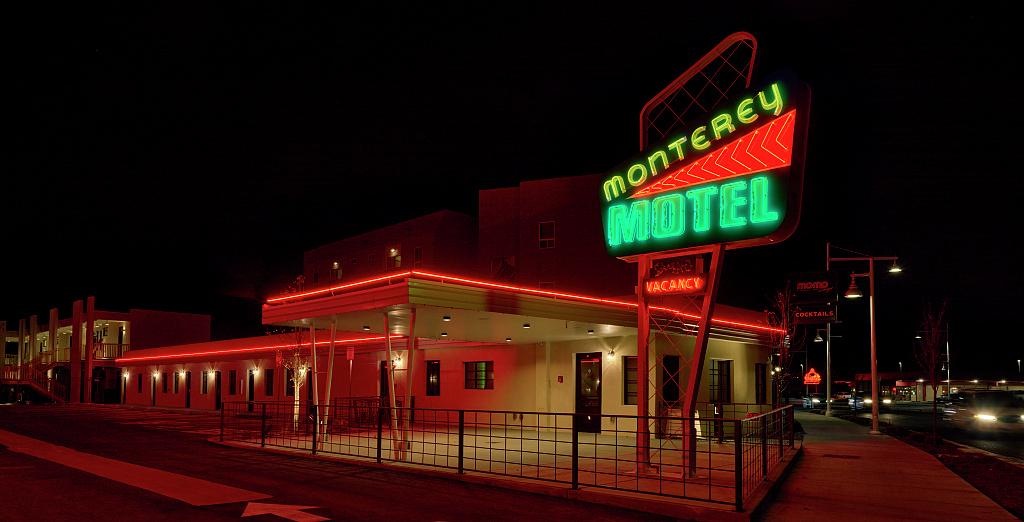
Monterey Motel, Albuquerque, NM
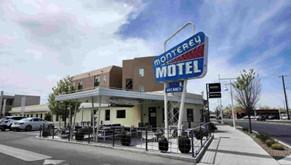
In continuous use since its construction in 1937, Albuquerque’s Monterey Motel on 2402 Central Avenue is a rare gem of googie architecture preserved in form and function.
The Monterey Motel is a stellar example of googie architecture along Albuquerque’s stretch of Route 66. Googie architecture became poplar in the western United States in the mid-twentieth century and the style is characterized by a futuristic and slightly industrial appearance. The building oozes a functional and futuristic aesthetic. The original steeply pitched roof of the motel was a hallmark of the type of commercial road-side buildings that make up the bulk of examples in googie architecture. A decorative aluminum band wraps around the entire structure and contributes to the futuristic styling that demarcates it as googie. The Monterey is especially interesting since its construction predicates the googie design as a cognizant genre. The most iconic attribute of the Monterey is its original neon sign, drawing travelers in for generations with its saturated colors and mod font, easily read from the road. The design motif of sharp acute angles is carried over to the sign, with the large sans serif letters being illuminated with the glow of the hand blown neon tubes.
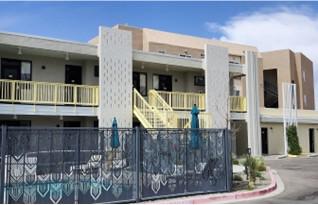
The motel was the brainchild of an Albuquerque businessman named Norman Bugg. In 1937, Bugg was one of the first to realize the economic promise that Route 66 held for those who would invest in it. The site he picked for the Monterey is directly across Route 66 from Albuquerque’s Old Town district, a hot spot for tourists as they traveled down the Mother Road. The structure has managed to retain its original status of a mid-century modern traveler’s paradise and was restored in 2018 as part of larger efforts to reinvigorate Albuquerque’s historic stretch of the Mother Road.
The Monterey Motel and its many sibling motor courts across the Duke City were thrown into flux with the construction of I40 in the late nineteen fifties. The coming of the highway created a marked difference in how vehicle tourism would function in Albuquerque. Motels gave way to budget hotels as the accommodation of choice for most travelers across the U.S. and the construction of googie motor courts like the Monterey gradually dropped off. Interestingly, the Albuquerque’s numerous motels fared decently well throughout the years despite the dip in tourism along the Mother Road. Many of the courts still operate today in some capacity, either as accommodations or as new boutiques and eateries, with the stylistic charm that once drew tourists in being re-packaged as retro flair along historic Route 66.
Similarly, in July of 2024 the Monterey participated in an event held for fans of the Borderlands games. The staff of the Monterey covered the updated facilities with decrepit neon signs and rusted metal siding to provide photo-ops and entertainment for fans at the event. This sort of community engagement highlights the public’s interest in the liminal spaces and aesthetics that googie structures like the Monterey represent. The hotel has come into a new era via a greater public interest and nostalgia for what Route 66 and its historic architecture, commercial or not, represent to the American public.
Images
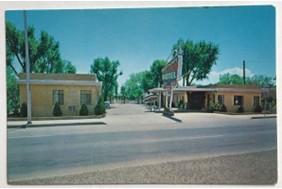
Duncan Hines postcard of the Monterey (circa 1937 to 1970) From the author’s collection.