<?xml version="1.0" encoding="UTF-8"?>
<feed xmlns="http://www.w3.org/2005/Atom">
  <title type="text">Intermountain Histories</title>
  <updated>2026-04-17T19:32:18+00:00</updated>
  <generator uri="http://framework.zend.com" version="1.12.20">Zend_Feed_Writer</generator>
  <link rel="alternate" type="text/html" href="https://www.intermountainhistories.org/"/>
  <link rel="self" type="application/atom+xml" href="https://www.intermountainhistories.org/items/browse?output=rss2"/>
  <id>https://www.intermountainhistories.org/</id>
  <author>
    <name>Intermountain Histories</name>
    <uri>https://www.intermountainhistories.org</uri>
  </author>
  <link rel="hub" href="https://pubsubhubbub.appspot.com/"/>
  <entry>
    <title type="html"><![CDATA[ Ernest L. Wilkinson Student Center (WILK)]]></title>
    <summary type="html"><![CDATA[<p><strong><em>The Ernest L. Wilkinson Student Center is one of the busiest buildings on BYU campus. It serves as the central hub for students, staff, faculty, and visitors to relax, grab a bite to eat, or participate in various activities while they are on campus. </p></strong></p><img src="https://www.intermountainhistories.org/files/fullsize/79be4af8c2a016dda0e391704ea44e7d.jpg" alt="Wilkinson Center" /><br/><p>The Ernest L. Wilkinson Student Center was completed in 1964 and named for Ernest L. Wilkinson, sixth president of BYU (1951–1971). As the number of students increased, both students, faculty, and administrators felt that campus needed a student or community center for large events, administrative offices, and other student activities. Construction on the Wilkinson Center began in 1960. The funding for construction came from the student fund, the Church, and auxiliary funds. The final cost of the construction of the Wilkinson Center was at $6,000,000. It became the largest university student center on the Wasatch Front. It also became the only building on campus to be named after a current BYU President. </p><p>The modern-day Wilkinson Student Center hosts numerous businesses, student activity and help offices, and a food court. On the main level, the BYU Bookstore takes up southwest corner of the building, the largest business in the Wilk. They sell textbooks and school supplies, BYU school spirit gear, with an LDS Distribution Center on the lower level. Recently, they expanded their sweets and candy counter, of course selling BYU specialties such as chocolate covered cinnamon bears and fudge. Additionally, the Wilkinson Center houses multiple food services. Located on the main level is the food court, known as the “Cougareat,” which is a popular lunch area for students and visitors alike. There Wilk also has two additional restaurants, the Wall located in the Southeastern corner on the first floor and a high class restaurant, the Skyroom, taking up the entire 6th floor. </p><p>The Wilkinson Center ultimately tries to cater to the needs of the students. It houses a post office, full-service copy center, and a barber shop and salon, to provide services for students close to campus. It also provides spheres for entertainment, such as a bowling alley with arcade games and billiards, a movie theater, and two large ballrooms. The ballrooms are often used for dance classes held on campus, as well as a space for various conferences and clubs to meet.  </p><p>Most of the student service offices are located in the Wilkinson Center. Student activity offices such as the Y-Serve office, and BYU, are located on the second and third floor of the Wilk. University advisement and other student services such as Career Services and CAPS can be found first and second floors. The Wilk has become a central hub for students and visitors alike, to get involved in the everyday life of BYU campus. </p><p><em><strong><a href="https://www.intermountainhistories.org/items/show/316">For more (including 3 images) view the original article</a></strong></em></p>]]></summary>
    <published>2019-04-12T04:20:45+00:00</published>
    <updated>2026-04-17T19:32:05+00:00</updated>
    <link rel="alternate" type="text/html" href="https://www.intermountainhistories.org/items/show/316"/>
    <id>https://www.intermountainhistories.org/items/show/316</id>
    <author>
      <name>Josh Franzen and Rachel Hendrickson, Brigham Young University</name>
    </author>
  </entry>
  <entry>
    <title type="html"><![CDATA[ Mountains, Mining, and Massacre: The History of Oatman, Arizona]]></title>
    <summary type="html"><![CDATA[<p><strong><em><span style="font-weight:400;">Free-roaming donkeys, an old mining district, a stop on Route 66, and ties to a famous kidnapping make up the storied past of this semi-abandoned town.</span></em></strong></p><img src="https://www.intermountainhistories.org/files/fullsize/d34d919e9df93dc8bb5d0f3e2ba0cc1d.jpg" alt="Oatman, Arizona circa 1930." /><br/><p><span style="font-weight:400;">Tucked away in the Black Mountains of Mohave County, Arizona is a community rich with legend. The town was named for Olive Oatman and her family who were victims of the Oatman Massacre in 1851, and it came to life in the following decades as prospectors discovered gold, ore, and other valuable resources in the land. Oatman is home to the three most prosperous gold mines in Arizona: the Gold Road, the Tom Reed, and the United Eastern. </span>
<span style="font-weight:400;">A gold prospector named John Moss was one of the first to discover gold in the area in the early 1860s, but it wasn’t until the 1900s that Oatman really boomed. A hotel and post office were built in 1902 and 1906 respectively, securing Oatman’s status as an official town. The mines brought riches and rapid growth to the community, with Tom Reed mine’s total profit reaching over nine-million by 1922 and the town’s population growing to 10,000 in the same decade.</span>
<span style="font-weight:400;">One of the oddities of Oatman is the population of wild burros (undomesticated donkeys). They were brought in by miners who used teams of them to haul supplies from out of town. Burro labor was a big part of the mining industry, but unlike the prospectors, they never picked up and left town. Billie Jo Moore, long time proprietor of the Oatman Hotel, said in an interview that, “the burros stayed behind and adapted to the desert. Now they are all over these mountains…They wander through the streets, turning over garbage cans and messing in people’s yards.” While they are little more than a nuisance to locals, tourists entertain them with attention, alfalfa pellets, and lots of pictures–burros have become iconic to the town. </span>
<span style="font-weight:400;">Oatman stitched itself into another legend of America when it became a part of Route 66. It was 1926, still bringing in plenty of spoils from the mines, and now gaining further revenue from the new highway. These were the glory days in Oatman; crime was low, employment was high, and people were optimistic about the future. While there was an occasional murder and a tendency for drunkenness in Oatman, it didn’t fall into the expected stereotype of the “wild west.” The isolation of the town, so far away from any other civilization at that time, created a tight-knit group that made new traditions together–like the annual three day long Fourth of July celebrations. When the Great Depression hit in the 1930s, the prosperity and liveliness of the community began to dwindle, and by the time Route 66 went out of commission in the 1950s it was well on its way to becoming a ghost town. Oatman has never been fully abandoned though, and it has been given new life through its performers and curious travelers. </span></p><p><em><strong><a href="https://www.intermountainhistories.org/items/show/802">For more (including 5 images) view the original article</a></strong></em></p>]]></summary>
    <published>2024-05-16T00:49:23+00:00</published>
    <updated>2026-04-17T19:32:17+00:00</updated>
    <link rel="alternate" type="text/html" href="https://www.intermountainhistories.org/items/show/802"/>
    <id>https://www.intermountainhistories.org/items/show/802</id>
    <author>
      <name>Megan Bailey, Brigham Young University</name>
    </author>
  </entry>
  <entry>
    <title type="html"><![CDATA[ Simpson Springs Pony Express Station]]></title>
    <summary type="html"><![CDATA[<p><strong><em>Simpson Springs provided the only freshwater to a barren part of the Pony Express. Riders and horses quenched their thirst there before continuing their long journey.</em></strong></p><img src="https://www.intermountainhistories.org/files/fullsize/d4b7991eb5b328b9f4874236122f35ac.jpg" alt="Pony Express Station" /><br/><p>In 1851, George Chorpenning and Absolom Woodward were awarded the first overland mail contract between Sacramento and Salt Lake City. Absolom was killed by Indians later that year, and George began running the mail by himself. Simpson Springs was a promising site along the route because it was the only good source of water for miles in the barren desert. In 1859, George set up a ring of stones as a foundation for his Sibley tent. </p><p>By 1860, a stone house was built, and the firm of Russell, Majors, and Waddell bought the site for the Pony Express. They eventually bought the entire Chorpenning mail and stage line. George Dewees managed the Simpson Springs Station, which was located between Government Creek Station to the northeast and River Bed Station to the southwest. Simpson Springs Station, like many of the stations along the Pony Express, went by many names. Richard F. Burton wrote that Simpson Springs was, “the station which Mormons call Egan’s Springs, anti-Mormons Simpson Springs, and Gentiles Lost Springs.” </p><p>The name Simpson Springs came from the Camp Floyd topographical engineer J. H. Simpson. In 1859, Simpson was commissioned to lay out an acceptable route from Salt Lake City to Carson Valley. On that expedition, he passed through what would be named Simpson Springs. After the Pony Express ended, the station was decreasingly used by mail and shipping companies until it was abandoned in 1869.</p><p>Richard Burton passed through the area in 1860 and described the landscape in this way. “All was desert: the bottom could no longer be called basin or valley: it was a thin fine silt, thirsty dust in the dry season, and putty-like mud in the springs and autumnal rains.” In 1965, a monument was placed to mark the station site, and, in 1975, the Bureau of Land Management and Future Farmers of America finished reconstructing the station.</p><p><em><strong><a href="https://www.intermountainhistories.org/items/show/197">For more (including 3 images) view the original article</a></strong></em></p>]]></summary>
    <published>2018-06-06T23:13:37+00:00</published>
    <updated>2026-04-17T19:32:02+00:00</updated>
    <link rel="alternate" type="text/html" href="https://www.intermountainhistories.org/items/show/197"/>
    <id>https://www.intermountainhistories.org/items/show/197</id>
    <author>
      <name>Samuel Hauber, Brigham Young University</name>
    </author>
  </entry>
  <entry>
    <title type="html"><![CDATA[ The Utah Minute Women]]></title>
    <summary type="html"><![CDATA[<p><strong><em>From painting their legs instead of wearing nylons to collecting “household fats,” the Minute Women aided in the World War II effort in Utah by creatively promoting the salvage and rationing efforts.</em></strong></p><img src="https://www.intermountainhistories.org/files/fullsize/335f44dd095c08beea9e74d628496e92.jpg" alt="Bushnell Military Hospital" /><br/><p>In a world that had begun to globalize and where many resources were traded internationally, World War II wreaked havoc on market stability. Materials such as steel, rubber, nylon, and silk were suddenly made scarce across the United States in the early 1940s. Utah was no exception to the rapid decline of available materials, and the Minute Women were organized to aid in the salvage effort. Over the course of the War, they would help in educating Utah citizens about which materials were needed, collecting those materials, and distributing them to specific locations. They would provide support for the war effort without ever having to travel overseas. </p><p>The Minute Women were part of the Volunteer Salvage Corps, a division under the federal War Production Board. When first recruiting women, letters were sent from Washington, D.C. making it sound like a competition, asking, “Which state could organize first with a woman on every block?” Each Minute Woman would be in charge of educating her neighbors about new salvage initiatives. Her responsibilities were numerous, but passing along communication and supporting American troops through salvage was her primary purpose. The chairmen of the Salvage Division in Utah sent letters to potential members, saying that if they were unable to serve, they should pass the baton to someone else on their block. The Utah Minute Women’s Organization was serious about meeting the expectations of the federal government, and worked hard over the next few years to meet the harsh demands of the war.</p><p>The Minute Women, as well as women in the United States in general, were creative in their efforts to support the war. One of the first materials requiring rationing was silk (and later nylon) because military parachutes were made out of them. When they couldn’t purchase silk or nylon stockings, some women would paint their legs to make them look like they were wearing nylons. They would even take an eyebrow pencil and draw a “seam” on the back to make the effect more convincing. Another sought-after resource was fat and oil, which many would save from their kitchens (leftovers from cooking). In Utah, hunting has always been a common pastime, and they also set up stations where hunters could leave deer and elk fats. They collected tin cans at grocery stores and schools, coordinated paper drives, and recruited dry cleaners to clean donated clothing. They aided in countless other war programs, such as bond drives, surveys, footwear exchanges, bottle collections, and volunteer recruitment. </p><p>The Minute Women also worked closely with the Bushnell Military Hospital in Brigham City, UT. They collected and donated needed materials, and on one occasion, donated trees for beautifying the area. The hospital no longer stands, but at the time it employed and serviced thousands of Americans. </p><p>Utah’s Minute Women never saw combat, but they fought and gave everything they had for what they believed to be a noble cause. Their efforts supported a national effort that was pivotal in the US military’s success in World War II. </p><p><em><strong><a href="https://www.intermountainhistories.org/items/show/83">For more (including 8 images) view the original article</a></strong></em></p>]]></summary>
    <published>2017-08-16T20:55:12+00:00</published>
    <updated>2026-04-17T19:31:59+00:00</updated>
    <link rel="alternate" type="text/html" href="https://www.intermountainhistories.org/items/show/83"/>
    <id>https://www.intermountainhistories.org/items/show/83</id>
    <author>
      <name>Aubrey Glazier, Brigham Young University</name>
    </author>
  </entry>
  <entry>
    <title type="html"><![CDATA[ Women in Los Alamos during the Manhattan Project <br />
]]></title>
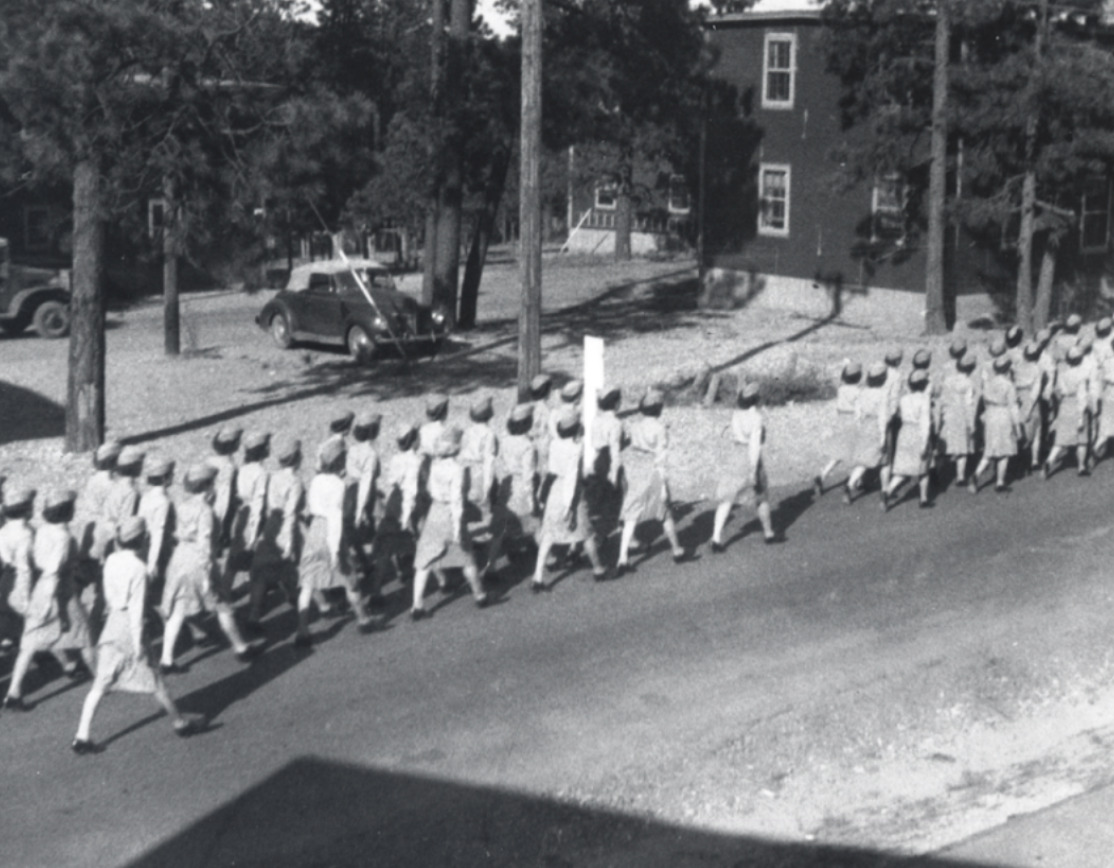
    <summary type="html"><![CDATA[<p><strong><em>With the war effort withdrawing men from the domestic labor force, women became an increasingly important part of the Manhattan Project in Los Alamos. </p></strong></p><img src="https://www.intermountainhistories.org/files/fullsize/c8f195c81db8f6804378056bc75c3f0b.jpg" alt="WAC March in Los Alamos" /><br/><p><span style="font-weight:400;">Wartime labor shortages were a constant struggle for the United States during World War II. They needed to send troops overseas, develop weaponry, spy on their enemies, strategically plan, and mobilize the entire nation as quickly as possible. By 1943, the United States Army was 200,000 men short for their invasion on D-Day, they were in need of 315 more physicists for their defense projects, and the Manhattan Project was desperately in search of all kinds of labor from scientists and engineers to machinists and pipefitters. In response, President Franklin D. Roosevelt signed into existence the Women’s Army Auxiliary Corps established “for the purpose of making available to the national defense the knowledge, skill, and special training of women of the nation” on May 15, 1942. Still facing discrimination, unequal pay, and fewer opportunities than their male counterparts, women played an essential role in World War II, especially in Los Alamos. </p>
<span style="font-weight:400;">Because Los Alamos was such a restricted town and the directors wanted to limit the number of outsiders, General Leslie Groves encouraged wives of scientists to work on the project in whatever capacity they could. As an incentive, they provided nursery schools for their young children to aid with childcare. Despite the government’s encouragement, some women were still hesitant to work on the project over concerns for their family’s well-being. Many had not expected to work at all, and quite a few were dissatisfied with the living conditions in which they now were expected to raise their children. Charlotte Serber, the only female group leader at the laboratory, wrote, “For the potential working wife, there was one chief worry. Could she manage her home here on the mesa and work too?” These were fair concerns. The conditions under which they were expected to work were difficult. They were isolated from extended family, were allowed only one day off of work per month for shopping in Santa Fe, were expected to work forty-eight hours in a week, and had almost no bargaining power to shift their rules or salary. They were also far less likely to gain security clearance than their male counterparts, so it was unlikely that they knew what they were helping create. </p>
<span style="font-weight:400;">Despite these stringent circumstances, many women in Los Alamos did work on the secretive atomic gadget. By October 1944, women constituted about 30% of the labor force in the Tech Area, hospital, and schools. It is also notable that although they did employ some women in clerical positions, the vast majority were scientists or technicians. They were metallurgists, engineers, physicists, chemists, and teachers, involved in every aspect of the atomic effort until the very end. The exception for this participation was in Project Alberta. This was the very last phase of the project; the physical delivery of the bomb to the Pacific island Tinian where the nuclear components were assembled before being dropped on Japan. Women who had spent years contributing to this moment were left behind in the United States to learn about the bombingsfrom the same newspapers as everyone else. However, the atomic bomb could not have been built as quickly or efficiently as it was without the contribution of women. They faced gender discrimination, suboptimal conditions, and unfair pay to contribute to the atomic effort in Los Alamos. </span>

</p><p><em><strong><a href="https://www.intermountainhistories.org/items/show/756">For more (including 3 images) view the original article</a></strong></em></p>]]></summary>
    <published>2023-09-24T18:36:48+00:00</published>
    <updated>2026-04-17T19:32:16+00:00</updated>
    <link rel="alternate" type="text/html" href="https://www.intermountainhistories.org/items/show/756"/>
    <id>https://www.intermountainhistories.org/items/show/756</id>
    <author>
      <name>Abigail Beus, Brigham Young University</name>
    </author>
  </entry>
  <entry>
    <title type="html"><![CDATA[“This Gathering”: Hispanics in Monticello 1900-1950 ]]></title>
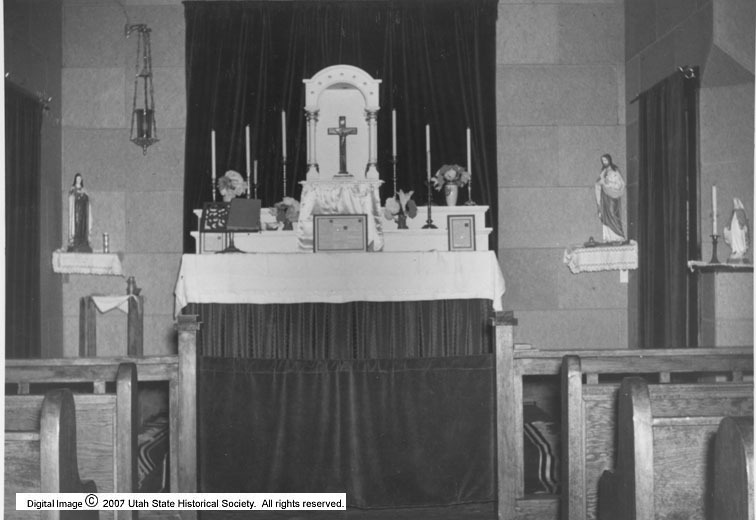
    <summary type="html"><![CDATA[<p><strong><em>Due to external pressures and free land, several Hispanic families moved to Monticello and the surrounding San Juan County. The rural landscape allowed Hispanic families to keep more of their culture than those in more urban spaces which manifested in the construction of the first Hispanic Catholic Church in the state. </em></strong></p><img src="https://www.intermountainhistories.org/files/fullsize/548a81439a5af7bab727f49d8255c5d3.jpg" alt="St. Joseph&#039;s Cathedral Altar" /><br/><p>Compared to the rest of the American Southwest, Utah did not have as strong a Hispanic population until the twentieth century. Previously, Hispanic men had often moved to southern Utah to herd sheep and cattle for three quarters of the year before moving back home to their families. Beginning in the early 1900s, men started to bring their families to Monticello,​​ Utah. Many of the Hispanic families who moved to Monticello were citizens from small New Mexican villages or Colorado. Governments and policies in these states took away Hispanics’ land, water, and right to be involved in the government. This, along with the promise of “free” land in Monticello, spurred Hispanics to move. Groups of families began homesteading in the community with men being employed as sheep herders, ranch hands, and cowboys. </p><p>William Herman Gonzalez’s father was of the first family to move to the community in the early twentieth century. Born and raised in Monticello, Gonzalez remembers that “there was always deer meat and potatoes and plenty of tortillas.” Their small group of Hispanics attracted others to move to the community, “this gathering.” In times of need, the families of Hispanics would rally around one another, although they were mostly independent due to the layout of Monticello. As a consequence of the rural landscape, the Hispanics who moved to Monticello were able to keep more of their traditional culture in comparison to Hispanics who moved to urban landscapes. Many were strongly Catholic and raised money to build the first Hispanic Catholic church in Utah, St. Joseph’s. </p><p>The relations between Hispanics and Anglos in the community were complex because of the cultural barriers between Catholic and Mormon and Anglo and Hispanic. The two communities did not intermarry until the late 1940s. When World War II began, about 125 Hispanic men enlisted in the war. Upon their return, some were able to advance economically. One of them was Robert Nieves who opened the Highland Café in 1947. However, World War II and the Korean War created new dynamics in this southern part of the state and led many Hispanics in and around Monticello to move north for better paying jobs, bringing with them their strong sense of culture.</p><p><em><strong><a href="https://www.intermountainhistories.org/items/show/636">For more (including 4 images) view the original article</a></strong></em></p>]]></summary>
    <published>2022-09-07T16:29:42+00:00</published>
    <updated>2026-04-17T19:32:14+00:00</updated>
    <link rel="alternate" type="text/html" href="https://www.intermountainhistories.org/items/show/636"/>
    <id>https://www.intermountainhistories.org/items/show/636</id>
    <author>
      <name>Lindsey Meza, Brigham Young University</name>
    </author>
  </entry>
  <entry>
    <title type="html"><![CDATA[Allen Hall (ALLN)]]></title>
    <summary type="html"><![CDATA[<p><strong><em>Named for philanthropic couple R. Eugene Allen and Inez Knight Allen, Allen Hall was established to accommodate growing numbers of students from beyond Utah Valley matriculating at Brigham Young University. BYU demolished the eighty-year-old building in 2018.</em></strong></p><img src="https://www.intermountainhistories.org/files/fullsize/e76dcda921fabedf4001fd384ec9cd90.jpg" alt="Allen Hall" /><br/><p><span style="font-weight:400;">To accommodate the growing student body, in 1937 BYU began constructing its first building meant specifically for use as a student dormitory. Utahn architect Joseph Nelson designed the building in the style of Jacobethan Revival, including gabled parapets and striated brick, and BYU students donated time and labor as construction workers to help building contractor Louis De Young turn Nelson’s vision into reality.</span>
<span style="font-weight:400;">Completed in 1938, the dormitory accommodated up to seventy residents, which BYU set aside for specifically male students. BYU named the building Allen Hall, after Inez Knight Allen and R. Eugene “Gene” Allen. The Allens were the daughter and son-in-law of </span><a href="https://www.intermountainhistories.org/items/show/140"><span style="font-weight:400;">Jesse Knight</span></a><span style="font-weight:400;">, a Latter-day Saint philanthropist who had financially supported BYU (a loan from the Knight Endowment Fund financed Allen Hall itself), and they were accomplished Latter-day Saints in their own right. Inez had been a student at BYU’s predecessor, Brigham Young Academy’s Normal Training School, from 1892 to 1896, where she studied pedagogy and philosophy. Two years after that, Knight became one of the first single sister missionaries for The Church of Jesus Christ of Latter-day Saints, serving for twenty-six months in Great Britain from 1898 to 1900. Gene was also a Brigham Young Academy alumnus; he also studied at Rochester Business College. As an officer of Knight Trust and Savings Bank, Gene managed the Knight Fund. Gene and Inez married in 1902, and they became philanthropists in their communities, following Jesse Knight’s example.</span>
<span style="font-weight:400;">BYU considered Allen Hall such a success as a housing unit that it immediately drew up plans to build another dormitory building, this time for women, which it named <a href="https://www.intermountainhistories.org/items/show/569">Amanda Knight Hall</a> and completed in 1939. BYU Students lived in Allen Hall for the next twenty-four years. Though originally intended only for men, when an influx of female students strained available housing during the mid-1940s, BYU temporarily used Allen Hall to house both men and women, renting first-floor rooms to men and second- and third-floor rooms to women. Eventually, the first floor was converted to women’s housing as well, and men did not fully occupy Allen Hall again until 1953. </span>
<span style="font-weight:400;">In the 1950s, BYU built new dorms to house its increasingly numerous students, perhaps making Allen Hall less significant to BYU’s overall housing needs. Students stopped living in Allen Hall in 1962, and the Church’s Language Training Mission took over the building to house missionaries-in-training. In 1980, BYU took over the building again and used it to host its Museum of Peoples and Cultures for over thirty years. After the museum moved to its present location on Canyon Road in 2014, BYU occasionally used Allen Hall to accommodate university employees when construction created a shortage of office space.</span>
<span style="font-weight:400;">Four years later, in June 2018, BYU announced plans to demolish Allen Hall on the grounds that its age made it unusable for university purposes. Preservation Utah, a historical preservation nonprofit, objected to the planned demolition, arguing that losing Allen Hall would “erase a key part of the university’s story of historical growth and expansion.”</span>
<span style="font-weight:400;">Despite Preservation Utah’s passion, however, its intervention came too late. BYU demolished Allen Hall in August 2018. As of January 2022, BYU maintains the empty lot as a grass field.</span></p><p><em><strong><a href="https://www.intermountainhistories.org/items/show/568">For more (including 13 images&#32;&amp;&#32;1 video) view the original article</a></strong></em></p>]]></summary>
    <published>2022-02-24T12:57:32+00:00</published>
    <updated>2026-04-17T19:32:12+00:00</updated>
    <link rel="alternate" type="text/html" href="https://www.intermountainhistories.org/items/show/568"/>
    <id>https://www.intermountainhistories.org/items/show/568</id>
    <author>
      <name>Makoto Hunter, Brigham Young University</name>
    </author>
  </entry>
  <entry>
    <title type="html"><![CDATA[Amanda Knight Hall (AKH)]]></title>
    <summary type="html"><![CDATA[<p><strong><em>Named for a notable pioneer woman, Amanda Knight Hall was part of BYU’s pioneering effort to house its growing student body.</em></strong></p><img src="https://www.intermountainhistories.org/files/fullsize/1841604c3b9fe7bc52381484b6101a06.jpg" alt="Amanda Knight’s legacy" /><br/><p><span style="font-weight:400;">In 1938, after Brigham Young University’s new <a href="https://www.intermountainhistories.org/items/show/568">Allen Hall</a> dormitory for men successfully addressed student housing needs, BYU administrators resolved to build a companion hall for women. BYU rehired Allen Hall’s architect, Joseph Nelson, to design the second building. Nelson innovated upon the Jacobethan Revival style he used for Allen Hall by seamlessly blending it with the English Tudor Revival, such as in the steep main gable, making the building simultaneously regal yet domestic.</span>
<span style="font-weight:400;">BYU Administrators named the building after Amanda Knight. Known as a philanthropist to BYU alongside her husband </span><a href="https://www.intermountainhistories.org/items/show/140"><span style="font-weight:400;">Jesse Knight</span></a><span style="font-weight:400;">, Amanda Knight also exemplified positive attributes worth emulating. Knight was thrifty, unselfish, devout, and feisty. A nephew’s journal noted her home industry, as she made and sold butter and cheese while raising her children. A friend, Mary Hammond, called Knight “absolute[ly] devot[ed]… to all that is better and purer and truer.”</span>
<span style="font-weight:400;">Construction crews finished building Amanda Knight Hall in 1939, and nine women lived there as early as April 1940. Only two were from Utah, while one was from Canada, two from Hawai’i, and three from Mexico. Over the years, many students, from around the world, followed these initial nine. Amanda Knight Hall was BYU’s first all-women dormitory, and before World War II it was BYU’s only institutional housing for female students. In 1954, the hall housed 130 students.</span>
<span style="font-weight:400;">Amanda Knight Hall was designed for student use. For “those interested in the books,” as a 1954 dedicatory program described, the hall had a study room with nighttime quiet hours. There was also had a sewing room so students could practice applied home economics. Student government was another feature, and residents elected a hall president and council to serve, represent, and manage the hall.</span>
<span style="font-weight:400;">Students lived in Amanda Knight Hall until 1964, when BYU stopped using the building as a dormitory. The university occasionally used Knight Hall as extra office space, and the Church’s Language Training Mission also used the building as overflow housing for missionaries until 1976, when the Church completed new housing and headquarters for the Training Mission. Thereafter, BYU also used the building for language training, and its English Language Center held classes in Amanda Knight Hall through the 1980s. The offices of the Foundation for Ancient Research and Mormon Studies even had a stint in Amanda Knight Hall into the 1990s.</span>
<span style="font-weight:400;">By the twenty-first century, however, BYU began seriously considering demolishing the building, deeming it unsafe. Amanda Knight Hall lacked modern earthquake-proofing, and its lead paint was a health hazard. However, Preservation Utah—a historic preservation nonprofit—urged BYU to instead conserve the building, especially after BYU demolished Allen Hall in 2018, making Amanda Knight Hall the last “visual tie between the original (lower) campus and the current (upper) campus of Brigham Young University,” in Korral Broschinsky’s words.</span>
<span style="font-weight:400;">Administrators had reservations about Amanda Knight Hall’s usefulness, but under university president Kevin Worthen’s leadership, BYU forestalled demolition and placed the building on sale. In 2019, Mountain Classic Real Estate—a firm with historic renovation experience—purchased Amanda Knight Hall and announced it would restore the building for its original purpose: student housing. During the process, the firm’s managers, brothers Chris and Davis Phipps, serendipitously learned they had a personal connection to the building: their grandmother, Patricia Leone Taylor, lived in Amanda Knight Hall in its early years.</span>
<span style="font-weight:400;">After two years of renovation, Mountain Classic held an open house for the restored building in August 2021, and it opened its doors for up to fifty-seven women as BYU contracted women’s housing. More than eighty years old, Amanda Knight Hall could once again be home to pioneering women scholars in honor of its pioneer woman namesake.</span></p><p><em><strong><a href="https://www.intermountainhistories.org/items/show/569">For more (including 13 images) view the original article</a></strong></em></p>]]></summary>
    <published>2022-02-27T07:29:08+00:00</published>
    <updated>2026-04-17T19:32:12+00:00</updated>
    <link rel="alternate" type="text/html" href="https://www.intermountainhistories.org/items/show/569"/>
    <id>https://www.intermountainhistories.org/items/show/569</id>
    <author>
      <name>Makoto Hunter, Brigham Young University</name>
    </author>
  </entry>
  <entry>
    <title type="html"><![CDATA[Annie Clark Tanner’s “Wedding Supper” and Early Marriage]]></title>
    <summary type="html"><![CDATA[<p><strong><em>After marrying Joseph Marion Tanner, Annie Clark spent the next four years masquerading as a single woman to evade anti-polygamy laws. She lived with her family, boarded with landladies, and pursued a teaching career in schools throughout northern Utah and southern Idaho, pretending she was unmarried all the while.</em></strong></p><img src="https://www.intermountainhistories.org/files/fullsize/0b954188f883617d837cdcb97ec279c9.jpg" alt="Annie and Marion" /><br/><p><span style="font-weight:400;">After Annie Clark Tanner married Joseph Marion Tanner in the Endowment House in Salt Lake City, they rode the northbound train home in silence. Annie suspected they refrained from conversation on account of the feelings of Jane “Jennie” Tanner, who also sat in the same train car. Jennie was Marion’s first wife, and by marrying Annie he had violated the Edmunds Anti-polygamy Act of 1882.</span>
<span style="font-weight:400;">Like many other members of The Church of Jesus Christ of Latter-day Saints at the time (nicknamed Mormons), the Tanners considered plural marriage a significant, even spiritually saving religious practice, and they chose to participate in spite of increasing pressure from federal marshals with arrest warrants and territorial judges with federal appointments. Even living in the heart of Latter-day Saint territory in Utah did not shield the Tanners from the judicial reach of the American government. To avoid arrest, the family resolved to engage in one of a few strategies used by the newly plurally wed of the time: acting as if the marriage had not happened. To the world, Marion would still be married only to Jennie, and Annie would still be single. Only they and their direct families knew the truth.</span>
<span style="font-weight:400;">Marion and Jennie dropped Annie off in Farmington, Utah, and they continued on the train to Ogden while Annie returned to her family’s home by herself. Arriving after they finished dinner, Annie just had a “glass of bread and milk” for her evening meal and thought to herself, “Well, this is my wedding supper.” Years later, Annie recalled feeling “conscious of the obscurity of my own first evening after marriage. ‘What a contrast,’ I said to myself. ‘No one will ever congratulate </span><i><span style="font-weight:400;">me</span></i><span style="font-weight:400;">.”</span>
<span style="font-weight:400;">Annie continued living with her family after marrying, and although Marion visited her, he did so sporadically. They scheduled their first date as husband and wife for two weeks after the wedding, but Marion missed the date and instructed Annie by mail to wait for him for another week. While Marion did make the new date, his visits thereafter remained infrequent, and Annie never felt sure of his promised dates after that.</span>
<span style="font-weight:400;">Even with Marion’s occasional calls, no one in Farmington outside of Annie’s family, even her closest friends, knew she was married. But while Annie kept her secrets, so did Marion. Within the first six months of their marriage, he married a third wife, Josephine Snow, without telling Annie. With no opportunity for recourse, Annie recalled she simply “hoped and prayed I would love her.” Shortly afterward, Marion left the country entirely, heading to Europe to serve a religious teaching mission at the call of the Church.</span>
<span style="font-weight:400;">In her husband’s absence, Annie lived actively. She volunteered in the Church, attended an 1886 women’s protest in Salt Lake City against anti-polygamy laws, and began a career as a schoolteacher, instructing at Centerville, Utah and at Bear Lake, Georgetown, and Woodruff, Idaho. In each city, Annie lived as a boarder and continued to be “known as Miss Clark,” and secrecy sometimes collided awkwardly with marital propriety:</span>
<p style="margin-left:50px;"><span style="font-weight:400;">I was true to my position as a married woman. If invited by some young man to go to a dance, I would answer, “I’ll be there; I’m coming with the Calls, with whom I board.” I recall one fine persistent young man who seemed puzzled to the point of vexation at my repeated declaration to accompany the Calls.</span>
<span style="font-weight:400;">Near the end of 1887, Annie finished teaching another school term in Georgetown, and she returned to live with her family in Farmington. Around the same time, Marion finished his three-and-a-half-year mission. He finally came home to Utah, and he visited Annie more frequently. They read American novels together, both discussing and laughing about them, and Annie recollected, “it was the happiest time of my life.”</span>
<span style="font-weight:400;">At the same time, though, she noted, “I was still Miss Clark and could go and come among my friends, but never with my husband.” After four years of marriage, Annie had interacted with her husband only sporadically, only her family knew she was married to Marion, and she had never had a home of her own—nor would she for the next two years. During this time with Marion, Annie became pregnant, and while this excited her, Annie realized she would soon be unable to masquerade as an unmarried woman. To keep her plural marriage to Marion a secret, Annie would have to take measures more drastic than living with her mother and going by Miss Clark. (For more, see the next story, <a href="https://www.intermountainhistories.org/items/show/502?tour=39&index=5">“Annie Clark Tanner’s Underground Journey.”</a>)</span></p><p><em><strong><a href="https://www.intermountainhistories.org/items/show/501">For more (including 3 images) view the original article</a></strong></em></p>]]></summary>
    <published>2021-09-23T11:20:21+00:00</published>
    <updated>2026-04-17T19:32:10+00:00</updated>
    <link rel="alternate" type="text/html" href="https://www.intermountainhistories.org/items/show/501"/>
    <id>https://www.intermountainhistories.org/items/show/501</id>
    <author>
      <name>Makoto Hunter, Brigham Young University</name>
    </author>
  </entry>
  <entry>
    <title type="html"><![CDATA[Annie Clark Tanner’s Underground Journey: “Years I Had Wandered”]]></title>
    <summary type="html"><![CDATA[<p><strong><em>When Annie became pregnant, masquerading as an unmarried woman became impossible. She put her teaching career on hold and went underground, moving more than twenty times in the span of two years.</em></strong></p><img src="https://www.intermountainhistories.org/files/fullsize/26719c90dcb49901dda01e5abfac6678.jpg" alt="Annie and Marion" /><br/><p><span style="font-weight:400;">In early 1888, Annie Clark Tanner was expecting her first child with Joseph Marion Tanner (see “Annie Clark Tanner’s ‘Wedding Supper’ and Early Marriage” for background). Motherhood made her feel “secure,” “thankful,” and “happy,” but contemporary circumstances cast a shadow over the pregnancy. Annie was Marion’s second wife, and for the last four years she had been masquerading as a single woman. Now pregnant, Annie could no longer pass as unmarried, and as a pregnant woman without an obvious husband, federal marshals would suspect she was a plural wife and might target her as a potential witness against her husband. To avoid subpoenas, Annie had to go underground.</span>
<span style="font-weight:400;">Annie was familiar with plural wives going underground, as her father sometimes provided a safehouse to underground women. She remembered, “When a young woman with a little baby came to my father’s, the only question asked by any of the family was, ‘Is she on the “underground railway”?’ No one wanted to know more for fear of being questioned by some Deputy Marshal who may be looking for her.”</span>
<span style="font-weight:400;">Latter-day Saints employed various underground strategies, including living far away or hiding on the outskirts of town. Annie’s strategy was to assume a false name—Mrs. Wilson—and live on the move, staying with family, friends, or willing strangers in any given town for as long as two months or as short as a day.</span>
<span style="font-weight:400;">Annie began her underground journey on April 11, 1888. Three-months pregnant, Annie felt “happy at the prospect of being a mother,” but “sad to have to leave” Farmington.</span>
<span style="font-weight:400;">Within five months, Annie moved seven times, moving back and forth to Logan, then Ogden, then Farmington with her family, then to Salt Lake City, then back to Farmington, then to Bountiful, and then finally to Centerville.</span>
<span style="font-weight:400;">Although living with her family was risky, Annie found her stays in Farmington welcome respites. Her hosts and neighbors in other towns were friendly, but she felt lonely because she could not meaningfully converse without risking revealing her true identity. “I could not say, ‘I am Ezra Clark’s daughter,’ and I hated the name of Wilson,” she recalled. Living in Farmington was precarious, though. During one stay, a neighbor saw Annie in the backyard, and “she did not conceal her surprise at seeing me big in the family way.”</span>
<span style="font-weight:400;">In Centerville, Annie stayed in the home of John Woolley and his wife. There on September 30, 1888, at around 2:00 AM, she gave birth to her daughter Jennie. Five days later, Marion made it to Centerville to visit.</span>
<span style="font-weight:400;">When Jennie was three weeks old, Annie returned again to Farmington for a few weeks, but this time her stay was “somewhat unpleasant.” Keeping baby Jennie a secret was stressful, and Annie constantly worried someone might discover them. Like her pregnancy, Annie’s daughter made her a target for federal marshals.</span>
<span style="font-weight:400;">In November, Annie moved to Ogden for a few days and then to Mendon. While she was in Mendon, both Marion and his first wife Jane “Jennie” Tanner visited. It was the first time Jennie saw Annie’s daughter, and Annie noticed Jennie start to cry, perhaps because she had no children of her own. Even so, Annie thought Jennie “loved the baby and manifested respect for me.”</span>
<span style="font-weight:400;">Even with her baby, Annie stayed itinerant. Over the next year, she lived in Logan and Richmond, Utah and then in Franklin, Georgetown, Montpelier, Paris, and Thomas’ Fork, Idaho.</span>
<span style="font-weight:400;">Marion visited Idaho in August, and on August 11 he and Annie joined a dinner in Paris, Idaho with Church apostles George Q. Cannon and Francis Lyman and Church president Wilford Woodruff also attended. While Annie “enjoyed the meetings splendidly,” one interaction became awkward. After dinner, they moved to the front room, where Jennie played on the floor while the adults talked. During the conversation, Woodruff asked Annie if she was the child’s mother. Annie said yes. Woodruff then inquired, with Marion still in the room, “And who is the happy father?”</span>
<span style="font-weight:400;">Annie wrote in her diary,</span>
<p style="margin-left:40px;"><span style="font-weight:400;">I hesitated a little and Brother Cannon, who had married us, came to my rescue by saying, “That is hardly a fair question, is it, Brother Woodruff?”</span>
<p style="margin-left:40px;"><span style="font-weight:400;">Later, one of my brothers who was there said, “You wouldn’t even tell the President of the Church who your husband was, would you?” Those of us who knew who the father was, could see how proud Brother Tanner would be to acknowledge claim on that lovely little girl. But nothing further was said.</span>
<span style="font-weight:400;">Annie’s whirlwind life continued. She left Paris the next day, and by August 16 she lived with her brother in Auburn, Wyoming. In December, she and Marion spent Christmas together in Auburn before moving to Liberty, Idaho for a week. By January 1890, Annie moved again to Montpelier for a night, then to Georgetown for a few days, and then to Franklin, arriving by January 20.</span>
<span style="font-weight:400;">For her February 8, 1890 diary entry, Annie wrote, “Mr. Tanner came to see us. We talked that evening of a home for me and baby which made our visit very memorable to me.”</span>
<span style="font-weight:400;">“Six years I had wandered,” Annie reminisced, including two years on the underground in which she moved more than twenty times and raised their daughter Jennie. Now, when she was a month pregnant with a second child, Marion finally provided Annie with a long-term home of her own in Franklin, Idaho.</span>
<span style="font-weight:400;">Franklin was comfortable, and Annie was in good company as a plural wife. She noticed “dozens of polygamist women, under assumed names, had temporary homes there while their husbands had employment elsewhere. No one asked questions.”</span>
<span style="font-weight:400;">Annie only lived in Franklin for a year before moving again, but she treasured her home while she had it. Decades later, after her relationship with Marion all but dissolved, Annie went on to build another home for herself in Farmington, Utah. The house was her “pride and security,” and she never sold it, living in Farmington for the rest of her life.</span></p><p><em><strong><a href="https://www.intermountainhistories.org/items/show/502">For more (including 4 images) view the original article</a></strong></em></p>]]></summary>
    <published>2021-09-23T11:54:46+00:00</published>
    <updated>2026-04-17T19:32:10+00:00</updated>
    <link rel="alternate" type="text/html" href="https://www.intermountainhistories.org/items/show/502"/>
    <id>https://www.intermountainhistories.org/items/show/502</id>
    <author>
      <name>Makoto Hunter, Brigham Young University</name>
    </author>
  </entry>
  <entry>
    <title type="html"><![CDATA[Anti-Chinese Riot in Tonopah, Nevada]]></title>
    <summary type="html"><![CDATA[<p><strong><em>Because of anti-Chinese attitudes in central Nevada, a mob of white union workers attacked Tonopah’s Chinatown in September of 1903. One Chinese man was killed and several others were injured, and Chinatown was destroyed. </em></strong></p><img src="https://www.intermountainhistories.org/files/fullsize/5db119f1bcc036387ec509da0fea5311.jpg" alt="Laundromat in Tonopah " /><br/><p><span style="font-weight:400;">Tonopah, Nevada is a small town in central Nevada that popped up in 1900 when silver was discovered in the area. Within a few years, the mining town was booming, and many Chinese immigrants, mainly men, moved to Tonopah seeking opportunity. The Chinese, however, were not actually allowed to mine in this part of Nevada, so they took up jobs as laundrymen and cooks. Although their labor was needed, white miners were still apprehensive about Chinese immigrants in town, and national anti-Chinese laws and broad anti-Chinese sentiment in the Western United States fomented resistance to their presence. Whereas many other outbursts of anti-Chinese violence in the west began when Chinese miners were hired to undercut unionized white miners, the Chinese population targeted in Tonopah were not hired to undercut potential strikes.</span>
<span style="font-weight:400;">On September 15, 1903, a group of about 30-50 white labor union members marched into Tonopah’s Chinatown and demanded the Chinese immigrants living there to leave in the next 24 hours. Later that day, a second, larger group of men came to Chinatown and began destroying the homes and businesses of the Chinese people. The mob burned down over 100 Chinese establishments and was responsible for the death of 66-year-old Chong Bing Long, who owned a laundromat in town and had lived in the United States for over 30 years. Long was not fast enough to escape the men in the mob, who robbed and beat him. They then drove him outside of town to the desert, where they beat him again and left him to die. Though this was the only death, several Chinese people received serious injuries from being beaten, with little being done by local police to protect them. </span>
<span style="font-weight:400;">In the aftermath, the Chinese returned to town to assess the damage. Fifteen white men were initially arrested for their involvement in the riot, but nine were immediately released and the other six were acquitted of all charges. The Chinese pulled all of their resources together to pay to convict members in the mob, but eventually ran out of money and had to stop pursuing the case.  The Chinese embassy tried to help, but was largely powerless. Many of the Chinese chose to stay in Tonopah, and several white locals told the Chinese they would, “work out a plan to provide protection” for them. Others left for nearby cities like Reno, and resentment for the Chinese gradually died down in Nevada over the next few years.</span></p><p><em><strong><a href="https://www.intermountainhistories.org/items/show/730">For more (including 6 images) view the original article</a></strong></em></p>]]></summary>
    <published>2023-03-06T22:40:44+00:00</published>
    <updated>2026-04-17T19:32:16+00:00</updated>
    <link rel="alternate" type="text/html" href="https://www.intermountainhistories.org/items/show/730"/>
    <id>https://www.intermountainhistories.org/items/show/730</id>
    <author>
      <name>Sydney Wilson, Brigham Young University</name>
    </author>
  </entry>
  <entry>
    <title type="html"><![CDATA[Anti-Chinese Riot near Virginia City, Nevada]]></title>
    <summary type="html"><![CDATA[<p><strong><em>In 1869, with anti-Chinese sentiment growing in the west, a mob in Virginia City, Nevada attempted to expel the Chinese immigrants from town. They raided the railroad where the Chinese were laying tracks, demanded their departure, and destroyed all of their property. </em></strong></p><img src="https://www.intermountainhistories.org/files/fullsize/b8f3b7605935f2ffe65447f76de43fe6.jpg" alt="Three Chinese Women and a Chinese Boy in Virginia City" /><br/><p><span style="font-weight:400;">In the latter half of the nineteenth century, thousands of people, including many immigrants, flocked to the Intermountain West region in search of economic opportunity. Virginia City, Nevada was a popular destination for these laborers due to its booming silver mining industry. The city sprung up in the late 1850s, and by the late 1860s, it was the largest mining town in Nevada. Most who migrated to Virginia City were of European descent, but the town also attracted many Chinese laborers. As was common in other parts of the country, the Chinese in Virginia City were willing to work for lower wages than other ethnic groups. This increased the competitiveness of the labor market in Virginia City and turned other groups against the Chinese community. </span>
<span style="font-weight:400;">In 1869, anti-Chinese sentiment was running high in Virginia City, and the unionized miners in the city decided to act against the Chinese laborers working on grading the Virginia and Truckee Railroad. On September 29th, a mob of nearly 400 men marched on the Chinese. Sensing trouble, Sheriff W. J. Cummings followed the mob and tried to stop them, but he was powerless against the mass of angered miners. When the mob arrived at the tracks, they demanded that the Chinese depart within thirty minutes and began destroying their property and makeshift residences. Luckily, no Chinese people were injured by the mob, but the property destruction was extensive. </span>
<span style="font-weight:400;">A week later, William Sharon, a railroad official, met with the leaders of the mob and came to an agreement with two provisions: first, the railroad would stop employing Chinese workers; and second, the mob would stop harassing the Chinese. Sharon was reluctant to enter into this agreement because he could employ Chinese laborers at a better rate than white laborers, but the mob could not be reasoned with. They simply wanted the Chinese gone. </span>
<span style="font-weight:400;">Local newspapers condemned the actions of the mob and called for those involved to be arrested; however, they knew it would be extremely difficult to find a jury who would convict the mob members. Indeed, no action was taken against any of the mob participants. By October 21st, the railroad only employed workers of European descent. Many of the Chinese people did leave town, but others found various forms of employment in the city. Chinese people faced continual discrimination in Virginia City, but they continued to find work and ways to send money back to their families in China and make a life in the country.</span></p><p><em><strong><a href="https://www.intermountainhistories.org/items/show/729">For more (including 6 images) view the original article</a></strong></em></p>]]></summary>
    <published>2023-03-06T22:17:52+00:00</published>
    <updated>2026-04-17T19:32:16+00:00</updated>
    <link rel="alternate" type="text/html" href="https://www.intermountainhistories.org/items/show/729"/>
    <id>https://www.intermountainhistories.org/items/show/729</id>
    <author>
      <name>Sydney Wilson, Brigham Young University</name>
    </author>
  </entry>
  <entry>
    <title type="html"><![CDATA[Apache County on Route 66]]></title>
    <summary type="html"><![CDATA[<p><strong><em><span style="font-weight:400;">The land on the Arizona-New Mexico border has a storied past–from Spanish trading routes and gutsy American cowboys to railroad tracks and the boom of a brand-new highway.</span></em></strong></p><img src="https://www.intermountainhistories.org/files/fullsize/c94d71a364203dd0571092e6433d1afa.jpg" alt="In Apache Land, Arizona" /><br/><p><span style="font-weight:400;">Apache County, which makes up the northeast region of Arizona, has been occupied since at least 800 A.D. by Ancestral Puebloans (formerly known as “Anasazi”). The first of many Spanish expeditions to the Arizona/New Mexico region lasted from 1540-1542, and began a tumultuous relationship with the indigenous population. In the following years Spanish colonists introduced new cattle to the region, and sheepherding became a popular practice for the next several hundred years. In 1864 the U.S. government issued a forced displacement of the Navajo people known as the “Long Walk.” It was a harsh and unforgiving journey that resulted in at least 500 deaths. One region exiled during the Long Walk later became known as Lupton, one of several unincorporated communities along Route 66. </span>
<span style="font-weight:400;">Famous for its scenic “painted cliffs,” brightly colored roadside shops, and appearance in the 1940 film adaptation of </span><i><span style="font-weight:400;">Grapes of Wrath</span></i><span style="font-weight:400;">, Lupton was built from a railroad settlement in 1905. The community's namesake, G.W. Lupton, was a trainmaster and owner of the first trading post in the area. In the post-war tourism boom of the early 1950s, the Yellowhorse family of the Navajo Reservation opened their own trading post. The building was painted a striking yellow with red and black painted signage advertising “The Indian Market Place: Deal with the Friendly Navajo.” Although Route 66 had given the area a new life after the railroad revolution, the construction plans for Interstate 40 bypassed Lupton. Like so many other little towns that survived only from the tourist revenue, Lupton soon slipped into obscurity. The shop fronts have not been well-preserved, and there is not much charm left to draw people in, but the sight of the painted cliffs when the sun hits them just right remains as breathtaking as it always was.</span>
<span style="font-weight:400;">Twelve miles west of Lupton and the New Mexico border another now deserted town called Houck has its own storied past. In 1877 James Houck, a horseback-riding mail carrier, established a trading post along his route which ran from Prescott, Arizona to Fort Wingate, New Mexico. The post, which was called “Houck’s Tank,” expanded into a small community which adopted Houck’s name. He lived a fairly successful life, but had a hard time staying out of trouble. He was no stranger to shoot-outs or plots of revenge–and his friendship with the Tewksbury family put him in the middle of a major feud between two ranching families. Known as the Pleasant Valley War or the Graham-Tewksbury Feud, it resulted in somewhere between thirty-five to fifty deaths. His career beyond mail delivery included sheepherding, mining, trading, and a position as the Apache County Deputy Sheriff. Yet he is memorialized now as the namesake for the once lively ghost town of Houck, Arizona.</span>
<span style="font-weight:400;">In late 1926, Route 66 made its way through Houck, attracting new visitors to what had once been nothing more than a trading post. Although becoming a part of Route 66 helped bring a more steady flow of business and traffic, Houck never quite blossomed the way other towns along the highway did. A gas station, a grocery store, a “Pancake House,” and a few other small establishments popped up, but much of it has since gone out of business and become overgrown. In 1998, long after the excitement died down, the Native American Bahá'í Institute opened as a place of worship, training, and gathering place for the Navajo reservation and surrounding communities. </span></p><p><em><strong><a href="https://www.intermountainhistories.org/items/show/800">For more (including 5 images) view the original article</a></strong></em></p>]]></summary>
    <published>2024-05-15T20:15:34+00:00</published>
    <updated>2026-04-17T19:32:17+00:00</updated>
    <link rel="alternate" type="text/html" href="https://www.intermountainhistories.org/items/show/800"/>
    <id>https://www.intermountainhistories.org/items/show/800</id>
    <author>
      <name>Megan Bailey, Brigham Young University</name>
    </author>
  </entry>
  <entry>
    <title type="html"><![CDATA[Ashley Pond]]></title>
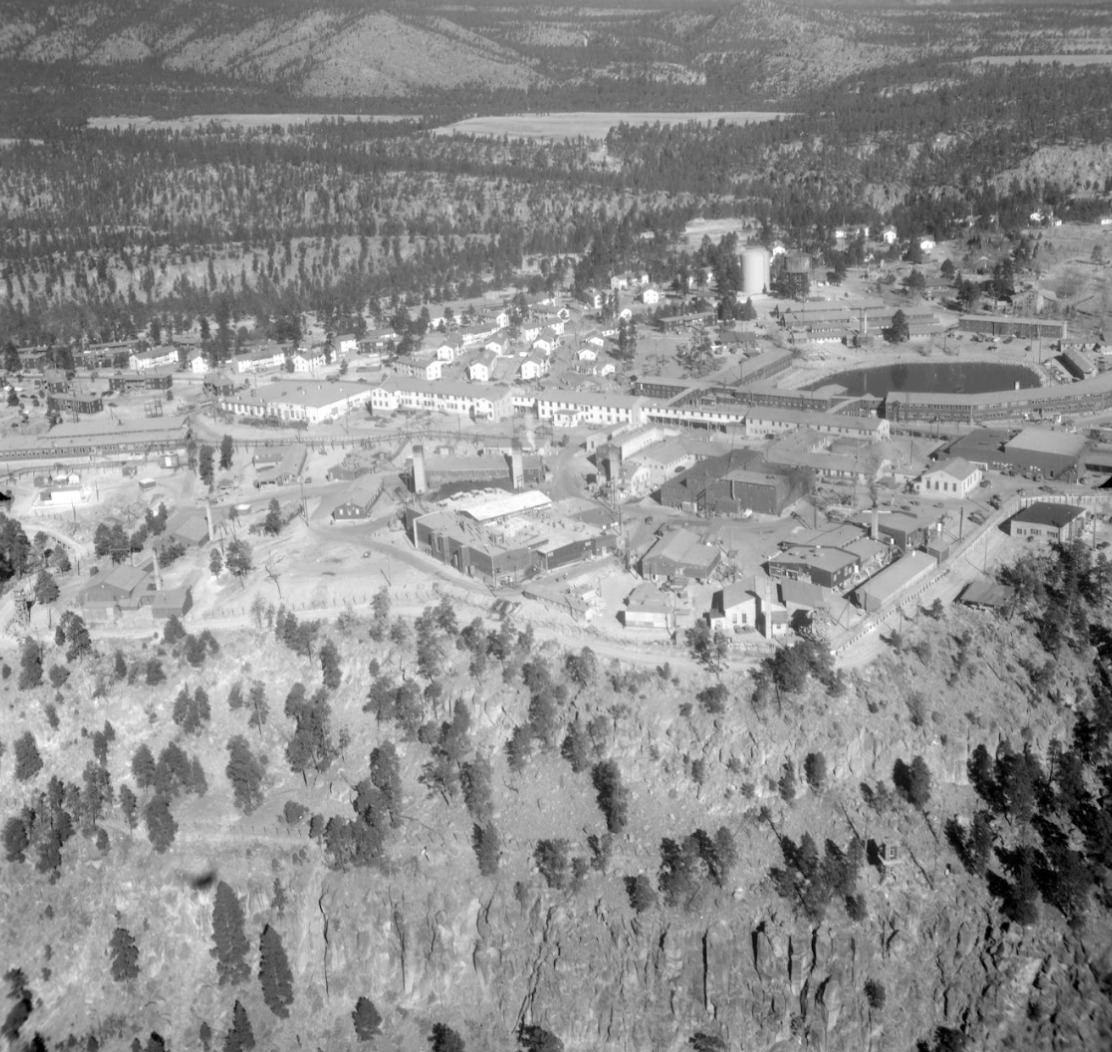
    <summary type="html"><![CDATA[<p><strong><em>From a soggy bog to a beloved community gathering place, the change and continuity of Ashley Pond illustrates the many eras of Los Alamos from homestead to Ranch School to government laboratory to the vibrant community of today.</em></strong></p><img src="https://www.intermountainhistories.org/files/fullsize/474ae326a19e2d428271b8e7a2ab5485.jpg" alt="1946 Aerial View of Los Alamos" /><br/><p><span style="font-weight:400;">Although Ashley Pond is now a prominent green space in the center of Los Alamos, it had a less majestic beginning. In 1908, it was a soggy depression used by homesteader H. H. Brook for watering his stock. Later, the Los Alamos Ranch School used it for the same purpose. Its applicable, albeit unimaginative, first name was the Stock Watering Tank. This was later switched to the Duck Pond in honor of its most popular visitors. The waterhole continued to remain a relatively unimpressive morass until the Ranch School built a dam in Los Alamos Canyon in 1923. This created a small reservoir which fed a pipeline to provide the school with water. The overflow from the pipeline was then dispersed into a puddle which progressively grew into a pond and then a small lake. </p>
<span style="font-weight:400;">The all-boys Los Alamos Ranch School was founded in 1917 by Detroit native, Ashley Pond Jr., who created it to generate tough, intelligent, well-rounded, and experienced outdoorsmen. As such, the students were encouraged to utilize the beautiful landscape for recreation and exercise. The pond provided an ideal place to put their learning into practice. Although never deep enough for true diving, the pond was perfect for canoeing and an excellent place to practice swimming. In the winter, the boys skated across its frozen surface playing hockey and harvesting the ice for the coming year. Ice blocks were stored in a nearby stone ice house and they were known to have collected enough ice to sustain them for up to two years. Once sufficiently filled, school faculty member—and notorious lover of puns—William Mills, provided the name of Ashley Pond in honor of the founder. The official title for the pond is Ashley Pond, not Ashley Pond Pond, but today Los Alamos natives enjoy the humorous anecdote. </p>
<span style="font-weight:400;">When the United States government acquired the land for the Manhattan Project, they allowed the school two months to make other arrangements. The boys went through a hurried graduation and left their beloved mountains, mesas, and pond in the hands of scientists. Manhattan Project staff built the Technical Area, also called TA 1, around the south side of Ashley Pond as a safeguard against fire. They repurposed the ice house as well, using it in 1945 to assemble nuclear components of the “gadget” which would be tested at Trinity. As such, Ashley Pond became restricted under laboratory security and very few outsiders were able to enjoy it. </p>
<span style="font-weight:400;">Today, Ashley Pond is a pleasant downtown landmark of Los Alamos. Situated near the center of town, it is used for picnics, walks, and outdoor concerts in the summer. Los Alamos natives attentively watch the ducks and geese who live at the pond, especially during chick season. During the winter, surrounding trees are decorated with colorful Christmas lights. The local winter parade currently ends at the pond, the same place where the Ranch School boys canoed and harvested ice nearly a century ago. </span>


</p><p><em><strong><a href="https://www.intermountainhistories.org/items/show/750">For more (including 6 images) view the original article</a></strong></em></p>]]></summary>
    <published>2023-09-07T23:39:58+00:00</published>
    <updated>2026-04-17T19:32:16+00:00</updated>
    <link rel="alternate" type="text/html" href="https://www.intermountainhistories.org/items/show/750"/>
    <id>https://www.intermountainhistories.org/items/show/750</id>
    <author>
      <name>Abigail Beus, Brigham Young University</name>
    </author>
  </entry>
  <entry>
    <title type="html"><![CDATA[Bathtub Row ]]></title>
    <summary type="html"><![CDATA[<p><strong><em>As scientists raced to build the first atomic weapon during WWII, they were required to sacrifice their time, academic careers, energy, bathtubs, and more in the remote desert highlands of New Mexico. </p></strong></p><img src="https://www.intermountainhistories.org/files/fullsize/81238fa6d58203850c43f89b67708cda.jpg" alt="Los Alamos Infrastructure " /><br/><p>As World War II raged into the 1940s, each country in the war was an avid participant in the race for scientific advancement. With such high stakes, the United States invested two billion dollars—over $33 billion today—in the creation of the atomic bomb. This massive project was dubbed the Manhattan Project, after its headquarters in New York, despite largely taking place in the remote highlands of New Mexico.</p><p><span style="font-weight:400;">While the United States had fiscal resources to invest in the project, they did not have much time. Both the Germans and the Soviets were developing their own nuclear weapons, and it seemed that whoever discovered how to harness the power of the atom first would win the war. The speed and urgency of the venture inevitably meant that some details were overlooked. Construction teams were tasked with building housing for thousands of men, women, and children in the remote deserts of New Mexico in total secrecy. The workmanship of many of these early houses was shoddy at best. Project builders were not only short on time, but materials. In particular, iron was a scarce resource and largely reserved for the war effort. Understandably, it could hardly be used for iron bathtubs. Due to these factors, the majority of scientists, military personnel, and their families lived in small, relatively iron-less, hastily built homes with only a few variations of bathroom fixtures—none of which included bathtubs. </span>
<span style="font-weight:400;">Only a single row of houses had the luxury of bathtubs because they were built before the war and had originally belonged to teachers of a secondary boys’ ranch school. These “master cottages” were some of the only buildings already built when the government bought the land and were a coveted luxury. Reserved for men such as Nobel-Prize winning Englishman Sir James Chadwick, explosives expert George Kistiakowsky, bomb designer Max Roy, ordnance director William S. “Deak” Parsons, and head scientist Robert J. Oppenheimer, bathtubs were a sign of prestige in this secret New Mexico town. According to local legend, Alice Kimball Smith, wife of scientist Cyril Smith, coined the term “bathtub row.” This effectively differentiated between the comfortable ranch school homes with bathtubs and those of government construction with showers.</p>
<span style="font-weight:400;">Despite the obvious disparity, many on Bathtub Row were willing to share their good fortune. Robert Oppenheimer was reportedly a generous host who invited many in the community into his home for classified discussions, drinks, and dinner parties. Ordnance director William S. Parsons’ home was fortunate enough to have two bathtubs. He often allowed military men to use them if they were injured and unable to stand for long periods of time under a shower. These bathtubs were also used to entice babysitters who would be rewarded with a relaxing soak in their neighbor’s home in exchange for an afternoon taking care of the owners’ children.</p>
<span style="font-weight:400;">Today, these houses are privately owned, but remain part of the Los Alamos National Historical Landmark District. In 2007, the Los Alamos population petitioned to change the street name from 20th to Bathtub Row. The community has continued to embrace this humorous anecdote from WWII through naming the local brewing co-op after the iconic row of houses. It stands as a reminder of the simple luxuries many relinquished in favor of supporting the American effort during WWII. </span>

</p><p><em><strong><a href="https://www.intermountainhistories.org/items/show/751">For more (including 10 images) view the original article</a></strong></em></p>]]></summary>
    <published>2023-09-08T00:39:58+00:00</published>
    <updated>2026-04-17T19:32:16+00:00</updated>
    <link rel="alternate" type="text/html" href="https://www.intermountainhistories.org/items/show/751"/>
    <id>https://www.intermountainhistories.org/items/show/751</id>
    <author>
      <name>Abigail Beus, Brigham Young University</name>
    </author>
  </entry>
  <entry>
    <title type="html"><![CDATA[Becoming a Ghost Town: The Superfund of Hayden, Arizona]]></title>
    <summary type="html"><![CDATA[<p><strong><em>Hayden, Arizona faces depopulation and pollution due to the nearby copper smelter that provided most of the town's jobs over the last century. </em></strong></p><img src="https://www.intermountainhistories.org/files/fullsize/3e32f171ae34e5252cf0c9c3ca0fcd9c.jpg" alt="Hayden Smelter" /><br/><p>Unlike scenic towns in Colorado and Idaho, Hayden, Arizona has been unable to shift its economic focus to tourism. According to one article, it lacks “charm” and is too polluted to attract visitors. Today Hayden’s very existence is threatened by depopulation: it has lost 75% of its people since 1920. Residents worry that if things don’t change soon, Hayden could be abandoned entirely. Like other cities in this tour, Hayden was built as a company town in the early 20th century close to the nearby source of jobs: a copper smelter. Kennecott built the smelter and operated the nearby mine that supplied the ore, but eventually both were bought by the Arizona-based mining company ASARCO in 1986. The smelter in Hayden has released a staggering amount of toxic metals into the air throughout the years and is responsible for adverse health effects on the townspeople.</p><p>Pollution and the health problems that come from it have divided the town. Some demand justice for ASARCO’s disregard for health and the environment, while others defend the company’s economic value in Hayden. There are key differences in Hayden though. For one, the smelter is still in operation today, and the threat of air pollution is still relevant. Another important distinction in Hayden is that the town isn’t technically on the National Priority List for Superfund sites. Instead, it has been classified as a Superfund alternative approach, which according to the EPA, “uses the same investigation and cleanup process and standards that are used for all Superfund sites.” Basically, when a potentially responsible party, in this case ASARCO, presents a plan for cleanup that the EPA deems acceptable, they allow the private company to handle operations with state and national oversight. Due to copper’s importance to the state’s economy, the state of Arizona worked hard to ensure Hayden avoided the stigma of being officially listed as a Superfund. However, no one worked harder than ASARCO to avoid the designation.</p><p>Over the years they have maintained that pollution is well under dangerous levels, even in the face of serious litigation brought on by fed-up Hayden residents in 2008. Reforms include installing new equipment with emission-reducing technology and covering contaminated soil. However, residents complained that the thin layer of gravel laid down by ASARCO isn’t enough to mitigate the danger, especially when it rains, and the contaminated soil escapes from underneath. </p><p>In 2011 the EPA officially sanctioned ASARCO for violating the Clean Air Act by having as much as two to three times the federal limit of lead emissions on some days, but cleanup was still left to the company. With budget cuts to the EPA and the current administration’s general views towards the environment, it is uncertain if federal aid for the cleanup will ever arrive in Hayden. Many have left as evidenced by the boarded-up buildings that line Main Street, but some claim to be too poor to relocate. Even the 10,000 dollars that residents won in the lawsuit against ASARCO is not enough to help people escape. For some, it feels as if they are trapped watching Hayden become a ghost town. </p><p><em><strong><a href="https://www.intermountainhistories.org/items/show/381">For more (including 3 images) view the original article</a></strong></em></p>]]></summary>
    <published>2020-01-08T23:11:54+00:00</published>
    <updated>2026-04-17T19:32:07+00:00</updated>
    <link rel="alternate" type="text/html" href="https://www.intermountainhistories.org/items/show/381"/>
    <id>https://www.intermountainhistories.org/items/show/381</id>
    <author>
      <name>Sam Heywood, Brigham Young University</name>
    </author>
  </entry>
  <entry>
    <title type="html"><![CDATA[Blackfeet Removal from Glacier National Park]]></title>
    <summary type="html"><![CDATA[<p><strong><em>Before the arrival of white settlers, Blackfeet territory included western Montana and southern parts of Canada. Blackfeet land claims were challenged as American settlers moved west and railroads expanded. As a result of starvation and government neglect in the late nineteenth century, they were forced to sell 800,000 acres of their reservation, land that would eventually make up the eastern portion of Glacier National Park. </em></strong></p><img src="https://www.intermountainhistories.org/files/fullsize/7a4db0d8cd0faf06f15da0d798e2989e.jpg" alt="Blackfeet in the Two Medicine Area, ca. 1914" /><br/><p>The Blackfeet Confederacy is made up of four bands: Piegan Blackfeet, Siksika, Piikani, and Kainai. Similar to other Great Plains tribes, they followed a yearly cycle which included hunting and gathering in the Rocky Mountains, what they called the “backbone of the world.” </p><p>In 1855, the Blackfeet signed the Lame Bull Treaty with the U.S. government which guaranteed their claims to land in Northern Montana and provided them with an Indian agent and annuities. </p><p>In 1870, following the revenge murder of a white rancher and his son, General Philip Sheridan sent Major Eugene Baker to find the leader of the attack. A camp of Piegans led by Heavy Runner was misidentified as the hostile band, and despite efforts by Heavy Runner and an army interpreter to prove their innocence, Baker ordered an attack. The number of deaths is disputed, but between 173 and 217 Piegan Blackfeet were killed. 140 were captured and became refugees at Fort Benton. The event became known as the Baker Massacre and marked the end of active Blackfeet hostility.</p><p>In the late 1870s, the Blackfeet faced starvation on their reservation. The government had eradicated the buffalo and rations were limited. The Blackfeet left the reservation to hunt, but were forced back by an army escort in 1880. Following their return, they became fully dependent on the government. Hundreds of Blackfeet starved to death on the reservation during the winter of 1883-1884. In need of money for food and supplies, they sold 800,000 acres of the western part of their reservation to the government in 1895. During the negotiations, Piikani Chief White Calf complained about the loss of sacred mountain land, calling it his people’s “last refuge,” and Little Dog reminded commissioners that they “did not ask the government to come and buy their land.” </p><p>In 1897, the ceded land was made a forest reserve, and Glacier National Park was created in 1910. The Blackfeet were central to many of the park’s advertising campaigns, especially those produced by the Great Northern Railroad. The Blackfeet accounted for over a third of Great Northern’s advertising images, making up more of the campaign than images of scenery. They were employed in the park and officials kept many Blackfeet place names. Unlike other National Parks, Glacier became synonymous with Indian presence. </p><p>With the park’s creation however, courts ruled that Blackfeet rights to access the mountains in the park were obsolete. In 1932, a US District Court ruled conclusively that they had no rights to hunt in the park. Claims resurfaced in 1973, when a judge ruled in favor of the Blackfeet, protecting their right to enter the park without paying the entrance fee. Even with limited access, the Blackfeet still feel the responsibility of their peoples’ “Covenant with the Creator.” One Kootenai woman said recently, “we are put here for a purpose and that is to guard our Columbia River Basin...that is why we are still here and that is why the [Spirits] are never going to let us go.” </p><p><em><strong><a href="https://www.intermountainhistories.org/items/show/341">For more (including 4 images) view the original article</a></strong></em></p>]]></summary>
    <published>2019-09-24T20:59:05+00:00</published>
    <updated>2026-04-17T19:32:06+00:00</updated>
    <link rel="alternate" type="text/html" href="https://www.intermountainhistories.org/items/show/341"/>
    <id>https://www.intermountainhistories.org/items/show/341</id>
    <author>
      <name>Allie Patterson, Brigham Young University</name>
    </author>
  </entry>
  <entry>
    <title type="html"><![CDATA[Boise&#039;s Chinatown]]></title>
    <summary type="html"><![CDATA[<p><strong><em>Walking around Boise today, there is little evidence of a bustling Chinatown—no markers, signs, or old buildings. In fact, most people would be surprised to learn that a large population of Chinese people once lived in Boise.  In fact, the Chinese community was strong and active in the early years of the city’s history</em></strong></p><img src="https://www.intermountainhistories.org/files/fullsize/f098af98c1e67d4e82ded64443854cf3.jpg" alt="Chinese New Year Parade" /><br/><p>Similar to the rest of Idaho, Boise was home to many Chinese immigrants in the mid to late 1800s. Integral to Boise’s history, Boise’s first Chinatown was first located in the middle of downtown Boise, on Idaho Street. Attracted to the Boise Basin area for its gold mines, many Chinese immigrants arrived to earn funds to return home to their families in China. Thousands of Chinese arrived at Boise and its surrounding area in the 1860s. However, by 1920, fewer than 600 remained. Despite the brevity of this period, Chinese immigrants left an impact on Boise that is often forgotten. </p><p>Cultural celebrations and parades in Boise's Chinatown were a key factor in raising its prominence in the broader community. Chinese parades fascinated the locals, and many residents of Boises took to the streets to watch the strange and colorful parades. Government officials, invited by Chinese associations, would also attend. During an era where Chinese were often discriminated against, the festivals provided Chinese immigrants a chance to celebrate their heritage. Moreover, these celebrations helped Chinese immigrants feel at home in a foreign land, and provided a way for them pass on Chinese cultural traditions to their children. </p><p>Despite the popularity of such events, all was not well in the community. Boise’s early Chinatown was often a violent place. First, Chinese immigrants faced violence from locals, such as Billy Haug robbing laundryman Wong Hong—and being acquitted for the act. Anti-Chinese sentiments grew from cultural, social, and economic rifts. There was also internal conflict. Belonging to different “tongs” or organizations, there was constant friction between the different groups of Chinese. Newspapers constantly reported on the various skirmishes between the tongs. Local Chinese leaders tried to control the violence by signing peace agreements. </p><p>Today, there are no historical markers to indicate Boise’s long-ago Chinese presence. Boise’s Chinatown is not a ghost town, but a town that has been completely subsumed by Boise’s cityscape. The last original Chinese building was removed in 1970 to make way for renovations. The presence and contributions of early Chinese immigrants to Boise merit remembrance.</p><p><em><strong><a href="https://www.intermountainhistories.org/items/show/126">For more (including 5 images) view the original article</a></strong></em></p>]]></summary>
    <published>2018-02-01T18:42:28+00:00</published>
    <updated>2026-04-17T19:32:00+00:00</updated>
    <link rel="alternate" type="text/html" href="https://www.intermountainhistories.org/items/show/126"/>
    <id>https://www.intermountainhistories.org/items/show/126</id>
    <author>
      <name>Dani Carmack, Brigham Young University</name>
    </author>
  </entry>
  <entry>
    <title type="html"><![CDATA[Boom and Bust in Bodie, CA]]></title>
    <summary type="html"><![CDATA[<p><strong><em><span style="font-weight:400;">Once among the largest and most prosperous towns in California, Bodie is now defined by the ghost of its past in the form of abandoned objects, peeling wallpaper, and half-destroyed buildings. </span></em></strong></p><img src="https://www.intermountainhistories.org/files/fullsize/24dc4420a11bbf404db7f58bf5daf143.jpg" alt="Old buildings in Bodie, California" /><br/><p><span style="font-weight:400;">In the summer of 1859, W. Bodey found rich gold deposits in California, seven miles west of the Nevada border. He had traveled from Poughkeepsie, New York, in pursuit of an adventure, and his discovery would lead to the town of Bodie and surrounding hills being named in his honor. His name is something of a mystery today; there are reports that refer to him as William, Waterman, and Wakeman, his second initial as either “T” or “S,” and his last name occasionally spelled as Body rather than Bodey. As for the spelling of the town’s name, the “ie” ending was initially the result of a confused sign painter, and it just stuck. </span>
<span style="font-weight:400;">Bodey’s ambition to find more for himself in life fueled both his success and his downfall. He was one of the first to discover gold in eastern California and managed to survive the dire circumstances of early prospecting life through the first change of seasons. It wasn't the work in the mines during the summer that killed him, but the harsh winter that followed. In November 1859 Bodey and his traveling companion left camp to get supplies. They were caught in a blizzard, and Bodey–unable to keep up with his companion–was left to die. His remains were recovered and now lie beneath two headstones: one that reads “Waterman S. Bodey” with an engraved image of miners panning gold from a stream against a backdrop of mountains; and another, much smaller with the name “William S. Bodey.”</span>
<span style="font-weight:400;">In the years following his death, the town of Bodie was brought to life by other ambitious miners and their families, bringing the town’s population to 10,000 in 1879. With so many people arriving in such a short period of time, most of them lived in tents–even after the town became more established. In 1881 the Bodie and Benton Railway was built and used to haul lumber and other goods from the Bodie mines to the saw mill by Mono Lake. Bodie was becoming a prosperous center for work. It served some twenty-two gold and silver mines in the region with a stamp mill for processing ore and plenty of businesses in town. Saloons dominated, but there was also a mercantile, several general stores, motels, gambling and dancing halls, schools, stables, and both a Catholic and a Methodist church. </span>
<span style="font-weight:400;">Like its namesake, the town is no stranger to tragedy and risk. Two accidental fires–one from a kitchen in 1892 and another started by a child in 1932–caused the destruction of several main street buildings, and led to economic hardship. Combined with the sundry difficulties of the Great Depression, the town failed to recover. It joined the arid region’s long list of ghost towns. Weather conditions in the mountains are still just as treacherous as they were in W. Bodey’s fateful last days. Travel to Bodie during winter months is only possible by way of skis, snowshoes, or snowmobiles. </span>
<span style="font-weight:400;">In an attempt to preserve the historic elements of the town, Bodie was made an official California State Park in 1962. Only five percent of what once made up the booming town of Bodie is thought to have survived, and today its ghost-like remains sit virtually untouched in tattered buildings and houses. </span></p><p><em><strong><a href="https://www.intermountainhistories.org/items/show/806">For more (including 6 images) view the original article</a></strong></em></p>]]></summary>
    <published>2024-05-16T02:01:48+00:00</published>
    <updated>2026-04-17T19:32:18+00:00</updated>
    <link rel="alternate" type="text/html" href="https://www.intermountainhistories.org/items/show/806"/>
    <id>https://www.intermountainhistories.org/items/show/806</id>
    <author>
      <name>Megan Bailey, Brigham Young University</name>
    </author>
  </entry>
  <entry>
    <title type="html"><![CDATA[Buffalo Bill Gravesite at Lookout Mountain]]></title>
    <summary type="html"><![CDATA[<p><strong><em>In 1917, William Frederick “Buffalo Bill” Cody died of organ failure in Denver, Colorado. He was so well-loved in life and in death that both Wyoming and Colorado wanted his body and both claim to have it. The tales and myths that surround his burial are just as grand as the shows that he participated in during his life.</em></strong></p><img src="https://www.intermountainhistories.org/files/fullsize/555ab8f0a618d544e058c23d6e2c67b1.jpg" alt="Portrait of William F. Cody (aka) &quot;Buffalo Bill.&quot;" /><br/><p><span style="font-weight:400;">There are two sides to the story of William Frederick “Buffalo Bill” Cody’s burial. One fact is agreed upon. Cody originally wished to be buried outside of Cody, the town that he established in Wyoming. He established this through a will, but later voided it.  Subsequent wills left the decision up to his wife, who chose the site on Lookout Mountain in Golden, Colorado. Cody died early in the year and was not buried until June. Between this time, his body sat at the morgue and was preserved until the open casket funeral could be held. This is where competing version of the following history split between the towns of Cody and Golden.</p><p>Golden, Colorado’s version of the tale is rather straightforward. Cody was buried after an open casket funeral during which thousands of people saw the body. It was then placed at Lookout Mountain and remains there to this day. The body is also buried under tons of concrete that was placed there after Cody's foster son heard rumors about trying to move the body of both Cody and his wife. Today, the grave is surrounded by a fence in an attempt to discourage individuals from tossing in coins and features a museum dedicated to the life of Buffalo Bill Cody.</p><p>In contrast, Cody, Wyoming claims that Buffalo Bill’s wife was bribed by Denver officials to bury the body in Colorado. She accepted due to the debts that he had incurred during his life. When she returned to Cody, the residents there were disappointed and a few concocted a plan to steal the body from the morgue and replace it with a recently deceased farm hand that had some resemblance to Cody. They took the body to Denver and swapped it with Cody’s while visiting the morgue to pay their respects. With Cody’s body in their possession, they returned with it to Cody, Wyoming, and buried it in a secret location in Spirit Mountain.</p><p>Evidence leans towards Colorado’s side of the tale but tensions still remain. Even those in Wyoming who recognize the Lookout Mountain gravesite claim that he should be returned by Denver to the city of Cody. Although this is unlikely to happen, it is interesting that such an compelling man in life remains so controversial in death.</span></p><p><em><strong><a href="https://www.intermountainhistories.org/items/show/469">For more (including 4 images) view the original article</a></strong></em></p>]]></summary>
    <published>2021-09-10T07:39:02+00:00</published>
    <updated>2026-04-17T19:32:09+00:00</updated>
    <link rel="alternate" type="text/html" href="https://www.intermountainhistories.org/items/show/469"/>
    <id>https://www.intermountainhistories.org/items/show/469</id>
    <author>
      <name>Nikki Smith, Brigham Young University</name>
    </author>
  </entry>
  <entry>
    <title type="html"><![CDATA[Bushnell Military Hospital]]></title>
    <summary type="html"><![CDATA[<p><strong><em>From a hospital to a school, to nothing—the Bushnell Military Hospital wasn’t in operation for long, but it had a lasting impact. </em></strong></p><img src="https://www.intermountainhistories.org/files/fullsize/fd74574b5e34696aec898ecd1a809b0e.jpg" alt="Bushnell Military Hospital Aerial View" /><br/><p>World War II took the lives of approximately 3% of the entire world’s population in the 1940s—so it’s no surprise that life-saving efforts became a top priority at the time. Military hospitals were built throughout the war front as well as the home front. Brigham City, UT became home to one: Bushnell General Military Hospital. The hospital impacted Brigham City in various ways, including the lives of many individuals who served and were served there.</p><p>Many employees at the facility were locals, which boosted Brigham City’s economy. They needed the skills that varying individuals possessed because Bushnell was innovative in their patient care. Just one of many examples is their developing a new type of prosthetic limb that used plastic instead of metal, which soon spread to other amputation centers and became more commonplace in the medical field.</p><p>They were also innovative in their treatment procedures. Bushnell had a significantly low death rate, which is accredited in part to their experimental use of penicillin. Penicillin was new to the medical world and proved effective for many patients, allowing doctors at Bushnell to save many more lives and limbs than they would have been permitted under other circumstances. </p><p>Once soldiers were healed, the focus shifted to rehabilitation. They had band performances by amputees, visits from celebrities such as Helen Keller to boost morale, and a general sense of community involvement to aid in all steps of this process. </p><p>The hospital also provided facilities for mental health treatment. The psychiatrists were well-trained and used the best and newest treatments they had at the time. However, many patients had already suffered from mental and emotional illness before the war, and seeing combat brought them to severe extremes. The psychological knowledge of the time was not sufficient to help many of them, and they ended up in hospitals for extended periods of time. However, due to many experimental treatments, they made advancements in psychiatric treatment that continued to be implemented afterward.</p><p>After the war, the hospital was closed in 1946. The buildings were remodeled and turned into the Intermountain Indian School: a boarding school for Native American children. It was successful for several years but was closed in 1984 and the land was given back to the city. The buildings have mostly been demolished now, but Brigham City has experienced the long-lasting effects of the hospital’s influence. Bushnell brought the community together in a way nothing else could—it was a chance for a small town to band together for a good cause in a troubling time. </p><p><em><strong><a href="https://www.intermountainhistories.org/items/show/86">For more (including 5 images) view the original article</a></strong></em></p>]]></summary>
    <published>2017-08-18T20:26:36+00:00</published>
    <updated>2026-04-17T19:31:59+00:00</updated>
    <link rel="alternate" type="text/html" href="https://www.intermountainhistories.org/items/show/86"/>
    <id>https://www.intermountainhistories.org/items/show/86</id>
    <author>
      <name>Aubrey Glazier, Brigham Young University</name>
    </author>
  </entry>
  <entry>
    <title type="html"><![CDATA[Butch Cassidy’s Childhood Home]]></title>
    <summary type="html"><![CDATA[<p><strong><em>Butch Cassidy worked hard to help provide for his family as a teenager on this homestead. It was the last place he lived with his family before going on to become an infamous outlaw. </em></strong></p><img src="https://www.intermountainhistories.org/files/fullsize/19f12888865cf412905d029dc4280975.jpg" alt="Butch Cassidy’s Childhood Home" /><br/><p>Robert Leroy Parker’s teenage years transpired on this homestead. Born on Friday, April 13, 1866, he would become known as the infamous Butch Cassidy. Butch’s parents, Maximillian and Annie Parker, moved Butch and his five younger siblings to this homestead when he was thirteen years old. Maxi and Ann had thirteen children total, and Butch started working to help provide for the family at thirteen years old. </p><p>In 1879 when the Parker family bought the homestead, there was already a two-room cabin on the property. As the family grew, Maxi added a kitchen on the east side and two bedrooms on the south side, expanding the house to its current size. The Parkers covered the ceiling in white cloth to make it feel less rugged. Each year, they also cleaned the homemade rag carpets and replaced the straw padding underneath them.</p><p>Though there was much hard work to be done, the Parkers still made time to have fun together. Butch, or Bob as his siblings called him, loved to take the children on pony rides or invent new games to play. They also shared a love for music, and Butch would often accompany everyone’s singing with his harmonica. There was also a fair amount of mischief. Once, Ann came home and noticed that the chickens were acting funny; reeling and stumbling around the yard. After some investigation, she figured out that the children had stolen some of their neighbor’s wine and filled pans with it for the chickens to drink. </p><p>Butch’s religious and family-centered upbringing does not match the typical origin story of an Old West outlaw. His grandparents were Mormon pioneers who crossed the plains in handcart and wagon train companies to follow their faith. But Butch started finding excuses not to go to church at a young age. Then he began to rub shoulders with outlaws like Mike Cassidy when he started working at Jim Marshall’s ranch located twelve miles south of Circleville. Mike took Butch under his wing and taught him about handling horses and guns. Butch looked up to Mike and many believe that Butch took his alias from this outlaw and cattle rustler. When Butch turned eighteen, he decided he didn’t want to scrap out a living in Circleville and wanted to go somewhere to get, “hard, solid gold.” When some thieves stole cattle in the area, Butch signed a false bill of sale and took the blame, riding out of town the day before it became known to the public. He left the homestead on an early April morning in 1884, leaving his mother to hold back his dog while he rode off on his mare Babe and lead his young colt Cornish. He sent money home often for the first few years and is considered one of the most well-liked and respected outlaws of the Old West.</p><p><em><strong><a href="https://www.intermountainhistories.org/items/show/198">For more (including 3 images) view the original article</a></strong></em></p>]]></summary>
    <published>2018-06-06T23:59:00+00:00</published>
    <updated>2026-04-17T19:32:02+00:00</updated>
    <link rel="alternate" type="text/html" href="https://www.intermountainhistories.org/items/show/198"/>
    <id>https://www.intermountainhistories.org/items/show/198</id>
    <author>
      <name>Samuel Hauber, Brigham Young University</name>
    </author>
  </entry>
  <entry>
    <title type="html"><![CDATA[BYU Creameries]]></title>
    <summary type="html"><![CDATA[<p><strong><em>While BYU is perhaps best known for its academic achievements and sports programs, since the mid 1940’s the university has owned and operated a successful dairy farm and creamery.</p></strong></p><img src="https://www.intermountainhistories.org/files/fullsize/f11b2acd3cce1c171bba4c851c42cf96.jpg" alt=" Creamery on Ninth. 
" /><br/><p>Brigham Young University has operated a dairy farm since 1946. The first farm was located on 24 acres in Northern Provo. The farm operations included a creamery, producing milk and dairy products mostly for the university community. In the 1950s, the creamery was transferred from the College of Applied Science to BYU Auxiliary Services. Then in 1957 the school purchased approximately 600 acres of farmland in Spanish Fork to increase the school’s farming operations. Agriculture professor Grant Richards helped bring BYU’s dairy herd to a prize-winning level and by 1959, BYU’s pure-bred Holsteins were known to produce over twice as much milk and butter than the average American dairy cow. </p><p>In 1949, a dairy-processing plant was built just north of the Central Heating Plant. The College of Biological and Agricultural Sciences developed a curriculum in dairy processing, though these courses were eventually replaced by food science courses. The Dairy Products Laboratory building was completed in 1964 after nine months of construction. In 2009, the facility moved locations on campus and expanded to become the BYU Culinary Support Center. This new expanded operation is responsible for all on campus food, feeding tens of thousands of people daily. </p><p>The Creamery on Ninth opened in 2000. Kent’s Market, a grocery store located in the current Creamery’s location, had closed in 1999 after serving BYU students for 59 years. Heritage Halls residents and other students complained about the closure, so the university decided to refurbish the building and open a university-run grocery store and grill. The Creamery on Ninth opened on August 23, 2000 and quickly became a popular spot for BYU students and locals alike. Besides the flagship Creamery on Ninth store, soon creamery locations were established including Helaman Creamery, Creamery Outlet, Wyview Creamery, Takeaway Creamery, and Creamery Express. </p><p>While BYU's Creamery locations sell a wide variety of goods, the main attraction has always been the ice cream. With milk supplied from BYU’s dairy farm in Elberta, Utah, BYU Creamery Operations now produce over 200,000 gallons of ice cream per year. BYU’s ice cream formulas have 2-4% higher milk fat content than most ice cream recipes, giving it an unusually rich, creamy consistency. Although LaVell’s Vanilla holds the number one spot for half-gallon sales, the Creamery reports Graham Canyon to be its most popular flavor.</p><p>BYU Creameries play an integral role in the social fabric of BYU, providing convenient locations for students and staff to buy groceries and a fun place to relax after a long day of work. </p><p><em><strong><a href="https://www.intermountainhistories.org/items/show/460">For more (including 5 images) view the original article</a></strong></em></p>]]></summary>
    <published>2021-03-30T06:24:01+00:00</published>
    <updated>2026-04-17T19:32:09+00:00</updated>
    <link rel="alternate" type="text/html" href="https://www.intermountainhistories.org/items/show/460"/>
    <id>https://www.intermountainhistories.org/items/show/460</id>
    <author>
      <name>Allie Patterson, Brigham Young University; Ryan J. Hallstrom, Brigham Young University</name>
    </author>
  </entry>
  <entry>
    <title type="html"><![CDATA[BYU Museum of Art (MOA)]]></title>
    <summary type="html"><![CDATA[<p><strong><em>BYU’s Museum of Art has provided students and locals with free access to world-class art exhibitions since 1993.</em></strong></p><img src="https://www.intermountainhistories.org/files/fullsize/cc6d72c6614fa87d654515751076703c.jpg" alt="Main Entrance" /><br/><p>Ground was broken for the Brigham Young University Museum of Art in 1991, and the museum was opened in October 1993. The museum cost $15 million and was financed entirely by private donations. It was designed by LA architect James Langenheim and former directors of lighting and design at the Metropolitan Museum of Art LeMar Terry and Stuart Oliver. Other personnel from the Smithsonian Institution, the Getty Museum, and the National Gallery of Art also contributed to the museum’s construction and design. </p><p>The museum’s four stories contain exhibition galleries, an auditorium, classrooms, a small theater, a print study room, a gift shop, a café, security and administration offices, and design, fabrication, imaging, registration, and storage areas. The grounds are decorated by a sculpture garden and reflection pool. The museum is staffed by student security guards who monitor the art and patrons. </p><p>Exhibitions have featured the works of M.C. Escher, Tiffany Glass, and Norman Rockwell, along with Pulitzer Prize photographs and other well-known local, national, and international artists. The museum found itself at the center of minor controversy following an administrative decision to leave out certain pieces of a traveling exhibit titled “The Hands of Rodin: Tribute to B. Gerald Cantor” when it came to BYU. Students protested the decision to keep “The Kiss,” “Saint John the Baptist Preaching,” “The Prodigal Son,” and “Monument to Balzac” out of the public eye, but the university defended its decision, contending that the museum services varying audiences and that the pieces might not be appropriate for every patron. </p><p>BYU’s collection of art started long before the museum was opened. The collection began in 1909 when a painting of a sycamore tree by Utah painter John Hafen was donated. In 1937, Herald R. Clark purchased 85 prints from artist Maynard Dixon. In 1960, the school received artist Mahonri Young’s art collection which included over 10,000 works. Several BYU presidents had commented on the value and extensive nature of the collection, but real efforts to create a public home for the collection did not begin until the 1980s. At the dedication of the campus Life Science Museum, Monte L. Bean said: “I’m going to recommend that we look forward to having a new art center…One day, they tactfully showed me all of the hundreds of beautiful paintings that are sealed in the room downstairs in the archives…and none of you people are enjoying them.” During the dedication of the art museum, BYU President Rex Lee noted, “We have an art museum to match the quality of our collection.”</p><p><em><strong><a href="https://www.intermountainhistories.org/items/show/417">For more (including 4 images) view the original article</a></strong></em></p>]]></summary>
    <published>2020-04-11T01:55:00+00:00</published>
    <updated>2026-04-17T19:32:08+00:00</updated>
    <link rel="alternate" type="text/html" href="https://www.intermountainhistories.org/items/show/417"/>
    <id>https://www.intermountainhistories.org/items/show/417</id>
    <author>
      <name>Allie Patterson, Brigham Young University</name>
    </author>
  </entry>
</feed>