Theodore Roosevelt and Roosevelt Dam
Story 6 of 8 of the President Theodore Roosevelt in the West Tour

[Salt River, Arizona. Apache Indian laborers, Roosevelt, Arizona]
Library of Congress, National Photo Company Collection
Reproduction Number LC-USZ62-107201
Call Number LOT 12337-4
Date: Between 1909 and 1932
President Theodore Roosevelt dedicated the Roosevelt Dam. At the time, it was the largest artificial lake and the largest masonry dam in the United States.
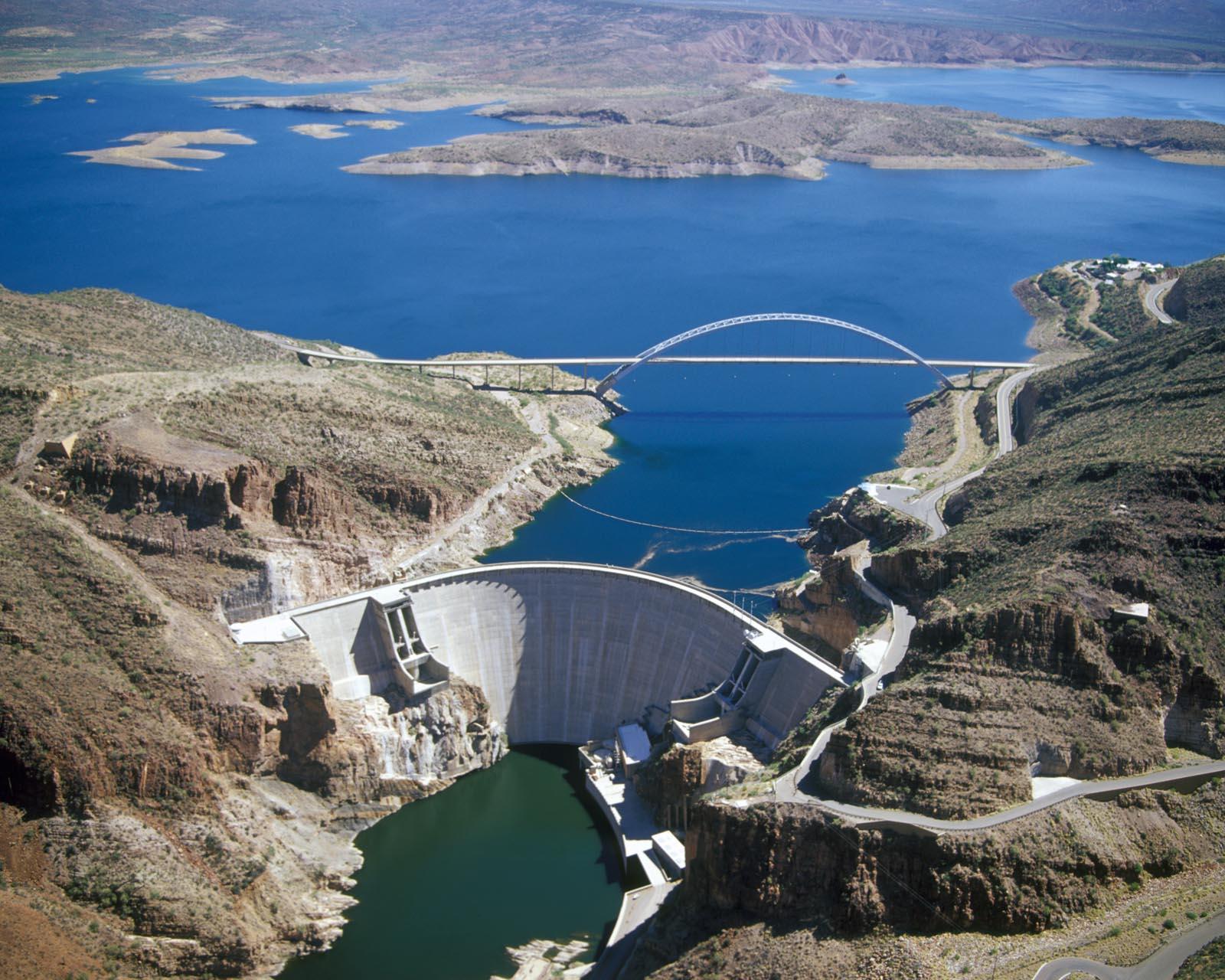
The signing of the Newlands Reclamation Act by President Theodore Roosevelt in 1902 began “the construction of irrigation works for the reclamation of arid lands.” One of the first projects authorized under this act was the world’s largest masonry dam, the Roosevelt Dam. The first stone was placed on September 20, 1906. Benjamin Austin Fowler, a former lawyer from New York City, was central to the dam’s construction. Having left the city scene, Fowler moved to the West in 1899, where he purchased 400 acres in Glendale, Arizona, to become a farmer. With the dry climate and high temperatures, water was scarce, and his farming would be greatly aided if a reservoir could provide steady irrigation water access. Fowler lobbied for 17 years for a dam and reservoir to be constructed northeast of Phoenix, in a narrow canyon of the Salt River. The Roosevelt Dam was built to provide flood control, municipal and irrigation water, and hydropower for central Arizona. This project involved over 3,000 diverse workers. There was a shortage of workers in the summer because of the intense heat, and one of the engineers remarked, “White men won’t stay on this job because they cannot spend their money fast enough.” In turn, they hired Apache Indians who had already long dwelt in the area, and who had excellent labor skills. They completed the dam on February 5, 1911. Roosevelt Lake was the largest artificial lake in the world when it held over 1 million acres of water.
One month later, on March 18th, former President Theodore Roosevelt came with a wagon parade to dedicate the dam. As most of the previous roads were then under the waters of the new reservoir, they took a route up the Apache Trail. Roosevelt reflected on the beauty of the wildflowers and landscapes in his dedicatory speech. At 5:48 pm and with about 1,000 spectators, he flipped the electric switch and opened the gate to begin Arizona’s new era of water control. This contributed to many settlements and a growing community that would not have existed otherwise. Serving communities with sustainable water and energy, Fowler’s and Roosevelt’s efforts paid off as the Scientific American newspaper publicized on the dam’s dedication day, “With the completion of the irrigation system which is being constructed by the federal government, we may safely predict for this valley an era of progress and substantial growth which will place it in the forefront of the most up-to-date agricultural districts in the world.”
The Salt River Project has monitored Roosevelt Dam since 1911, and the site has changed in many ways. In 1992, overflowing problems necessitated renovations. The road to drive across it was removed, the dam was raised 23.5 meters, and a bridge was suspended over Roosevelt Lake. Today, many make the trek to enjoy the water and view the architectural feat that the Roosevelt Dam is.
Images
[Salt River, Arizona. Apache Indian laborers, Roosevelt, Arizona]
Library of Congress, National Photo Company Collection
Reproduction Number LC-USZ62-107201
Call Number LOT 12337-4
Date: Between 1909 and 1932
.jpg)
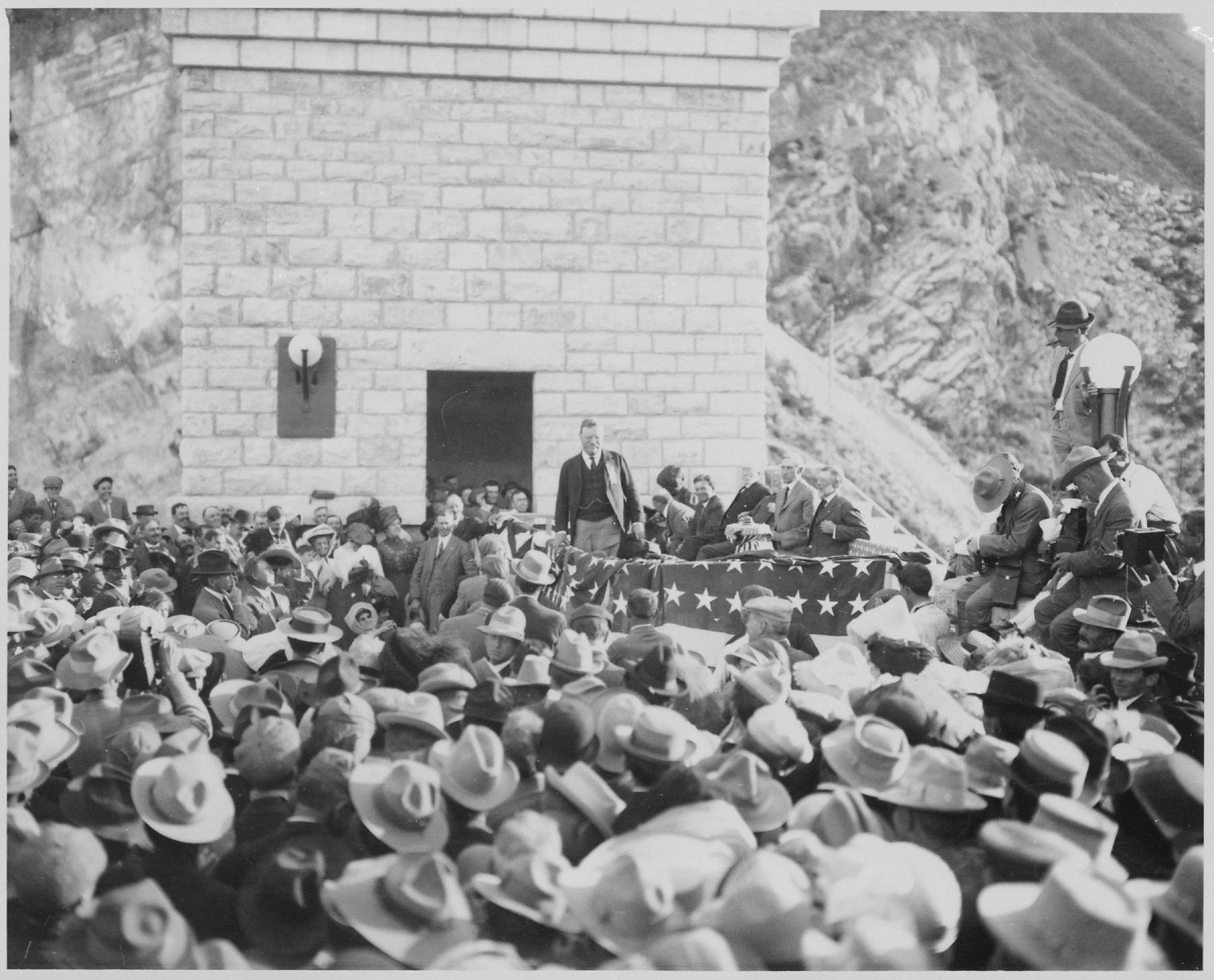
Dedication ceremonies of Roosevelt Dam [Arizona Territory], Col. Roosevelt speaking, March 18, 1911. By Lubken.
National Archives Catalog, Records of the Bureau of Reclamation 1889 - 2008
Photographs of Irrigation Projects, 1896 - 1938
National Archives Identifier 531561
Local Identifier 115-JAA-2267
Creator: Department of the Interior, Bureau of Reclamation Date: March 18, 1911
,_Col._Roosevelt_speaking,_March_18,_1911.%22_By_Lubkin_-_NARA_-_531561.jpg)

Aerial View of Roosevelt Dam and Roosevelt Lake. Photograph, March 18, 1916. Library of Congress Prints and Photographs Division, Washington, D.C. https://hdl.loc.gov/loc.pnp/ppmsca.15834.