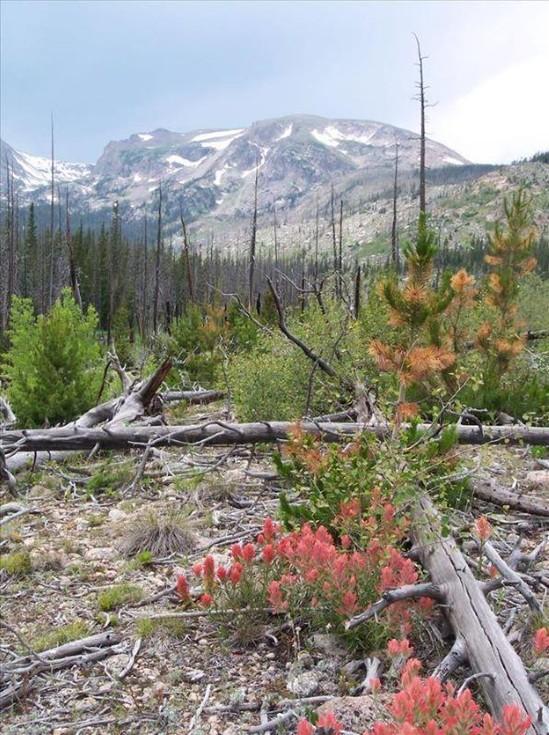
Ouzel Fire, Rocky Mountain National Park
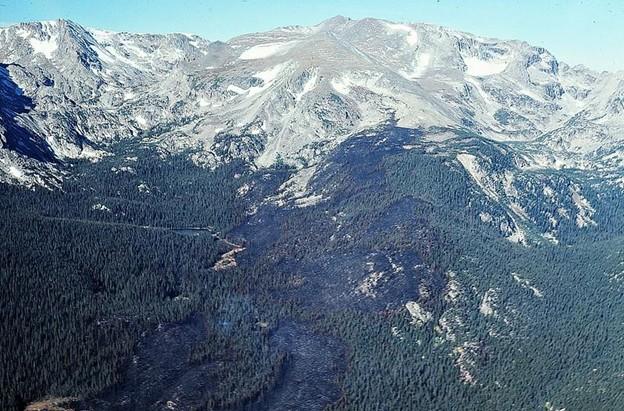
Bird, Cathie. Aerial View of Ouzel Burn Area. Flickr Creative Commons, https://www.flickr.com/photos/seabird7/6568053439/in/album-72157628558927927
In 1978, the Ouzel Fire tested Rocky Mountain National Park’s let-burn fire management policies. After park officials allowed it to burn, it escaped park boundaries and threatened the nearby community of Allenspark, Colorado, prompting backlash from residents.
In 1977, scientist David Butts composed a new management plan for Rocky Mountain National Park. This strategy, which the park quickly approved, aligned with evolving understandings of blazes within the United States National Park Service (NPS). Suppression defined NPS policy for decades, but in 1977, the nationwide NPS-18 procedure required parks to plan for let-burn fires. During these situations, park officials monitored natural burns closely, allowing them to burn in specific boundaries if they did not threaten structures or cultural resources. At Rocky Mountain, administrators followed this procedure by dividing park land into three distinct risk categories based on vegetation, elevation, and the number of structures nearby. Within low-risk areas, the Park Service allowed burning, but it suppressed any blaze that entered a moderate or high-risk area.
On August 9, 1978, the Ouzel Fire started in Rocky Mountain near Ouzel Lake. Park administrators considered the area low risk, so they allowed it to burn naturally. For a month, NPS closely monitored the flames, which stayed within a designated containment zone. However, on September 15, high winds in Wild Basin pushed Ouzel outside the Park Service’s boundaries. Firefighters immediately worked to suppress it , but the weather conditions made it difficult to contain. It quickly approached the park’s boundaries and the nearby town of Allenspark, Colorado. Ouzel became the first let-burn blaze to threaten a community outside park boundaries.
On September 30, NPS declared Ouzel contained when heavy equipment created a barrier around it. When contained, fires end once they consume all available fuel. Firefighters halted Ouzel’s advance before it destroyed any structures in Allenspark, but the risk it posed generated significant hostility among residents. Many nearby communities also experienced air pollution during the blaze due to the smoke it released, generating further hostility. Locals argued that the let-burn policy had failed, and the Park Service irresponsibly placed its experimental management plan before the needs of residents.
To regain the trust of local communities, a local Park Service superintendent requested an official review of fire management operations during both the let-burn and suppression phases of Ouzel. Regional NPS manager Kenneth Ashley served as the board’s chair. It consisted of U.S Forest Service specialists, state foresters, and a professional fire scientist from Colorado State University. Its members met on November 8, 1978, and they found that the Park Service’s management plan was too vague to facilitate swift, decisive action during Ouzel. It recommended that Rocky Mountain should develop a new plan with public input. The board also suggested that prescribed burning, which deliberately lights blazes in controlled conditions, would be a safer and more effective way to achieve Rocky Mountain’s management goals. This suggestion marked the beginning of a national transition between the let-burn policy and prescribed burning.
Images
Bird, Cathie. Aerial View of Ouzel Burn Area. Flickr Creative Commons, https://www.flickr.com/photos/seabird7/6568053439/in/album-72157628558927927

Pollock, A.A. Boulder Fire Department: One year after the Ouzel Lake fire. Photo 2 – August 9, 1979. Carnegie Library for Local History, https://localhistory.boulderlibrary.org/islandora/object/islandora%3A103233 .

Golden Transcript newspaper. “Park Service Takes Fire Blame.” 21 September 1978.