<?xml version="1.0" encoding="UTF-8"?>
<feed xmlns="http://www.w3.org/2005/Atom">
  <title type="text">Intermountain Histories</title>
  <updated>2026-04-17T19:32:21+00:00</updated>
  <generator uri="http://framework.zend.com" version="1.12.20">Zend_Feed_Writer</generator>
  <link rel="alternate" type="text/html" href="https://www.intermountainhistories.org/"/>
  <link rel="self" type="application/atom+xml" href="https://www.intermountainhistories.org/items/browse?output=rss2"/>
  <id>https://www.intermountainhistories.org/</id>
  <author>
    <name>Intermountain Histories</name>
    <uri>https://www.intermountainhistories.org</uri>
  </author>
  <link rel="hub" href="https://pubsubhubbub.appspot.com/"/>
  <entry>
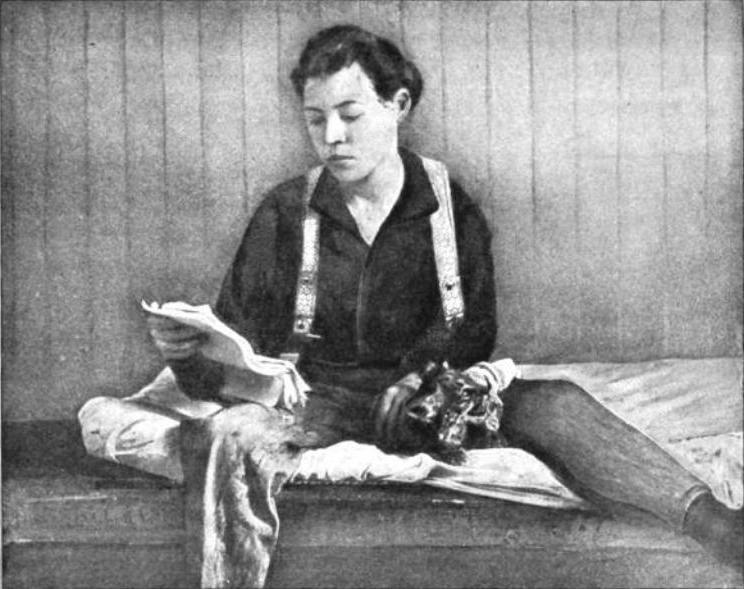
    <title type="html"><![CDATA[Pearl Hart: The Bandit Queen]]></title>
    <summary type="html"><![CDATA[<p><strong><em>Best remembered for committing a stagecoach robbery, and her rare identity as a “Lady Outlaw” of the Wild West, the life of Pearl Hart might not have been as adventurous or romantic as it appears on the surface. </em></strong></p><img src="https://www.intermountainhistories.org/files/fullsize/22b8112b8583aaa5d0d96bbc1c1ccaca.jpg" alt="Pearl Hart reading a paper in her jail cell" /><br/><p><span style="font-weight:400;">Lillie Naomi Davy, later known as “Pearl Hart,” was born into a violence that she would spend the rest of her life attempting to escape. Born in 1871, she was the third of at least eight children and spent most of her childhood in rural Lindsay, Ontario. Her father was relentlessly abusive, and her mother had little power over the situation. Lillie and her siblings were often left to fend for themselves, turning to mischief and even crime. In her youth she was described as, “livesome, blythe, and witty.” At eleven-years-old Lillie and her thirteen-year-old brother William stole a cow from a neighboring farm and re-sold it before they were caught. Lillie and her sisters Catherine and Saphronia frequently ran away from home, usually to the western United States. They cut their hair short and dressed in men's clothes, which helped them fly under the radar. Once they’d been discovered, which they always were, the sisters were usually sent back to New York, where their mother had moved prior to their father’s imprisonment for violent crime. </span>
<span style="font-weight:400;">Lillie was only fifteen when she started seeing Charles Dean, who became her first husband only a year later, although he was thirty-five and had been married to another woman when they had initially met. When he grew increasingly violent towards her, Lillie ran away with her sister Catherine once again. In the next several years Lillie remarried, or at least claimed to be re-married, for there was no legal documentation of divorce from Charles, to a man named Dan Bandman. She admired him for his college education and musical talents, though it did not take long for his charm to wear thin and the violence that so haunted young Lillie’s life to once again threaten her. </span>
<span style="font-weight:400;"></span><span style="font-weight:400;">The western frontier beckoned hope to anyone looking for an escape. There was a promise of freedom, opportunity, and prosperity for those who had the guts and grit to make it on their own. Work in the west was mostly limited to hard labor for men in fields such as mining, logging, and construction. Women, especially the unmarried, had far fewer options. The most profitable by far being prostitution. Lillie and Catherine worked for a time in a brothel run by the mistress Pearl Hart, someone they both likely admired, for Catherine began referring to herself as “Minnie Hart,” and in the following years Lillie took on the alias of “Pearl Hart” herself. Like her contemporaries “Butch Cassidy” and “Billy the Kid,” this new title was more than just a new name, it was an attempt to reinvent her persona and conceal her past identity. </span>
<span style="font-weight:400;">From late adolescence to early adulthood, Pearl never stayed anywhere long and did whatever she could to survive––which often meant working in dangerous conditions or returning to an equally dangerous life with an abusive husband. </span>
<span style="font-weight:400;"></span><span style="font-weight:400;">In 1899 Pearl became desperate to make a decent sum of money, and quick, presumably because she had just discovered her mother was dying and wanted to get back east to say goodbye. After a brief, and fruitless, stint working in the mines of Globe, Arizona Pearl teamed up with a man known as “Joe Boot.” It is unclear what kind of relationship they had, or who the mastermind behind the operation was, but most signs point to Pearl as the instigator. After they had been taken into custody, Pearl described Joe as cowardly, stating that his hands were “shaking like leaves” the whole time. Although they had been somewhat kind to the victims of their heist, giving them back half of the money so that the travelers would not be left completely destitute, Pearl was sentenced to five years at Yuma Territorial Prison. </span>
<span style="font-weight:400;"></span><span style="font-weight:400;">Following her stint in prison, Pearl became more elusive and there are not many records of her exploits––criminal or otherwise. While her incarceration kept her from ever reuniting with her mother, she did reconnect with some of her siblings. One of her sisters wrote a play based on the exploits of “Pearl Hart,” the legendary character she had become. She acted in the play as herself, fulfilling a dream she had once had of becoming an actress. </span>
<span style="font-weight:400;">Pearl spent much of her life in seemingly hopeless and tumultuous circumstances, but she might have found joy in stage performance. Or in time spent reminiscing with her sisters about their adolescent larks––dressing in boys clothes and hopping trains to unexplored cities––before they had to face the reality of their stations in life. </span></p><p><em><strong><a href="https://www.intermountainhistories.org/items/show/929">For more (including 3 images) view the original article</a></strong></em></p>]]></summary>
    <published>2025-12-09T17:24:32+00:00</published>
    <updated>2026-04-17T19:32:21+00:00</updated>
    <link rel="alternate" type="text/html" href="https://www.intermountainhistories.org/items/show/929"/>
    <id>https://www.intermountainhistories.org/items/show/929</id>
    <author>
      <name>Megan Bailey, Brigham Young University</name>
    </author>
  </entry>
  <entry>
    <title type="html"><![CDATA[Girl Scouts of Utah]]></title>
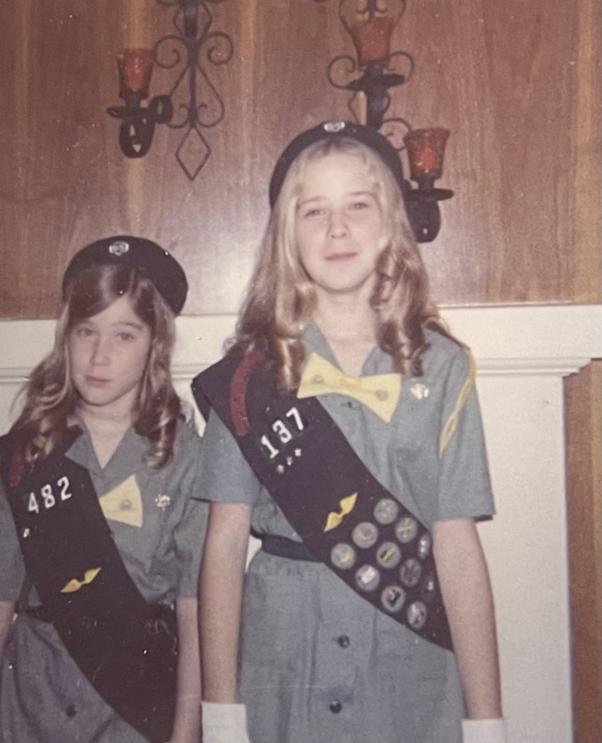
    <summary type="html"><![CDATA[<p><strong><em>Barbara Schmidt, a scout of 65 years, recalls her fondest memories growing up as a girl scout in mid-twentieth century Utah. </em></strong></p><img src="https://www.intermountainhistories.org/files/fullsize/0d86281475893b6bdc8c122102bc6d41.jpg" alt="Sisters posing in their Girl Scout uniforms circa 1970" /><br/><p><span style="font-weight:400;">The first Girl Scout troop was founded in Virginia in 1912, and it wasn’t long before troops sprouted up throughout the nation. Founded by Juliette Gordon Low, the organization was modeled to build “courage, confidence, and character,” as their mission statement declares. Becoming a Girl Scout also provided young girls with leadership opportunities and outdoor experiences, not unlike their male peers in the Boy Scouts program. </span>
<span style="font-weight:400;"></span><span style="font-weight:400;">In 1920, a group of mothers in Ogden, Utah united to find a positive community for their daughters. They initially looked into Campfire Girls, but ultimately discovered that the Girl Scouts were more suited to their needs. Advertising the opportunity in local schools, they soon had enough willing participants to create Utah’s first ever Girl Scout troop. Just a year later, another troop formed in Salt Lake City. </span>
<span style="font-weight:400;"></span><span style="font-weight:400;">In the late 1940s Barbara Schmidt, a student at Hawthorne Elementary School in Salt Lake City, was thrilled at the prospect of becoming a Girl Scout. She saw an announcement at her school for a new local troop and ran home that afternoon excitedly to ask her mom if she could go. Barbara became a Brownie which was, at the time, the group for girls aged eight to ten years old. The troop met at first in the home of the troop leader, a mother of her classmate, but as the troop grew they began meeting in the basement of Zion Lutheran Church.</span>
<span style="font-weight:400;"></span><span style="font-weight:400;">Some of Barbara’s fondest memories are from her summers at camp––and all of the months spent selling cookies in preparation. Each scout who wished to attend a camp had a quota to meet, so they had to be both diligent and creative to meet their goals. In her years of motherhood Barbara always followed her own cookie-selling scouts at a safe distance in her mini van, back in her day Barbara and her fellow scouts were often allowed out on their own––so long as they stuck with a buddy at all times. She spent countless afternoons pulling a red wagon full of cookies, twenty-five cents each, up and down the neighborhoods of Salt Lake. Her troop also received permission from the local Catholic church to sell cookies in the parking lot after mass, which drummed up a fair amount of business. When their work was done, the girls boarded an old rickety school bus that trudged wearily up the mountain to camp. Once they had finally arrived the girls spent their days developing outdoorsmanship skills and making friendships that would last a lifetime. </span>
<span style="font-weight:400;"></span><span style="font-weight:400;">Besides selling cookies and camping, Barbara recalls participating in service projects and feeling that she was “making a real difference in the community.” Though she states that she is not quite “going strong” in her volunteering today as she once did, she continues to volunteer regularly at the Heritage Museum in the Girl Scouts of Utah Council Resource Center. She continues to advocate for the girl scout program because it helps young girls to “embrace a perspective beyond their own.</span></p><p><em><strong><a href="https://www.intermountainhistories.org/items/show/928">For more (including 6 images) view the original article</a></strong></em></p>]]></summary>
    <published>2025-12-09T17:24:32+00:00</published>
    <updated>2026-04-17T19:32:21+00:00</updated>
    <link rel="alternate" type="text/html" href="https://www.intermountainhistories.org/items/show/928"/>
    <id>https://www.intermountainhistories.org/items/show/928</id>
    <author>
      <name>Megan Bailey, Brigham Young University</name>
    </author>
  </entry>
  <entry>
    <title type="html"><![CDATA[Carol Ryrie Brink and the Real Caddie Woodlawn]]></title>
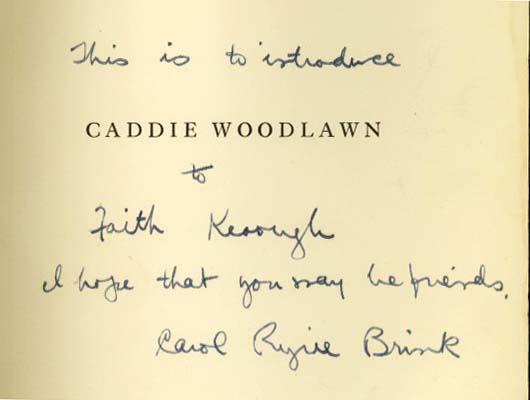
    <summary type="html"><![CDATA[<p><strong><em><span style="font-weight:400;">As an only child in rural Idaho Carol found amusement in her grandmother’s stories of an adventurous childhood in a homestead bustling with children and mischief. Later in life Carol would immortalize her grandmother through the titular character in the beloved children’s novel </span><i><span style="font-weight:400;">Caddie Woodlawn. </span></i></em></strong></p><img src="https://www.intermountainhistories.org/files/fullsize/0410429e7156474d165a3e74fc36171e.jpg" alt="Cover page of Caddie Woodlawn signed by author Carol Ryrie Brink" /><br/><p><span style="font-weight:400;">In 1895 Carol Ryrie Brink was born “Caroline Sybil Ryrie” in Moscow, Idaho. Her father died when she only five-years-old and her mother, stricken with grief and depression, died by suicide four years later. Orphaned, Brink went to live with her widowed grandmother “Gram” and an unmarried aunt who raised her for the remainder of her childhood.</span>
<span style="font-weight:400;"></span><span style="font-weight:400;">In her youth Brink’s favorite activity was listening to Gram's tales of mischief and adventure growing up with six siblings on the Wisconsin frontier. Such a large family was a novelty to Brink, who had no siblings and had only the company of her guardians. She described Gram as “a naturally gifted storyteller” who did not feel “at home with pen and paper.” Of </span><i><span style="font-weight:400;">Caddie Woodlawn</span></i><span style="font-weight:400;">, Brink remarked, “The adventures of Caddie would probably have remained unwritten if I had not been a lonely little girl who adored stories.” </span>
<span style="font-weight:400;">While Brink eventually outgrew her loneliness, she never abandoned her passion for storytelling. In high school and throughout college she dedicated her talent to the school papers. She graduated from University of California, Berkeley in 1917 and was married the following summer Raymond W. Brink, an old friend she had met in Moscow nearly a decade prior. The Brinks had two children, David Ryrie and Nora Caroline, were raised on their mother’s stories and often spent their summers in the Wisconsin woods or the Scottish countryside. </span>
<span style="font-weight:400;"></span><span style="font-weight:400;">Brink wrote several manuscripts before she began the semi-biographical tale of </span><i><span style="font-weight:400;">Caddie Woodlawn</span></i><span style="font-weight:400;">. She dabbled in playwriting for a time, though she was primarily interested in writing novels, often for children. The collection of stories and characters who would eventually come to life in </span><i><span style="font-weight:400;">Caddie Woodlawn </span></i><span style="font-weight:400;">had been in the back of her mind since her childhood declaration, “When I grow up, I am going to write books.”</span><i></i><span style="font-weight:400;">The project took several years, as Brink wanted to make sure she got all of the historical and cultural details right and truly did it justice. </span>
<span style="font-weight:400;">The woman who inspired Caddie was eighty-two-years-old when the book was published in 1935. She was thrilled to read the story and astounded by her granddaughter’s memory, stating “there are things I told her when she was eight years old which are perfectly remembered!” </span>
<i><span style="font-weight:400;">Caddie Woodlawn </span></i><span style="font-weight:400;">received a Newbery Medal in 1936, beloved by both critics and children alike. Young girls living through the Great Depression found escape in the exciting tale of Caddie, just as Brink had during her gloomy childhood. </span></p><p><em><strong><a href="https://www.intermountainhistories.org/items/show/927">For more (including 3 images) view the original article</a></strong></em></p>]]></summary>
    <published>2025-12-09T17:24:31+00:00</published>
    <updated>2026-04-17T19:32:21+00:00</updated>
    <link rel="alternate" type="text/html" href="https://www.intermountainhistories.org/items/show/927"/>
    <id>https://www.intermountainhistories.org/items/show/927</id>
    <author>
      <name>Megan Bailey, Brigham Young University</name>
    </author>
  </entry>
  <entry>
    <title type="html"><![CDATA[Camp Cloud Rim]]></title>
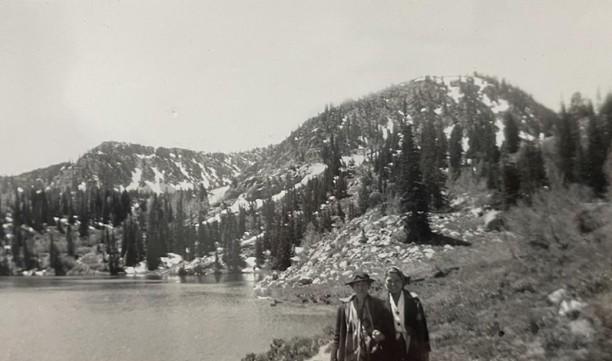
    <summary type="html"><![CDATA[<p><strong><em>Nestled in the mountains of northeast Utah, Camp Cloud Rim has been a place of refuge, belonging, and adventure to Girl Scouts for nearly a hundred years. Rising like a phoenix from its ashes at the turn of the century, the camp stands as a testament to the strength and kindness of its community. </em></strong></p><img src="https://www.intermountainhistories.org/files/fullsize/86286387e18e803da26bda97432f9ba9.jpg" alt="Two girl scouts posing in front of Lake Brimhall and the Wasatch Mountain Range." /><br/><p><span style="font-weight:400;">Camp Cloud Rim, originally called “Camp Pinar,” was constructed in 1934 with funding and labor provided by Franklin Roosevelt’s New Deal program. In 1937 the camp was officially dedicated to the Girl Scouts of America and renamed Camp Cloud Rim. While the camp is still up and running nearly a century later, its survival has been no easy feat. Following several catastrophic events the camp continues to be revived by the driven community which surrounds it. </span>
<span style="font-weight:400;"></span><span style="font-weight:400;">Located in the Wasatch Mountain Range, just outside of Park City, much of the community surrounding Camp Cloud Rim in the early days came from local mining camps. Barbara Schmidt, a lifelong scout, remembers attending the camp in the late 1940s. She has fond memories of her summers at camp which were spent swimming in Lake Brimhall, making pull taffy, developing wilderness survival skills, and forming some of the most meaningful friendships she’s ever had. One of Barbara’s first and dearest friends at the camp was a local girl whose father had died in the mines. As she returned each year she made more friends from around the state, many of whom were from mining communities, and some of which she kept in touch with by exchanging letters over the winter and even after they had aged out of camp. </span>
<span style="font-weight:400;">The trips up to camp each summer were infamous for their chaos. The road up the mountain was winding and bumpy, a journey not made any more pleasant by the old bus that carried them. Barbara recalls frequent transmission issues that sometimes stranded them on the mountain for long periods of time. </span>
<span style="font-weight:400;"></span><span style="font-weight:400;">While camp transportation has improved over the years, many aspects of camp culture from the early years live on today. Choosing a new name to go by at camp has been a common practice across the United States for decades, a tradition upheld by both the leaders and campers of all ages at Camp Cloud Rim. For many girls, camp is an opportunity to be braver, bolder, and more adventurous than they usually would be. With their new aliases, often chosen from favorite cartoon characters or fairytale heroines, they have the freedom to reinvent themselves. Like Barbara and her friends in the 1940s and 50s, girl scouts today enjoy recreational lake activities, learning survival skills, and experiencing their first taste of independence. </span>
<span style="font-weight:400;"></span><span style="font-weight:400;">In late November 1992 a fire spread throughout the camp destroying the main lodge and most of the other structures on property. The winter conditions made a trek up the mountain impossible, so the county sent helicopters to extinguish the fire. In just under six years the damaged property was brought back to life through the tireless efforts of community volunteers, fundraising efforts, and a generous benefactor––Janet Quinney Lawson, a philanthropist and lover of the outdoors. Camp Cloud Rim was reopened in 1999 and it continues to cultivate meaningful relationships and experiences for girls today, just as it did for Barbara and her friends back in the 40s. </span></p><p><em><strong><a href="https://www.intermountainhistories.org/items/show/926">For more (including 5 images) view the original article</a></strong></em></p>]]></summary>
    <published>2025-12-09T17:24:31+00:00</published>
    <updated>2026-04-17T19:32:21+00:00</updated>
    <link rel="alternate" type="text/html" href="https://www.intermountainhistories.org/items/show/926"/>
    <id>https://www.intermountainhistories.org/items/show/926</id>
    <author>
      <name>Megan Bailey, Brigham Young University</name>
    </author>
  </entry>
  <entry>
    <title type="html"><![CDATA[Title IX and Women’s Athletics at Utah State University]]></title>
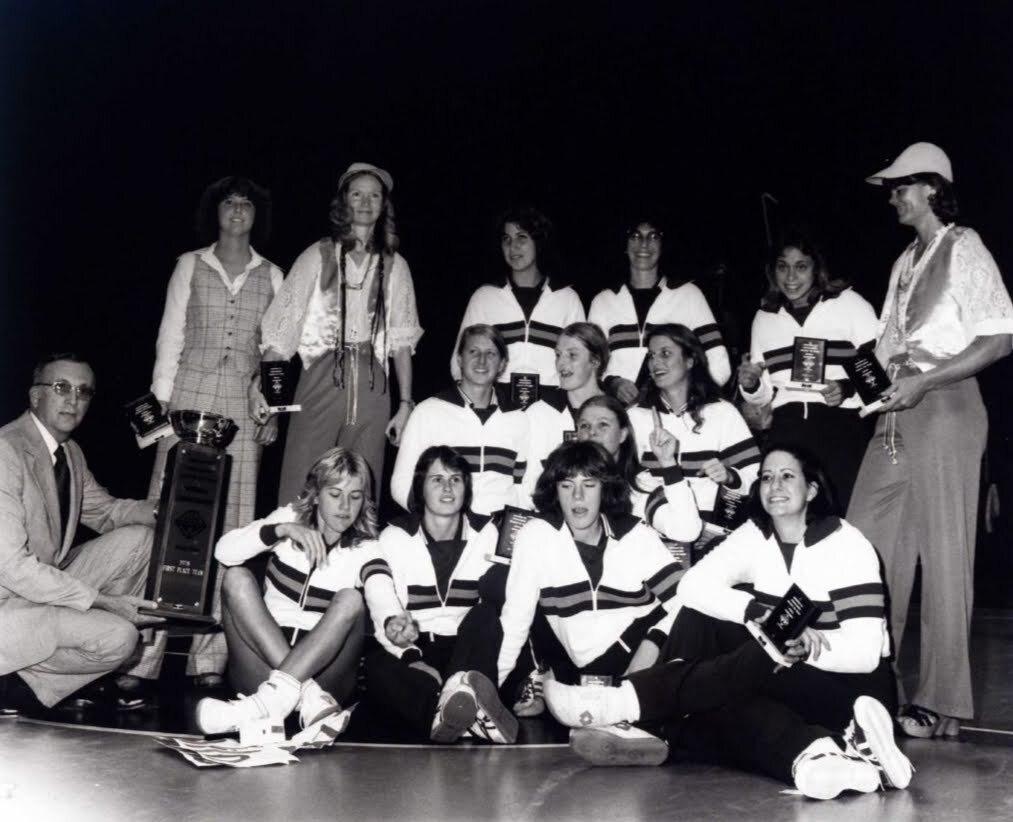
    <summary type="html"><![CDATA[<p><strong><em>Women’s athletics at Utah State University have come a long way since the passing of Title IX in 1972. Athletic Director Marilyn Weiss worked hard to gain more resources for female athletes. During her time at Utah State, three women’s athletic teams won national championship titles. She helped to lay the foundation for the long-term success of women’s athletics at USU.</em></strong></p><img src="https://www.intermountainhistories.org/files/fullsize/db7904d3f034ebce2d2e9c00c65de8d7.jpg" alt="1978 Women&#039;s Volleyball Team at Utah State University" /><br/><p><span style="font-weight:400;">Women have been involved in athletics since the early days of Utah State University. As early as 1901, USU boasted an organized softball team and hosted basketball tournaments. Due to a lack of funding, however, women’s athletics stayed local and small. This began to change after Title IX became law on June 23, 1972. The law prohibited sex-based discrimination in any institution that receives federal funding. Initially created to encourage more women to pursue higher education, today the law is mostly associated with college and high school athletics and promoting equality between men’s and women's sports. </span></p><p><span style="font-weight:400;">Title IX changed the college landscape, in the classroom and on the court. Schools were required to give women more support and resources. Before Title IX, women’s athletics didn’t offer athletic scholarships. As of 2021, there are 74,173 athletic scholarships available to women compared to 77,784 available to men.</span>
<span style="font-weight:400;">Marilyn Weiss was the USU Athletics Director for Women’s sports from 1975 to 1981. Under her leadership, Utah State formed its first volleyball team in 1976. Weiss served as the USU’s women’s basketball coach, volleyball coach, and track coach during her tenure with the university, and knew that not much had changed at USU after the passage of Title IX. She was determined to change that. In 1976, Weiss hired Mary Jo Peppler and Marilyn McReavy, both former Olympians, as co-head coaches of the volleyball team. They recruited strongly from across the country to bring great talent to USU. </span>
<span style="font-weight:400;">Weiss knew that the women’s programs would have to operate under a very tight budget, but she was determined to succeed. If the Aggies wanted to compete against the top teams in the country, they had to get to the West Coast. In the off-season, the team traveled in a fifth-wheel trailer to southern California to challenge powerhouse teams like USC and UCLA. Although the budget was small, the coaches and athletic director made it work and their efforts paid off. The USU Volleyball team became National Champions in 1978, winning the Association for Intercollegiate Athletics for Women (AIAW) volleyball championship. They were runner-up the following season. During Weiss’s time at USU, the softball team also won two national titles in 1980 and 1981. </span>
<span style="font-weight:400;">Weiss filed a Title IX complaint against the university a few years before she left. Although USU saw success while she was here, she knew womens’ athletics were still being underfunded. Marilyn Weiss and the coaches and players laid a foundation to move women’s athletics forward at Utah State University. As of 2024, USU has 8 women's varsity teams and over 180 women rostered. USU offered $3,106,721.54 in scholarships to female athletes in 2024, among 149 athletes.</span></p><p><em><strong><a href="https://www.intermountainhistories.org/items/show/873">For more (including 5 images) view the original article</a></strong></em></p>]]></summary>
    <published>2024-11-02T17:31:25+00:00</published>
    <updated>2026-04-17T19:32:19+00:00</updated>
    <link rel="alternate" type="text/html" href="https://www.intermountainhistories.org/items/show/873"/>
    <id>https://www.intermountainhistories.org/items/show/873</id>
    <author>
      <name>Hadli Lords, Utah State University</name>
    </author>
  </entry>
  <entry>
    <title type="html"><![CDATA[Hazel Hunkins-Hallinan: Silent Sentinel Suffragist ]]></title>
    <summary type="html"><![CDATA[<p><strong><em>Billings native Hazel Hunkins-Hallinan, alongside other members of the National Women’s Party, peacefully picketed the White House fence from 1917-1919 to advocate for a federal amendment for women’s right to vote. Known as the “Silent Sentinels,” they proved to be a continual reminder to President Woodrow Wilson of the issue of suffrage.</em></strong></p><img src="https://www.intermountainhistories.org/files/fullsize/bffa4510a4cca3ac68232b815d975d58.jpg" alt="[Untitled]" /><br/><p><span style="font-weight:400;">Hazel Hunkins grew up in Billings, Montana, and as a young girl, she was seen as “different” because she wanted to do what boys could do from climbing trees to becoming a doctor. After graduating valedictorian from Billings High School, Hunkins obtained her chemistry degree from Vassar College. However, when she applied to chemistry labs across the country they all replied that although she was qualified, they “don’t hire women.” </span>
<span style="font-weight:400;">This response sparked a fire in her, and when she met Anne Louise Rowe of the National Women’s Party (NWP), Hunkins realized that she “was one of millions who had been shoved aside because of my sex” and she had to do something about the exclusion of women. Within six months of joining the NWP, she became the Montana State Chairman. When the NWP began their constant picketing of the White House in 1917, Hunkins participated in the demonstrations. The pickets were peaceful—holding purple, gold, and white suffrage banners and signs like “Mr. President, how long must women wait for liberty?” </span>
<span style="font-weight:400;">Hunkins led a protest at Lafayette Square, carrying the American flag and leading the way to the Park. Once at the statue, she made the simple statement: “Here, at the statue of Lafayette, who fought for the liberty of this country, and under the American flag, I am asking for the enfranchisement of American Women.” She was immediately arrested. Other women followed Hunkins’ lead, each suffragist making her own statement until 47 women were arrested.</span>
<span style="font-weight:400;">Lafayette Square confirmed the NWP efforts were unpopular; however, once World War started, they were scrutinized even more, as people thought the women needed to support the war effort rather than picket a wartime president. The NWP, instead of wavering in their resolve, started new demonstrations like the watchfires of freedom—where President Wilson’s speeches about democracy in Europe were read aloud and burned because American women did not have democracy at home.</span>
<span style="font-weight:400;">The arrests of NWP women continued, often being charged with newly fabricated crimes like “obstruction of a public sidewalk.” Rather than paying fines, they chose jail because as Hunkins stated, “Women cannot be law-breakers until they are law-makers.” The prison conditions were awful—cold, damp areas, without proper clothing, blankets, and food—so the suffragists would often go on hunger strikes to protest these conditions, and in some cases, they would be force-fed. After one such hunger strike, Hunkins left the prison hardly able to walk. </span>
<span style="font-weight:400;">Despite all of the challenges they faced fighting public opinion and police officers’ efforts to stop their protests, in 1920 the 19th Amendment was finally ratified, giving American women the right to vote. After this triumph, Hazel Hunkins continued to push for women’s rights. When she moved to London with her husband, Charles Thomas Hallinan, she joined the British feminist Six Point Group. At age 87, Hunkins-Hallinan returned to America to participate in the March for Equal Rights. There she stated what she fought her whole life for, “Equal Rights is so clear cut; it’s fundamental—a basic change… For half a cent I would stay here and campaign.” </span></p><p><em><strong><a href="https://www.intermountainhistories.org/items/show/866">For more (including 4 images) view the original article</a></strong></em></p>]]></summary>
    <published>2024-10-21T17:33:32+00:00</published>
    <updated>2026-04-17T19:32:19+00:00</updated>
    <link rel="alternate" type="text/html" href="https://www.intermountainhistories.org/items/show/866"/>
    <id>https://www.intermountainhistories.org/items/show/866</id>
    <author>
      <name>Rosalyn Visser, Rocky Mountain College</name>
    </author>
  </entry>
  <entry>
    <title type="html"><![CDATA[Molly Brown: The &quot;Unsinkable” Suffragist and Workers’ Rights Activist]]></title>
    <summary type="html"><![CDATA[<p><strong><em>Famously called the “Unsinkable Molly Brown” for surviving the Titanic, the suffragist had a remarkable life before and after the tragedy.</em></strong></p><img src="https://www.intermountainhistories.org/files/fullsize/8513fb5a82d7726a5750959d63e83e46.jpg" alt="Portrait of Margaret “Molly” Brown" /><br/><p><span style="font-weight:400;">Margret Tobin Brown was born in Hannibal, Missouri in 1867 to Irish immigrants. Life in Hannibal greatly influenced her outlook, as she was surrounded by diversity and saw the struggles of the working class. Her parents valued education, so Margaret was able to attend school until she was 13 when she had to drop out to work in a factory. Like her father and countless others, she experienced low wages, instability, and dangers at work. </span>
<span style="font-weight:400;">Margaret dreamed of going West, and at age 18, she followed one of her older brothers, Daniel, who had moved to Leadville, Colorado, to strike rich in the mines. Women were not allowed to work in the mines, so they had to find jobs in the mining towns, as cooks, nurses, saloon girls, or store workers. Margret worked in a store, and while she did not have much, she participated in causes she believed in, like volunteering in soup kitchens.</span>
<span style="font-weight:400;">It was in Leadville that she met her husband James Joseph Brown, a mining engineer. They got married in 1886 and soon had two children. Surprisingly, in 1893, they became millionaires when the Little Jonny Mine that J.J. invested in struck gold. Now wealthy, they moved their family and built their home in Denver, Colorado which can be visited today. </span>
<span style="font-weight:400;">They became prominent figures in Denver, Margaret in the political realm and J.J. in the business sphere. Denver was rampant with various social issues—poverty, homelessness, and workers’ rights issues—and now Brown held a position where she could promote political action. She advocated for labor reform and became an involved member of the National American Women’s Suffrage Association (NAWSA). </span>
<span style="font-weight:400;">Margaret’s situation was unique because she separated from her husband in 1909 to live independently. In 1912, she embarked on the Titanic. When tragedy struck, she was pushed onto a lifeboat, even though she was still trying to help others. After the lifeboat was deployed, she protested, saying they needed to save more people, but the sailor refused. Although not allowed to testify in court because she was a woman, she became one of the most famous survivors. </span>
<span style="font-weight:400;">With her newfound fame after the Titanic, Brown used her position to raise awareness of the Ludlow Massacre of Colorado miners, who were striking for more rights. She understood the challenges workers and families faced, so she not only helped the affected families but also advocated for workers' rights and spoke about how women having the right to vote could help pass necessary reforms across the country. </span>
<span style="font-weight:400;">Brown did important work for Colorado and people began encouraging her to run for Congress in 1914. However, with growing tensions with World War, she decided not to run and shifted her focus to war relief programs. She became the self-sufficient woman of the 1920s, continuing to advocate for women’s and laborer’s rights until her death on October 26, 1932. </span></p><p><em><strong><a href="https://www.intermountainhistories.org/items/show/864">For more (including 4 images) view the original article</a></strong></em></p>]]></summary>
    <published>2024-10-18T23:42:20+00:00</published>
    <updated>2026-04-17T19:32:19+00:00</updated>
    <link rel="alternate" type="text/html" href="https://www.intermountainhistories.org/items/show/864"/>
    <id>https://www.intermountainhistories.org/items/show/864</id>
    <author>
      <name>Rosalyn Visser, Rocky Mountain College</name>
    </author>
  </entry>
  <entry>
    <title type="html"><![CDATA[Bessie Morehead: The Fight for a Spot ]]></title>
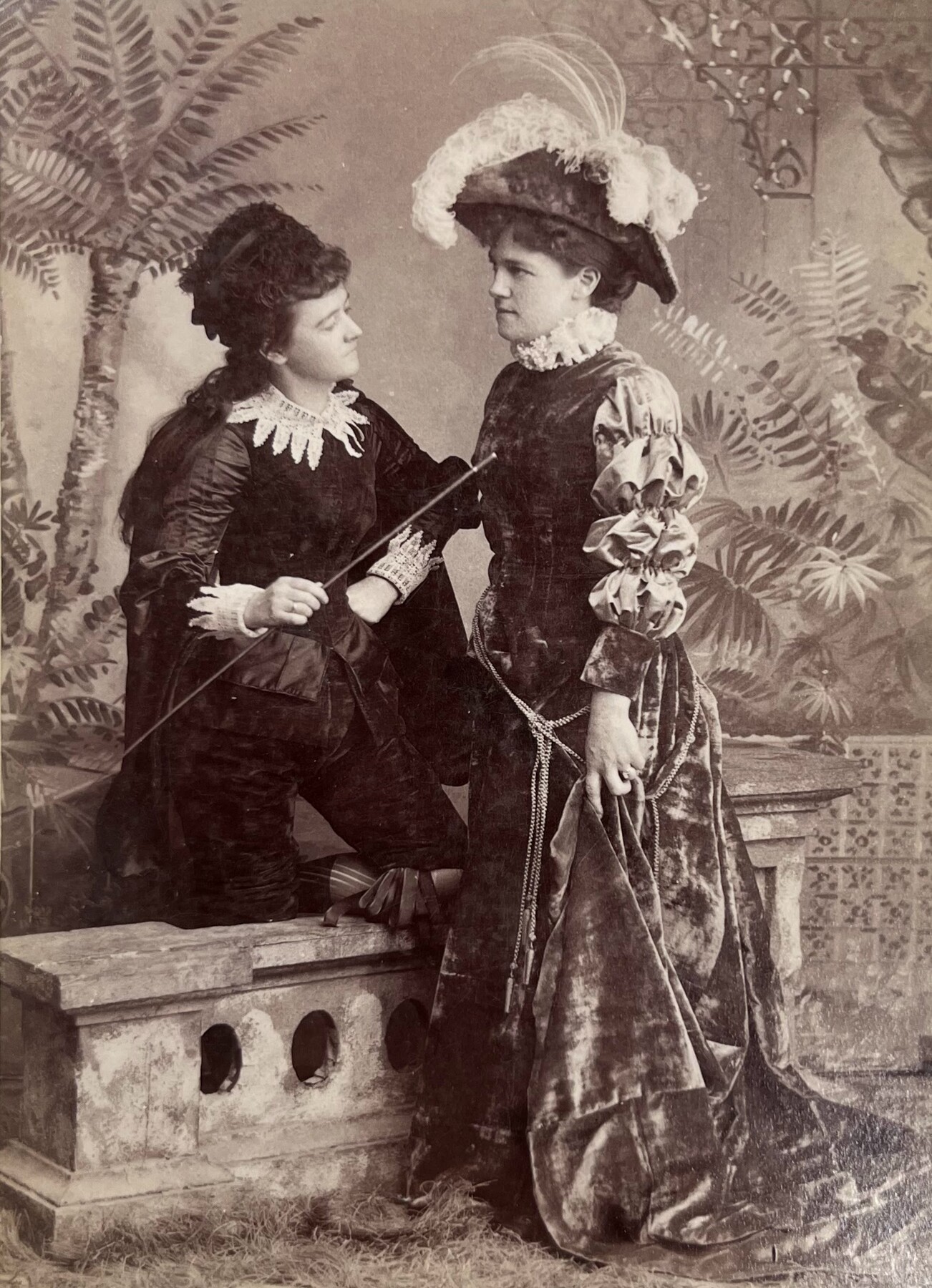
    <summary type="html"><![CDATA[<p><strong><em>Bessie Morehead, a well-known singer in Cache Valley, defeated her opponent Charles Hyde to become the first female County Recorder in Cache County, Utah.</em></strong></p><img src="https://www.intermountainhistories.org/files/fullsize/a689c8c32b896bc5645f616e6b0df0a9.jpg" alt="Actresses Bessie Morehead and Maggie Sloan in theatrical costume for &quot;The Three Mantles&quot;" /><br/><p>In 1896 Utah became a state and women were allowed to run for public office. In that year 14 women won public office in Utah: one to the U.S. Senate, two to the state House of Representatives, and eleven to county offices, including Bessie Morehead. Morehead was born in Smithfield, Utah in 1867 and became a well known Logan citizen. She was a talented singer and performed in the Logan Opera Company. She was seen as one of Utah’s “best and favorite vocalists.” </p><p>She decided to run for the Cache County Recorder in 1896. This was a highly respected and honorable position to hold. Democrats nominated Morehead instead of the incumbent Charles Hyde. Many Democrats at the time were excited for women to participate in public office and wanted to give Morehead a chance. Hyde decided to switch to the Republican party to run against her. When Hyde came to the Democratic Convention, Morehead kicked him out. He then came at her with a knife but luckily nothing happened. </p><p>The fight didn’t stop there. Her LDS stake president casted doubt on Morehead as a candidate. He implied that Charles Hyde was a more religious member than she was. One editor for the Logan Journal defended her and said she was just as faithful. Amongst all this opposition. Morehead still won the election. She received 3,174 votes and Hyde received 1,840. After the election Hyde said the “Democratic party of Cache County is corrupt”. Only to receive backlash from the newspaper asking why he sought the Democratic nomination for recorder in the first place if it was corrupt. </p><p>Bessie Morehead served two terms from 1897-98 and 1899-1900. Morehead and 13 other Women in Utah made history. Bessie Morehead became the first woman in Cache County to hold public office. </p><p><em><strong><a href="https://www.intermountainhistories.org/items/show/861">For more (including 4 images) view the original article</a></strong></em></p>]]></summary>
    <published>2024-10-18T05:49:35+00:00</published>
    <updated>2026-04-17T19:32:19+00:00</updated>
    <link rel="alternate" type="text/html" href="https://www.intermountainhistories.org/items/show/861"/>
    <id>https://www.intermountainhistories.org/items/show/861</id>
    <author>
      <name> Samantha H. Crockett, Utah State University</name>
    </author>
  </entry>
  <entry>
    <title type="html"><![CDATA[Founding of Cache Valley Woman Suffrage Association]]></title>
    <summary type="html"><![CDATA[<img src="https://www.intermountainhistories.org/files/fullsize/c97e35b6b620861cc49ef8a031fb1953.jpg" alt="The Logan Tabernacle" /><br/><p>The Cache Valley Woman Suffrage Association (CVWSA) was established in the Logan Tabernacle on December 10, 1889. The CVWSA was a local division of the Utah Woman Suffrage Association and the National Woman Suffrage Association. Many other counties in Utah were also forming Woman Suffrage Associations at this time. The CVWSA was established to regain the voting rights Utah women had been stripped of in 1887. Utah women felt strongly about their right to vote, as can be seen in the Logan Journal article about the CVWSA founding meeting. The writer of the article even went so far as to call those that succeeded in stripping women’s right to vote in 1887 “Utah Carpet Bag Liberals.” Carpet Baggers was a term most commonly used in the Reconstruction South to describe someone perceived as politically disruptive or taking advantage of a situation for political or financial gain. In this context, “Utah Carpet Bag Liberals” is clearly an insult toward those who helped remove women’s suffrage. The women of Cache Valley, just like many women in Utah, were determined to regain the right to vote.</p><p>On December 10, 1889, at 10 am, the founding meeting was held for the CVWSA. Many prominent women in the community and in politics were there. Adeline Barber and Jane Hyde Molen, two local Relief Society Presidents, the women's organization in the Church of Jesus Christ of Latter-Day Saints, were officers of the association. Jane Hyde Molen, a prominent leader of the Democratic Party of Cache County and a member of the Cache County School Board, was named secretary. Women such as Adeline Barber and Jane Hyde Molen who had both political and religious leadership could easily spread information about the association. All officers elected to the CVWSA were women, though men were also in attendance in the meeting. Seventy-eight women joined the association that founding day. Over the years, the Logan Tabernacle was used to house many CVWSA meetings.</p><p>The 1895 Constitutional Convention of Utah was very concerned with the issue of women’s suffrage. Delegates from Cache County presented eight petitions on April 18th, signed by men and women, in favor of equal suffrage in the Utah Constitution. As a result of the hard work of men and women in Cache County and throughout the state, women’s right to vote was reinstated. A banquet was held in the Logan Tabernacle in January 1896 to celebrate the reinstatement of Utah women’s right to vote.</p><p><em><strong><a href="https://www.intermountainhistories.org/items/show/860">For more (including 3 images) view the original article</a></strong></em></p>]]></summary>
    <published>2024-10-17T23:24:35+00:00</published>
    <updated>2026-04-17T19:32:19+00:00</updated>
    <link rel="alternate" type="text/html" href="https://www.intermountainhistories.org/items/show/860"/>
    <id>https://www.intermountainhistories.org/items/show/860</id>
    <author>
      <name>Madison Harris, Utah State University</name>
    </author>
  </entry>
  <entry>
    <title type="html"><![CDATA[The Deseret Hospital]]></title>
    <summary type="html"><![CDATA[<p><strong><em>When pioneer Utahns realized their lack of medical knowledge, Brigham Young sent women to the East to obtain medical degrees. Upon their return, many set up private practices, but they wanted to have an official hospital. This desire led to the construction of the Deseret Hospital in 1882 and its operation for 12 years until it closed in 1894. In 2003, a replica of the building was constructed at This is the Place Heritage Park in Salt Lake City. </p></strong></p><img src="https://www.intermountainhistories.org/files/fullsize/84306f5df0e3c988b3178f132247e081.jpg" alt="LDS Hospital - a Full-Service Community Hospital - Salt Lake City, Utah" /><br/><p><span style="font-weight:400;">During Utah’s territorial years, the pioneer settlers lacked medical knowledge which led to high maternal and infant mortality rates. This problem led Brigham Young to encourage a few women to go to the Eastern United States to obtain medical degrees. Some of the women who heeded the call were Martha H. Cannon, Romania P. Penrose, Ellis R. Shipp, Ellen B. Ferguson, and Elvira S. Barney. When they returned to Utah, several opened private practices but they all recognized the need for an official hospital. With the support of the scores of women who convinced church leaders of the need, the women gained their hospital in 1882. </span>
<span style="font-weight:400;">The Deseret Hospital was established by the Latter-day Saint Relief Society and was dedicated in July 1882 by LDS apostle Franklin D. Richards. It was located in a building previously used by the nuns of the Holy Cross Hospital. At the dedication, Ellen B. Ferguson was set apart as the resident physician and Romania P. Penrose as the resident surgeon and visiting physician. </span>
<span style="font-weight:400;">The hospital treated illnesses such as rheumatism, typhoid fever, and diphtheritic tonsillitis, among other diseases. It was also used as a maternity home and training facility for midwives. Women who wanted to learn midwifery but who could not pay for instruction could give fifty days of charity work instead. The hospital was supported by donations that supplied it with the materials necessary to operate. The Relief Society also organized the Deseret Hospital Association, which any woman in good standing could join by paying one dollar annually. Patients were charged $3-6 a week for board, room, and nursing, and the hospital’s maximum capacity was about 40-50 patients. </span>
<span style="font-weight:400;">In 1884 the hospital was moved to a different location, but a lack of funds forced its closure in 1894. The midwifery school continued to operate until 1905 when W. H. Groves purchased land to build a new LDS Hospital. This hospital continued to expand until it had fifteen branches under the direction of The Church of Jesus Christ of Latter-Day Saints. In 1975, the Church transferred the operation of the hospitals to Intermountain Health Care. </span>
<span style="font-weight:400;">A replica of the Deseret Hospital was constructed at This is the Place Heritage Park in 2003. The first floor of the building shows a replica of the hospital and the second floor contains a collection from the Utah Quilt Guild. Elder Russell M. Nelson dedicated the structure on October 25, 2003, to highlight the contributions of the women who traveled to the East to obtain an education and to commemorate the original Deseret Hospital.</span></p><p><em><strong><a href="https://www.intermountainhistories.org/items/show/791">For more (including 4 images) view the original article</a></strong></em></p>]]></summary>
    <published>2024-03-03T04:30:48+00:00</published>
    <updated>2026-04-17T19:32:17+00:00</updated>
    <link rel="alternate" type="text/html" href="https://www.intermountainhistories.org/items/show/791"/>
    <id>https://www.intermountainhistories.org/items/show/791</id>
    <author>
      <name>Madison Sterzer, Brigham Young University</name>
    </author>
  </entry>
  <entry>
    <title type="html"><![CDATA[Martha Hughes Cannon Memorial Statue]]></title>
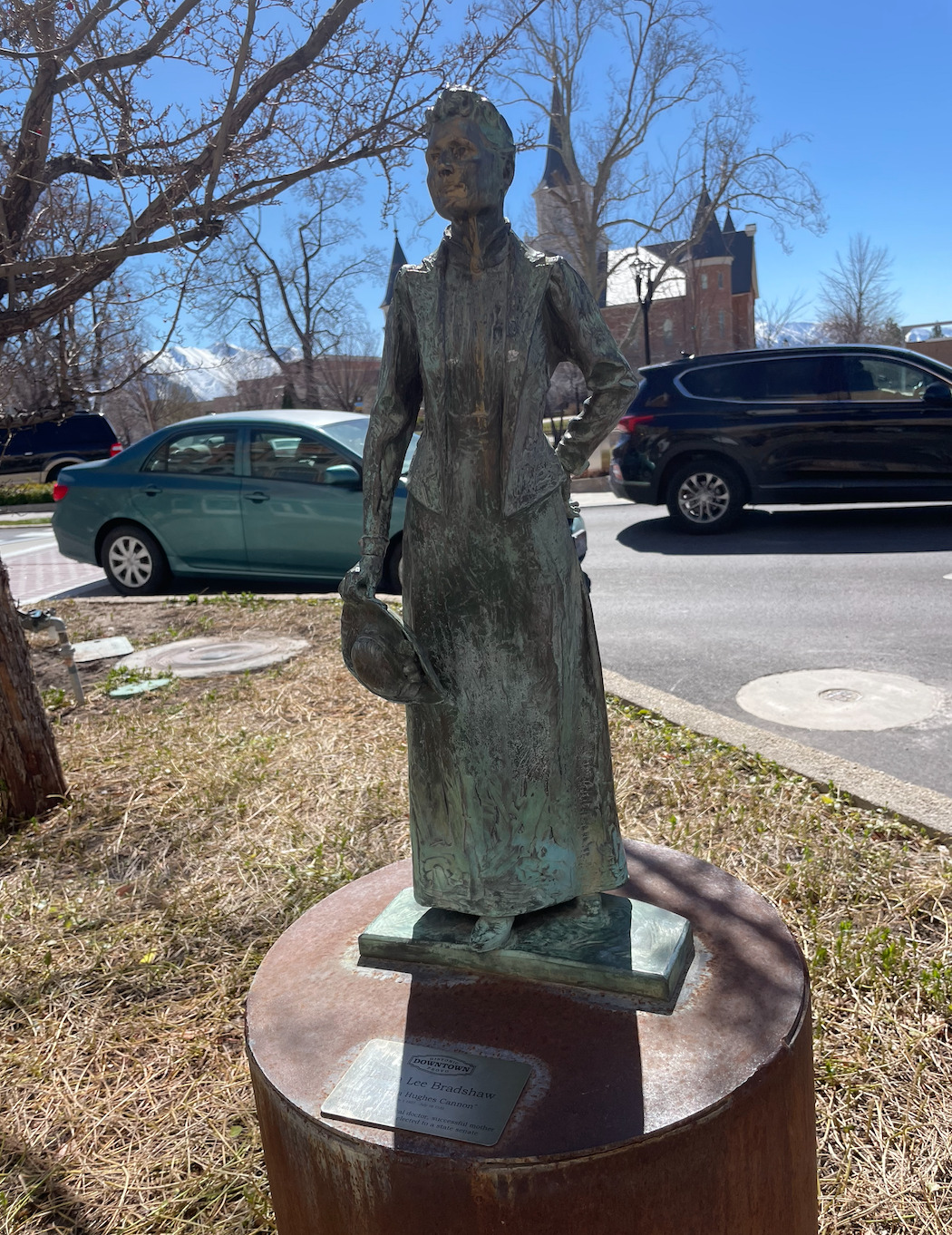
    <summary type="html"><![CDATA[<p><strong><em>Martha Hughes Cannon was an outstanding woman with great ambition and intelligence. As she gained an education and grew in the LDS religion, she capitalized on her position as an educated woman of faith to represent Utah women as they battled anti-polygamy legislation and public health issues.</em></strong></p><img src="https://www.intermountainhistories.org/files/fullsize/48b93f901ad49440cfe49a8350fd6fe1.jpg" alt="Martha Hughes Cannon Statue, Provo" /><br/><p>Martha Hughes Cannon was born in Wales on July 1st, 1857. During her infant years, Martha’s parents joined other new converts to the LDS faith on a long journey to Utah. Tragically, her father passed away only three days after arriving in Utah and surviving the arduous westward trek. By her teenage years, Martha had faced considerable hardship and poverty, but showed resilience and hope for the future. Martha’s young adult years were full of education. After graduating college with a degree in chemistry, Martha was accepted into the University of Michigan, one of few medical schools that admitted men and women. She also studied at the National School of Oratory, becoming a skilled public speaker. Her medical skills and oratorical skills would be great assets during her involvement in Utah politics. </p><p>Martha’s personal and professional life gave her a unique position in the eyes of the United States government. As the fourth wife to Angus M. Cannon, Martha faced considerable scrutiny from territorial officials. As a doctor, she delivered many children born to polygamist mothers and was seen as an important witness to prosecute polygamy. She lived out of state for many years to avoid testifying against and incriminating her husband, along with other polygamist families. The official outlawing of polygamy in 1890 allowed Martha to return to Utah and begin her career in politics.</p><p>A request from the Democratic party prompted Martha to run in the state senate election. Although her husband was running for the Republican party, this did not stop Martha from fulfilling what she viewed as an incredible civic opportunity. After winning the Democratic seat, Martha spent four years effectively advocating for public health and education causes in Utah. She authored bills to start the Utah Health Department, and schools for children with disabilities. Unfortunately, Martha’s political career came to an end with her third pregnancy. The nation viewed this as proof that Mormons were still practicing polygamy, and she was now an unacceptable representative. Although her time was cut short, Martha provided many valuable insights to Utah’s state legislature and was a voice for women across the state of Utah.</p><p><em><strong><a href="https://www.intermountainhistories.org/items/show/783">For more (including 3 images) view the original article</a></strong></em></p>]]></summary>
    <published>2024-02-26T19:39:54+00:00</published>
    <updated>2026-04-17T19:32:17+00:00</updated>
    <link rel="alternate" type="text/html" href="https://www.intermountainhistories.org/items/show/783"/>
    <id>https://www.intermountainhistories.org/items/show/783</id>
    <author>
      <name>Olivia Stockman, Brigham Young University</name>
    </author>
  </entry>
  <entry>
    <title type="html"><![CDATA[ Women in Los Alamos during the Manhattan Project <br />
]]></title>
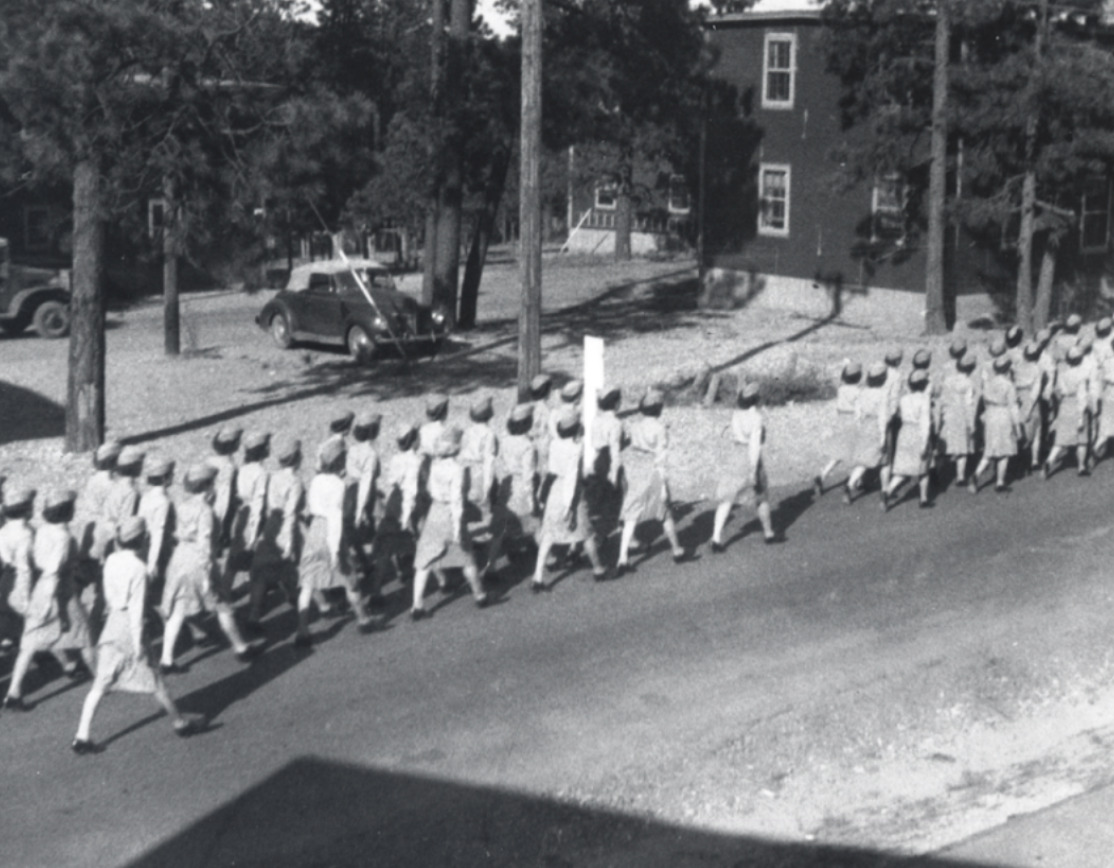
    <summary type="html"><![CDATA[<p><strong><em>With the war effort withdrawing men from the domestic labor force, women became an increasingly important part of the Manhattan Project in Los Alamos. </p></strong></p><img src="https://www.intermountainhistories.org/files/fullsize/c8f195c81db8f6804378056bc75c3f0b.jpg" alt="WAC March in Los Alamos" /><br/><p><span style="font-weight:400;">Wartime labor shortages were a constant struggle for the United States during World War II. They needed to send troops overseas, develop weaponry, spy on their enemies, strategically plan, and mobilize the entire nation as quickly as possible. By 1943, the United States Army was 200,000 men short for their invasion on D-Day, they were in need of 315 more physicists for their defense projects, and the Manhattan Project was desperately in search of all kinds of labor from scientists and engineers to machinists and pipefitters. In response, President Franklin D. Roosevelt signed into existence the Women’s Army Auxiliary Corps established “for the purpose of making available to the national defense the knowledge, skill, and special training of women of the nation” on May 15, 1942. Still facing discrimination, unequal pay, and fewer opportunities than their male counterparts, women played an essential role in World War II, especially in Los Alamos. </p>
<span style="font-weight:400;">Because Los Alamos was such a restricted town and the directors wanted to limit the number of outsiders, General Leslie Groves encouraged wives of scientists to work on the project in whatever capacity they could. As an incentive, they provided nursery schools for their young children to aid with childcare. Despite the government’s encouragement, some women were still hesitant to work on the project over concerns for their family’s well-being. Many had not expected to work at all, and quite a few were dissatisfied with the living conditions in which they now were expected to raise their children. Charlotte Serber, the only female group leader at the laboratory, wrote, “For the potential working wife, there was one chief worry. Could she manage her home here on the mesa and work too?” These were fair concerns. The conditions under which they were expected to work were difficult. They were isolated from extended family, were allowed only one day off of work per month for shopping in Santa Fe, were expected to work forty-eight hours in a week, and had almost no bargaining power to shift their rules or salary. They were also far less likely to gain security clearance than their male counterparts, so it was unlikely that they knew what they were helping create. </p>
<span style="font-weight:400;">Despite these stringent circumstances, many women in Los Alamos did work on the secretive atomic gadget. By October 1944, women constituted about 30% of the labor force in the Tech Area, hospital, and schools. It is also notable that although they did employ some women in clerical positions, the vast majority were scientists or technicians. They were metallurgists, engineers, physicists, chemists, and teachers, involved in every aspect of the atomic effort until the very end. The exception for this participation was in Project Alberta. This was the very last phase of the project; the physical delivery of the bomb to the Pacific island Tinian where the nuclear components were assembled before being dropped on Japan. Women who had spent years contributing to this moment were left behind in the United States to learn about the bombingsfrom the same newspapers as everyone else. However, the atomic bomb could not have been built as quickly or efficiently as it was without the contribution of women. They faced gender discrimination, suboptimal conditions, and unfair pay to contribute to the atomic effort in Los Alamos. </span>

</p><p><em><strong><a href="https://www.intermountainhistories.org/items/show/756">For more (including 3 images) view the original article</a></strong></em></p>]]></summary>
    <published>2023-09-24T18:36:48+00:00</published>
    <updated>2026-04-17T19:32:16+00:00</updated>
    <link rel="alternate" type="text/html" href="https://www.intermountainhistories.org/items/show/756"/>
    <id>https://www.intermountainhistories.org/items/show/756</id>
    <author>
      <name>Abigail Beus, Brigham Young University</name>
    </author>
  </entry>
  <entry>
    <title type="html"><![CDATA[Dorothy McKibbins: The Gatekeeper of Los Alamos ]]></title>
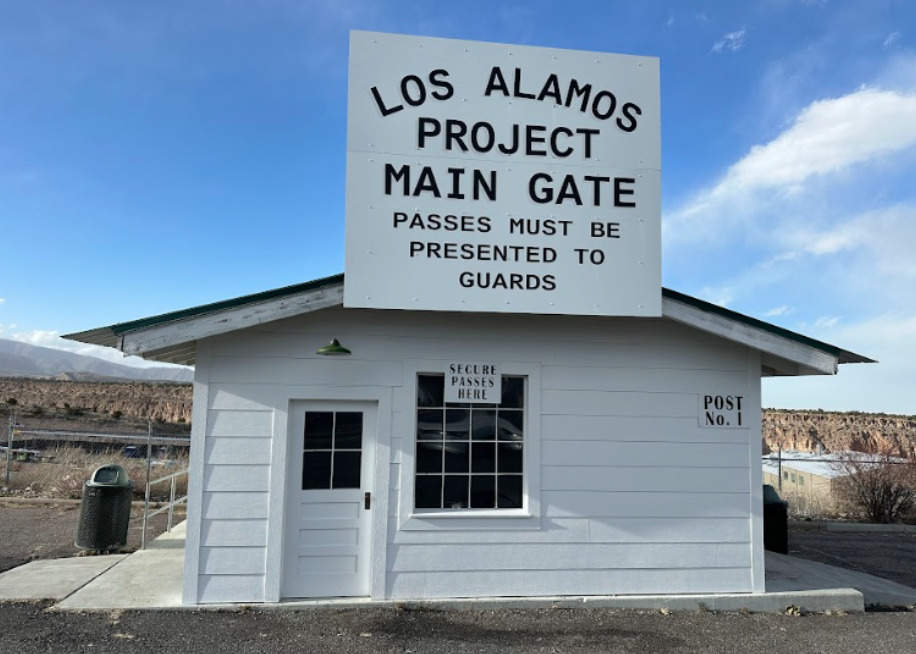
    <summary type="html"><![CDATA[<p><strong><em>The Manhattan Project would not have been possible without the efforts of Dorothy McKibbin, the Gatekeeper of Los Alamos. From attaining marriage licenses to transferring phone calls, Dorothy McKibbin was an integral and diversely skilled cog in the large machine of building the first nuclear weapons. </p></strong></p><img src="https://www.intermountainhistories.org/files/fullsize/5c401996b7cfdc416ba17d96a788fbec.jpg" alt="Los Alamos Project Main Gate Replica" /><br/><p><span style="font-weight:400;">Once General Leslie Groves and Dr. J. Robert Oppenheimer chose Los Alamos, New Mexico as the place to build the atomic bomb; hundreds of bewildered employees streamed into the nearby town of Santa Fe. Due to the confidentiality of the Manhattan Project, recruitment was difficult and details provided to the new hires were vague because of the classified nature of their work. They were told that their work would helpe war effort and be located in the scenic mesas of New Mexico, but little else. After a long train ride to the nearby town of Lamy, scientists and their families hauled their luggage through the winding streets of Santa Fe, looking for 109 East Palace Avenue—the only address they had been given. There, they were met by a simple red and blue sign reading “United States Engineer Office No. 3” and the welcoming presence of Dorothy McKibbin. </p>
<span style="font-weight:400;">In 1932, recently-widowed Dorothy McKibbin moved to Santa Fe from Kansas with her son, hoping for a new life. When she met Dr. J. Robert Oppenheimer in 1943, she found one. Oppenheimer recognized her comforting, calming, and competent presence and asked her to be a War Department secretary with unspecified duties. Like the other personnel, she only knew that her job concerned an essential war project. As she discovered after accepting the position, duties encompassed everything from disciplining Nobel laureates, receiving classified mail, enforcing security, helping lost families find the way to their new homes, and more. She was there for some of the most important moments of the project, even observing the Trinity Test from a car parked near Albuquerque. To Dorothy McKibbin, “Working at 109 was more than just a job. It was an exciting experience. Our office served as the entrance to one of the most significant undertakings of the war or, indeed, of the twentieth century.” </p>
<span style="font-weight:400;">For the entirety of the Manhattan Project she was the point of contact between the secret city and the rest of the world, earning herself the nickname of  the “Gatekeeper of Los Alamos.” After the Manhattan Project concluded, the site was renamed the Los Alamos National Laboratory, and McKibbin continued to work there until her retirement in 1963. She spent her retirement organizing community programs in Los Alamos and Santa Fe until her death in 1985. Today, a room in the Los Alamos History Museum is named in her honor, and although her office at 109 East Palace currently houses a gift shop, its original iron gate which once welcomed thousands to the secret city is on display at the Los Alamos History Museum. </span>
</p><p><em><strong><a href="https://www.intermountainhistories.org/items/show/752">For more (including 4 images) view the original article</a></strong></em></p>]]></summary>
    <published>2023-09-08T01:24:19+00:00</published>
    <updated>2026-04-17T19:32:16+00:00</updated>
    <link rel="alternate" type="text/html" href="https://www.intermountainhistories.org/items/show/752"/>
    <id>https://www.intermountainhistories.org/items/show/752</id>
    <author>
      <name>Abigail Beus, Brigham Young University</name>
    </author>
  </entry>
  <entry>
    <title type="html"><![CDATA[Iona House]]></title>
    <summary type="html"><![CDATA[<p><strong><em>Named after the philanthropic Knights’ youngest daughter, Iona House had a colorful half-century life as a dormitory, missionary training home, therapy clinic, and Spanish laboratory.</em></strong></p><img src="https://www.intermountainhistories.org/files/fullsize/0ed394d7efbad5e4dd4dc97203bc7632.jpg" alt="Addie Iona Knight Jordan" /><br/><p><span style="font-weight:400;">Born December 18, 1891 in Provo, Addie Iona Knight was the youngest daughter of Latter-day Saint philanthropists </span><a href="https://www.intermountainhistories.org/items/show/569"><span style="font-weight:400;">Amanda McEwan Knight</span></a><span style="font-weight:400;"> and </span><a href="https://www.intermountainhistories.org/items/show/140"><span style="font-weight:400;">Jesse Knight</span></a><span style="font-weight:400;">. Her older brother, J. William, recalled that Iona had “a keen intellect, a generous heart, and an unusually intelligent sense of humor.” Always eager to learn, Iona enjoyed discovering the world beyond Utah, and in 1907 she traveled throughout Europe (with a BYU professor chaperone).</span>
<span style="font-weight:400;">Iona was well-educated; she studied first at Brigham Young University, then West Lake School for Girls in Los Angeles, and finally Stanford University in Palo Alto. While at Stanford, Iona befriended Professor David Starr Jordan—a renowned ichthyologist whose controversial legacy includes both democratizing education and propounding racist eugenics—and his wife Jessie Knight.</span>
<span style="font-weight:400;">Iona moved back and forth between Provo and California, and she had a brief stint teaching in BYU’s English Department. She remained close to David and Jessie throughout her life and even moved back to Palo Alto to live with them during David’s final, ailing years. Iona remained in California, and she also died there after a long illness on May 7, 1937. She was buried with the rest of the Knight family in Provo.</span>
<span style="font-weight:400;">The building’s story has its roots in 1942, when World War II defense workers flooded Provo, creating a housing shortage for students. To alleviate this, 1940s BYU bought houses and turned them into “co-op” student residences. </span><a href="https://www.intermountainhistories.org/items/show/619"><span style="font-weight:400;">Warnick House</span></a><span style="font-weight:400;"> was the first, bought in 1942, and BYU considered it such a success they purchased and renovated a second in 1943, which they named Iona House, after the late English teacher.</span>
<span style="font-weight:400;">Like Warnick, Iona was a “co-op.” Student residents shared bedrooms, restrooms, a kitchen, and communal spaces, and they bore responsibility for working together to manage the home. Cooperative living had its pluses; residents always had a group to hold activities with, whether potlucks or sled parties, and they knew how to work together. For example, in a 1945 Women’s Athletic Association softball tournament with several other dormitories plus PEMM (the Physical Education Majors club), Iona’s residents lost only one game and overall tied with PEMM. Three years later, the 1948 residents won the Homecoming parade’s best humor award for their float, which “portrayed college life in the dormitories and completed the task so well.”</span>
<span style="font-weight:400;">In 1959, the need for men’s housing increased such that Iona House switched from a women’s residence to a male graduate student residence. For the next three decades, Iona served numerous purposes. In the 1960s or 1970s, Church missionaries learning to speak Navajo lived in Iona, and from sometime in the 1970s until 1976, sister missionaries learning Italian lived there. From 1976 to at least 1979, BYU Marriage and Family Counseling held its clinic in Iona. Finally, in the 1980s, Iona was the “Spanish House” for students in the intensive Spanish language program.</span>
<span style="font-weight:400;">In the early 1990s, BYU decided Iona had run its course. It demolished the building and apparently sold the lot; today, townhouses fill the property.</span></p><p><em><strong><a href="https://www.intermountainhistories.org/items/show/634">For more (including 12 images) view the original article</a></strong></em></p>]]></summary>
    <published>2022-07-01T16:44:38+00:00</published>
    <updated>2026-04-17T19:32:14+00:00</updated>
    <link rel="alternate" type="text/html" href="https://www.intermountainhistories.org/items/show/634"/>
    <id>https://www.intermountainhistories.org/items/show/634</id>
    <author>
      <name>Makoto Hunter, Brigham Young University</name>
    </author>
  </entry>
  <entry>
    <title type="html"><![CDATA[Queen Aggie: Boise’s Black Madam]]></title>
    <summary type="html"><![CDATA[<p><strong><em>Levy’s Alley was Boise’s most notorious restricted district. After Davis Levy’s death, Agnes Bush became one of its most famous proprietors.</em></strong></p><img src="https://www.intermountainhistories.org/files/fullsize/0cad4d80950205d12f20127cfaf8287c.jpg" alt="Parlor" /><br/><p>Named for Davis Levy, the original owner of many of the cribs that lined the alley in the 1880s, Levy’s Alley ran behind the 600 block of Main Street in downtown Boise. While the alley was not the only restricted district in the city, it was the most notorious, and the majority of Boise’s most famous madams and sex workers lived and worked there. One such person was Agnes Bush, also known as “Queen Aggie,” a Black woman who operated multiple cribs and parlor houses in Boise.
Bush was one of Levy’s prior tenants, and after he died, she acquired some of the property for herself and expanded a pleasure business of her own. Bush soon ran multiple rooms in the district, by then nicknamed “Levy’s Alley” after Davis, which she rented out by individual women known as “crib girls.” She was known not only as a successful businesswoman but also as a prominent citizen, and the <em>Idaho Daily Statesman</em> frequently wrote about her charitable acts for the poor and children in need. Bush also made important donations to the city and formed long-standing financial and “friendly” ties with the press and local law enforcement. These relationships were supplemented by expensive gifts such as a diamond-encrusted badge she gave to Boise police chief B. F. Francis and a $250 diamond ring to local journalist C. Miles. These gifts and activities both ensured and announced Bush’s prominent role in Boise, for which she earned the nickname “Queen Aggie.”
Agnes Bush stands out because she was a Black woman. As a prominent figure in the Boise community with ties to law enforcement, as well as significant property holdings and wealth, she stands as a curious anomaly in the history of the Treasure Valley and the broader region. Though there was white supremacist activity in the area given Boise’s proximity to Oregon (which white residents established officially as a white-only state in its 1859 constitution), Bush was a major player in her community. Indeed, local government and law enforcement typically tolerated sex workers in Boise until 1909, when national sentiments turned against the traditional practice of relegating sex workers to restricted districts in favor of completely expelling such para-legal practices in the name of public health. That year, Congress passed the Mann Act, and local Boise officials began targeting their city’s sex workers for fear of federal intervention.
After being run out of the city, Bush moved to Portland, Oregon to live with one of her sons while she suffered from partial paralysis. In 1910, the <em>Statesman</em> reported her death in Portland and revealed her “real name,” Frances Richardson. Despite how her story ended, Bush’s success and her ties to the community suggest the rich tapestry of people that comprised the state of Idaho’s early years and reflect the fascinating and dynamic time in which she lived.</p><p><em><strong><a href="https://www.intermountainhistories.org/items/show/624">For more (including 3 images) view the original article</a></strong></em></p>]]></summary>
    <published>2022-06-25T23:56:23+00:00</published>
    <updated>2026-04-17T19:32:13+00:00</updated>
    <link rel="alternate" type="text/html" href="https://www.intermountainhistories.org/items/show/624"/>
    <id>https://www.intermountainhistories.org/items/show/624</id>
    <author>
      <name>Gabriel Herring, College of Idaho</name>
    </author>
  </entry>
  <entry>
    <title type="html"><![CDATA[Lucy Mack Smith Hall (HR14): Israel A. Smith (Almost) Goes to Provo]]></title>
    <summary type="html"><![CDATA[<p><strong><em>In his zeal to make a mass-dedication of new buildings a “fine chapter” of BYU history, Ernest L. Wilkinson unwittingly created a missed encounter between two Smith family cousins who were on difficult terms despite both loving the “Grandmother Smith” Lucy Mack Smith Hall was named after.</em></strong></p><img src="https://www.intermountainhistories.org/files/fullsize/f80cd674044820befb2f0f883585dd9d.jpg" alt="Smith Hall" /><br/><p><span style="font-weight:400;">BYU president Ernest L. Wilkinson planned for May 26, 1954 to be, in his words, “a very fine chapter to be added to the history of the Institution.” For years BYU had been growing, and there were twenty-two undedicated buildings. To celebrate, BYU hosted a special dedication on May 26. Speakers gave remarks for each building, and David McKay—president of BYU’s sponsor, The Church of Jesus Christ of Latter-day Saints (LDS)—offered a prayer dedicating all twenty-two.</span>
<span style="font-weight:400;">Two days later, Wilkinson received an unexpected letter from Israel A. Smith, president of the Reorganized Church of Jesus Christ of Latter Day Saints (RLDS). In the twentieth century, both the LDS and RLDS Churches claimed to be the sole successor to the nineteenth-century church founded by Joseph Smith. The churches’ relationship vacillated between warmly sharing heritage and icily distrusting one another because they differently interpreted that heritage.</span>
<span style="font-weight:400;">Israel wrote that it was “an honor to be invited” to the dedication of one of BYU’s </span><a href="https://www.intermountainhistories.org/items/show/148"><span style="font-weight:400;">Heritage Halls</span></a><span style="font-weight:400;"> dormitories: Lucy Mack Smith Hall, named after Joseph Smith’s mother, also great-grandmother of Israel. Wilkinson had asked his secretary to “send invitations to all known relatives of the women… having Heritage Halls named after them” but apparently had not expected her to invite Israel even though he was, after all, Lucy’s descendant.</span>
<span style="font-weight:400;">Israel did not attend, though. He offered “good wishes for [Wilkinson’s] personal success” but also brought up the LDS Church’s unfortunate history with Lucy. Nearly a century prior, LDS president Brigham Young excoriated a family history Lucy wrote about Joseph. Israel still felt stung by that undeserved rebuke against his ancestor. Still, while the letter seemed intended to ruffle Wilkinson’s feathers, Israel was otherwise polite.</span>
<span style="font-weight:400;">Given Israel’s relatively mild message, Wilkinson’s response may have been an overreaction. On June 14, he forwarded Israel’s letter to the Joseph Fielding Smith, an LDS apostle who was also a great-grandson of Lucy, and asked for Joseph Fielding’s “approval” of a reply to Israel in which he tried to defend Young’s objections to Lucy’s history. Strangely, Joseph Fielding apparently read “bitterness,” as he wrote, into Israel’s letter and claimed Israel “could not answer a letter like a gentleman” even though Israel’s letter was polite. Perhaps Joseph Fielding felt galled by Israel’s implication that he disrespected their common ancestor, whom Joseph Fielding affectionately called “Grandmother Smith.”</span>
<span style="font-weight:400;">Israel and Joseph did not write directly to each other, and since Israel did not attend, the missed encounter became a kind of muddled tragedy. The Smiths were cousins, after all—family—and both had good reason to celebrate a tribute to their ancestor. Rivalry, unfortunately, kept them from understanding one another and coming together. Warmer feelings had to wait for a future generation.</span>
<span style="font-weight:400;">Lucy Mack Smith Hall went on to be a rather ordinary dormitory, though the hall’s residents did win the 1962–1963 year’s homecoming housing sweepstakes. Like the other Heritage Halls, it was demolished in 2015 to make way for a new Heritage Halls complex with building numbers instead of names.</span></p><p><em><strong><a href="https://www.intermountainhistories.org/items/show/620">For more (including 18 images) view the original article</a></strong></em></p>]]></summary>
    <published>2022-06-24T05:45:27+00:00</published>
    <updated>2026-04-17T19:32:13+00:00</updated>
    <link rel="alternate" type="text/html" href="https://www.intermountainhistories.org/items/show/620"/>
    <id>https://www.intermountainhistories.org/items/show/620</id>
    <author>
      <name>Makoto Hunter, Brigham Young University</name>
    </author>
  </entry>
  <entry>
    <title type="html"><![CDATA[Warnick House]]></title>
    <summary type="html"><![CDATA[<p><strong><em>Named for a pioneering home economics professor at BYU, the Warnick House provided modest cooperative housing for BYU women when housing was short in Provo.</em></strong></p><img src="https://www.intermountainhistories.org/files/fullsize/e25d5bef5741f5ee6008cbd6e0ed1658.jpg" alt="Warnick House" /><br/><p><span style="font-weight:400;">Born April 8, 1883 in Pleasant Grove, Utah, approximately ten miles away from Brigham Young Academy (BYA), Effie Warnick enrolled in BYA’s Normal School when she was seventeen-years-old. After finishing the two-year teaching program, she taught for about ten years before enrolling at Utah State Agricultural College in Logan, where by 1914 she graduated with a Bachelor of Science in food and nutrition. After several years spent teaching first in Cedar City and then in Lehi, in 1922 Warnick returned to her alma mater, the rechristened Brigham Young University, to continue her career as a home economics instructor.</span>
<span style="font-weight:400;">For the next thirty-one years, Warnick was a beloved leader on campus and a pioneer in home economics. She served as president of the Utah State Home Economics Association from 1924 to 1925, and by 1927 she was an assistant professor at BYU; in 1935, she became a full professor. During this time, Warnick continued her own lifelong learning and obtained a Masters degree in Home Management from Iowa State College in 1937. And when BYU built its </span><a href="https://www.intermountainhistories.org/items/show/569"><span style="font-weight:400;">first women’s dorm</span></a><span style="font-weight:400;"> in 1939, Warnick stepped up to serve as matron.</span>
<span style="font-weight:400;">Warnick chaired the Home Economics Department for twenty-five years, from 1923 to 1948, and she broadened BYU’s vision of what studying home and family could mean. In a posthumous tribute, Virginia Poulson and Angelyn Wadley reported that under Warnick’s direction, “the focus changed from separate homemaking skills to a focus on the family with increased emphasis on management problems and relationships of family members. Effie was years ahead of her time.” To Warnick, home economics was more than discrete skills; understanding the home meant understanding people, and that meant studying social sciences and more. Warnick’s expansive Home Economics Department became the forerunner to BYU’s modern College of Family, Home, and Social Sciences.</span>
<span style="font-weight:400;">In 1942, defense workers supporting America’s World War II effort flooded Provo, creating a housing shortage for students. To alleviate the situation, BYU purchased a home near campus to use as student housing, and Warnick directed its conversion into a “co-op house” where student housemates worked together to manage the home. BYU dubbed the building “Warnick House,” fittingly naming it after the pioneering professor who dedicated her life to scholarly study of the home. Warnick House hosted its first cohort of students, whom </span><i><span style="font-weight:400;">Y News</span></i><span style="font-weight:400;"> called the “sweet sixteen,” in 1943, and the </span><i><span style="font-weight:400;">Banyan</span></i><span style="font-weight:400;"> yearbook reported that in their arrangement, “girls who live in one room cook together, and all cooperate on the general upkeep of the home.”</span>
<span style="font-weight:400;">Warnick achieved emeritus status in 1953. In 1963, she suffered a head injury from a serious fall, and she died on January 16, 1965, in Pleasant Grove.</p>
<span style="font-weight:400;">Warnick housed women students at least until 1952 but changed to male student housing by 1956, perhaps because BYU built the larger <a href="https://www.intermountainhistories.org/items/show/148">Heritage Halls</a> to house women students. How long BYU maintained Warnick as student housing after that is not completely clear. Sometime before and until 1976, The Church of Jesus Christ of Latter-day Saints, BYU’s sponsor, used Warnick as housing for sister missionaries.  In 1992, BYU sold Warnick House, and it became a privately-owned single-family dwelling. Warnick House still stands today. Passersby can see the exterior, but it is not open to the public.</span></p><p><em><strong><a href="https://www.intermountainhistories.org/items/show/619">For more (including 17 images) view the original article</a></strong></em></p>]]></summary>
    <published>2022-06-24T00:58:16+00:00</published>
    <updated>2026-04-17T19:32:13+00:00</updated>
    <link rel="alternate" type="text/html" href="https://www.intermountainhistories.org/items/show/619"/>
    <id>https://www.intermountainhistories.org/items/show/619</id>
    <author>
      <name>Makoto Hunter, Brigham Young University</name>
    </author>
  </entry>
  <entry>
    <title type="html"><![CDATA[Suffrage at the Coconino County Courthouse in Flagstaff, Arizona]]></title>
    <summary type="html"><![CDATA[<p><strong><em>In 1912, the Arizona Territory became a state, and the Arizona Equal Suffrage Association invited prominent suffragette Anna Howard Shaw to visit the Coconino County Courthouse in Flagstaff to speak about women’s rights. Shaw, from Massachusetts, was a doctor, minister, and president of the National Women’s Suffrage League.</em></strong></p><img src="https://www.intermountainhistories.org/files/fullsize/6a7936a403c1c0c6baed9163ac721c1f.jpg" alt="Coconino Courthouse" /><br/><p>The United States created Arizona Territory by splitting New Mexico Territory in half in February 1863. Unlike some other western territories, Arizona forestalled legally granting women the right to vote or hold office, despite efforts by suffragists in 1881, 1883, and 1885. In 1891, after President Benjamin Harrison denied Arizona statehood and included equal suffrage law included in its proposed state constitution territorial suffragettes founded the Arizona Equal Suffrage Association, combining the fight for women’s rights with the continued fight for statehood. In February 1912, Arizona finally became a state under President William Taft; though the new state constituion did not immediately afford women the right to vote, the women of the Arizona Equal Suffrage Association saw the constitution’s initiative laws as an opportunity to continue the fight for women’s votes.
On October 18, 1912, the Arizona Equal Suffrage Association invited Dr. Anna Howard Shaw, president of the National Women’s Suffrage League, to visit Arizona and speak on the steps of the Coconino County Courthouse in Flagstaff. A month later, the initiative to introduce women’s suffrage to the ballot passed the legislature. On November 5, 1912, the state’s voters cast their ballots on the initiative, and the women’s suffrage initiative passed with a seventy percent majority victory, even with all of Arizona’s voters being men. This made the Arizona the tenth state to allow women to vote.
In April 2021, Coconino County unveiled a marker at the Flagstaff County Courthouse with the National Collaborative for Women’s History Site and Pomeroy Foundation to commemorate the centennial of women’s voting rights, marking the courthouse as a significant place for the history of women’s suffrage. Speakers that day included County Supervisors Matt Ryan and Patrice Hortsman as well as County Recorder Patty Hansen.</p><p><em><strong><a href="https://www.intermountainhistories.org/items/show/618">For more (including 3 images) view the original article</a></strong></em></p>]]></summary>
    <published>2022-06-23T08:45:45+00:00</published>
    <updated>2026-04-17T19:32:13+00:00</updated>
    <link rel="alternate" type="text/html" href="https://www.intermountainhistories.org/items/show/618"/>
    <id>https://www.intermountainhistories.org/items/show/618</id>
    <author>
      <name>Megan Salinas, Northern Arizona University</name>
    </author>
  </entry>
  <entry>
    <title type="html"><![CDATA[Suffrage at the City and Council Building in Salt Lake City]]></title>
    <summary type="html"><![CDATA[<p><strong><em>Utah’s Constitutional Convention and the Rocky Mountain Suffrage Convention, both major events in the story of women’s suffrage in Utah, were held here in 1895. Dr. Martha Hughes Cannon also served in office here after she became the country’s first female U. S. state senator.</em></strong></p><img src="https://www.intermountainhistories.org/files/fullsize/521903b93ed013636ed82163ece66a80.jpg" alt="Sisters in suffrage" /><br/><p>Although Utah was one of the earliest territories to codify women’s right to vote, it was not always easy for women to maintain this right. In 1887, the United States Congress passed the Edmunds–Tucker Anti-Polygamy Act; in addition to enhancing criminal penalties for polygamy and “unlawful cohabitation,” Edmunds–Tucker also revoked the voting rights of women in Utah Territory, a right which women had been exercising since 1870. This unequal state of affairs persisted until Utah’s Constitutional Convention met at the then-Capitol Building, today’s City and County Building, in 1895.
That March, delegates came together in Salt Lake City to pursue statehood and write a constitution. For Utah’s women, this was an opportunity to restore suffrage, and they campaigned to include gender equal suffrage as a clause in the constitution so that when Utah received statehood, they would also reobtain the right to vote and hold political office. Although the convention did not allow women to vote for delegates, Utah’s women—led by state suffrage leaders such as Sarah M. Kimball, Emmeline B. Wells, and Dr. Martha Hughes Cannon—still advocated for themselves. An assembled group of women marched into the building to hear their petition read, and Utah women also testified in a committee hearing about the benefits of allowing women to vote.
In this same year, Utah women also hosted the Rocky Mountain Suffrage Convention in the same building; prominent suffragist women like Susan B. Anthony and Anna Howard Shaw, among others, attended and gave speeches. In November 1895, the constitutional convention voted to approve the new state constitution, including an equal suffrage provision. When Utah officially achieved statehood in January 1896, women also reobtained the right to vote and hold public office.
Dr. Martha Hughes Cannon soon exercised that right when she ran for public office. Originally from the United Kingdom, Cannon immigrated to Utah to join the Latter-day Saints with her family in 1861. She later graduated with a medical degree in pharmaceuticals from the University of Pennsylvania; she was the only woman in her graduating class. In addition to running a private practice while also working as the resident physician at Deseret Hospital in Salt Lake City, in 1896 Cannon ran against her own husband for a state senate seat and won, making her the United States’ first female state senator.
Because the City and County Building also served as the first state capitol, Cannon took office and served there until 1900. In 1916, Utah completed a new state Capitol Building on a hill to the north. Today, the City and County Building is still in use for public purposes, and it also serves as a monument for women’s suffrage in the United States.</p><p><em><strong><a href="https://www.intermountainhistories.org/items/show/617">For more (including 4 images) view the original article</a></strong></em></p>]]></summary>
    <published>2022-06-23T08:02:09+00:00</published>
    <updated>2026-04-17T19:32:13+00:00</updated>
    <link rel="alternate" type="text/html" href="https://www.intermountainhistories.org/items/show/617"/>
    <id>https://www.intermountainhistories.org/items/show/617</id>
    <author>
      <name>Megan Salinas, Northern Arizona University</name>
    </author>
  </entry>
  <entry>
    <title type="html"><![CDATA[Suffrage at the Salt Lake Tabernacle]]></title>
    <summary type="html"><![CDATA[<p><strong><em>In 1871, national women’s suffrage leaders met at Temple Square in Salt Lake City, Utah, a year after Seraph Young cast the nation’s first vote by a woman under an equal suffrage law. Both Susan B. Anthony and Elizabeth Cady Stanton were present and spoke to the crowd that gathered. </em></strong></p><img src="https://www.intermountainhistories.org/files/fullsize/09accb9bcc5e5a535558ca686a74dbf4.jpg" alt="Tabernacle at Temple Square" /><br/><p>The Church of Jesus Christ of Latter-day Saints (sometimes nicknamed “Mormons”) built the Salt Lake Tabernacle as a space where members could gather in large groups. Its design was such that the acoustics carry a speaker’s voice a long distance, allowing many people to hear. This made the Salt Lake Tabernacle the perfect location for a historic gathering of women’s suffragists, including Susan B. Anthony and Elizabeth Cady Stanton. Susan B. Anthony and Elizabeth Cady Stanton were incredibly prominent suffragists in the nineteenth century. Anthony is the most widely known suffragist of her time and has become a historical icon, having traveled the country to help organize women’s rights organizations, circulate petitions, and give speeches that inspired women, and men as well, to join the movement. Stanton, another leader in the movement, also toured the United States speaking to women about suffrage. In 1871, both Anthony and Stanton visited Utah Territory. For both Anthony and Stanton, traveling to Utah to watch women exercise their right to vote was incredibly significant. They each bore speeches to women assembled at the Salt Lake Tabernacle in Temple Square, expressing the magnanimity of the privilege that they had received, their opposition to young marriages taking place in Utah, and their support for other women’s rights initiatives such as family planning. While in Salt Lake City, Anthony and Stanton also establish the Women’s Suffrage Association of Utah, an affiliate of Susan B. Anthony’s National American Woman Suffrage Association. Today, the Salt Lake Tabernacle is a National Register Historic Landmark District, both because of its significance as a religious site and as a site of women’s suffrage.</p><p><em><strong><a href="https://www.intermountainhistories.org/items/show/616">For more (including 4 images) view the original article</a></strong></em></p>]]></summary>
    <published>2022-06-23T07:30:55+00:00</published>
    <updated>2026-04-17T19:32:13+00:00</updated>
    <link rel="alternate" type="text/html" href="https://www.intermountainhistories.org/items/show/616"/>
    <id>https://www.intermountainhistories.org/items/show/616</id>
    <author>
      <name>Megan Salinas, Northern Arizona University</name>
    </author>
  </entry>
  <entry>
    <title type="html"><![CDATA[Suffrage at Council Hall in Salt Lake City]]></title>
    <summary type="html"><![CDATA[<p><strong><em>In 1869, Utah became the second territory to codify women’s right to vote, and in 1870 a young woman named Seraph Young became the first woman in the United States to cast a vote under an equal suffrage law.</em></strong></p><img src="https://www.intermountainhistories.org/files/fullsize/ec17009c35844913ef31aefc7de55ea3.jpg" alt="The first vote under equal suffrage" /><br/><p>Wyoming became the first United States territory to extend women the right to vote with the passage of an equality act in 1869. A few months later, Utah Territorial Secretary S. A. Mann signed a similar act, extending voting rights to women who were at least twenty-one-years old and were U. S. citizens or the wife, daughter, or widow of a U. S. citizen. Utah then beat Wyoming to the punch when a woman named Seraph Young—a young schoolteacher and grandniece of Brigham Young, former territorial governor and then-president of The Church of Jesus Christ of Latter-day Saints (nicknamed “Mormons”), the majority faith in Utah—made history on February 14, 1870, when she walked up the steps to Utah’s Council Hall in Salt Lake City and became the first woman to legally cast a vote, only a few days after Utah passed the equal suffrage act.
The seeming irony of women first voting in Utah was not lost to history. In the nineteenth century, Utah was nationally famous—or infamous—for the Latter-day Saints’ practice of religious polygamy, something many Americans at the time and later on as well considered irreconcilable with women suffragists’ vision of political rights and social equality. Latter-day Saints plural marriage primarily took the form of polygyny, meaning one man could have multiple wives, and many people believed this practice could only be oppressive to women. However, polygamy was not a hindrance to making Utah one of the earliest sites of women's suffrage. To anti-polygamists, Utah was the perfect place to experiment with women’s voting rights, as they hoped enfranchised women would rise up and end the practice through their votes. Inside Utah, however, it was this exact attitude that drove Utahns to adopt women’s suffrage, hoping that endorsing women’s voting rights would dispel the idea that their society oppressed women.
Although only a few women voted in this first special election in 1870, thousands more joined in by voting in Utah’s general election a few months later. A few years after her momentous vote, Seraph Young married veteran Seth L. Ford, and they later moved to New York City in the late 1870s to be close to his family. Even though Young was a part of such a momentous occasion, she was all but forgotten in popular memory until Utah women and Young’s descendants resurrected her story in the twenty-first century. In February 2020, Utah women gathered to march from City Creek Park to Council Hall, honoring Young and the other women who were so important to Utah’s history. A mural displayed at Council Hall also commemorates Young’s historic vote.</p><p><em><strong><a href="https://www.intermountainhistories.org/items/show/615">For more (including 4 images) view the original article</a></strong></em></p>]]></summary>
    <published>2022-06-23T06:04:16+00:00</published>
    <updated>2026-04-17T19:32:13+00:00</updated>
    <link rel="alternate" type="text/html" href="https://www.intermountainhistories.org/items/show/615"/>
    <id>https://www.intermountainhistories.org/items/show/615</id>
    <author>
      <name>Megan Salinas, Northern Arizona University</name>
    </author>
  </entry>
  <entry>
    <title type="html"><![CDATA[Suffrage in South Pass City]]></title>
    <summary type="html"><![CDATA[<p><strong><em>South Pass City, Wyoming, has long been considered “the birthplace of the women’s suffrage movement” in the West. It is here that women first secured a codified right to vote, and it was also home to the first woman Justice of the Peace. </em></strong></p><img src="https://www.intermountainhistories.org/files/fullsize/b97ab37a1b561f9bed835ce7511cda5a.jpg" alt="City of suffrage" /><br/><p>South Pass City, Wyoming, was the site of Wyoming’s first gold boom. In 1867, prospectors discovered gold, and soon a thousand people rushed to the area, hoping to strike it rich. Like most other gold strike towns, South Pass City boomed and then busted, and most of the newcomers abandoned the community by 1872. However, during the rush, South Pass City became one of the major sites of women’s suffrage in the United States, and is known by some as the birthplace of the women’s suffrage movement.
In 1869, during Wyoming’s first territorial legislation, a saloon keeper named William Bright presented a bill to recognize and affirm women’s right to vote in the territory. The governor at that time, Otis Campbell, passed this bill in December of the same year. This, for the first time, gave women not only the right to vote in Wyoming but to also hold office. In February of 1870, only a few months after the passing of the bill, residents elected South Pass City resident Esther Hobart Morris as Justice of the Peace. She was the first woman in the United States to hold judicial office.
Because of South Pass City’s role in women’s suffrage, the National Park Service designated it a National Historic Landmark in 1961, and the Wyoming 75th Anniversary Commission purchased the town for the state citizens as a “birthday present” in 1966. Four year later, the town was added to the National Register of Historic Places and still operates today as a state park. In 2019, the Wyoming legislature passed a joint resolution recognizing December 10, 2019, as Wyoming Women’s Suffrage Day, commemorating the 150th anniversary of the passage of the bill formally enabling women to vote. </p><p><em><strong><a href="https://www.intermountainhistories.org/items/show/614">For more (including 4 images) view the original article</a></strong></em></p>]]></summary>
    <published>2022-06-23T04:53:03+00:00</published>
    <updated>2026-04-17T19:32:13+00:00</updated>
    <link rel="alternate" type="text/html" href="https://www.intermountainhistories.org/items/show/614"/>
    <id>https://www.intermountainhistories.org/items/show/614</id>
    <author>
      <name>Megan Salinas, Northern Arizona University</name>
    </author>
  </entry>
  <entry>
    <title type="html"><![CDATA[Burr Studio and the Denver Women’s Press Club]]></title>
    <summary type="html"><![CDATA[<p><strong><em>The Denver Women’s Press Club met in Burr Studio beginning in 1924 to organize, socialize, and develop their professional interests. Members discussed writing topics, offered feedback, and provided support and friendship.</em></strong></p><img src="https://www.intermountainhistories.org/files/fullsize/1775257afe5059fb2574db204b9f7d2c.jpg" alt="Studio and Press Club" /><br/><p>In 1906, George Burr, an American artist of natural scenes, decided to settle in Denver, Colorado, and he built Burr Studio as his home. This red brick building’s style resembles that of an English cottage. It has restricted decorative elements and horizontal windows. Inside the entrance hall is a small staircase that leads to a loft overlooking the skylighted studio.
After Burr moved to Phoenix, Arizona, in 1924, the Denver Women’s Press Club (DWPC) purchased the studio. Founded in 1898, DWPC is one of the oldest women’s press clubs in the nation. Members include professional women from various writing occupations such as journalists, editors, essayists, novelists, poets, and historians. Burr Studio was a place where members developed writing and communications skills for publications.
In addition to being a meeting ground for women to organize and socialize, the studio was also a business, and authors could earn a living by working at Burr Studio. President Minnie J. Reynolds was an influential leader for the suffrage movement and one of the first woman political writers for a local newspaper, the <i>Rocky Mountain News</i>. Club members inspired much of Reynolds’s political writings for that paper.
The Denver Women’s Press Club celebrated its 200th anniversary in 1998, and its membership has continued to grow since. In 1980, DWPC expanded its occupational fields to include a wider variety of communication professions, including marketing, electronics, and advertising. Members of DWPC secured Burr Studio a spot on the National Register of Historic Places in 1995. The studio continues to act as a community center and has also grown in functionality to host receptions and other events. Burr Studio has long honored DWPC’s mission by functioning as a gathering place for women pursuing literary endeavors. Above all, it was and remains a haven where members could cultivate friendship, encouragement, and moral support.</p><p><em><strong><a href="https://www.intermountainhistories.org/items/show/608">For more (including 5 images) view the original article</a></strong></em></p>]]></summary>
    <published>2022-06-10T20:57:01+00:00</published>
    <updated>2026-04-17T19:32:13+00:00</updated>
    <link rel="alternate" type="text/html" href="https://www.intermountainhistories.org/items/show/608"/>
    <id>https://www.intermountainhistories.org/items/show/608</id>
    <author>
      <name>Amy Megowan, Northern Arizona University</name>
    </author>
  </entry>
  <entry>
    <title type="html"><![CDATA[Piper’s Opera House and the Virginia Benevolent Association]]></title>
    <summary type="html"><![CDATA[<p><strong><em>This historic venue in Virginia City, Nevada offered a space for women during the early nineteenth century to express their creativity. Whether it was public plays or private theatrics, the auditorium was a place where women could escape daily life and participate in meetings dedicated to their unique interests with friends.</em></strong></p><img src="https://www.intermountainhistories.org/files/fullsize/494df09b46e1da0a2bc49152b8f0e09c.jpg" alt="Piper’s auditorium" /><br/><p>The building that currently sits on B Street in Virginia City, Nevada is the third iteration of Piper’s Opera House. Wealthy entrepreneur John Piper financed the city’s first opera house in 1863, but the structure burned to the ground in the Great Fire of 1875. Three years later in 1878, Piper funded construction for a new opera house on the same land, yet it also burned down in 1883. To raise money for yet another opera house, Piper rented Cooper Hall and began presenting various entertainments within only days after the 1883 fire. Piper’s (third) Opera House opened its doors on March 6, 1885, and John Piper organized a town dance on the same day to celebrate its completion.
This final version of Piper’s Opera House, built into the eastern slope of Mount Davidson, has a stone foundation and masonry façade with wooden shiplap siding and asymmetrical arched windows. Inside is an auditorium smaller than a full basketball court, a sloped stage which makes the entire area visible from any seat, a box office, and Piper’s private apartment. Colorful and textured wallpapers adorn the auditorium interior, and wooden flooring runs throughout. The opera house still bears its original sign, featured above the entrance doors. In its early history, the building served as a performing venue, meeting ground, and training facility for boxers.
Piper’s three Opera Houses also provided acceptable public forums for women to participate in amateur and professional theater. The Virginia Benevolent Association produced a concert in 1875 to raise funds to help the poor prepare for winter. Club women provided much of the entertainment. Members recited from <em>Hiawatha</em>, sang “Good Night My Sweet,” and played the hornpipe. One club affiliate reminisced that the opera house provided an outlet for women to express themselves in a safe space, whether in public or privately among a few women. Piper’s Opera House was an essential location for Virginia City’s women to discover and develop creative expression.
The Virginia Benevolent Association disbanded in the early-twentieth century, but Piper’s Opera House still hosts events today. Theater production is ongoing, and Piper’s is also a popular venue for local events like weddings, ceremonies, birthdays, and holidays. Preservationists secured the opera house a place on the National Register of Historic Places in 1997.</p><p><em><strong><a href="https://www.intermountainhistories.org/items/show/607">For more (including 5 images) view the original article</a></strong></em></p>]]></summary>
    <published>2022-06-10T20:15:56+00:00</published>
    <updated>2026-04-17T19:32:13+00:00</updated>
    <link rel="alternate" type="text/html" href="https://www.intermountainhistories.org/items/show/607"/>
    <id>https://www.intermountainhistories.org/items/show/607</id>
    <author>
      <name>Amy Megowan, Northern Arizona University</name>
    </author>
  </entry>
</feed>