<?xml version="1.0" encoding="UTF-8"?>
<feed xmlns="http://www.w3.org/2005/Atom">
  <title type="text">Intermountain Histories</title>
  <updated>2026-04-17T19:32:21+00:00</updated>
  <generator uri="http://framework.zend.com" version="1.12.20">Zend_Feed_Writer</generator>
  <link rel="alternate" type="text/html" href="https://www.intermountainhistories.org/"/>
  <link rel="self" type="application/atom+xml" href="https://www.intermountainhistories.org/items/browse?output=rss2"/>
  <id>https://www.intermountainhistories.org/</id>
  <author>
    <name>Intermountain Histories</name>
    <uri>https://www.intermountainhistories.org</uri>
  </author>
  <link rel="hub" href="https://pubsubhubbub.appspot.com/"/>
  <entry>
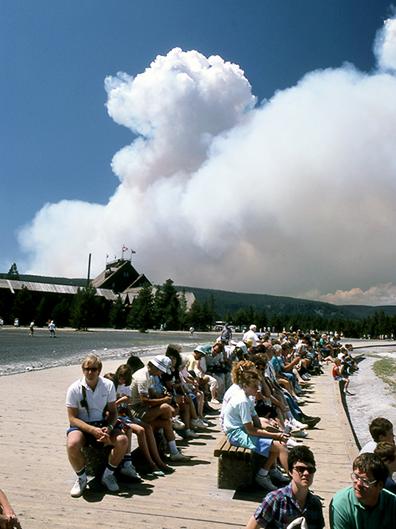
    <title type="html"><![CDATA[1988 Fire Season, Yellowstone National Park]]></title>
    <summary type="html"><![CDATA[<p><strong><em>Starting in the 1970s, Yellowstone National Park experimented with a policy that allowed natural fires to burn within park boundaries. In 1988, a series of highly destructive wildfires put this policy to the test, leading to a comprehensive review of the National Park Service’s fire management procedures. </em></strong></p><img src="https://www.intermountainhistories.org/files/fullsize/cbe39d48527aa1fc2d28fe58044f461b.jpg" alt="Wildfire smoke behind Old Faithful Lodge, 1988" /><br/><p>In 1972, the United States National Park Service (NPS) adopted Yellowstone National Park’s first fire management plan, which allowed natural fires to burn in designated parts of the park. In 1976, a revised plan expanded this controversial approach, called prescribed natural fire or the “let-burn” policy, to impact the entire park. Historically, fires played a key role in thinning forests and clearing dry, dead plants from the landscape, and species like lodgepole pine trees rely on extreme heat from fires to release their seeds and reproduce. In theory, prescribed natural burning maintained these conditions and controlled the damage fires caused. While smoke pollution from let-burn events caused controversy throughout the 1970s, they scorched only 34,175 of Yellowstone's 2,221,800 acres between 1977 and 1988. The Park Service extinguished any fires that threatened people, buildings, or roads.
In the summer of 1988, dry weather and high winds created dangerous conditions in Yellowstone. On June 14, 1988, lightning sparked the Storm Creek Fire just north of the park near Cooke City, Montana, and it gradually made its way into Yellowstone’s boundaries. Initially, NPS allowed about twenty lightning-caused fires, including Storm Creek, to burn in every corner of Yellowstone. Without rainfall to dampen their impact, wind spread the fires rapidly. By July 15, the Park Service suspended the let-burn policy and fought every fire that threatened the park.
The public idolized Yellowstone as the first national park and a crown jewel of the park system, so the 1988 fires rapidly generated a significant media presence in Yellowstone and caused public backlash. By August, the Cable News Network (CNN) and National Broadcasting Company (NBC) sent reporters to the park and presented daily fire updates. When the largest blaze in the park, the North Fork Fire, threatened the historic Old Faithful Inn on September 7, reporters and their viewers blamed NPS officials and the let-burn policy for allowing the fires to spread out of control. A week later, presidential candidate Michael Dukakis visited the park to generate publicity for his campaign, symbolizing the fires’ grip on national media.
             When snow finally ended the fires in November, fifty-one total fires had burned 995,000 acres, damaging about forty-five percent of the park. They destroyed sixty-seven structures in total, including thirty-six privately owned homes, garages, and stores. The North Fork Fire alone scorched approximately 495,000 acres. After the fires, two review committees found that they represented a perfect storm of natural conditions that made them incredibly difficult to fight, but politicians and the media continued to place blame on NPS management strategies. On July 12, 1989, the Park Service began a systematic review of its fire management procedures. Its new policy, approved in 1991, set detailed limits on the prescription and containment of natural fires, rolling back much of the let-burn approach. Firefighters still use prescribed burns and let-burn management to maintain healthy forests in national parks today, sustaining the 1991 policy.</p><p><em><strong><a href="https://www.intermountainhistories.org/items/show/917">For more (including 4 images) view the original article</a></strong></em></p>]]></summary>
    <published>2025-09-23T15:39:30+00:00</published>
    <updated>2026-04-17T19:32:21+00:00</updated>
    <link rel="alternate" type="text/html" href="https://www.intermountainhistories.org/items/show/917"/>
    <id>https://www.intermountainhistories.org/items/show/917</id>
    <author>
      <name>Kaylen Wilson, Northern Arizona University </name>
    </author>
  </entry>
  <entry>
    <title type="html"><![CDATA[Ouzel Fire, Rocky Mountain National Park]]></title>
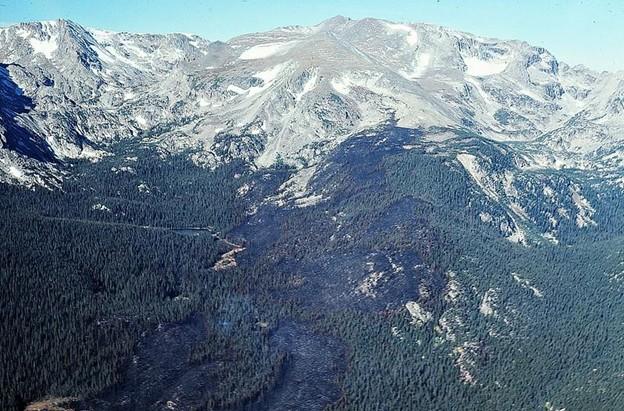
    <summary type="html"><![CDATA[<p><strong><em>In 1978, the Ouzel Fire tested Rocky Mountain National Park’s let-burn fire management policies. After park officials allowed it to burn, it escaped park boundaries and threatened the nearby community of Allenspark, Colorado, prompting backlash from residents. </em></strong></p><img src="https://www.intermountainhistories.org/files/fullsize/82b8dbf734d2ed422931bd8585e88351.jpg" alt="Aerial View of Ouzel Burn Area, September 1978" /><br/><p>In 1977, scientist David Butts composed a new management plan for Rocky Mountain National Park. This strategy, which the park quickly approved, aligned with evolving understandings of blazes within the United States National Park Service (NPS). Suppression defined NPS policy for decades, but in 1977, the nationwide NPS-18 procedure required parks to plan for let-burn fires. During these situations, park officials monitored natural burns closely, allowing them to burn in specific boundaries if they did not threaten structures or cultural resources. At Rocky Mountain, administrators followed this procedure by dividing park land into three distinct risk categories based on vegetation, elevation, and the number of structures nearby. Within low-risk areas, the Park Service allowed burning, but it suppressed any blaze that entered a moderate or high-risk area.
On August 9, 1978, the Ouzel Fire started in Rocky Mountain near Ouzel Lake. Park administrators considered the area low risk, so they allowed it to burn naturally. For a month, NPS closely monitored the flames, which stayed within a designated containment zone. However, on September 15, high winds in Wild Basin pushed Ouzel outside the Park Service’s boundaries. Firefighters immediately worked to suppress it , but the weather conditions made it difficult to contain. It quickly approached the park’s boundaries and the nearby town of Allenspark, Colorado. Ouzel became the first let-burn blaze to threaten a community outside park boundaries.
            On September 30, NPS declared Ouzel contained when heavy equipment created a barrier around it. When contained, fires end once they consume all available fuel. Firefighters halted Ouzel’s advance before it destroyed any structures in Allenspark, but the risk it posed generated significant hostility among residents. Many nearby communities also experienced air pollution during the blaze due to the smoke it released, generating further hostility. Locals argued that the let-burn policy had failed, and the Park Service irresponsibly placed its experimental management plan before the needs of residents.
To regain the trust of local communities, a local Park Service superintendent requested an official review of fire management operations during both the let-burn and suppression phases of Ouzel. Regional NPS manager Kenneth Ashley served as the board’s chair. It consisted of U.S Forest Service specialists, state foresters, and a professional fire scientist from Colorado State University. Its members met on November 8, 1978, and they found that the Park Service’s management plan was too vague to facilitate swift, decisive action during Ouzel. It recommended that Rocky Mountain should develop a new plan with public input. The board also suggested that prescribed burning, which deliberately lights blazes in controlled conditions, would be a safer and more effective way to achieve Rocky Mountain’s management goals. This suggestion marked the beginning of a national transition between the let-burn policy and prescribed burning.</p><p><em><strong><a href="https://www.intermountainhistories.org/items/show/916">For more (including 4 images) view the original article</a></strong></em></p>]]></summary>
    <published>2025-09-23T15:39:30+00:00</published>
    <updated>2026-04-17T19:32:21+00:00</updated>
    <link rel="alternate" type="text/html" href="https://www.intermountainhistories.org/items/show/916"/>
    <id>https://www.intermountainhistories.org/items/show/916</id>
    <author>
      <name>Kaylen Wilson, Northern Arizona University </name>
    </author>
  </entry>
  <entry>
    <title type="html"><![CDATA[La Mesa Fire, Bandelier National Monument]]></title>
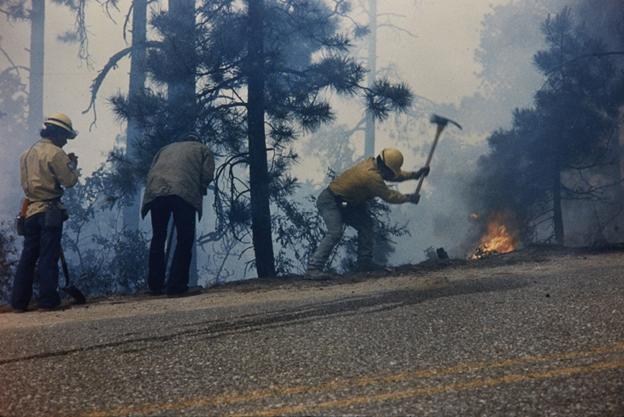
    <summary type="html"><![CDATA[<p><strong><em>In national parks and monuments, flames pose a significant threat to archaeological resources. During the 1977 La Mesa Fire, Bandelier National Monument became the first known park to conduct archaeological surveys on fire lines. </em></strong></p><img src="https://www.intermountainhistories.org/files/fullsize/c2bb9bc0b3c1876b9c14448a59827b75.jpg" alt="Firefighters battling the La Mesa Fire, c. 1977." /><br/><p>Established in 1916 to preserve Ancestral Puebloan archaeological resources near Los Alamos, New Mexico, Bandelier National Monument historically experienced few wildfires. Because the park protected cultural resources instead of natural ones, it extinguished fires to protect archaeological sites. The nearby development of the atomic bomb at Los Alamos, New Mexico, also made the Pajarito Plateau a high-risk area for federal officials, contributing to rapid suppression policies.
In 1977, the U.S National Park Service (NPS) approved NPS-18, a nationwide policy that established new protocols for fire management. Under the new “let-burn” policy, the Park Service allowed natural fires to burn and experimented with deliberate burns in controlled areas. However, the National Historic Preservation Act required archaeological surveys to approve prescribed burn areas. These policies put Bandelier in a delicate position: it had to simultaneously avoid burning cultural resources and promote the let-burn approach. As a result, park managers at Bandelier continued to suppress blazes long after most of the park system allowed them to burn.
            On June 16, 1977, the La Mesa Fire began in the Santa Fe National Forest near Bandelier’s park boundaries. Officials speculated that either a cigarette or a motorcyclist’s engine started it. Because it posed a risk to nearby communities, wildland firefighters worked to suppress La Mesa immediately. Hot, dry conditions and dense vegetation allowed it to spread quickly, threatening both residents and the national monument. By June 17, it entered Bandelier and started to advance towards Los Alamos. NPS evacuated families living in Bandelier’s Frijoles Canyon, demonstrating the immediate threat the flames posed to locals.
Below the surface of the ground, Bandelier contained numerous archaeological sites that researchers never examined. NPS used heavy equipment, including bulldozers, to construct physical barriers where flames could not access fuel. The blaze itself also threatened to destroy delicate structures. These factors meant both La Mesa and the efforts to stop it endangered the national monument. In response, Park Service scientist Millford R. Fletcher worked with cultural resource manager Cal Cummings to enlist volunteer archaeologists on fire lines who surveyed land in front of heavy equipment and recommended locations that would minimize damage to archeological sites. While they could not survey every line in the area, La Mesa damaged only forty percent of the cultural resources it threatened, demonstrating their effectiveness.
On June 21, summer rain slowed La Mesa down, allowing firefighters to contain it. It burned over 23,000 acres, becoming the largest wildfire on the Pajarito Plateau in the twentieth century. The blaze exposed gaps in NPS fire policy, which had not historically accounted for archaeological resources. While federal officials did not address the issue, park managers at Bandelier developed a new management system that ignited small, carefully monitored burns to determine whether officials could safely implement let-burn procedures near cultural resources.</p><p><em><strong><a href="https://www.intermountainhistories.org/items/show/915">For more (including 3 images) view the original article</a></strong></em></p>]]></summary>
    <published>2025-09-23T15:39:30+00:00</published>
    <updated>2026-04-17T19:32:21+00:00</updated>
    <link rel="alternate" type="text/html" href="https://www.intermountainhistories.org/items/show/915"/>
    <id>https://www.intermountainhistories.org/items/show/915</id>
    <author>
      <name>Kaylen Wilson, Northern Arizona University </name>
    </author>
  </entry>
  <entry>
    <title type="html"><![CDATA[Waterfalls Canyon Fire, Grand Teton National Park]]></title>
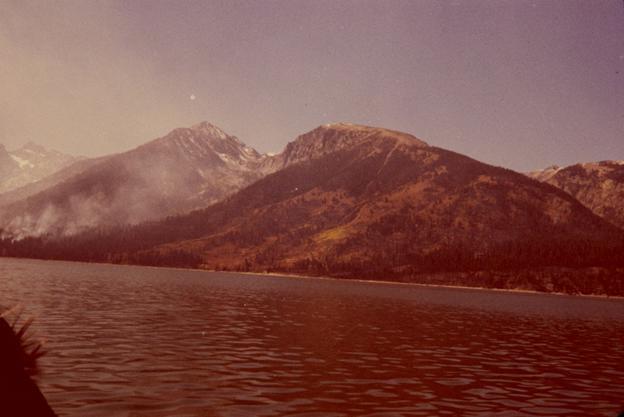
    <summary type="html"><![CDATA[<p><strong><em>The 1974 Waterfalls Canyon Fire started in a designated let-burn area near Jackson Lake in Grand Teton National Park, so the National Park Service allowed it to burn. Smoke from the blaze impacted tourists and local communities, prompting public debates about the Park Service policy that allowed natural fires to burn. </em></strong></p><img src="https://www.intermountainhistories.org/files/fullsize/218d40ecfabb4d0268fec6ef7807fcd7.jpg" alt="Smoke in the mountains at Grand Teton National Park during a fire." /><br/><p>In 1968, the National Park Service (NPS) officially revised its approach to wildfires, stating that they played a key role in maintaining the health of forests. According to Department of the Interior reports, natural burns cleared dead timber and dense clusters of young trees that prevented new growth. In the wake of the decision, park managers experimented with different approaches to maintain healthy forests without causing severe damage. During prescribed burns, the Park Service started fires within strictly defined boundaries and weather conditions to control their severity. During let-burn situations, the agency monitored natural blazes and allowed them to burn. Grand Teton National Park experimented with both approaches.
On August 28, 1973, NPS officials ignited  the Uhl Hill Fire in a dense grove of sagebrush and aspen near the Grand Teton’s eastern edge. One of two prescribed fire experiments that year, NPS expected Uhl Hill to burn one-hundred acres. Cool, wet conditions made it easier to control, but fifty-six firefighters stood by to suppress it if it escaped approved boundaries. While snow and high wind quickly ended the project, which only burned thirty acres of brush, it showed that the Park Service could control blazes within park boundaries. This experiment proved useful on July 17, 1974, when lightning sparked the Waterfalls Canyon Fire near Jackson Lake. It started in the same area that a five-acre let-burn blaze impacted in 1973. Because of its location, park officials allowed it to burn. The Park Service closely monitored the flames, noting that they spread slowly unless high winds or heavy fuels stimulated them.
While NPS perceived Waterfalls Canyon as a successful test of let-burn management, decades of suppression had pushed the public to fear fire, generating controversy. By September 18, the blaze burned 1,900 acres, and smoke from it reached the nearby town of Jackson, Wyoming. The Park Service estimated that about 100,000 tourists observed the smoke, and it incensed Jackson’s citizens, many of whom relied on tourist traffic from Grand Teton to make a living. Residents complained that the let-burn policy ignored the needs of local communities, drawing increased attention to the flames. The National Broadcasting Company (NBC), the Columbia Broadcasting System (CBS), and <em>Time </em>magazine reported on Waterfalls Canyon in September, bringing it to national attention. In response to the controversy, the Park Service’s Rocky Mountain regional office issued a press release that explained the let-burn approach.
Despite public backlash, Park Service officials never suppressed Waterfalls Canyon. Snow finally extinguished it in November 1974, and it only burned 3,500 acres. However, the negative publicity pushed NPS to educate the public about the let-burn approach. In 1974, the Park Service issued a press release that argued that natural fires maintained a healthy landscape in parks. Three years later, a Park Service policy known as NPS-18 approved let-burn management nationwide.</p><p><em><strong><a href="https://www.intermountainhistories.org/items/show/914">For more (including 3 images) view the original article</a></strong></em></p>]]></summary>
    <published>2025-09-23T15:39:29+00:00</published>
    <updated>2026-04-17T19:32:21+00:00</updated>
    <link rel="alternate" type="text/html" href="https://www.intermountainhistories.org/items/show/914"/>
    <id>https://www.intermountainhistories.org/items/show/914</id>
    <author>
      <name>Kaylen Wilson, Northern Arizona University </name>
    </author>
  </entry>
  <entry>
    <title type="html"><![CDATA[1967 Fire Season, Glacier National Park]]></title>
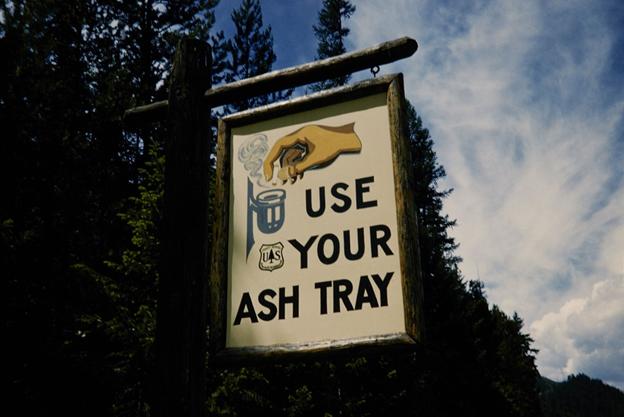
    <summary type="html"><![CDATA[<p><strong><em>Glacier National Park burned more frequently throughout its history than almost any other national park in the United States. Starting in 1910, the National Park Service persistently extinguished all wildfires that occurred within parks, but Glacier’s severe fire season in 1967 helped to end this suppression policy.</em></strong></p><img src="https://www.intermountainhistories.org/files/fullsize/75678ebbab988382ceaac098ab81df69.jpg" alt="Fire Safety Sign" /><br/><p>Throughout the early twentieth century, Glacier National Park in Montana utilized suppression, which required federal land management agencies to extinguish all forest fires. This approach gained national support after millions of acres of land burned in Idaho and Montana in 1910, including about 60,000 acres in Glacier. When 50,000 acres of Glacier burned in 1926, the National Park Service began to formulate official firefighting in the park. By 1929, Chief Forester John D. Coffman drafted the first national park fire management plan to organize firefighters and their equipment at Glacier. During the same year, the Half Moon Fire burned 50,000 acres in Glacier and destroyed numerous buildings. Coffman used analyses of Half Moon to revise and expand his initial strategy, making suppression an integral part of park policy.
In the 1960s, NPS developed a scientific approach to park management that changed the way it approached wildfires, but individual parks rarely aligned their management procedures with these ideas. In 1963, the Advisory Board on Wildlife Management, created by Interior Secretary Stuart Udall, published the Leopold Report. It stated that flames played a key role in maintaining healthy forests, advising administrators to contain wildfires and allow them to burn. Without routine burning, plant materials accumulated on the forest floor, fueling more destructive blazes. However, decades of fighting fires pushed park managers to fear the damage they caused. For decades, NPS managed forests to create attractive landscapes for visitors, and burned forests challenged this idealized image. As such, Glacier’s revised 1965 management plan upheld suppression.
In 1967, a significant drought and hot, windy weather created optimal conditions for flames to spread in Glacier. On August 11, 1967, lightning sparked approximately twenty-one fires throughout the park, including the Glacier Wall and Flathead blazes. They continued burning for a month despite containment efforts. The Office of Emergency Preparedness declared Glacier and the national forests surrounding it a national disaster area, contributing federal funding and labor to put out the flames. 1967 became the most destructive fire season Glacier had seen since 1929, and about 90,000 acres in the park burned.
The 1967 season quickly sparked a debate between the Park Service and the public over suppression. NPS officials contrasted it with the 1910 season  it to display the effectiveness of the policy, noting that less acres burned and less people died in the 1967 fires. However, inholders, who owned cabins, ranches, and hotels in Glacier, blamed the Park Service for mismanaging burns that damaged their properties. One vocal inholder, Montana Senator Burton Wheeler, brought these criticisms to national attention, prompting NPS to reassess its firefighting policies. In 1968, the Park Service acknowledged the ecological benefits of fire in the Green Book, a policy document that established budgets and dictated management policies for the entire park system. Revising this document made changing the suppression policy an issue of national importance. By 1977, Glacier’s management plan allowed natural fires to burn.</p><p><em><strong><a href="https://www.intermountainhistories.org/items/show/913">For more (including 5 images) view the original article</a></strong></em></p>]]></summary>
    <published>2025-09-23T15:39:29+00:00</published>
    <updated>2026-04-17T19:32:21+00:00</updated>
    <link rel="alternate" type="text/html" href="https://www.intermountainhistories.org/items/show/913"/>
    <id>https://www.intermountainhistories.org/items/show/913</id>
    <author>
      <name>Kaylen Wilson, Northern Arizona University </name>
    </author>
  </entry>
</feed>