<?xml version="1.0" encoding="UTF-8"?>
<feed xmlns="http://www.w3.org/2005/Atom">
  <title type="text">Intermountain Histories</title>
  <updated>2026-04-17T19:32:20+00:00</updated>
  <generator uri="http://framework.zend.com" version="1.12.20">Zend_Feed_Writer</generator>
  <link rel="alternate" type="text/html" href="https://www.intermountainhistories.org/"/>
  <link rel="self" type="application/atom+xml" href="https://www.intermountainhistories.org/items/browse?output=rss2"/>
  <id>https://www.intermountainhistories.org/</id>
  <author>
    <name>Intermountain Histories</name>
    <uri>https://www.intermountainhistories.org</uri>
  </author>
  <link rel="hub" href="https://pubsubhubbub.appspot.com/"/>
  <entry>
    <title type="html"><![CDATA[The Brown Palace Hotel – Denver, Colorado]]></title>
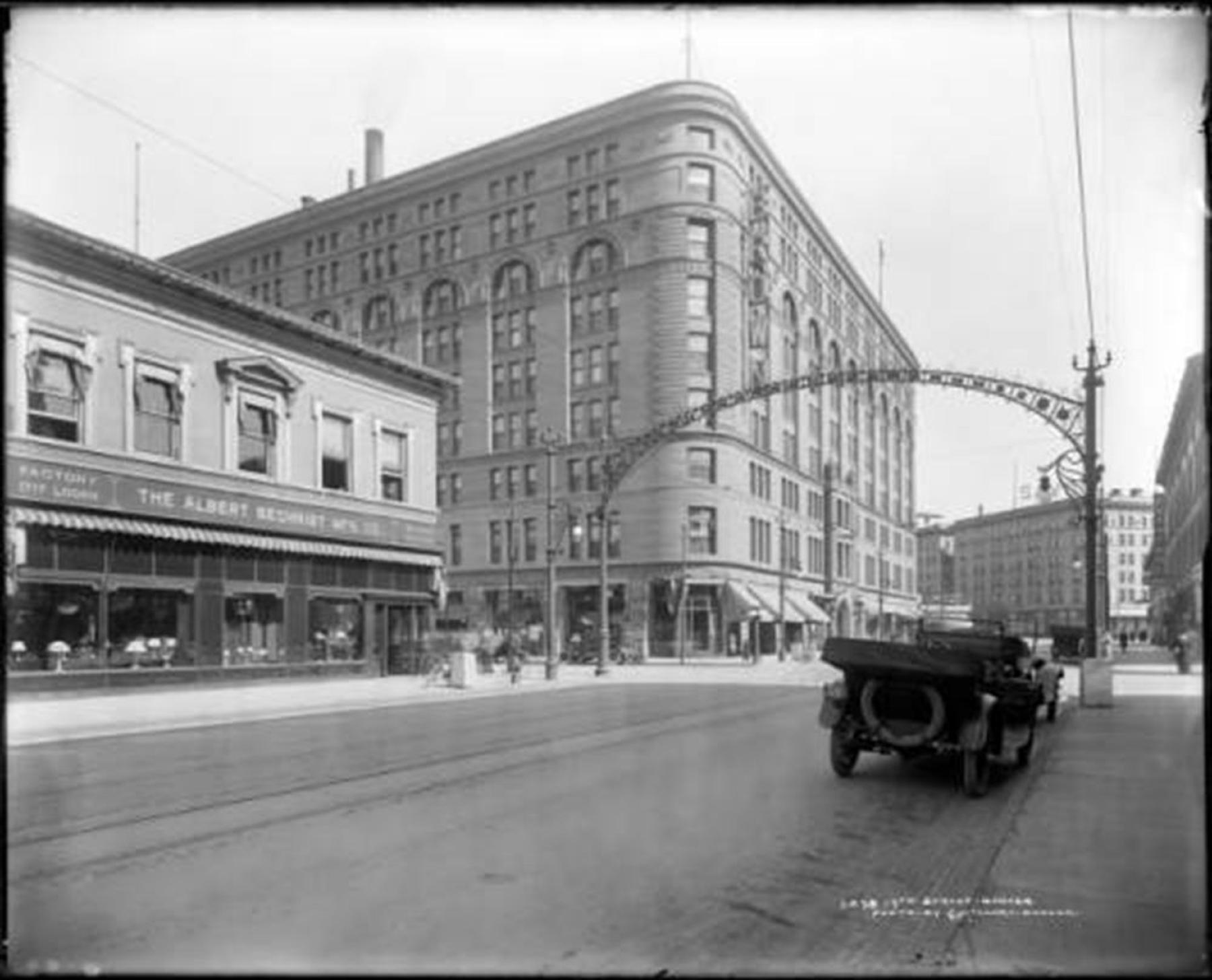
    <summary type="html"><![CDATA[<p><strong><em>When Colorado enacted Prohibition in 1916, the Brown Palace Hotel quickly revealed how wealth evades discipline. Behind its European elegance, the hotel hosted bootleggers, celebrities, and politicians who drank with impunity. Its story offers a glimpse into how the elite can often sidestep laws supported and followed by the broader public.</em></strong></p><img src="https://www.intermountainhistories.org/files/fullsize/72d73fe3024bb85dbf7955365a8a338b.jpg" alt="The Brown Palace Hotel in 1916, the year Colorado passed its Prohibition laws" /><br/><p>In 1860, Henry Cordes Brown arrived in Denver and purchased several plots of land. In 1888, Brown began constructing the Brown Palace Hotel. He was determined to make it one of the best hotels in Colorado and spared no expense. Its central atrium, fireproof blocks of terracotta, and gold and European import detailing make the building stand out. The construction cost about $1.6 million, $50 million today, and featured Arizona sandstone.
In 1916, Colorado became one of the first states to pass Prohibition laws. Temperance was popular among the large population of progressive residents. The general population here did not desire or accept alcohol as readily as people in other Intermountain West states. This is one of the reasons the Brown Palace Hotel felt no need to cater to the middle class. The hotel’s prominence made it a prime location for celebrities, politicians, and social leaders to grab an illegal drink. Due to its prestigious reputation and clientele, authorities never shut the establishment down, despite raiding it multiple times for alcohol.
The 18 February 1930 issue of the <em>Rocky Mountain News (Daily) </em>described a large-scale raid conducted by police on the Brown Palace Hotel. Officers stormed room 929 on a tip about liquor distribution at a war veterans' convention. Law enforcement found approximately 116 cases of beer and fifty pints of whisky in the hotel room and arrested five hotel employees for conspiracy to violate Prohibition laws. With a bust this large, the courts threatened to padlock room 929, meaning it would be a “forbidden room,” a place “which none should enter.”
The 22 April 1930 issue of the same paper updated the room 929 story. Authorities indicted those arrested during the raid and fined them $300 ($5,700 today). While those associated with the Brown Palace Hotel typically earned higher salaries, this fine was no slap on the wrist. Intense repercussions like these aligned with Colorado’s strong temperance attitude and deterred Prohibition violations.
This story also shows how the elite used the Brown Palace Hotel to escape prosecution for alcohol-related crimes. The article indicates that the volume of alcohol found in room 929 suggests someone “higher up” knew about the stash. A key witness testified that former state senator and convention chairman Rice Means rented room 929 and knew “what this room was to be used for.” Despite this, officials never arrested Means. This case shows that large-scale alcohol consumption occurred at the Brown Palace Hotel and how those in power hid behind the establishment’s high-end reputation to evade Prohibition laws.
The Brown Palace Hotel’s Prohibition-era history highlights the intersection of wealth, power, and privilege. Despite multiple raids, its prestigious reputation and elite clientele allowed it to maintain alcohol sales. Its role during Prohibition demonstrates how the powerful navigated around the law. Today, the Brown Palace Hotel remains a cornerstone of Denver’s heritage and a symbol of the city’s transnational significance as a hub of influence.</p><p><em><strong><a href="https://www.intermountainhistories.org/items/show/898">For more (including 3 images) view the original article</a></strong></em></p>]]></summary>
    <published>2025-09-23T15:34:53+00:00</published>
    <updated>2026-04-17T19:32:20+00:00</updated>
    <link rel="alternate" type="text/html" href="https://www.intermountainhistories.org/items/show/898"/>
    <id>https://www.intermountainhistories.org/items/show/898</id>
    <author>
      <name>Scarlett Kluge, Northern Arizona University </name>
    </author>
  </entry>
  <entry>
    <title type="html"><![CDATA[Two-Bit Street – Ogden, Utah]]></title>
    <summary type="html"><![CDATA[<p><strong><em>Over the years, Ogden, Utah built its reputation as a countercultural hub, steadfastly resisting religious and political authority and conformity. During Prohibition, the city’s infamous Two-Bit Street flirted with illegality by housing speakeasies, stills, and brothels hidden behind innocent storefronts.</em></strong></p><img src="https://www.intermountainhistories.org/files/fullsize/6ab53cfbcdd11113ac6b62738af2d528.jpg" alt="A photo taken of Ogden’s 25th Street sometime between 1892-1904 shows the area before Prohibition began in 1917" /><br/><p>In early twentieth-century Utah, temperance was popular among many members of the Church of Jesus Christ of Latter-day Saints (LDS). The church’s temperance beliefs stemmed from an 1833 doctrine called the “Word of Wisdom,” which church leaders initially treated as guidance for moderate alcohol use. In 1902, Joseph Fielding Smith urged members to view the doctrine instead as a strong suggestion against alcohol. In 1909, this position began influencing state law when Governor William Spry and the legislature passed a local option bill allowing towns to vote on banning alcohol. Many smaller towns voted in favor, while more diverse cities like Ogden and Salt Lake City did not. Despite urban opposition, Utah ratified statewide Prohibition in 1917. In 1921, church president Heber J. Grant aligned church doctrine with state law by declaring alcohol abstinence a requirement. While many LDS members adopted the policy and supported enforcement, an underground drinking culture emerged among other Utahns, especially in Ogden’s 25th Street, also known as Two-Bit Street.
In the late nineteenth century, the completion of the continental railroad brought Chinese and Irish rail workers to Utah. By the turn of the century, LDS members still owned most businesses in smaller towns, but Italian, Chinese, Jewish, and Japanese immigrants owned much of Ogden’s commercial district. This demographic shift made Ogden a culturally distinct city, less influenced by the church’s temperance stance. When Prohibition began, Two-Bit Street became known for alcohol stills, speakeasies, and brothels. Business owners often ran legal operations on the ground floor—ice cream, clothing, and soda shops—while concealing illegal activities on the floors above. A notable example of this was the Davenport Saloon, which was located above various short-lived legal businesses like the Night Hawk Café.
On 03 January 1922, the <em>Ogden Standard-Examiner</em> reported that police raided an ice cream parlor at 170 25th Street. They found two quarter-full bottles of moonshine whisky and arrested the owner, William Pranthel, who pleaded guilty to possession. He claimed the liquor was for personal use, not for sale, but could not explain why it was at the parlor instead of home. He received a sentence of a $299 fine or 180 days in jail. A month later, the same paper reported that police discovered remnants of a recently abandoned still in the same neighborhood, along with several bottles of homemade wine—but no bootleggers.
Prohibition in Utah was more than a legal change—it was a struggle between religious authority and cultural resistance. In Ogden, immigrant families turned Two-Bit Street into a quiet act of defiance, building their own economy behind legal storefronts. It was as much about autonomy as alcohol. While the LDS Church shaped much of the state, Ogden pushed back. Today, Two-Bit Street remains a space where Utah residents challenge law and societal norms.</p><p><em><strong><a href="https://www.intermountainhistories.org/items/show/897">For more (including 4 images) view the original article</a></strong></em></p>]]></summary>
    <published>2025-09-23T15:34:48+00:00</published>
    <updated>2026-04-17T19:32:20+00:00</updated>
    <link rel="alternate" type="text/html" href="https://www.intermountainhistories.org/items/show/897"/>
    <id>https://www.intermountainhistories.org/items/show/897</id>
    <author>
      <name>Scarlett Kluge, Northern Arizona University </name>
    </author>
  </entry>
  <entry>
    <title type="html"><![CDATA[The Rockwood Speakeasy – Butte, Montana: When Montana lawmakers passed alcohol bans in 1918, Butte’s nightlife went underground. Business owners concealed their speakeasies, brothels, and gambling halls in basements under the city’s sidewalks. During Prohibition, Rockwood (Rookwood) Speakeasy earned its fame hidden behind coats and code words.]]></title>
    <summary type="html"><![CDATA[<img src="https://www.intermountainhistories.org/files/fullsize/51321426bb9e095b46c0551d1ba7b90f.jpg" alt="The cross section of Butte’s Broadway and Main Street in the 1920s" /><br/><p>James Pratt, proprietor of the Red Boot and Shoe Company, built the Rockwood (also called the Rookwood), in Butte, Montana in 1912. The ground level housed the shoe company’s shop, and the floors above functioned as a hotel. Pratt designed the building to attract attention and business with décor like Tudor-arching, green tile, a copper-clad cornice, a wrought iron staircase, and marble wainscoting and floors. The Rockwood’s unique ambiance and railroad access attracted elite and traveling patrons alike.
Before Prohibition, Butte, Montana, boomed as a mining town and gained notoriety for its lively bar and entertainment scene. When the Montana government banned alcohol distribution and consumption in December of 1918, Butte bars moved underground—into basements and tunnels beneath storefronts—and continued to sell alcohol. During this time, over one hundred underground speakeasies, including the Rockwood, operated in the city. In 1918, Pratt converted the building’s basement into a speakeasy. This underground area matched the hotel’s elegance above, attracted numerous clients, and became one of Butte’s more famous drinking spots.
In 1923, one of Rockwood’s moonshine clients, Mae Holberg, died by suicide after overconsuming alcohol. The 29 January 1923 issue of <em>The Butte Daily Post </em>describes the harrowing story. Holberg attended an all-night party at the Rockwood. Witnesses and police confirmed this party involved large quantities of illegal liquor. Around 7:00 A.M., Holberg drank one and a half ounces of Lysol, a fatal dose that ended her life within hours. A friend at the party told officers he believed Holberg took her own life because “she was despondent,” he said, “one or two drinks always made her despondent and downhearted.” Tragic stories like this made the Rockwood notorious in the illegal drinking world.
After Prohibition ended, Butte’s underground scene lost its appeal. Shop owners no longer needed to hide their liquor, so they moved alcohol sales to street levels, and many permanently sealed off their speakeasies. Rockwood’s basement became one of these buried speakeasies, while the rest operated as a hotel and retail space. In 2004, workers renovating the Rockwood Hotel discovered a closet filled with untouched coats from decades past. Behind the coats, they uncovered a two-way mirror which concealed a hole that opened into the Rockwood Speakeasy—frozen in time since the Prohibition era.
This discovery highlights the secretive and exclusive nature of the Rockwood Speakeasy and explains how it remained hidden and operational throughout Prohibition. It is a modern-day time capsule, offering visitors a glimpse into the past. Visitors can imagine stepping into the shoes of a 1920s client—looking into the mirror, giving the bouncer the code, and feeling the thrill of defying Montana’s dry laws.</p><p><em><strong><a href="https://www.intermountainhistories.org/items/show/896">For more (including 5 images) view the original article</a></strong></em></p>]]></summary>
    <published>2025-09-23T15:34:47+00:00</published>
    <updated>2026-04-17T19:32:20+00:00</updated>
    <link rel="alternate" type="text/html" href="https://www.intermountainhistories.org/items/show/896"/>
    <id>https://www.intermountainhistories.org/items/show/896</id>
    <author>
      <name>Scarlett Kluge, Northern Arizona University </name>
    </author>
  </entry>
  <entry>
    <title type="html"><![CDATA[Kemmerer, Wyoming Alcohol Culture during Prohibition]]></title>
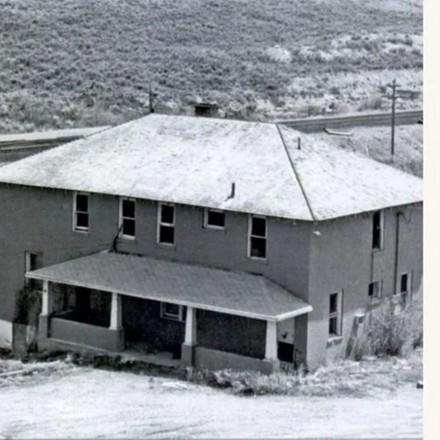
    <summary type="html"><![CDATA[<p><strong><em>Kemmerer, Wyoming emerged in the late nineteenth century when Patrick J. Quealy founded a coal company and a town to go with it. Kemmerer was popular among immigrant business owners who set up shops seeking financial and personal freedom. Their diverse cultures contributed to Kemmerer becoming a bootlegger’s haven when Prohibition began a few decades later.</em></strong></p><img src="https://www.intermountainhistories.org/files/fullsize/bc57fb9731bf760db28ae4ec4796ab05.jpg" alt="The original Southern Hotel building" /><br/><p>In 1897, Patrick J. Quealy founded a town and coal company, naming them “Kemmerer” after his financial backer, Mahlon S. Kemmerer of Pennsylvania. Quealy made Kemmerer an “independent town,” meaning that the coal company sold land to businesses and residents. This attracted immigrant miners and business owners, including those from southern and eastern Europe. Drinking was integral to many of the immigrants’ cultures, which included Italian, Polish, Slovak, and Scottish. This influenced Kemmerer’s freedom-focused Prohibition culture. In 1919, Wyoming passed laws banning alcohol. Kemmerer and its neighboring communities of Diamondville and Frontier formed a triangle network for illegal bootlegging and drinking.
During Prohibition, many Kemmerer residents made little effort to hide their drinking, as it was a southern and eastern European cultural norm and popular with the white men who worked the area’s mines. Isabel Burns migrated to Kemmerer in the 1880s and later established the brothel she named the Southern Hotel, which catered to illegal activities like prostitution and drinking. Burns and her successors operated the Southern Hotel for seven decades, throughout all of Prohibition, and continuously offered drinking and prostitution, regardless of legality. For its size, Kemmerer hosted a disproportionately large number of saloons and brothels like the Southern Hotel, which testified to local positive sentiment toward alcohol and cultural autonomy.
In addition to establishments like the Southern Hotel, well-documented arrests for alcohol possession and public intoxication highlight the prominence of drinking in Kemmerer during Prohibition. While police were generally tolerant of illegal alcohol consumption—acknowledging the town’s large immigrant population—the widespread nature of drinking still led to arrests, often for disrupting the peace. The <em>Kemmerer Gazette</em> reports indicate that authorities arrested people on alcohol-related charges, typically for public intoxication, operating stills, or alcohol distribution.
For example, the 20 April 1927 issue of the paper reported two separate intoxication cases from earlier that month. Both men paid $25 in fines (around $450 today). According to the paper, the first man, E. L. Mitchell, “made his rounds, proceeding to hit the high spots,” and caused a “rucus” at the Kemmerer hotel, thanks to “the potency of Kemmerer’s supply of moonshine, which will give a jackrabbit enough nerve to defy a bulldog.” The second man, a railroad worker from Mexico, “got all corned up on moonshine [then] ran a muck on the streets of Kemmerer.” Authorities incarcerated both men not merely for drinking, but for disorderly public conduct.
Kemmerer’s Prohibition history tells not a story of law, but a tale of western mining culture. As immigrants arrived for railroad and mining jobs, they brought customs wherein drinking was a way of life. When Prohibition criminalized that lifestyle, the law did not erase people’s culture. Places like the Southern Hotel thrived not because people wanted to rebel, but because they wanted to keep living as they always had. Kemmerer’s Prohibition history is one of colliding international and mining cultures withstanding the force of national reform.</p><p><em><strong><a href="https://www.intermountainhistories.org/items/show/895">For more (including 3 images) view the original article</a></strong></em></p>]]></summary>
    <published>2025-09-23T15:34:47+00:00</published>
    <updated>2026-04-17T19:32:20+00:00</updated>
    <link rel="alternate" type="text/html" href="https://www.intermountainhistories.org/items/show/895"/>
    <id>https://www.intermountainhistories.org/items/show/895</id>
    <author>
      <name>Scarlett Kluge, Northern Arizona University </name>
    </author>
  </entry>
  <entry>
    <title type="html"><![CDATA[The Mint Bar – Sheridan, Wyoming]]></title>
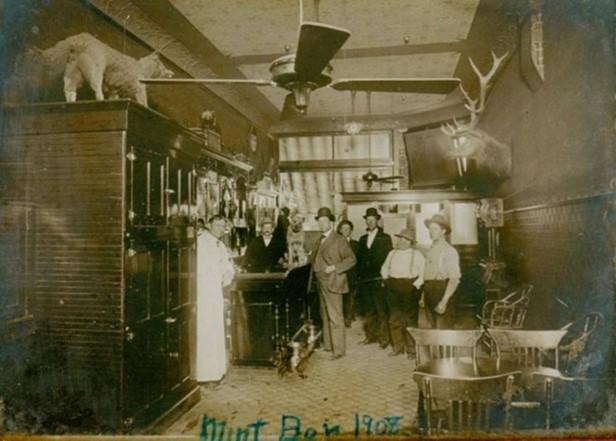
    <summary type="html"><![CDATA[<p><strong><em>In 1907 Charles “Dick” Marlow founded the Mint Saloon in Sheridan, WY. When Wyoming Prohibition laws banned alcohol in 1919, Marlow rebranded “the Mint” as legal storefronts but continued illegal alcohol sales. In 1935, post-Prohibition, the Mint Bar reopened its storefront as a bar. Today, the Mint Bar is still a staple of entertainment in Sheridan, Wyoming.</em></strong></p><img src="https://www.intermountainhistories.org/files/fullsize/634d0740f89c76472de8ecde2b526e01.jpg" alt="The Mint Bar in 1907, shortly after opening. " /><br/><p>In 1907 Charles “Dick” Marlow bought the building that would later become the Mint Bar from a barber and transformed it into the “Mint Saloon,” which locals often referred to as “the Mint.” In 1919, Wyoming passed laws banning the sale and consumption of alcohol unless for prescribed medicinal purposes. At this time, Marlow changed the Mint’s front into a dress shop, then a real estate office, while continuing alcohol sales in the back. In 1923, Oran Moore purchased the Mint, turning it into the “Mint Cigar Company and Soda Shop.” Between 1923 and 1930, Moore operated the Mint’s legal front while maintaining one of Sheridan’s more notorious speakeasies and gambling halls in the back.
During this time, law enforcement suspected the Mint of alcohol sales and conducted multiple raids on the location. On 23 June 1925, the <em>Sheridan Post Enterprise</em> published an article describing a moonshine bust at the Mint. Sheridan town sheriffs and a Wyoming state officer raided the Mint at four o’clock in the afternoon. Police discovered one gallon of moonshine whiskey hidden in a coffee pot by employees. The officers arrested Moore and several other employees. The court fined Moore $500.
On Tuesday, 23 June 1925, an article appeared in the <em>Sheridan Post Enterprise</em> about the officer’s raid at the Mint. A month later, the paper published a follow-up article on Tuesday, 07 July 1925, which mentioned that the court judge postponed the Mint employees’ trial. Lax police and judicial enforcement meant that raids, arrests, and trials like this never prevented the Mint from selling illegal alcohol. The establishment continued its bootlegging and alcohol sales until the stock market crash of 1929 forced Moore to close its doors. In 1933, the United States’ Twenty-first Amendment ended Prohibition, and Wyoming dissolved its alcohol ban.
In 1934, Archie Milson and Robert Thirlwell purchased the establishment and reopened the space as “the Mint Bar.” In 1948, the owner at the time, Lauren L. McVean, renovated the Mint Bar, giving the location its warm rustic style and now iconic bucking horse and cowboy neon sign. Cowboys, locals, travelers, and even celebrities like Ernest Hemingway once again made the bar a popular stop because of its historic charm, great beer, and gambling.
The Mint Bar’s story shows how Prohibition reshaped Sheridan without breaking its spirit. The hidden bar was a gathering place for cowboys and townsfolk alike. Raids and fines were a constant threat, but the establishment’s patrons remained loyal. After Prohibition, the Mint Bar never lost its notoriety. Today, “Meet me at the Mint” is now a signature phrase shared between Sheridan locals. The Mint Bar’s history is a nod to Western independence and resilience.</p><p><em><strong><a href="https://www.intermountainhistories.org/items/show/894">For more (including 4 images) view the original article</a></strong></em></p>]]></summary>
    <published>2025-09-23T15:34:46+00:00</published>
    <updated>2026-04-17T19:32:20+00:00</updated>
    <link rel="alternate" type="text/html" href="https://www.intermountainhistories.org/items/show/894"/>
    <id>https://www.intermountainhistories.org/items/show/894</id>
    <author>
      <name>Scarlett Kluge, Northern Arizona University </name>
    </author>
  </entry>
  <entry>
    <title type="html"><![CDATA[The Shooting Star Saloon]]></title>
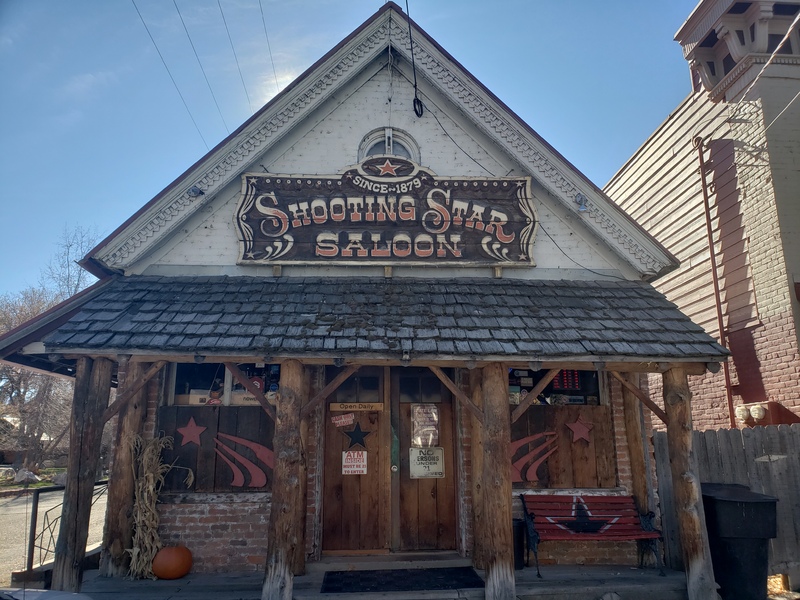
    <summary type="html"><![CDATA[<p><strong><em><span style="font-weight:400;">The Shooting Star Saloon is one of the oldest operating businesses in the state of Utah. Its unique interior and local folklore have made it a staple in Huntsville.</span></em></strong></p><img src="https://www.intermountainhistories.org/files/fullsize/19b659e1fc460dfe79186664309c32a2.jpg" alt="The Shooting Star Saloon" /><br/><p><span style="font-weight:400;">The building from which the Shooting Star Saloon currently operates was erected around 1850 as a mercantile shop for Native Americans, fur trappers, fur traders, herders, and the small number of settlers of the town. The mercantile switched to a saloon in 1879, originally named Hoken’s Hole for its owner Hoken Olsen. Hoken (1862-1945) was the son of Norwegian immigrants who had converted to Mormonism and moved to Utah in 1876 as part of the “gathering.” He became a citizen of the US in 1902. Hunstville’s early newspapers are filled with accounts of how “Slippery Hoken'' had once more been fined for selling liquor without a license, or sent to jail for the same. His wife Maria Bingham operated the saloon when Hoken was in jail. </span>
<span style="font-weight:400;">During the Prohbition Era in the 1920s, alcoholic drinks and card games were enjoyed in secret and a confectionery shop for children was displayed on the top floor of the saloon. However, Hoken continued to be arrested for selling liquor without a license. In 1929, Hoken sold his property to Ben Wood. In 1940, Huntsville’s Carl Stokes moved the saloon upstairs from the basement and named it the Shooting Star. </span>
<span style="font-weight:400;">The Saloon has had several owners these past years. It is known for its menu, consisting of burgers and hotdogs. There is even a combination of hot dog and burger called the Star Burger. And, of course, there is a full bar of alcoholic beverages. The Saloon’s decor is also of note. Inside, the ceiling is completely covered in dollar bills and has a St. Bernard’s head stuffed and displayed on the wall, belonging to the deceased Buck, a previous Guinness World Record holder for St. Bernards because of its size and weight. “Buck” is a gift from Ernie Schultz who ran a bar in West Yellowstone, Montana. The tables were once used by monks at the nearby Trappist monastery. Antique items such as registers can also be found in the Saloon. </span>
<span style="font-weight:400;">The origins of the dollar bill ceiling are unclear. Some say that Whiskey Joe, a patron from decades orevious, began the trend of tacking dollar bills on the ceiling. Whiskey Joe was notorious for never having enough money to pay for his beer. He'd give the bartender a dollar toward his tab, and it would be tacked up on the ceiling. Whiskey Joe would show up the next day with an additional dollar, and so it continued. A few have claimed that Whiskey Joe continues to haunt the saloon. </span><span style="font-weight:400;">However, Whiskey Joe's legacy is debated. Huntsville librarian Carol Stoker claims that her uncle Charlie left the first dollar bill on the ceiling on his way to fight in World War II, declaring he would use it when he came back. Whatever the real story, today hundreds of dollar bills blanket the ceiling. Names of patrons penned on each one are a sign that they'll be back for another round. </span></p><p><em><strong><a href="https://www.intermountainhistories.org/items/show/683">For more (including 4 images) view the original article</a></strong></em></p>]]></summary>
    <published>2022-10-26T19:17:54+00:00</published>
    <updated>2026-04-17T19:32:15+00:00</updated>
    <link rel="alternate" type="text/html" href="https://www.intermountainhistories.org/items/show/683"/>
    <id>https://www.intermountainhistories.org/items/show/683</id>
    <author>
      <name>Julia Johnson, Weber State University</name>
    </author>
  </entry>
  <entry>
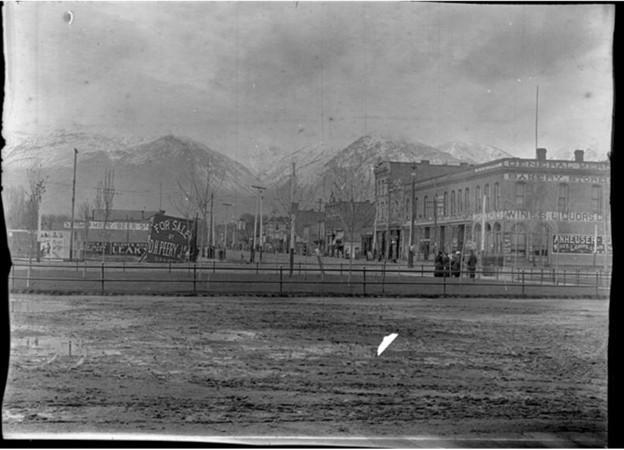
    <title type="html"><![CDATA[The Bigelow Hotel and Historic 25th Street<br />
]]></title>
    <summary type="html"><![CDATA[<p><strong><em>The Bigelow Hotel has graced Ogden's historic 25th Street since 1891. It is one of old three "grand" hotels in Utah </em></strong></p><img src="https://www.intermountainhistories.org/files/fullsize/2e59ff9e864ab71274edda7cac593bb8.jpg" alt="Union Station in Ogden, Utah " /><br/><p>In 1889, Ogden history changed forever with the opening of the Union Station. The arrival of the railroad brought new life to the town of Ogden as people from all over the nation now stopped in and became acquainted with the previously little-known town. With the increase of visitors, Ogden quickly needed to provide better accommodations for incoming guests. The answer came in the summer of 1889 with the approval of a new 5-story hotel to be built on the corner of Washington and 25th street. The hotel was to be built by E.A. Reed Esquire at the cost of $75,000. Initially the hotel had several struggles and delays in development but it finally opened its doors for business on July 4th 1891. The hotel opened with 130 rooms and had elegant interior furnishings including velvet carpet. The hotel struggled financially early on, even closing briefly in 1893, but it quickly reopened and continued to serve guests to the city.</p><p>With the boom in the economy at the heels of World War I, the hotel was completely remodeled in the 1920’s to become a more modern facility. M.S. Eccles and A.P. Bigelow took on the reconstruction project, adding eleven stories to the hotel. With much anticipation, the hotel officially reopened under the new name of The Bigelow Hotel, on March 3rd, 1927. The remodeling was praised for its elegance and quickly became known as a first class hostelry as it was considered one of only 3 grand hotels in Utah. In 1933, the hotel was again renamed as it took on the new title of the Ben Lomond Hotel, named after the local mountain in Weber County.</p><p>The hotel is part of the intriguing history of 25th street in Ogden. With the arrival of the railroad on the west end of 25th, many new and interesting personalities descended on Ogden and more specifically on this famous street. Soon after the railroad arrived, brothels infiltrated many of the establishments on this road. With these came much gambling and crime, including many murders. In the 1920’s, the street became known for its many moonshiners selling alcohol illegally during the prohibition. Many of these establishments would hide the alcohol under floorboards, or would have someone posing as a guest to conceal the alcohol under a coat. When a guest came asking for a drink, the bartender would give a signal to the individual who would then secretly come forward with the illegal drink. These are just a few examples of the crime and corruption that permeated this street.</p><p>Today, the Bigelow Hotel and 25th street have held onto their compelling history and is true to their historic roots. As one explores the hotel and wanders down 25th they truly feel that they have stepped back almost 100 years into 1920’s Ogden.</p><p><em><strong><a href="https://www.intermountainhistories.org/items/show/435">For more (including 6 images) view the original article</a></strong></em></p>]]></summary>
    <published>2020-10-24T03:49:51+00:00</published>
    <updated>2026-04-17T19:32:08+00:00</updated>
    <link rel="alternate" type="text/html" href="https://www.intermountainhistories.org/items/show/435"/>
    <id>https://www.intermountainhistories.org/items/show/435</id>
    <author>
      <name>Josh Camp, Brigham Young University </name>
    </author>
  </entry>
  <entry>
    <title type="html"><![CDATA[Women’s Suffrage and Temperance in Idaho]]></title>
    <summary type="html"><![CDATA[<p><strong><em>The fight for women’s suffrage was closely tied to the temperance movement. Many women in Idaho supported both temperance and women’s suffrage, and although some suffragettes like Abigail Scott Duniway worried that the association between the two would prompt greater opposition from men, the WCTU helped win the right to vote for women in Idaho in 1896.</p></strong></p><img src="https://www.intermountainhistories.org/files/fullsize/3430039af5cc919129c52b625dbb981f.jpg" alt="Abigail Scott Duniway
" /><br/><p>In Idaho, like most states in the West, the Women’s Christian Temperance Union played an important role in the women’s suffrage movement. The WCTU advocated a variety of social reforms, such as prohibition of alcohol, for the purpose of creating a moral and clean society. Many Idaho women first became involved in the public sphere through participation in the WCTU, and later became suffragettes. The President of the Idaho Women’s Christian Temperance Union, Henrietta Skelton, encouraged local WCTU chapters in Idaho to incorporate women’s suffrage into their cause. The Idaho WCTU also helped push the territorial government to consider women’s suffrage. During Idaho’s Constitutional Convention in 1889, Henrietta Skelton gave a speech to the legislature requesting the following two clauses in the new state constitution: “No discrimination on account of sex shall be made; but citizens of both sexes, possessing the necessary qualifications, shall be equally eligible as electors;’ and “that manufacture, sale, or keeping of intoxicating liquors for use as a beverage is hereby prohibited.” For temperance activists in Idaho, women’s suffrage and prohibition were inseparable.</p><p>However, the connection of women’s suffrage to prohibition of alcohol by the WCTU created some problems. Due to this connection, liquor companies became some of the main opponents of female enfranchisement and some men viewed women’s suffrage in a negative light. When Henrietta Skelton argued for both suffrage and prohibition amendments in Idaho’s new state constitution, some suffragettes feared this would endanger the cause of women’s suffrage. One such suffragette was Abigail Scott Duniway. Abigail Scott Duniway had spent decades working for women’s suffrage in Washington, Oregon, and Idaho as a speaker and newspaperwoman, and previously spoke before Idaho’s legislature in 1887 in favor of women’s right to vote. In her autobiography, she recalled her reaction to the WCTU’s speech to the legislature: “I received a message from my Equal Suffrage co-workers in Boise, urging me to come to them at once. “The Woman’s Christian Temperance Union is spoiling everything,” the letter said. “They have arranged for a hearing before the convention, in advance of ours, asking for a clause in the new Constitution to prohibit the liquor traffic. They won’t get it, of course, but they will prohibit us from getting a Woman Suffrage plank, if you don’t come!” Duniway gave a speech to the legislature right after Skelton in which she attacked the idea that women’s suffrage and prohibition were connected and instead argued for the adoption of an independent women’s suffrage clause. Idaho did not give women the right to vote in the new state constitution, but Skelton and Duniway’s speeches reveal some of the tension in the relationship between women’s suffrage and temperance.</p><p>Despite the misgivings of Abigail Scott Duniway and other suffragettes, the Woman’s Christian Temperance Union remained an active part of the women’s suffrage movement in Idaho. The next president of the WCTU in Idaho, Rebecca Mitchell, convinced Lewis E. Workman, a Republican member of the state’s House of Representatives, to introduce another women’s suffrage bill to the legislature in 1893. Although that bill was not successful, the WCTU kept working with Idaho’s Equal Suffrage Association until women’s suffrage was successfully passed in 1896. The WCTU continued its social reform efforts with continued strength after women in Idaho won the right to vote. As public services and symbols of prohibition, they erected temperance water fountains, one of which still stands outside of Boise City Hall. In 1916, the WCTU achieved one of its main goals in Idaho when Governor Moses Alexander approved statewide prohibition.</p><p><em><strong><a href="https://www.intermountainhistories.org/items/show/250">For more (including 4 images) view the original article</a></strong></em></p>]]></summary>
    <published>2019-01-18T03:43:46+00:00</published>
    <updated>2026-04-17T19:32:04+00:00</updated>
    <link rel="alternate" type="text/html" href="https://www.intermountainhistories.org/items/show/250"/>
    <id>https://www.intermountainhistories.org/items/show/250</id>
    <author>
      <name>Sarah Rounsville, Brigham Young University</name>
    </author>
  </entry>
  <entry>
    <title type="html"><![CDATA[Brewing a Brew Culture]]></title>
    <summary type="html"><![CDATA[<p><strong><em>Though prohibition in Fort Collins ended in 1969, the breweries that would become a staple in Western college town culture did not arrive for another twenty years. It was Fort Collins’ status as a college town and location near the pristine waters of the Poudre River that drew brewers to the area.</em></strong></p><img src="https://www.intermountainhistories.org/files/fullsize/2300d113185bf834094ae68a4ed879af.jpg" alt="Old Town Square" /><br/><p>As one of Fort Collins’ oldest breweries, Coopersmith’s Pub & Brewing is a cultural mainstay of the college town. It opened in 1989 along with several other breweries that followed the opening of the Anheuser-Busch brewery in 1988, after a law changed allowing Fort Collins to produce and sell beer. Upon learning of the change in law, Coopersmith's founder Scott Smith took advantage of the opportunity, opening the pub & brewing facility with investors’ assistance. Though several breweries have since opened and closed, Coopersmith’s has survived through the years as a successful model to other similar businesses. Front Range Historian Brea D. Hoffman even suggests that Coopersmith’s helped to make Old Town Fort Collins a popular local destination. Now, the brewery employs over one hundred people with around twenty house beers on tap.</p><p>But brewing was not always the industry it is today. It took more than a decade after prohibition ended for the city to even consider allowing breweries to set up shop in Fort Collins, and almost two decades until breweries were actually established. One of the bigger concerns for both the brewers and the locals was water usage. Like the rest of the West, Fort Collins and Northern Colorado face challenges when it comes to water access. For breweries, water is an integral part of their process; water supports the yeast which feeds off of sugar and turns it into alcohol. In order for beer to obtain its natural flavor, the water from which the process begins needs to be free of bacteria and pollutants that can alter the flavor of the beer, leading many breweries to spend considerable funds on treating their water. The City of Fort Collins invests attention to the health of its natural environment and water sources, and has been doing so since the 1970s. Since both the city and the breweries were and continue to be so concerned with water, these entities have worked together on shared goals toward water conservation. This sort of local collaboration was a necessity for brewers in Fort Collins, for the city’s location on the Poudre River made it and ideal place for brewers to set up shop.</p><p>Breweries also received pushback from more conservative residents, who were concerned with the kind of culture that would come with an industry centered around alcohol consumption. “The city was dry until ’69,” said Coopersmith’s President, Dwight Hall, who explained what he thought about the cultural changes it took for breweries to take off. “But I’ll go back to CSU being such a moderating influence on the community. It brings people in with new perspectives.” </p><p>“It’s the rebirth of a historic tradition,” founder Scott Smith was quoted as saying in the Coloradoan. “Brew pubs aren’t a fad.” Though Fort Collins might have held onto prohibition longer than most, changing attitudes throughout the region helped bring brewery culture to a once dry city.</p><p><em><strong><a href="https://www.intermountainhistories.org/items/show/135">For more (including 4 images) view the original article</a></strong></em></p>]]></summary>
    <published>2018-02-01T20:07:47+00:00</published>
    <updated>2026-04-17T19:32:00+00:00</updated>
    <link rel="alternate" type="text/html" href="https://www.intermountainhistories.org/items/show/135"/>
    <id>https://www.intermountainhistories.org/items/show/135</id>
    <author>
      <name>Davis Brady, Jason Caskey, and Elaine Gay, Colorado State University</name>
    </author>
  </entry>
  <entry>
    <title type="html"><![CDATA[A Thirst for Freedom in a Dry Town]]></title>
    <summary type="html"><![CDATA[<p><strong><em>A long-brewing issue, the Fort Collins, Colorado City Council voted to permit the sale of beer, wine, and liquors on April 8, 1969 and passed Ordinance No. 14. The voices of the community, including local businessmen, politicians, and the Colorado State University student population, were integral in influencing this decision.</em></strong></p><img src="https://www.intermountainhistories.org/files/fullsize/a0ecee72beabc8b0b2187f586ba3d78b.jpg" alt="Thomas Bennett" /><br/><p>The repeal of prohibition in Fort Collins was not easily completed. In 1969 a petition was circulated for the third time to end prohibition. First in 1961 and again in 1965, the petition had been defeated due to strong moral opposition from religious organizations. Yet, as Dr. Thomas Bennett, Mayor of Fort Collins from 1967 to 1968 pointed out, there were two liquor stores within city limits that held liquor licenses from Larimer County. Outside city limits, there were establishments like Ladd’s Covered Wagon. In 1961, owner Lloyd Ladd was granted a liquor license from Larimer County for his restaurant just north of Fort Collins. Fort Collins residents who wished to drink had several options to do so. </p><p>Dr. Thomas Bennett stepped down as mayor of Fort Collins in 1968 to serve as a councilman for the city and worked with others to end prohibition. Dr. Bennett felt passionately this was the moment to repeal prohibition. His primary argument was based on economics. The numerous bars and restaurants at the edge of city limits were proof of the profitability of alcohol sales. A new revenue stream, and the local jobs bars and liquor stores would generate, were appealing to the city council and the local community. Another source of pressure on the city council was the increase in student enrollment, specifically military veterans on the GI Bill, at Colorado State University (CSU). The 1968 Beer-In at CSU, referenced in the previous article, spoke volumes about the attitudes of college students towards prohibition. Two other college towns along the Front Range area were also in the process of repealing their own long-standing prohibition laws: Boulder, repealed in 1967 and Greeley in 1969. </p><p>The first legally sold drink of spirituous liquor since 1896 was sold in Fort Collins on August 8, 1969, at 5:00 pm in the Top Restaurant, located on the top floor of the Rocky Mountain Bank and Trust building. Les Ware, the owner of the Top Restaurant, had photographers on hand to commemorate the event. Red Ferrell, owner of Campus West Liquors and Larimer County liquor inspector at the time of the Fort Collins prohibition repeal, received the first license to sell packaged liquors in the city. Nancy Kavastanjian, staff writer for The Coloradoan newspaper, interviewed Ferrell in 1977 for a piece on the end of prohibition in Fort Collins. Ferrell reflected on the growth of liquor stores within Fort Collins, commenting that he “didn’t think it was healthy for a community to have that many.” </p><p>After the repeal, the number of bars and liquor stores within city limits did increase quickly.  According to Ferrell, the saturation of the market limited individual business earnings. The moral orientation of the town was still influential, limiting large-scale production and distribution of alcohol in Fort Collins for another two decades, when once again, it was the economic appeal of new businesses and new jobs that presented themselves in the form of beer production and breweries. </p><p><em><strong><a href="https://www.intermountainhistories.org/items/show/134">For more (including 5 images) view the original article</a></strong></em></p>]]></summary>
    <published>2018-02-01T20:00:10+00:00</published>
    <updated>2026-04-17T19:32:00+00:00</updated>
    <link rel="alternate" type="text/html" href="https://www.intermountainhistories.org/items/show/134"/>
    <id>https://www.intermountainhistories.org/items/show/134</id>
    <author>
      <name>Rose Gorrell, Colton Morton, and Keanu Squire, Colorado State University</name>
    </author>
  </entry>
  <entry>
    <title type="html"><![CDATA[CSU Students Protest and Hold a &quot;Beer-in&quot; in 1968]]></title>
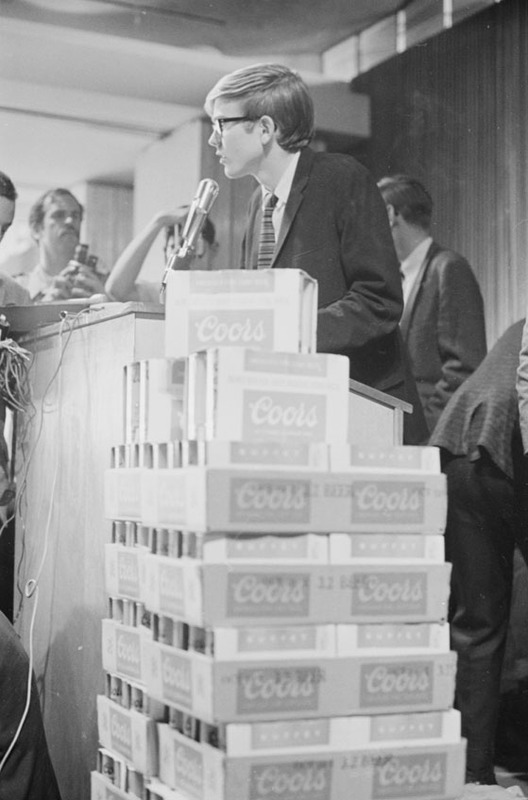
    <summary type="html"><![CDATA[<p><strong><em>Drinking culture in Fort Collins may seem pedestrian today, what with nineteen breweries dotting the city’s landscape, but the barbarous beer and bar culture of contemporary Ft. Collins was born of far more conservative roots. How did  After the repeal of the Volstead act and the resulting end of prohibition in 1933, Fort Collins maintained prohibition far longer than the majority of the country. How did the town's brew culture evolve? It all comes down to a single number: 3.2. </p></strong></p><img src="https://www.intermountainhistories.org/files/fullsize/c6befaad17dcba3f15d5ec36f11ec99f.jpg" alt="Beer-In 1968" /><br/><p>After the repeal of Prohibition in 1933, Fort Collins remained somewhat dry.  On March 22, 1933, the town passed the Cullen-Harrison Act, which allowed lawful distribution and consumption of beer that was 3.2% alcohol by weight - a fairly light brew. </p><p>Some thirty-five years later, students of Colorado State University borrowed demonstration tactics employed by civil rights activists to fight for greater student input in what they felt to be an unfair paternal relationship with university administrators—one of the first items on student protestors’ agenda was the accessibility and consumption of 3.2 beer on campus. How better to demonstrate their frustrations than staging a “beer-in” in the student center? Though the student body was far from unanimous on these matters, on Friday, October 18, 1968, the president of the Associated Students of Colorado State University (ASCSU), Doug Phelps, rallied more than 150 students in the Lory Student Center to stage a “beer-in” under the pretense of liberating the student center. </p><p>As early as November of 1965 students had expressed their displeasure with the lack of 3.2 drinking establishments in Fort Collins. A number of students attended the December 7, 1965, meeting that founded the Fort Collins Malt Beverage Association, a group comprised of city officials, existing tavern owners, and other Ft. Collins merchants. Almost exactly two years later, the ASCSU voted to poll the student body to glean student attitudes in support or opposition to the selling of 3.2 beer on campus. By February 1967, the subject had reportedly become a topic of daily discussion and debate. The State Board of Agriculture, the university governing entity, began debating the topic of 3.2 beer sales on campus by the Spring of 1968. In August of the same year, The State Board of Agriculture voted 4-1 against a request to allow the on-campus sale of 3.2 beer by the glass. On October 10, 1968, a helicopter commissioned by student body president Doug Phelps, flew over CSU campus dropping pamphlets urging students to convene for the “liberation” of the Lory Student Center as soon as possible. The resulting crowd discussed issues of student power, and Phelps announced that on October 18 at 3:00 P.M. he intended to drink beer in the student center in an act that was meant to symbolize the potential of student power to dictate Student Center policy. On October 18, 1968, Phelps and more than 150 other students made good on their promise by staging a beer-in in the Student Center Main Ballroom (only approximately 30 actually drank a beer). Students voiced their desire for beer to be sold in the newly constructed Student Center coffee shop which, perhaps not coincidentally, is the current location of the only on-campus drinking establishment, the beloved Ramskeller. </p><p><em><strong><a href="https://www.intermountainhistories.org/items/show/133">For more (including 4 images) view the original article</a></strong></em></p>]]></summary>
    <published>2018-02-01T19:51:26+00:00</published>
    <updated>2026-04-17T19:32:00+00:00</updated>
    <link rel="alternate" type="text/html" href="https://www.intermountainhistories.org/items/show/133"/>
    <id>https://www.intermountainhistories.org/items/show/133</id>
    <author>
      <name>William Bundy and Keegan Martin, Colorado State University</name>
    </author>
  </entry>
  <entry>
    <title type="html"><![CDATA[Bootlegging, Immigrants, and Crime in Prohibition-Era Fort Collins]]></title>
    <summary type="html"><![CDATA[<p><strong><em>By 1896, the Temperance Movement in Fort Collins celebrated the issuance of Ordinance No. 8 prohibiting the purchase, sale, and gifting of alcohol. The ordinance paved the way for years of crime, illicit trade, and legal conflict as bootleggers worked to meet Fort Collin's continuing demand for alcohol.</em></strong></p><img src="https://www.intermountainhistories.org/files/fullsize/3ab0e6698166c5e00fccc4a98c981820.jpg" alt="Moonshiner Still" /><br/><p>As a result of city-wide prohibition starting in 1896, crime rates in Fort Collins increased. Skirmishes between law enforcement and drunken residents were a common sight, and cases of illegal intoxication often resulted in incarceration into the town’s local “Drunk Tank” or “calaboose." Frequent distillery raids led to additional arrests.  According to an account from Larimer County Sheriff’s officer Orville Pollock Kelly, getting rid of the stills was the “main problem.” During the eight years he worked at the sheriff's office (1925-1933) he never witnessed or heard of anyone being shot in the capture of a whiskey still.</p><p>Immigrants of Russian, German, and Histpanic descent had unique experiences during Fort Collins prohibition. Discrimination took many forms. For many, even making purchases at the grocery store was problematic, as only a select few stores would serve immigrants. Economic disparity between immigrants and white Americans in an already tight economy left some immigrant families seeking ways to augment their income. Some turned to the illicit manufacture and sale of alcohol. When asked what he remembered about bootlegging, lifelong Fort Collins resident Walter Salisbury recalled that the moonshining stills up in the foothills were largely operated by Mexican immigrants. Wages for these people were particularly poor, and discrimination allowed for very few advancement opportunities. Thus the “Bootlegger” scene in Fort Collins came to life, with an old race track located by what is now City Park serving as a “hot spot” of bootlegging activity. </p><p>One notable bootlegger, Cleofas Ambriz, held a daytime occupation as a sugar beet factory laborer but constructed his own still to help combat the poor living conditions. Ambriz explicitly made a point not to sell his moonshine to white members of the community for fear of the legal consequences should he be discovered. Eventually he was caught conducting business in Denver, which temporarily stalled his operations. However, Ambriz’s secret business resumed upon his return to Fort Collins. Salisbury recounted another instance when a Mexican moonshiner who lived near him was imprisoned the man’s son continued with running his father's bootlegging business. </p><p>In Fort Collins, alcohol was sometimes transported and sold through tunnels that ran beneath the streets of Old Town. In the early years of prohibition in Fort Collins (1884-1895), these tunnels were sometimes home to “sampling rooms,” defined as a “quiet, calm environment” where alcohol could be traded and purchased. Other cities in the intermountain west have similar stories, including, for example, Ogden Utah, which has legends of a city-wide tunnel network used for all manner of illicit activities.  </p><p>In 1933, federal prohibition was overturned, and 3.2% alcohol beer was legalized with the passage of the Cullen-Harrison Act. For Fort Collins, however, this was not the end of prohibition altogether, but rather a long period during which the community negotiated the degree to which alcohol should be a legal part Fort Collins life.</p><p><em><strong><a href="https://www.intermountainhistories.org/items/show/132">For more (including 5 images) view the original article</a></strong></em></p>]]></summary>
    <published>2018-02-01T19:42:47+00:00</published>
    <updated>2026-04-17T19:32:00+00:00</updated>
    <link rel="alternate" type="text/html" href="https://www.intermountainhistories.org/items/show/132"/>
    <id>https://www.intermountainhistories.org/items/show/132</id>
    <author>
      <name>Caroline Cutshall, Alan Linenburger, Devan Walsh, and Matt Witczak, Colorado State University</name>
    </author>
  </entry>
  <entry>
    <title type="html"><![CDATA[Early Prohibition and the The Woman&#039;s Christian Temperance Union in Fort Collins]]></title>
    <summary type="html"><![CDATA[<p><strong><em>In the late nineteenth century, women across the United States were fighting for prohibition. The Women’s Christian Temperance Union (WCTU) was one of the most influential nationwide organizations pushing to ban alcohol.  In August of 1880, several local influential local women in Fort Collins, Colorado established a chapter of the WCTU.</em></strong></p><img src="https://www.intermountainhistories.org/files/fullsize/16c89b2946eab17c4c00259ab95e768a.jpg" alt="137 Matthew Street, McIntyre Home" /><br/><p>Prohibition began in Fort Collins in 1896, over twenty years before the 21st Amendment was passed. According to first-hand accounts gathered by Fort Collins historian Ansel Watrous, Fort Collins was a wide open town “full of idle and vicious men, driftwood from railroad and ditch camps, irresponsible creatures, without home or friends who hung about the saloons and brothels" prior to prohibition. Women founded the WCTU to combat such perceived characteristics of the northern Colorado town.  The passage of women's suffrage in 1893 in Colorado fueled aided the WCTU formation and quest to permanently end the sale of liquor in the state. This movement provided women in Fort Collins (and elsewhere) an early chance to influence their community and participate in public politics.</p><p>The meetings of the WCTU, according to an issue of the Fort Collins Courier published on August 9, 1894, were held at a variety of locations including churches and the Fort Collins Opera House on College Avenue; however, the majority of the meetings were held in the intimate confines of important members’ homes and parlors. One such home was the residence of Mrs. Lucy McIntyre. Lucy McIntyre was one of the founders of the WCTU of Fort Collins and Watrous described her as “devoted to the work of uplifting humanity.” Mrs. McIntyre and other members of the WCTU felt that the abolition of alcohol would improve the quality of life in Fort Collins. As Emily Abbot, a prominent member of the local WCTU described it, the members feared that “one-third of the men of this community are surely traveling the road that leads to destruction of mind, of body, and of soul...manhood destroyed, intellect in ruins, families made miserable.” At their meetings, the women discussed temperance literature and promoted prohibitionist ideas. For example, at one meeting Mrs. McIntyre provided figures that she claimed plainly proved “how much better it is to govern a city according to the ‘Good Old Book’.”  </p><p>The women had their first success in April 1884, when the town passed an anti-liquor ordinance. This ordinance, however, was repealed a year later and the city returned to a high license fee ordinance. . In 1895, Ordinance No. 8 passed and reads: “it is unlawful for any person or persons…to sell or give away intoxicating malts, vinous, mixed, fermented or spirituous liquors within the corporate limits of the City of Fort Collins.” The city of Fort Collins remained a dry town until 1969.</p><p><em><strong><a href="https://www.intermountainhistories.org/items/show/131">For more (including 3 images) view the original article</a></strong></em></p>]]></summary>
    <published>2018-02-01T19:35:50+00:00</published>
    <updated>2026-04-17T19:32:00+00:00</updated>
    <link rel="alternate" type="text/html" href="https://www.intermountainhistories.org/items/show/131"/>
    <id>https://www.intermountainhistories.org/items/show/131</id>
    <author>
      <name>Owen England, Matt Hood, Jourdyn Russell, and Madi Steine, Colorado State University</name>
    </author>
  </entry>
</feed>