<?xml version="1.0" encoding="UTF-8"?>
<feed xmlns="http://www.w3.org/2005/Atom">
  <title type="text">Intermountain Histories</title>
  <updated>2026-08-18T16:00:24+00:00</updated>
  <generator uri="http://framework.zend.com" version="1.12.20">Zend_Feed_Writer</generator>
  <link rel="alternate" type="text/html" href="https://www.intermountainhistories.org/"/>
  <link rel="self" type="application/atom+xml" href="https://www.intermountainhistories.org/items/browse?output=rss2"/>
  <id>https://www.intermountainhistories.org/</id>
  <author>
    <name>Intermountain Histories</name>
    <uri>https://www.intermountainhistories.org</uri>
  </author>
  <link rel="hub" href="https://pubsubhubbub.appspot.com/"/>
  <entry>
    <title type="html"><![CDATA[The Boone and Crockett Club&#039;s Connection with Theodore Roosevelt: Story 8 of 8 of the President Theodore Roosevelt in the West Tour]]></title>
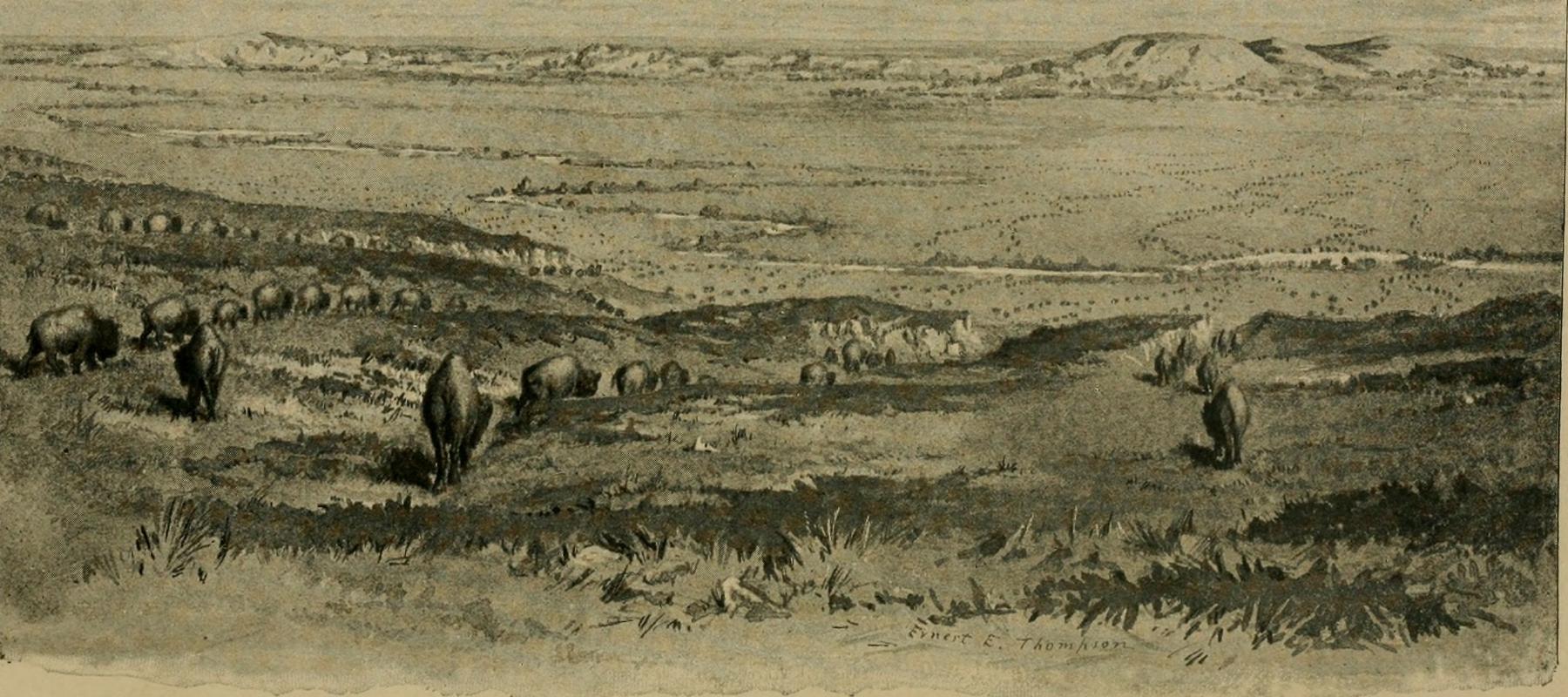
    <summary type="html"><![CDATA[<p><strong><em>By the late 1800s, Western sportsmen and settlers were hunting wildlife at such a rapid pace that many species risked extinction. Theodore Roosevelt recognized this and founded a club dedicated to conserving the land, resources, and wildlife for future generations.  </em></strong></p><img src="https://www.intermountainhistories.org/files/fullsize/31a977bb0a49566874be31d932edb7f7.jpg" alt="Artist’s depiction of big game in the American West in the late 19th century" /><br/><p>At the end of the 19th century, big game hunting became so popular that many wildlife populations faced extinction. Western railways increased access to previously remote regions, accelerating settlement. This Westward expansion also created a surge of irresponsible hunting for food, trophies, and improper land use. In 1883, on a trip to Little Cannonball Creek in Montana, Roosevelt enthusiastically hunted his first buffalo. Amid the thrill of this first-time accomplishment, he also reflected on the animal’s scarcity in his journal, “I watched the great beasts as they grazed...mixed with the eager excitement of the hunter was a certain half-melancholy feeling as I gazed on these bison, themselves part of the last remnant of a doomed and nearly vanished race.”
Like Roosevelt, many other sportsmen noticed how quickly wildlife in the West was disappearing. Determined to preserve his hobby and the land he loved, Roosevelt gathered fellow hunters to form the Boone and Crockett Club. Named after Daniel Boone and Davy Crockett, two famous frontiersmen and heroes of American expansion, the club advocated for the conservation and management of wildlife and habitat in the nation’s newest territories.
Founded on December 7, 1887, with the help of visionaries like George Bird Grinnell, Madison Grant, Gifford Pinchot, and 20 others, the club helped enact many legislative acts to protect and manage public lands. With their great influence, they initiated management regulations in the nation's first National Parks like Yellowstone, Glacier, and the Grand Canyon. They lobbied for federal laws that passed, including the 1891 General Revision Act (also known as the Forest Reserve Act), which enabled the President to withdraw forested lands from the public domain and offer them protections not guaranteed under previous legislation like the 1873 Timber Culture Act. This led to millions of acres being designated as “forest reserves” in the following two decades.
Roosevelt continued his efforts and spoke out about conservation when he was president with his annual address to Congress in 1907, saying, "Optimism is a good characteristic, but if carried to an excess, it becomes foolishness. We are prone to speak of the resources of this country as inexhaustible; this is not so." Educating the public, one of the club's biggest successes was the “Fair Chase” hunting ethic. This philosophy influenced game laws in the United States and created a system of data collection to monitor North American habitat health and big game populations today. Dedicated hunters and naturalists in the Boone and Crockett Club continually play a key role in balancing the well-being of the wild and the enjoyment of future generations. Roosevelt emphasized the importance in his book, My Life as a Naturalist, in 1918, “While my interest in natural history has added very little to my sum of achievement, it has added immeasurably to my sum of enjoyment of life.” He speaks for the wildlife as it cannot speak for itself.</p><p><em><strong><a href="https://www.intermountainhistories.org/items/show/925">For more (including 3 images) view the original article</a></strong></em></p>]]></summary>
    <published>2025-10-24T15:03:20+00:00</published>
    <updated>2026-08-18T15:52:41+00:00</updated>
    <link rel="alternate" type="text/html" href="https://www.intermountainhistories.org/items/show/925"/>
    <id>https://www.intermountainhistories.org/items/show/925</id>
    <author>
      <name>Jessika Cole, Brigham Young University</name>
    </author>
  </entry>
  <entry>
    <title type="html"><![CDATA[Theodore Roosevelt and the Havasupai in the Grand Canyon: Story 2 of 8 of the President Theodore Roosevelt in the West Tour]]></title>
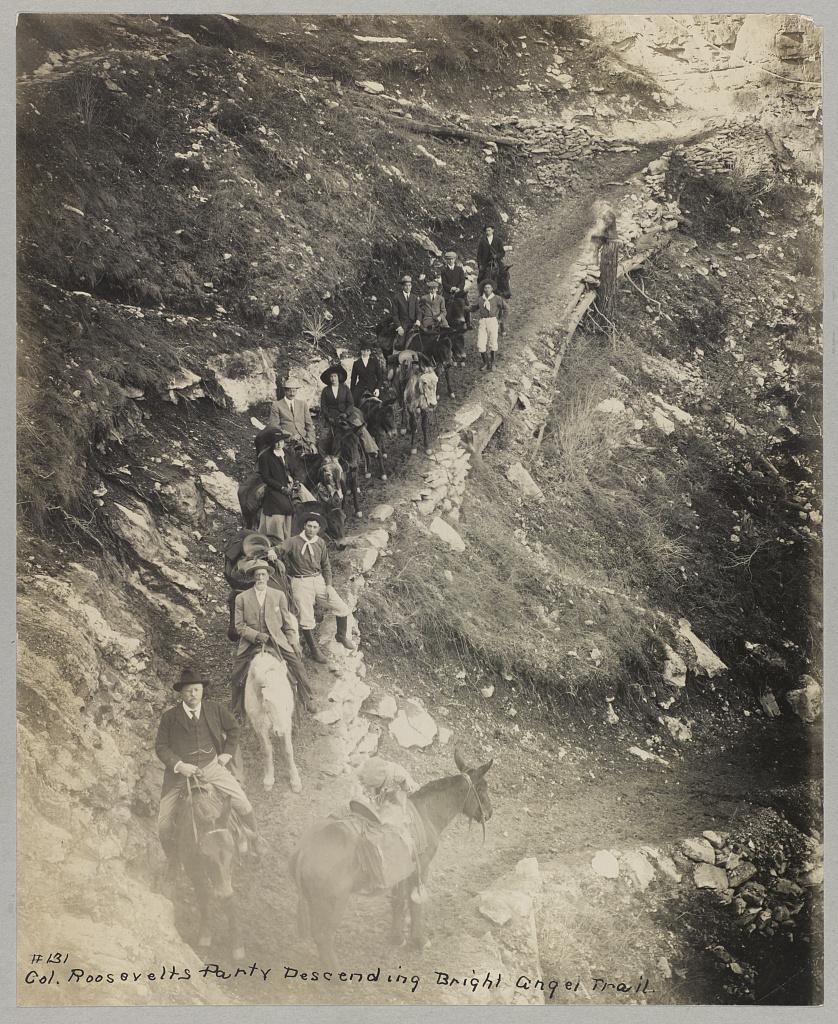
    <summary type="html"><![CDATA[<p><strong><em>President Theodore Roosevelt visits the Grand Canyon meeting the Havasupai Tribe. His efforts are making this landmark a National Park.</em></strong></p><img src="https://www.intermountainhistories.org/files/fullsize/81adde6a6a5c04daf97ec29b93d422ee.jpg" alt="Down a winding pathway, Theodore Roosevelt and others ride mules down Bright Angel Trail in the Grand Canyon" /><br/><p>Theodore Roosevelt traveled over 14,000 miles, visiting over 25 states, in the span of nine weeks in the early summer of 1903. His western tour was filled with speeches, commemorations, and his favorite thing to do: exploring the outdoors. His tours of Yosemite and Yellowstone are widely known, but in between them, he visited the Grand Canyon on May 6, 1903. He said, giving a speech, “In the Grand Canyon, Arizona has a natural wonder which, so far as I know, is absolutely unparalleled throughout the rest of the world.” Astounded, he said, “I shall not attempt to describe it, because I cannot. I could not choose words that would convey or that could convey to any outsider what that canyon is.” The majesty of Earth’s beauty there led him to explore more.
Riding a mule down Bright Angel Trail, he met two natives from the Havasupai tribe who lived in the Indian Garden with their families. For 1,000 years, the tribe lived in this region without outside contact, until Spanish priest Francisco Garces explored the area in 1776. As a result of the Santa Fe Railroad in the early 18th century, the Havasupai had increasingly more contact with other explorers and settlers. When Roosevelt and his regiment visited, he asked them to leave to make the canyon a National Park. To gain the status of a national park, all private development on the land would be illegal according to Congress. This resulted in the Havasupi’s relocation to a 518-acre reservation in Havasu Canyon instead.
Roosevelt was also concerned about the commercialization and exploitation of the land due to encroaching mining and timber interests. On June 8th, 1906, he signed the Antiquities Act, which authorized the president to “declare by public proclamation historic landmarks, historic and prehistoric structures, and other objects of historic or scientific interest that are situated upon the lands owned or controlled by the Government of the United States to be national monuments.” Subsequently, this act was used to establish the Grand Canyon National Monument on January 11th, 1908. It was made a National Park in 1919. Roosevelt Point and Trail were named in the President’s honor for the efforts he provided. A placard at Roosevelt Point reads another part from his speech advocating one request, “Leave it as it is. You can not improve on it. The ages have been at work on it, and man can only mar it. What you can do is to keep it for your children, your children's children, and for all who come after you, as one of the great sights which every American, if he can travel at all, should see.” Poetically, he wrote a letter to John Hay, former Secretary of State, summing up his experience on his Western tour and paying special attention to the Grand Canyon, “To me the most impressive piece of scenery I have ever looked at. I don’t exactly know what words to use in describing it. It is beautiful and terrible and unearthly. It made me feel as if I were gazing at a sunset of strange and awful splendor.” Today, almost 5 million tourists continue to explore this canyon that Roosevelt cared so profoundly to preserve.</p><p><em><strong><a href="https://www.intermountainhistories.org/items/show/924">For more (including 4 images) view the original article</a></strong></em></p>]]></summary>
    <published>2025-10-24T15:03:19+00:00</published>
    <updated>2026-08-18T15:52:34+00:00</updated>
    <link rel="alternate" type="text/html" href="https://www.intermountainhistories.org/items/show/924"/>
    <id>https://www.intermountainhistories.org/items/show/924</id>
    <author>
      <name>Jessika Cole, Brigham Young University</name>
    </author>
  </entry>
  <entry>
    <title type="html"><![CDATA[Theodore Roosevelt and Roosevelt Dam: Story 6 of 8 of the President Theodore Roosevelt in the West Tour]]></title>
    <summary type="html"><![CDATA[<p><strong><em>President Theodore Roosevelt dedicated the Roosevelt Dam. At the time, it was the largest artificial lake and the largest masonry dam in the United States. </em></strong></p><img src="https://www.intermountainhistories.org/files/fullsize/a6393024b0add557182e524e08d64ac1.jpg" alt="Apache Indian men working on Roosevelt Dam" /><br/><p>The signing of the Newlands Reclamation Act by President Theodore Roosevelt in 1902 began “the construction of irrigation works for the reclamation of arid lands.” One of the first projects authorized under this act was the world’s largest masonry dam, the Roosevelt Dam. The first stone was placed on September 20, 1906. Benjamin Austin Fowler, a former lawyer from New York City, was central to the dam’s construction. Having left the city scene, Fowler moved to the West in 1899, where he purchased 400 acres in Glendale, Arizona, to become a farmer. With the dry climate and high temperatures, water was scarce, and his farming would be greatly aided if a reservoir could provide steady irrigation water access. Fowler lobbied for 17 years for a dam and reservoir to be constructed northeast of Phoenix, in a narrow canyon of the Salt River. The Roosevelt Dam was built to provide flood control, municipal and irrigation water, and hydropower for central Arizona. This project involved over 3,000 diverse workers. There was a shortage of workers in the summer because of the intense heat, and one of the engineers remarked, “White men won’t stay on this job because they cannot spend their money fast enough.” In turn, they hired Apache Indians who had already long dwelt in the area, and who had excellent labor skills. They completed the dam on February 5, 1911. Roosevelt Lake was the largest artificial lake in the world when it held over 1 million acres of water.
One month later, on March 18th, former President Theodore Roosevelt came with a wagon parade to dedicate the dam. As most of the previous roads were then under the waters of the new reservoir, they took a route up the Apache Trail. Roosevelt reflected on the beauty of the wildflowers and landscapes in his dedicatory speech. At 5:48 pm and with about 1,000 spectators, he flipped the electric switch and opened the gate to begin Arizona’s new era of water control. This contributed to many settlements and a growing community that would not have existed otherwise. Serving communities with sustainable water and energy, Fowler’s and Roosevelt’s efforts paid off as the Scientific American newspaper publicized on the dam’s dedication day, “With the completion of the irrigation system which is being constructed by the federal government, we may safely predict for this valley an era of progress and substantial growth which will place it in the forefront of the most up-to-date agricultural districts in the world.”
The Salt River Project has monitored Roosevelt Dam since 1911, and the site has changed in many ways. In 1992, overflowing problems necessitated renovations. The road to drive across it was removed, the dam was raised 23.5 meters, and a bridge was suspended over Roosevelt Lake. Today, many make the trek to enjoy the water and view the architectural feat that the Roosevelt Dam is.</p><p><em><strong><a href="https://www.intermountainhistories.org/items/show/923">For more (including 4 images) view the original article</a></strong></em></p>]]></summary>
    <published>2025-10-24T15:03:19+00:00</published>
    <updated>2026-08-18T15:52:26+00:00</updated>
    <link rel="alternate" type="text/html" href="https://www.intermountainhistories.org/items/show/923"/>
    <id>https://www.intermountainhistories.org/items/show/923</id>
    <author>
      <name>Jessika Cole, Brigham Young University</name>
    </author>
  </entry>
  <entry>
    <title type="html"><![CDATA[Theodore Roosevelt&#039;s Ride Through the Cowboy State: Story 5 of 8 of the President Theodore Roosevelt in the West Tour]]></title>
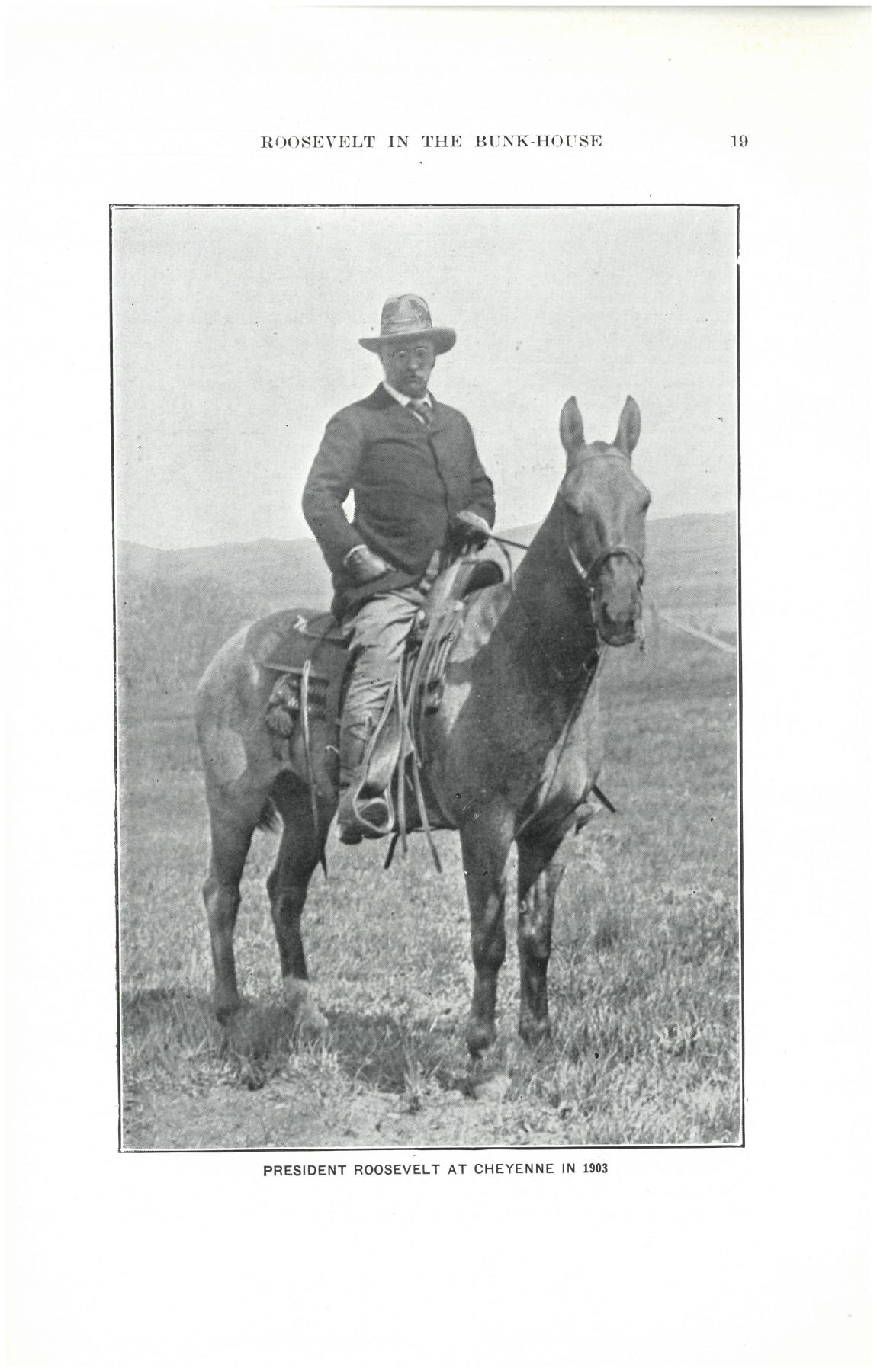
    <summary type="html"><![CDATA[<p><strong><em>President Theodore Roosevelt's iconic horseback ride from Laramie to Cheyenne to greet the veterans and citizens of Wyoming.</em></strong></p><img src="https://www.intermountainhistories.org/files/fullsize/60adc8f5c3838543347d6d16506e64cc.jpg" alt="President Roosevelt mounted on Ragalon, a horse who could count, bow, roll over, and distinguish colors. It was a “fine galloper and a speedy trotter.” " /><br/><p>President Theodore Roosevelt had a penchant for the dramatic in his public persona. His 1903 visit to Wyoming and May 31 speech commemorating Decoration Day (Memorial Day) was no exception.
Upon arrival in Evanston, Wyoming, via train from the west, President Theodore Roosevelt was greeted by a crowd of 7,000 peoplegathered from Wyoming and surrounding states to see the Commander in Chief. After a short visit, he continued east to Laramie, Wyoming. From there, he rode the remaining 65 miles to Cheyenne, Wyoming, on horseback. Along the way, he changed horses four times with prominent citizens like Senator Francis E. Warren and famous lawman and Black Hills Forest Reserve Supervisor Seth Bullock.Senator Warren, in a telegram, said it would be a “long, hard ride,”and indeed it was. Familiar with risk and discomfort, and always eager to make a dramatic scene, Roosevelt’s party emerged from a mountain valley near Telephone Canyon and was greeted by a crowd in Cheyenne. The Cheyenne Daily Leader later wrote, "The West was written in every line of his frame," alluding to Roosevelt’s strong connection with the land and spirit of the West. The stunt exemplified his well-known advocacy for the “strenuous life” and love of the West. Having “waved all possible objections” to overcome the difficulties he might have encountered, Roosevelt felt the West as a very restorative place. At the lowest point in his life, when his mother and wife died the same day, he had “lost the light” in his life but found it again in the American West.
Nearly 20,000 citizens gathered in Cheyenne to hear the President speak on May 31, 1903. Reflecting on his horseback arrival, he stated his desire “not to strive to find out the things that are easiest to do, but the things that are best worth doing.” The crowd included Civil War veterans in both Confederate gray and Union blue uniforms. With them in view, he emphasised the importance of national unity. Referring to the their wartime service, he declared “You don’t care where that man’s birthplace has been; you don't care a snap of your fingers how he worshiped his Maker; you don't care whether he was a banker, bricklayer, lawyer, mechanic, or farmer” Perhaps hoping to point to bridging divides between former enemies, he continued, “It is the same thing now in civil life.”His message was well-received, and the citizens reflected that sense of community with a frontier twist. A handsome cowpony, Ragalon, was gifted to Roosevelt with a specially made saddle, bridle, and blanket. Roosevelt was also entertained with an impromptu frontier show and many barbecues during his stay. 
This time in Wyoming marked the value Roosevelt had for veterans and small towns in America. His personability with common Americans, honored veterans included, helped boost his popularity in the subsequent 1904 election. Roosevelt loved the West, and the West loved him back.</p><p><em><strong><a href="https://www.intermountainhistories.org/items/show/922">For more (including 4 images) view the original article</a></strong></em></p>]]></summary>
    <published>2025-10-24T15:03:18+00:00</published>
    <updated>2026-08-18T15:52:16+00:00</updated>
    <link rel="alternate" type="text/html" href="https://www.intermountainhistories.org/items/show/922"/>
    <id>https://www.intermountainhistories.org/items/show/922</id>
    <author>
      <name>Jessika Cole, Brigham Young University</name>
    </author>
  </entry>
  <entry>
    <title type="html"><![CDATA[Teddy Roosevelt and John Muir Adventures in Yosemite: Story 3 of 8 of the President Theodore Roosevelt in the West Tour]]></title>
    <summary type="html"><![CDATA[<p><strong><em>President Theodore Roosevelt and his guide John Muir explored California’s beautiful National Park, Yellowstone, resulting in a nationwide conservation effort. </em></strong></p><img src="https://www.intermountainhistories.org/files/fullsize/091739d27efed8fc403fa07e54012ffd.jpg" alt="Theodore Roosevelt and John Muir pose in front of Glacier Point at Yosemite" /><br/><p>With a fondness for adventure, the outdoors, and the American West, President Theodore Roosevelt itched to experience the natural landscapes in California he’d heard so much about. Yosemite was one of only two national parks at the turn of the century, and he felt it fitting to include that stop in his 1903 Western tour. Roosevelt wrote a letter to John Muir, a Scottish botanist and conservationist who caught the President’s attention with his non-fiction novel “Our National Parks,” and asked him to be his guide. “I do not want anyone with me but you, and I want to drop politics absolutely for four days and just be out in the open with you.” Muir had an overseas journey planned in Europe and Asia at that time that he didn’t think he could cancel. After explaining the situation to the President of the University of California, Benjamin Ide Wheeler, he got an appeal and joined Roosevelt in the mountains, “I might be able to do some forest good in freely talking around the campfire,” Muir mused. As per Roosevelt’s request, politics were not discussed, but Muir’s agenda was nonetheless accomplished: to advocate for the land in the American West.
Roosevelt and his contingent arrived at Yosemite’s Wawona Hotel on May 15, 1903. With others remaining there, Muir, Roosevelt, a cook, two packers, and four mules left for the trees. They traveled through the giant sequoias, wandered through Mariposa Grove in the valley, and one night after camping at Glacier Point, they woke up to a blanket of snow, five inches atop them. If Roosevelt didn’t have forty wool blankets his men laid down for him and a warm fire by his side, he would have froze! Nonetheless, the men had great conversations. Charles Leidig was the cook and documented that “they talked a great deal about the conservation of forests in general and Yosemite in particular.” He also said, “he heard them discussing the setting aside of other areas in the United States for park purposes.” Muir had, indeed, done the “forest good.”
This trip jump-started Roosevelt's efforts to preserve public lands and natural resources across the nation. He was impressed to immediately go to Congress when returning to Washington and implement some of Muir’s ideas. He pushed for wildlife reserves, and on June 8, 1906, he signed the Antiquities Act which allowed the President to “declare by public proclamation historic landmarks” to be “national monuments, and may reserve as a part thereof parcels of land, the limits of which in all cases shall be confined to the smallest area compatible with proper care and management of the objects to be protected.” Roosevelt famously said in a speech in Sacramento after his experience in Yosemite, “We are not building this country for a day. It is to last through the ages.” Yosemite laid the groundwork for protecting other national forests in California and across the nation.</p><p><em><strong><a href="https://www.intermountainhistories.org/items/show/921">For more (including 3 images) view the original article</a></strong></em></p>]]></summary>
    <published>2025-10-24T15:03:18+00:00</published>
    <updated>2026-08-18T15:52:06+00:00</updated>
    <link rel="alternate" type="text/html" href="https://www.intermountainhistories.org/items/show/921"/>
    <id>https://www.intermountainhistories.org/items/show/921</id>
    <author>
      <name>Jessika Cole, Brigham Young University</name>
    </author>
  </entry>
  <entry>
    <title type="html"><![CDATA[The Big Stick: Teddy Roosevelt Speaks at Idaho University: Story 7 of 8 of the President Theodore Roosevelt in the West Tour]]></title>
    <summary type="html"><![CDATA[<p><strong><em>“Ex-President Theodore Roosevelt visits the University of Idaho to give a speech and plant a tree,” read an article from Moscow, Idaho’s Daily Argonaut in anticipation of his April 9, 1911, visit to town.</em></strong></p><img src="https://www.intermountainhistories.org/files/fullsize/c5ffffacc9410315cdef74f37b166af9.jpg" alt="Theodore Roosevelt address Idaho citizens atop a stack of wheat sacks. This is a nod to his time as a Rough Rider and agricultural advancements in Idaho" /><br/><p>Even though he had visited Idaho twice before, President Theodore Roosevelt’s spring 1911 visit to the state was no less elaborate and momentous. His escort through Moscow, Idaho, could barely get to his hotel as the streets were so packed full of excited spectators. After arriving at his hotel and indulging in an informal Sunday dinner with “a small party of political officials,” Roosevelt appeared grandly at the University of Idaho the following morning, April 9, 1911. From breakfast in Ridenbaugh Hall with about 80 of the school’s finest, “university faculty, several prominent citizens and government officials, and the presidents and secretaries of the various classes of the university” Roosevelt was “escorted by the Grand Army Corps, carrying the American flag, and by a company of the University cadets” and saluted by the students until he arrived in front of the administrative building. A crowd Roosevelt estimated to be about 20,000 gathered to hear his address.
The setup for Roosevelt’s speech was unusual. The Administration building’s front doors were stacked with what seemed to be sandbags but were in fact sacks of wheat. This was a nod to northern Idaho’s agricultural industry. It made for a striking image as the adventurous former president climbed and spoke from the top of the pile. His 45-minute speech urged Idaho to “follow the rest of the West in progressive legislation.” Roosevelt was preparing to run for his 3rd term as the Progressive Party (also nicknamed the Bull Moose Party) candidate. He continued that, “true government by the people once obtained and improperly used, would work out for us, not salvation, but damnation.” After concluding, the crowd witnessed Roosevelt planting a tree on the university’s lawn. Still standing today, with a placard label, Roosevelt’s Colorado Blue Spruce is a reminder of Roosevelt’s 1911 visit and his views on forestry, the outdoors, and conservation. Speech and tree-planting concluded, Roosevelt made his way to the train station and departed Moscow by 10:30 AM.
This particular visit to the University of Idaho made a special impact through symbolism and memorabilia. Reflecting on the University’s motto, “For the training of Idaho's future citizens to their highest usefulness in private life and public service” Roosevelt said he admired the ideals that were expressed and that “the pioneer spirit is still the proper spirit, but with it we must prepare to meet new conditions.” His tree planting stunt helped those present remember the importance of the conservation of natural resources. With its presence standing tall on campus today, it serves as a reminder for the current generations to be good farmers and good citizens.
 </p><p><em><strong><a href="https://www.intermountainhistories.org/items/show/920">For more (including 3 images) view the original article</a></strong></em></p>]]></summary>
    <published>2025-10-24T15:03:17+00:00</published>
    <updated>2026-08-18T15:51:59+00:00</updated>
    <link rel="alternate" type="text/html" href="https://www.intermountainhistories.org/items/show/920"/>
    <id>https://www.intermountainhistories.org/items/show/920</id>
    <author>
      <name>Jessika Cole, Brigham Young University</name>
    </author>
  </entry>
  <entry>
    <title type="html"><![CDATA[Yellowstone’s Favorite President’s Monument: Roosevelt Arch: Story 1 of 8 of the President Theodore Roosevelt in the West Tour]]></title>
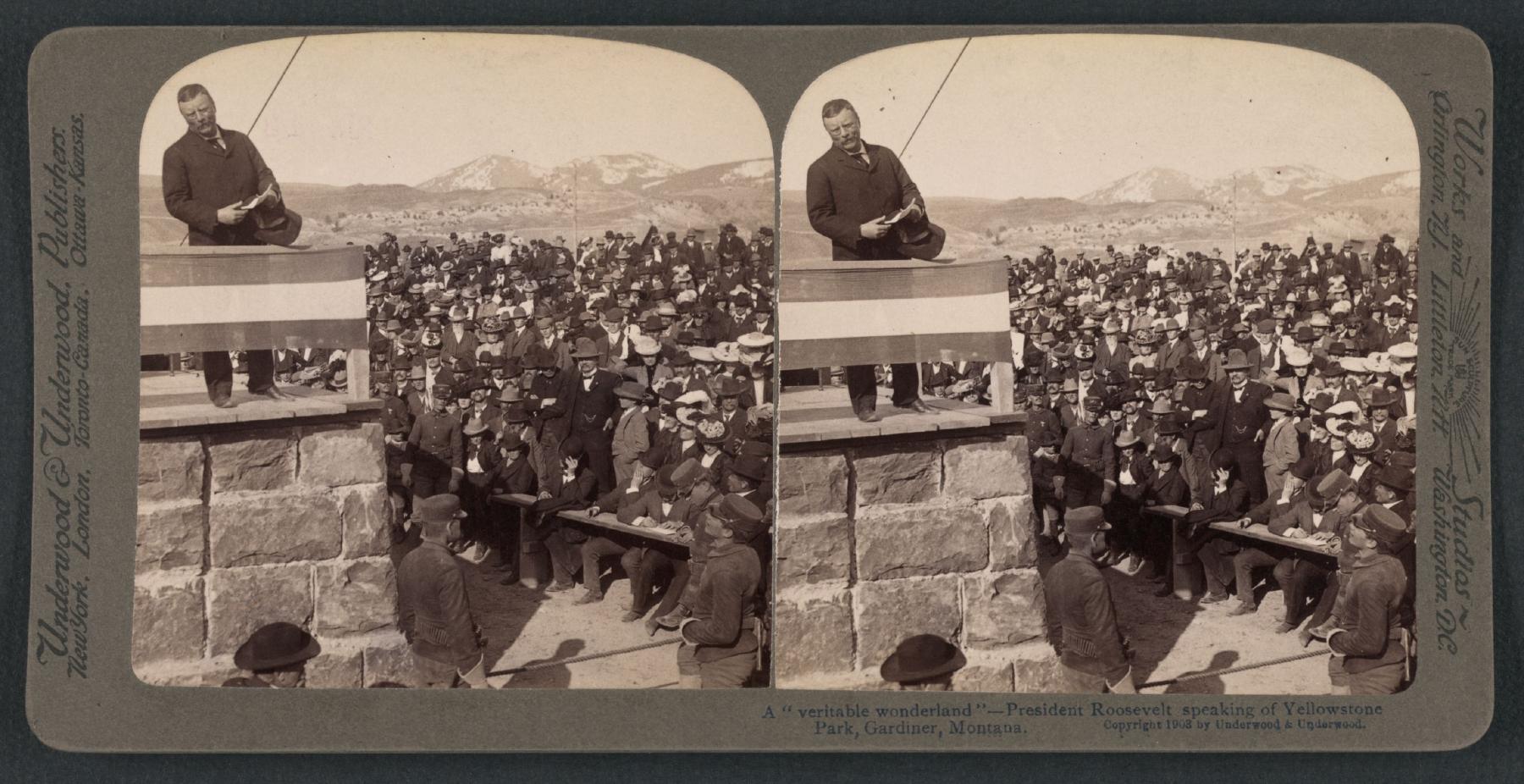
    <summary type="html"><![CDATA[<p><strong><em>Yellowstone receives an upgraded welcome with the Roosevelt Arch and gets a surprise visitor, Theodore Roosevelt, to dedicate it. </em></strong></p><img src="https://www.intermountainhistories.org/files/fullsize/f5ae52940338461ed18d1b83497abbb0.jpg" alt="President Roosevelt addresses a crowd at the dedication of Roosevelt Arch" /><br/><p>“Dedicated and set apart as a public park or pleasuring-ground for the benefit and enjoyment of the people.” Roosevelt Arch is a hearty welcome on the North entrance side of Yellowstone National Park. Standing at 52 feet, this monument is a symbol ofthe cultural and natural significance of the Park. Erected in 1903, the arch spanned what was at the time the park’s only entrance. Visitors passed under the arch from Gardiner, Montana, taking stagecoaches into Yellowstone. Army Co Engineer, Hiram M. Chittenden, the idea man, said, “...the natural features of the country at this portion of the boundary are about the least interesting of any part of the Park, and the first impression of visitors upon entering the Park was very unfavorable.” Accordingly, he proposed the arch as a beautiful park entry. Construction began on February 19, 1903 and a dedication ceremony was planned for April 24, 1903 to coincide with Roosevelt's planned visit to the park.</p><p>Yellowstone Park officials asked Roosevelt to participate in the event. This was a perfect opportunity for his conservation efforts and love for the park. With great fanfare, Roosevelt shared, “The geysers, the extraordinary hot springs, the lakes, the mountains, the canyons, and cataracts unite to make this region something not wholly to be paralleled elsewhere on the globe.” His love for the land was shared with the visitors there. They added a time capsule in the arch containing local newspapers, a bible, Masonic documents, a picture of President Roosevelt, and U.S. coins, among other items.
Roosevelt Arch still stands as a ceremonial welcoming committee to Yellowstone. Although not as popular as it was in the 20th century because of changing traffic patterns, automobiles couldn’t take the route like stagecoaches had, it is still a valuable spot to visit when exploring the park. Multiple entrances being added make this an out-of-the-way stop for those accessing the park from the more popular southern and western entrances. Yellowstone is visited by approximately 4 million people annually, and the arch continues to be a popular destination, especially for those visiting the Mammoth area or arriving from points north. It was added to the National Register of Historic Places in 2002 and is a potent symbol and reminder that National parks are “For the benefit and enjoyment of the people” as Theodore Roosevelt referenced the Act Congress passed in 1872 making Yellowstone a public park in his speech, and is not engraved on a place at the top of the arch itself.</p><p><em><strong><a href="https://www.intermountainhistories.org/items/show/919">For more (including 4 images) view the original article</a></strong></em></p>]]></summary>
    <published>2025-10-24T15:03:17+00:00</published>
    <updated>2026-08-18T15:51:51+00:00</updated>
    <link rel="alternate" type="text/html" href="https://www.intermountainhistories.org/items/show/919"/>
    <id>https://www.intermountainhistories.org/items/show/919</id>
    <author>
      <name>Jessika Cole, Brigham Young University</name>
    </author>
  </entry>
  <entry>
    <title type="html"><![CDATA[Teddy Roosevelt&#039;s Welcome in the Beehive State: Story 4 of 8 of the President Theodore Roosevelt in the West Tour]]></title>
    <summary type="html"><![CDATA[<p><strong><em>President Teddy Roosevelt's Welcome in the Beehive State and his patriotic parade. He addresses Utah citizens and their advancements in irrigation and economics. </em></strong></p><img src="https://www.intermountainhistories.org/files/fullsize/a7ca3d8cfd35ec2ca4a058b9d4af50b2.jpg" alt="President Roosevelt speaks to Ogden citizens on his way to Salt Lake City" /><br/><p>Incoming from Ogden, Utah, pulled by the Union Pacific Engine No. 659, President Theodore Roosevelt steps onto the Oregon Short Line Depot on May 29th, 1903, at 8:30 am, greeted by thousands waiting for his arrival since 6 am. The Salt Lake Tribune newspaper covers the day as the itinerary is published, highlighting, “Today Salt Lake and Utah have the distinguished honor of entertaining the Chief Magistrate of the United States. An enthusiastic welcome is accorded, and our only regret is the briefness of the visit.” On his whistle-stop tour of the West, Roosevelt is adorned with cheers and taken through a parade around Salt Lake City with a route lined with 50,000 people, flags, ribbons, and all manner of decorations along the street. Stores closed, and the city practically shut down other than essentials to welcome in the 26th president. Roosevelt delighted seeing a “little tot of the kindergarten…” and was impressed to say, “I am very glad to see you. I believe in work and I believe in play. Play hard while you play; and when you work, don’t play at all. That is good advice for children, and it is good advice for grown folks too. It is a great pleasure to see you.” With a big, burly grin, Roosevelt paraded Eastward from West South Temple Street to Main Street, passing by school children and mounted soldiers until he arrived at his destination, the Tabernacle.
The Salt Lake City Tabernacle was also decorated with banners, greenery, flags, and ribbons. It was a common congregating location for members of the Church of Jesus Christ of Latter-day Saints and was used to host Roosevelt’s address to the citizens of Utah. The Salt Lake Herald reported the next day that the, “Historic old building could not accommodate the throngs that gathered there” it was so packed. Roosevelt was accompanied by Senator Thomas Kearns, members of the influential Alta Club and Lester Club, LDS Church President Joseph F. Smith, Mayor Ezra Thompson, Governor Heber Manning Wells, and singer Emma Ramsey (also known as “The Utah Nightingale.”) Ramsey opened the event by singing “Rent the Air,” according to the Deseret News. Roosevelt covered many topics he was known for, including his love of the wilderness and respect for the land<b>. </b>His point about conservation was made, “while citizens die, the government and the nation do not die, and we are bound in dealing with the forests to exercise the foresight necessary to use them now, but to use them in such way as will also keep them for those who are to come after us.” This was a great feat, particularly in Utah, as he emphasized the hard work of the citizens, “You took territory which at the outset was called after the desert, and you literally—not figuratively—you literally made the wilderness blossom as the rose.” Utah’s happy reaction was reflected in the evening newspaper, “It is not often that Salt Lake gets to look upon the actual person of a president of the United States, but when it does it enjoys it thoroughly. The appreciation it felt today of the honor of the visit was manifest in every possible manner. Its citizens turned out with pride and turned her children out with still greater pride.”
After his short visit, Roosevelt was back on the train at 1:00 p.m. Utah citizens celebrated his visit with great remembrance. It strengthened the state’s relationship with the federal government and aided Roosevelt’s success in gaining Utah’s vote for the 1904 presidential election. For the rest of his Western tour, he created a precedent of energy and patriotism that Theodore Roosevelt was known for sharing.</p><p><em><strong><a href="https://www.intermountainhistories.org/items/show/918">For more (including 5 images) view the original article</a></strong></em></p>]]></summary>
    <published>2025-10-24T15:03:16+00:00</published>
    <updated>2026-08-18T15:51:43+00:00</updated>
    <link rel="alternate" type="text/html" href="https://www.intermountainhistories.org/items/show/918"/>
    <id>https://www.intermountainhistories.org/items/show/918</id>
    <author>
      <name>Jessika Cole, Brigham Young University</name>
    </author>
  </entry>
  <entry>
    <title type="html"><![CDATA[JFK at the Salt Lake City Tabernacle (Mormon Tabernacle)<br />
: Story 4 of 5 of the John F. Kennedy’s Conservation Tour in September, 1963 Tour]]></title>
    <summary type="html"><![CDATA[<p><strong><em>The State of Utah was John F. Kennedy’s next stop during his 1963 Conservation Tour. He delivered two speeches. The first one was at the Salt Lake Tabernacle. It is notable that nearly all American presidents have spoken from its podium since its construction in 1867.</em></strong></p><img src="https://www.intermountainhistories.org/files/fullsize/48b0f684a20b7032c575ac4df901cd2e.jpg" alt="Conservation Tour of Western States: Utah, Salt Lake City: Address at Mormon Tabernacle, 8:18 PM" /><br/><p>The president arrived at the Mormon Tabernacle on Temple Square in Salt Lake City at 7:50 p.m. on Thursday, September 26, 1963. The program at the Tabernacle started at 8:00 p.m., and more than eleven thousand people (eight thousand inside and three thousand outside on the grounds of the Tabernacle) gathered to hear the president speak.</p><p>Before talking about environmental protection or domestic and foreign affairs, Kennedy emphasized the history of the Tabernacle and of the Mormon community. He said he was “proud to be back in this historic building,” noting that he had already given a speech at the Tabernacle during his 1960 presidential campaign. The President highlighted the invaluable contribution of American pioneers and settlers, the Mormon Trail, and the founders of the Mormon community, who were courageous, faithful, self-reliant, and determined to see the right prevail.</p><p>Kennedy was sure that Salt Lake City was the perfect place to talk about what could be done to preserve natural resources and the precious environment of the Salt Lake region. Besides natural resources, the president also mentioned the importance of preserving human resources, by which he meant human spirit and perseverance.</p><p>John F. Kennedy emphasized the contribution of the state of Utah not only in the field of conservation, but also in the education of children. He pointed out that a very high percentage of boys and girls at that moment were able to finish high school and then go to college.</p><p>The focus of the President’s speech was not only resource conservation and domestic affairs, like education and radical reduction of federal spending, but also U.S. foreign policy. He talked about the importance of U.S. involvement in the affairs of other countries in the world and emphasized America’s indisputable role as the global leader. “We cannot turn our back on the world outside,” President Kennedy told the crowd.</p><p>At 8:35 p.m., President Kennedy departed the Mormon Tabernacle for Hotel Utah (now the Joseph Smith Memorial Building). News accounts reported that more than 100,000 citizens, of the capital city’s 189,000 residents, gathered along the parade route to see the Democratic President. </p><p>The Salt Lake Tabernacle is an institution universally known for the music of its great choir. Its construction began in 1863 and was complete in 1867. In March 2007, the building was reopened after a two-year renovation. The Tabernacle is located in Temple Square and, even standing in front of the building, the visitors can enjoy its remarkable acoustics.</p><p><em><strong><a href="https://www.intermountainhistories.org/items/show/224">For more (including 6 images) view the original article</a></strong></em></p>]]></summary>
    <published>2018-06-14T00:54:03+00:00</published>
    <updated>2026-08-18T16:00:03+00:00</updated>
    <link rel="alternate" type="text/html" href="https://www.intermountainhistories.org/items/show/224"/>
    <id>https://www.intermountainhistories.org/items/show/224</id>
    <author>
      <name>Anastasiia Shuvaeva, Northern Arizona University</name>
    </author>
  </entry>
  <entry>
    <title type="html"><![CDATA[JFK at Great Falls High School Memorial Stadium: Story 3 of 5 of the John F. Kennedy’s Conservation Tour in September, 1963 Tour]]></title>
    <summary type="html"><![CDATA[<p><strong><em>Although the primary purpose of President Kennedy’s Conservation Tour was environmental protection and efficient use of natural resources, a significant part of his speech in Great Falls focused on U.S. foreign policy. Maintaining mutually beneficial relations with other countries of the world and promoting U.S. national interests were on the president’s international agenda.</em></strong></p><img src="https://www.intermountainhistories.org/files/fullsize/b27f99ad4998dc498f7014d9ec7025a8.jpg" alt="Conservation Tour of Western States: Montana, Great Falls: President Kennedy Addressing and Greeting Crowd at Great Falls High School Memorial Stadium" /><br/><p>The Great Falls High School Memorial Stadium in Great Falls, Montana was President Kennedy’s next stop during his Conservation Tour. The president departed Great Falls International Airport at 11:45 a.m. on Thursday, September 26, 1963, and arrived at the stadium at 12:25 p.m. Five minutes later, he was ready to deliver his speech.</p><p>The first part of the president’s address was dedicated to the United States’ foreign policy and highlighted the importance of preventing a nuclear war between the United States and the Soviet Union. Kennedy focused on the concentration of the most powerful nuclear missile systems in the state of Montana and urged the citizens to be conscious of every possible danger. However, he shared his hopes for a peaceful conclusion to the Cold War and emphasized the United States’ commitment to help other countries like Laos, Vietnam, or the Congo in maintaining their freedom. One of the major aspects of the U.S. international agenda was, according to President Kennedy, the country’s determination to develop a world in which all countries were free. He believed this would eventually decrease the threat to the United States’ security.</p><p>President Kennedy then focused on the elimination of possible environmental threats and introduced his administration’s plans to implement natural resource conservation. Preserving the natural resources and beauty of Montana would make the Northwest United States highly attractive to people from other states and from all over the world. Kennedy also hoped that the Columbia River Treaty with Canada would be ratified and that the Libby Dam Project in Northwest Montana would soon begin. </p><p>The President emphasized the importance of making American cities better places to live; he focused on the significance of good education for children, the prosperity of the country in general, and the nation’s interest in promoting freedom around the globe. At 1:05 p.m., President Kennedy departed Great Falls High School Memorial Stadium for the airport, leaving the more than twenty thousand people who gathered to hear his speech with positive thoughts about a bright future for the United States. </p><p>The Great Falls High School Memorial Stadium is located on the campus of the Great Falls High School in Great Falls, Montana. The stadium was built in November 1930 to honor the veterans of World War I and World War II.</p><p><em><strong><a href="https://www.intermountainhistories.org/items/show/223">For more (including 3 images) view the original article</a></strong></em></p>]]></summary>
    <published>2018-06-14T00:18:04+00:00</published>
    <updated>2026-08-18T15:59:56+00:00</updated>
    <link rel="alternate" type="text/html" href="https://www.intermountainhistories.org/items/show/223"/>
    <id>https://www.intermountainhistories.org/items/show/223</id>
    <author>
      <name>Anastasiia Shuvaeva, Northern Arizona University</name>
    </author>
  </entry>
  <entry>
    <title type="html"><![CDATA[JFK at the Yellowstone County Fairgrounds: Story 2 of 5 of the John F. Kennedy’s Conservation Tour in September, 1963 Tour]]></title>
    <summary type="html"><![CDATA[<p><strong><em>At Yellowstone County Fairgrounds in Billings, Montana, President John F. Kennedy extended his message on conservation. He also focused on the prevention of a nuclear conflict and the importance of maintaining world peace. Some significant issues in the U.S. domestic policy like education, economics, and national security were also addressed. </em></strong></p><img src="https://www.intermountainhistories.org/files/fullsize/7289602c39d624563a43cf066cb2b3d8.jpg" alt="President John F. Kennedy delivers an address at Yellowstone County Fairgrounds on September 25, 1963. " /><br/><p>After giving a speech at the University of Wyoming earlier that day (September 25, 1963), President John F. Kennedy arrived at the Yellowstone Fairgrounds in Billings, Montana, at 3:55 p.m. The Secret Service estimated that more than seventeen thousand people in this Republican stronghold gathered to greet the Democratic president and listen to his speech on outdoor recreation policy. Before arriving at the Fairgrounds, Kennedy was greeted by more than one hundred thousand people waiting for his arrival both at the airport and on the streets of the city.</p><p>In his speech, the President addressed U.S. foreign policy and the complexities of the world in a time of great changes. Assisting other countries of the world served the national interest of the United States, and decreasing the chance of a military collision between the two great nuclear powers – the USA and the Soviet Union – was of key significance. Kennedy emphasized the importance of developing international relations and highlighted the support of the Nuclear Test Ban Treaty.</p><p>Kennedy also talked about significant aspects in the U.S. domestic policy, focusing on the importance of passing a new tax bill, stimulating the U.S. economy, and avoiding overwhelming economic problems. Creating new jobs, promoting the development of education, increasing youth employment and security would make the country stronger and help promote its vital interests. According to the President, it was also crucial to focus on the protection of resources like land, water, and power in order to keep the United States strong.</p><p>John F. Kennedy discussed the projects that had already been initiated in Washington, D.C. He focused on ten reclamation projects and the acquisition of wetlands, as well as the importance of saving woodlands, protecting the country’s wildlife, and supporting farmers and ranchers. Kennedy emphasized the role of the state of Montana in conservation and pointed out that creating new wilderness areas would attract even more tourists and help develop the state tourism industry. Each citizen, according to the president, should help lay the foundation for a prosperous and peaceful future for both the state and the country. Everyone should take action in order for future generations to live in greater security and prosperity.</p><p>At 4:35 p.m. on Wednesday, September 25, 1963, President John F. Kennedy departed the Yellowstone County Fairgrounds by motor for Logan Field Airport.</p><p>Yellowstone County, which is located in south-central Montana, is the state’s most populous county with an estimated population of 158,980 in 2017. Billings is the largest city in the state of Montana, and it is a major retail and wholesale trade, financial, energy, transportation and medical center.</p><p><em><strong><a href="https://www.intermountainhistories.org/items/show/222">For more (including 3 images) view the original article</a></strong></em></p>]]></summary>
    <published>2018-06-13T23:45:26+00:00</published>
    <updated>2026-08-18T16:00:24+00:00</updated>
    <link rel="alternate" type="text/html" href="https://www.intermountainhistories.org/items/show/222"/>
    <id>https://www.intermountainhistories.org/items/show/222</id>
    <author>
      <name>Anastasiia Shuvaeva, Northern Arizona University</name>
    </author>
  </entry>
  <entry>
    <title type="html"><![CDATA[JFK at the University of Wyoming War Memorial Fieldhouse: Story 1 of 5 of the John F. Kennedy’s Conservation Tour in September, 1963 Tour]]></title>
    <summary type="html"><![CDATA[<p><strong><em>The first public speech delivered by President John F. Kennedy in the Intermountain West focused on the diversity of the state of Wyoming and the importance of the youth’s contribution in protecting the country’s invaluable resources. The President was determined to continue the great conservation movement of the early 1900s.</em></strong></p><img src="https://www.intermountainhistories.org/files/fullsize/c168ced43c79b62f07fc2ada587b7e75.jpg" alt="Conservation Tour of Western States: Montana, Billings: President Kennedy Addressing and Greeting Crowd at Yellowstone County Fairgrounds" /><br/><p>The University of Wyoming War Memorial Fieldhouse was President Kennedy’s first stop in the Intermountain West during his 1963 Conservation Tour. The President arrived at the University at 12:45 p.m. on Wednesday, September 25. At 12:50 p.m., he was ready to address the audience.</p><p>Each speech made by John F. Kennedy during the Conservation Tour addressed specific needs and characteristic features of the place where it was given, and the University of Wyoming was not an exception. In the first part of his speech, JFK focused on the key role of universities in educating new generations and developing the talents of the United States of America. He addressed the students directly, emphasizing the importance of their invaluable service to their state and to the country. Kennedy then addressed the diversity of Wyoming and pointed out the importance of public investment in protecting and expanding the resources of the state and the whole county. The President talked about the protection of all nonrenewable resources (coal, oil) and mentioned the steps that should be taken in developing new resources, including ocean and space. He emphasized the importance of understanding of the environment and its value and suggested changing the whole concept of conservation. The contribution of the youth in conservation and the protection of the resources across the United States was crucial to ensure that future generations lived in a strong and prosperous country.</p><p>Kennedy then focused on the importance of maintaining the military and economic strength of the United States. In order to hold leading positions in the world, as well as protect their quality of life, Americans needed to use science and technology to not only protect the environment, but also to develop new energy sources, especially nuclear power plants. Like in almost all of his speeches during the Conservation Tour, Kennedy emphasized the importance of helping other countries of the world, encouraging mutual understanding between the Americans and the representatives of other nations. </p><p>JFK pointed out the contribution of Presidents Theodore Roosevelt and Franklin Delano Roosevelt in the conservation of natural resources in the first half of the twentieth century. Praising the great conservation movement of the 1900s, John F. Kennedy declared himself to be in favor of the third wave of conservation in the United States. </p><p>At 1:25 p.m. on September 25, 1963, John F. Kennedy departed the University of Wyoming Fieldhouse for his next stop in the Intermountain West. </p><p>Today, the University of Wyoming is a nationally recognized research institution. The War Memorial Fieldhouse located on the campus of the university is a 5,000 seat multi-purpose arena, which opened in 1951 along with the War Memorial Stadium.</p><p><em><strong><a href="https://www.intermountainhistories.org/items/show/221">For more (including 4 images) view the original article</a></strong></em></p>]]></summary>
    <published>2018-06-13T16:48:01+00:00</published>
    <updated>2026-08-18T16:00:16+00:00</updated>
    <link rel="alternate" type="text/html" href="https://www.intermountainhistories.org/items/show/221"/>
    <id>https://www.intermountainhistories.org/items/show/221</id>
    <author>
      <name>Anastasiia Shuvaeva, Northern Arizona University</name>
    </author>
  </entry>
</feed>