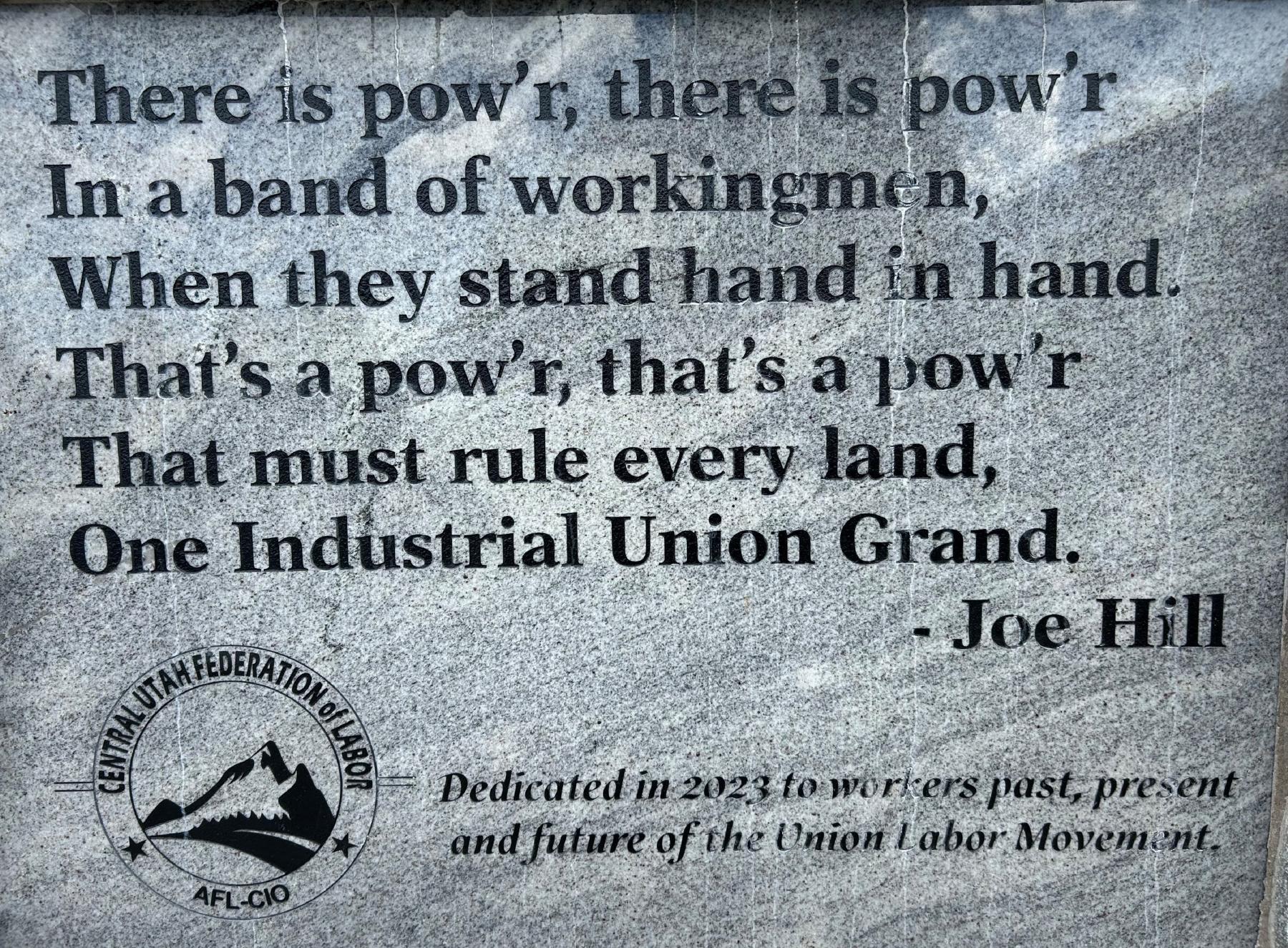
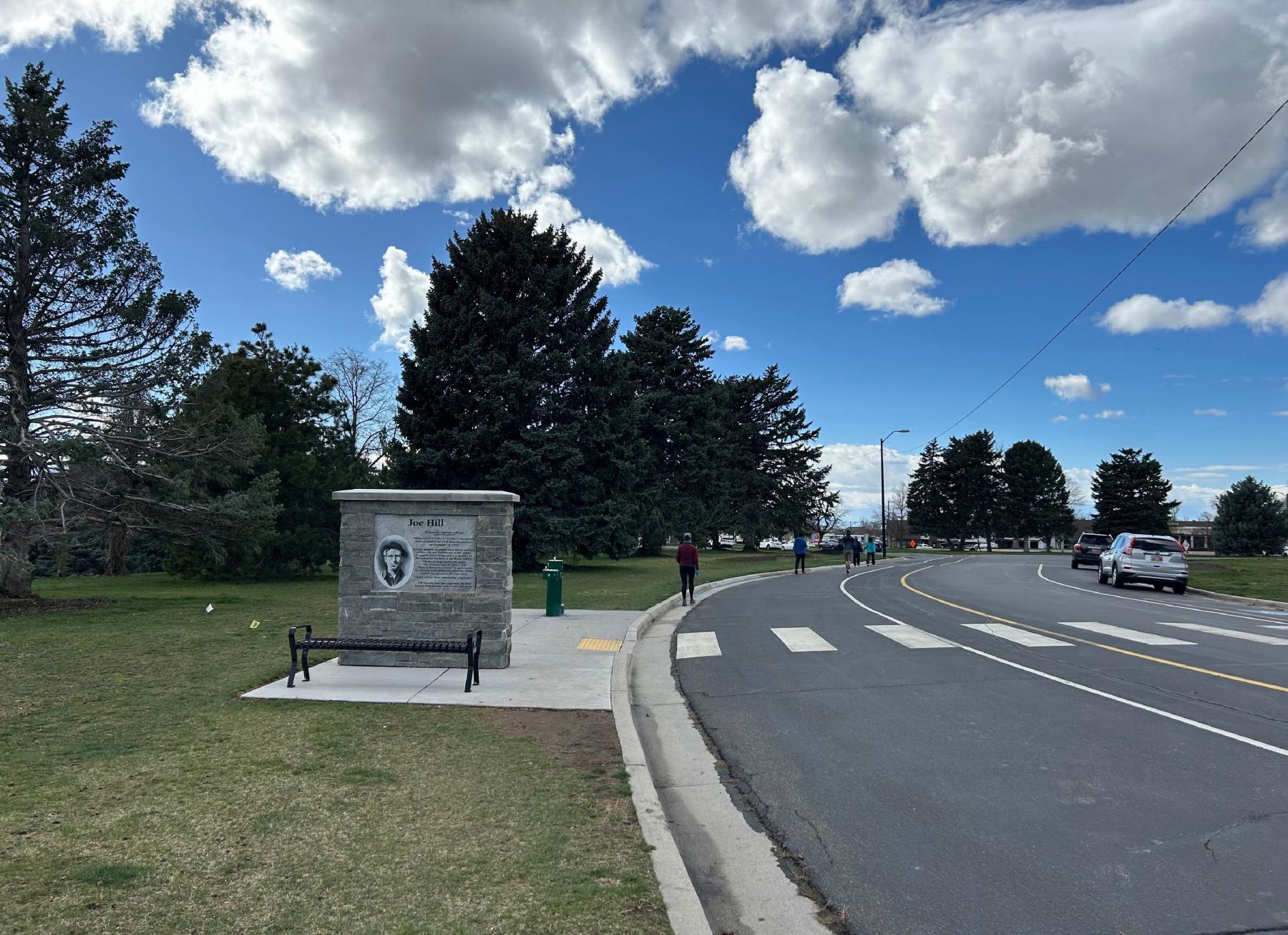
Joe Hill: The Singing Voice of Labor

This monument was raised in 2013, 108 years after Joe Hill’s execution and built on the very spot where the IWW songwriter was executed, based on circumstantial evidence.
Joe Hill was born in Gavle, Sweden in 1879, and immigrated to the USA in 1902 for want of work. After years of itinerant labor, he joined the Industrial Workers of the World (IWW,) commonly known as the "Wobblies," in 1908. The IWW was a radical labor union, which represented not just skilled workers, but any worker, in any job, regardless of age, race, or gender. The union was also not just focused on obtaining improvements in wages, hours, or conditions, but a total overthrow of the capitalist system.
Hill hid in boxcars and "rode the rails" to where he could find work, and after a couple years he became an organizer in the IWW, writing songs to mobilize the workers during times of strikes. His "Little Red Songbook" spread throughout the IWW and therefore throughout the country, whenever Wobblies went on strike, they would sing his songs, and usually he would be there too. And in 1914, the strikes were in Utah, involving the workers of Utah Construction Company, represented by IWW local 69, cheered on by Joe Hill in person. There had been repeated clashes between the IWW and the Salt Lake City Police that created an atmosphere of tension in the city.
On January 10, 1914. Hill was shot in the chest and went to visit a doctor friend to have it treated, the same night John and Arling Morrison were killed in a robbery at the grocery store at which they worked. Hill's doctor reported him to the police, and Hill was promptly arrested. Hill, and many others in the IWW or otherwise sympathetic to his cause, believed the arrest and trial would simply be harassment, as it so often had been before. But Hill, after meeting his state-appointed lawyers, felt strongly that his lawyers had been bribed to 'throw' the case, despite the lack of evidence, and he chose to represent himself. He argued that his songs were free and protected speech, and that the work of the IWW in Utah was protected under the right to associate, and that their actions were chiefly against economic inequality.
Hill's trial lasted less than one month, during which time the state failed to provide any motive, a single piece of evidence, or indeed any possible indication that any of the bandits had been Joe Hill. The only piece of evidence the prosecution submitted was Joe Hill's IWW red card. The IWW were known for being violent and inhumane, claimed the prosecution, and Hill was a member of it. Hill wanted to overthrow capitalism, civilization itself they claimed, and through his songwriting and performances, even if he hadn't done the murders himself, he was equally responsible. Hill's demands that he had been mistried and appeals for a retrial fell upon deaf ears, and against nationwide beliefs that there had been an abrogation of due process, he was found guilty by jury on June 27 and sentenced to death on July 8th.
Hill appealed the sentence, and a massive letter-writing campaign began, with letters pouring into the office of Utah Governor Spry, both demanding Spry pardon Hill or to permit the execution. President Woodrow Wilson asked Spry to pardon, stating that Hill's trial had not been fair, as had the Swedish ambassador. In the end, Hill was executed by firing squad on November 19, 1915. Many felt then and feel to this day that Hill had been tried for his speech and for his affiliations rather than any possibility of being among the murderers.
Images