<?xml version="1.0" encoding="UTF-8"?>
<feed xmlns="http://www.w3.org/2005/Atom">
  <title type="text">Intermountain Histories</title>
  <updated>2026-04-17T19:32:20+00:00</updated>
  <generator uri="http://framework.zend.com" version="1.12.20">Zend_Feed_Writer</generator>
  <link rel="alternate" type="text/html" href="https://www.intermountainhistories.org/"/>
  <link rel="self" type="application/atom+xml" href="https://www.intermountainhistories.org/items/browse?output=rss2"/>
  <id>https://www.intermountainhistories.org/</id>
  <author>
    <name>Intermountain Histories</name>
    <uri>https://www.intermountainhistories.org</uri>
  </author>
  <link rel="hub" href="https://pubsubhubbub.appspot.com/"/>
  <entry>
    <title type="html"><![CDATA[Phil’s World, Cortez, CO: Follow Me, the Trails are Great]]></title>
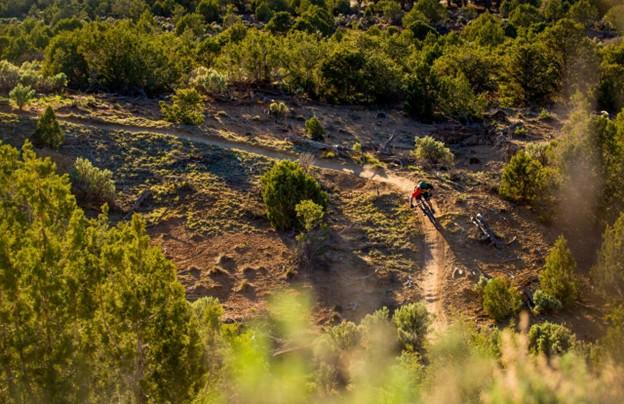
    <summary type="html"><![CDATA[<p><strong><em>Phil Vigil wanted little more than to explore. After relocating from Fairbanks, AK, to Cortez, CO, in the late 1980’s he found himself mountain biking on deer tracks and game trails across a seldom frequented patch of federal and state trust land five miles east of town. Despite his unexpected passing in 2020, his proclivity for route finding and engagement with the mountain biking community in Cortez have seen him remembered as the pioneer of one of the most renowned mountain bike trail networks on the Colorado Plateau. </em></strong></p><img src="https://www.intermountainhistories.org/files/fullsize/ef3252717c0ac23a2d1deb65ecc0bab9.jpg" alt="Mountain Biker Navigates Sweeping Right Turn, Sunset" /><br/><p>The state and federal trust land east of Cortez, CO, on which Phil’s World lies saw infrequent use into the late 1980’s with a small portion on the western half leased by a shooting range and the rest exploited or polluted through livestock grazing, firewood gathering, and illegal waste disposal. The sparse use and proximity to town did however offer enough seclusion for recent transplant Phil Vigil to trace deer tracks on his mountain bike across the undulating terrain. As the paths grew broader and more distinct, Vigil marked them with animal skulls and in-so-doing laid the groundwork for the trail system that came to bear his name.
In 1994, friends Jimbo Farley and Morgan Bell moved west from Alabama and opened Cortez’s only bike shop, Kokopelli Bike and Board. Vigil quickly became a regular. Phil’s tales of the paths near the shooting range prompted staff to nickname the area Phil’s World. Cortez local Scott Darling, then a teenager employed at the shop, was introduced to the trail system by Phil. Inspired, he and a small group of riders began to develop the network. While Phil had moved on to more remote country in the four corners region, builders like Bob Wright, Stephan Barnes, Sam Dayzie, and Shawn Gregory saw potential in the terrain and further established an engaging network unlike any other in the Southwest. Wright, Barnes, and Gregory prioritized ease, fun, and speed in their design and were advised by Dayzie, an indigenous amateur archaeologist, of conflicts in route finding with remnants of Ancestral Puebloan sites.
In the late 1990’s electricity supplier Tri-State Generation expressed interest in developing the land for coal production. While Tri-State pursued extractive access, the shooting range expanded its lease in October of 2003. Safety concerns citing repeated conflict between cyclists and target shooters and a lack of legal authority to build and maintain trail on the land placed Phil’s World in jeopardy. Advocacy groups Kokopelli Bike Club (now Southwest Colorado Cycling Association) and Greater Dolores Action filed a motion to lease 500 acres of state trust land and use adjacent Bureau of Land Management holdings to avoid conflict with gun enthusiasts with dual-members of the bike club and Four Corners Rifle and Pistol Club acting as mediating liaisons. By 2005, Tri-State Generation had shifted interest and the lease and funding for Phil’s World had been secured, mountain bikers were formally guaranteed land and resources.
To maintain the feeling of solitude for riders in the spirit of Phil’s original design, organizers established a directional loop system to minimize rider interaction and traffic. The clever layout, fast and fun trail building approach, and nearness to Cortez distinguished Phil’s as a prototype of the BLM’s Backyard to Backcountry project. The network’s revenue generating ability for Cortez and nearby Dolores, accessibility for all ability levels, and protection of sensitive resources made it a valuable asset to the BLM and encouraging example in cooperative land management for other Plateau communities.</p><p><em><strong><a href="https://www.intermountainhistories.org/items/show/907">For more (including 4 images) view the original article</a></strong></em></p>]]></summary>
    <published>2025-09-23T15:36:56+00:00</published>
    <updated>2026-04-17T19:32:20+00:00</updated>
    <link rel="alternate" type="text/html" href="https://www.intermountainhistories.org/items/show/907"/>
    <id>https://www.intermountainhistories.org/items/show/907</id>
    <author>
      <name>Nicholas Nation, Northern Arizona University </name>
    </author>
  </entry>
  <entry>
    <title type="html"><![CDATA[MEDL, Flagstaff, AZ: The People Want Trails]]></title>
    <summary type="html"><![CDATA[<p><strong><em>The Mount Elden Dry Lake Hills trail system north of Flagstaff, AZ, traces its legacy of use closely with the history of the city. Dedicated in 1987, the network has steadily grown through community initiatives in cooperation with the Forest Service in Coconino National Forest to over 100 miles of trail. The proximity to town and rugged terrain give the illusion of a backcountry experience in an accessible frontcountry setting while the repurposing of game trails, sheepherding trails, fire breaks, and transportation lines maintains a connection to Flagstaff’s past.</em></strong></p><img src="https://www.intermountainhistories.org/files/fullsize/48b5ffa5c2b75a1821ff98ce917ee2a7.jpg" alt="Sunset Trail No. 23, Mount Elden" /><br/><p>As mountain biking developed around Marin County, CA, from the outfitting of WWII era “balloon tire” bikes with knobby tires and better brakes to more specialized equipment, two-wheeled recreation also began to take hold in the mountains and forests near Flagstaff, AZ. A local motorcycle club, the Coconino Motorcycle Trail Riders, connected remnants of the original Schultz Pass Road into a unified trail running up Schultz Creek in the 1970’s. When bicycle manufacturers began bringing bespoke mountain bikes to the market in the early 1980’s, Flagstaff’s existing cycling culture made for a quick uptake of the new machines. Mechanic Steve Garro of local shop Cosmic Cycles and the counterculture mountain bike racing team The Mutants joined other hobbyists to set about exploring the higher elevations accessible by Schultz Pass and Elden Lookout roads.
A series of disused wagon routes from the early 1900’s, old communications lines servicing the first lookout towers, fire breaks from the 1977 Radio Fire, and the plethora of livestock and game trails on the slopes were connected to unify the upper elevations of Mount Elden with the lower Dry Lake Hills to the west. As the trail network grew and diversified, so did the user base and rate of conflict. Many trails were closed to mountain bike access after unfavorable interactions with hikers and equestrians. After the forest service officially dedicated the Mount Elden Dry Lake Hills trail system in 1987, local advocacy groups successfully lobbied to restore mountain bike access and employed a code of conduct wherein cyclists were to yield to hikers or equestrians. 
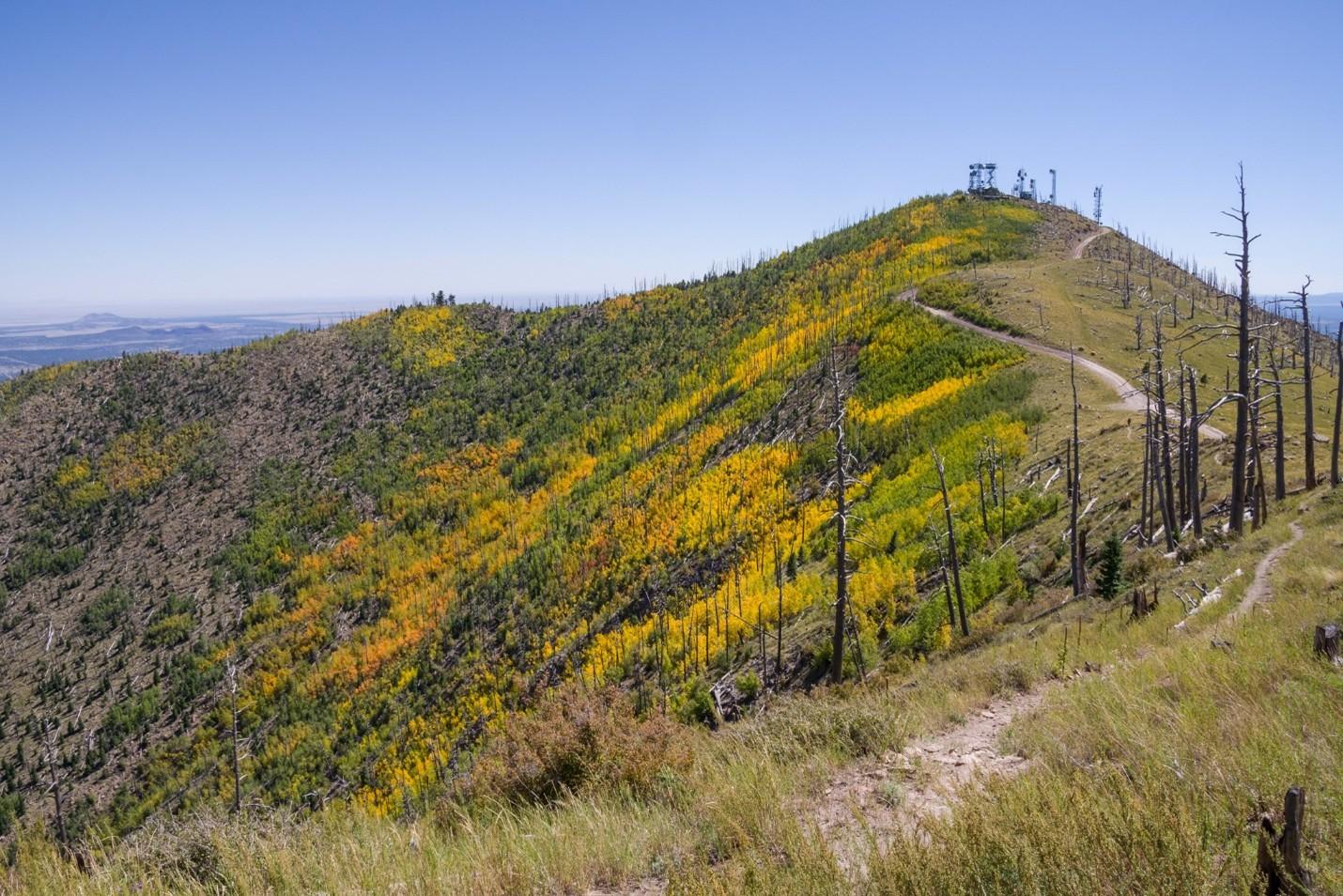
As mountain bikes modernized into the 2000’s and usage expanded, MEDL supervisors recognized that mitigation of environmental damage induced by increased traffic was necessary. In 2006, the Flagstaff Bicycle Organization began advocating for directional downhill trails in the MEDL network to minimize hiker-biker interactions. Following the Schultz Fire in 2010, the forest service advanced a comprehensive trail planning scheme accounting for fire risk, endangered species protection, reduced user conflict, and local quality of life improvement. The proposed MEDL trail plan specifically focused on environmental protection and improved recreational access for residents over tourism.
Though delayed by thoughtful debate with groups like the Sierra Club, and the Museum Fire in 2019 that burned existing paths and planned expansion, the realignment of several traverses on erosive slopes in 2020 proved the venture worthwhile. The subsequent effort between the forest service and volunteer mountain bike, trail running, and motorcycle groups to professionally mark and build sustainable routes across the MEDL network garnered community support. The ongoing project has improved or created over twenty-five miles of trail since 2022 including the first sanctioned, directional mountain bike trails in Flagstaff – called Meteoride and Full Sail. The city’s assets in the sciences and passionate volunteer advocacy groups have allowed for thorough planning in current and future trail building that is as mindful of the protection of the mountain’s fragile ecology as it is of the improved quality of life that outdoor recreation can bring the community.  </p><p><em><strong><a href="https://www.intermountainhistories.org/items/show/906">For more (including 4 images) view the original article</a></strong></em></p>]]></summary>
    <published>2025-09-23T15:36:55+00:00</published>
    <updated>2026-04-17T19:32:20+00:00</updated>
    <link rel="alternate" type="text/html" href="https://www.intermountainhistories.org/items/show/906"/>
    <id>https://www.intermountainhistories.org/items/show/906</id>
    <author>
      <name>Nicholas Nation, Northern Arizona University </name>
    </author>
  </entry>
  <entry>
    <title type="html"><![CDATA[Kokopelli’s Trail, Loma, CO: In Pursuit of Solitude]]></title>
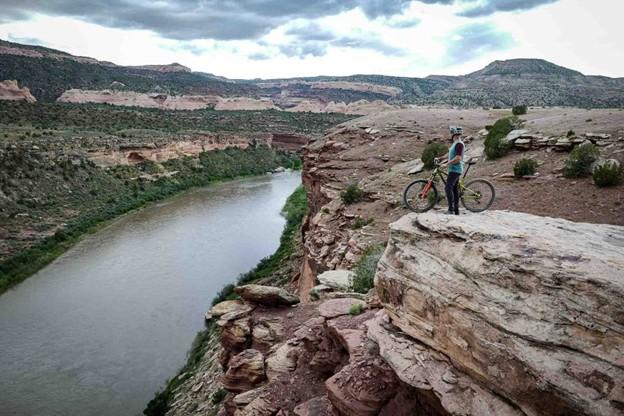
    <summary type="html"><![CDATA[<p><strong><em>Stretching 142 miles between Loma, CO, and Moab, UT, Kokopelli’s Trail is one of the earliest publicized examples of a backcountry mountain biking route. The unification of Kokopelli’s in 1989 by the Colorado Plateau Mountain Bike Trail Association helped popularize a new brand of distance cycling – bikepacking - and inadvertently made the American Southwest one of the best-known bikepacking destinations in the world. </em></strong></p><img src="https://www.intermountainhistories.org/files/fullsize/ec7c7c9ba0710082ba17aaf9f08f0443.jpg" alt="View of Kokopelli Trail Grand Junction" /><br/><p>When mountain bikes became commercially available in the early 1980’s, wealthy baby boomers from coastal California began to explore the west on their new machines enticed by the vast landscapes and inexpensive accommodation. Moabites recognized the economic opportunity afforded by mountain bike tourism and by the late 1980’s Moab, UT, had become a premier cycling destination. While the highly publicized Slickrock Trail was leveraged to draw visitors in, the vast network of 4x4 roads surrounding the town, relics of a defunct uranium industry, began to see increased use among cyclists. Nearby Grand Junction, CO, was experiencing similar backcountry traffic in the late 1980’s. Grand Junction Bureau of Land Management officials observed illegal mountain bike use in the Black Ridges Wilderness Study Area threatening to undermine ecological research. BLM area manager John Singlaub sought to protect the wilderness without alienating cyclists and proposed BLM recreation planner Carlos Sauvage build a cycling route on non-wilderness lands along the Colorado River. Lacking funding, the BLM turned to mountain biker and Grand Junction lawyer Timms Fowler to help plan and coordinate the effort. Long dreaming of a unified route across the remote region, Fowler jumped at the opportunity to aid in the construction.
Beginning in November of 1988, Sauvage and other BLM personnel began driving and mapping the dozens of dirt roads abandoned by the uranium industry between the route’s planned start point in Loma, CO, and terminus in Moab, UT. Meanwhile, Fowler set up meetings with bike shops in Grand Junction and Moab to secure volunteer support for the project. After identifying a course on 4wd tracks, BLM workers planned ten additional miles of singletrack trail to access scenic vistas and ensure an engaging riding experience. A volunteer building effort commenced in the spring of 1989 under the newly formed Colorado Plateau Mountain Bike Trail Association and after six weekends of construction, the 142 mile long Kokopelli’s Trail was completed. On May 6<sup>th</sup>, 1989, the Hopi Flute Clan for whom the trail was named held a ceremony under elder Ebin Leslie in Cisco, UT, the halfway point, to officially open Kokopelli’s to the public.  
Kokopelli’s quickly generated interest among mountain bikers. The high level of community engagement guaranteed considerable public awareness of the project and increased ridership. Proximity to major throughfares like Interstate 70 and Highway 191 made for easy access to the trail. The federal officiating in route creation and surveying resulted in an abundance of maps and backcountry planning resources for prospective users. The trail’s position on BLM land made it popular among bikepackers, backcountry cyclists who pursue multi-day, self-supported rides, because of the relaxed camping regulations imposed on remote public lands. The vastness of the landscape Kokopelli’s Trail traverses and the solitude afforded by its 142 miles in length made for an experience difficult to capture elsewhere and secured the Southwest as a stronghold for backcountry mountain biking.</p><p><em><strong><a href="https://www.intermountainhistories.org/items/show/905">For more (including 3 images) view the original article</a></strong></em></p>]]></summary>
    <published>2025-09-23T15:36:54+00:00</published>
    <updated>2026-04-17T19:32:20+00:00</updated>
    <link rel="alternate" type="text/html" href="https://www.intermountainhistories.org/items/show/905"/>
    <id>https://www.intermountainhistories.org/items/show/905</id>
    <author>
      <name>Nicholas Nation, Northern Arizona University </name>
    </author>
  </entry>
  <entry>
    <title type="html"><![CDATA[Gooseberry Mesa National Recreation Trail, Hurricane, UT: We Can Ride Too]]></title>
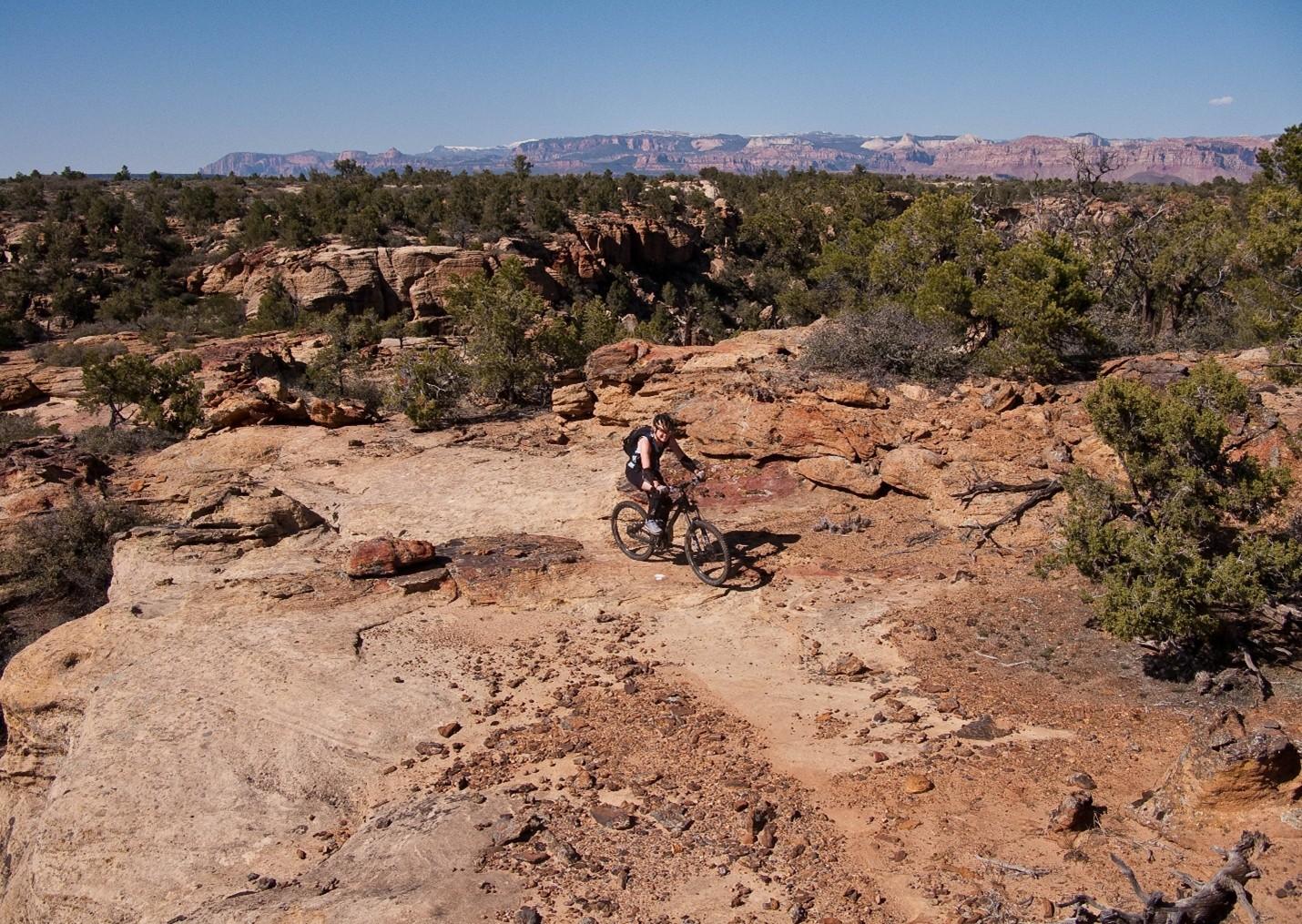
    <summary type="html"><![CDATA[<p><strong><em>After Mike and Morgan Harris started building the trail system now called Gooseberry Mesa National Recreation Trail in the early 1990’s, they had no idea it would become such a significant attraction to the mountain biking community. Situated eight and a half miles from Hurricane, Utah, and twenty miles southwest of Zion National Park, “The Goose” as it’s affectionately known is one of the most scenic riding centers on the Colorado Plateau.  </em></strong></p><img src="https://www.intermountainhistories.org/files/fullsize/7071445632eb7a04a4404768333d12d1.jpg" alt="Harris Secret Trail" /><br/><p>When Mike and Morgan Harris relocated to Hurricane, UT, in the early 1960’s, Gooseberry Mesa was a seldom frequented parcel allocated to the Bureau of Land Management that remained unused on account of the tight, maze-like topography. The water holding capacity of the rock that caps the mesa, Shinarump conglomerate, enables an ecology with pockets of lush vegetation frequented by game populations. The Harris’ early exploration of the mesa was as a hunting ground. Their use of motorcycles and frequent hikes through the formation gave them an intimate knowledge of the landscape and route-finding abilities that others lacked.
While the Harris’s were hunting the mesa, mountain biking had slowly been moving into the rural West. The fledgling sport originated in the late 1960’s in Marin County, CA, when a group of teens started riding single-speed “balloon tire” bikes up and down Mt. Tamalpais. After noticing cycling clubs optimizing old bikes for offroad races in the 1970’s, major manufacturers developed consumer market bicycles for the harsher settings mountain bikers were riding in the early 1980’s. Enticed by the new trend and cheap, rural accommodation, wealthy baby-boomers bought in and began to explore the Colorado Plateau. Moab’s Slickrock Trail came to be the pinnacle mountain biking destination in the late 1980’s and after a visit in 1993, Mike and Morgan realized their secluded hunting ground would be an ideal venue to develop deliberate mountain bike paths.
Upon returning from Moab, the Harris’ scouted and marked a primitive trail network across the twenty-four square miles of Gooseberry Mesa. Their approach attempted to fully immerse riders in the terrain by utilizing the entirety of the landscape. Though both were inexperienced riders and still honing their skills, their recognition that mountain biking equipment was consistently improving lead them to pursue increasingly challenging obstacles. They offered the spectacular scenery afforded by the mesa’s 2000 feet of prominence over the badlands below as a reward for each completed section. While their Gooseberry trails lacked the elevation gain and loss of Slickrock in Moab, they engaged mountain bikers by keeping difficult trail features like near vertical ascents and descents hidden around corners or behind foliage affording little time to prepare for each challenge. The construction style they helped popularize made riding acumen more important than quality of gear earning popularity among hobbyists and professionals alike.
After hearing that other builders were fined for similar unsanctioned work, the brothers turned themselves in to the BLM and facilitated a visit with federal officials to the mesa. To their surprise, BLM personnel were so impressed with the work that measures were taken to officially adopt the tracks resulting in their designation as the first official mountain biking trails in Washington County, Utah, on October 26<sup>th</sup>, 1999. Seven years later in 2006 the routes were upgraded to National Recreation Trail status by the BLM, an accolade that demonstrates a commitment to continued use, sustainable environmental practice, and an anticipated increase in tourism for the surrounding communities.</p><p><em><strong><a href="https://www.intermountainhistories.org/items/show/904">For more (including 3 images) view the original article</a></strong></em></p>]]></summary>
    <published>2025-09-23T15:36:54+00:00</published>
    <updated>2026-04-17T19:32:20+00:00</updated>
    <link rel="alternate" type="text/html" href="https://www.intermountainhistories.org/items/show/904"/>
    <id>https://www.intermountainhistories.org/items/show/904</id>
    <author>
      <name>Nicholas Nation, Northern Arizona University </name>
    </author>
  </entry>
  <entry>
    <title type="html"><![CDATA[Title IX and Women’s Athletics at Utah State University]]></title>
    <summary type="html"><![CDATA[<p><strong><em>Women’s athletics at Utah State University have come a long way since the passing of Title IX in 1972. Athletic Director Marilyn Weiss worked hard to gain more resources for female athletes. During her time at Utah State, three women’s athletic teams won national championship titles. She helped to lay the foundation for the long-term success of women’s athletics at USU.</em></strong></p><img src="https://www.intermountainhistories.org/files/fullsize/db7904d3f034ebce2d2e9c00c65de8d7.jpg" alt="1978 Women&#039;s Volleyball Team at Utah State University" /><br/><p><span style="font-weight:400;">Women have been involved in athletics since the early days of Utah State University. As early as 1901, USU boasted an organized softball team and hosted basketball tournaments. Due to a lack of funding, however, women’s athletics stayed local and small. This began to change after Title IX became law on June 23, 1972. The law prohibited sex-based discrimination in any institution that receives federal funding. Initially created to encourage more women to pursue higher education, today the law is mostly associated with college and high school athletics and promoting equality between men’s and women's sports. </span></p><p><span style="font-weight:400;">Title IX changed the college landscape, in the classroom and on the court. Schools were required to give women more support and resources. Before Title IX, women’s athletics didn’t offer athletic scholarships. As of 2021, there are 74,173 athletic scholarships available to women compared to 77,784 available to men.</span>
<span style="font-weight:400;">Marilyn Weiss was the USU Athletics Director for Women’s sports from 1975 to 1981. Under her leadership, Utah State formed its first volleyball team in 1976. Weiss served as the USU’s women’s basketball coach, volleyball coach, and track coach during her tenure with the university, and knew that not much had changed at USU after the passage of Title IX. She was determined to change that. In 1976, Weiss hired Mary Jo Peppler and Marilyn McReavy, both former Olympians, as co-head coaches of the volleyball team. They recruited strongly from across the country to bring great talent to USU. </span>
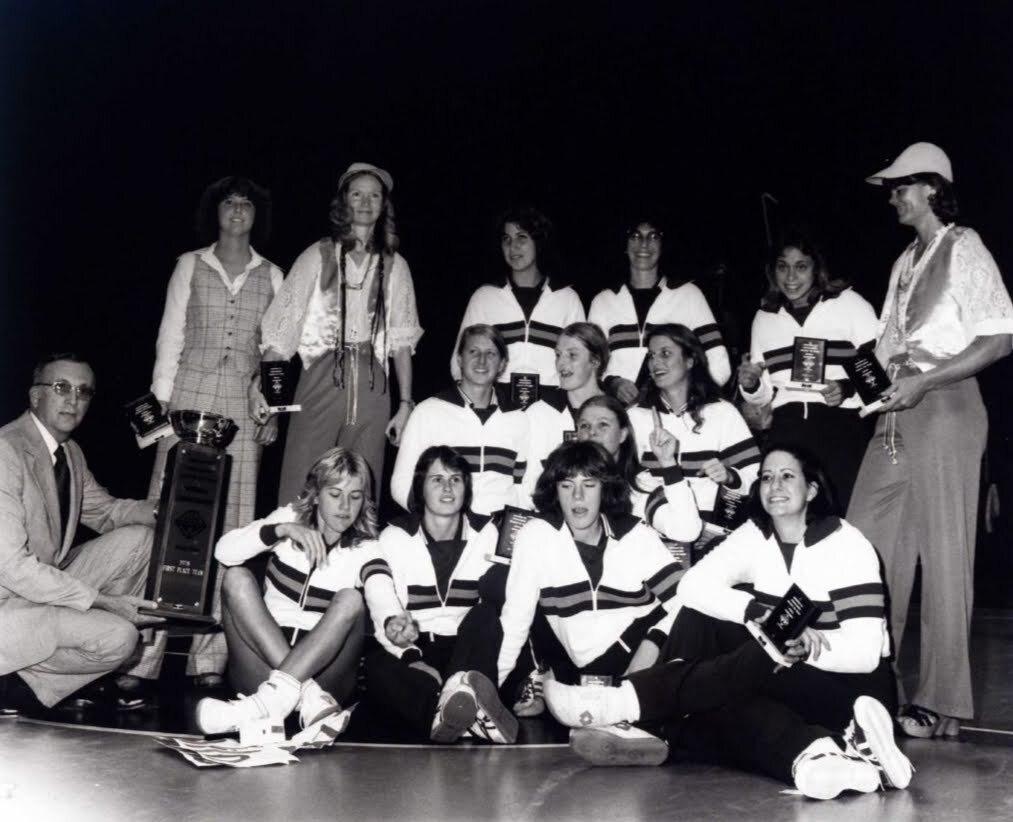
<span style="font-weight:400;">Weiss knew that the women’s programs would have to operate under a very tight budget, but she was determined to succeed. If the Aggies wanted to compete against the top teams in the country, they had to get to the West Coast. In the off-season, the team traveled in a fifth-wheel trailer to southern California to challenge powerhouse teams like USC and UCLA. Although the budget was small, the coaches and athletic director made it work and their efforts paid off. The USU Volleyball team became National Champions in 1978, winning the Association for Intercollegiate Athletics for Women (AIAW) volleyball championship. They were runner-up the following season. During Weiss’s time at USU, the softball team also won two national titles in 1980 and 1981. </span>
<span style="font-weight:400;">Weiss filed a Title IX complaint against the university a few years before she left. Although USU saw success while she was here, she knew womens’ athletics were still being underfunded. Marilyn Weiss and the coaches and players laid a foundation to move women’s athletics forward at Utah State University. As of 2024, USU has 8 women's varsity teams and over 180 women rostered. USU offered $3,106,721.54 in scholarships to female athletes in 2024, among 149 athletes.</span></p><p><em><strong><a href="https://www.intermountainhistories.org/items/show/873">For more (including 5 images) view the original article</a></strong></em></p>]]></summary>
    <published>2024-11-02T17:31:25+00:00</published>
    <updated>2026-04-17T19:32:19+00:00</updated>
    <link rel="alternate" type="text/html" href="https://www.intermountainhistories.org/items/show/873"/>
    <id>https://www.intermountainhistories.org/items/show/873</id>
    <author>
      <name>Hadli Lords, Utah State University</name>
    </author>
  </entry>
  <entry>
    <title type="html"><![CDATA[Stephen L. Richards Building]]></title>
    <summary type="html"><![CDATA[<p><strong><em>In 1965, amidst a rising student population and an increased interest in recreation, Brigham Young University opened the Stephen L. Richards Building. The "RB" provides courts and pools and has been host to a plethora of activities through the decades. </em></strong></p><img src="https://www.intermountainhistories.org/files/fullsize/87e1320830f03e17d39f23941a31b5e6.jpg" alt="Stephen L. Richards Physical Education Building" /><br/><p><span style="font-weight:400;">As the population of Brigham Young University increased in the latter-half of the 20th century, new facilities were being announced and constructed to accommodate growing numbers as part of BYU's "building boom." In 1965, as part of this boom, the Stephen L. Richards Building was opened. The “RB” is an athletic facility that houses multiple courts and olympic-sized pools. Recreational activities are held in the building, which at the time of its opening, seemed to be an ever-increasing necessity for students. Since its opening, it has become vital to the experience of many students. As one article read, “Students interested in exercise and intramural sports should become familiar with the Stephan [sic] L. Richards Building.” </span>
<span style="font-weight:400;">In the RB, a wide range of classes and activities have been offered to keep students busy. In 1970, classes included slimnastics, personal safety for women, senior life saving, and physical education for men. Around that same time, an outdoor camping workshop with intermittent adventures in the Uintas was offered. Additionally, many clubs met at the Richards Building. One club, the Orson Hyde club, met at the RB for an “Israeli folk dancing” activity. There was also a fencing club, Polynesian club, ski club, skydiving club, and Swedish club which utililized the building's facilities. </span>
<span style="font-weight:400;">In 1988, the RB hosted a special olympics, where students were able to volunteer. Discussions on health were also held in the RB on topics such as mental health, cardiovascular health and exercise, and physical education in public schools. Interestingly, in 1996, the RB was host to a juice booth in an effort to “promote the health benefits of drinking Florida orange juice.” Just a few years later in 2000, the RB put on a turkey trot in celebration of Thanksgiving. However, despite the range of activities offered through the decades, one of students’ favorite activities is the annual Midnight Madness, put on by BYU Student Wellness, where students come to watch and participate in an array of activities. In 2022, these activities included Zumba, Spin, High Fitness, basketball, volleyball, and a cannon-ball contest. To further entice students, Chip cookies and a soda bar were served. Student activity continues through the rest of the year, as well. The Richards Building is often packed during nights, especially Monday nights, when free play is available. True to its purpose, students continue to participate in recreational classes such as pickleball, basketball, and volleyball. </span></p><p><em><strong><a href="https://www.intermountainhistories.org/items/show/731">For more (including 7 images) view the original article</a></strong></em></p>]]></summary>
    <published>2023-03-09T16:08:38+00:00</published>
    <updated>2026-04-17T19:32:16+00:00</updated>
    <link rel="alternate" type="text/html" href="https://www.intermountainhistories.org/items/show/731"/>
    <id>https://www.intermountainhistories.org/items/show/731</id>
    <author>
      <name>Lindsey Meza, Brigham Young University</name>
    </author>
  </entry>
  <entry>
    <title type="html"><![CDATA[Marriott Center Annex]]></title>
    <summary type="html"><![CDATA[<p><strong><em>Nicknamed the “Y” MCA by a Wikipedian, the Marriott Center Annex is a “a second home for [BYU’s] men’s and women’s basketball programs.”</em></strong></p><img src="https://www.intermountainhistories.org/files/fullsize/4dcf8802b8be4576d074f8781a953d7c.jpg" alt="The Marriott Center Annex" /><br/><p><span style="font-weight:400;">In 2015, BYU officials announced the construction of several improvements to the Marriott Center, including a new annex to be built right next to the arena. This wave of improvements was sponsored solely by private donors. The new Marriott Center Annex was completed in December 2016 and had its open house on February 21, 2017. </span>
<span style="font-weight:400;">The 30,000 square-foot annex was meant to give players full access to practice and training areas. The Marriott Center is used for devotionals and other concerts weekly, which limits players’ ability to access the court. Therefore, the annex was highly anticipated by the men’s and women’s teams. The coach of the men's basketball team at the time, Dave Rose, worked tirelessly with donors to enable the annex. This, he earnestly hoped, would help the players in all aspects of their experience at BYU. After years of preparatory work on the annex, construction took only thirteen months. The annex opened in time for players to utilize the facility for the 2016-2017 season. </span>
<span style="font-weight:400;">The annex, which has now become a “second home” for basketball players, contains a full-size replica of the Marriott Center basketball court, a strength and conditioning center, a training room, study spots, offices and meeting rooms, a theater, and a hall of honor showcasing the history of BYU basketball. The hall of honor also serves as an interactive museum display, granting visitors, including potential team members, a look at the rosters, stats, and tradition of BYU basketball. The museum, located in the front entrance, also includes TV monitors which continually play highlights from previous games. Other features of the annex include a hydrotherapy machine, which reaches negative 270 degrees fahrenheit. This, along with the other amenities of the annex, point to the increasing hope of coaches and fans to implement their “player-driven program,” aimed at helping players reach their full potential at BYU.</span></p><p><em><strong><a href="https://www.intermountainhistories.org/items/show/701">For more (including 8 images) view the original article</a></strong></em></p>]]></summary>
    <published>2023-02-09T16:26:48+00:00</published>
    <updated>2026-04-17T19:32:15+00:00</updated>
    <link rel="alternate" type="text/html" href="https://www.intermountainhistories.org/items/show/701"/>
    <id>https://www.intermountainhistories.org/items/show/701</id>
    <author>
      <name>Lindsey Meza, Brigham Young University&amp;#32;&amp;amp;&amp;#32;Makoto Hunter, Brigham Young University</name>
    </author>
  </entry>
  <entry>
    <title type="html"><![CDATA[George Albert Smith Fieldhouse (SFH)]]></title>
    <summary type="html"><![CDATA[<p><strong><em>The George Albert Smith Fieldhouse, built in 1951, has been busy ever since its opening. Students were constantly filling the space for dances, devotionals, sports games, and concerts. </p></strong></p><img src="https://www.intermountainhistories.org/files/fullsize/6aec470ba5e6ae2faf4d69099e2893b5.jpg" alt="BYU Basketball Game" /><br/><p><span style="font-weight:400;">After years of inadequate sports facilities, BYU fans were very pleased when the university announced construction of the Smith Fieldhouse. The Smith Fieldhouse, named after former apostle George Albert Smith, was opened in 1951. The building was constructed to provide space for the men’s basketball team and their games, which had previously been hosted in off-campus courts. Soon, the building became the backdrop for many of the students’ most cherished memories.</span>
<span style="font-weight:400;">The Smith Fieldhouse hosted a wide range of social activities for BYU students, especially in its first 30 years. In 1958, students were constantly traversing down campus to the Smith Fieldhouse for a wide range of activities and events. The Banyan Ball was held that year, where Shirley Robinson was crowned as Banyan queen. A Fite Nite, where BYU students who pronounced themselves as boxers and wrestlers took part in “intramural sponsored fisticuffs.” Also that year, someone wished to stir up trouble. An unidentified assailant broke into the Smith Fieldhouse and stole the Y Bell held in the facility, causing quite an uproar. In 1959, the Globetrotters played the Baltimore Rockets in the fieldhouse, drawing a roaring crowd. The Smith Fieldhouse also housed debates, including one in 1960 entitled “How Well do Labor Unions Serve the Public Interest?” In one case, the Smith Fieldhouse hosted a trial, albeit not a legal one. In 1956, Officials held a trial against the Gold-bricker social unit, which functioned similarly to a fraternity. Several complaints were lodged against the Gold-brickers which included harmful hazing initiations such as dropping pledges off in the mountains in the middle of winter to find their way home.</p><p>The Smith Fieldhouse also held concerts and other events. Some performances included the Salt Lake Tabernacle Choir, the Chicago Symphony, and the Carpenters. In 1973, BYU had a “French week” where a flea market “with a French accent,” sponsored by the French club and the Married Students, was held in the Smith Fieldhouse. </span><span style="font-weight:400;">In 1987, a Pow Wow was held in the Smith Fieldhouse as part of the university’s “Lamanite Week” celebrations. In 1989, when the floor was replaced in the fieldhouse, framed pieces of the old playing floor were being sold as a keepsake for students, a testament to the love many held for the building.</p><p>It wasn’t until 1990 that volleyball was first played in the Smith Fieldhouse. As time continued, general use of the Smith Fieldhouse became less varied and more focused on volleyball and other sports rather than events and devotionals. For visiting athletic teams, the Smith Fieldhouse presents a formidable atmosphere due to the fans' cheering and the subsequent noise on the court. This only encourages fans and students, alike, and the Smith Fieldhouse continues to see crowds flock to the building to cheer on BYU. </span></p><p><em><strong><a href="https://www.intermountainhistories.org/items/show/699">For more (including 8 images) view the original article</a></strong></em></p>]]></summary>
    <published>2023-01-25T18:42:44+00:00</published>
    <updated>2026-04-17T19:32:15+00:00</updated>
    <link rel="alternate" type="text/html" href="https://www.intermountainhistories.org/items/show/699"/>
    <id>https://www.intermountainhistories.org/items/show/699</id>
    <author>
      <name>Lindsey Meza, Brigham Young University</name>
    </author>
  </entry>
  <entry>
    <title type="html"><![CDATA[Sports in the Topaz Internment Camp]]></title>
    <summary type="html"><![CDATA[<p><strong><em>To alleviate boredom while interred in the Topaz Relocation Center, the residents organized recreational activities. Some of the most popular pastimes were sports including baseball, golf, and football. </em></strong></p><img src="https://www.intermountainhistories.org/files/fullsize/db63feff62a2b3b0c02f2f9da947aa52.jpg" alt="The Baseball Field at Topaz" /><br/><p><span style="font-weight:400;">The Topaz Internment Camp was organized in October of 1942 in a desert area near Delta, Utah. The Camp was created to house Japanese Americans, formerly living on the coast of California, after being forcefully relocated during World War II.</span><span style="font-weight:400;"> Japanese Americans were compelled to sell or abandon their homes, cars, and any belongings they could not carry on their person. They first were placed in </span><span style="font-weight:400;">Tanforan and Santa Anita Racetracks in </span><span style="font-weight:400;">California in converted horse stables until they were moved again to a more permanent location in Topaz, Utah. Topaz was in operation </span><span style="font-weight:400;">from September 11, 1942, until October 31, 1945. During that time, the Japanese Americans who lived there struggled to create</span><span style="font-weight:400;"> lives for themselves in this new, remote desert environment.</span>
<span style="font-weight:400;">To help alleviate the boredom, Japanese Americans developed several pastimes. Schools were opened, artists taught their crafts, and sports teams were created. Fans followed their favorite teams. Sports and outdoor recreation became very popular, particularly baseball. Topaz was divided </span><span style="font-weight:400;">into 42 blocks </span><span style="font-weight:400;">and each block created its own baseball team. Teams would compete against each other, drawing dozens of spectators. </span>
<span style="font-weight:400;">The daily sports section in the </span><span style="font-weight:400;">Topaz Times</span><span style="font-weight:400;">, the local newspaper, revealed the importance of sporting events at the camp. The </span><span style="font-weight:400;">Topaz Times</span><span style="font-weight:400;"> included articles about the results of golf tournaments, baseball games, and the high school football team. In addition to local games, the </span><span style="font-weight:400;">Topaz Times</span><span style="font-weight:400;"> reported on the National Baseball League and other national sporting events. </span>
<span style="font-weight:400;">Sporting events in Topaz created strong rivalries between blocks in the camp. The most notable rivalry was between the softball teams. Like the baseball teams, the softball teams were organized by blocks and run by managers elected by each block’s players. Softball games were highly anticipated, and each team would practice for several weeks before the competitions. Unfortunately, with young people constantly leaving for the army, school, or work, fully manning each team was a continual struggle. </span>
<span style="font-weight:400;">The High School fielded many teams that students would compete on. The high school football team traveled and played against other local Utah high schools. Players would also compete against their peers, with a senior football team challenging the juniors and sophomores. The high school also had a track team. In the 1944 season, the track team got off to a late start, but was in full swing by May of that year, competing against students at other Utah high schools.</span>
<span style="font-weight:400;">The time in Topaz was difficult in the lives of the people sent to live there. But they found ways to go on living. To help make the most of a difficult situation, the residents of Topaz showed their resilience by promoting their love of sports and participating in a variety of recreational activities. Something that started as a way to alleviate boredom became a favorite pastime in Topaz, Utah during WWII.</span></p><p><em><strong><a href="https://www.intermountainhistories.org/items/show/660">For more (including 3 images) view the original article</a></strong></em></p>]]></summary>
    <published>2022-09-19T21:10:31+00:00</published>
    <updated>2026-04-17T19:32:14+00:00</updated>
    <link rel="alternate" type="text/html" href="https://www.intermountainhistories.org/items/show/660"/>
    <id>https://www.intermountainhistories.org/items/show/660</id>
    <author>
      <name>Anna Tenney, Brigham Young University</name>
    </author>
  </entry>
  <entry>
    <title type="html"><![CDATA[Marriott Center]]></title>
    <summary type="html"><![CDATA[<p><strong><em>“Dr. Wilkinson said the new center will be more than a sports pavilion and music hall. It is being designed to accommodate devotionals, student assemblies, forums, lyceums, convocations, religious assemblies, public gatherings, and other activities.” -Office of the News Bureau, Brigham Young University, September 17, 1968</p></strong></p><img src="https://www.intermountainhistories.org/files/fullsize/508122a19b7dfd91f71ba330dc55d753.jpg" alt="Front of the Marriott Center" /><br/><p>Before the construction of the Marriott Center, the George Albert Smith Fieldhouse served as the main sports arena and general gathering venue on campus. However, the growing athletics program and other student body activities created a need for a new facility to accommodate the growing campus. At the conclusion of his tenure as university president, President Ernest L. Wilkinson was successful in getting approval to build a new arena, the future Marriott Center. Construction of the Marriott Center began in the spring of 1970. </p><p>The Marriott Center was an ambitious project from the start. First, a space needed to be procured to accommodate the gigantic arena. BYU found the perfect place north of the Smoot Administration Building. It was a large parcel of land full of temporary war surplus homes, named Wyview Village. After removing the buildings, the construction began. </p><p>The construction of the Marriott Center was pretty unique. Rather start with the mainframe of the arena, work first began with the roof. The ceiling of the Marriott Center is held up by a single-span space frame. Construction crews worked on building the steel, four million pound frame that eventually covered 130,000 square feet. It took extensive work, but eventually frame was ready to be raised. One hundred feet from the ground, approximately the height of a ten-story building, the roof was hoisted into place and the construction of the main building commenced. “The [Marriott Center] measures 380 by 340 feet and covers nearly three acres, enough space to place two football fields side by side.” For the seating area cement was formed to created the raised levels. Benches were installed to accommodate more people in the arena. A full-size basketball court floor was built at the center of the arena. In its completion, the Marriott Center contained 10,092 chair seats, 12,590 bleacher seats, and 372 other spaces for a combined seating of 23,054. Based on the gigantic measurements and the large seating capacity, the Marriott Center became the largest college arena in the United States at the time. </p><p>The Marriott Center was completed in December of 1971 under a new BYU administration headed by Dallin H. Oaks. It was completed in time to host its first home basketball game. A formal dedication ceremony was conducted on February 4, 1973, with then LDS Church President Harold B. Lee presiding. The ceremony honored and celebrated the arena’s main donor and namesake, J. Willard Marriott. </p><p>Since its construction, smaller renovations have been made in the seating to increase legroom for patrons and update technology in the building. The last major renovation in 2015 included removing the lower benches and replacing them with padded chairs, replacing the old scoreboards and  adding four LED video boards above the center of the court, and a brand new training facility next door to the arena. The Marriott Center Annex, entirely funded by private donations, includes offices for the coaches, locker rooms, training and conditioning room, and an exact replica of the Marriott Center court for the players to practice on. </p><p>The Marriott Center has truly become a center for student and community activities. Its functionality as a multi-purpose arena allows it to serve more than just a venue for BYU basketball. It can serve as a venue for gymnastics, volleyball games, and other competitions. The Marriott Center also becomes the stage for music and dance concerts. Traditionally annual concerts like BYU’s Homecoming Spectacular and Christmas Around the World are performed on the Marriott Center court. Many performing artists have showcased their talents at the Marriott Center, including popular artists Kristin Chenoweth and David Archuleta. Weekly university devotionals and forums are broadcasted from the Marriott Center floor. Speakers range from BYU faculty, general authorities and officers of the Church, to social and political and business leaders throughout the world. Public figures such as former president George H. W. Bush, have addressed BYU campus from the Marriott Center podium. Even the unique walkways surrounding the Marriott Center provide a center of activity for the student body. More likely than not, one can find a small body of BYU students and local youth gathering in one of the ‘tunnels’ on a Sunday night, singing hymns and socializing with each other. Perhaps the highlight of most students’ time at BYU comes with the opportunity to walk across the Marriott Center stage and receive their university diploma. Surrounding high schools also use the Marriott Center for their own graduation ceremonies. </p><p>Since its construction in the 1960's, the Marriott Center has become an iconic building on BYU campus, serving as a gathering place for the BYU and Provo, and other surrounding communities. </p><p><em><strong><a href="https://www.intermountainhistories.org/items/show/315">For more (including 4 images) view the original article</a></strong></em></p>]]></summary>
    <published>2019-04-12T03:56:49+00:00</published>
    <updated>2026-04-17T19:32:05+00:00</updated>
    <link rel="alternate" type="text/html" href="https://www.intermountainhistories.org/items/show/315"/>
    <id>https://www.intermountainhistories.org/items/show/315</id>
    <author>
      <name>Rachel Hendrickson, Brigham Young University</name>
    </author>
  </entry>
  <entry>
    <title type="html"><![CDATA[El Monte Golf Course Clubhouse<br />
]]></title>
    <summary type="html"><![CDATA[<p><strong><em>The El Monte clubhouse was built with local and federal funds in 1934-1935. It is a fine example of bungalow style architecture used in a recreational setting.</p></strong></p><img src="https://www.intermountainhistories.org/files/fullsize/c765270ee01407d547d566a43a4faa10.jpg" alt="El Monte Clubhouse" /><br/><p>In 1928, with support from the Ogden Golf and Country Club, efforts were begun to secure a municipal golf course for Ogden. Led by florist Fred A. Huish (1866 – 1949) and other sports boosters, the course was to be located near El Monte Springs, at the mouth of Ogden Canyon. The Springs (formerly the Ogden Canyon Resort, 1895-1927) was a local resort which offered swimming, dancing, and picnicking activities. </p><p>El Monte Springs closed in 1932 because of the economic crisis of the Great Depression and the city considered leasing the facilities for use by the municipal golf players. However, the next year, the city opted to seek federal funds to build a clubhouse. Utah was one of the states most severely affected by the Great Depression.  As a consequence, it received substantial federal funding from New Deal programs. Perhaps the most prominent of these were building programs -- 233 public works buildings were constructed in the state of Utah.  Of these, 15 were constructed within Weber County.  The El Monte Golf Course Clubhouse was one of these projects.   </p><p>Funded by the Federal Emergency Relief Administration (FERA), the clubhouse project received $17,000, which was coupled with $5,500 from the city of Ogden.  Eber F. Piers (1889 – 1961) was hired as the architect. Piers came to Utah from Colorado in 1908 to work at an architecture firm.  In 1910, he opened his own firm and became a distinguished practitioner. Over the course of his career he designed over 300 buildings throughout the greater Ogden area.  Many of them, including the El Monte Clubhouse, are still in use today.</p><p>Most of the materials for construction, including the stonework on the exterior of the building, were taken from Ogden Canyon. The Clubhouse is a fairly simple, bungalow style building with a gable roof.  The exterior stonework continues inside to frame the large fireplace.  Most of the original decorations and paintings still adorn the walls.  It is a simple, yet elegant design that adds a certain beauty to the small golf course it accompanies.  Both the course and the clubhouse are still owned by the city of Ogden.</p><p><em><strong><a href="https://www.intermountainhistories.org/items/show/263">For more (including 4 images) view the original article</a></strong></em></p>]]></summary>
    <published>2019-01-26T04:21:27+00:00</published>
    <updated>2026-04-17T19:32:04+00:00</updated>
    <link rel="alternate" type="text/html" href="https://www.intermountainhistories.org/items/show/263"/>
    <id>https://www.intermountainhistories.org/items/show/263</id>
    <author>
      <name>Kiselya Plewe, Weber State University</name>
    </author>
  </entry>
</feed>