<?xml version="1.0" encoding="UTF-8"?>
<feed xmlns="http://www.w3.org/2005/Atom">
  <title type="text">Intermountain Histories</title>
  <updated>2026-04-17T19:32:16+00:00</updated>
  <generator uri="http://framework.zend.com" version="1.12.20">Zend_Feed_Writer</generator>
  <link rel="alternate" type="text/html" href="https://www.intermountainhistories.org/"/>
  <link rel="self" type="application/atom+xml" href="https://www.intermountainhistories.org/items/browse?output=rss2"/>
  <id>https://www.intermountainhistories.org/</id>
  <author>
    <name>Intermountain Histories</name>
    <uri>https://www.intermountainhistories.org</uri>
  </author>
  <link rel="hub" href="https://pubsubhubbub.appspot.com/"/>
  <entry>
    <title type="html"><![CDATA[Life in Los Alamos: Linking the Past and Present <br />
]]></title>
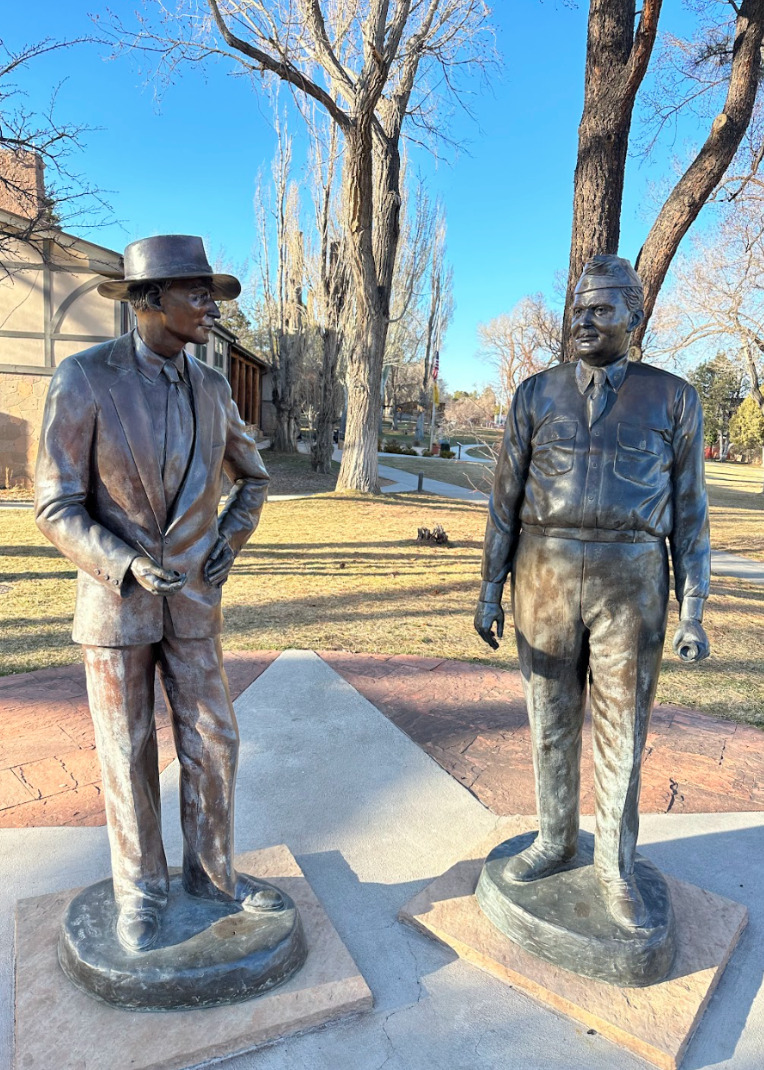
    <summary type="html"><![CDATA[<p><strong><em>Los Alamos residents in the 1940s found themselves in unusual circumstances. John von Neumann explained that, “At great expense we have gathered on this mesa the largest collection of crackpots ever seen.” Yet these people continued life under the cover of secrecy and created a community which has lasted until this day. 	</p></strong></p><img src="https://www.intermountainhistories.org/files/fullsize/a56ce2e0f40dcd7d1a6e2fe9af1ddcf0.jpg" alt="Statue of Oppenheimer and Groves" /><br/><p><span style="font-weight:400;">As the scientists and military personnel worked furiously to create an atomic weapon during the latter years of WWII, many moved to the classified town of Los Alamos, New Mexico. Because their project was shrouded in such secrecy, they were required to move themselves and their family without knowing many of the details of their new job or location. Although the civilian and academic director, J. Robert Oppenheimer, tried to make it as much of a collaborative and normal operation as possible, the nature of their assignment meant that living in Los Alamos was unique. </p>
<span style="font-weight:400;">Many scientists arrived without knowing exactly where they would be working or what they would be doing. They were not even allowed to tell their spouses what their work in the restricted laboratories entailed. Secrecy was of the utmost importance. Oppenheimer spread disinformation to nearby cities, such as Santa Fe, that they were working on an electric rocket. Mail for all scientists was addressed to Box 1663, Sandoval County, Rural. It was liable to searches and some outgoing mail was redacted for security concerns. Even phone calls were monitored—army intelligence agents were obvious in listening in on people’s private conversations. Barbed wire covered the scenic landscape and made some workers feel as though they were the ones imprisoned rather than the liberators of those in European prison camps. </p>
<span style="font-weight:400;">Despite the secrecy and sometimes oppressive security, many familiar aspects of daily life continued in Los Alamos. Many women were given clerical jobs such as secretaries or computer operators to keep them occupied while their husbands worked. Children continued to attend school and babies continued to be born. In regards to the baby boom, the military official General Leslie Groves grumbled that they were simply taking advantage of the free healthcare awarded to those in the army effort. The few movies which were allowed to play were quite popular. In a move for additional entertainment, engineers and scientists threw amateur theatricals which even featured the eminent Oppenheimer in the role of “corpse.” </p>
<span style="font-weight:400;">The setting of Los Alamos itself served as a diversion for employees and their families. Oppenheimer had picked the site of Los Alamos for its beauty and openness. He thought that it could give the scientists a sense of freedom amidst all of their restrictions. Placed on top of towering mesas flanked by green mountains and overlooking fantastic natural features, there were many opportunities for outdoor recreation. During the winter, avid skiers trekked up the nearby Jemez Mountains and skied back down to their homes. The outdoor ice rink, built in 1936, became an unofficial youth center for local children to spend their winters with friends. The warmer months brought camping, horseback riding, fishing, and hiking. Curious children and adults also explored the many nearby Ancestral Puebloan archaeological sites and ruins. </p>
<span style="font-weight:400;">Even though Los Alamos was a unique environment of brilliant scientists sequestered in the wilderness, life found a way to continue in relative normalcy. It grew out of a wartime necessity into a long-lasting community with unusual origins. Today, Los Alamos is home to around 13,000 people and a National Laboratory specializing in weapon-making for the United States government. The community maintains their engagement in many of the recreational activities that their predecessors did. The Pajarito Ski Hill and the ice rink continue to gather youth and adults during the winter months. Warmer times of the year bring outdoor sports, especially running and hiking, among the abundant natural landscape. Summer is also the ideal time for weapons testing. For seasoned Los Alamos citizens, a large explosion miles away that rattles windows and door frames is unsurprising—rarely do they suspect an earthquake.  The work and life of Los Alamos persists nearly a century after it was settled. </span>


</p><p><em><strong><a href="https://www.intermountainhistories.org/items/show/754">For more (including 5 images) view the original article</a></strong></em></p>]]></summary>
    <published>2023-09-20T19:36:59+00:00</published>
    <updated>2026-04-17T19:32:16+00:00</updated>
    <link rel="alternate" type="text/html" href="https://www.intermountainhistories.org/items/show/754"/>
    <id>https://www.intermountainhistories.org/items/show/754</id>
    <author>
      <name>Abigail Beus, Brigham Young University</name>
    </author>
  </entry>
  <entry>
    <title type="html"><![CDATA[Dorothy McKibbins: The Gatekeeper of Los Alamos ]]></title>
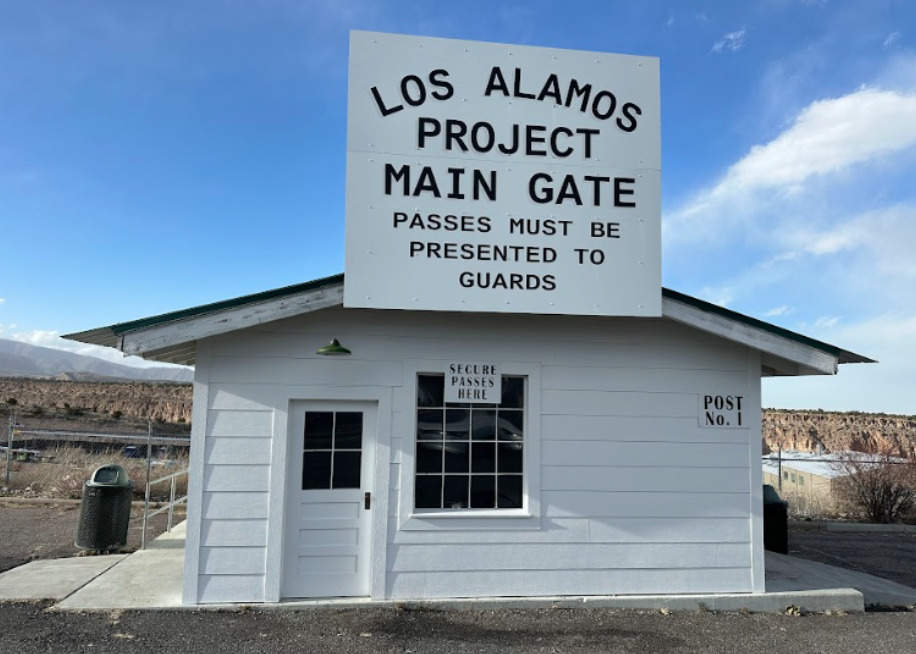
    <summary type="html"><![CDATA[<p><strong><em>The Manhattan Project would not have been possible without the efforts of Dorothy McKibbin, the Gatekeeper of Los Alamos. From attaining marriage licenses to transferring phone calls, Dorothy McKibbin was an integral and diversely skilled cog in the large machine of building the first nuclear weapons. </p></strong></p><img src="https://www.intermountainhistories.org/files/fullsize/5c401996b7cfdc416ba17d96a788fbec.jpg" alt="Los Alamos Project Main Gate Replica" /><br/><p><span style="font-weight:400;">Once General Leslie Groves and Dr. J. Robert Oppenheimer chose Los Alamos, New Mexico as the place to build the atomic bomb; hundreds of bewildered employees streamed into the nearby town of Santa Fe. Due to the confidentiality of the Manhattan Project, recruitment was difficult and details provided to the new hires were vague because of the classified nature of their work. They were told that their work would helpe war effort and be located in the scenic mesas of New Mexico, but little else. After a long train ride to the nearby town of Lamy, scientists and their families hauled their luggage through the winding streets of Santa Fe, looking for 109 East Palace Avenue—the only address they had been given. There, they were met by a simple red and blue sign reading “United States Engineer Office No. 3” and the welcoming presence of Dorothy McKibbin. </p>
<span style="font-weight:400;">In 1932, recently-widowed Dorothy McKibbin moved to Santa Fe from Kansas with her son, hoping for a new life. When she met Dr. J. Robert Oppenheimer in 1943, she found one. Oppenheimer recognized her comforting, calming, and competent presence and asked her to be a War Department secretary with unspecified duties. Like the other personnel, she only knew that her job concerned an essential war project. As she discovered after accepting the position, duties encompassed everything from disciplining Nobel laureates, receiving classified mail, enforcing security, helping lost families find the way to their new homes, and more. She was there for some of the most important moments of the project, even observing the Trinity Test from a car parked near Albuquerque. To Dorothy McKibbin, “Working at 109 was more than just a job. It was an exciting experience. Our office served as the entrance to one of the most significant undertakings of the war or, indeed, of the twentieth century.” </p>
<span style="font-weight:400;">For the entirety of the Manhattan Project she was the point of contact between the secret city and the rest of the world, earning herself the nickname of  the “Gatekeeper of Los Alamos.” After the Manhattan Project concluded, the site was renamed the Los Alamos National Laboratory, and McKibbin continued to work there until her retirement in 1963. She spent her retirement organizing community programs in Los Alamos and Santa Fe until her death in 1985. Today, a room in the Los Alamos History Museum is named in her honor, and although her office at 109 East Palace currently houses a gift shop, its original iron gate which once welcomed thousands to the secret city is on display at the Los Alamos History Museum. </span>
</p><p><em><strong><a href="https://www.intermountainhistories.org/items/show/752">For more (including 4 images) view the original article</a></strong></em></p>]]></summary>
    <published>2023-09-08T01:24:19+00:00</published>
    <updated>2026-04-17T19:32:16+00:00</updated>
    <link rel="alternate" type="text/html" href="https://www.intermountainhistories.org/items/show/752"/>
    <id>https://www.intermountainhistories.org/items/show/752</id>
    <author>
      <name>Abigail Beus, Brigham Young University</name>
    </author>
  </entry>
  <entry>
    <title type="html"><![CDATA[El Palacio de los Gobernadores: The First American Revolution]]></title>
    <summary type="html"><![CDATA[<p><strong><em>The late 17th century saw drought, increased nomadic raiding, and religious repression for Rio Grande Puebloan peoples. The arrest of forty-seven Pueblo religious leaders was the last straw. After planning his rebellion for five years, Popé and the Rio Grande Pueblo warriors converged around Santa Fe, but not before executing twenty-one of the thirty-three Franciscan missionaries in New Mexico.</em></strong></p><img src="https://www.intermountainhistories.org/files/fullsize/af94482953bc232618fa3f72c9a764ce.jpg" alt="[Untitled]" /><br/><p>        The Palace of the Governors in Santa Fe was built in 1610 with the rest of the early town. It served as the governing seat of New Mexico from 1610 to 1886.  </p><p>The arrest of forty-seven Puebloan spiritual leaders by Governor Juan Francisco Treviño in 1775 exacerbated the deepening rifts between the Pueblo people and the Spanish colonial administration in New Mexico. The Pueblo Revolt, started by one of the forty-seven leaders released at arrowpoint by Governor Treviño, started in 1680 and quickly spread through the countryside. Churches and haciendas were burnt to the ground, and Pueblo armies quickly reached Santa Fe. </p><p>The Pueblo warriors besieged the Palace of the Governors. Governor Antonio de Otermin led a desperate sally out of the Palace which Pueblo forces, under Juan, a Tano man sporting a Spanish leather jacket, arquebus, sword, and dagger, rebuffed. As the Rio Grande Pueblo numbers swelled with reinforcements from the northern pueblos, the situation began to look more and more grim for the Spaniards barricaded in the Palace of the Governors. After five days of siege, running dangerously low on water and food supplies, Otermin ordered another charge, which took the Pueblo warriors by surprise. The previously cornered Spaniards were able to rout enough of the Pueblo force to escape the city the next day. </p><p>Two Spanish groups, one from Santa Fe and another that hid in the Isleta Pueblo (who did not participate in the revolt) headed by the lieutenant governor of New Mexico, met at Socorro, New Mexico, on September 6, 1680. Otermin had Alonso Garcia, his lieutenant governor, arrested for not assisting Santa Fe in its time of need, but released him upon hearing the official’s story, which included being informed that everyone up north was already dead. The defeated Spanish then headed to El Paso and were expelled from New Mexico for the next twelve years, ending the first Spanish occupation of New Mexico.</p><p>Diego de Vargas retook the  Palace of the Governorsduring his reconquest of New Mexico, and served as his government’s seat. Neither the Mexican  nor  early American period saw a new capitol building until 1886. The Palace  served the public as the New Mexico History Museum between 1909 and 2009. The state then built a larger building next to it to house the museum collections, and the Palace of the Governors itself is now only part of the museum. The building saw many iterations of remodeling and change during its later periods. A particularly dramatic episode followed the popularity of the Pueblo Revival style, which resulting in the complete transformation of the historic Santa Fe area.</p><p><em><strong><a href="https://www.intermountainhistories.org/items/show/328">For more (including 3 images) view the original article</a></strong></em></p>]]></summary>
    <published>2019-09-12T06:35:54+00:00</published>
    <updated>2026-04-17T19:32:06+00:00</updated>
    <link rel="alternate" type="text/html" href="https://www.intermountainhistories.org/items/show/328"/>
    <id>https://www.intermountainhistories.org/items/show/328</id>
    <author>
      <name>Edgar I Bernal Sevilla, Northern Arizona University</name>
    </author>
  </entry>
  <entry>
    <title type="html"><![CDATA[Santa Fe Plaza and Religious Repression: Cracks in the Spanish Walls]]></title>
    <summary type="html"><![CDATA[<p><strong><em>In 1775, Governor Juan Francisco Treviño’s first year in office, he ordered the arrest of forty-seven Puebloan religious leaders and had them stand trial for witchcraft. Santa Fe was shortly surrounded by a force of angry and armed Puebloan men, forcing the governor to release the Pueblo religious leaders. Among those released was a shaman from Ohkay Owingeh Pueblo named Popé, who later became the architect of the Pueblo Revolt of 1680.</em></strong></p><img src="https://www.intermountainhistories.org/files/fullsize/dc5ae6b131aad86760889e5c60b3c176.jpg" alt="[Untitled]" /><br/><p>        The Santa Fe Plaza is a traditional Spanish colonial style city square built in 1610 by the founders of Santa Fe under the orders of Don Pedro de Peralta, the second governor of New Mexico. Like other Spanish colonial plazas, the Santa Fe plaza served as the central hub of its city. It was flanked by the town church, the Palace of the Governors, and the houses of local notables. </p><p>The late 17th century was a period of drought, nomadic raids, and increased political repression for the Rio Grande Puebloan people. The Spanish Franciscan missionaries increasingly asserted their power over the New Mexican colony, culminating in a showdown with the provincial governor, Diego de Peñalosa. Governor Peñalosa arrived in New Mexico in 1661, and governed until ousted by Franciscan political pressure in 1664. While in office, he banned forced Native American labor and worked to preserve Puebloan cultures. This led to excommunication by a local Catholic clergyman, which Peñalosa had arrested, triggering the series of events that led to his ouster and a Mexican Inquisition jail cell.</p><p>The following governor was also not to the local clergymen’s liking, so he was politically forced to retire as well, leading to installation of Governor Juan Francisco Treviño in 1675. He was dedicated to the supremacy of the Catholic faith and the eradication of Puebloan culture. In the same year that he came to power, he ordered Spanish troops to burn kivas and arrest forty-seven Puebloan religious authorities. He then commanded that they all be tried for witchcraft. After three men were executed and a third that was sentenced to death committed suicide, a large, armed group of Pueblo men surrounded the Santa Fe Plaza and demanded that the shamans be released from prison. With most of the Spanish troops of Santa Fe out fighting nomads, Governor Treviño was forced to release the men. One of the men released was determined to end the Spanish period in New Mexico and safeguard the religious traditions of Puebloan people. Popé, a religious leader from the pueblo Ohkay Owingeh, retreated to the safer and more distant Taos Pueblo after he was released, where he would hatch a plan to remove the Spaniards.</p><p>The Santa Fe Plaza continued being the center of city life after the reconquest of New Mexico by Don Diego de Vargas. To this day, it serves as the city center for many communal events like the annual Fiestas de Santa Fe. After the Civil War, the New Mexican government erected a monument  in the middle of the plaza and dedicated to Union troops and Indian fighters. In 1974, an unidentified man chiseled out the word “savage,” which was used to describe indigenous people by the monument’s creators. </p><p><em><strong><a href="https://www.intermountainhistories.org/items/show/326">For more (including 4 images) view the original article</a></strong></em></p>]]></summary>
    <published>2019-09-12T01:11:35+00:00</published>
    <updated>2026-04-17T19:32:05+00:00</updated>
    <link rel="alternate" type="text/html" href="https://www.intermountainhistories.org/items/show/326"/>
    <id>https://www.intermountainhistories.org/items/show/326</id>
    <author>
      <name>Edgar I Bernal Sevilla, Northern Arizona University</name>
    </author>
  </entry>
</feed>