<?xml version="1.0" encoding="UTF-8"?>
<feed xmlns="http://www.w3.org/2005/Atom">
  <title type="text">Intermountain Histories</title>
  <updated>2026-08-18T15:51:43+00:00</updated>
  <generator uri="http://framework.zend.com" version="1.12.20">Zend_Feed_Writer</generator>
  <link rel="alternate" type="text/html" href="https://www.intermountainhistories.org/"/>
  <link rel="self" type="application/atom+xml" href="https://www.intermountainhistories.org/items/browse?output=rss2"/>
  <id>https://www.intermountainhistories.org/</id>
  <author>
    <name>Intermountain Histories</name>
    <uri>https://www.intermountainhistories.org</uri>
  </author>
  <link rel="hub" href="https://pubsubhubbub.appspot.com/"/>
  <entry>
    <title type="html"><![CDATA[Girl Scouts of Utah]]></title>
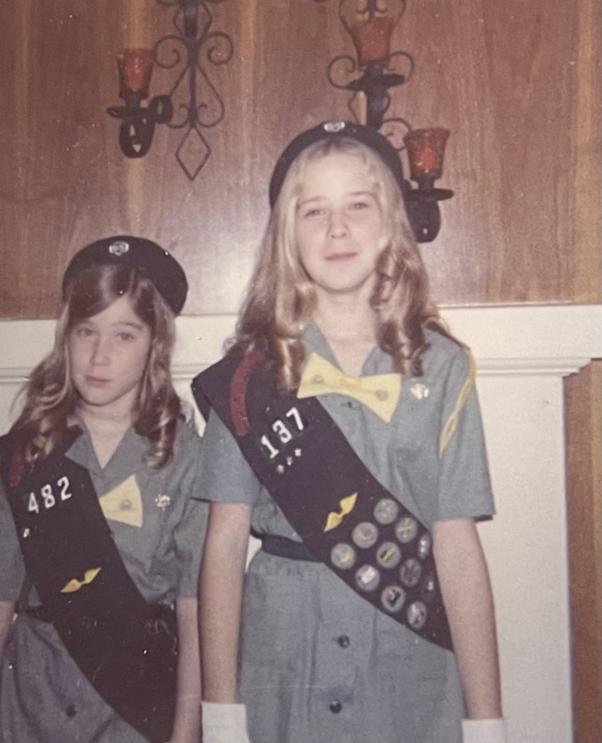
    <summary type="html"><![CDATA[<p><strong><em>Barbara Schmidt, a scout of 65 years, recalls her fondest memories growing up as a girl scout in mid-twentieth century Utah. </em></strong></p><img src="https://www.intermountainhistories.org/files/fullsize/0d86281475893b6bdc8c122102bc6d41.jpg" alt="Sisters posing in their Girl Scout uniforms circa 1970" /><br/><p><span style="font-weight:400;">The first Girl Scout troop was founded in Virginia in 1912, and it wasn’t long before troops sprouted up throughout the nation. Founded by Juliette Gordon Low, the organization was modeled to build “courage, confidence, and character,” as their mission statement declares. Becoming a Girl Scout also provided young girls with leadership opportunities and outdoor experiences, not unlike their male peers in the Boy Scouts program. </span>
<span style="font-weight:400;"></span><span style="font-weight:400;">In 1920, a group of mothers in Ogden, Utah united to find a positive community for their daughters. They initially looked into Campfire Girls, but ultimately discovered that the Girl Scouts were more suited to their needs. Advertising the opportunity in local schools, they soon had enough willing participants to create Utah’s first ever Girl Scout troop. Just a year later, another troop formed in Salt Lake City. </span>
<span style="font-weight:400;"></span><span style="font-weight:400;">In the late 1940s Barbara Schmidt, a student at Hawthorne Elementary School in Salt Lake City, was thrilled at the prospect of becoming a Girl Scout. She saw an announcement at her school for a new local troop and ran home that afternoon excitedly to ask her mom if she could go. Barbara became a Brownie which was, at the time, the group for girls aged eight to ten years old. The troop met at first in the home of the troop leader, a mother of her classmate, but as the troop grew they began meeting in the basement of Zion Lutheran Church.</span>
<span style="font-weight:400;"></span><span style="font-weight:400;">Some of Barbara’s fondest memories are from her summers at camp––and all of the months spent selling cookies in preparation. Each scout who wished to attend a camp had a quota to meet, so they had to be both diligent and creative to meet their goals. In her years of motherhood Barbara always followed her own cookie-selling scouts at a safe distance in her mini van, back in her day Barbara and her fellow scouts were often allowed out on their own––so long as they stuck with a buddy at all times. She spent countless afternoons pulling a red wagon full of cookies, twenty-five cents each, up and down the neighborhoods of Salt Lake. Her troop also received permission from the local Catholic church to sell cookies in the parking lot after mass, which drummed up a fair amount of business. When their work was done, the girls boarded an old rickety school bus that trudged wearily up the mountain to camp. Once they had finally arrived the girls spent their days developing outdoorsmanship skills and making friendships that would last a lifetime. </span>
<span style="font-weight:400;"></span><span style="font-weight:400;">Besides selling cookies and camping, Barbara recalls participating in service projects and feeling that she was “making a real difference in the community.” Though she states that she is not quite “going strong” in her volunteering today as she once did, she continues to volunteer regularly at the Heritage Museum in the Girl Scouts of Utah Council Resource Center. She continues to advocate for the girl scout program because it helps young girls to “embrace a perspective beyond their own.</span></p><p><em><strong><a href="https://www.intermountainhistories.org/items/show/928">For more (including 6 images) view the original article</a></strong></em></p>]]></summary>
    <published>2025-12-09T17:24:32+00:00</published>
    <updated>2026-04-17T19:32:21+00:00</updated>
    <link rel="alternate" type="text/html" href="https://www.intermountainhistories.org/items/show/928"/>
    <id>https://www.intermountainhistories.org/items/show/928</id>
    <author>
      <name>Megan Bailey, Brigham Young University</name>
    </author>
  </entry>
  <entry>
    <title type="html"><![CDATA[Teddy Roosevelt&#039;s Welcome in the Beehive State: Story 4 of 8 of the President Theodore Roosevelt in the West Tour]]></title>
    <summary type="html"><![CDATA[<p><strong><em>President Teddy Roosevelt's Welcome in the Beehive State and his patriotic parade. He addresses Utah citizens and their advancements in irrigation and economics. </em></strong></p><img src="https://www.intermountainhistories.org/files/fullsize/a7ca3d8cfd35ec2ca4a058b9d4af50b2.jpg" alt="President Roosevelt speaks to Ogden citizens on his way to Salt Lake City" /><br/><p>Incoming from Ogden, Utah, pulled by the Union Pacific Engine No. 659, President Theodore Roosevelt steps onto the Oregon Short Line Depot on May 29th, 1903, at 8:30 am, greeted by thousands waiting for his arrival since 6 am. The Salt Lake Tribune newspaper covers the day as the itinerary is published, highlighting, “Today Salt Lake and Utah have the distinguished honor of entertaining the Chief Magistrate of the United States. An enthusiastic welcome is accorded, and our only regret is the briefness of the visit.” On his whistle-stop tour of the West, Roosevelt is adorned with cheers and taken through a parade around Salt Lake City with a route lined with 50,000 people, flags, ribbons, and all manner of decorations along the street. Stores closed, and the city practically shut down other than essentials to welcome in the 26th president. Roosevelt delighted seeing a “little tot of the kindergarten…” and was impressed to say, “I am very glad to see you. I believe in work and I believe in play. Play hard while you play; and when you work, don’t play at all. That is good advice for children, and it is good advice for grown folks too. It is a great pleasure to see you.” With a big, burly grin, Roosevelt paraded Eastward from West South Temple Street to Main Street, passing by school children and mounted soldiers until he arrived at his destination, the Tabernacle.
The Salt Lake City Tabernacle was also decorated with banners, greenery, flags, and ribbons. It was a common congregating location for members of the Church of Jesus Christ of Latter-day Saints and was used to host Roosevelt’s address to the citizens of Utah. The Salt Lake Herald reported the next day that the, “Historic old building could not accommodate the throngs that gathered there” it was so packed. Roosevelt was accompanied by Senator Thomas Kearns, members of the influential Alta Club and Lester Club, LDS Church President Joseph F. Smith, Mayor Ezra Thompson, Governor Heber Manning Wells, and singer Emma Ramsey (also known as “The Utah Nightingale.”) Ramsey opened the event by singing “Rent the Air,” according to the Deseret News. Roosevelt covered many topics he was known for, including his love of the wilderness and respect for the land<b>. </b>His point about conservation was made, “while citizens die, the government and the nation do not die, and we are bound in dealing with the forests to exercise the foresight necessary to use them now, but to use them in such way as will also keep them for those who are to come after us.” This was a great feat, particularly in Utah, as he emphasized the hard work of the citizens, “You took territory which at the outset was called after the desert, and you literally—not figuratively—you literally made the wilderness blossom as the rose.” Utah’s happy reaction was reflected in the evening newspaper, “It is not often that Salt Lake gets to look upon the actual person of a president of the United States, but when it does it enjoys it thoroughly. The appreciation it felt today of the honor of the visit was manifest in every possible manner. Its citizens turned out with pride and turned her children out with still greater pride.”
After his short visit, Roosevelt was back on the train at 1:00 p.m. Utah citizens celebrated his visit with great remembrance. It strengthened the state’s relationship with the federal government and aided Roosevelt’s success in gaining Utah’s vote for the 1904 presidential election. For the rest of his Western tour, he created a precedent of energy and patriotism that Theodore Roosevelt was known for sharing.</p><p><em><strong><a href="https://www.intermountainhistories.org/items/show/918">For more (including 5 images) view the original article</a></strong></em></p>]]></summary>
    <published>2025-10-24T15:03:16+00:00</published>
    <updated>2026-08-18T15:51:43+00:00</updated>
    <link rel="alternate" type="text/html" href="https://www.intermountainhistories.org/items/show/918"/>
    <id>https://www.intermountainhistories.org/items/show/918</id>
    <author>
      <name>Jessika Cole, Brigham Young University</name>
    </author>
  </entry>
  <entry>
    <title type="html"><![CDATA[Thomas Rhoads, The Forgotten Mormon<br />
]]></title>
    <summary type="html"><![CDATA[<img src="https://www.intermountainhistories.org/files/fullsize/8270cbc2aff28b5cd485285278466bee.jpg" alt="Map demonstrating the “Old Spanish Trail” initially used by Colonial Spanish in the late sixteenth century." /><br/><p><span style="font-weight:400;">Born in 1796 in Kentucky, Thomas Rhoads fought for the U.S. Army in the War of 1812. Marrying his first wife Elizabeth Forter in 1817, having sixteen children together, he then converted to The Church of Jesus Christ of Latter-day Saints in Nauvoo, Illinois, in 1835. Rhoads belonged to the Danites and to the Nauvoo Legion as Lieutenant. He moved his family from Illinois to Missouri and finally to California. Rhoads led the first LDS pioneers into future Utah Territory in 1846, before continuing west into California, where he struck gold. After Samuel Brannon refused church leaders’ call to return to Great Salt Lake City, Brigham Young wrote to Rhoads asking him to lead members and tithes back to Salt Lake.</p> <span style="font-weight:400;">Arriving in 1849 at the head of a wagon train, the Saints hailed Rhoads as a hero in a parade wherein Young spoke of Rhoads’ vital contributions of gold to the territory. Submitting four thousand dollars’ worth of gold members had sent as tithing, Rhoads then gave his own seventeen thousand dollars of gold. In exchange Rhoads was given an exceptional plot of land near the temple in Salt Lake and credited with over ten thousand dollars in the church bank ledger, the only man to receive his own dedicated page in the ledger aside from Brigham Young himself.</p> <span style="font-weight:400;">Rhoads served Brigham Young in many ways to help establish Utah Territory’s economic footing over the coming years. Young handpicked Rhoads multiple times to accompany him on scouting parties around the state to determine future settlements. Furthermore, Rhoads continued to provide a steady supply of gold each year to the Mormon mint. Multiple primary sources describe his deliveries in person; however, the church ledgers do not record the deposits, and scholars debate the amounts. Ultimately, the income was crucial to the young community facing extreme opposition as minted gold coins contributed to the perpetual immigration fund as well as construction of the temple.</p> <span style="font-weight:400;">Just as the amount is contested, so are the various sources. Accounts detail how Rhoads knew about a multitude of old mines in the mountains, abandoned by the Spanish. Several of these mines have been located and confirmed, others were claimed to have been found but were not accessible, while others still are lost. Most controversial amongst these is “Carre Shin Ob” located near White Rocks Canyon in the Wasatch Forests of Eastern Utah. As the story goes, in 1852 Brigham Young and Utes Chief Walker entered an arrangement thanks to Isaac Morely, wherein Rhoads would be permitted to travel alone deep into Indian territory to retrieve gold for the Mormon church. Walker was a convert and believed in the church, giving three simple rules: only Rhoads may know the location, he only takes the specified amount, and no Ute Indians would transport gold.</p> <span style="font-weight:400;">Dozens of accounts detail Rhoads’ travels; and the days absent compared to confirmed distance traveled proves wherever Rhoads retrieved gold from, he did not have to mine it himself. Scientific analysis of remaining Mormon mint coins matches the chemical makeup of old Spanish gold mined in the era. There are critiques that doubt the stories of Rhoads’ lost mine; regardless, Rhoads gathered gold from somewhere and this gold was immensely important to the foundation of Salt Lake City and eventually Utah.</span></p><p><em><strong><a href="https://www.intermountainhistories.org/items/show/877">For more (including 4 images) view the original article</a></strong></em></p>]]></summary>
    <published>2025-01-25T03:15:14+00:00</published>
    <updated>2026-04-17T19:32:20+00:00</updated>
    <link rel="alternate" type="text/html" href="https://www.intermountainhistories.org/items/show/877"/>
    <id>https://www.intermountainhistories.org/items/show/877</id>
    <author>
      <name>Travis Sorensen, Brigham Young University</name>
    </author>
  </entry>
  <entry>
    <title type="html"><![CDATA[Joe Hill: The Singing Voice of Labor]]></title>
    <summary type="html"><![CDATA[<p><strong><em>This monument was raised in 2013, 108 years after Joe Hill’s execution and built on the very spot where the IWW songwriter was executed, based on circumstantial evidence. </em></strong></p><img src="https://www.intermountainhistories.org/files/fullsize/16274c8b51b488d753e1d34265c74b56.jpg" alt="Joe Hill Memorial Plaque" /><br/><p>Joe Hill was born in Gavle, Sweden in 1879, and immigrated to the USA in 1902 for want of work. After years of itinerant labor, he joined the Industrial Workers of the World (IWW,) commonly known as the "Wobblies," in 1908. The IWW was a radical labor union, which represented not just skilled workers, but any worker, in any job, regardless of age, race, or gender. The union was also not just focused on obtaining improvements in wages, hours, or conditions, but a total overthrow of the capitalist system. </p><p>Hill hid in boxcars and "rode the rails" to where he could find work, and after a couple years he became an organizer in the IWW, writing songs to mobilize the workers during times of strikes. His "Little Red Songbook" spread throughout the IWW and therefore throughout the country, whenever Wobblies went on strike, they would sing his songs, and usually he would be there too. And in 1914, the strikes were in Utah, involving the workers of Utah Construction Company, represented by IWW local 69, cheered on by Joe Hill in person. There had been repeated clashes between the IWW and the Salt Lake City Police that created an atmosphere of tension in the city. </p><p>On January 10, 1914. Hill was shot in the chest and went to visit a doctor friend to have it treated, the same night John and Arling Morrison were killed in a robbery at the grocery store at which they worked. Hill's doctor reported him to the police, and Hill was promptly arrested. Hill, and many others in the IWW or otherwise sympathetic to his cause, believed the arrest and trial would simply be harassment, as it so often had been before. But Hill, after meeting his state-appointed lawyers, felt strongly that his lawyers had been bribed to 'throw' the case, despite the lack of evidence, and he chose to represent himself. He argued that his songs were free and protected speech, and that the work of the IWW in Utah was protected under the right to associate, and that their actions were chiefly against economic inequality. </p><p>Hill's trial lasted less than one month, during which time the state failed to provide any motive, a single piece of evidence, or indeed any possible indication that any of the bandits had been Joe Hill. The only piece of evidence the prosecution submitted was Joe Hill's IWW red card. The IWW were known for being violent and inhumane, claimed the prosecution, and Hill was a member of it. Hill wanted to overthrow capitalism, civilization itself they claimed, and through his songwriting and performances, even if he hadn't done the murders himself, he was equally responsible. Hill's demands that he had been mistried and appeals for a retrial fell upon deaf ears, and against nationwide beliefs that there had been an abrogation of due process, he was found guilty by jury on June 27 and sentenced to death on July 8th. </p><p>Hill appealed the sentence, and a massive letter-writing campaign began, with letters pouring into the office of Utah Governor Spry, both demanding Spry pardon Hill or to permit the execution. President Woodrow Wilson asked Spry to pardon, stating that Hill's trial had not been fair, as had the Swedish ambassador. In the end, Hill was executed by firing squad on November 19, 1915. Many felt then and feel to this day that Hill had been tried for his speech and for his affiliations rather than any possibility of being among the murderers.</p><p><em><strong><a href="https://www.intermountainhistories.org/items/show/872">For more (including 3 images) view the original article</a></strong></em></p>]]></summary>
    <published>2024-10-31T21:23:23+00:00</published>
    <updated>2026-04-17T19:32:19+00:00</updated>
    <link rel="alternate" type="text/html" href="https://www.intermountainhistories.org/items/show/872"/>
    <id>https://www.intermountainhistories.org/items/show/872</id>
    <author>
      <name>Joseph R. McKellar, Utah State University</name>
    </author>
  </entry>
  <entry>
    <title type="html"><![CDATA[Salt Lake City&#039;s Trolley Square, Utah]]></title>
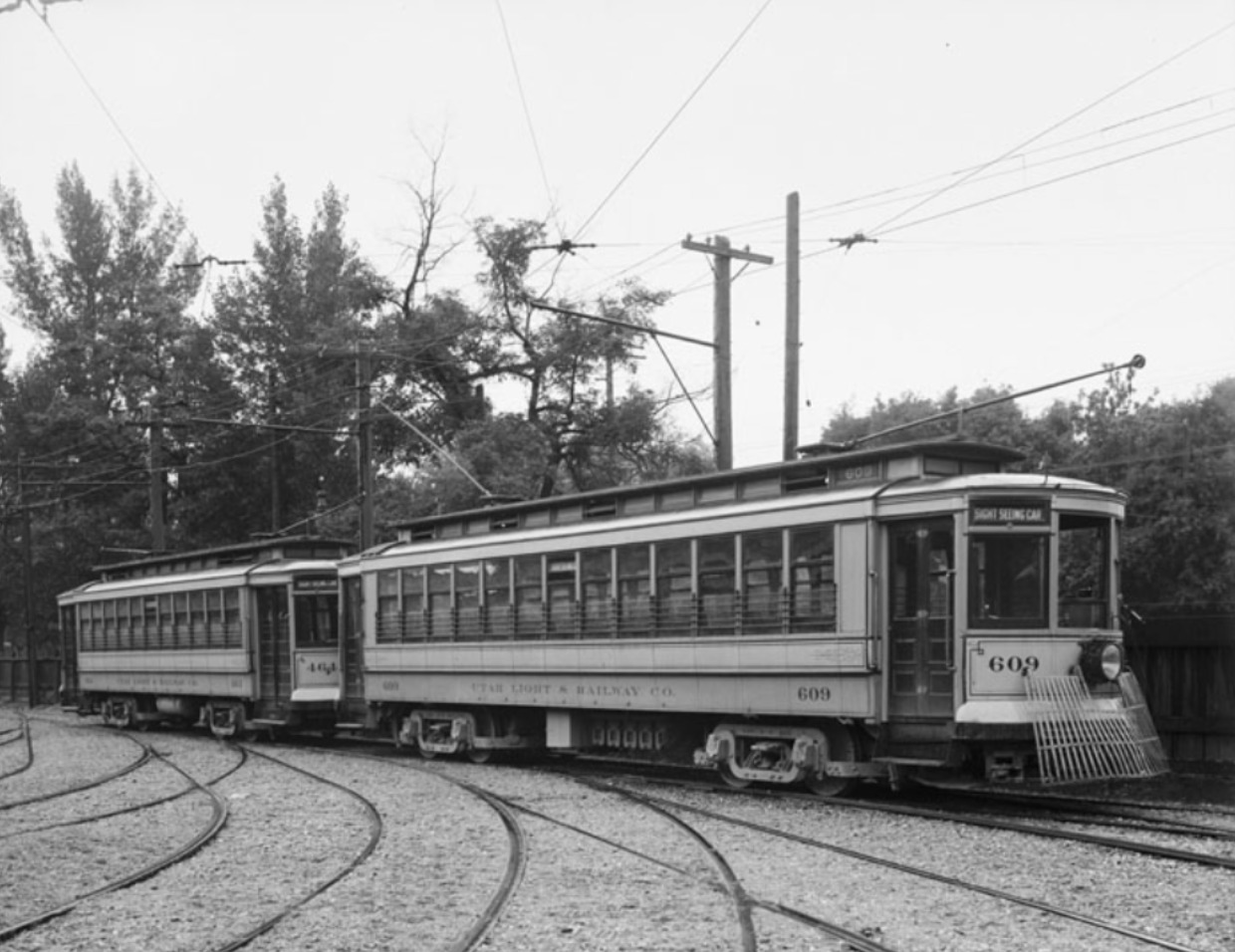
    <summary type="html"><![CDATA[<p><strong><em>Once the site of Salt Lake City’s trolley car barns, Trolley Square is now a bustling public marketplace that commemorates the city’s transit history.</em></strong></p><img src="https://www.intermountainhistories.org/files/fullsize/6449b1648fa44c9d528bf9ee7241c03c.jpg" alt="Street Cars, Utah Light and Railway Company. 1911" /><br/><p><span style="font-weight:400;">Historic Trolley Square is one of downtown Salt Lake City’s most popular tourist attractions. Though it is more renowned for its shopping center, Trolley Square also features a Trolley History Museum, dedicated to the Square’s storied lineage as the former site of the Utah Light and Rail Company’s trolley car barns.</span>
<span style="font-weight:400;">Salt Lake City’s streetcar history began in 1872. The Salt Lake Street Railway Company, formed by prominent Mormons including two sons of Brigham Young, built the first tracks, along which mules would pull the new streetcars. The mule-drawn cars were popular, and within two decades the network had expanded to include fourteen miles of track and twenty-one cars. The mules polluted the tracks with waste, however, and thus the system required constant maintenance. The advent of centralized electrification allowed for the Company to replace the mule-drawn line with Salt Lake City’s very first electric streetcar.</span>
<span style="font-weight:400;">The city’s early electric trolley system was a hit with the public, featuring over sixty cars and over forty miles of track within the first few years. However, it was also chaotic. Following the success of the Salt Lake Street Railway Company, more than a dozen companies fought bitterly and vigorously for ridership and line control. This discordant period ended in 1901, when most of the companies merged into the Consolidated Railway and Power Company, which itself became the Utah Light and Railway Company in 1904.</span>
<span style="font-weight:400;">The Salt Lake City trolley took its next major step forward in 1906, when Union Pacific Railroad executive E.H. Harriman purchased a controlling interest in the Light and Railway Company. Harriman wanted to turn the Salt Lake streetcar into a world-class model of inexpensive electrified mass transit. He added eighty miles of new track to the network, and also constructed a massive new holding facility for the network’s rapidly expanding fleet of cars on land. Due to the risk of fires at this hub of electric streetcar activity, Harriman’s architects also constructed a water tower in the vicinity.</span>
<span style="font-weight:400;">Harriman’s efforts paid off in the short term. By 1914, the Salt Lake City network operated 144 trolley cars on 146 miles of track in Salt Lake and nearby communities, and the system served as a model for others throughout the United States. However, the advent of automobiles would ultimately doom the Salt Lake streetcar. As more automobiles entered the streets, passengers complained of congestion. Even the Light and Traction Company’s new trolley buses, designed to operate without tracks on the street itself, couldn’t compete. Throughout the 1920s and 1930s, the Light and Railway Company closed lines and gradually phased out the trolley. On May 31, 1941, the last trolley car completed its run.</span>
<span style="font-weight:400;">The former car barns of Trolley Square faced the prospect of demolition in 1969, but a local family purchased them in 1972. Soon that same year, architect Wally Wright converted the car barns into a shopping center and festival marketplace. Light rail returned to Utah when the TRAX system began operation in 1999, but Trolley Square is still a powerful reminder of when electric trolleys dominated transportation in Salt Lake City.</span></p><p><em><strong><a href="https://www.intermountainhistories.org/items/show/819">For more (including 3 images) view the original article</a></strong></em></p>]]></summary>
    <published>2024-05-21T06:02:45+00:00</published>
    <updated>2026-04-17T19:32:18+00:00</updated>
    <link rel="alternate" type="text/html" href="https://www.intermountainhistories.org/items/show/819"/>
    <id>https://www.intermountainhistories.org/items/show/819</id>
    <author>
      <name>Liam Craddock, Northern Arizona University</name>
    </author>
  </entry>
  <entry>
    <title type="html"><![CDATA[The KKK Crash the Funeral of a Salt Lake County Sheriff]]></title>
    <summary type="html"><![CDATA[<p><strong><em><span style="font-weight:400;">On April 19</span><span style="font-weight:400;">th</span><span style="font-weight:400;">, 1922, eight hooded Klansmen crashed the funeral of Salt Lake County Sheriff Gordon Stuart. The motive seems to have been a desire to be associated with law enforcement and to be seen in a grandiose manner.</span></em></strong></p><img src="https://www.intermountainhistories.org/files/fullsize/ec9bbf127f5a04bb8e83b1f74d3b3169.jpg" alt="“Klansmen paying respects to Salt Lake County Sheriff,” Salt Lake Telegram April 20th, 1922, 1." /><br/><p><span style="font-weight:400;">A key difference between the 20</span><span style="font-weight:400;">th</span><span style="font-weight:400;">-century Klan and its 19</span><span style="font-weight:400;">th</span><span style="font-weight:400;">-century counterparts was its decentralized motives as the group expanded from the South. In Salt Lake County, Utah, one of the motivations of the local chapter seemed to be a desire to associate with law enforcement and to make a spectacle.</span></p><p><span style="font-weight:400;">In Sandy, Utah, near Salt Lake City, eight Klansmen in full regalia crashed the funeral of Salt Lake County Deputy Sheriff Gordan Stuart on April 19, 1922. The presence of the Klansmen was a surprise to the funeralgoers and the local paper, the </span><i><span style="font-weight:400;">Salt Lake Telegram, </span></i><span style="font-weight:400;">painted their arrival as sudden and mysterious. The hooded men arrived toward the end of the funeral when the mourners had their heads bowed in prayer, and when they finished the </span><i><span style="font-weight:400;">Telegram </span></i><span style="font-weight:400;">stated, “the mourners lifted their heads only to stare at the ghostlike costume of the little group.”</span>
<span style="font-weight:400;">The Klansmen placed a large floral cross on the grave bearing the inscription “Knights of the Ku Klux Klan Salt Lake Chapter No. 1, April 19, 1922.” They then simultaneously raised their left hand, an action the </span><i><span style="font-weight:400;">Telegram </span></i><span style="font-weight:400;">attributed to a “mark of respect to the deputy sheriff.” Following the salute, the Klansmen made their way to the other side of the cemetery where two vehicles waited to take them away. </span>
<span style="font-weight:400;">The motive behind the uninvited attendance at the funeral is unknown. It could be evidence of the departed deputy sheriff’s involvement in the local chapter of the Klan. However, a more likely explanation for their presence was a desire to be associated with law enforcement. The Klan had been struggling to gain popular support in Utah as the Mormon Church opposed its actions. The appearance allowed them an opportunity to emphasize their grandeur and intrigue as well as to show support for law enforcement. By doing so, it is possible they hoped to dispel negative connotations that were becoming synonymous with Klan activities. When looking at the details of Stuart’s death, as well as the details of the Klan’s procession at the funeral, this theory makes sense.</span>
<span style="font-weight:400;">Deputy Sheriff Gordon Stuart died when attempting to serve civil papers to a farmer, who, mistaking the officer’s motives, opened fire with a shotgun and killed Stuart, who had pushed his partner out of harm's way. The Klan surely would have desired to be associated with the commemoration, either to appeal to the deputy sheriff's law enforcement martyrdom or to simply show respect for his service. </span>
<span style="font-weight:400;">Further evidence of this can be seen in the details of the procession itself. The Klan marched slowly in uniform—until eventually speeding up to reach the position of the funeral while the mourners' heads were bowed. Their organization and precision suggest that they knew they were being viewed and wanted to act accordingly. Furthermore, it seems the Klan wanted to appear in front of the bowing mourners before their heads were lifted. Regardless of their motives, the event shows the Salt Lake County chapter of the KKK desired an association with law enforcement.  </span></p><p><em><strong><a href="https://www.intermountainhistories.org/items/show/812">For more (including 3 images) view the original article</a></strong></em></p>]]></summary>
    <published>2024-05-21T00:26:08+00:00</published>
    <updated>2026-04-17T19:32:18+00:00</updated>
    <link rel="alternate" type="text/html" href="https://www.intermountainhistories.org/items/show/812"/>
    <id>https://www.intermountainhistories.org/items/show/812</id>
    <author>
      <name>Aidan Capristo, Northern Arizona University</name>
    </author>
  </entry>
  <entry>
    <title type="html"><![CDATA[First National Bank of Utah: Also known as the Bamberger Building, Masonic Hall, and Wells Fargo Building.]]></title>
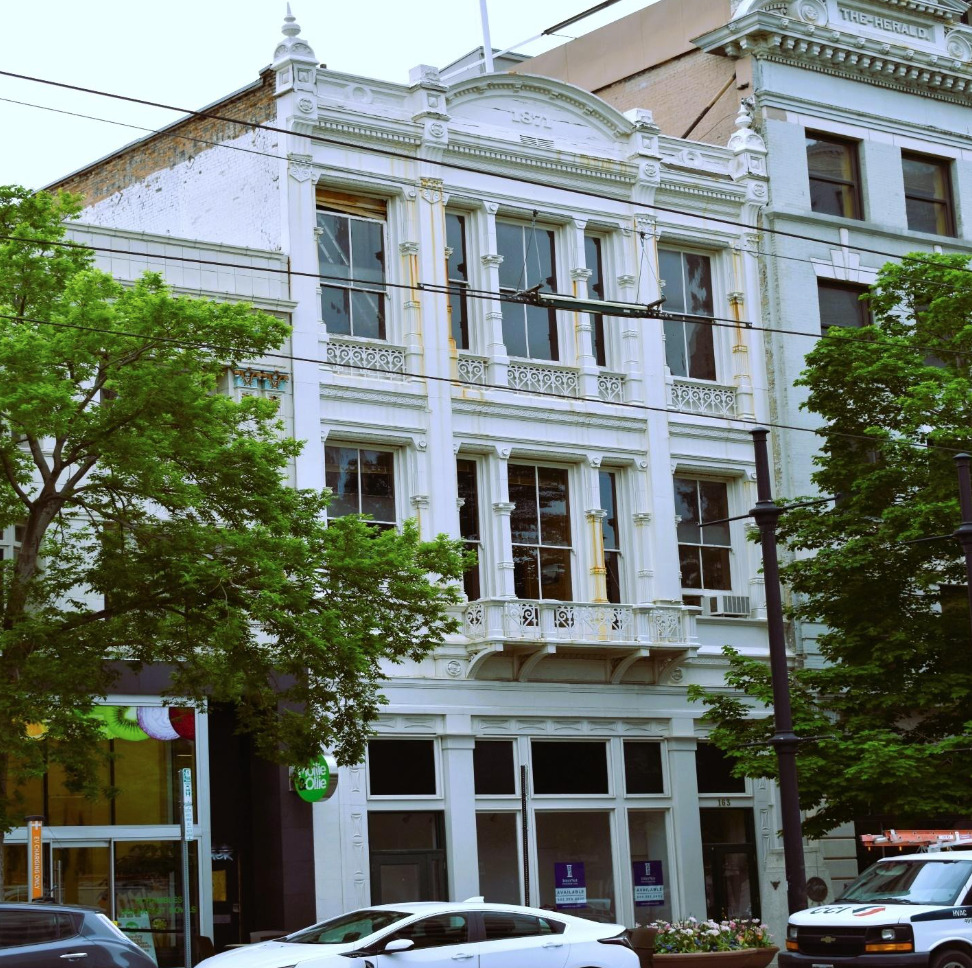
    <summary type="html"><![CDATA[<p><strong><em>The First National Bank of Utah, once the Territory’s most publicized financial institution, failed because of the shady operations of its president, Warren Hussey, closing only five years after its incorporation.</em></strong></p><img src="https://www.intermountainhistories.org/files/fullsize/3d811606a4f71a89ee1b5030426bbffe.jpg" alt="First National Bank Building, Salt Lake City" /><br/><p><span style="font-weight:400;">In the 1860s, Utah Territory began relying more on mining over agriculture, with eventually hundreds of claims dotting its landscape. Salt Lake City, serving as Utah Territory’s capital, benefitted most from this economic expansion, attracting miners and investors alike. Warren G. Hussey, a gold broker operating across the Intermountain West, expanded into the financial realm by purchasing the Miners’ National Bank of Salt Lake in 1869, notably the year of the Transcontinental Railroad’s completion, reorganizing it into the First National Bank of Utah.</span>
<span style="font-weight:400;">Hussey quickly established this new bank as Utah’s most important financial house, with total assets in 1871 amounting to $582,000. Hussey appeared so adept in banking that dividends, or returns to shareholders on investments, amounted to one hundred percent in 1871-2. In 1872, Hussey bought out any remaining stock in circulation, becoming First National’s sole owner, and decided to construct a new banking facility. </span>
<span style="font-weight:400;">Commenced in early 1871, First National’s new building opened in September 1873. Designed by Thomas J. Johnson, a San Francisco-based builder, and Richard M. Upjohn, one of the United States’s foremost architects. No expense was spared, with total cost ballooning to $140,000, far higher than initial estimates. Its opening also aligned with the Panic of 1873, an economic recession causing bank runs across the United States. In response, Hussey suspended deposit payouts the month the new building opened. He also held interests in Utah’s Emma Mine, an operation riddled with fraudulent activity, losing tens of thousands of dollars upon its closure in 1873 after reports of its rich silver deposits being falsified.</span>
<span style="font-weight:400;">However, First National’s economic condition appeared sound. The U.S. Comptroller, the monitoring office for financial activities, reopened the bank in October 1873 after reporting that the bank’s resources were four times higher than deposits. Within fourteen months, however, the Comptroller shut down First National in December 1874, citing incompetent management. After its liquidation was finalized in 1878, only twenty-five percent of clients received compensation. </span>
<span style="font-weight:400;">Hussey embezzled First National’s remaining assets into a personal account and continued opening banks across the Intermountain West. Notably, Hussey opened the Spokane National Bank in Washington in 1888, again investing considerable sums into a lavish headquarters. This bank failed in 1891, attributed to risky mining investments and negligible financial practices. Hussey, aged eighty-three, died in his Spokane home in 1920.</span>
<span style="font-weight:400;">In 1875, First National’s building suffered from a city-wide fire, losing its fourth story, never to be rebuilt. However, the structure continued serving as office spaces, and the Deseret National Bank (now Zion Bancorporation) occupied the first floor into the 1880s. Utah’s territorial archives lodged the second level, and the Oddfellows, a fraternal society, filled the third story until 1896, with their private library located on the second floor.</span>
<span style="font-weight:400;">Around 1885, Simon Bamberger, a Utah financier, purchased the building to house his business offices. Eventually, Bamberger became Utah’s governor in 1917 and the building served as a movie theater for several decades. Since the 1990s, the First National Bank Building has housed multiple commercial businesses, remaining one of Salt Lake City's most recognizable nineteenth-century structures.</span></p><p><em><strong><a href="https://www.intermountainhistories.org/items/show/809">For more (including 6 images) view the original article</a></strong></em></p>]]></summary>
    <published>2024-05-19T19:21:51+00:00</published>
    <updated>2026-04-17T19:32:18+00:00</updated>
    <link rel="alternate" type="text/html" href="https://www.intermountainhistories.org/items/show/809"/>
    <id>https://www.intermountainhistories.org/items/show/809</id>
    <author>
      <name>William R. Batson, Northern Arizona University</name>
    </author>
  </entry>
  <entry>
    <title type="html"><![CDATA[The Deseret Hospital]]></title>
    <summary type="html"><![CDATA[<p><strong><em>When pioneer Utahns realized their lack of medical knowledge, Brigham Young sent women to the East to obtain medical degrees. Upon their return, many set up private practices, but they wanted to have an official hospital. This desire led to the construction of the Deseret Hospital in 1882 and its operation for 12 years until it closed in 1894. In 2003, a replica of the building was constructed at This is the Place Heritage Park in Salt Lake City. </p></strong></p><img src="https://www.intermountainhistories.org/files/fullsize/84306f5df0e3c988b3178f132247e081.jpg" alt="LDS Hospital - a Full-Service Community Hospital - Salt Lake City, Utah" /><br/><p><span style="font-weight:400;">During Utah’s territorial years, the pioneer settlers lacked medical knowledge which led to high maternal and infant mortality rates. This problem led Brigham Young to encourage a few women to go to the Eastern United States to obtain medical degrees. Some of the women who heeded the call were Martha H. Cannon, Romania P. Penrose, Ellis R. Shipp, Ellen B. Ferguson, and Elvira S. Barney. When they returned to Utah, several opened private practices but they all recognized the need for an official hospital. With the support of the scores of women who convinced church leaders of the need, the women gained their hospital in 1882. </span>
<span style="font-weight:400;">The Deseret Hospital was established by the Latter-day Saint Relief Society and was dedicated in July 1882 by LDS apostle Franklin D. Richards. It was located in a building previously used by the nuns of the Holy Cross Hospital. At the dedication, Ellen B. Ferguson was set apart as the resident physician and Romania P. Penrose as the resident surgeon and visiting physician. </span>
<span style="font-weight:400;">The hospital treated illnesses such as rheumatism, typhoid fever, and diphtheritic tonsillitis, among other diseases. It was also used as a maternity home and training facility for midwives. Women who wanted to learn midwifery but who could not pay for instruction could give fifty days of charity work instead. The hospital was supported by donations that supplied it with the materials necessary to operate. The Relief Society also organized the Deseret Hospital Association, which any woman in good standing could join by paying one dollar annually. Patients were charged $3-6 a week for board, room, and nursing, and the hospital’s maximum capacity was about 40-50 patients. </span>
<span style="font-weight:400;">In 1884 the hospital was moved to a different location, but a lack of funds forced its closure in 1894. The midwifery school continued to operate until 1905 when W. H. Groves purchased land to build a new LDS Hospital. This hospital continued to expand until it had fifteen branches under the direction of The Church of Jesus Christ of Latter-Day Saints. In 1975, the Church transferred the operation of the hospitals to Intermountain Health Care. </span>
<span style="font-weight:400;">A replica of the Deseret Hospital was constructed at This is the Place Heritage Park in 2003. The first floor of the building shows a replica of the hospital and the second floor contains a collection from the Utah Quilt Guild. Elder Russell M. Nelson dedicated the structure on October 25, 2003, to highlight the contributions of the women who traveled to the East to obtain an education and to commemorate the original Deseret Hospital.</span></p><p><em><strong><a href="https://www.intermountainhistories.org/items/show/791">For more (including 4 images) view the original article</a></strong></em></p>]]></summary>
    <published>2024-03-03T04:30:48+00:00</published>
    <updated>2026-04-17T19:32:17+00:00</updated>
    <link rel="alternate" type="text/html" href="https://www.intermountainhistories.org/items/show/791"/>
    <id>https://www.intermountainhistories.org/items/show/791</id>
    <author>
      <name>Madison Sterzer, Brigham Young University</name>
    </author>
  </entry>
  <entry>
    <title type="html"><![CDATA[Founding of the Utah People’s Party]]></title>
    <summary type="html"><![CDATA[<p><strong><em><span style="font-weight:400;">19th-century tensions between members of the Church of Jesus Christ of Latter-day Saints and opponents of the church in Utah led to the creation of two political parties in 1870, the People’s Party and the Liberal Party. The founding of these parties was controversial in that members of the Church flooded their opponents’ meeting in order to form their own party. </span></em></strong></p><img src="https://www.intermountainhistories.org/files/fullsize/59e45fffcfef628985ad3c07fba0226b.jpg" alt="William Godbe" /><br/><p><span style="font-weight:400;">In 1870, tension between the members of the Church of Jesus Christ of Latter-day Saints and non-members living in Utah was high. Church members voted as a block, which made it nearly impossible for non-members of the church to find a voice in government through traditional democratic means. </span>
<span style="font-weight:400;">The foundation of what some called the New Movement, or the Godbeites aggravated the tensions. The Godbeites were former members of the LDS Church, newfound spiritualists, and reformists. They were a unique splinter group within the Church who wanted to reform the Church rather than destroy it, as many of its enemies hoped to do. The Godbeites preached education and reform to Utah’s LDS and non-LDS residents as well as to the federal officials in the state. </span>
<span style="font-weight:400;">The Godbeites gained little traction against the the Church of Jesus Christ of Latter-day Saints, which maintained a large majority of the population in Utah, but it did capture the attention of non-members who sought to create a coalition to counter church political dominance. Godbeites joined non-member businessmen, miners, and others unaffiliated with the Church, bound by little other than their goal of disrupting the dominance of the Church of Jesus Christ in political matters. </span>
<span style="font-weight:400;">On the evening of February 10, 1870, the Godbeites and their partners gathered at the Walker Dry Goods Store on the corner of 3rd South and Main Street in Salt Lake City, Utah. The Godbeites and their new allies intended to form a new political party—one for the “People” as they advertised it. Church members caught word. Editors of the Deseret News and other church leaders organized a protest. Many members showed up at the meeting and managed to get in the doors before anyone else. They occupied all the seats, elected their own candidates, and formed a new party, calling themselves the “People’s Party” as a tongue-in-cheek reference to the Godbeites earlier advertisements. </span>
<span style="font-weight:400;">After their peaceful protest, the Saints left and the non-members organized the “Liberal Party.” One member of the new party remarked that the move by LDS leaders to flood their meeting was the “cleverest thing.” Luckily, the event did not devolve into violence, but the tension between these two parties would continue for their two decades of existence. Newspapers as far away as Sacramento, California wrote about the tension, predicting incorrectly that conflict between the competing factions spelled “impending doom.”</span></p><p><em><strong><a href="https://www.intermountainhistories.org/items/show/788">For more (including 4 images) view the original article</a></strong></em></p>]]></summary>
    <published>2024-03-02T01:46:51+00:00</published>
    <updated>2026-04-17T19:32:17+00:00</updated>
    <link rel="alternate" type="text/html" href="https://www.intermountainhistories.org/items/show/788"/>
    <id>https://www.intermountainhistories.org/items/show/788</id>
    <author>
      <name>Elle Morgan, Brigham Young University</name>
    </author>
  </entry>
  <entry>
    <title type="html"><![CDATA[The Salt Lake Theatre: Brigham Young&#039;s Love Letter to Theater Out West]]></title>
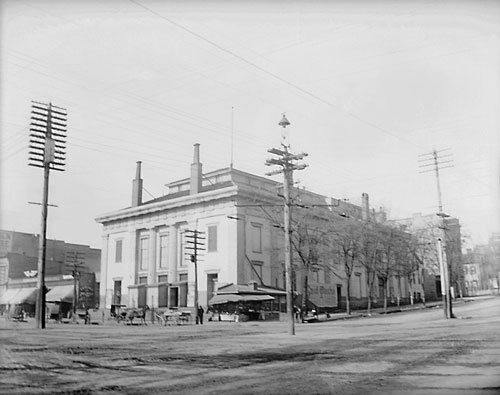
    <summary type="html"><![CDATA[<p><strong><em>The creation of the Salt Lake Theatre was led by Brigham Young and supported by the Church of Jesus Christ of Latter Day Saints in 1862. The Theatre was the most decorated building in Utah territory before the Salt Lake City Temple and Tabernacle were constructed. Its 66-year run brought entertainment and enjoyment to early Utah settlers.</em></strong></p><img src="https://www.intermountainhistories.org/files/fullsize/5d59a9a867f7c3f8c5b35d2310be0c7e.jpg" alt="An Exterior View of the Salt Lake Theatre. Salt Lake City, Utah, 1900. " /><br/><p>Early LDS church leaders were fond of artistic expression to bring culture, entertainment, and refinement to the Salt Lake Valley. In 1852, just a few years after settling in Utah, Brigham Young decided it was time to bring theater back into the lives of the saints, forming The Deseret Dramatic Association. These Saint-actors performed at the Social Hall for five years, marking a vital advancement to society in the West. Unfortunately, the Utah War made the stage go dark for a few years. It returned when Phill Margaretts created The Mechanics Dramatic Association in 1859, which sponsored plays that were not affiliated with the church. In response, Brigham Young decided it was time to create a permanent stage where he could control the actors, scripts, and overall impression of the theater.</p><p>It was the perfect timing in Utah History for the construction of a gathering place to enjoy the arts. Initially, Brigham Young intended to build a dance hall. Instead, he determined to create “a model playhouse for producing professional theatre.” Construction of the Salt Lake Theatre began in July 1861 and was completed by March the following year at a cost of around $100,000. The architect was William H Folsom, with E. L. T. Harrison designing the interior. The theatre had room to hold an audience of 1500. Throughout Utah’s territorial history, the LDS church and the growth of Utah’s economy went hand and hand. The theater was just one of many buildings and ventures that were sponsored by the church. Because Young used church funds to finance the Salt Lake Theatre he guided its operation.</p><p>A dedication was held to honor this “temple of drama,” built to bring wholesome amusement and moral guidance to its patrons. The theater became a huge success. Thomas Lyne, a professional actor who had joined the church and promoted theater in Nauvoo, was instrumental in the popularity of plays presented there. The success of The ‘Mormon theater’ sparked the interest of many famous actors and drew them to Utah throughout its 66-year run. Several famous actresses, including Maude Adams, who later pioneered the role of Peter Pan on Broadway, played their first roles in Salt Lake City. The building was used not only for local arts but it hosted political events and eventually touring performing groups coming through Salt Lake City. Despite Young’s original vision, over time the theater welcomed people of all religious backgrounds and secular attitudes. Throughout its history, the theater played a significant role in the culture of Salt Lake City. Unfortunately, the creation of many new vaudeville theaters and Utah’s economic downturn of 1920s drove the theater into deep debt. People desperate for basic needs could not afford to attend shows. In addition, the building needed renovations. The president of the Church, Heber J. Grant, closed the theater and sold the building. In 1928 it was demolished–a great loss of a cultural icon to Utah and the United States.</p><p><em><strong><a href="https://www.intermountainhistories.org/items/show/779">For more (including 4 images) view the original article</a></strong></em></p>]]></summary>
    <published>2024-02-23T15:13:08+00:00</published>
    <updated>2026-04-17T19:32:17+00:00</updated>
    <link rel="alternate" type="text/html" href="https://www.intermountainhistories.org/items/show/779"/>
    <id>https://www.intermountainhistories.org/items/show/779</id>
    <author>
      <name>Mikenzie Moon, Brigham Young University</name>
    </author>
  </entry>
  <entry>
    <title type="html"><![CDATA[The B’nai Israel Cemetery]]></title>
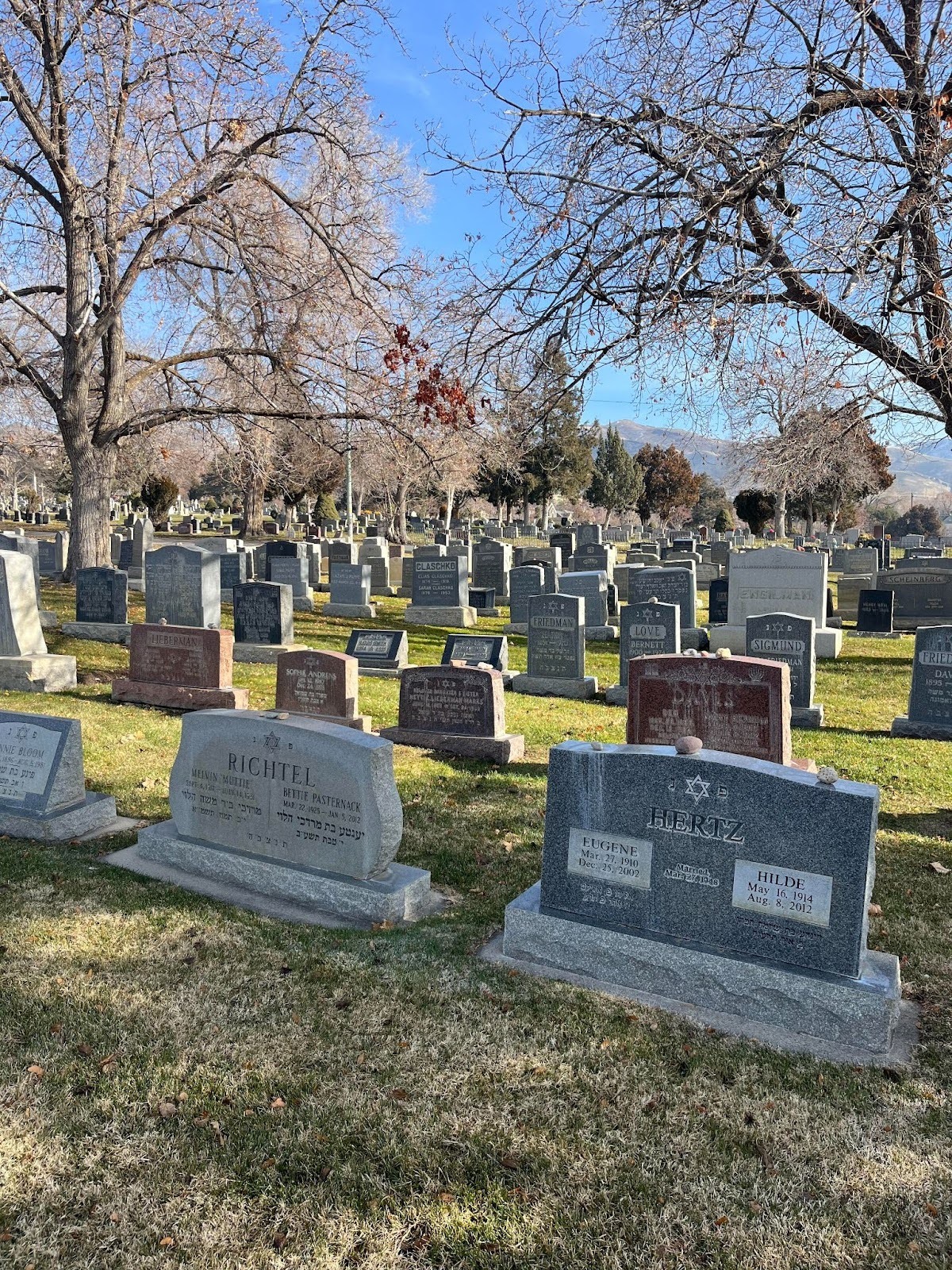
    <summary type="html"><![CDATA[<p><strong><em><span style="font-weight:400;">Cemetery B’nai Israel is a burial ground dedicated to followers of the Reform branch of Judaism. Located in the sloping Avenues of Salt Lake City, this space is a beautiful resting place for some of Utah’s most famous Jewish residents.</span></em></strong></p><img src="https://www.intermountainhistories.org/files/fullsize/fdf6c8848584d2a8d6f2dee9d815a3ee.jpg" alt="B&#039;nai Israel Cemetery" /><br/><p><span style="font-weight:400;">The B’nai Israel Cemetery is one of Salt Lake City’s three Jewish cemeteries. The other cemeteries connected with the Kol Ami Cemetery Association are Montefiore (Conservative) and Shaare Tzedek (Orthodox). Located at 1021 East and 4th Avenue, it serves adherents of Reform Judaism. The tenets of Reform Judaism include an emphasis on the growing, changing nature of Judaism, a focus on its ethical implications rather than its ceremonial ones, a constant search for knowledge and truth, and a focus on human reason. It is a more liberal branch of Judaism, with less focus on ritual observance and more focus on the autonomy of the individual and progressive values. </span>
<span style="font-weight:400;">The land for Salt Lake’s Jewish cemeteries was originally donated to the Jewish community by Brigham Young around 1866. These were the first Jewish cemeteries in the Intermountain West. The cemeteries are exclusively maintained by the Kol Ami Cemetery Association. This association is composed of members of Salt Lake’s synagogue, Congregation Kol Ami. Members of the board serve as volunteers. Although any Jewish person can be buried in one of the three cemeteries, each has slightly different requirements. Those wanting to be buried with non-Jewish spouses can only do so in the Reform cemetery. Orthodox and Conservative cemeteries require a ceremonial washing of the body before burial, but Reform cemeteries make that ritual optional. </span>
<span style="font-weight:400;">Cemetery B’nai Israel is located on the south side of Salt Lake City Cemetery. Unlike the Montefiore and Shaare Tzedek cemeteries, B’nai Israel permits the burial of non-Jewish spouses and minor Children with the Jewish family member. The guiding principles of the Kol Ami Cemetery Association are </span><i><span style="font-weight:400;">Kavod Ha Meit: </span></i><span style="font-weight:400;">showing honor and respect for the dead; </span><i><span style="font-weight:400;">Nichum Aveilim: </span></i><span style="font-weight:400;">comforting those who are mourning a loss; and simplicity: all are equal in death.</span>
<span style="font-weight:400;">Several prominent figures in Utah history were laid to rest in this peaceful graveyard, including Simon Bamberger, the first Jewish governor of Utah whose term ran from 1917 to 1921, and brothers Samuel and Frederick Auerbach, who established the People’s Store– a long-time Salt Lake City landmark. </span>
<span style="font-weight:400;">The tranquil B’nai Israel Cemetery has served practitioners of Reform Judaism for well over one hundred years, and continues to do so today. Under the governance of the Kol Ami Cemetery Association, these burial grounds are maintained with a tangible sanctity and respect.</span></p><p><em><strong><a href="https://www.intermountainhistories.org/items/show/765">For more (including 4 images) view the original article</a></strong></em></p>]]></summary>
    <published>2024-01-12T22:29:43+00:00</published>
    <updated>2026-04-17T19:32:17+00:00</updated>
    <link rel="alternate" type="text/html" href="https://www.intermountainhistories.org/items/show/765"/>
    <id>https://www.intermountainhistories.org/items/show/765</id>
    <author>
      <name>Isabella Holt, Brigham Young University</name>
    </author>
  </entry>
  <entry>
    <title type="html"><![CDATA[The Cathedral of the Madeleine ]]></title>
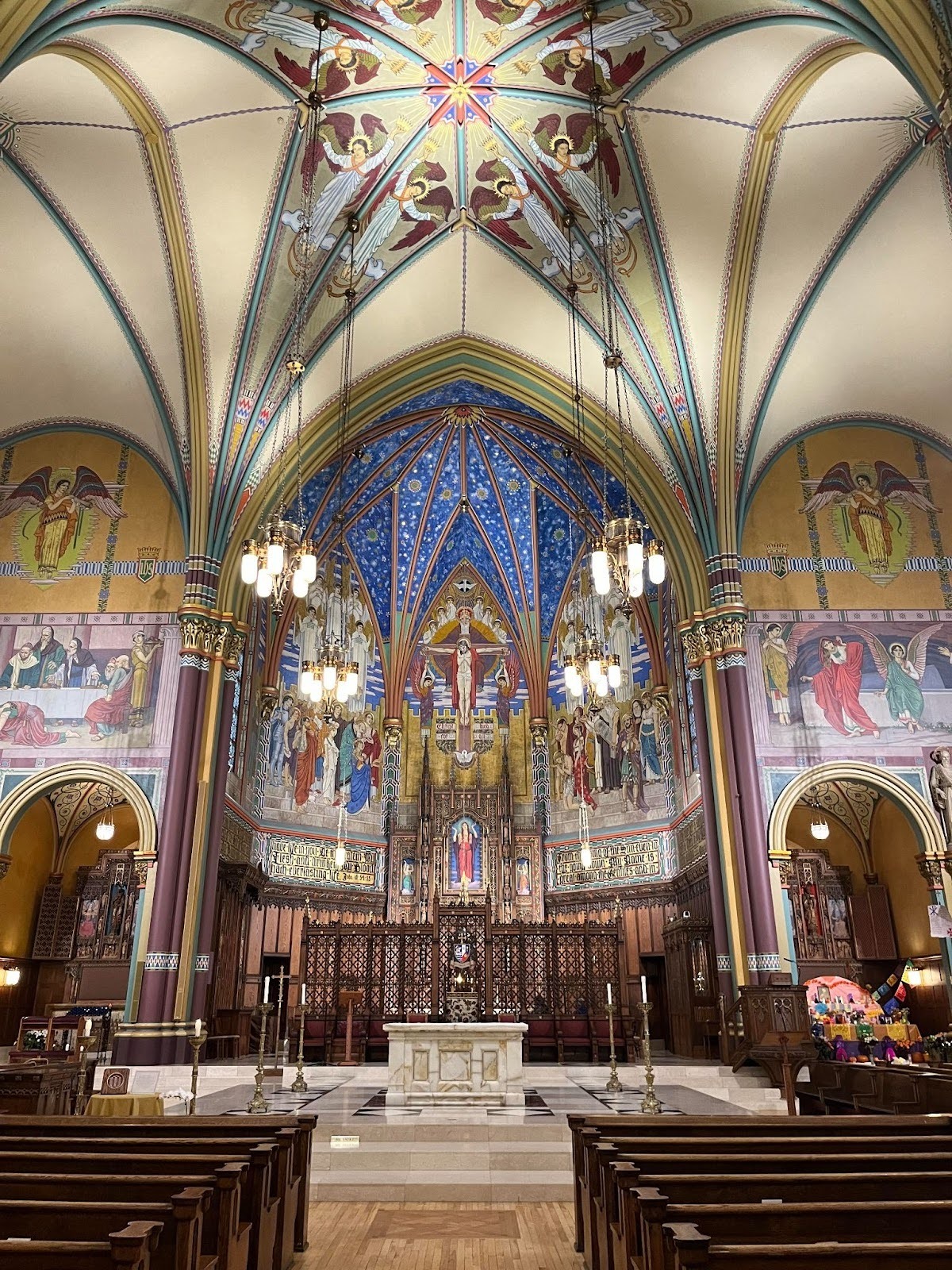
    <summary type="html"><![CDATA[<p><strong><em><span style="font-weight:400;">The Cathedral of the Madeleine, constructed in the late 19th and early 20th centuries, stands at the head of the Diocese of Salt Lake City. Featuring neo-Gothic architecture and glorious stained glass windows, the cathedral is a beautiful place to visit and worship. </span></em></strong></p><img src="https://www.intermountainhistories.org/files/fullsize/f7791fe20b0648355edb90452c3b4370.jpg" alt="Church Interior" /><br/><p><span style="font-weight:400;">The Cathedral of the Madeleine, located in downtown Salt Lake City, is the only cathedral in the United States under the patronage of Saint Mary Magdalene. Construction on this venerable building began in 1899 and was completed in 1909. It was dedicated under the name Saint Mary’s Cathedral on August 15, 1909, but was given its present name under the leadership of Bishop Joseph Glass, the second bishop of Salt Lake City.</span>
<span style="font-weight:400;">The stained glass windows are original to the Cathedral and were commissioned by Lawrence J. Scanlan, the first Catholic bishop of Salt Lake City. Designed by F.X. Zettler of the Royal Bavarian Institute in Munich, Germany, these windows tell the story of Christ’s life through what Catholics call the “Mysteries of the Rosary.” Scenes included are the annunciation with Gabriel and Mary, Mary visiting Elizabeth, Christ’s birth, Christ’s presentation at the temple to Simeon and Anna, the Resurrection, Christ’s ascension into heaven, the Assumption of Mary, and Mary being crowned Queen of Heaven. </span>
<span style="font-weight:400;">In addition to these scenes from the “Mysteries of the Rosary, moments  from Christ’s life between His presentation at the temple and His Resurrection are commemorated with stunning murals. These murals were completed in 1918 by artist Felix Lieftuchter. Combining Byzantine, Spanish Gothic, and modern art styles, the murals depict Christ teaching at the temple, a woman (portrayed here as Mary Magdalene) washing Christ’s feet, and Christ’s suffering in the Garden of Gethsemane. A mural of Christ’s sacrifice on the cross stands above the Blessed Sacrament Chapel and the Tabernacle. It is the focal point of the chapel. Christ is shown on the cross in a red robe, with God the Father and the Holy Spirit watching from above. Below Christ’s pierced feet are a pelican and her chicks. In Catholic iconography, the pelican symbolizes Christ’s sacrifice. Biblical figures and Catholic saints stand on either side of the crucified Christ, worshiping and praising the Lord. </span>
<span style="font-weight:400;">The Stations of the Cross were painted by Utah native Roger ‘Sam’ Wilson between 1992-1993. The Stations of the Cross commemorate Christ’s suffering and death. There are fourteen stations in all, each depicting a moment on His journey to Calvary. The Stations at the Cathedral of the Madeleine follow the revisions of the second Vatican Council, which took place between 1962-1965. This council helped to bridge the gap between Catholic tradition and the modern world. It made many changes to Catholic practices– one of the most dramatic of these was holding Mass in languages other than Latin. The updated Stations of the Cross are more in keeping with Biblical descriptions rather than oral tradition. Wilson’s rendition of the Stations blends Catholic iconography with an American Southwestern style. Flowers, animals, and other symbols are included to lend to the significance and power of each scene. </span>
<span style="font-weight:400;">The cathedral underwent heavy restoration projects between 1991-1993. The stained glass was carefully preserved. The altar and the baptismal font were re-positioned in accordance with the established traditions of the Vatican II Council. The organ was replaced, as were the Stations of the Cross. The floor of the Cathedral of the Madeleine is currently being restored. There are about four hundred regularly attending constituents, with about half of that number speaking Spanish as their first language. On weekdays, masses are held at 8:00 AM and 5:15 PM. Saturday masses are at 8:00 AM, 5:00 PM, and 7:00 PM, with the latter exclusively in Spanish. Sunday worship times are at 8:30 AM, 11:00 AM, 3:00 PM (Spanish), and 6:00 PM. The Cathedral was added to the National Register of Historic Places on March 11, 1971, and serves thousands of people annually. From practicing Catholics to those interested in theology or the Cathedral’s architecture, all are welcome. </span></p><p><em><strong><a href="https://www.intermountainhistories.org/items/show/764">For more (including 7 images) view the original article</a></strong></em></p>]]></summary>
    <published>2024-01-12T22:03:33+00:00</published>
    <updated>2026-04-17T19:32:17+00:00</updated>
    <link rel="alternate" type="text/html" href="https://www.intermountainhistories.org/items/show/764"/>
    <id>https://www.intermountainhistories.org/items/show/764</id>
    <author>
      <name>Isabella Holt, Brigham Young University</name>
    </author>
  </entry>
  <entry>
    <title type="html"><![CDATA[Shaare Tzedek Cemetery]]></title>
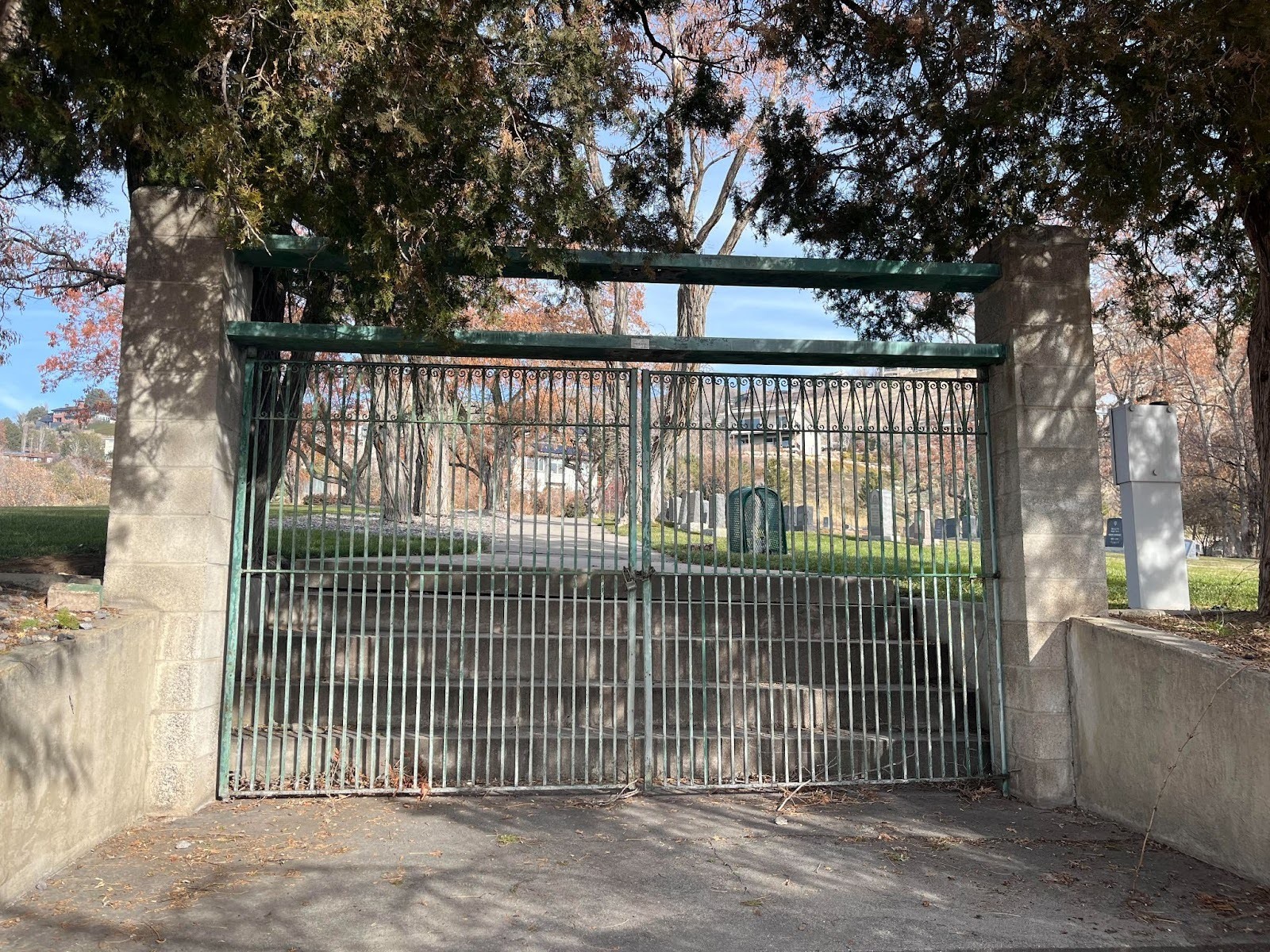
    <summary type="html"><![CDATA[<p><strong><em>The Shaare Tzedek Cemetery is a dedicated gravesite for practicing Orthodox Jews in the Salt Lake City area. Though smaller than its sister cemeteries, B’nai Israel and Montefiore, the recently rededicated Shaare Tzedek is nonetheless a quiet and peaceful site for remembrance and service.</em></strong></p><img src="https://www.intermountainhistories.org/files/fullsize/70156a3e7c4070953a3aad3742f17530.jpg" alt="Cemetery Gate" /><br/><p><span style="font-weight:400;">Cemetery Shaare Tzedek has stood for over a century and is one of the three Jewish cemeteries in the Salt Lake City metro. It can be found at 915 East 11th Avenue. Shaare Tzedek is designated for Orthodox adherents of Judaism, whereas its sister cemeteries, Montefiore and B’nai Israel, serve Conservative and Reform Jews, respectively. Orthodox Jews believe that the Torah (both the written word and oral traditions) were divinely revealed to Moses on Mount Sinai and have been faithfully maintained throughout the centuries. Being Orthodox entails a strict adherence to Jewish law (</span><i><span style="font-weight:400;">halakha</span></i><span style="font-weight:400;">). Practices include Sabbath-day observance, following Kosher dietary restrictions, and regular study of the Torah. To be buried in an Orthodox Jewish cemetery, one must be an Orthodox Jew, undergo rituals of washing and dressing, and generally be buried in a plain wooden casket without internal or external adornment. </span>
<span style="font-weight:400;">These lands in the larger Salt Lake City Cemetery were set aside for the use of the Jewish community by Brigham Young in 1866. The care and upkeep of these three cemeteries is entrusted to the Kol Ami Cemetery Association. This association is run on a volunteer basis by members of Salt Lake’s synagogue, Congregation Kol Ami. Members of the board serve as volunteers. The guiding principles of the Kol Ami Cemetery Association are </span><i><span style="font-weight:400;">Kavod Ha Meit: </span></i><span style="font-weight:400;">showing honor and respect for the dead; </span><i><span style="font-weight:400;">Nichum Aveilim: </span></i><span style="font-weight:400;">comforting those who are mourning a loss; and simplicity: all are equal in death. While any member of the Jewish community may be buried in one of the three cemeteries, each graveyard has slightly different requirements. Those wanting to be buried with non-Jewish spouses are only permitted to do so in the Reform cemetery. Both Conservative and Orthodox cemeteries require a ceremonial washing of the body before burial, but that practice is mandatory in Reform cemeteries. </span>
<span style="font-weight:400;">The Shaare Tzedek Cemetery is located just above the sprawling expanse of the Salt Lake City Cemetery, a few blocks north of the B’nai Israel and Montefiore cemeteries. It is the smallest of the three Jewish cemeteries. Salt Lake’s Orthodox Jewish community and synagogue faded around 1930, largely due to financial reasons and fewer Orthodox Jews as opposed to Conservative and Reform Jews in the city. The Shaare Tzedek Cemetery was recently rededicated– a very rare circumstance, but necessary because the western part of the burial ground, though original to the cemetery, had never been dedicated. That issue was resolved in 2023. Shortly after the rededication, the Kol Ami Cemetery Board held a tree-planting ceremony to further protect and beautify the space. </span></p><p><em><strong><a href="https://www.intermountainhistories.org/items/show/763">For more (including 4 images) view the original article</a></strong></em></p>]]></summary>
    <published>2024-01-12T20:29:15+00:00</published>
    <updated>2026-04-17T19:32:17+00:00</updated>
    <link rel="alternate" type="text/html" href="https://www.intermountainhistories.org/items/show/763"/>
    <id>https://www.intermountainhistories.org/items/show/763</id>
    <author>
      <name>Isabella Holt, Brigham Young University</name>
    </author>
  </entry>
  <entry>
    <title type="html"><![CDATA[Montefiore Cemetery ]]></title>
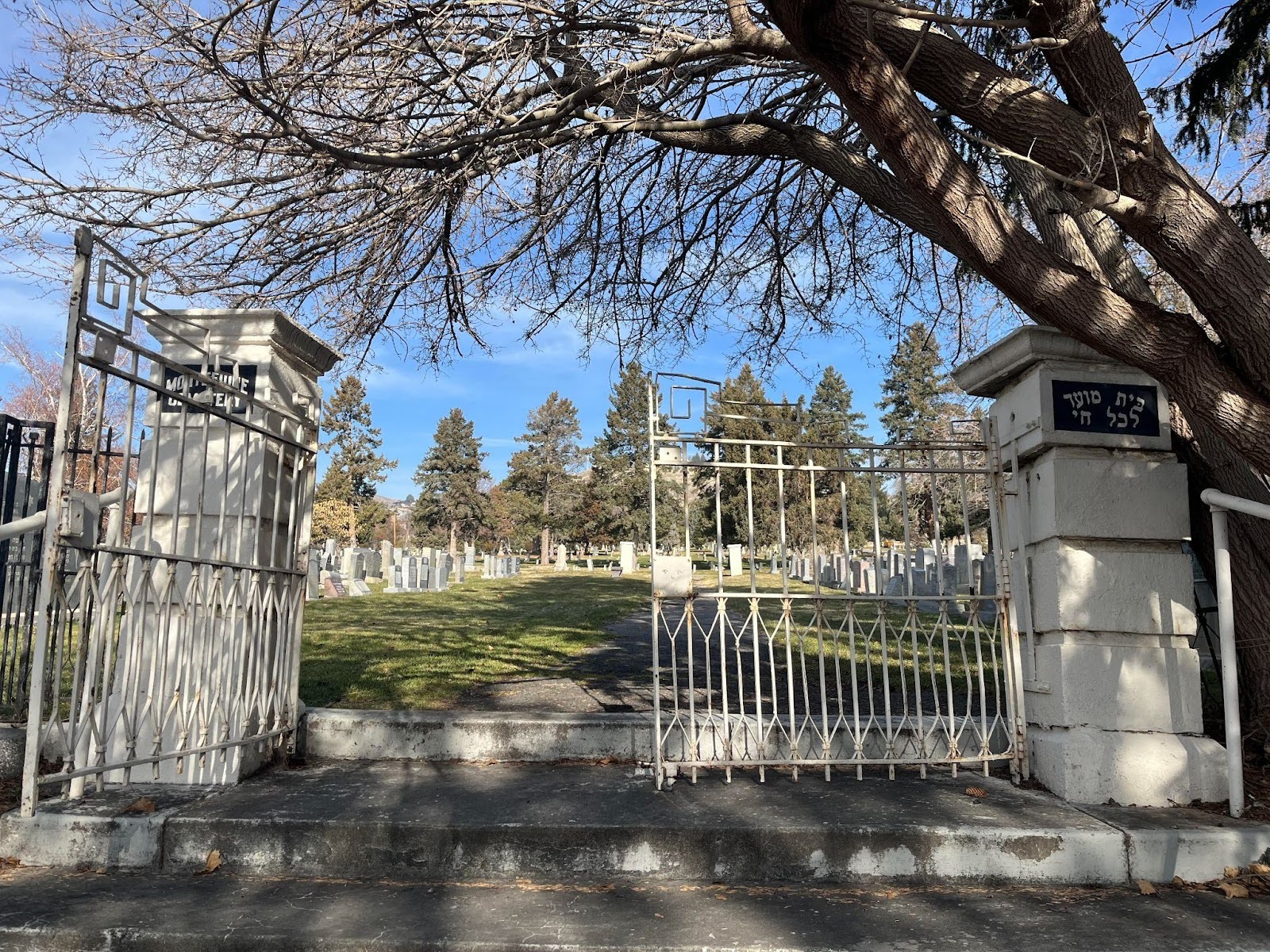
    <summary type="html"><![CDATA[<p><strong><em>Serving Conservative Jews in the Salt Lake area, the Montefiore Cemetery can be found amidst the city’s historic Avenues. Dedicated to preserving the memories of Utah’s Jewish community, the Montefiore Cemetery contains a personal memorial to those who lost their lives in the Holocaust. </em></strong></p><img src="https://www.intermountainhistories.org/files/fullsize/50818c535c735867b8f5aed3ca63fe44.jpg" alt="Cemetery Gates" /><br/><p><span style="font-weight:400;">Cemetery Montefiore is one of three Jewish cemeteries in Salt Lake City. It is affiliated with cemeteries B’nai Israel, serving Reform Jews, and Shaare Tzedek, which is specifically for Orthodox Jews. Located at 1081 East 4th Avenue, Montefiore is dedicated to followers of the Conservative branch of Judaism. Conservative Judaism is a movement that focuses on the authority of Jewish law and tradition, but with an emphasis on obtaining assent from the people. For Conservative Jews, Jewish law (</span><i><span style="font-weight:400;">Halakha</span></i><span style="font-weight:400;">) is simultaneously binding and subject to historical development. It allows for greater pluralism than Orthodox Judaism, but is more traditional than Reform Judaism. There is room for the traditional, received forms, but Conservative Jews hold space for various ways to interpret and apply these past traditions. </span>
<span style="font-weight:400;">Brigham Young donated the land for this and Salt Lake’s other Jewish cemeteries to the Jewish community in 1866. The cemeteries are operated by the Kol Ami Cemetery Association: Salt Lake City does not allocate resources to maintain them. Those serving on the board of this association are volunteers from Salt Lake’s synagogue, Congregation Kol Ami. The guiding principles of the Kol Ami Cemetery Association are </span><i><span style="font-weight:400;">Kavod Ha Meit: </span></i><span style="font-weight:400;">showing honor and respect for the dead; </span><i><span style="font-weight:400;">Nichum Aveilim: </span></i><span style="font-weight:400;">comforting those who are mourning a loss; and simplicity: all are equal in death. A Jew can be in any one of the three cemeteries, but each has slightly different requirements. Those who wish to be buried with their non-Jewish spouses can only do so in the Reform cemetery. Orthodox and Conservative cemeteries require a ceremonial washing of the body before burial, but Reform cemeteries do not require the washing. </span>
<span style="font-weight:400;">The Montefiore Cemetery can be found on the southern end of the larger Salt Lake City Cemetery, just a few streets east of the Reform B’nai Israel Cemetery. As it is Conservative, those wishing to be buried in this cemetery are to be ritually washed before burial and cannot be buried with non-Jewish family members. </span>
<span style="font-weight:400;">One of the most moving sites at the Montefiore Cemetery is very discrete– it does not immediately catch one’s eye amidst the rows of marble. Toward the eastern edge of the cemetery stands the headstone of Josef and Ruth Teustch Schwager, whose son, Pete Schwager, is on the Kol Ami Cemetery Board. The Schwagers fled Nazi Germany in 1939, arriving in New York that same year, then making their way west to Utah. Ruth Schwager’s parents, Dr. Arthur Teutsch and Clara Holzinger Teutsch, were unable to escape the Nazi regime and perished in the Theresienstadt and Auschwitz concentration camps. Ruth Schwager was determined that her parents be remembered, and thus included their names on her gravemarker. </span>
<span style="font-weight:400;">Cemetery Montefiore is a calm and peaceful spot amidst the bustle of Salt Lake City. Dedicated to adherents of Conservative Judaism, it has stood for over a century. The Kol Ami Cemetery Association preserves this and other Jewish cemeteries with evident care and approbation. </span></p><p><em><strong><a href="https://www.intermountainhistories.org/items/show/762">For more (including 5 images) view the original article</a></strong></em></p>]]></summary>
    <published>2024-01-12T20:03:55+00:00</published>
    <updated>2026-04-17T19:32:17+00:00</updated>
    <link rel="alternate" type="text/html" href="https://www.intermountainhistories.org/items/show/762"/>
    <id>https://www.intermountainhistories.org/items/show/762</id>
    <author>
      <name>Isabella Holt, Brigham Young University</name>
    </author>
  </entry>
  <entry>
    <title type="html"><![CDATA[Cathedral Church of Saint Mark]]></title>
    <summary type="html"><![CDATA[<p><strong><em>St. Mark’s Cathedral began its life as the headquarters of the Salt Lake Missionary Diocese, later becoming the base for the Diocese of Utah. Serving parishioners for over 150 years, this Gothic Revival Cathedral was added to the National Register of Historic Places in 1970.</em></strong></p><img src="https://www.intermountainhistories.org/files/fullsize/e7e58cf77fd4e76efacbeb4cf870ec8d.jpg" alt="Photograph of St. Mark&#039;s Cathedral " /><br/><p><span style="font-weight:400;">The story of St. Mark’s Cathedral begins with Bishop Daniel S. Tuttle, who took his post presiding over the missionary district of Montana in 1867. This district included jurisdiction over Idaho and Utah. After the completion of the Transcontinental Railroad in 1869, Bishop Tuttle decided to make Salt Lake City the headquarters of the district. From 1867-1871, Utah’s earliest Episcopalian parishioners met in Independence Hall, an adobe building on Third South and East Temple (now Main Street). The land for St. Mark’s Cathedral was purchased on April 20, 1870. The cornerstone was laid on July 30, 1870. Opening on September 3, 1871, St. Mark’s Cathedral was designed in the Gothic Revival style by Richard Upjohn – one of his only two identified works west of the Mississippi River. </span>
<span style="font-weight:400;">The Cathedral was officially consecrated on May 14, 1874. In April 1902, money was raised for the addition of the west transept, the Chancel, and a room to house the organ pipes. When the chancel was added in 1903, this room became the Chapel of the Resurrection. Extensive renovations took place after the Cathedral was damaged by a fire in 1935. Fire damage can still be observed today from the exterior and along the ceiling of the Chapel of the Resurrection. A number of the Cathedral’s windows were destroyed in the fire, but the May Lillian Bishop Thompson Window (a scene depicting the women at Christ’s tomb speaking with an angel), was reassembled. When the fire melted the lead holding the window together, a parishioner was able to collect the glass pieces and take them to Tiffany Studios in New York, where the window was repaired. However, some pieces were lost, and thus the previously brunette angel became a blonde. </span>
<span style="font-weight:400;">St. Mark’s Cathedral has hosted a number of noteworthy visitors over the years. Episcopalian Archbishop Demond Tutu came to Salt Lake City for the opening ceremonies of the 2002 Olympics, calling on the Cathedral on February 10, 2002. St. Mark’s hosted the North American Dean’s Conference from April 23-25, 2009. Over the week of June 25-July 3, 2015, the Diocese of Utah and St. Mark’s Cathedral welcomed delegates to the 78th Convention of the Episcopal Church. On June 27, 2015, St. Mark’s made headlines when Michael Bruce Curry became the first African American to be elected presiding bishop of the Episcopalian Church. </span>
<span style="font-weight:400;">To conclude, St. Mark’s Cathedral has been part of the Salt Lake City skyline since 1871. Its bell was the first church bell to ring in Salt Lake City and continues to call Episocpalians and visitors for worship today. </span></p><p><em><strong><a href="https://www.intermountainhistories.org/items/show/761">For more (including 12 images) view the original article</a></strong></em></p>]]></summary>
    <published>2024-01-11T23:36:49+00:00</published>
    <updated>2026-04-17T19:32:16+00:00</updated>
    <link rel="alternate" type="text/html" href="https://www.intermountainhistories.org/items/show/761"/>
    <id>https://www.intermountainhistories.org/items/show/761</id>
    <author>
      <name>Isabella Holt, Brigham Young University</name>
    </author>
  </entry>
  <entry>
    <title type="html"><![CDATA[Congregation Kol Ami ]]></title>
    <summary type="html"><![CDATA[<p><strong><em>Nestled in the foothills of Salt Lake City, Congregation Kol Ami recently celebrated its 50th anniversary. Born of a merger between two branches of Judaism, this synagogue now serves about a quarter of Utah’s Jewish population. </em></strong></p><img src="https://www.intermountainhistories.org/files/fullsize/0875c2459ce79a9c26983139436db612.jpg" alt="Exterior of Kol Ami, taken between the 1970s-1980s.
" /><br/><p><span style="font-weight:400;">Salt Lake City’s Jewish community traces its roots back to 1854, with the arrival of both European immigrants and east-coast transplants. Several prominent figures in Utah history belonged to this community, including brothers Samuel and Frederick Auerbach (founders of the People’s Store: F. Auerbach and Brothers) and Simon Bamberger, who was elected governor of Utah in 1916. The city’s first synagogues were Congregation B’nai Israel and Congregation Montefiore. Congregation B’nai Israel was founded in 1891 and served those following Reform practices, while Congregation Montefiore was established in 1899 and served Conservative adherents to the faith. </span>
<span style="font-weight:400;">Congregation Kol Ami was established in 1972 as a result of a merger between these two historic communities. The merger occurred for several reasons. Financially, it was more viable to have Salt Lake’s Jewish community gather in one place. It also strengthened ties between adherents of Reform and Conservative Judaism. The synagogue’s name, </span><i><span style="font-weight:400;">Kol Ami </span></i><span style="font-weight:400;">roughly translates to “all of my people” in Hebrew.  Because it is a joint Conservative and Reform Congregation, Congregation Kol Ami holds Reform worship services on Fridays and Conservative on Saturdays. Now into its fiftieth year, Congregation Kol Ami serves about 400 families and has experienced 35% growth since Rabbi Samuel Spector’s tenure began in 2018. </span>
<span style="font-weight:400;">Construction of the synagogue was completed in the early 1970s. It is a multi-purpose space, holding classrooms, offices, a central worship space, and a kitchen. In addition to Shabbat services, the synagogue hosts daily classes at the Rafi Schwartz Religious School. The mission of the Religious School is “to create students who are active participants in the intellectual, religious, and cultural traditions of Judaism.” The school serves students of various backgrounds and traditions from preschool through 12th grade. </span>
<span style="font-weight:400;">Congregation Kol Ami hosts a number of community events, including a class called “Introduction to Jewish Life.” Members of the congregation or interested residents of the greater Salt Lake area are invited to come learn more about Jewish beliefs, practices, history, holidays, and basic Hebrew. There are also Sunday study sessions hosted by Rabbi Fred Wenger. Topics vary week by week, but typically address themes connected to the Jewish diaspora. With their emphasis on education, community, and worship, Kol Ami’s congregants are wonderful contributors to Salt Lake City’s diversity and development.</span></p><p><em><strong><a href="https://www.intermountainhistories.org/items/show/759">For more (including 4 images) view the original article</a></strong></em></p>]]></summary>
    <published>2024-01-11T21:53:01+00:00</published>
    <updated>2026-04-17T19:32:16+00:00</updated>
    <link rel="alternate" type="text/html" href="https://www.intermountainhistories.org/items/show/759"/>
    <id>https://www.intermountainhistories.org/items/show/759</id>
    <author>
      <name>Isabella Holt, Brigham Young University</name>
    </author>
  </entry>
  <entry>
    <title type="html"><![CDATA[Sheepherding on Fremont Island]]></title>
    <summary type="html"><![CDATA[<p><strong><em>In 1859, two pioneer brothers from Farmington, Henry William Miller and Daniel Arnold Miller, began the first ranching operation on Salt Lake’s Fremont Island.</em></strong></p><img src="https://www.intermountainhistories.org/files/fullsize/1e4eeac398afc93856bcf40417422df4.jpg" alt="Fremont Island" /><br/><p><span style="font-weight:400;">The storied explorer John C. Fremont and his traveling companions initially documented their foray onto the Great Salt Lake with incredible optimism. While paddling arduously in their small rubber craft in 1843, they observed that, “Several large islands raised their high rocky heads out of the waves; but whether or not they were timbered, was still left to our imagination…”. When they explored one of the aforementioned “high rocky heads,”  they found  an island populated with sagebrush, bunch grass, and a surprising lack of fresh water. After a day or two, Fremont dubbed his discovery “Disappointment Island.”</span>
<span style="font-weight:400;">While surveying the Great Salt Lake for The Church of Jesus Christ of Latter-day Saints in 1850, Captain Howard Stansbury, perhaps to Fremont’s chagrin, changed the name of the formerly disappointing island to Fremont Island. Stansbury noted that the plentiful bunch grass and brackish water would be perfect for livestock. In 1859, Daniel and Henry Miller demonstrated their agreement by moving flocks of sheep and some cattle to the island, which the locals then recognized as “Miller Island.”</span>
<span style="font-weight:400;">Seymour Miller, the grandson of Daniel and Henry, recorded some of his experiences as a de facto ranch hand for the family ranching business on Fremont Island. They kept 2,000 sheep on the island and ferried themselves and their stock back and forth on the </span><i><span style="font-weight:400;">Lady of the Lake</span></i><span style="font-weight:400;">, a boat designed by Jacob Miller, Seymour’s cousin. Keeping the sheep on a relatively small island (4.60 sq. mi.) led the Millers to conclude that they did not need a full-time herder on the island. Instead, they let the sheep run wild for most of the year, confident in the confines of the island.</span>
<span style="font-weight:400;">The sheep quickly went feral and became “wild as a deer.” This provided the Millers with some market advantage because “The meat of this flock tasted more like venison than mutton and would always bring a fancy price on the market when ordinary mutton could hardly be sold.” Unfortunately, during shearing and lambing seasons, these wild qualities caused numerous problems for the island herders. They would sometimes go a full day or two during round ups without successfully driving a single sheep into the shearing pens. During one especially eventful drive, Seymour and his companions cornered some sheep on a peninsular part of the island and “Rather than be caught, several of them took off into the lake. The last I saw of them they were still going.”</span>
<span style="font-weight:400;">Unfortunately for the Millers, their ranching operation did not last past 1885, when local lawyer Uriah Wenner took an interest in living on the island and began legal procedures to oust them and their flocks. The Millers were forced to move their herds to the mainland, where they continually lost woolies due to the sheep’s feral nature that befuddled conventional herders. In his memoir, Seymour concluded that “we never got a dollar out of them.”</span>
<span style="font-weight:400;">After Wenner and his wife died, possession of the island changed hands without remarkable business or improvement until 2003. For a few years, Fremont Island underwent a small stint as a hunting ground for exotic livestock and then changed ownership until it landed in the hands of the State of Utah.</span></p><p><em><strong><a href="https://www.intermountainhistories.org/items/show/735">For more (including 3 images) view the original article</a></strong></em></p>]]></summary>
    <published>2023-04-06T16:23:06+00:00</published>
    <updated>2026-04-17T19:32:16+00:00</updated>
    <link rel="alternate" type="text/html" href="https://www.intermountainhistories.org/items/show/735"/>
    <id>https://www.intermountainhistories.org/items/show/735</id>
    <author>
      <name>Joshua Rust, Brigham Young University</name>
    </author>
  </entry>
  <entry>
    <title type="html"><![CDATA[B&#039;Nai Israel Temple in Salt Lake City, Utah]]></title>
    <summary type="html"><![CDATA[<p><strong><em>The historic 1891 B’nai Israel Temple (Hebrew for “children of Israel”) is a testament to the “Gentile” Jewish community in Utah. It is the oldest synagogue in the state, and while it is no longer used for religious purposes, it symbolizes over 150 years of flourishing Jewish life. </em></strong></p><img src="https://www.intermountainhistories.org/files/fullsize/c4e28a3c867db607ead3b75663091086.jpg" alt="B&#039;Nai Israel Temple" /><br/><p><p style="font-weight:400;">The first Jews to migrate to Utah arrived in small numbers due to confict with the United States government which lasted until 1857. This precipitated more movement, and many Jewish pioneers came to Salt Lake City as entrepreneurs and craftsmen. Many of these migrants were from Germany. Until the 1880s, the Jewish population practiced their faith in rented Masonic halls or Mormon Churches. They incorporated the B’nai Israel congregation and built a small synagogue in 1883; however, infighting over religious doctrine split the group in two, a fairly commonplace occurence for American Jews at the time. Meanwhile, the social status of Utah’s Jews increased overall, and Congregation B’nai Israel looked to create a more distinguished synagogue. In 1889, they purchased land formerly belonging to Brigham Young for B’Nai Israel Temple.
<p style="font-weight:400;">Utah magnate, Frederick Auerbach, brought his nephew Philip Meyer from Germany to design the synagogue and work with local architect Henry Monheim. They modeled it after a famous synagogue in Berlin, called Fasanenstrasse. Its architectural style reflects Romanesque and Moorish Revival, both popular in the mid to late nineteenth century and is most notablie in the temple's arched windows, intricate stonework, and hallmark dome. Workers constructed the building with local Kyune stone, and its design includes a brick dome and two stained-glass windows in front. The architects built it to seat 500 people, including two stories and a choir gallery. It was dedicated in 1891; the Salt Lake Tribune remarked that it had “an air of quiet elegance.” Later, in 1929, a concrete block addition added classrooms, a social area, and a kitchen to the temple.
<p style="font-weight:400;">The ornate synagogue represents the active and successful community. Early settlers Julius and Fanny Brooks were merchants in early years of white settlement. The Auerbach brothers became prominent businessmen and dominated mercantile industries before Zion’s Cooperative Mercantile Institution was formed. Simon Bamberger, who was involved in silver mining and railroads in Salt Lake, became the first non-Mormon, and the only Jewish, governor in state history in 1916. The Jewish community also developed a unique relationship to Utah’s Mormon population, occupying a position of “favored Gentiles." The Mormon settlers were largely supportive of Jewish migrants as they also claimed spiritual ties to Israel. Relations grew tense at times due to economic competition, but mostly remained amicable. The Jewish community grew as refugees increased after World War II. Tragically, architect Philip Meyer, who had designed the synagogue, died in a Nazi death camp in 1943.
<p style="font-weight:400;">In 1972, the divided Jewish congregations of Salt Lake moved to reunite, but the historic B’Nai Israel Temple could not accommodate its new group, now known as Kol Ami. They soon constructed their present synagogue and sold B’Nai Israel, which is now used commercially. In 1978, the community successfully nominated the temple to the National Register of Historic Places. Even though it is no longer used for religious practice, the historic building stands as a monument to the Jewish community of Utah.</p><p><em><strong><a href="https://www.intermountainhistories.org/items/show/720">For more (including 4 images) view the original article</a></strong></em></p>]]></summary>
    <published>2023-03-02T04:59:29+00:00</published>
    <updated>2026-04-17T19:32:15+00:00</updated>
    <link rel="alternate" type="text/html" href="https://www.intermountainhistories.org/items/show/720"/>
    <id>https://www.intermountainhistories.org/items/show/720</id>
    <author>
      <name>Katie Scholler, Northern Arizona University </name>
    </author>
  </entry>
  <entry>
    <title type="html"><![CDATA[State Capitol Rotunda Murals: Salt Lake City, Utah]]></title>
    <summary type="html"><![CDATA[<p><strong><em>Utah’s State Capitol building features several artworks in its interior. Four large murals covering the Capitol Rotunda completed in 1935 particularly display the hopeful imagery typically found in art funded by New Deal-era projects.   </em></strong></p><img src="https://www.intermountainhistories.org/files/fullsize/8354ef98e35f8f660395b21e7783d729.jpg" alt="State Capitol Dome" /><br/><p><p style="font-weight:400;">The Utah Capitol’s ornate rotunda includes twelve murals that the Public Works of Art Project funded during the New Deal era. The pieces fill the dome and the spaces between the rotunda’s arches. Painted along the dome’s base, four illustrations display scenes from Utah’s pioneer settlement history, including: <em>Father Escalante Discovers Utah Lake – 1776</em>, <em>Peter Skene Ogden at Ogden River – 1828, Fremont First Sees Great Salt Lake – 1843</em>, and <em>Brigham Young and Pioneers Entering the Valley</em>. Prominent architect Richard K.A. Kletting, known for creating several Utah buildings, completed the Capitol in 1915 after winning a competition. Inspired by Greek and Roman architecture, Kletting designed the Capitol in the Corinthian style, seen through features such as its distinct exterior columns. With its large scale, Utah marble, and commanding city view, the building’s construction cost a grand $2,739,529.
<p style="font-weight:400;">Lee Greene Richards led the mural project, while Henry Rasmussen, Ranch S. Kimball, and Gordon Cope assisted him, with Waldo Midgely creating the murals’ borders. Richards grew up in Salt Lake City in an artistic family. He studied under J.T. Harwood in Salt Lake City, and at Paris’s <em>Académie Julian</em> and <em>École des Beaux-Arts</em>. While visiting England on a mission for The Church of Jesus Christ of Latter-day Saints, Richards developed a passion for portraiture, although he also became a popular muralist who captured Utah’s settler history in the rotunda murals. The Capitol rotunda’s murals opened in 1935 with ceremonies headed by former Utah Governor, Henry H. Blood.
<p style="font-weight:400;">The muralists conducted lengthy research to ensure that their chosen depictions were significant and accurately portrayed. While researching <em>Peter Skene Ogden at Ogden River –1828</em>, for example, Richards ensured that he depicted period-accurate weapons. In the murals including Brigham Young, however, Richards decided to artistically represent the Salt Lake City founder with his more recognizable beard, despite pioneer depictions from this period showing that Young was clean-shaven.
<p style="font-weight:400;"><em>Father Escalante Discovers Salt Lake – 1776,</em> depicts the Spanish expedition of Atanasio Domínguez and Silvestre Vélez de Escalante accompanied by a small group and one of three Ute people who guided them. Flanked by the area’s foliage, the background exhibits the scenic waters of the Great Salt Lake. In <em>Peter Skene Ogden at Ogden River – 1828</em>, Ogden and his company are in the vividly colored Ogden Valley using weapons like the Hawken rifle, the preferred weapon of choice along the western frontier. <em>Fremont First Sees Great Salt Lake –1843, </em>features John. C. Fremont and his party overlooking the lake’s expanse, positioned in an adventurous pose overlooking the scene. <em>Brigham Young and Pioneers Entering the Valley, </em><span>focuses </span><span>on Brigham young and his distinctive beard standing proudly as he reaches the Salt Lake Valley, joined by pioneers, cattle, and covered wagons</span>.
<p style="font-weight:400;">Examining these murals reveals the aims of the New Deal-era art projects in not only employing artists but also in creating a western American artistic identity. Indeed, the Public Works of Art Project-funded murals did not typically illustrate the Great Depression’s despair. Conversely, muralists like Richards chose to focus on themes of a settling, pioneering past. In choosing to depict scenes of Utah’s pioneer settlement, then, this optimistic vision guided Richards and his co-painters.<span>  </span></p><p><em><strong><a href="https://www.intermountainhistories.org/items/show/717">For more (including 4 images) view the original article</a></strong></em></p>]]></summary>
    <published>2023-03-01T18:13:30+00:00</published>
    <updated>2026-04-17T19:32:15+00:00</updated>
    <link rel="alternate" type="text/html" href="https://www.intermountainhistories.org/items/show/717"/>
    <id>https://www.intermountainhistories.org/items/show/717</id>
    <author>
      <name>Lindsey Cillis, Northern Arizona University</name>
    </author>
  </entry>
  <entry>
    <title type="html"><![CDATA[Walker Bank Building Fire Lookout]]></title>
    <summary type="html"><![CDATA[<p><strong><em>Experience scenic vistas from an unusual site, downtown Salt Lake City.</em></strong></p><img src="https://www.intermountainhistories.org/files/fullsize/a0bda3406bdf1d5a8d85c9a99e125261.jpg" alt="The Walker Center Today" /><br/><p><p style="font-weight:400;">When describing the role of fire lookouts in the Intermountain West, one typically pictures scenic vistas atop remote woodland mountaintops. Lookouts rarely serviced urban areas, so imagine how odd it would have been to encounter a Forest Service fire lookout in the middle of a metropolitan area. As unusual as this sounds, one lookout station did operate in the center of downtown Salt Lake City, Utah, for roughly a decade.
<p style="font-weight:400;">Completed in 1912, the Walker Bank Building is a sixteen-story skyscraper in downtown Salt Lake. At the time of its construction, the building was the tallest structure in the Intermountain West. In the decades following Utah’s statehood in 1896, Utahans considered the construction of impressive infrastructure such as the Walker Bank an important step in the modernization of Salt Lake City.
<p style="font-weight:400;">During the 1930s, the city faced a water crisis. The Great Salt Lake itself is far too salty to use as drinking water, so most of the city’s water came from streams and rivers in the mountains surrounding the Salt Lake Valley. Grazing and wildfires had led to erosion that damaged the watersheds the city relied on. Determined to fix the issue, Wasatch National Forest began placing more emphasis on fire suppression. In 1939, the Forest Service and Salt Lake City Water Department banded together to establish a fire lookout to protect watersheds in the foothills around the Valley. Due to its height, the Walker Bank Building had an impeccable view of the region, so with permission from the bank, Wasatch National Forest set up a small lookout station atop the building.
<p style="font-weight:400;">The lookout itself consisted of little more than a small alidade table which was a map with a sighting device affixed to it for pinpointing spotted fires. From beneath a three-story steel tower advertising the Walker Bank and Trust, urban forest rangers surveilled the surrounding foothills for twelve hours daily. In 1941, <em>The Times</em> of San Mateo, California, reported that the Walker Bank Building had the only fire lookout in a downtown area in the entire country. In 1943, a fifteen-year-old named James Sarvis took on the lookout position. Despite his age, Wasatch National Forest at the Salt Lake Tribune credited him with the protection of the city’s valuable water resources. Sarvis returned to the post several times.
<p style="font-weight:400;">Wasatch National Forest has no records of the lookout being occupied after 1948, but the Walker Bank Building still exists. Now known as the “Walker Center,” the building is currently owned and operated by Wells Fargo.</p><p><em><strong><a href="https://www.intermountainhistories.org/items/show/712">For more (including 4 images) view the original article</a></strong></em></p>]]></summary>
    <published>2023-02-24T18:28:19+00:00</published>
    <updated>2026-04-17T19:32:15+00:00</updated>
    <link rel="alternate" type="text/html" href="https://www.intermountainhistories.org/items/show/712"/>
    <id>https://www.intermountainhistories.org/items/show/712</id>
    <author>
      <name>Tanner Hammarstrom, Northern Arizona University</name>
    </author>
  </entry>
  <entry>
    <title type="html"><![CDATA[The Lone Cedar Tree]]></title>
    <summary type="html"><![CDATA[<p><strong><em>In downtown Salt Lake City sits a monument for the Lone Cedar Tree. The Lone Cedar was rumored to be the only tree in the valley at the time Mormon pioneers settled in the area. Its famous role in the story of Mormon settlement has led some to question the tale's veracity.</em></strong></p><img src="https://www.intermountainhistories.org/files/fullsize/a6aa720541f62d8183978d93e3712b78.jpg" alt="A Child with Lone Cedar" /><br/><p><span style="font-weight:400;">In 1847, Brigham Young and his party of Mormon settlers arrived in what would eventually become Utah. Mormons were escaping persecution in the East by the United States. No one had a clear idea of where their destination, and new home, would be, but many agreed that it would have to reside beyond the United States’ political border. Many initially thought that the territories of California or Oregon would be their last stop since it was as far west as one could get from the U.S. without crossing an ocean. However, John C. Fremont’s expeditions into Utah made the territory an attractive place to settle and it was eventually decided that the Utah area would be where the Mormons settled.</span>
<span style="font-weight:400;">Utah was home to the Utes, Paiutes, Dine’, Goshutes, and Shoshone. At the time, some mountain men also lived in the area. These men largely served as road guides for wagoneers heading west and their numbers were generally scarce. Utah was certainly more of a desert than the Mormons envisioned their new home to be and had what many diligent journal writers described as a “dead sea” to accompany it. However, there was one tree, the "Lone Cedar Tree," in the Salt Lake Valley which provided coveted shade. Seemingly everyone used this iconic tree to rendezvous under—children, church officials, lovers, weary travelers. The tree’s significance to these early Mormons was commemorated with a monument in 1933 by the Daughters of Utah Pioneers. The monument initially encompassed the dying tree, but in 1958, the tree was cut down and stolen. A bounty for it was placed by the Daughters of Utah Pioneers. When the missing lumber never turned up, a modified monument was erected in 1960 to preserve what remained of the leveled stump. A bronze replica soon stood in place of the section of tree that was stolen. Unfortunately, the remaining stump of the original tree was later stolen. The monument today contains no traces of the original tree.</span>
<span style="font-weight:400;">However, historians argue whether the tree ever existed in the sense that it is now remembered. Some claim that stories exaggerate the tree’s existence because journals at the time mention other trees in the valley. Some dispute whether the tree was a cedar at all. Moreover, some accounts mention a “Lone Cedar Post” in the proximity of where the tree was believed to have stood, leading a few to believe that it was the post rather than a tree which provided such needed shade. Nevetheless, the memorialization of the lone cedar tree still stands in downtown Salt Lake City to commemorate the pioneer memory that permeates much of early Utah history. </span></p><p><em><strong><a href="https://www.intermountainhistories.org/items/show/702">For more (including 3 images) view the original article</a></strong></em></p>]]></summary>
    <published>2023-02-20T21:21:14+00:00</published>
    <updated>2026-04-17T19:32:15+00:00</updated>
    <link rel="alternate" type="text/html" href="https://www.intermountainhistories.org/items/show/702"/>
    <id>https://www.intermountainhistories.org/items/show/702</id>
    <author>
      <name>Emma Dutcher, Brigham Young University</name>
    </author>
  </entry>
  <entry>
    <title type="html"><![CDATA[First Zions Bank]]></title>
    <summary type="html"><![CDATA[<img src="https://www.intermountainhistories.org/files/fullsize/ef9008287dbad34b0b647d4a80b6f211.jpg" alt="Original Eagle Emporium Building and Clock" /><br/><p><span style="font-weight:400;">Zion’s Savings Bank and Trust Company was incorporated under the laws of the Utah Territory under the direction of Brigham Young. On July 10, 1873, it became Utah's first chartered savings bank and trust company. Zion’s Savings Bank and Trust Company grew over the decades, enduring the economic booms and busts including the Great Depression.</span>
</p><p><span style="font-weight:400;">On Dec. 31, 1957, Zion’s Savings Bank and Trust Company, Utah Savings and Trust Company, and First National Bank of Salt Lake City merged to form Zions First National Bank. This merger brought each of these institutions under the management of the LDS church and brought an end to the apostrophe in its name. In early 1960, authorities of The Church of Jesus Christ of Latter-day Saints decided to relieve itself of its banking interests, and on April 22, 1960, the church sold majority control of Zions First National Bank</span>
</p><p><span style="font-weight:400;">The Salt Lake City office on Main Street and the iconic clock just outside are both historically significant. They represent original architecture from early LDS settlements. The building is called the “Eagle Emporium Building” and is the oldest existing commercial building in downtown Salt Lake City. It is the city’s only remaining commercial structure built prior to the completion of the transcontinental railroad. The Eagle Emporium Building was constructed for William Jennings, Utah’s first millionaire, and was originally used to house his mercantile business. Originally powered by a water wheel, the clock was erected on the building in 1873. The clock is one of the few remaining pieces of 19th-century street furniture in downtown Salt Lake. At the request of Brigham Young, the building became the first home of Zion’s Savings Bank and Trust Company. </span>
</p><p><span style="font-weight:400;">Zions Bank continues to bring value to individuals, small-to middle-market businesses, nonprofits, corporations and institutions through a wide range of traditional banking and innovative technology services. It currently has a network of 122 full-service financial centers across Utah, Idaho, and Wyoming. </span></p><p><em><strong><a href="https://www.intermountainhistories.org/items/show/653">For more (including 4 images) view the original article</a></strong></em></p>]]></summary>
    <published>2022-09-16T16:53:09+00:00</published>
    <updated>2026-04-17T19:32:14+00:00</updated>
    <link rel="alternate" type="text/html" href="https://www.intermountainhistories.org/items/show/653"/>
    <id>https://www.intermountainhistories.org/items/show/653</id>
    <author>
      <name>Michael M. Heaton, Brigham Young University</name>
    </author>
  </entry>
  <entry>
    <title type="html"><![CDATA[Spanish Speaking Saints and La Rama Mexicana]]></title>
    <summary type="html"><![CDATA[<p><strong><em>When immigrants from Mexico and other Latin American countries began settling in Utah in the early 20th century, many of them converted to the Church of Jesus Christ of Latter-Day Saints. Eventually, La Rama Mexicana—The Mexican Branch—was formed in the early 1920’s.</em></strong></p><img src="https://www.intermountainhistories.org/files/fullsize/931d18be56d3a7b42375f62d3021becb.jpg" alt="&quot;Mexicans Await New Church&quot;" /><br/><p><span style="font-weight:400;">At the end of the 19</span><span style="font-weight:400;">th</span><span style="font-weight:400;"> century, Utah was in an economic boom that would change the course of its history. With the completion of the transcontinental railroad in 1869, thousands of immigrants flooded the state to work in mines that sprung up across Utah. Although initially very few of these immigrants were from Mexico, the start of the Mexican Revolution in 1910 resulted in Mexicans fleeing north to escape conflict. Although the Immigration Acts of 1917 and 1924 had placed quotas on the number of people that could immigrate from each country, the need for laborers allowed a large number of Mexicans to obtain a permit to temporarily enter the country. The number of Spanish-speaking immigrants in Utah continued to grow throughout the following decades as they sought work on railroads, on farms, and in mines. While the 1890 census only recorded 19</span> <span style="font-weight:400;">Mexican people living in Utah, by 1920 there were 1,083. These immigrants created a thriving hub of Hispanic culture in Salt Lake City’s west side. </span>
<span style="font-weight:400;">After their arrival in Salt Lake City, many of these immigrants were converted and baptized as members of The Church of Jesus Christ of Latter-Day Saints. However, very few of them spoke English, the predominant language of the Church in Utah. Noticing a problem, Juan Ramon Martinez, Margarito Buatista, and Francisco Solano sought permission from church leadership to hold meetings in Spanish. In April of 1921, the first Spanish meeting was held in a rented restaurant. The meeting was attended by 19 Latter-Day Saints and 33 non-members being taught by missionaries. On May 15, 1923, the members of this congregation were made into an official branch called La Rama Mexicana. </span>
<span style="font-weight:400;">Two years later the branch began meeting in available rooms in the 6th Stake meetinghouse. In 1950, La Rama Mexicana received their own meetinghouse after three years of construction. Just a decade later, the brach became the Lucero Ward. The population of Spanish-speakers continued to grow and, as of 2019, there were 58 Spanish-speaking wards and branches in Utah.</span></p><p><em><strong><a href="https://www.intermountainhistories.org/items/show/643">For more (including 3 images) view the original article</a></strong></em></p>]]></summary>
    <published>2022-09-09T18:27:12+00:00</published>
    <updated>2026-04-17T19:32:14+00:00</updated>
    <link rel="alternate" type="text/html" href="https://www.intermountainhistories.org/items/show/643"/>
    <id>https://www.intermountainhistories.org/items/show/643</id>
    <author>
      <name>Maggie Allen, Brigham Young University</name>
    </author>
  </entry>
  <entry>
    <title type="html"><![CDATA[The Guadalupe Center: A Haven for Hispanics]]></title>
    <summary type="html"><![CDATA[<p><strong><em>In 1966, on 346 West 100 South in Salt Lake City, UT, the Guadalupe Center opened its doors to the public. Started by Father Jerald H. Merrill, this center was a haven for the Hispanic population of Salt Lake.</em></strong></p><img src="https://www.intermountainhistories.org/files/fullsize/2c2175e6d7758e3defd53960ca070a96.jpg" alt="The Guadalupe Center" /><br/><p><span style="font-weight:400;">In 1961, Father Jerald Merrill, a Catholic priest, was assigned to the “Our Lady of Guadalupe” Mission on the West side of Salt Lake City, Utah. With the mission having recently received a new building, all adults of the parish were invited to monthly meetings of the Guadalupana Society—a group which met to discuss problems pertaining to their mission. A few months after his arrival, Father Merrill created a branch of the Guadalupana Society that focused on social programs meant to solve the Hispanic community’s problems. In a rented room underneath the Rio Grande Hotel, Merrill and other members founded the precursor to the Guadalupe Center. Later, in 1966 and under the direction of Manuel G. Martinez and Oliver Ulibarri, volunteers helped to open a larger version of the center on 346 West 100 South with faith that the center would become a focal point for local Hispanics. </span>
<span style="font-weight:400;">After its opening, the center focused on projects for the economic and professional development and well-being of the Hispanic community. The Westside Catholic Credit Union focused on helping local members of the community to build capital. The Voluntary Improvement Program taught English and other valuable skills. A cooperative store was opened to serve poorer families in the area. Additionally, the Utah Nonprofit Housing Corporation collaborated with multiple churches and cooperative associations in the area to rehabilitate houses in the inner city region. The Guadalupe Center served as a clearinghouse for information on these and other services and coordinated support for the city’s Hispanic population. The center was also the birthplace for Hispanic activist group SOCIO, which helped pave the way for Latino civil rights throughout Utah. </span>
<span style="font-weight:400;">To create capital that could be reinvested into these programs, leaders decided to open La Morena Café as part of the center. Started just six months after the opening of the Guadalupe Center, La Morena proved immensely valuable. In addition to the profit it eventually generated, enough to support many of the Center’s programs, it also unified a diverse set of people—both hispanic and non-hispanic—in the community through its warm atmosphere and authentic Mexican cuisine. La Morena became a welcoming place for all and encapsulated the vision of  Father Merrill through its ability to unify the community. </span>
<span style="font-weight:400;">In 1986, after their rented lot was bought to build the Triad center, the original Guadalupe Center closed its doors. However, the center’s aims extended into the Guadalupe School which continues to operate today. The school provides personalized education for children with a focus on those in the Latinx community. For Latinx adults the center provides English classes, citizenship classes, and career planning. Since its inception, the spirit of the Guadalupe Center and those who founded it continue to better the lives and welfare of members of the Utah Latinx community. </span></p><p><em><strong><a href="https://www.intermountainhistories.org/items/show/642">For more (including 2 images) view the original article</a></strong></em></p>]]></summary>
    <published>2022-09-09T16:01:16+00:00</published>
    <updated>2026-04-17T19:32:14+00:00</updated>
    <link rel="alternate" type="text/html" href="https://www.intermountainhistories.org/items/show/642"/>
    <id>https://www.intermountainhistories.org/items/show/642</id>
    <author>
      <name>Lindsey Meza, Brigham Young University </name>
    </author>
  </entry>
</feed>