<?xml version="1.0" encoding="UTF-8"?>
<feed xmlns="http://www.w3.org/2005/Atom">
  <title type="text">Intermountain Histories</title>
  <updated>2026-04-17T19:32:18+00:00</updated>
  <generator uri="http://framework.zend.com" version="1.12.20">Zend_Feed_Writer</generator>
  <link rel="alternate" type="text/html" href="https://www.intermountainhistories.org/"/>
  <link rel="self" type="application/atom+xml" href="https://www.intermountainhistories.org/items/browse?output=rss2"/>
  <id>https://www.intermountainhistories.org/</id>
  <author>
    <name>Intermountain Histories</name>
    <uri>https://www.intermountainhistories.org</uri>
  </author>
  <link rel="hub" href="https://pubsubhubbub.appspot.com/"/>
  <entry>
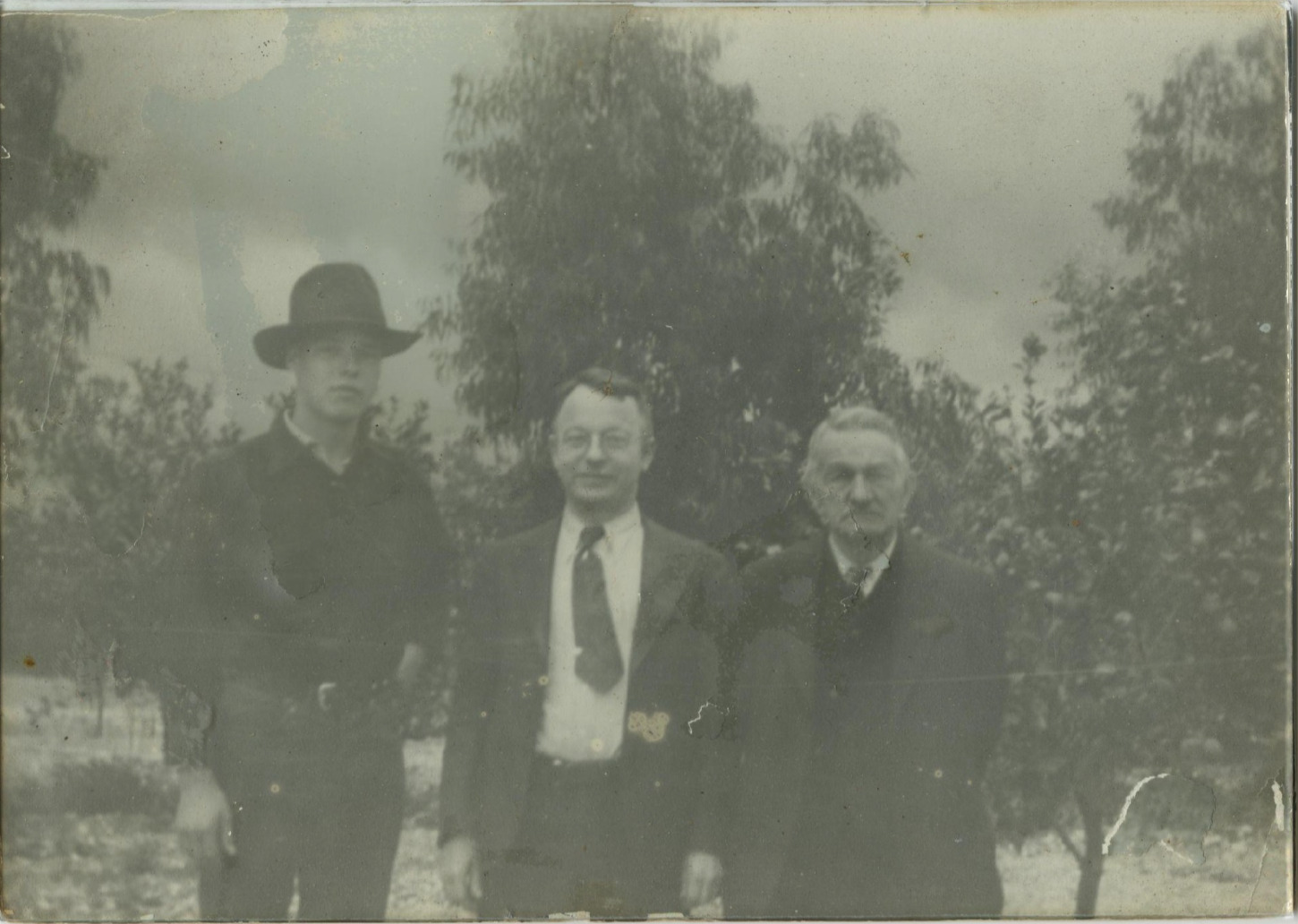
    <title type="html"><![CDATA[Everett Ruess at Veit Springs near Flagstaff, Arizona]]></title>
    <summary type="html"><![CDATA[<p><strong><em>Serving as a homestead and a later rest stop for Everett Ruess' introduction to the Intermountain West as a solo traveler, Veit Springs rests on the side of Arizona's highest mountain, the San Francisco Peaks.</em></strong></p><img src="https://www.intermountainhistories.org/files/fullsize/010f42c0309f906e6329d5c5d348784e.jpg" alt="Everett Ruess with his father and grandfather" /><br/><p>Just north of Flagstaff, Arizona sits in the San Francisco Peaks, or "Dook'o'oosłííd," <em>The Summit that Never Melts</em>, to the Navajo Nationa. In the year 1891, German immigrant Ludwig Veit received a patent for a 160-acre homestead where he and his family constructed a cabin and other structures at what came to be called Veit Springs. Randolph (Pat) Jenks, a student at the Evans Ranch School, a boys preparatory school in Mesa, Arizona, purchased the property from Veit’s relatives in 1930. Jenks, and his classmate Tad Nichols, enjoyed their summers in Flagstaff when the school summered up North. In 1931 the two boys encountered Everett Ruess on his journey through northern Arizona, inviting him to join them back on the homestead. </p><p>Everett Ruess was seventeen when he was picked up near Cameron, Arizona, by Jenks and Nichols. Everett was in bad shape, suffering from his history of anemia and other physical degradation from the desert environment. Tad Nichols, famous photographer of the Colorado Plateau, snapped a photo of Everett and Pat loading his gear, his dog Curly, and Burro Pegasus, into Jenks’ truck before they all set on their way to Jenks’ Deerwater Ranch on the San Francisco Peaks. While Everett was at Veit Springs, he bonded with Jenks over his love for ornithology, the study of birds, and their mutual love for art and the Southwest. Everett created a block print painting and described Jenks’ fascination with his art in a letter home. In fact, Jenks was intrigued enough to purchase one of Everett’s block prints of some native Cliff Dwellings. He enjoyed his new friends and wrote a letter about his “idyllic days” at Deerwater Ranch. Here, Everett escaped the traditional aridness of the Intermountain West and described the environment of the ranch as “cool and bracing” in a letter to his family on June 8th, 1931. Among Everett’s belongings in Davis Gulch was an unsent letter that expressed his “true spirit of delight, exaltation, [and] sense of being more than a man” that he experienced at Veit Springs. </p><p>Everett later traversed the Grand Canyon and resided throughout northeast Arizona, returning home later that year. He set off again to the region in 1932, one of the only years his journey was successfully documented. </p><p>In the 1970s, The United States Forest Service aimed to demolish the cabin Veit hand-built, but the Flagstaff community successfully advocated for its relocation just west of the city's downtown. The Veit Cabin relocation by the Arizona National Guard moved the cabin to its current position within Thorpe Park in Flagstaff, Arizona, just South of Francis Short Pond. Since 1988, the new cabin location has facilitated educational events regarding natural and cultural studies of the landscape. Meanwhile, the cabin’s former site at Veit Springs remains a beautiful spot among the tall aspens on the Veit Springs Hiking Trail where tourists can experience the bracing environment that Everett described, as well as Indigenous petroglyphs and abandoned pumphouses from its early days in history.</p><p><em><strong><a href="https://www.intermountainhistories.org/items/show/829">For more (including 5 images) view the original article</a></strong></em></p>]]></summary>
    <published>2024-05-24T22:33:19+00:00</published>
    <updated>2026-04-17T19:32:18+00:00</updated>
    <link rel="alternate" type="text/html" href="https://www.intermountainhistories.org/items/show/829"/>
    <id>https://www.intermountainhistories.org/items/show/829</id>
    <author>
      <name>Matthew T. Lankton, Northern Arizona University</name>
    </author>
  </entry>
  <entry>
    <title type="html"><![CDATA[John Jarvie’s Historic Ranch]]></title>
    <summary type="html"><![CDATA[<p><strong><em>Not all hospitality is returned in kind. In the case of John Jarvie, the outlaws to whom he was so obliging went on to rob and murder both him and his son. </p></strong></p><img src="https://www.intermountainhistories.org/files/fullsize/fa571c3f7ee8336879f9a9d505c7f737.jpg" alt="John Jarvie" /><br/><p><span style="font-weight:400;">In 1880 John Jarvie and his wife Nellie Barr moved from Rock Springs, Wyoming to the burgeoning settlement of Brown’s Park. Jarvie set up a general store, post office, and ran a river ferry that crossed the nearby Green River. Jarvie became well known for his sagacity and kindness to all those who lived in the region, even the Wild Bunch outlaws. Such associations did not serve him well in the long run, but his kindness did, and his legacy has continued to today in Uintah and Daggett County.</span>
<span style="font-weight:400;">John Jarvie was born in Scotland in 1844. As a young man after being beaten soundly by a mine supervisor, Jarvie elected to immigrate to the United States as a stowaway. He arrived in America in 1870 and settled in Rock Springs, Wyoming.  After several years as a businessman in Rock Springs, working as a Saloon Owner, Jarvie met residency requirements and became a citizen on October 8</span><span style="font-weight:400;">th</span><span style="font-weight:400;">, 1875. In 1880 at the age of 36, Jarvie married Nellie Barr, 22, and the couple moved to Brown’s Park, the present location of John Jarvie’s Historic Ranch.  Jarvie opened a general store, moved the local post office to his property, and ran a ferry that crossed the Green River.</span>
<span style="font-weight:400;">Jarvie sold to everyone in the region, even notorious outlaws. One location on the historic ranch in particular, a storage cellar, was thought to have housed criminals like Butch Cassidy when they were on the run from the law. One notable event on the Ranch in 1895 termed the “Outlaws’ Thanksgiving Dinner” saw a dinner of gratitude  between several notorious outlaws including Billie Bender, Les Megs, Butch Cassidy, Elza Lay, Isom Dart, and the Sundance Kid. The meeting was jovial and in celebration of Jarvie and other residents in Brown’s Park tolerance of the outlaw’s activities. In light of their warm relationship, it is tragic that Jarvie and one of his sons eventually lost their lives to outlaws.</span>
<span style="font-weight:400;">William King and George Hood, hearing false rumors about Jarvie’s great wealth, came to the ranch on July 6</span><span style="font-weight:400;">th</span><span style="font-weight:400;">, 1909. Jarvie was alone, his sons having taken jobs on other farms, and his wife having died of Tuberculosis in 1895. Jarvie was known for his generosity and tendency to feed visitors so he set the table for three. The outlaws did not return his kindness. They forced Jarvie to open his store safe and took the contents, a $100 bill and a pearl handled revolver. Jarvie fled the store and was shot in the back and head. The outlaws placed his body on a boat and sent it down the river. Details of the murder slowly tricked out. When reports circulated of two men trying to change a $100 bill in Rock Springs, Jarvie’s son Jimmy pursued the outlaws voraciously. Jimmy was on their trail at an Inn in Idaho when he was pushed from a second-floor balcony and fell to his death. The criminals were never apprehended.</span>
<span style="font-weight:400;">Jarvie left a powerful legacy which was seen in the obituary written for him in the Vernal Express. There he was praised as a “the sage of the Uintahs, the Genius of Brown’s Park, and the Wizzard [sic] of the hills and rivers. He was not only a man among men but he was a friend among men… He was as broad and generous and far reaching in his good deeds as the stream which he knew and loved[.]”</span></p><p><em><strong><a href="https://www.intermountainhistories.org/items/show/770">For more (including 3 images) view the original article</a></strong></em></p>]]></summary>
    <published>2024-01-20T08:08:00+00:00</published>
    <updated>2026-04-17T19:32:17+00:00</updated>
    <link rel="alternate" type="text/html" href="https://www.intermountainhistories.org/items/show/770"/>
    <id>https://www.intermountainhistories.org/items/show/770</id>
    <author>
      <name>Samuel Pulsipher, Brigham Young University</name>
    </author>
  </entry>
  <entry>
    <title type="html"><![CDATA[Hardware Ranch ]]></title>
    <summary type="html"><![CDATA[<p><strong><em>Hardware Ranch in Hyrum, Utah was created to keep elk away from the lower valley and its inhabitants. Today, the ranch is a popular spot for visitors to get a closer look at elk and other wildlife. </p></strong></p><img src="https://www.intermountainhistories.org/files/fullsize/f81afce9790f5a0a5591caf762da95b5.jpg" alt="An Elk in Hardware Ranch" /><br/><p><span style="font-weight:400;">In the 1940s, complaints from people in the valley of the Blacksmith Fork Canyon about elk eating their stores of hay began to be more frequent. This prompted the state of Utah to purchase the Hardware Ranch to prevent elk from entering the lower parts of the Blacksmith Fork Canyon and interfering with the settlers in the valley of inner Hyrum. The state then created the winter feeding program to keep elk out of the valley. </span>
<span style="font-weight:400;">Before the ranch was a place for Elk to receive food and refuge during the winter, it was a sawmill during the 1870s, then later home to Utah’s largest Cheese company during the 1890s. Lehi Curtis, who homesteaded the ranch during the late 1860s, was part of the 16th Company of pioneers who emigrated to Utah. The company was led by Lehi’s father Uriah Curtis and had a total of 266 members; it traveled from Kanesville, Iowa in 1852 to Cache County, Utah. Upon arriving at Cache Valley, Lehi helped plan out a road that lead to Blacksmith Canyon. Soon, farmers began to further settle the area. </span>
<span style="font-weight:400;">Hardware Ranch was purchased 8 years after the Pittman-Robertson Act was passed. The act, also known as the Wildlife Restoration Act, allowed for revenue from the sporting arms tax to be used as for restoring and managing wildlife. In 1945, the revenue was used to purchase the Ranch from the family estate of Ernst Lorentz Petersen. The original size of the ranch was 7,560 acres but acquisitions by the state enlarged it to about 19,000 acres.During the first year, 120 Rocky Mountain Elk were fed through the winter. Within a few years the number of elk rose to above 500. </span>
<span style="font-weight:400;">In 1971, The state built an education center with two outside viewing areas to observe the elk. Sleigh rides were also provided to further enjoy the ranch and the local elk. In 1988, the Utah Legislature cut funding support for the sleigh rides. Outrage led the state to approve a fee structure and the sleigh rides resumed.</span>
<span style="font-weight:400;">Although the purpose of the ranch was initially to prevent the Elk from eating the hay from the settlers and to keep the elk out of the lower valley, the ranch has become a popular site in Utah and has had thousands of visitors since its opening. People can bring their children to have very close interactions with the Elk and learn about the history of the Ranch. The ranch also provides researchers with vital information in the preservation of wildlife. </span>
<span style="font-weight:400;">The elk is the state animal of Utah. Once winter forage grasses are covered in snow, Division of Wildlife Resources stadd begin feeding the elk. The feed is grown by the ranch. Soon, between 400 and 700 animals migrate to the ranch for the winter. </span></p><p><em><strong><a href="https://www.intermountainhistories.org/items/show/691">For more (including 5 images) view the original article</a></strong></em></p>]]></summary>
    <published>2022-11-03T15:08:01+00:00</published>
    <updated>2026-04-17T19:32:15+00:00</updated>
    <link rel="alternate" type="text/html" href="https://www.intermountainhistories.org/items/show/691"/>
    <id>https://www.intermountainhistories.org/items/show/691</id>
    <author>
      <name>Rosa Rodriguez, Weber State University</name>
    </author>
  </entry>
  <entry>
    <title type="html"><![CDATA[Literature and Legacy of Pyramid Lake Ranch]]></title>
    <summary type="html"><![CDATA[<p><strong><em>This ranch served as home to many divorcees evolved through many owners over the years.</p></strong></p><img src="https://www.intermountainhistories.org/files/fullsize/d6040b730f6676b759e385d0d96c4ebf.jpg" alt="[Untitled]" /><br/><p>Like the Riverside Hotel, Pyramid Lake Guest Ranch has roots in the 1880s, before being passed around from owner to owner in the 20th century. The first commercial use of the land came from Sutcliffe’s 1880s ranch dubbed the Willows. Sutcliffe’s era came to a close in 1926 when he sold the residence to A.J. Olds. Five years later, in 1931, the property was rebounded in its sale to John Marshall. In 1936, the ranch was sold to Alva and Leslie Kitselman who called the property, “The Sage” until 1946. During the Kitselman’s reign, Alva and Leslie’s adult son Beau caused conflicts with neighboring Native Americans. Harry Drackert then leased and managed the ranch with his wife Joan until 1956. By the sixties, Nevada’s role as a divorce haven began to wane as did the number of visitors to Pyramid Lake. </p><p>A few visitors wrote about their experiences at Pyramid Lake. Connecticut transplant Marilu Norden wrote a fictional book based on her 1951 experience at Pyramid Lake . From an interview with her and her son, she describes daily experiences at the ranch and the closeness of the community. She knew and loved the ranch’s manager Harry and his wife and Joan Drackert, she befriended a Grecian Premier, and once talked with Frank Sinatra during her stay. The cabins in pyramid lake were not extravagant.  By Nordan’s description, the cabins bore light with a single dangling light bulb. The cabins were twenty years old when Norden and her son arrived.</p><p>One story set in Pyramid Lake was published a few years later, in 1954. After visiting the lakeside dude ranch, Abbott Joseph Leibling wrote an story based in Pyramid Lake. Leibling’s fictional article was overtaken by Arthur Miller’s 1961 film “Misfits”, also based on his time at  Pyramid Lake.  </p><p>Arthur Miller was a Pulitzer Prize Winner who had penned successful plays like 'Death of A Salesman.'  He came to stay at Pyramid Lake two years after Liebling's Pyramid Lake story was published. Miller came as the lover of Marilyn Monroe and husband of Mary Miller, from whom he was seeking a divorce.</p><p>Miller wrote while waiting out his Nevadan residency on the rural landscape. The ranch rested on the shores of its namesake, Pyramid Lake. Situated 30 miles outside of Reno, the ranch offered a slower pace, well suited to Miller’s writing needs. In 1960, Miller would return when his short story had evolved into a screenplay for the Nevada divorce film. </p><p>Pyramid Lake served as a temporary home to many divorcees. Hospitality ranged from owner to owner, including the troublesome Beau Kitselman to the beloved Harry Drackert.  Like the ownership, the name of the ranch changed frequently moving from its 1880 origins of the Willows to Sutcliffe, then becoming The Sage before being dubbed Pyramid Lake Guest Ranch. After the divorce haven era, the ranch was renamed the Sutcliffe Inn before its current title as the Crosby Lodge. Today, this historic plot of land remains a home to travelers and likely some divorcees in Sutcliffe, Nevada. </p><p><em><strong><a href="https://www.intermountainhistories.org/items/show/353">For more (including 5 images) view the original article</a></strong></em></p>]]></summary>
    <published>2019-10-01T20:39:27+00:00</published>
    <updated>2026-04-17T19:32:06+00:00</updated>
    <link rel="alternate" type="text/html" href="https://www.intermountainhistories.org/items/show/353"/>
    <id>https://www.intermountainhistories.org/items/show/353</id>
    <author>
      <name>Ann Johnston, Brigham Young University</name>
    </author>
  </entry>
</feed>
