<?xml version="1.0" encoding="UTF-8"?>
<feed xmlns="http://www.w3.org/2005/Atom">
  <title type="text">Intermountain Histories</title>
  <updated>2026-04-17T19:32:19+00:00</updated>
  <generator uri="http://framework.zend.com" version="1.12.20">Zend_Feed_Writer</generator>
  <link rel="alternate" type="text/html" href="https://www.intermountainhistories.org/"/>
  <link rel="self" type="application/atom+xml" href="https://www.intermountainhistories.org/items/browse?output=rss2"/>
  <id>https://www.intermountainhistories.org/</id>
  <author>
    <name>Intermountain Histories</name>
    <uri>https://www.intermountainhistories.org</uri>
  </author>
  <link rel="hub" href="https://pubsubhubbub.appspot.com/"/>
  <entry>
    <title type="html"><![CDATA[Joe Hill: The Singing Voice of Labor]]></title>
    <summary type="html"><![CDATA[<p><strong><em>This monument was raised in 2013, 108 years after Joe Hill’s execution and built on the very spot where the IWW songwriter was executed, based on circumstantial evidence. </em></strong></p><img src="https://www.intermountainhistories.org/files/fullsize/16274c8b51b488d753e1d34265c74b56.jpg" alt="Joe Hill Memorial Plaque" /><br/><p>Joe Hill was born in Gavle, Sweden in 1879, and immigrated to the USA in 1902 for want of work. After years of itinerant labor, he joined the Industrial Workers of the World (IWW,) commonly known as the "Wobblies," in 1908. The IWW was a radical labor union, which represented not just skilled workers, but any worker, in any job, regardless of age, race, or gender. The union was also not just focused on obtaining improvements in wages, hours, or conditions, but a total overthrow of the capitalist system. </p><p>Hill hid in boxcars and "rode the rails" to where he could find work, and after a couple years he became an organizer in the IWW, writing songs to mobilize the workers during times of strikes. His "Little Red Songbook" spread throughout the IWW and therefore throughout the country, whenever Wobblies went on strike, they would sing his songs, and usually he would be there too. And in 1914, the strikes were in Utah, involving the workers of Utah Construction Company, represented by IWW local 69, cheered on by Joe Hill in person. There had been repeated clashes between the IWW and the Salt Lake City Police that created an atmosphere of tension in the city. </p><p>On January 10, 1914. Hill was shot in the chest and went to visit a doctor friend to have it treated, the same night John and Arling Morrison were killed in a robbery at the grocery store at which they worked. Hill's doctor reported him to the police, and Hill was promptly arrested. Hill, and many others in the IWW or otherwise sympathetic to his cause, believed the arrest and trial would simply be harassment, as it so often had been before. But Hill, after meeting his state-appointed lawyers, felt strongly that his lawyers had been bribed to 'throw' the case, despite the lack of evidence, and he chose to represent himself. He argued that his songs were free and protected speech, and that the work of the IWW in Utah was protected under the right to associate, and that their actions were chiefly against economic inequality. </p><p>Hill's trial lasted less than one month, during which time the state failed to provide any motive, a single piece of evidence, or indeed any possible indication that any of the bandits had been Joe Hill. The only piece of evidence the prosecution submitted was Joe Hill's IWW red card. The IWW were known for being violent and inhumane, claimed the prosecution, and Hill was a member of it. Hill wanted to overthrow capitalism, civilization itself they claimed, and through his songwriting and performances, even if he hadn't done the murders himself, he was equally responsible. Hill's demands that he had been mistried and appeals for a retrial fell upon deaf ears, and against nationwide beliefs that there had been an abrogation of due process, he was found guilty by jury on June 27 and sentenced to death on July 8th. </p><p>Hill appealed the sentence, and a massive letter-writing campaign began, with letters pouring into the office of Utah Governor Spry, both demanding Spry pardon Hill or to permit the execution. President Woodrow Wilson asked Spry to pardon, stating that Hill's trial had not been fair, as had the Swedish ambassador. In the end, Hill was executed by firing squad on November 19, 1915. Many felt then and feel to this day that Hill had been tried for his speech and for his affiliations rather than any possibility of being among the murderers.</p><p><em><strong><a href="https://www.intermountainhistories.org/items/show/872">For more (including 3 images) view the original article</a></strong></em></p>]]></summary>
    <published>2024-10-31T21:23:23+00:00</published>
    <updated>2026-04-17T19:32:19+00:00</updated>
    <link rel="alternate" type="text/html" href="https://www.intermountainhistories.org/items/show/872"/>
    <id>https://www.intermountainhistories.org/items/show/872</id>
    <author>
      <name>Joseph R. McKellar, Utah State University</name>
    </author>
  </entry>
  <entry>
    <title type="html"><![CDATA[Hazel Hunkins-Hallinan: Silent Sentinel Suffragist ]]></title>
    <summary type="html"><![CDATA[<p><strong><em>Billings native Hazel Hunkins-Hallinan, alongside other members of the National Women’s Party, peacefully picketed the White House fence from 1917-1919 to advocate for a federal amendment for women’s right to vote. Known as the “Silent Sentinels,” they proved to be a continual reminder to President Woodrow Wilson of the issue of suffrage.</em></strong></p><img src="https://www.intermountainhistories.org/files/fullsize/bffa4510a4cca3ac68232b815d975d58.jpg" alt="[Untitled]" /><br/><p><span style="font-weight:400;">Hazel Hunkins grew up in Billings, Montana, and as a young girl, she was seen as “different” because she wanted to do what boys could do from climbing trees to becoming a doctor. After graduating valedictorian from Billings High School, Hunkins obtained her chemistry degree from Vassar College. However, when she applied to chemistry labs across the country they all replied that although she was qualified, they “don’t hire women.” </span>
<span style="font-weight:400;">This response sparked a fire in her, and when she met Anne Louise Rowe of the National Women’s Party (NWP), Hunkins realized that she “was one of millions who had been shoved aside because of my sex” and she had to do something about the exclusion of women. Within six months of joining the NWP, she became the Montana State Chairman. When the NWP began their constant picketing of the White House in 1917, Hunkins participated in the demonstrations. The pickets were peaceful—holding purple, gold, and white suffrage banners and signs like “Mr. President, how long must women wait for liberty?” </span>
<span style="font-weight:400;">Hunkins led a protest at Lafayette Square, carrying the American flag and leading the way to the Park. Once at the statue, she made the simple statement: “Here, at the statue of Lafayette, who fought for the liberty of this country, and under the American flag, I am asking for the enfranchisement of American Women.” She was immediately arrested. Other women followed Hunkins’ lead, each suffragist making her own statement until 47 women were arrested.</span>
<span style="font-weight:400;">Lafayette Square confirmed the NWP efforts were unpopular; however, once World War started, they were scrutinized even more, as people thought the women needed to support the war effort rather than picket a wartime president. The NWP, instead of wavering in their resolve, started new demonstrations like the watchfires of freedom—where President Wilson’s speeches about democracy in Europe were read aloud and burned because American women did not have democracy at home.</span>
<span style="font-weight:400;">The arrests of NWP women continued, often being charged with newly fabricated crimes like “obstruction of a public sidewalk.” Rather than paying fines, they chose jail because as Hunkins stated, “Women cannot be law-breakers until they are law-makers.” The prison conditions were awful—cold, damp areas, without proper clothing, blankets, and food—so the suffragists would often go on hunger strikes to protest these conditions, and in some cases, they would be force-fed. After one such hunger strike, Hunkins left the prison hardly able to walk. </span>
<span style="font-weight:400;">Despite all of the challenges they faced fighting public opinion and police officers’ efforts to stop their protests, in 1920 the 19th Amendment was finally ratified, giving American women the right to vote. After this triumph, Hazel Hunkins continued to push for women’s rights. When she moved to London with her husband, Charles Thomas Hallinan, she joined the British feminist Six Point Group. At age 87, Hunkins-Hallinan returned to America to participate in the March for Equal Rights. There she stated what she fought her whole life for, “Equal Rights is so clear cut; it’s fundamental—a basic change… For half a cent I would stay here and campaign.” </span></p><p><em><strong><a href="https://www.intermountainhistories.org/items/show/866">For more (including 4 images) view the original article</a></strong></em></p>]]></summary>
    <published>2024-10-21T17:33:32+00:00</published>
    <updated>2026-04-17T19:32:19+00:00</updated>
    <link rel="alternate" type="text/html" href="https://www.intermountainhistories.org/items/show/866"/>
    <id>https://www.intermountainhistories.org/items/show/866</id>
    <author>
      <name>Rosalyn Visser, Rocky Mountain College</name>
    </author>
  </entry>
  <entry>
    <title type="html"><![CDATA[Molly Brown: The &quot;Unsinkable” Suffragist and Workers’ Rights Activist]]></title>
    <summary type="html"><![CDATA[<p><strong><em>Famously called the “Unsinkable Molly Brown” for surviving the Titanic, the suffragist had a remarkable life before and after the tragedy.</em></strong></p><img src="https://www.intermountainhistories.org/files/fullsize/8513fb5a82d7726a5750959d63e83e46.jpg" alt="Portrait of Margaret “Molly” Brown" /><br/><p><span style="font-weight:400;">Margret Tobin Brown was born in Hannibal, Missouri in 1867 to Irish immigrants. Life in Hannibal greatly influenced her outlook, as she was surrounded by diversity and saw the struggles of the working class. Her parents valued education, so Margaret was able to attend school until she was 13 when she had to drop out to work in a factory. Like her father and countless others, she experienced low wages, instability, and dangers at work. </span>
<span style="font-weight:400;">Margaret dreamed of going West, and at age 18, she followed one of her older brothers, Daniel, who had moved to Leadville, Colorado, to strike rich in the mines. Women were not allowed to work in the mines, so they had to find jobs in the mining towns, as cooks, nurses, saloon girls, or store workers. Margret worked in a store, and while she did not have much, she participated in causes she believed in, like volunteering in soup kitchens.</span>
<span style="font-weight:400;">It was in Leadville that she met her husband James Joseph Brown, a mining engineer. They got married in 1886 and soon had two children. Surprisingly, in 1893, they became millionaires when the Little Jonny Mine that J.J. invested in struck gold. Now wealthy, they moved their family and built their home in Denver, Colorado which can be visited today. </span>
<span style="font-weight:400;">They became prominent figures in Denver, Margaret in the political realm and J.J. in the business sphere. Denver was rampant with various social issues—poverty, homelessness, and workers’ rights issues—and now Brown held a position where she could promote political action. She advocated for labor reform and became an involved member of the National American Women’s Suffrage Association (NAWSA). </span>
<span style="font-weight:400;">Margaret’s situation was unique because she separated from her husband in 1909 to live independently. In 1912, she embarked on the Titanic. When tragedy struck, she was pushed onto a lifeboat, even though she was still trying to help others. After the lifeboat was deployed, she protested, saying they needed to save more people, but the sailor refused. Although not allowed to testify in court because she was a woman, she became one of the most famous survivors. </span>
<span style="font-weight:400;">With her newfound fame after the Titanic, Brown used her position to raise awareness of the Ludlow Massacre of Colorado miners, who were striking for more rights. She understood the challenges workers and families faced, so she not only helped the affected families but also advocated for workers' rights and spoke about how women having the right to vote could help pass necessary reforms across the country. </span>
<span style="font-weight:400;">Brown did important work for Colorado and people began encouraging her to run for Congress in 1914. However, with growing tensions with World War, she decided not to run and shifted her focus to war relief programs. She became the self-sufficient woman of the 1920s, continuing to advocate for women’s and laborer’s rights until her death on October 26, 1932. </span></p><p><em><strong><a href="https://www.intermountainhistories.org/items/show/864">For more (including 4 images) view the original article</a></strong></em></p>]]></summary>
    <published>2024-10-18T23:42:20+00:00</published>
    <updated>2026-04-17T19:32:19+00:00</updated>
    <link rel="alternate" type="text/html" href="https://www.intermountainhistories.org/items/show/864"/>
    <id>https://www.intermountainhistories.org/items/show/864</id>
    <author>
      <name>Rosalyn Visser, Rocky Mountain College</name>
    </author>
  </entry>
  <entry>
    <title type="html"><![CDATA[Founding of Cache Valley Woman Suffrage Association]]></title>
    <summary type="html"><![CDATA[<img src="https://www.intermountainhistories.org/files/fullsize/c97e35b6b620861cc49ef8a031fb1953.jpg" alt="The Logan Tabernacle" /><br/><p>The Cache Valley Woman Suffrage Association (CVWSA) was established in the Logan Tabernacle on December 10, 1889. The CVWSA was a local division of the Utah Woman Suffrage Association and the National Woman Suffrage Association. Many other counties in Utah were also forming Woman Suffrage Associations at this time. The CVWSA was established to regain the voting rights Utah women had been stripped of in 1887. Utah women felt strongly about their right to vote, as can be seen in the Logan Journal article about the CVWSA founding meeting. The writer of the article even went so far as to call those that succeeded in stripping women’s right to vote in 1887 “Utah Carpet Bag Liberals.” Carpet Baggers was a term most commonly used in the Reconstruction South to describe someone perceived as politically disruptive or taking advantage of a situation for political or financial gain. In this context, “Utah Carpet Bag Liberals” is clearly an insult toward those who helped remove women’s suffrage. The women of Cache Valley, just like many women in Utah, were determined to regain the right to vote.</p><p>On December 10, 1889, at 10 am, the founding meeting was held for the CVWSA. Many prominent women in the community and in politics were there. Adeline Barber and Jane Hyde Molen, two local Relief Society Presidents, the women's organization in the Church of Jesus Christ of Latter-Day Saints, were officers of the association. Jane Hyde Molen, a prominent leader of the Democratic Party of Cache County and a member of the Cache County School Board, was named secretary. Women such as Adeline Barber and Jane Hyde Molen who had both political and religious leadership could easily spread information about the association. All officers elected to the CVWSA were women, though men were also in attendance in the meeting. Seventy-eight women joined the association that founding day. Over the years, the Logan Tabernacle was used to house many CVWSA meetings.</p><p>The 1895 Constitutional Convention of Utah was very concerned with the issue of women’s suffrage. Delegates from Cache County presented eight petitions on April 18th, signed by men and women, in favor of equal suffrage in the Utah Constitution. As a result of the hard work of men and women in Cache County and throughout the state, women’s right to vote was reinstated. A banquet was held in the Logan Tabernacle in January 1896 to celebrate the reinstatement of Utah women’s right to vote.</p><p><em><strong><a href="https://www.intermountainhistories.org/items/show/860">For more (including 3 images) view the original article</a></strong></em></p>]]></summary>
    <published>2024-10-17T23:24:35+00:00</published>
    <updated>2026-04-17T19:32:19+00:00</updated>
    <link rel="alternate" type="text/html" href="https://www.intermountainhistories.org/items/show/860"/>
    <id>https://www.intermountainhistories.org/items/show/860</id>
    <author>
      <name>Madison Harris, Utah State University</name>
    </author>
  </entry>
  <entry>
    <title type="html"><![CDATA[The Women of the Ku Klux Klan in Denver]]></title>
    <summary type="html"><![CDATA[<p><strong><em><span style="font-weight:400;"> In 1926, the Women of the Ku Klux Klan (WKKK), along with their male counterparts, marched down Larimer Street in downtown Denver. The WKKK was an appealing way for Protestant women to display comradery, exist in a historically male space, and spew anti-Catholic and Jewish rhetoric.</span></em></strong></p><img src="https://www.intermountainhistories.org/files/fullsize/5d9244d4ded11646b84fd3324a59938c.jpg" alt="“Ku Klux Klan members march down Larimer Street in Denver.” 1926." /><br/><p><span style="font-weight:400;">A notable difference between the KKK of the 19</span><span style="font-weight:400;">th</span><span style="font-weight:400;"> century and the Klan of the 20</span><span style="font-weight:400;">th</span><span style="font-weight:400;"> century was the latter’s inclusion of women—a sub-organization called the Women of the Ku Klux Klan (WKKK). Like their male counterparts, the WKKK promoted a skewed version of “Americanism” and believed that the United States needed saving from minorities and non-Protestant religions. However, they filtered their bigotry and xenophobia through a uniquely feminine manner. They sought to present themselves as good, charitable, white Protestant American women and believed that they needed to uphold KKK ideals to do so. Furthermore, they had their own leaders, rules, and initiations. </span></p><p><span style="font-weight:400;">Colorado’s Klan chapters and activities were perhaps the most potent of anywhere in the Intermountain West during the 1920s, and the Klanswomen activities in this period reflected that. In 1926, the Klan held a large parade and marched down Larimer Street in Denver, Colorado. The women, like the men, marched in full regalia, although they were notably unhooded. It seems like they felt a great deal of pride and wanted their actions recognized. </span>
<span style="font-weight:400;">An important figure of Colorado’s WKKK was influential leader Laurena Senter. Senter was very active in the public sphere and acted as president of organizations such as the Colorado Federation of Women’s Clubs and the Women’s Club of Denver. Her husband was a very high-ranking member of the Klan and together they were very dedicated to the Klan. </span>
<span style="font-weight:400;">In 1925, Senter traveled around the state and performed rituals and initiations. Historian Betty Jo Brenner notes that women were eager to join the WKKK for reasons such as the allure of mystery and ritual. However, rather notably it also appealed to women seeking more agency. Women often joined independently from their husbands and were able to obtain leadership positions. Joining the WKKK also allowed women to foster comradery with other women and participate in secret organizations, a space historically dominated by men. Because of these reasons, their actions can be seen as a form of feminism. </span>
<span style="font-weight:400;">Klanswomen in Denver believed that charitable actions and benevolence defined their role. They delivered Thanksgiving baskets to less fortunate families in Denver and even adopted an orphaned child called Richard—who they dressed up in Klan regalia. They also attempted to deter people from patronizing businesses that were “run by Jews,” and raised money to keep orphans out of Catholic-supported orphanages.</span>
<span style="font-weight:400;">The WKKK of Colorado eventually split from the national WKKK. Senter described in her diary her frustration with the Klan’s leadership in Colorado. It seems that although she still believed in its mission of white Protestant supremacy, she believed that the Colorado Klan had lost sight of its purpose and criticized members for joining in hopes of personal gain and glory. </span>
<span style="font-weight:400;">The national WKKK determined that the Colorado chapter could no longer call themselves the WKKK and thus Senter reorganized her group as the “Colorado Cycle Club.” Although some members defected, many remained loyal to Senter’s group. Under the “Colorado Cycle Club,” the organization lasted until 1945. </span></p><p><em><strong><a href="https://www.intermountainhistories.org/items/show/815">For more (including 3 images) view the original article</a></strong></em></p>]]></summary>
    <published>2024-05-21T01:24:52+00:00</published>
    <updated>2026-04-17T19:32:18+00:00</updated>
    <link rel="alternate" type="text/html" href="https://www.intermountainhistories.org/items/show/815"/>
    <id>https://www.intermountainhistories.org/items/show/815</id>
    <author>
      <name>Aidan Capristo, Northern Arizona University</name>
    </author>
  </entry>
  <entry>
    <title type="html"><![CDATA[The Klan in Colorado Springs]]></title>
    <summary type="html"><![CDATA[<p><strong><em><span style="font-weight:400;">Following successes in Denver, the Ku Klux Klan formed a new chapter in Colorado Springs. Although this new chapter hoped to gain similar success, it faced many difficulties in accomplishing its goals.</span></em></strong></p><img src="https://www.intermountainhistories.org/files/fullsize/baf2ca0344300dd4d216c34836e78a31.jpg" alt="“KKK members standing in front of a cross at Pikes Peak.” July 4th, 1923." /><br/><p><span style="font-weight:400;">The Klan in Colorado originally began in Denver, but soon spread to nearby towns and cities such as Colorado Springs in hopes of gaining more influence and followers. The 30,605 residents of Colorado Springs were overwhelmingly Protestant, with only 500 Jews and 2,965 Catholics, and thus seemed like an ideal location for the Klan to penetrate. </span></p><p><span style="font-weight:400;">In 1921, the Klan immediately sought to gather support from local organizations— a strategy that worked well for them in Denver. However, many in the community, the police included, were weary of the Klan. After sending a letter to a veteran’s group that was deemed to be a veiled threat, the Klan was met with fervent backlash from local organizations. The leadership of the American Legion condemned the Klan and emphasized its lawbreaking, and Reverend Charles A. Fulton denounced the Klan to his congregation. The Klan’s attempts to gain support in Colorado Springs were deemed a failure and they retreated for the time being</span>
<span style="font-weight:400;">Two years later, on July 4th, 1923, the day following a local screening of </span><i><span style="font-weight:400;">Birth of a Nation,</span></i><span style="font-weight:400;"> Klansmen set ablaze a 30-foot-tall cross on Pikes Peak near Colorado Springs. This marked the creation of a new Klan chapter that sought to renew previous efforts. As before, Klansmen sought connections with local groups but now attempted to invoke fears about the town’s bootlegging Catholics and presented themselves as a lawful solution.</span>
<span style="font-weight:400;">However, the Klan faced multiple problems bringing their goals to fruition. Although anti-Catholicism was no doubt present in the majority Protestant population, many did not view Catholics as an immediate threat. Thus, the Klan offered a violent and militant solution that offered little appeal. Bootlegging, a prominent crime in Colorado Springs that was often used to scapegoat Catholics, was being dealt with by the actual law enforcement, and the Klan’s vigilantism was not seen as needed by the police and citizens. Colorado Springs was a popular tourist destination and residents feared that the Klan’s violent image could negatively affect their commerce and industry.  The Klan’s frequent crises of local leadership also did not help their cause. During their brief presence in Colorado Springs during the 1920s, four different men acted as the local leader or “Exalted Cyclops.” Two of these leaders were deposed before the end of their term.</span>
<span style="font-weight:400;">Although the Klan did not initially vacate the city this time, its unpopularity drove the Klan to operate from the shadows. Klan activities in Colorado Springs during the 1920s mostly consisted of debate and discussion at lodge meetings, and the occasional cross-burning. The Colorado Springs Chapter only appeared once publicly during the 1920s. Not even daring to show themselves in Colorado Springs, they decided to make a donation to a church in the nearby municipality of Fountain resulting in an uproar.</span>
<span style="font-weight:400;">Following their actions in Fountain and the subsequent backlash, the Colorado Springs Klan chapter shrank and eventually dissipated. Although reaching a notable member count of 2,000 during the 1920s, a combination of poor leadership and uninterested potential members resulted in the Colorado Springs chapter of the Klan not having the same amount of success as their Denver neighbors in gaining membership and influence during the 1920s.</span></p><p><em><strong><a href="https://www.intermountainhistories.org/items/show/814">For more (including 3 images) view the original article</a></strong></em></p>]]></summary>
    <published>2024-05-21T01:15:28+00:00</published>
    <updated>2026-04-17T19:32:18+00:00</updated>
    <link rel="alternate" type="text/html" href="https://www.intermountainhistories.org/items/show/814"/>
    <id>https://www.intermountainhistories.org/items/show/814</id>
    <author>
      <name>Aidan Capristo, Northern Arizona University</name>
    </author>
  </entry>
  <entry>
    <title type="html"><![CDATA[A Large KKK Parade and Initiation Ceremony in Boise, Idaho]]></title>
    <summary type="html"><![CDATA[<p><strong><em><span style="font-weight:400;">A large Ku Klux Klan parade marched through downtown Boise in 1924. The parade had floats and pyrotechnics. The procession ended at the fairgrounds where Klan initiation ceremonies took place. </span></em></strong></p><img src="https://www.intermountainhistories.org/files/fullsize/49066b000484ae4fe8e361ce7330a383.jpg" alt="Group of Klansmen photographed without masks" /><br/><p><span style="font-weight:400;">On September 8</span><span style="font-weight:400;">th</span><span style="font-weight:400;">, 1924, 350 Knights of the Ku Klux Klan marched through downtown Boise, Idaho. The parade—representing Klan chapters from all over Idaho—was a large spectacle and reminiscent of a traditional Fourth of July celebration. The parade contained floats, pyrotechnics, and a band blaring “Rally ‘Round the Flag”—an old Civil War tune. They marched through downtown before eventually ending at the fairground where Klan initiation ceremonies and speeches took place in front of an audience of 3000.</span></p><p><span style="font-weight:400;">Most remarkable about the Klan’s presence on that day was how they chose to represent themselves. Following backlash concerning its violent and clandestine nature in previous years, Klansmen presented themselves unhooded and orderly to emphasize their grandeur and image as proper Americans. Many members felt proud to display their allegiance, and twenty even chose to pose unmasked for an </span><i><span style="font-weight:400;">Idaho Statesman</span></i><span style="font-weight:400;"> photograph.  Their use of expensive pyrotechnics and floats is also notable because it not only shows a desire for attention but demonstrates the Klan was organized and wealthy enough to produce such a parade. Furthermore, when the procession reached the fairgrounds, Klansman concluded speeches with special bombs exploding in the air. When the bombs exploded, American flags and three “K” flags were produced in the air and gradually floated back to the ground. </span>
<span style="font-weight:400;">Two floats present in the parade represented Klan political beliefs/tactics during this period. One float was titled “Little Red Schoolhouse” but instead of a traditional red schoolhouse the Klan had draped the schoolhouse in white and added a banner proclaiming “one flag, one county, one school.” Another float followed, also covered in white, with a banner stating, “America First.” According to the Boise paper the </span><i><span style="font-weight:400;">Idaho Statesman,</span></i><span style="font-weight:400;"> this float represented the women of the Klan. Together these floats show the Klan desired to be represented as model Protestant Americans.</span>
<span style="font-weight:400;">The </span><i><span style="font-weight:400;">Statesman</span></i><span style="font-weight:400;"> and others had criticized the Klan inflicting violence against minorities and the Klan used the parade to quell the fears of the citizens. When they reached the fairgrounds, J.H Harmon, a Klansman, stated “we have demonstrated in Boise today that we are a law and order organization…It should prove to you that we do not commit violence.”  Another Klansman, W.M Cortner, stated in a speech “The Knights of the Ku Klux Klan are standing for nothing that is not just, right and honorable. It is not anti-one church, race, creed, or people. The reason why a Catholic, a Jew, or a negro cannot belong to the Klan Is because they have their own organizations.”  </span>
<span style="font-weight:400;">The Boise parade and speeches represent the Klan’s desire to use grandeur and spectacle to alter its image from violence and racism to a softer one of proper American Protestants and white supremacists. </span></p><p><em><strong><a href="https://www.intermountainhistories.org/items/show/813">For more (including 3 images) view the original article</a></strong></em></p>]]></summary>
    <published>2024-05-21T01:01:51+00:00</published>
    <updated>2026-04-17T19:32:18+00:00</updated>
    <link rel="alternate" type="text/html" href="https://www.intermountainhistories.org/items/show/813"/>
    <id>https://www.intermountainhistories.org/items/show/813</id>
    <author>
      <name>Aidan Capristo, Northern Arizona University</name>
    </author>
  </entry>
  <entry>
    <title type="html"><![CDATA[The KKK Crash the Funeral of a Salt Lake County Sheriff]]></title>
    <summary type="html"><![CDATA[<p><strong><em><span style="font-weight:400;">On April 19</span><span style="font-weight:400;">th</span><span style="font-weight:400;">, 1922, eight hooded Klansmen crashed the funeral of Salt Lake County Sheriff Gordon Stuart. The motive seems to have been a desire to be associated with law enforcement and to be seen in a grandiose manner.</span></em></strong></p><img src="https://www.intermountainhistories.org/files/fullsize/ec9bbf127f5a04bb8e83b1f74d3b3169.jpg" alt="“Klansmen paying respects to Salt Lake County Sheriff,” Salt Lake Telegram April 20th, 1922, 1." /><br/><p><span style="font-weight:400;">A key difference between the 20</span><span style="font-weight:400;">th</span><span style="font-weight:400;">-century Klan and its 19</span><span style="font-weight:400;">th</span><span style="font-weight:400;">-century counterparts was its decentralized motives as the group expanded from the South. In Salt Lake County, Utah, one of the motivations of the local chapter seemed to be a desire to associate with law enforcement and to make a spectacle.</span></p><p><span style="font-weight:400;">In Sandy, Utah, near Salt Lake City, eight Klansmen in full regalia crashed the funeral of Salt Lake County Deputy Sheriff Gordan Stuart on April 19, 1922. The presence of the Klansmen was a surprise to the funeralgoers and the local paper, the </span><i><span style="font-weight:400;">Salt Lake Telegram, </span></i><span style="font-weight:400;">painted their arrival as sudden and mysterious. The hooded men arrived toward the end of the funeral when the mourners had their heads bowed in prayer, and when they finished the </span><i><span style="font-weight:400;">Telegram </span></i><span style="font-weight:400;">stated, “the mourners lifted their heads only to stare at the ghostlike costume of the little group.”</span>
<span style="font-weight:400;">The Klansmen placed a large floral cross on the grave bearing the inscription “Knights of the Ku Klux Klan Salt Lake Chapter No. 1, April 19, 1922.” They then simultaneously raised their left hand, an action the </span><i><span style="font-weight:400;">Telegram </span></i><span style="font-weight:400;">attributed to a “mark of respect to the deputy sheriff.” Following the salute, the Klansmen made their way to the other side of the cemetery where two vehicles waited to take them away. </span>
<span style="font-weight:400;">The motive behind the uninvited attendance at the funeral is unknown. It could be evidence of the departed deputy sheriff’s involvement in the local chapter of the Klan. However, a more likely explanation for their presence was a desire to be associated with law enforcement. The Klan had been struggling to gain popular support in Utah as the Mormon Church opposed its actions. The appearance allowed them an opportunity to emphasize their grandeur and intrigue as well as to show support for law enforcement. By doing so, it is possible they hoped to dispel negative connotations that were becoming synonymous with Klan activities. When looking at the details of Stuart’s death, as well as the details of the Klan’s procession at the funeral, this theory makes sense.</span>
<span style="font-weight:400;">Deputy Sheriff Gordon Stuart died when attempting to serve civil papers to a farmer, who, mistaking the officer’s motives, opened fire with a shotgun and killed Stuart, who had pushed his partner out of harm's way. The Klan surely would have desired to be associated with the commemoration, either to appeal to the deputy sheriff's law enforcement martyrdom or to simply show respect for his service. </span>
<span style="font-weight:400;">Further evidence of this can be seen in the details of the procession itself. The Klan marched slowly in uniform—until eventually speeding up to reach the position of the funeral while the mourners' heads were bowed. Their organization and precision suggest that they knew they were being viewed and wanted to act accordingly. Furthermore, it seems the Klan wanted to appear in front of the bowing mourners before their heads were lifted. Regardless of their motives, the event shows the Salt Lake County chapter of the KKK desired an association with law enforcement.  </span></p><p><em><strong><a href="https://www.intermountainhistories.org/items/show/812">For more (including 3 images) view the original article</a></strong></em></p>]]></summary>
    <published>2024-05-21T00:26:08+00:00</published>
    <updated>2026-04-17T19:32:18+00:00</updated>
    <link rel="alternate" type="text/html" href="https://www.intermountainhistories.org/items/show/812"/>
    <id>https://www.intermountainhistories.org/items/show/812</id>
    <author>
      <name>Aidan Capristo, Northern Arizona University</name>
    </author>
  </entry>
  <entry>
    <title type="html"><![CDATA[The KKK in Butte, Montana]]></title>
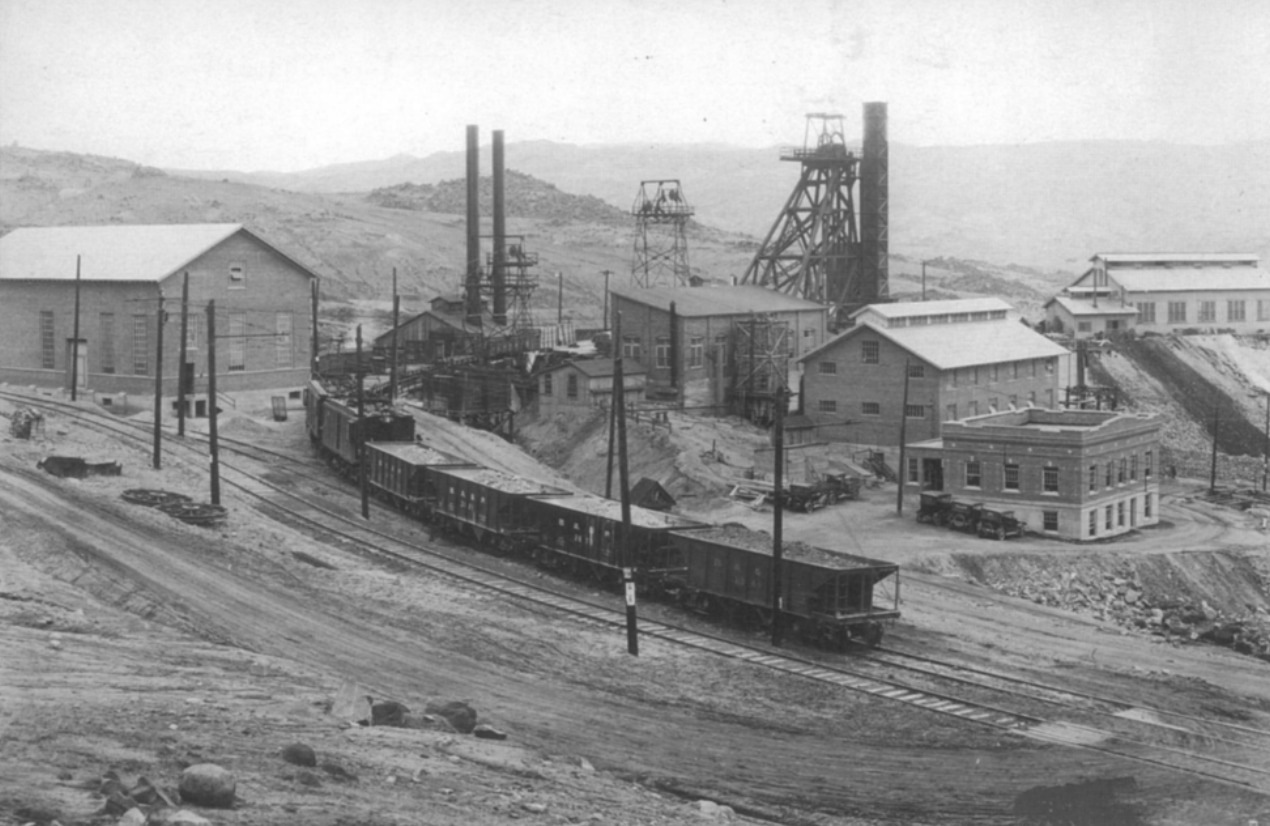
    <summary type="html"><![CDATA[<p><strong><em><span style="font-weight:400;">Taking advantage of existing tensions between Protestants and Irish Catholics in Butte, Montana, the Ku Klux Klan sought to penetrate the community and hoped to stoke discourse.</span></em></strong></p><img src="https://www.intermountainhistories.org/files/fullsize/23f3a64865731d1aad110432024680ba.jpg" alt="Undated photograph of Elm Orlu mine" /><br/><p><span style="font-weight:400;">Before the arrival of the Ku Klux Klan in 1923, tension between Protestants and Catholics existed in the mining communities of Butte, Montana. The so-called “War of the Copper Kings” was a feud between mine owners Marcus Daly and William A. Clark during an 1888 campaign for territorial representation of the companies. Although both were Irish, Clark was a Protestant while Daly was a fervent Catholic. Many of the miners were migrant Irish-Catholics and Daly won the election. Clark never forgot the loss and battled for control until he died in 1900. It was also during this period that a group known as The American Protective Association (APA) gained popularity in Butte. The APA was an organization that was extremely anti-Catholic and members frequently got into violent altercations with Catholics at local bars.   </span></p><p><span style="font-weight:400;">Furthermore, due to issues such as decreased copper demand following the end of the First World War, many in Montana felt economically unstable and wary of foreigners. When the Ku Klux Klan arrived in Butte in the 1920s, it hoped to exacerbate the existing religious tensions and economic fears by using Irish Catholic workers as scapegoats. </span>
<span style="font-weight:400;">Originally gaining popularity in Billings, the Klan sought to move into Butte. However, as Butte historian Christine Erikson notes, “Catholic Immigrants cared little for an organization that referred to the Pope as an ‘impatient, meddling individual controlled by a Jesuitical lot of assaassainous villains.’” The Klan notably chose to act in an especially clandestine manner while conducting operations in Butte. Local Klansmen moved from town to town and conducted meetings under various aliases such as the “Protestant Men’s Welfare Council” and “Butte Men’s Literary Club.” Klan officers also urged other chapters in Montana to avoid exposing Butte Klansmen by ensuring that any mail to members in Butte didn’t indicate anything that suggested a Klan association. It is estimated that at least 181 residents of Butte joined the organization during 1923-1929, including 39 who worked as miners and on rail lines for Clark. </span>
<span style="font-weight:400;">The reasons for their especially secretive nature are not completely clear. The Butte Klan could have been worried about backlash from other Protestant organizations that operated in the area such as Masonic groups. It is also possible that other Butte clandestine organizations were not eager to associate with a group that was gaining a national reputation for terrorism. Another reason could be that in a town with a sizable Irish-Catholic population, the Klan worried about community backlash. Butte’s </span><i><span style="font-weight:400;">Labor Bulletin </span></i><span style="font-weight:400;">heavily criticized the Klan in Butte and proclaimed, “Their Invisible Empire Should Have No Place in These United States.”</span>
<span style="font-weight:400;">The Klan's larger efforts in Butte eventually proved to be fruitless—the membership and public activity essentially became dormant by the 1930s. Instead, the Klansmen opted to do smaller acts such as “guarding” voting booths and writing opinion pieces in editorials about unfavorable politicians. However, most of their Butte activities seemed to be brooding in their meeting places and discussing inter-Klan politics. </span></p><p><em><strong><a href="https://www.intermountainhistories.org/items/show/811">For more (including 3 images) view the original article</a></strong></em></p>]]></summary>
    <published>2024-05-21T00:10:52+00:00</published>
    <updated>2026-04-17T19:32:18+00:00</updated>
    <link rel="alternate" type="text/html" href="https://www.intermountainhistories.org/items/show/811"/>
    <id>https://www.intermountainhistories.org/items/show/811</id>
    <author>
      <name>Aidan Capristo, Northern Arizona University</name>
    </author>
  </entry>
  <entry>
    <title type="html"><![CDATA[Founding of the Utah People’s Party]]></title>
    <summary type="html"><![CDATA[<p><strong><em><span style="font-weight:400;">19th-century tensions between members of the Church of Jesus Christ of Latter-day Saints and opponents of the church in Utah led to the creation of two political parties in 1870, the People’s Party and the Liberal Party. The founding of these parties was controversial in that members of the Church flooded their opponents’ meeting in order to form their own party. </span></em></strong></p><img src="https://www.intermountainhistories.org/files/fullsize/59e45fffcfef628985ad3c07fba0226b.jpg" alt="William Godbe" /><br/><p><span style="font-weight:400;">In 1870, tension between the members of the Church of Jesus Christ of Latter-day Saints and non-members living in Utah was high. Church members voted as a block, which made it nearly impossible for non-members of the church to find a voice in government through traditional democratic means. </span>
<span style="font-weight:400;">The foundation of what some called the New Movement, or the Godbeites aggravated the tensions. The Godbeites were former members of the LDS Church, newfound spiritualists, and reformists. They were a unique splinter group within the Church who wanted to reform the Church rather than destroy it, as many of its enemies hoped to do. The Godbeites preached education and reform to Utah’s LDS and non-LDS residents as well as to the federal officials in the state. </span>
<span style="font-weight:400;">The Godbeites gained little traction against the the Church of Jesus Christ of Latter-day Saints, which maintained a large majority of the population in Utah, but it did capture the attention of non-members who sought to create a coalition to counter church political dominance. Godbeites joined non-member businessmen, miners, and others unaffiliated with the Church, bound by little other than their goal of disrupting the dominance of the Church of Jesus Christ in political matters. </span>
<span style="font-weight:400;">On the evening of February 10, 1870, the Godbeites and their partners gathered at the Walker Dry Goods Store on the corner of 3rd South and Main Street in Salt Lake City, Utah. The Godbeites and their new allies intended to form a new political party—one for the “People” as they advertised it. Church members caught word. Editors of the Deseret News and other church leaders organized a protest. Many members showed up at the meeting and managed to get in the doors before anyone else. They occupied all the seats, elected their own candidates, and formed a new party, calling themselves the “People’s Party” as a tongue-in-cheek reference to the Godbeites earlier advertisements. </span>
<span style="font-weight:400;">After their peaceful protest, the Saints left and the non-members organized the “Liberal Party.” One member of the new party remarked that the move by LDS leaders to flood their meeting was the “cleverest thing.” Luckily, the event did not devolve into violence, but the tension between these two parties would continue for their two decades of existence. Newspapers as far away as Sacramento, California wrote about the tension, predicting incorrectly that conflict between the competing factions spelled “impending doom.”</span></p><p><em><strong><a href="https://www.intermountainhistories.org/items/show/788">For more (including 4 images) view the original article</a></strong></em></p>]]></summary>
    <published>2024-03-02T01:46:51+00:00</published>
    <updated>2026-04-17T19:32:17+00:00</updated>
    <link rel="alternate" type="text/html" href="https://www.intermountainhistories.org/items/show/788"/>
    <id>https://www.intermountainhistories.org/items/show/788</id>
    <author>
      <name>Elle Morgan, Brigham Young University</name>
    </author>
  </entry>
  <entry>
    <title type="html"><![CDATA[Martha Hughes Cannon Memorial Statue]]></title>
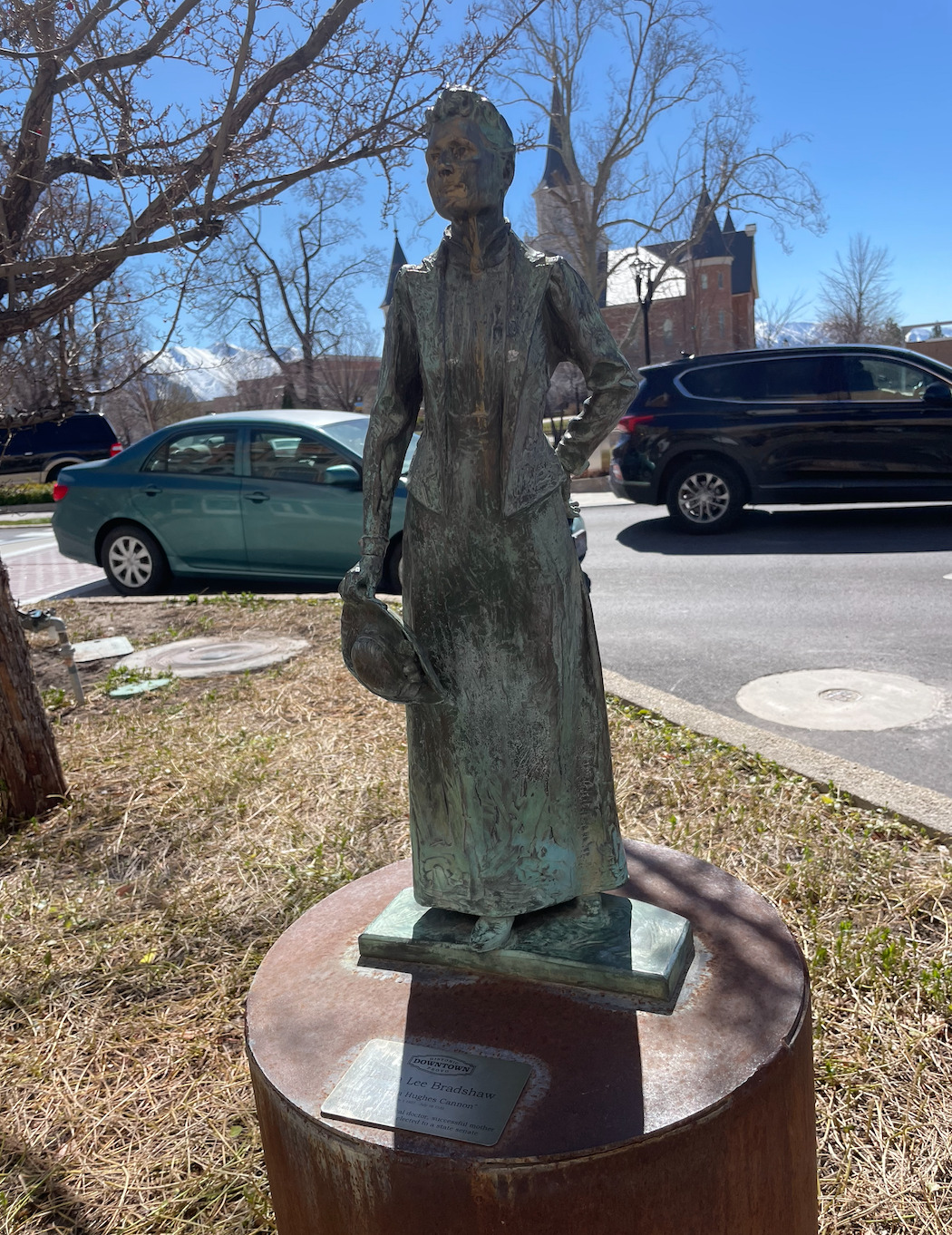
    <summary type="html"><![CDATA[<p><strong><em>Martha Hughes Cannon was an outstanding woman with great ambition and intelligence. As she gained an education and grew in the LDS religion, she capitalized on her position as an educated woman of faith to represent Utah women as they battled anti-polygamy legislation and public health issues.</em></strong></p><img src="https://www.intermountainhistories.org/files/fullsize/48b93f901ad49440cfe49a8350fd6fe1.jpg" alt="Martha Hughes Cannon Statue, Provo" /><br/><p>Martha Hughes Cannon was born in Wales on July 1st, 1857. During her infant years, Martha’s parents joined other new converts to the LDS faith on a long journey to Utah. Tragically, her father passed away only three days after arriving in Utah and surviving the arduous westward trek. By her teenage years, Martha had faced considerable hardship and poverty, but showed resilience and hope for the future. Martha’s young adult years were full of education. After graduating college with a degree in chemistry, Martha was accepted into the University of Michigan, one of few medical schools that admitted men and women. She also studied at the National School of Oratory, becoming a skilled public speaker. Her medical skills and oratorical skills would be great assets during her involvement in Utah politics. </p><p>Martha’s personal and professional life gave her a unique position in the eyes of the United States government. As the fourth wife to Angus M. Cannon, Martha faced considerable scrutiny from territorial officials. As a doctor, she delivered many children born to polygamist mothers and was seen as an important witness to prosecute polygamy. She lived out of state for many years to avoid testifying against and incriminating her husband, along with other polygamist families. The official outlawing of polygamy in 1890 allowed Martha to return to Utah and begin her career in politics.</p><p>A request from the Democratic party prompted Martha to run in the state senate election. Although her husband was running for the Republican party, this did not stop Martha from fulfilling what she viewed as an incredible civic opportunity. After winning the Democratic seat, Martha spent four years effectively advocating for public health and education causes in Utah. She authored bills to start the Utah Health Department, and schools for children with disabilities. Unfortunately, Martha’s political career came to an end with her third pregnancy. The nation viewed this as proof that Mormons were still practicing polygamy, and she was now an unacceptable representative. Although her time was cut short, Martha provided many valuable insights to Utah’s state legislature and was a voice for women across the state of Utah.</p><p><em><strong><a href="https://www.intermountainhistories.org/items/show/783">For more (including 3 images) view the original article</a></strong></em></p>]]></summary>
    <published>2024-02-26T19:39:54+00:00</published>
    <updated>2026-04-17T19:32:17+00:00</updated>
    <link rel="alternate" type="text/html" href="https://www.intermountainhistories.org/items/show/783"/>
    <id>https://www.intermountainhistories.org/items/show/783</id>
    <author>
      <name>Olivia Stockman, Brigham Young University</name>
    </author>
  </entry>
  <entry>
    <title type="html"><![CDATA[Daniel Heiner House]]></title>
    <summary type="html"><![CDATA[<p><strong><em>The Daniel Heiner home in Morgan is a distinguished pioneer residence that marks the importance of a local man who combined a life of religious leadership with active entrepreneurial activity in ranching, mining, banking, and politics.</em></strong></p><img src="https://www.intermountainhistories.org/files/fullsize/9381682d589f70a69f10fe50163bd149.jpg" alt="Daniel Heiner and his wives, Martha Stephens and Sarah Coulam" /><br/><p><span style="font-weight:400;">Daniel Heiner was one of 11 children born to German immigrant parents, Martin Heiner and Adelgunda Dietzel Heiner.  Martin and Adelgunda were the first people from the town of Wasungen, Germany, to apply for emigration to the United States in 1845 following the repeal of anti-emigration laws. They moved to Thomastown, Pennsylvania, where they met LDS missionaries and joined The Church of Jesus Christ of Latter-day Saints.</span>
<span style="font-weight:400;">In 1859, Daniel, along with his parents and nine of his siblings, migrated from Pennsylvania to Utah in 1859. Heiner was eight years old at the time of the journey and walked most of the thousand miles to Salt Lake City, Utah. In Utah they faced financial hardship and all held various jobs around Salt Lake City to provide for the family.</span>
<span style="font-weight:400;">The family then moved from Salt Lake City to Morgan County, Utah  in  December 1863. Here, the family took care of a small lot of sheep. Daniel Heiner helped tend to the family’s sheep crop and wheat and potato fields which had been cleared in the summer of 1864. Later, he got a job working on the Union Pacific Railroad. In 1872, he became the school master for Morgan County, despite having little education. He gained a reputation during this time for becoming an expert deer hunter and marksman, leading several successful hunting parties throughout the county to provide for his family. </span>
<span style="font-weight:400;">He and his two wives, Martha Stephens and Sarach Coulam, farmed and hunted to provide a meager living. In the 1880s, he was arrested for polygamy and faced trial at the Weber County Courthouse in Ogden. He was not convicted due to the 1890 Manifesto from the Church of Jesus Christ of Latter-day Saints. This manifesto ended the practice of polygamy and halted active prosecutions of polygamists under the Edmunds-Tucker Act.</span>
<span style="font-weight:400;">After this, Heiner created a family ranching business, the Echo Land and Livestock Company, which he maintained throughout his life. In addition, he bought and sold cattle on behalf of the Whitney & Chambers Company of Evanston, Wyoming. He also invested in the Black Hawk coal mine in Emery County. Growing out of his mining and ranching activity was Heiner's interest in banking. This led to the creation of the First National Bank of Morgan of which he was President for 16 years. </span>
<span style="font-weight:400;">Twice, Heiner was elected to be Mayor of Morgan. Heiner was also elected to be Morgan County’s Representative in Utah’s first State Legislature in 1896. In 1898, Governor Heber Manning Wells appointed Heiner as the Road Commissioner for Morgan County, where he built a new road between Mountain Green, Utah, and Devils Canyon, Utah. He was also active in church service locally and served as Stake President for his church from 1900-1924. Heiner died August 8, 1931 in Morgan, Utah, where his historic home still stands. </span></p><p><em><strong><a href="https://www.intermountainhistories.org/items/show/667">For more (including 3 images) view the original article</a></strong></em></p>]]></summary>
    <published>2022-10-14T15:44:47+00:00</published>
    <updated>2026-04-17T19:32:14+00:00</updated>
    <link rel="alternate" type="text/html" href="https://www.intermountainhistories.org/items/show/667"/>
    <id>https://www.intermountainhistories.org/items/show/667</id>
    <author>
      <name>Joseph Brownlow, Weber State University </name>
    </author>
  </entry>
  <entry>
    <title type="html"><![CDATA[Idaho’s Territorial Capital Dispute]]></title>
    <summary type="html"><![CDATA[<p><strong><em>Lewiston was Idaho's first territorial capital, but the title was short-lived. Many disputes over moving the capital down to Boise ensued between the people of Lewiston and the people of Boise, contributing to a longstanding divide between northern and southern Idaho.</em></strong></p><img src="https://www.intermountainhistories.org/files/fullsize/acc53b1a3c757d53c6ac8a90857a5ee8.jpg" alt="First" /><br/><p>A nineteenth-century dispute over where to place the state capital dispute helped create a regional divide that persists in Idaho to this day. It all started when westward settlers found gold in 1860, leading many to migrate to the Rocky Mountains in hopes of striking it rich. Settlers found gold in the Clearwater River, in northern Idaho, and some formed mining camps, one of which was Lewiston. As the settler population grew, many in the area called for establishing a seat of United States government closer than Olympia, Washington. In response, in March 1863, territorial governor William H. Wallace pronounced Lewiston the capital of Idaho. Wallace chose this location because in addition to the gold, there was already an established transportation and communication system that linked northern Idaho to other U.S. states and territories.
After the discovery of gold in 1862 in the Boise Basin, however, eager settlers rushed to the southern part of the territory. At the same time, gold had depleted up north in Lewiston, even further accelerating the southward migration. With most of the settler population now residing in the south, moving the capital seemed logical, especially since mountainous terrain made traveling between Boise and Lewiston difficult.
This turned out to be easier said than done, however. The territorial legislature, primarily made up of representatives from northern Idaho, failed the first initiative to change Idaho’s capital. However, in 1864 Idaho’s number of legislative representatives changed to accommodate the difference in population, leaving three representatives for the north and four for the south. This change in political power—plus pressure from H. C. Riggs, one of Bosise’s founders—convinced acting governor Caleb Lyon to move the capital to Boise. On November 23, 1864, Riggs introduced a bill to make Boise the capital. It passed six days later, and Lyon signed it into law.
Rather than fix the problem, this may have only made it worse. Governor Lyon fled to nearby Walla Walla, Washington, and sent a trusted official to retrieve the official documents from the acting secretary of Lewiston. After a stalemate over who had rights to the papers, and where the capital would officially reside, President Lincoln’s territorial secretary C. DeWitt Smith went to serve as acting governor of Idaho. With help from Fort Lapwai soldiers, Smith obtained the documents and traveled to Boise, where he put the new law into effect.
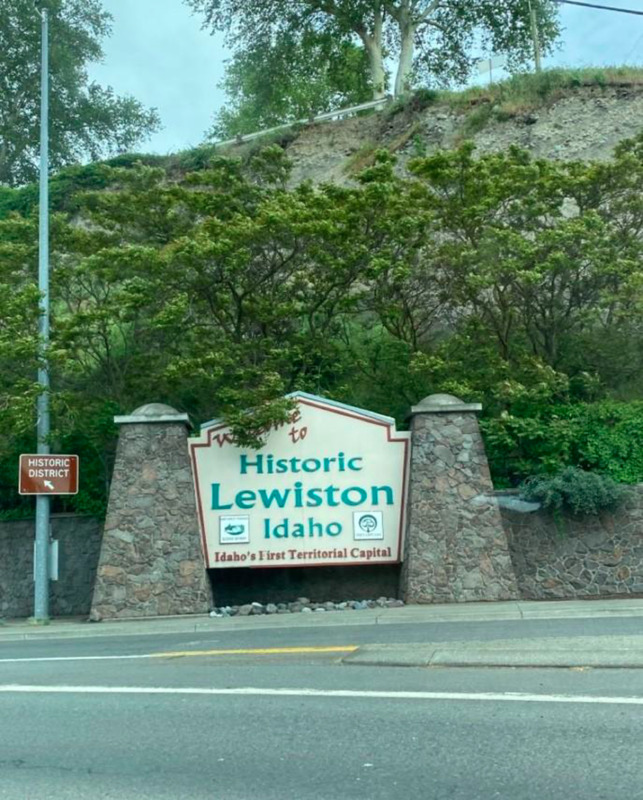
In the end, moving the capitol from Lewiston to southern Idaho left its residents with a sense of lost pride. This sparked a cultural divide between northern and southern Idaho that continues to this day. To this day, downtown Lewiston hosts a sign proclaiming the city “Idaho's First Territorial Capital,” demonstrating that the residents remember their city’s history and will not let people forget Idaho’s original territorial capital.</p><p><em><strong><a href="https://www.intermountainhistories.org/items/show/628">For more (including 3 images) view the original article</a></strong></em></p>]]></summary>
    <published>2022-06-30T20:51:21+00:00</published>
    <updated>2026-04-17T19:32:13+00:00</updated>
    <link rel="alternate" type="text/html" href="https://www.intermountainhistories.org/items/show/628"/>
    <id>https://www.intermountainhistories.org/items/show/628</id>
    <author>
      <name>Dawson Packwood, College of Idaho</name>
    </author>
  </entry>
  <entry>
    <title type="html"><![CDATA[“A Path Forward”: Celebrating Women&#039;s Suffrage in Utah]]></title>
    <summary type="html"><![CDATA[<p><strong><em>“A Path Forward” was built in 2020 in Salt Lake City, Utah, to celebrate 150 years since women first voted in Utah, and 100 years since the 19th Amendment gave women throughout the United States the right to vote. The memorial, located near the Utah State Capitol, highlights women’s suffrage leaders and movements for women’s rights in Utah, in the United States, and for women of color. </em></strong></p><img src="https://www.intermountainhistories.org/files/fullsize/1854c046bfba836fd7f45e298b4376f2.jpg" alt="Archways" /><br/><p>On February 14, 1870, Seraph Young voted in Utah two days after Utah’s territorial legislature granted women the right to vote. She was, in the words of <i>Better Days 2020</i>, the "first woman to vote under a women’s equal suffrage law" in the United States. Six months later, women in Utah had the opportunity to vote in the general election that took place. The hope for equality for women in Utah and the United States was on the horizon.
However, seventeen years later, the United States federal government revoked the voting rights of Utah women as part of the anti-polygamy Edmunds–Tucker Act of 1878, which disfranchised all women in Utah, including whether or not they Latter-day Saints. However, Utah’s women continued to campaign for their voting rights. In 1894, just four years after the practice of polygamy officially ended in the Church of Jesus Christ of Latter-Day Saints, the United States passed the Enabling Act, which invited Utah to apply for statehood. Utah became a state in 1896, and the constitutional convention included Article Four in the state constitution, which granted women the right to vote and hold office. Twenty-four years later, in 1920, Congress finally granted women across the United States the right to vote with the ratification of the 19th Amendment.
The fight for women’s rights in America did not end here. Other acts were passed through the years that protected and enforced voting rights for women of color. For example, the Voting Rights Act of 1965 secured African Americans’ right to.
The memorial “A Path Forward” takes visitors through a timeline of these milestones of women’s suffrage in Utah and the United States. Tourists first follow footsteps engraved on the ground of the monument honoring Seraph Young as the first woman to vote in a United States election. Next to the footsteps is a sculpted table displaying the Enabling Act. Article 4 of the Utah Constitution is etched on the ground next to the table. A series of arches, each one progressively wider than the previous, represents the expansion of women’s suffrage rights. The first arch includes quotes from suffragists who played a significant role in the women’s suffrage movement including Sojourner Truth, Emmeline B. Wells, Martha Hughes Cannon, Susan B. Anthony, and many more. Emmeline B. Wells wrote in her journal, “I desire to do all in my power to help elevate the condition of my own people, especially women.” The “A Path Forward” monument honors courageous suffragists who, like Wells, fought for women’s right to vote. Today, we have the opportunity to honor them and their valiant efforts.</p><p><em><strong><a href="https://www.intermountainhistories.org/items/show/561">For more (including 3 images) view the original article</a></strong></em></p>]]></summary>
    <published>2021-12-18T06:45:38+00:00</published>
    <updated>2026-04-17T19:32:12+00:00</updated>
    <link rel="alternate" type="text/html" href="https://www.intermountainhistories.org/items/show/561"/>
    <id>https://www.intermountainhistories.org/items/show/561</id>
    <author>
      <name>Kate Hill, Brigham Young University</name>
    </author>
  </entry>
  <entry>
    <title type="html"><![CDATA[Castle Gate Mine Disaster]]></title>
    <summary type="html"><![CDATA[<p><strong><em>The Castle Gate Mine Disaster was a horrific tragedy that took the lives of 171 men. Considered the second-worst mining disaster in Utah’s history, the disaster is well remembered not only for the death toll but also for the push for safety reform in its aftermath.</em></strong></p><img src="https://www.intermountainhistories.org/files/fullsize/3addcc19e4ca5cf2966b852500df227f.jpg" alt="Mass funeral" /><br/><p>On March 8, 1924, in Castle Gate, Utah, two explosions rocked the local coal mine, killing all 171 men working at the time. Both explosions happened when men ignited carbon monoxide while trying to relight their lamps. First, a boss investigating some methane gas near the roof of a mineshaft. When his lamp went out, he tried to relight it, but his match ignited the gas, which in turn ignited coal dust, setting off a huge explosion. Those who survived this first explosion found themselves plunged into darkness, as the blast blew out their lamps. When these survivors attempted relighting their lamps, they set off another explosion.
Rescue workers faced severe challenges when they entered the mine to look for any possible survivors. The passageway was covered with debris and badly damaged. It made the passageway incredibly difficult to traverse and slowed them down. The mine was also filled with gas, which made it deadly for the rescue workers. One rescuer died when another knocked off his oxygen clip; within a few minutes, he breathed in too much gas and perished. When the workers found the bodies, many were badly burned and mutilated. Because of huge number of deaths, bodies were buried soon after identification.
Most of the men were married with children, leaving behind many widows and children without fathers. In the days after the disaster, the Red Cross along with women from other parts of came to offer aid to the families. They cooked meals, tended to children, and even sewed mourning clothes for the community. The families of the miners were devastated; in addition to losing a husband and father, they also lost their primary financial provider. Although the families did receive compensation, many left Castle Gate to go live with relatives. Those who stayed received aid from a Red Cross committee that provided food, clothes, and anything else the families might need. The relief committee continued to distribute aid until 1936, ultimately dispersing $132,145 worth of relief.
The mine eventually reopened with increased safety measures. The Utah Fuel Company, which owned the mine, met with the state government to review safety laws and create new amendments and resolutions to make the mines safer. This included more funding for mine inspectors, mandates about clearing dust created from rock mining, prohibiting moving methane gas while men were working in the mine, and requiring coal dust be cleaned from abandoned rooms. Though these new procedures did not completely stop other disasters, they did greatly improve the safety of the mines.</p><p><em><strong><a href="https://www.intermountainhistories.org/items/show/538">For more (including 3 images) view the original article</a></strong></em></p>]]></summary>
    <published>2021-11-13T22:04:12+00:00</published>
    <updated>2026-04-17T19:32:11+00:00</updated>
    <link rel="alternate" type="text/html" href="https://www.intermountainhistories.org/items/show/538"/>
    <id>https://www.intermountainhistories.org/items/show/538</id>
    <author>
      <name>Megan Wagner, Northern Arizona University</name>
    </author>
  </entry>
  <entry>
    <title type="html"><![CDATA[Wyoming State Capitol in Cheyenne]]></title>
    <summary type="html"><![CDATA[<p><strong><em>The Wyoming State Capitol building is the seat of the Wyoming State Legislature and the Governor’s Office. This modest and comparatively inexpensive Capitol of the smallest U.S. state by population is a working government building and symbol of Wyoming and its past.</em></strong></p><img src="https://www.intermountainhistories.org/files/fullsize/8ecc0a262ac751f87a33d08199fb94e9.jpg" alt="Wyoming Capitol" /><br/><p>The land that became Wyoming was originally the territory of Native peoples. Wyoming’s modern Native tribes include the Ute, Arapaho, Cheyenne, Shoshone, and Crow. The California Trail, Oregon Trail, and Mormon Trail all passed through Wyoming and brought droves of white settlers through the area on their way to the West Coast and Utah the mid-nineteenth century, though few took up residence in the Wyoming area itself. The U.S. Government negotiated the Treaty of Fort Laramie in an effort to protect settlers moving through the area by compensating tribes and building forts. The U.S. Government soon reneged on these treaty obligations and on those of a second Fort Laramie Treaty, causing an escalating cycle of violence. The U.S. Government eventually forced the remaining Native peoples of Wyoming into the reservation system.
Cheyenne began as a stop along the Union Pacific Railroad line in 1867 and quickly surpassed other population centers to become the Territorial Capitol and then State Capitol, as well as Wyoming’s largest city. Ranching, mining, and agriculture continued to draw a trickle of settlers, but the harsh environment, scarce arable land, and temperature extremes restricted the population. Wyoming became its own territory on July 25, 1868 under Andrew Johnson’s presidency and inaugurated its first government May 19, 1869. It achieved statehood July 10, 1890 despite disputes over whether it had achieved the minimum population threshold at that time. In 1886, the Territorial Legislature created a Capitol Commission to organize construction of a capitol building. It chose David W. Gibbs & Co. to design the Capitol and Adam Feick & Bros. to construct it at a bid of only $150,000, worth a little over $4,000,000 in 2020. The Territorial Legislature used the building even before its completion in 1890. By 1915, the State Legislature had outgrown the building and voted to add the House and Senate chambers to the structure, which were completed in 1917.
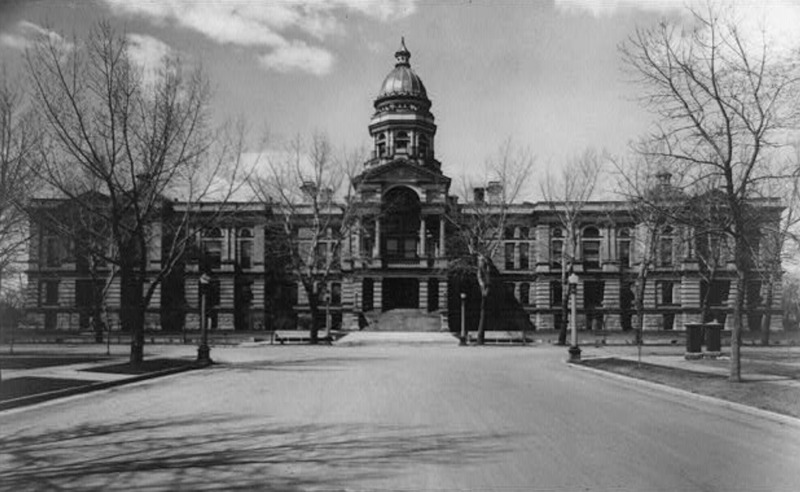
The Capitol is a Renaissance Revival structure made of both native and Colorado sandstone with a copper dome, which was later gilded in 1900. The interior is finished in marble with a beautiful cherrywood staircase with murals decorating many of the walls. An enormous stuffed bison stands in part of the rotunda, and a bronze bison sculpture stands outside. The bison was a critical part of the diet and culture of the Native people of Wyoming and the intentional near extinction of the animal by white hunters was a severe blow to them. Now, the bison is a symbol of the state and adorns its flag.
In 2016 the Capitol underwent a major renovation which restored decorative elements, added more accessibility with additional elevators and restrooms, and upgraded technology resources. These improvements, completed in 2019, will ensure that the State Capitol building can continue to function as the working seat of government for the people of Wyoming for many years to come.</p><p><em><strong><a href="https://www.intermountainhistories.org/items/show/509">For more (including 4 images) view the original article</a></strong></em></p>]]></summary>
    <published>2021-10-10T09:05:30+00:00</published>
    <updated>2026-04-17T19:32:10+00:00</updated>
    <link rel="alternate" type="text/html" href="https://www.intermountainhistories.org/items/show/509"/>
    <id>https://www.intermountainhistories.org/items/show/509</id>
    <author>
      <name>David Cady, Northern Arizona University</name>
    </author>
  </entry>
  <entry>
    <title type="html"><![CDATA[Utah State Capitol in Salt Lake City]]></title>
    <summary type="html"><![CDATA[<p><strong><em>The Utah State Capitol building in Salt Lake City stands as a symbol of Utah and its state and territorial history. Today it houses the two legislative chambers of the state government.</em></strong></p><img src="https://www.intermountainhistories.org/files/fullsize/39d0ca498073db59fd125d1d3e75efa1.jpg" alt="Utah State Capitol" /><br/><p>The land that became Utah was originally the territory of Native peoples. Its modern Native tribes include the Utes, Northern Shoshone, Western Shoshone (Goshute), Navajo, and Southern Paiutes. On July 21, 1847, two advance scouts of the first of many members of The Church of Jesus Christ of Latter-day Saints (often nicknamed “Mormons” in that time) arrived in the Salt Lake Valley. The last members of this first company of settlers, including Church president Brigham Young, entered the valley on July 24, which later was commemorated as the official date of arrival. The Latter-day Saints had migrated to Salt Lake Valley in search of independent self-governance and escape from the conflict and persecution they faced in places like Illinois and Missouri. This influx of Mormon migrants to the area set off a complex period of interaction with its Native inhabitants which was at times peaceful and at others violent. Over time, white settlers dispossessed Native people of their land, ending with the forced relocation of Utah’s Native people to reservations. The area and its landmarks were renamed and reimagined from a Mormon perspective.
The Latter-day Saints’ strong social and religious bonds helped the community based around Salt Lake survive and grow, but they also became an obstacle to statehood. Utah’s settlers applied for statehood in 1849, but although Utah was organized as a territory in 1850 by an act of Congress, the federal government was wary of adding the Latter-day Saints’ unique community to the national body politic as a full-fledged state. Territorial Utah applied for statehood again in 1856, 1862, 1876, 1882, and 1887, with its application rejected each time. Much criticism focused on the Church’s then-current practice of polygamy. After a complex process of policy and cultural shifts in the Church over the course of decades, it renounced polygamy in 1890. Six years later, after decades of applying for statehood, Utah was finally admitted on January 4, 1896.
The territorial and state governments of Utah used several different buildings before the creation of the Capitol. The current site, an area known as Arsenal Hill owing to its prior use as a munitions dump, was donated from the City of Salt Lake to the State of Utah in 1888. An initial Capitol Commission scrapped a design by notable state capitol designer Elijah E. Myers in 1891 because it was cost prohibitive. Funding for the project proved elusive until, in 1911 the Utah resident widow of railroad magnate Edward Henry Harriman paid $798,546 in inheritance tax to the state upon his death and the Legislature passed a $1,000,000 bond. Construction started the following year.
Richard Kletting won the design contest but had to compromise on its execution to see it opened by 1916. The building operated as seat of government for decades with incremental upgrades and maintenance but was found to be dangerously susceptible to earthquakes. From 2004 to 2008, the Capitol underwent a massive restoration project which strengthened it against earthquakes, restored artwork and public spaces, and included newly commissioned artwork to more closely match Kletting’s original, grander vision for the building. After the costs of renovation, it is the most expensive capitol complex in America. In keeping with the tradition of its community, Utah’s capitol began with a vision which took many years of hard work and setbacks to fully realize.
The grounds of the Capitol house a large collection of statuary and monuments honoring early pioneers, veterans of the Civil War and Vietnam War, Martin Luther King Jr, the Mormon Battalion, and others. The fourth floor of the Capitol building is now home to a gallery of rotating exhibits dedicated to the history of Utah.</p><p><em><strong><a href="https://www.intermountainhistories.org/items/show/508">For more (including 4 images) view the original article</a></strong></em></p>]]></summary>
    <published>2021-10-10T08:12:14+00:00</published>
    <updated>2026-04-17T19:32:10+00:00</updated>
    <link rel="alternate" type="text/html" href="https://www.intermountainhistories.org/items/show/508"/>
    <id>https://www.intermountainhistories.org/items/show/508</id>
    <author>
      <name>David Cady, Northern Arizona University</name>
    </author>
  </entry>
  <entry>
    <title type="html"><![CDATA[Idaho State Capitol in Boise]]></title>
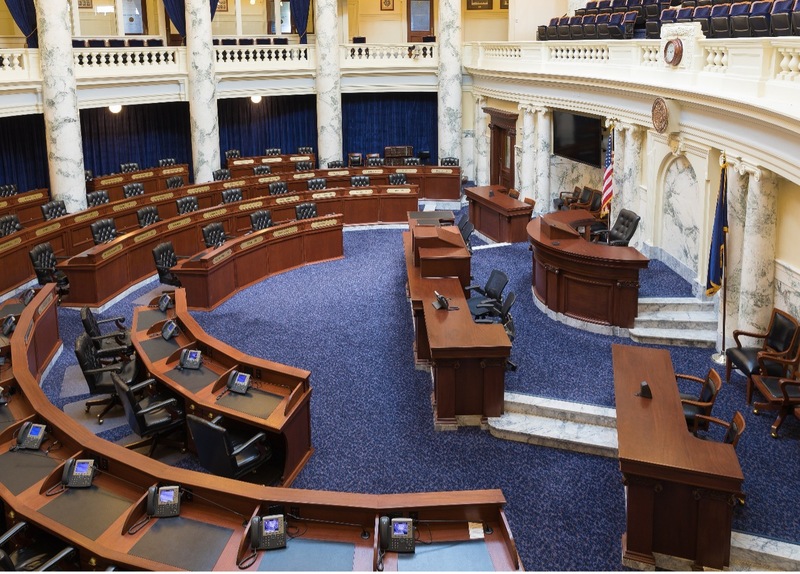
    <summary type="html"><![CDATA[<p><strong><em>The Capitol building in downtown Boise houses the bicameral Legislature of the State of Idaho as well as several offices of the executive branch. It is an impressive building which speaks to the history of the state.</em></strong></p><img src="https://www.intermountainhistories.org/files/fullsize/f06979ab23734dfbc6f456e70ce3331c.jpg" alt="Chamber of the Idaho House of Representatives" /><br/><p>The land that would become Idaho was originally Native land. Today these Native tribes include the Coeur dAlene, Kootenai, Shoshone-Bannock, and Nez Perce. White settlers had been passing through along the Oregon trail earlier in the nineteenth century but became more established in the wake of gold rushes starting in 1860. Many more white immigrants arrived to farm in the 1890s and, along with the U.S. government, forced Native peoples onto reservations.
Idaho was formed largely by agricultural boosterism. White settlers who had envisioned a farming paradise were soon confronted by the difficulty of the land and the unpredictable Snake River. Many persevered, however, and helped Idaho grow. Boosterism even gave the state its name. The name is often taken as a Native word meaning “gem of the mountain” or similar, but it actually traces back to a white man named George Willing, who suggested it as a name of what became Colorado territory. Although the name was pulled as a candidate for Colorado after the truth was discovered, it remained popular and was applied to the Idaho Territory by territorial officials when Congress separated it from Washington Territory. It was established as a territory by Abraham Lincoln on March 4, 1863 with Boise decided as its capitol the following year. Benjamin Harrison signed Idaho into statehood on July 3rd, 1890, though it took fifteen years for the old Territorial Capitol building to be replaced by the new State Capitol building.
Construction of the Capitol took place in two distinct phases. Builders constructed the central dome and north wing from 1905–1912, after which it began to operate as the seat of government. In 1919, the legislature secured additional funds to build the east and west wings, completing them the next year. The Legislature tapped J.E. Tourtellotte and Charles Hummel to design the initial structure and chose native sandstone for the building’s superstructure. The state used convict labor to transport the blocks from a nearby quarry but employed craftsmen to finish the fine multicolored foreign marble of the building’s interior. Since its completion, the Capitol has been updated for comfort, safety, and technology to preserve it as a working seat of government.
While facing the front of the Capitol from beyond Jefferson Sreet, visitors can see a statue of Abraham Lincoln; behind that a memorial for Governor Frank Steunenberg, who was assassinated in 1905; and behind that a replica of the Liberty Bell, donated by the U.S. Treasury department in 1950. A Pioneer Monument to the east of the entrance honors the travelers of the Oregon Trail, and to the west stands an 1840 Confederate seacoast gun and the Grand Army of the Republic Monument dedicated to soldiers of the Union Army. A relic from the old Idaho Territorial Capitol stands on the fourth floor: a gilded pinewood statue of George Washington carved in 1869 by Charles L. Ostner. These objects and the building itself stand as a reminder of Idaho’s place in U.S. history.</p><p><em><strong><a href="https://www.intermountainhistories.org/items/show/507">For more (including 3 images) view the original article</a></strong></em></p>]]></summary>
    <published>2021-10-09T22:39:59+00:00</published>
    <updated>2026-04-17T19:32:10+00:00</updated>
    <link rel="alternate" type="text/html" href="https://www.intermountainhistories.org/items/show/507"/>
    <id>https://www.intermountainhistories.org/items/show/507</id>
    <author>
      <name>David Cady, Northern Arizona University</name>
    </author>
  </entry>
  <entry>
    <title type="html"><![CDATA[Montana State Capitol in Helena]]></title>
    <summary type="html"><![CDATA[<p><strong><em>The Montana State Capitol in Helena houses the State Legislature. Its intriguing history and grand design speak to the spirit of Montana.</em></strong></p><img src="https://www.intermountainhistories.org/files/fullsize/1f9fdd07bd4e9b5e8edbf7bbbe16aab5.jpg" alt="Montana Capitol" /><br/><p>The land that became Montana was originally the territory of Native peoples. Its current Native tribes include the Blackfeet, Assiniboine, Cheyenne, Crow, Shoshoni, Sioux, Gros Ventre, Salish, and Kootenai. A limited number of white settlers and missionaries had been in the area in the early nineteenth century, but it was not organized into a territory until May 28, 1864, during the Civil War. As with many western states, a gold rush brought the first significant wave of white settlers. White immigration and encroachment led to escalating violence and the invasion of the United States Army. The period of conflict after the Civil War, notably including the Battle of Little Bighorn, resulted in the forced removal of Native peoples onto reservation land.
Mining, fur, ranching, timber, and agriculture continued to draw white settlers to the territory and on November 8, 1889 Montana was admitted to the Union as the forty-first state. Helena became the Territorial Capitol after the Legislature moved it from Virginia City in 1875, but it was not officially ratified as the site by election until 1894. The following year, a Capitol Commission was authorized by the State Legislature and a design by George R. Mann was approved with construction beginning in 1896. The Capitol follows a neoclassical design and is made of sandstone and granite with a copper dome topped by a Columbia figure. State Representative Fred Whiteside exposed a plot by Commission members to use cheap materials and embezzle leftover funds from the project, after which the Commission disbanded and a second one was convened. The second commission chose Charles Bell and John Kent to complete the capitol, and the cornerstone was laid July 4, 1899.
The construction of the Capitol happened in two phases with the main section completed in 1902 and the wings constructed in 1911-1912. An outside firm known as F. Pedretti’s Sons decorated and furnished the 1902 section, but when the wings were built the state commissioned Montana artists to adorn them. One of these Montana artists, Charles M. Russell, created the 12-feet by 25-feet painting titled “Lewis and Clark Meeting the Flathead Indians at Ross’ Hole” which hangs in the chamber of the House of Representatives. Within the rotunda there are four portraits representing early Montana: a prospector, a trapper, and Native chief, and a cowboy. Various busts and statues of important <span>Montanans</span> fill the landings of the grand staircase, and murals adorn the walls of the main hall, notably one donated by the Northern Pacific Railroad to commemorate the completion of a portion of the transcontinental railroad in Gold Creek on September 8, 1883. In front of the Capitol steps stands a bronze statue of Thomas Francis Meagher, a Union general in the Civil War and a representative of the many Irish immigrants who settled in Montana. Earthquakes damaged the capitol in 1935, but Works Progress Administration workers restored or replaced the damaged elements. Updates and upkeep continue at Montana’s State Capitol, securing its place as a modern seat of government and a monument to its past.</p><p><em><strong><a href="https://www.intermountainhistories.org/items/show/506">For more (including 3 images) view the original article</a></strong></em></p>]]></summary>
    <published>2021-10-09T21:43:47+00:00</published>
    <updated>2026-04-17T19:32:10+00:00</updated>
    <link rel="alternate" type="text/html" href="https://www.intermountainhistories.org/items/show/506"/>
    <id>https://www.intermountainhistories.org/items/show/506</id>
    <author>
      <name>David Cady, Northern Arizona University</name>
    </author>
  </entry>
  <entry>
    <title type="html"><![CDATA[Colorado State Capitol in Denver]]></title>
    <summary type="html"><![CDATA[<p><strong><em>This unique building houses the Legislature and Governor of the Colorado State Government. Its architecture and construction reflect some of the history of early Colorado.</em></strong></p><img src="https://www.intermountainhistories.org/files/fullsize/e15b14846b6b51a30dc05f0aa7650b0d.jpg" alt="Colorado State Capitol Building" /><br/><p>The land that would become modern Colorado was acquired by the United States in two parts. Its eastern half was part of the Louisiana Purchase, and the west was ceded by Mexico at the end of the Mexican–American War. Native tribes, including the Ute, Arapaho, Jicarilla Apache, Comanche, and Navaho, had long called the area home, but encroachment and attacks by European Americans changed demographics in the mid-nineteenth century, displacing and dispossessing the original inhabitants. Prospectors discovered gold veins near present day Denver and Boulder in 1858 and founded Denver the following year. White miners, merchants, and families moved into what was then part of the Territory of Kansas to seek their fortune. Locals seeking political independence organized the Jefferson Territory, which was then established as the Colorado Territory by the U.S. Congress in 1861.
The 1886 projected cost of construction was $1,000,000, equivalent to $26,400,000 in 2020, but by the time of its completion, it had cost $3,700,000, equivalent to $97,400,000 in 2020. The Board of Capitol Managers fired the original designer, E.E. Myers, after successive cost overruns, and the capitol was completed under Frank Edbrooke in 1901. Myer’s original commission was to be based on a percentage of the total cost of construction, so there had been an incentive to spare no expense.
In 1876, Colorado’s founders christened it the “Centennial State” and used this association with the nation’s centennial for promotion. Builders laying the cornerstone of the Capitol in 1890 on July 4<sup>th</sup> furthered the association with America’s founding. The Colorado State Capitol is intentionally modeled after the Capitol building in Washington, D.C. as a neoclassical “Greek Cross.” The structure extensively uses several types of native Colorado marble, some of which can only be found in the state. These include the ultra-dense Yule marble and beautiful Rose Onyx, which is technically a type of metamorphosed limestone containing iron oxide. The interior contains murals, stained glass, and statuary. The exterior houses various monuments, cannon, and “mile high” markers for the approximate elevation.
The gold rush that prompted settlement in Colorado made it seem like anyone could become rich. Even though the rush’s profits never exceeded the total investment and only a relative few made their fortune, this vision of accessible wealth drove the early development of Colorado. A notable reflection of this history in the actual architecture of the Capitol is the beautiful golden dome which crowns it. In 1908, miners donated 200 ounces of gold to gild it in commemoration of the 1858 gold rush. The original copper dome that could be afforded in the original construction had been deemed by Coloradans to be insufficiently grand. Since then, the Capitol has been upgraded several times for safety, technology, and comfort.
With the gold rush long over, the Colorado State Capitol building in Denver is now the administrative center of a state which has outgrown its goldmining past to become dynamic and economically diverse. It is a building which speaks to the time of its creation as well as the present.</p><p><em><strong><a href="https://www.intermountainhistories.org/items/show/505">For more (including 4 images) view the original article</a></strong></em></p>]]></summary>
    <published>2021-10-09T04:10:41+00:00</published>
    <updated>2026-04-17T19:32:10+00:00</updated>
    <link rel="alternate" type="text/html" href="https://www.intermountainhistories.org/items/show/505"/>
    <id>https://www.intermountainhistories.org/items/show/505</id>
    <author>
      <name>David Cady, Northern Arizona University</name>
    </author>
  </entry>
  <entry>
    <title type="html"><![CDATA[Geraldine Lucas, Female Homesteader<br />
]]></title>
    <summary type="html"><![CDATA[<p><strong><em>“They’ll never get me off my land,” vowed Geraldine Lucas. Drawn to Jackson Hole as a beautiful location to retire and by the presence of several siblings, Geraldine became a legendary character of the locale both for her eccentricity and her refusal to sell her land to the National Parks Association. </p></strong></p><img src="https://www.intermountainhistories.org/files/fullsize/59bed290014649aa28d35288cc8edfc5.jpg" alt="Geraldine with other locals during winter
" /><br/><p>Geraldine Lucas was not one to simply comply with traditional norms. At 21, she left a brief but rocky marriage, bringing her son, Russell with her. She then chose to attend school at Oberlin College, becoming both a “returning student” and “single parent” before either term was common. Both Geraldine and Russell had strong personalities, and they clashed over Russell’s educational future spurring him to run away to the Navy. When he returned, they made up, and Geraldine successfully convinced him to join the Coast Guard.</p><p>After she retired in 1913 from teaching public school in New York, Geraldine joined several of her siblings in Jackson Hole, Wyoming where she filed for a 160-acre homestead. Geraldine chose her property as much for the grandeur of the Tetons as for its agricultural potential. She cultivated what was required by law to obtain the property, but then abandoned those efforts and grew only what she needed.</p><p>Geraldine built a cabin and made other improvements, including a second cabin, log storeroom, granary, rabbit hatch, fencing, and over two miles of ditches, all valued at over $7,000. In 1914, she also applied for a timber and stone claim along Phelps Lake, intending to enlarge her landholdings. Geraldine was at odds early on with the federal government due to various errors and complexities associated with her claim. In 1918, when she planned to prove up (colloquial phrase for the legal process of securing title to homestead lands after meeting certain government requirements) on the land, there were complications with the new land office survey and records of intention to file. Geraldine was finally issued her certificate nine years after initiating the process. Then in 1922, Geraldine filed for a desert land entry, but encountered more difficulties with the land office and, ultimately, had to revise the claim from 100 to 70 acres. These frustrations and delays antagonized her against government interference and regulation. Like many Westerners, Geraldine “believed the agency loved technicalities that bordered on harassment.”</p><p>Around 1918, Geraldine persuaded Naomi Colwell to take up an adjacent homestead. At the final proof, Geraldine witnessed that Naomi had no intention to sell her land, a legal requirement, but a short two months later bought 80 acres from her for $500. There were few qualms on the frontier about evading laws or restrictions in the pursuit of additional property. </p><p>In many ways “a loner, ”Geraldine garnered a reputation in Jackson Hole as a man hater. This was reinforced by her efforts to undermine an emerging relationship between Naomi and Russell, as well as run off other potential suitors of the young woman. </p><p>Geraldine spent her summers visiting various family members for weeks at a time, but, come fall and winter, she returned alone to her homestead until spring. She would gather the necessary groceries and wood supply then settle into her books and sewing. A talented seamstress, according to her nephew, she “would sew until hell wouldn’t have it.” Geraldine only ever wore knickers, so it is a mystery what or whom she sewed for. Her personal library consisted of over 1,350 carefully cataloged and numbered books. She also owned a piano, and her home was decorated with gifts from Russell's travels, including a walrus skull and tusks, Kodiak bear head, Eskimo pipe, and reindeer antlers. He also sent a sled and dog team to serve as transport during winter months.</p><p>A mountain climbing craze hit in the 1920s, and Geraldine suddenly had more on her mind than land. In August 1924, age 58, she joined Paul Petzoldt on his climb and became the second woman to summit the crest of the Grand. Instead of warrant accolades, her actions only tended to convince family and neighbors of her eccentricity. As they reached the summit, Petzoldt pushed Geraldine ahead of him so she would be the first on top. He said of her, “I don’t think she often broke through her protected personality, but in that moment when she threw her arms around me with a soft sob, I sensed the real Geraldine Lucas, an intelligent, loving woman who had elected for some reason to leave most of society behind.” Blunt, opinionated, and perhaps unconventional, Geraldine was certainly a character of Jackson Hole. She “simply lived life on her own terms... Yet, much of what set her apart as ‘eccentric’ in her own day, has become commonplace for today’s western women.”</p><p>In the late 1920s, John D. Rockefeller and allies formed a front organization, the Snake River Land Company, to buy property that could be added to the Grand Teton National Park. Many affected by the Great Depression were ready and willing to sell for the fair market prices being offered, but Geraldine was not one of these. Harold Fabian, tasked with buying parcels of land, said of her, “She came out from the east and homesteaded under the Tetons because she wanted to spend the rest of her life within sight of these mountains. She is a lover of beauty and nature.” When offered $50,000 for her homestead, Geraldine responded, “You stack up those silver dollars as high as the Grand Teton and I might talk to you!” She did not share the vision for a national park and had “no use for those who wanted to transform her private playground into a public one.”</p><p>Even amidst the tension of the park property disputes, Geraldine had very pleasant final years on her beloved homestead. She considered making a gift of her land to Oberlin College, but died of heart failure without a will and before any plans were official, so the homestead and property went to Russell. He sold it to a neighbor who sold to Rockefeller who in turn gave it to Jackson Hole Preserve. While Russell never shared his mother’s love for her homestead, he did appreciate it. He placed her cremated remains under a large boulder on her property with a plaque bearing her name and commemorating her memory.</p><p><em><strong><a href="https://www.intermountainhistories.org/items/show/456">For more (including 11 images) view the original article</a></strong></em></p>]]></summary>
    <published>2021-02-06T09:19:15+00:00</published>
    <updated>2026-04-17T19:32:09+00:00</updated>
    <link rel="alternate" type="text/html" href="https://www.intermountainhistories.org/items/show/456"/>
    <id>https://www.intermountainhistories.org/items/show/456</id>
    <author>
      <name>Anna Bailey, Brigham Young University</name>
    </author>
  </entry>
  <entry>
    <title type="html"><![CDATA[Katherine Garetson, Female Homesteader<br />
]]></title>
    <summary type="html"><![CDATA[<p><strong><em>Midsummer 1914, Katherine Garetson stood on the front porch of her sister’s mountain cabin and felt herself “whipped and tossed and spattered by a violent storm of wind, rain, thunder, and lightning.” Instead of hating the experience, she wished that “everyone could put into his life one storm of the high mountains.” Katherine saw homesteading as an opportunity for adventure as well as property ownership. </p></strong></p><img src="https://www.intermountainhistories.org/files/fullsize/db41df44e2eae29d90afc2b68b337941.jpg" alt="Map of Estes Park
" /><br/><p>During that 1914 midsummer storm, Katherine offered shelter to a man who had recently established his own homestead in the area, and he related its virtues to her. Katherine wrote that “every American with a spark of romance in his make-up has at some time of his life cherished this idea of taking up a claim.” Her visitor’s words, however, “fell on particularly fertile ground because [she] was seeking escape from the return to St. Louis.” So, in 1914, Katherine Garetson, a single woman in her late thirties from St. Louis, Missouri, filed for a 160-acre claim in Tahosa Valley, Colorado just south of Rocky Mountain National Park.</p><p>Katherine called filing a three-year residence claim “the most serious thing you can do, aside from marrying.” As she considered the possibility, she said “The more I thought, the more I feared. At last I deliberately took the leap as one who shuts his eyes and jumps.” </p><p>Katherine’s cabin on the property was completed just before winter set in. It was given the name Big Owl, a tribute to the great horned owl living nearby. She moved in with two companions, Annie Adele (A.A.) Shreve and Gypsy, a Great Dane. Even with their company, she often felt “desolately lonely and homesick.” With so much to learn and do, Katherine, overwhelmed, “now and then… nearly lost [her] nerve.” Looking back, Katherine commented, “It seems to me that I had an unbearable amount of ignorance to fight against that first year.” </p><p>Fortunately, there were friends who offered kindness and support. With the first big snow, Alfred Oberg “rushed down in the morning… fearing that [they] would not know how to prepare for the storm.” He taught the women tricks to prepare for and survive the long, cold winters. The excitement of Saturday mail was a boost, but also “interfered with a settled content,” reawakening interest in a life from which they “were hopelessly cut off.” </p><p>Katherine endured incredible hardship, poverty, and loneliness, especially after A.A. took a teaching position in Wyoming and Gypsy, who she struggled to feed, had to be given away. The tearoom Katherine operated was only marginally successful. The first summer ended with bills pouring in and Katherine uncertain how she could survive the coming winter. A brief visit with family revitalized her determination and provided her with a wealthy benefactor willing to “take a long chance on a good land proposition.” He gave her a thousand dollars to pay her debts and get restarted.</p><p>Katherine continued her improvements and endured another winter before reporting to the land office in Denver in December 1917 to “prove up” her claim (colloquial phrase for the legal process of securing title to homestead lands after meeting certain government requirements). “Free of all obligations to the government,” she boarded a train for St. Louis. In March, a large envelope arrived from the land office. Instead of containing her patent, it informed her that the Forest Service contested her fulfillment of cultivation requirements. Disregarding the advice of friends and family, she returned, with A.A. to the claim and planted another crop. The next envelope was good news, delivering her patent, the reward of all her labors.</p><p>While Katherine had originally hoped her land “would become valuable as summer cottage sites,” by the end of her proving time, she “was in no hurry to go someplace else to live.” She loved her home, her land, and “the whole mountain world.” She stayed as long as possible, but World War I and the influenza epidemic forced her, financially, to move out to Denver. There, she relied on her stenography and typewriting skills to work for a state senator and later the Secretary of State. She vacationed at Big Owl, “the best loved spot on earth” for years to come, but never lived there again.</p><p><em><strong><a href="https://www.intermountainhistories.org/items/show/454">For more (including 8 images) view the original article</a></strong></em></p>]]></summary>
    <published>2021-02-06T08:37:02+00:00</published>
    <updated>2026-04-17T19:32:09+00:00</updated>
    <link rel="alternate" type="text/html" href="https://www.intermountainhistories.org/items/show/454"/>
    <id>https://www.intermountainhistories.org/items/show/454</id>
    <author>
      <name>Anna Bailey, Brigham Young University</name>
    </author>
  </entry>
  <entry>
    <title type="html"><![CDATA[Elizabeth P. Ensley: Suffragette and African American Women’s Club Leader<br />
]]></title>
    <summary type="html"><![CDATA[<p><strong><em>An active leader in African American women’s clubs and the women’s suffrage movement in Colorado, Elizabeth Piper Ensley worked to improve the rights of women and African Americans.</p></strong></p><img src="https://www.intermountainhistories.org/files/fullsize/e66a347e1047100dbbab4985d3bfcf57.jpg" alt="Banner with the National Association of Colored Women’s Clubs’ Motto
" /><br/><p>Elizabeth Piper Ensley came to Colorado in the 1890s. Born in Massachusetts in 1847, she studied abroad in Europe, taught school in Boston, and established a circulating library. In the 1880s, she and her husband, Howell N. Ensley, moved to Washington, D.C. and taught at Howard University, one of the top African American universities in the country. In the 1890s, the Ensleys moved to Denver, which had the largest African American population in the state. Elizabeth immediately became involved in activism, social work, the women’s suffrage movement, and local women’s clubs.</p><p>Elizabeth P. Ensley was one of the key members of the Non-Partisan Equal Suffrage Association of Colorado. She was one of the twenty-eight original members when the association was created in 1893 in the face of the campaign for the popular referendum. Ensley was elected treasurer of the Association, which had only $25.00 at its inception. As treasurer, she would have handled and overseen things like fundraising, management of funds, donations from national suffrage organizations, and funding for leaders who spoke around the state such as Carrie Chapman Catt. Under Ensley’s guidance, the Non-Partisan Equal Suffrage Association of Colorado became financially secure and carried out a successful statewide campaign, even in the midst of an economic depression in Colorado. Ensley was also instrumental in mobilizing African American women to join the suffrage campaign and persuading African American men to vote for women’s suffrage. When the popular referendum came in November of 1893, male voters passed women’s suffrage by a margin of six thousand votes, giving both black and white women the right to vote in Colorado.</p><p>Along with her leadership in the campaign for women’s suffrage in Colorado, Elizabeth Ensley was an active leader of African American women’s clubs. In 1894, the first year women could vote in Colorado, Ensley helped found both the Colored Women’s Republican Club and the Woman’s League of Denver, which worked to mobilize African American women to vote. That year, Elizabeth Ensley and the African American women of Denver voted to elect Joseph Henry Stuart to the Colorado Assembly, where he became one of Colorado’s first African American legislators and passed an important civil rights bill. Ensley noted the power of the African American women voters and their clubs in Colorado in an article she wrote entitled “Election Day” in December 1894 for The Woman’s Era, the official publication of the National Association of Colored Women’s Clubs and the first national newspaper written by and for African American women. She wrote, “The readers of the ERA will be interested to know what special part the colored women have taken in the election. Most of them have done admirable work in the interest of the Republican party. They also formed clubs of their own and heroically helped their brothers to elect a representative to the legislature.” Elizabeth Ensley continued to be an active member of women’s clubs in Colorado. In 1904, she called for the African American women’s clubs of the state to organize, and founded the Colorado Association of Colored Women’s Clubs, of which she was later vice president. The association's song, written by Eva Carter Buckner, well encapsulates Elizabeth Ensley’s lifelong mission to fight for the rights of women and African Americans:</p><p>“We’re Colorado’s colored women struggling for a place;</p><p>We’re loyal to our country and we’re loyal to our race;</p><p>We’re holding high the banner, in the dust it must not trail,</p><p>As we go marching on.</p><p>Onward, upward to the summit,</p><p>Onward, upward to the summit,</p><p>Onward, upward to the summit,</p><p>We’re advancing step by step.”</p><p><em><strong><a href="https://www.intermountainhistories.org/items/show/257">For more (including 2 images) view the original article</a></strong></em></p>]]></summary>
    <published>2019-01-18T07:58:47+00:00</published>
    <updated>2026-04-17T19:32:04+00:00</updated>
    <link rel="alternate" type="text/html" href="https://www.intermountainhistories.org/items/show/257"/>
    <id>https://www.intermountainhistories.org/items/show/257</id>
    <author>
      <name>Sarah Rounsville, Brigham Young University</name>
    </author>
  </entry>
  <entry>
    <title type="html"><![CDATA[First to Vote: Women’s Suffrage in Wyoming<br />
]]></title>
    <summary type="html"><![CDATA[<p><strong><em>In 1869, Wyoming’s territorial legislature passed a bill approving women’s suffrage, making the women in Wyoming the first in the United States to have the right to vote. Although debates continue over who should receive the credit, Wyoming’s status as the first territory and state to grant full suffrage for women remains a source of state pride.</p></strong></p><img src="https://www.intermountainhistories.org/files/fullsize/b0dddb555e0c94f563b54b4e12cd2918.jpg" alt="Esther Morris
" /><br/><p>Wyoming was organized as a territory of the United States in 1868. When the first territorial legislature met in the capital of Cheyenne in the late 1869, William H. Bright introduced a bill to give women the right to vote in Wyoming. Passed by both chambers of the territorial legislature, the bill proposed: “That every woman of the age of twenty-one years, residing in this territory, may, at every election to be holden under the laws thereof, cast her vote. And her rights to the elective franchise and to hold office shall be the same under the election laws of the territory, as those of electors.” Approved on December 10, 1869, the bill became a law and women in Wyoming became the first in the country to legally have the full right to vote.</p><p>When women in Wyoming gained the right to vote in 1869, they did so without an official campaign. Unlike most states, Wyoming did not have a suffrage association or organization prior to the passage of women’s suffrage. Still, the people of Wyoming knew about the idea of women’s suffrage. Female circuit lecturers, such as the nationally acclaimed orator Anna Dickinson, came to Wyoming and spoke on women’s rights and suffrage. Newspapers throughout the territory included news and information about the women’s suffrage movement across the country. Even without an organized women’s suffrage movement in Wyoming, supporters of women’s suffrage helped push the territorial legislature to take action.</p><p>It is unsure who was most responsible for the passage of women’s suffrage in Wyoming. Some argue that the legislators like William H. Bright who introduced and passed the bill should be given credit, while others claim that the Wyoming women who supported women’s suffrage had an instrumental role in influencing the legislators. Popular Wyoming history credits Esther Hobart Morris, who became the first woman elected to judicial office in the United States with her appointment as a justice of the peace in 1870, as the “mother of woman suffrage,” but historians debate the extent of her influence. A compromise between these two ideas about who was responsible for the passage of women’s suffrage in Wyoming can be seen in the women’s suffrage commemorative statue in front of the state Capitol Building in Cheyenne, Wyoming. The statue depicts Esther Hobart Morris and the inscription reads: “Esther Hobart Morris: Proponent of the legislative act which in 1869 gave distinction to the territory of Wyoming as the 1st government in the world to grant women equal rights.” Thus, the statue highlights the importance of women like Morris in pushing for women’s suffrage while also acknowledging the role of the territorial legislature both in the inscription and in the placement of the statue in front of the Capitol Building.</p><p>Women’s suffrage is an important part of Wyoming’s history and identity. During the process of applying for statehood, Wyoming women successfully demanded that female enfranchisement be officially included in the state constitution. When the United States Congress threatened to withhold statehood from Wyoming because of that clause in the state constitution, the territorial legislators sent a telegram stating that Wyoming would rather remain out of the Union for one hundred years rather than join without women’s suffrage. When Wyoming did gain statehood in 1890, it became the first state where women had the full right to vote. Wyoming’s support of women’s suffrage led to its nicknames as “The Suffrage State” and “The Equality State.” The state’s history of equal suffrage led Wyoming to send a copy of the Esther Morris statue to Washington, D.C., where it is displayed in the National Statuary Hall at the United States Capital. Even though debates continue over which historical individuals deserve credit, Wyoming’s status as the first territory and state in the United States where women had the right to vote remains a source of state pride.</p><p><em><strong><a href="https://www.intermountainhistories.org/items/show/256">For more (including 3 images) view the original article</a></strong></em></p>]]></summary>
    <published>2019-01-18T07:45:55+00:00</published>
    <updated>2026-04-17T19:32:04+00:00</updated>
    <link rel="alternate" type="text/html" href="https://www.intermountainhistories.org/items/show/256"/>
    <id>https://www.intermountainhistories.org/items/show/256</id>
    <author>
      <name>Sarah Rounsville, Brigham Young University</name>
    </author>
  </entry>
</feed>