<?xml version="1.0" encoding="UTF-8"?>
<feed xmlns="http://www.w3.org/2005/Atom">
  <title type="text">Intermountain Histories</title>
  <updated>2026-04-17T19:32:19+00:00</updated>
  <generator uri="http://framework.zend.com" version="1.12.20">Zend_Feed_Writer</generator>
  <link rel="alternate" type="text/html" href="https://www.intermountainhistories.org/"/>
  <link rel="self" type="application/atom+xml" href="https://www.intermountainhistories.org/items/browse?output=rss2"/>
  <id>https://www.intermountainhistories.org/</id>
  <author>
    <name>Intermountain Histories</name>
    <uri>https://www.intermountainhistories.org</uri>
  </author>
  <link rel="hub" href="https://pubsubhubbub.appspot.com/"/>
  <entry>
    <title type="html"><![CDATA[The Founding of Luccock Park Camp]]></title>
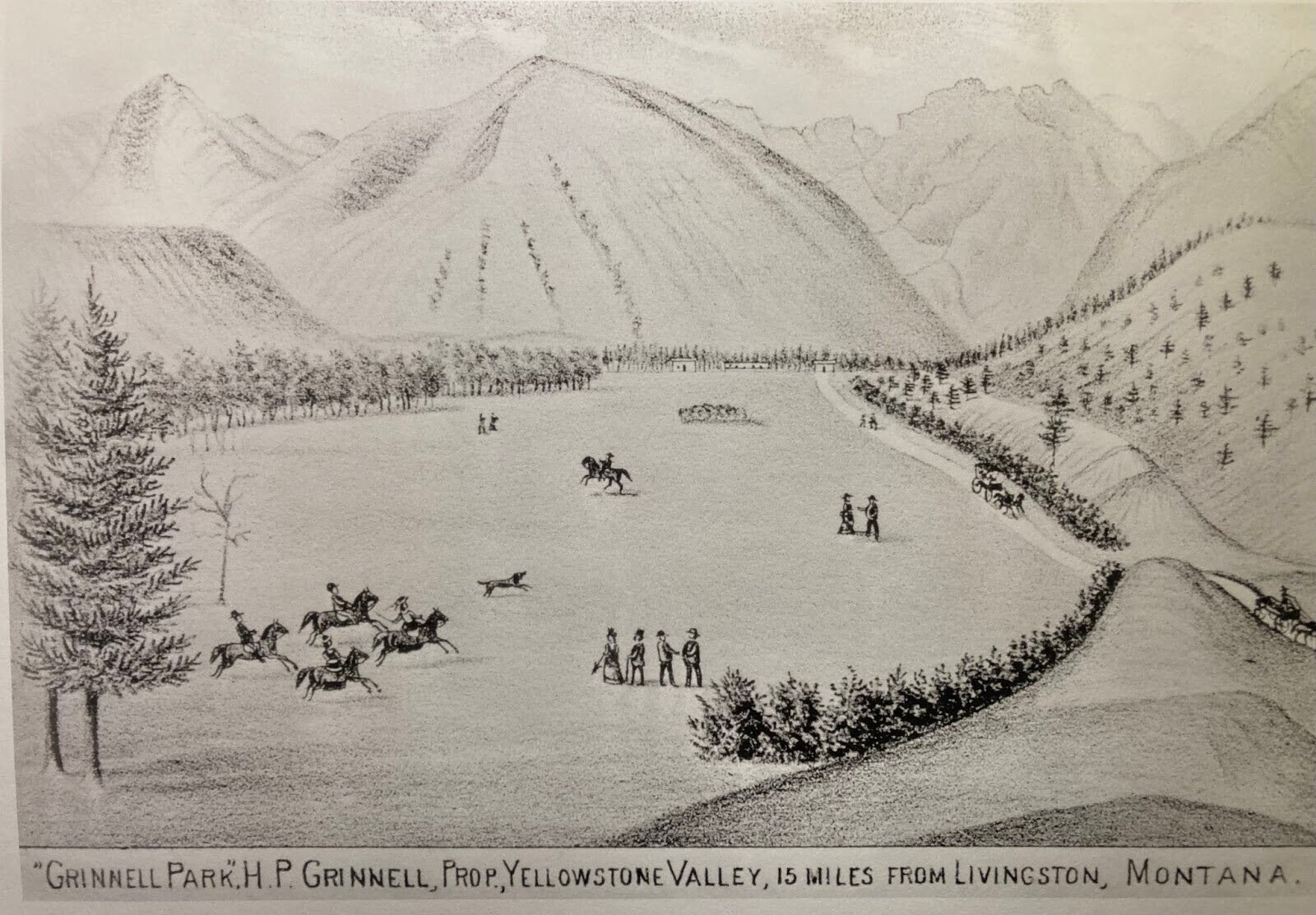
    <summary type="html"><![CDATA[<p><strong><em>After World War 1, a group of Methodists in Livingston, Montana planned to build a summer camp near Yellowstone Park. They travelled 15 miles outside Livingston in buckboard wagons through 2-3 feet of snow to a potential location for this camp, Grinnell Park. Arriving at Grinnell Park, the Methodists knew that they had found the perfect place for a summer camp.</em></strong></p><img src="https://www.intermountainhistories.org/files/fullsize/3cf3158003ddbe0be98bbbc2cb654fab.jpg" alt="Sketch of Grinnell Park" /><br/><p>In the summer of 1919, the Methodist Epworth League in Montana wanted to join the growing trend of church camps that started after World War I. At a conference in Billings, they decided to create a camp about 30 miles north of Helena at Wolf Creek. The Wolf Creek camp was a hit, so the Epworth League decided to build more camps in Montana. Four years later on, a district missionary conference convened in Livingston to build a camp near Yellowstone Park. They decided to investigate Grinnell Park, a glacially-formed valley about 15 miles south of Livingston near Pine Creek as a potential site for this camp. </p><p>On March 11, 1923, a group consisting of Epworth League members, conference members, and Albert Alan, the owner of the land, traveled to Grinnell Park in 3-seated buckboard wagons, fighting against 2-3 feet of snow. The Methodists fell in love with the area and swiftly authorized the Livingston conference to “proceed with all necessary arrangements” to use Grinnell Park as the location for a church camp. Alan sold the land, which was about 25 acres “more or less” for $2,500. Pastor Otto G. Ponath of the local Pine Creek Church helped to build a road up to the camp that was determined to be about a $6,000 job by the highway department. With this road, a Model-T Ford was “driven, pushed, and pulled up to the camp” and both guests and staff were able to travel to the camp. Using old Ringling Circus tents from Billings, members of the state convention were able to make important decisions while being protected from an oncoming storm. One of these decisions was naming the camp “Luccock Park” after the first resident Bishop of Helena, Naphtali Luccock. They also decided to name the mountains that surround the camp from left to right, Faith, Hope, and Charity. </p><p>One hundred years later, Luccock Park still stands as a place for people to gather. It has survived extreme weather, a wildfire that almost burned down the camp, and a global pandemic. There are now permanent buildings on site: the main lodge, an old ranger’s station, a chapel, multiple bathhouses, and dozens of cabins. The camp is open from mid-May to mid-September, hosting a number of Methodist camps, weddings, group getaways, and so much more. In the summer of 2023, a celebration was held to celebrate the last 100 years of Luccock Park. People from all over the country came together at Luccock Park to celebrate and talk about the past and their hopes for the future of the camp.</p><p><em><strong><a href="https://www.intermountainhistories.org/items/show/865">For more (including 4 images) view the original article</a></strong></em></p>]]></summary>
    <published>2024-10-19T00:58:26+00:00</published>
    <updated>2026-04-17T19:32:19+00:00</updated>
    <link rel="alternate" type="text/html" href="https://www.intermountainhistories.org/items/show/865"/>
    <id>https://www.intermountainhistories.org/items/show/865</id>
    <author>
      <name>Alyssa Ulrickson, Rocky Mountain College</name>
    </author>
  </entry>
  <entry>
    <title type="html"><![CDATA[The Corinne Methodist Episcopal Church <br />
]]></title>
    <summary type="html"><![CDATA[<p><strong><em>Dedicated in 1870, the Corinne Methodist Episcopal Church was the center of efforts to “convert” Mormons to Christianity and to break the power of the LDS church in Utah Territory. </p></strong></p><img src="https://www.intermountainhistories.org/files/fullsize/b4ed198c1c0ce1ca0ee14f927523b645.jpg" alt="The Methodist Episcopal Church" /><br/><p><span style="font-weight:400;">In 1869, when Union Pacific Railroad tracks were laid on the west side of the Bear River, the city of Corinne was established. It was the last Union Pacific Railroad tracks on the transcon</span><span style="font-weight:400;">tinental line. Within a month, the population had reached 1,500. By April, the number had risen to 3,000. In February 1870, Corinne had been incorporated. The state of Utah was full of members of The Church of Jesus Christ of Latter-day Saints, however, Corinne was not built by its members. Instead, the town was inhabited by people from different religious, mainly Christian, denominations. In September 1870, the Corrinne Methodist Episcopal Church was formed. </span>
<span style="font-weight:400;">The Corrine Methodist Episcopal Church was a samll, one story building. The front entrance has a Gothic arch with a pair of doors under a glass transom bordered with tiny square panes in wood muntins. </span><span style="font-weight:400;">The Reverend G.M. Pierce had a specific mission in opening the church's doors. He hoped to convert Mormons in Utah and diminish the power that the church had in the territory. However, his grand vision was never realized. As the railroad continued to develop in Northern Utah, the main freight hub moved away from Corinne into the rail yard in Ogden and the city largely closed its doors. </span>
<span style="font-weight:400;">In 1971, the building was placed on the National Register of Historic Places. After church services ended in 1957, the building was used for a wide array of purposes. The building was used as a venue for weddings, funerals, civic meetings, and recitals. The space was also used as a museum. It still has the original bricks which were made in Corinne. The original bell still sits in the small tower atop the building. In 2020, the building was closed due to safety concerns. However, as of 2022, restoration efforts are being made by townspeopel to open the building for activities. </span></p><p><em><strong><a href="https://www.intermountainhistories.org/items/show/696">For more (including 3 images) view the original article</a></strong></em></p>]]></summary>
    <published>2022-11-04T15:51:02+00:00</published>
    <updated>2026-04-17T19:32:15+00:00</updated>
    <link rel="alternate" type="text/html" href="https://www.intermountainhistories.org/items/show/696"/>
    <id>https://www.intermountainhistories.org/items/show/696</id>
    <author>
      <name>David Tullis, Weber State University</name>
    </author>
  </entry>
  <entry>
    <title type="html"><![CDATA[Wesleyan Heritage Organ at First United Methodist Church: History and Community]]></title>
    <summary type="html"><![CDATA[<p><strong><em>Initially dedicated six months following the dedication of their new church building, the pipe organ at First United Methodist Church has a long and storied history. Having gone through many updates, improvements, and restorations over the last several decades, the organ remains a highlight of religious music culture in Salt Lake City, Utah. </em></strong></p><img src="https://www.intermountainhistories.org/files/fullsize/f60f373de01c4c6aa7aaf09c151e3200.jpg" alt="1930 Console and Organ Choir" /><br/><p>Perhaps the most nationally recognized organ in Utah is found at the Mormon Tabernacle on Temple Square. However, First United Methodist Church in the heart of downtown Salt Lake City, Utah is home to the oldest pipe organ in the state that features the most original components in their original location. The church building on the corner of 200 South and 200 East was built and dedicated in May of 1906. The dedication of the original church organ, made by George Kilgan & Sons, followed seven months later on December 7, 1906. The organ featured pipes painted in shades of green and highlighted by intricate stenciling, as well as a console close to the organ choir that faced the congregation. Between 1915 and 1960, the organ underwent enlargements, various color changes accentuated by gold paint, as well as the movement of the console closer to the congregation on the main floor of the chapel. During the period of 1924–1939, the First United Methodist Church organist and choir director was Dr. Frank W. Asper, who also was an organist for the Mormon Tabernacle during the years 1924–1965. The organ underwent significant renovation during what is called the sanctuary and chancel beautification project. A notable change to the organ included moving the organ pipes behind a screen. Further, the pipes were hidden by a wooden grill, crosses, and lights that highlighted the new front to the Church chancel and sanctuary. The beautification project also included the incorporation of permanent pulpits and flower boxes. </p><p>In 2009, First United Methodist Church made the decision to restore the organ back to its original style, parts, and feel as part of a larger effort to remodel and renovate an integral and central component of the church’s community, history, and tradition. At this time, fundraising efforts began with recitals performed by local organists, grants, and a crowdfunding campaign. First United Methodist’s principal organist, Scott Mills, attributes the success of the fundraising efforts to the community, similar to an outreach that led to the building and dedication of the Church building over one hundred years earlier in 1906. Later at the completion of the project, Mills said, “The donations came in from one penny to thousands of dollars. And so, this whole restored effort . . . it was done mostly by the widow’s mite, literally the widow’s mite was the efforts of people who came together and made this all possible.” By 2014, the church had raised an ample sum to hire local American Fork, Utah based organ builders, Bigelow & Co. The restoration effort consisted of finding necessary vintage parts at the local Salt Lake Masonic Temple, locating and purchasing a 1930 organ console from Old St. Mary’s Catholic Church in Cincinnati, Ohio, and the hiring of Tony Devroude to recreate the original stenciling on the organ pipes. In addition, the 1960 paneling and carpeting was removed, opening up the chancel area and exposing the organ façade.  The organ console was dedicated to the memory of the 1924–1939 director and organist, Dr. Frank W. Asper. Restored to its original look and vintage composition, the Wesleyan Heritage Organ at First United Methodist continues to serve the local Methodist community, a wide variety of community events, as well as amateur and professional organ recitals on a regular basis. </p><p><em><strong><a href="https://www.intermountainhistories.org/items/show/154">For more (including 3 images) view the original article</a></strong></em></p>]]></summary>
    <published>2018-05-04T02:18:30+00:00</published>
    <updated>2026-04-17T19:32:01+00:00</updated>
    <link rel="alternate" type="text/html" href="https://www.intermountainhistories.org/items/show/154"/>
    <id>https://www.intermountainhistories.org/items/show/154</id>
    <author>
      <name>Nicholas Shrum, Brigham Young University</name>
    </author>
  </entry>
  <entry>
    <title type="html"><![CDATA[Building Dedication for Salt Lake City’s First United Methodist Church]]></title>
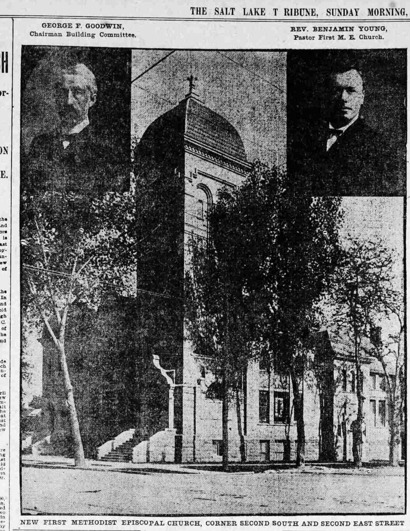
    <summary type="html"><![CDATA[<p><strong><em>For well over a century, the First United Methodist Church building has established its place in downtown Salt Lake City. The turn-of-the-century structure’s dedication was celebrated across the city and among Salt Lake City’s Methodist community.</em></strong></p><img src="https://www.intermountainhistories.org/files/fullsize/8691fcb64eb218642184ccdb10e2a624.jpg" alt="Methodists Will Dedicate Church" /><br/><p>For the last quarter of the nineteenth century (1871-1906), Salt Lake City’s First Methodist Episcopal Church was located downtown on 300 South between Main Street and State Street. This original church structure was dedicated after its completion in 1875. Due to the ever-increasing Methodist population and community needs, the original building was sold in 1905 for the price of $47,500, with the new funds available for the purchase of new property and for the construction of a brand-new building. A new site was purchased on May 10, 1905, for $13,500 at a nearby plot located at 203 South and Second East. The former church building was torn down and the Metropole Hotel eventually came to inhabit the site. Today, the old church and later hotel site is occupied by a parking garage.</p><p>The task of designing the new church building was placed upon the well-renowned Utah architect, Frederick Albert Hale (1855-1934). Mr. Hale, originally from Rochester, New York, grew up in Colorado after migrating out West with his parents. He returned to New York, Ithaca in particular, to study at Cornell University to become an architect. After graduating in 1875, Mr. Hale came back to the West where he began his architectural practice with buildings in Colorado, Wyoming, and Utah. In Utah, Frederick Albert Hale’s more well-known works include the Alta Club, a variety of Salt Lake City homes and mansions along South Temple, commercial structures such as the A.O. Whitmore Electric Automobile building and Continental Bank, and civic buildings such as the old Salt Lake Public Library. During his career, Mr. Hale was also the architect for a variety of church buildings in Wyoming and Colorado. However, the only church building Mr. Hale designed and completed in the state of Utah was what would eventually become the First Methodist Episcopal Church building completed in April of 1906 and subsequently dedicated the following month on May 22nd. </p><p>The dedicatory sermon was given by Bishop Moore of Portland, Oregon who was accompanied by the Utah Mission Superintendent Dr. Henry J. Talbott. Bishop Moore and Superintendent Talbott were also joined by an additional speaker, Dr. Robert McIntyre, pastor of the First Methodist Church of Los Angeles. On the day of the dedication, the church was filled beyond capacity, with occupants overflowing into the classrooms and any available space. The total cost of the structure, property, organ, and interior furnishings was generously donated by loyal and dedicated church members and local citizens; a sum of close to $80,000. The general appearance of what is now the First United Methodist Church has remained essentially the same for well over a century and has played an instrumental role in grounding a strong Methodist Community in the middle of downtown Salt Lake City. </p><p><em><strong><a href="https://www.intermountainhistories.org/items/show/153">For more (including 4 images) view the original article</a></strong></em></p>]]></summary>
    <published>2018-05-04T01:22:35+00:00</published>
    <updated>2026-04-17T19:32:01+00:00</updated>
    <link rel="alternate" type="text/html" href="https://www.intermountainhistories.org/items/show/153"/>
    <id>https://www.intermountainhistories.org/items/show/153</id>
    <author>
      <name>Nicholas Shrum, Brigham Young University</name>
    </author>
  </entry>
  <entry>
    <title type="html"><![CDATA[Utah’s First Methodist Pioneer - Jedediah Strong Smith]]></title>
    <summary type="html"><![CDATA[<p><strong><em>Said to have been the first great protestant missionary to mountain men, “Bible Totin' Jed Smith” holds a special place in the memory of the Methodist community of Utah. </em></strong></p><img src="https://www.intermountainhistories.org/files/fullsize/7b138a6554c82831c59ac1c0b4ce33a7.jpg" alt="Jedediah Smith" /><br/><p>Early American Methodism and the exploration of the American West share a common pioneering ancestor in Jedediah Smith. While many of the commonly held beliefs about Jedediah Smith’s religious background and affiliation would require the support of more historical documentation than is currently available, Jedediah Smith’s life and subsequently developed popular legend provide an influential look into how the early nineteenth century explorer helped forge a future for the development of Utah and as a result, the Methodist Community that reveres the formidable mountaineer, appropriately referred to as “Bible Totin’ Jed Smith.”</p><p>Jedediah Strong Smith, Jr. was born on January 6, 1799 in Jericho, New York (present-day Bainbridge) to Jedediah Smith, Sr. and Sally Strong. The Smith family had early Puritan roots in the Samuel Smith family, which immigrated to the Massachusetts Bay Colony from Hadleigh, England in 1634. Jedediah Smith, Sr. became associated with the Wesleyan movement in the 1790s, tying the Smith family to the Methodist Church. It was a new movement, having just been developed in the 1780s in America by John and Charles Wesley. Though tempted to consider a life in the ministry, Jedediah Smith, Jr. chose to pursue a career as a trapper, frontiersman, and explorer. However, due to the revivalist fervor of the Second Great Awakening, Jedediah undoubtedly was shaped by his upbringing in the Methodist faith, influencing his actions and worldview throughout his short life. </p><p>Jedediah Smith’s contributions to early nineteenth-century exploration of the American West are well known and many. He was the first Anglo-American to make his way to California directly overland as well as the first to make an overland journey through northwest California into Oregon, a remarkable feat considering the densely forested landscape. Further, he was the first American to traverse the length of the Pacific Coast, ranging from San Diego in the South to Vancouver in the North. Smith was among the first to pass over the Sierra Nevada Mountains, and the first Americans to journey across the length and width of Utah. In 1826, he trekked into the Salt Lake and Utah Valleys, being the first American explorer to step foot south or west of the Great Salt Lake. Smith met a young and untimely death in a conflict with Comanche Indians in Kansas on May 27, 1831. Many of Jedediah Smith’s biographers note that he was a pious, sober, and God-fearing man. While Smith’s explorations in the West kept him from any form of regular or intermittent church attendance, he is known to have regularly devoted himself to the reading of the Bible. In fact, at the time of his death, Jedediah Smith’s estate contained a modest collection of books, two of which likely traveled with him during his career: The Holy Bible and a book of Methodist hymns. Today the Utah Methodist community reveres the memory and legend of Jedediah Smith as a pioneer of both their home state and faith. First United Methodist in Salt Lake City proudly displays a portrait of Jedediah Smith as a part of the faith’s community in the Great Basin. </p><p><em><strong><a href="https://www.intermountainhistories.org/items/show/152">For more (including 3 images) view the original article</a></strong></em></p>]]></summary>
    <published>2018-05-02T22:11:31+00:00</published>
    <updated>2026-04-17T19:32:01+00:00</updated>
    <link rel="alternate" type="text/html" href="https://www.intermountainhistories.org/items/show/152"/>
    <id>https://www.intermountainhistories.org/items/show/152</id>
    <author>
      <name>Nicholas B. Shrum, Brigham Young University</name>
    </author>
  </entry>
  <entry>
    <title type="html"><![CDATA[James Cash Penney, Jr. and Salt Lake’s First United Methodist Church]]></title>
    <summary type="html"><![CDATA[<p><strong><em>James Cash (J.C.) Penney, Jr., early twentieth-century business and retail man, was dedicated to the local Methodist community of Salt Lake City. As a religious attendee and significant patron, J.C. Penney holds a prominent spot in the history of First United Methodist Church. </em></strong></p><img src="https://www.intermountainhistories.org/files/fullsize/229971960039eaffff7d1d268dc2ec08.jpg" alt="Portrait of J.C. Penney, Jr. " /><br/><p>James Cash (J.C.) Penney, Jr. was born on September 16, 1875 in the small Caldwell County town of Hamilton, Missouri to James Cash Penney, Sr. and Mary Frances Paxton. His father was a notable member of the Hamilton community as a minister for the local Baptist church, farmer, and civic leader. J.C. Penney’s family eventually moved out West to the town of Longmont, Colorado. It was here that J.C. Penney began pursuing a life as a businessman and entrepreneur that would eventually develop into a prominent and successful career. In Longmont, Penney met his future wife, Berta Alva Hess, and they were married in Cheyenne, Wyoming on August 24, 1899. The couple had two sons, Roswell Kemper Penney (b. 1901) and James Cash Penney III (b. 1903). After establishing a successful store in Kemmerer, Wyoming in 1902, Penney decided it was time for a change of scenery. He wrote in his 1950 autobiography, “In 1909 things were moving in a way which seemed to warrant a new phase. I gave up managing the Kemmerer store personally and moved Mrs. Penney and the boys to Salt Lake City.”</p><p>Berta Penney was a devoted member of the Methodist Church and the blossoming Penney family’s new environment helped facilitate a connection to their new community. Penney wrote, “Our two boys were nearing the age when they should be going to Sunday School. Mrs. Penney and I sought out a church of her denomination, and the boys began going before long to the Sunday school of the First Methodist Church.” The Penney family began attending services at the First Methodist Church in Salt Lake City, then under the stewardship of Dr. Francis Burgette Short.  Penney described him as “a forceful speaker and a man of striking appearance and personality, standing six foot four.” Shortly after the move to Salt Lake City, Berta Penney underwent a tonsillectomy procedure that unfortunately led to the development of pneumonia after traveling in the rain. The illness led to her tragic death on December 26, 1910. The passing of his wife devastated Penney, leaving him with two sons, in a new city, and with demanding business responsibilities. </p><p>The death of his wife deepened his involvement in the church. The First Methodist Church in Salt Lake City had been built and dedicated in May 1906 at the cost of approximately $80,000. The cost of the building, furniture, fixtures, organ, and grounds were covered for the most part by generous members of the church and community, yet at the time of the dedication, a $20,000 debt remained. Dr. Short, who assumed leadership of the Church in 1907, successfully acquired the remaining funds and paid off the indebtedness by 1912, the final $5,000 being donated by J.C. Penney in memory of his late wife. He noted in his autobiography that “a man’s duty was to support the church with money in addition to living in a conscientious and upright manner.” In 1914, Penney moved the headquarters of his company to New York City and later remarried, but his generous contribution to the Methodist community of Salt Lake City is held in highest regard to this day. One of the church towers of First United Methodist Church on 203 South 200 East in Salt Lake City is dedicated to Berta Penney and is designated with a plaque in her memory. </p><p><em><strong><a href="https://www.intermountainhistories.org/items/show/151">For more (including 5 images) view the original article</a></strong></em></p>]]></summary>
    <published>2018-05-02T21:27:57+00:00</published>
    <updated>2026-04-17T19:32:01+00:00</updated>
    <link rel="alternate" type="text/html" href="https://www.intermountainhistories.org/items/show/151"/>
    <id>https://www.intermountainhistories.org/items/show/151</id>
    <author>
      <name>Nicholas Shrum, Brigham Young University</name>
    </author>
  </entry>
</feed>