<?xml version="1.0" encoding="UTF-8"?>
<feed xmlns="http://www.w3.org/2005/Atom">
  <title type="text">Intermountain Histories</title>
  <updated>2026-04-17T19:32:17+00:00</updated>
  <generator uri="http://framework.zend.com" version="1.12.20">Zend_Feed_Writer</generator>
  <link rel="alternate" type="text/html" href="https://www.intermountainhistories.org/"/>
  <link rel="self" type="application/atom+xml" href="https://www.intermountainhistories.org/items/browse?output=rss2"/>
  <id>https://www.intermountainhistories.org/</id>
  <author>
    <name>Intermountain Histories</name>
    <uri>https://www.intermountainhistories.org</uri>
  </author>
  <link rel="hub" href="https://pubsubhubbub.appspot.com/"/>
  <entry>
    <title type="html"><![CDATA[The Captivity of Olive Oatman]]></title>
    <summary type="html"><![CDATA[<p><strong><em><span style="font-weight:400;">In the wake of a massacre, an orphaned girl is taken captive and raised by Native Americans on the Western Frontier. She returns to Euro-American society in adulthood, becoming a shrouded mystery through each conflicting narrative she spins.</span></em></strong></p><img src="https://www.intermountainhistories.org/files/fullsize/3ed4a32f7a4e886223523110e2babe43.jpg" alt="Portrait of Olive Oatman, 1863." /><br/><p><span style="font-weight:400;">A town in the Black Mountains of Mohave County formerly called “Vivian” after a mining company was renamed “Oatman” in 1909 to honor Olive Oatman, the victim of an infamous kidnapping. The Oatmans were Mormon pioneers who left their home in Illinois to build a new life in the Salt Lake Valley of what is now Utah. They were traveling through Arizona in February 1851 when they were ambushed by a tribe, believed to have been Western Yavapai. They killed Royce Oatman and his pregnant wife as well as four of their seven children. One son, Lorenzo, was able to escape. Sisters Olive and Mary Ann, who were about thirteen and eight-years-old, were taken captive. Neither of them had shoes and Olive was terrified that they would kill her little sister because she had a hard time keeping up with the pace of their travel. They were kept as slaves for about a year until they were sold to Mojaves for an assortment of horses, blankets, vegetables, and beads.</span>
<span style="font-weight:400;">Life with the Mojaves was more comfortable for Olive and Mary Ann as they were adopted by a tribe leader and his wife and were treated as members of the family rather than servants. In Olive’s earliest interview post-captivity she recalls that the Mojaves treated her and her sister “very well.” Members of their tribe made shoes for the girls and did their best to protect them–which included giving them tribal chin tattoos which were believed to grant access to the afterlife. Despite their best efforts, Mary Ann and several members of the tribe died of starvation during a drought in 1858. White settlers in surrounding communities began to notice Olive’s presence in the Mojave tribe, and they grew increasingly concerned. She became something of a legend before she was willfully released by the tribe to re-enter American society in 1856. </span>
<span style="font-weight:400;">Now nineteen-years-old, this transition was jarring for Olive. She had lived with the Yavapais and Mojaves for five years and was a stranger to her old way of life. She struggled to overcome culture shock and grew increasingly homesick for her Mojave family. One bright spot for Olive during these years was reuniting with her brother Lorenzo, who had been searching for her and Mary Ann for years. As she worked to readapt and relearn to dress, speak, and behave–her accounts of her time with the Western Yavapai and Mojave tribes blurred together and turned sour. A reverend, R. B. Stratton, quickly took interest in Olive’s story. He wrote a book, published a year after her return, called </span><i><span style="font-weight:400;">Captivity of the Oatman Girls</span></i><span style="font-weight:400;">. It was riddled with misinformation and prejudice, and the twisted narrative seemed to become a story Olive herself believed. Stratton arranged speaking tours for Olive all over the country, where she shocked people with this crafted version of her life. </span>
<span style="font-weight:400;">At a lecture she gave in Michigan, Olive met a man named John Fairchild, and he seemed to give her the peace she yearned for after so many years of trauma. When they married in 1865 Olive retired from touring and everything to do with Stratton, refusing to perform ever again. John never spoke publicly about her past, and they did their best to live a quiet life in Sherman, Texas. Still she was plagued by her past and mental illnesses, likely PTSD and depression, for the rest of her life. She died in 1903, at the age of 65, leaving behind John and their daughter, Mary Elizabeth. </span>
<span style="font-weight:400;">The scraps of information we have from Olive’s fateful childhood could never do her story justice. Regardless of all the hearsay and sensationalism that grew with her fame, even her earliest interviews are difficult to make sense out of. She was solemn and even glum in nearly every account we have of her, yet she laughed in that first interview while talking about her time with the Mojaves. Olive’s story is as compelling today as it was to those who once gathered in crowds around the country to hear her speak, and the true circumstances of her life remain largely as mysterious.</span></p><p><em><strong><a href="https://www.intermountainhistories.org/items/show/803">For more (including 4 images) view the original article</a></strong></em></p>]]></summary>
    <published>2024-05-16T01:11:43+00:00</published>
    <updated>2026-04-17T19:32:17+00:00</updated>
    <link rel="alternate" type="text/html" href="https://www.intermountainhistories.org/items/show/803"/>
    <id>https://www.intermountainhistories.org/items/show/803</id>
    <author>
      <name>Megan Bailey, Brigham Young University</name>
    </author>
  </entry>
  <entry>
    <title type="html"><![CDATA[ Mountains, Mining, and Massacre: The History of Oatman, Arizona]]></title>
    <summary type="html"><![CDATA[<p><strong><em><span style="font-weight:400;">Free-roaming donkeys, an old mining district, a stop on Route 66, and ties to a famous kidnapping make up the storied past of this semi-abandoned town.</span></em></strong></p><img src="https://www.intermountainhistories.org/files/fullsize/d34d919e9df93dc8bb5d0f3e2ba0cc1d.jpg" alt="Oatman, Arizona circa 1930." /><br/><p><span style="font-weight:400;">Tucked away in the Black Mountains of Mohave County, Arizona is a community rich with legend. The town was named for Olive Oatman and her family who were victims of the Oatman Massacre in 1851, and it came to life in the following decades as prospectors discovered gold, ore, and other valuable resources in the land. Oatman is home to the three most prosperous gold mines in Arizona: the Gold Road, the Tom Reed, and the United Eastern. </span>
<span style="font-weight:400;">A gold prospector named John Moss was one of the first to discover gold in the area in the early 1860s, but it wasn’t until the 1900s that Oatman really boomed. A hotel and post office were built in 1902 and 1906 respectively, securing Oatman’s status as an official town. The mines brought riches and rapid growth to the community, with Tom Reed mine’s total profit reaching over nine-million by 1922 and the town’s population growing to 10,000 in the same decade.</span>
<span style="font-weight:400;">One of the oddities of Oatman is the population of wild burros (undomesticated donkeys). They were brought in by miners who used teams of them to haul supplies from out of town. Burro labor was a big part of the mining industry, but unlike the prospectors, they never picked up and left town. Billie Jo Moore, long time proprietor of the Oatman Hotel, said in an interview that, “the burros stayed behind and adapted to the desert. Now they are all over these mountains…They wander through the streets, turning over garbage cans and messing in people’s yards.” While they are little more than a nuisance to locals, tourists entertain them with attention, alfalfa pellets, and lots of pictures–burros have become iconic to the town. </span>
<span style="font-weight:400;">Oatman stitched itself into another legend of America when it became a part of Route 66. It was 1926, still bringing in plenty of spoils from the mines, and now gaining further revenue from the new highway. These were the glory days in Oatman; crime was low, employment was high, and people were optimistic about the future. While there was an occasional murder and a tendency for drunkenness in Oatman, it didn’t fall into the expected stereotype of the “wild west.” The isolation of the town, so far away from any other civilization at that time, created a tight-knit group that made new traditions together–like the annual three day long Fourth of July celebrations. When the Great Depression hit in the 1930s, the prosperity and liveliness of the community began to dwindle, and by the time Route 66 went out of commission in the 1950s it was well on its way to becoming a ghost town. Oatman has never been fully abandoned though, and it has been given new life through its performers and curious travelers. </span></p><p><em><strong><a href="https://www.intermountainhistories.org/items/show/802">For more (including 5 images) view the original article</a></strong></em></p>]]></summary>
    <published>2024-05-16T00:49:23+00:00</published>
    <updated>2026-04-17T19:32:17+00:00</updated>
    <link rel="alternate" type="text/html" href="https://www.intermountainhistories.org/items/show/802"/>
    <id>https://www.intermountainhistories.org/items/show/802</id>
    <author>
      <name>Megan Bailey, Brigham Young University</name>
    </author>
  </entry>
  <entry>
    <title type="html"><![CDATA[Battle Creek Canyon Massacre]]></title>
    <summary type="html"><![CDATA[<p><strong><em>Battle Creek Canyon's name originates from Utah's first major skirmish between the Utes and the Mormon militia. </em></strong></p><img src="https://www.intermountainhistories.org/files/fullsize/54eea90162a257c6e9cd4299408aea71.jpg" alt="Kade Dallin, Purple Mountain Majesties, 2020.
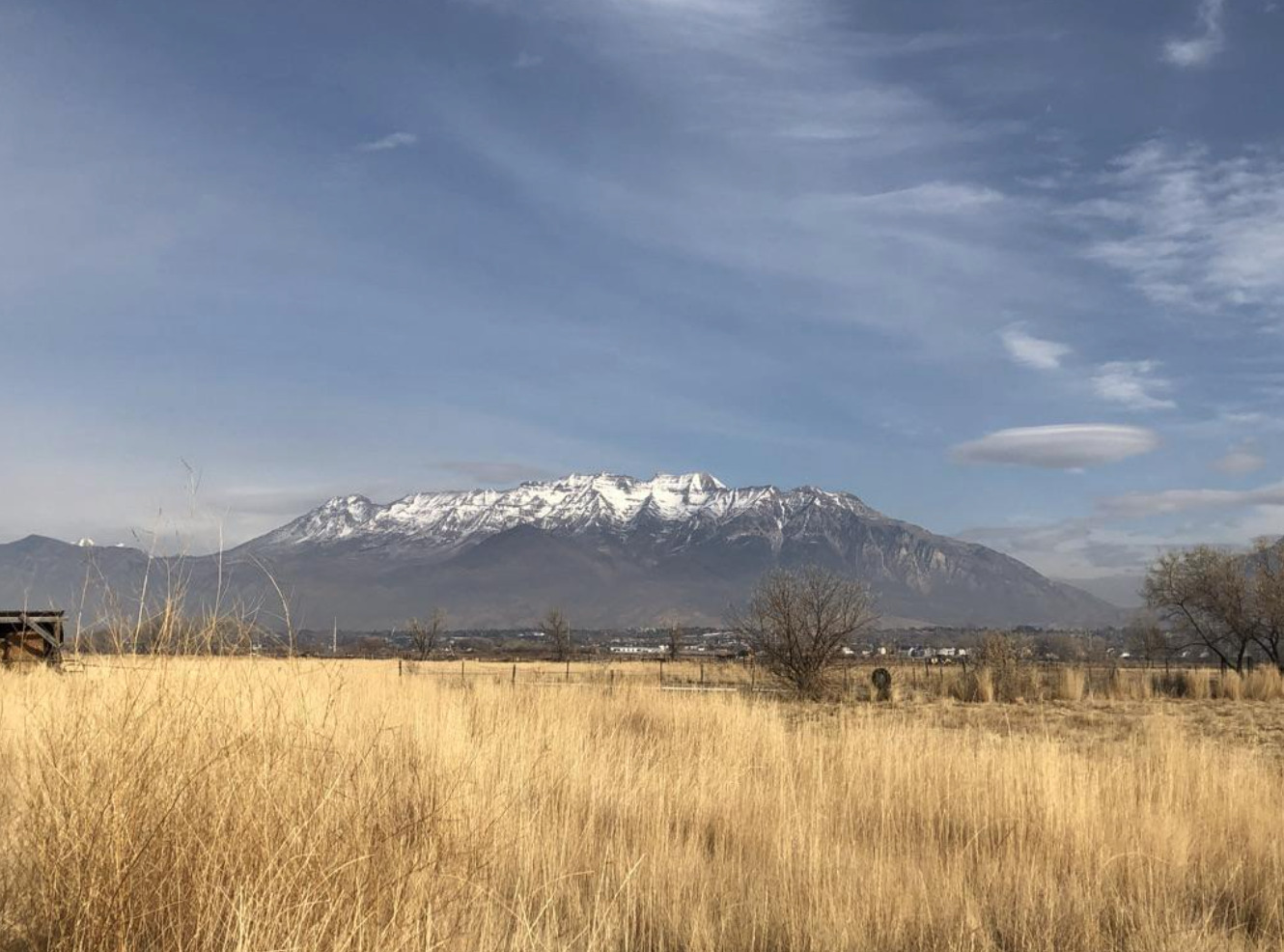
" /><br/><p><span style="font-weight:400;">When the pioneers of the Church of Jesus Christ of Latter-day Saints entered the Salt Lake Valley, they generally settled in what is now Salt Lake County on the Wasatch Front. The area was largely a desert and many, including some mountain men, suggested that the people settle further south in the freshwater valley that now comprises the bulk of Utah County. Brigham Young immediately sent out people to found colonies, cities, and towns throughout modern Utah, Arizona, Nevada, California, and Mexico. Yet, the pioneers balked at the initial thought of settlement in Utah Valley because of the native tribes who already lived there. Various bands of the Ute and Timpanogos tribes lived throughout the valley and had a reputation of being warlike and aggressive as a way to defend their land and livelihood. </p>
<span style="font-weight:400;">The pioneers especially resented the Ute practice of poaching the settler’s cattle. Roman Nose, a prominent Ute, was particularly troublesome. He led a band that repeatedly raided the farms and ranches near the valley border, and was even accused of stealing several of Brigham Young’s personal horses. After Brigham Young heard of the theft, he ordered Captain John Scott to lead a posse against the Utes in hopes of apprehending Roman Nose and his band. Their orders were to find the band of thieves and to “take such measures as would put a final end to their depredations in the future.” In 1849, they began raiding the Ute bands they deemed responsible for the loss of the livestock. However, Brigham Young soon discovered that the Utes had been mistakenly blamed: his horses had simply been moved to different pastures. He ordered Scott and the posse to stand down, but they refused. </p>
<span style="font-weight:400;">On the morning of March 5, 1849, the relationship between Mormon settlers and the local band of Timpanogos Indians deteriorated into brutal hostility in what is now Pleasant Grove, Utah. Scott’s rogue posse of 44 men soon arrived where they found the Ute camp which they thought participated in the raids. The group surrounded the sleeping camp and opened fire in a reign of terror. The members of the posse then hunted down many of the Utes who managed to escape the initial shootout. In total, they killed seventeen men, women, and children, including Roman Nose. </p>
<span style="font-weight:400;">After seeing the massacre, the chief of the Native American tribe, Little-Chief was distraught. Although he reportedly agreed that the killing of the supposed thieves was justified, he understood that this would cause a rift to form between white settlers and local tribes. This event, among many other skirmishes, led to heightened tension between the two groups and permanently damaged the already delicate relationship between the Native American tribes and the Mormon settlers. After this event, the area became known as Battle Creek Canyon and is today memorialized by the Battle Creek Marker. </span>


</p><p><em><strong><a href="https://www.intermountainhistories.org/items/show/757">For more (including 2 images) view the original article</a></strong></em></p>]]></summary>
    <published>2023-10-22T05:05:29+00:00</published>
    <updated>2026-04-17T19:32:16+00:00</updated>
    <link rel="alternate" type="text/html" href="https://www.intermountainhistories.org/items/show/757"/>
    <id>https://www.intermountainhistories.org/items/show/757</id>
    <author>
      <name>Kade Dallin, Brigham Young University&amp;#32;&amp;amp;&amp;#32;Bryce Revelli, Brigham Young University</name>
    </author>
  </entry>
  <entry>
    <title type="html"><![CDATA[Fish Creek Massacre]]></title>
    <summary type="html"><![CDATA[<p><strong><em>In the summer of 1869, Italian immigrants in Eureka, Nevada decided to go on strike to protest low wages. Local tensions escalated the situation to the point of violence, and, on August 18, 1879, five protesting Italian immigrants were killed. </p></strong></p><img src="https://www.intermountainhistories.org/files/fullsize/ecef27111ebdf406b0daf3a633e5fe8b.jpg" alt="Ore Shutes in Eureka" /><br/><p><span style="font-weight:400;">In the 1870s, Eureka was the second largest mining town in Nevada. Eureka produced primarily charcoal, and many flocked there as new smelters increased labor demands. As was the case in many other booming western mining towns, immigrants made up a large portion of the population. Italians were by far the largest immigrant group in Eureka. Racial and cultural prejudice against Italians that was prevalent throughout the United States was mirrored in Eureka and other western mining towns. As a result, they were paid less than half of what the average miner made. On July 6, 1879, a large group of mainly Italian coal burners gathered at a local saloon to unionize. They formed the Eureka Charcoal Burners Protective Association with the goal of increasing wages. Since Italians made up the majority of Eureka’s cheap labor force, the group's resulting labor strike halted charcoal production. </span>
<span style="font-weight:400;">With a dwindling charcoal supply, tensions in town grew. Eventually, Sheriff Matthew Kyle began arresting some of the strike’s ringleaders. Further, because he did not want to involve state militia, he created a “fighting posse” to go to the charcoal camps and arrest the strike leaders.  They did so over the next month, but on August 18, 1879, the posse turned violent.</span>
<span style="font-weight:400;">The posse of about 20 men set out for Fish Creek, where a large group of strikers was rumored to be camped.  Despite being extremely outnumbered by the striking laborers, deputies attempted to arrest the strike leader. When strikers resisted and the posse was unable to make their arrest, tempers flared. Marshall Rich, one of the head deputies, started insulting the Italian leader, who pulled out his gun and fired at Rich. The posse then opened fire on the mostly unarmed coal burners. Five Italians were killed in the massacre, six were seriously injured, and fourteen were sent to prison. Those who died were all Italian and included: Giovanni Pedroni, Marcellus Locatelli, Todoro Zesta, Pompeo Pattini, and Anotonio Canonica.  </span>
<span style="font-weight:400;">Other accounts of the massacre vary, with some placing all of the blame on the posse and others claiming that the Italians were seeking violence. Regardless, the posse ceased making arrests after this and no one in the posse was charged. The strike eventually ended, and tensions between the Italians and other groups lessened in the following years. </span></p><p><em><strong><a href="https://www.intermountainhistories.org/items/show/727">For more (including 6 images) view the original article</a></strong></em></p>]]></summary>
    <published>2023-03-06T21:27:00+00:00</published>
    <updated>2026-04-17T19:32:16+00:00</updated>
    <link rel="alternate" type="text/html" href="https://www.intermountainhistories.org/items/show/727"/>
    <id>https://www.intermountainhistories.org/items/show/727</id>
    <author>
      <name>Sydney Wilson, Brigham Young University </name>
    </author>
  </entry>
  <entry>
    <title type="html"><![CDATA[Battle of Julesburg]]></title>
    <summary type="html"><![CDATA[<p><strong><em>After American militias massacred Cheyenne and Arapaho as part of the Civil War in the West, indigenous warriors banded together, determined to not let American colonizers’ unwarranted violence go unanswered.</em></strong></p><img src="https://www.intermountainhistories.org/files/fullsize/39ffd1ff27a2be44f963f783464803e2.jpg" alt="Battle of Julesburg" /><br/><p>In January 1865, Julesburg, Colorado was 200 miles east of Denver. Complete with an eating-house, stable, blacksmith, repair shop, granary, and corral, the town was an important waystation for immigrants and settlers traveling along the Platte River on the Oregon Trail.
However, Julesburg’s relative prominence also made it a target for Native retaliation after the Sand Creek Massacre. Six weeks earlier, on November 29, 1864, led by brevet Colonel John Chivington, the 675-men strong Third Colorado massacred several hundred Cheyenne and Arapaho men, women, and children in southeastern Colorado Territory. Dog Soldiers (a militant Cheyenne subgroup) allied with other Cheyenne, Arapaho, and Lakota warriors to avenge their relatives who died at Sand Creek. In total, they numbered some 1200 Dog Soldiers and other warriors. Sitting Bull, Spotted Tail, Pawnee Killer, and others led the attack on Julesburg. On January 7, 1865, the allied Natives found that many soldiers had left town as part of their regular patrols, leaving only 37 men to defend the fort at Julesburg.
A small group of Lakotas led the initial charge. Nicholas James O’Brien, a highly decorated Civil War soldier and commander of the troops at Julesburg, saw the oncoming attack and pursued the Lakotas, unwittingly falling into their strategic trap to encircle the soldiers once they had been separated from reinforcements. The Native alliance intended to surround the American soldiers, but some young Cheyenne left their position too early before the entrapment could be realized. Despite this minor lapse, within a few minutes of fighting, nearly half of the U.S. soldiers were killed.
O’Brien led his surviving soldiers back to the fort, and the Native alliance laid siege. The remaining tribesmen entered Julesburg and raided every building. George Bent, a Cheyenne who participated in the raid, recalled that allied Natives found all the goods they desired. Tribal women brought extra horses to carry the spoils back to their camps. The horses were so heavily loaded that it took three days to make the return trip home. The raid lasted the whole day and became the first of many Cheyenne, Arapaho, and Lakota raids conducted in the Central Plains over the coming months. The accumulation of goods brought sustenance to the tribes that winter while the United States took a staggering blow to their efforts to control American Indian affairs during the Civil War.</p><p><em><strong><a href="https://www.intermountainhistories.org/items/show/576">For more (including 4 images) view the original article</a></strong></em></p>]]></summary>
    <published>2022-03-12T07:54:28+00:00</published>
    <updated>2026-04-17T19:32:12+00:00</updated>
    <link rel="alternate" type="text/html" href="https://www.intermountainhistories.org/items/show/576"/>
    <id>https://www.intermountainhistories.org/items/show/576</id>
    <author>
      <name>Ryan Blamires, Brigham Young University</name>
    </author>
  </entry>
  <entry>
    <title type="html"><![CDATA[Sand Creek Massacre of 1864]]></title>
    <summary type="html"><![CDATA[<p><strong><em>Trying to choose peace over conflict, the Cheyenne and Arapaho groups surrendered outside Fort Lyon, Colorado in 1864. A Colorado militia attacked them, killing hundreds.</em></strong></p><img src="https://www.intermountainhistories.org/files/fullsize/2a49aee7fffe146c430e5d1ceb690b15.jpg" alt="Depiction of the Sand Creek Massacre" /><br/><p>In response to the influx of white settlers traveling west throughout the nineteenth century, Cheyennes and Arapahos in Colorado tried to find a stable location to support their people. They had previously raided white settlements to survive but soon concluded that they should attempt peaceful coexistence. These groups traveled to Denver in September 1864 to discuss these goals but were redirected to Fort Lyon, a small fort near the Big Sandy Creek River. Those in Denver told the Cheyenne and Arapahos that as long as they waved a white flag as they approached Fort Lyon, no one would harm them.</p><p>Meanwhile, the American Civil War solicited the service of many men across the country, leaving western settlements largely unprotected from Indian raids. Military leader John Chivington organized a militia unit of six hundred men to defend the state of Colorado from Native American advances for a period of one hundred days. However, the militia experienced very little action in those three months. As the deadline of one hundred days came to a close, people mocked the militia for their lack of combat. </p><p>In November 1864, with the American flag and the white flag of surrender raised, the Cheyenne and Arapaho tribes settled down around Fort Lyon. The militia, wanting to fight before the end of the one hundred days, saw the large mass of Indians outside Fort Lyon and waited. On Chivington’s order, a cavalry unit attacked the native settlements at dawn on November 29, 1864. He told the militia not to take prisoners, resulting in the massacre of around 150-250 Cheyenne and Arapahos. They killed men, women, and children, sparing none. The militia also scalped heads, cut off genitalia, and mutilated the bodies of those they killed. Some even tied parts of the dead Indians onto their belts as symbols of pride and victory. One account of a survivor states, “I saw one squaw cut open, with an unborn child lying by her side.” Additional witnesses mentioned many other horrific scenes from the massacre. Since this was a militia group and not an official U.S. military troop, John Chivington resigned from his position, thereby freeing him from any formal charges of his actions.</p><p>The tragic events that occurred here taint Colorado and U.S. history. A National Historic site now stands near the field, paying homage to the silenced voices of the native men, women, and children who desired peace.</p><p><em><strong><a href="https://www.intermountainhistories.org/items/show/396">For more (including 3 images) view the original article</a></strong></em></p>]]></summary>
    <published>2020-03-04T23:32:01+00:00</published>
    <updated>2026-04-17T19:32:08+00:00</updated>
    <link rel="alternate" type="text/html" href="https://www.intermountainhistories.org/items/show/396"/>
    <id>https://www.intermountainhistories.org/items/show/396</id>
    <author>
      <name>Hannah Fowler, Brigham Young University</name>
    </author>
  </entry>
  <entry>
    <title type="html"><![CDATA[Forest Service Road 300 and General Crook]]></title>
    <summary type="html"><![CDATA[<p><strong><em>Brigadier General George R. Crook (September 8, 1828 -March 21, 1890)  is popularly recognized as the quintessential 'Indian Fighter' of the late nineteenth century. In the Apache Campaign, Crook's troopers frequented the Mogollon Rim above Fort Verde in central Arizona Territory on the path to engage the Tonto Apache. This crest trail is designated as Forest Service Road 300.</em></strong></p><img src="https://www.intermountainhistories.org/files/fullsize/d160b0efcada34d1ed16a5a3c1f4d869.jpg" alt="General Crook and William Alchesay" /><br/><p>Located at the crest of the Mogollon Rim, the trail that became Forest Service Road 300 (FS 300) served as the primary path for engagements against the Tonto Apache. FS 300 traverses the 2,000 feet above the Verde Valley on the Colorado Plateau. There are several historical landmarks along the route, such as the '13 mile rock', military telegraph lines, and the grave of Andres Moreno of 'E' Company. Thirteen miles from Fort Verde, near the ridge of the Colorado Plateau, is an original rock carving, marking the troopers' ascent from the Verde Valley. A quarter of a mile onto FS 300, there are white insulators scattered in the forest, from the original nineteenth century telegraph lines. One mile from Hwy 87 is the grave of Andres Moreno who served in the 1st Arizona Infantry, under the command of Lieutenant Primitivo Cervantes in 1865. In 1887, teamster Knox Lee murdered Moreno. Lee plead guilty for manslaughter and was sentenced to seven years. </p><p>In 1871, Crook used this route as he began the unenviable mission of  attempting to separate native Apache on the Colorado Plateau from white settlers in the Verde Valley. According to Lt. John G. Bourke, “Our line of travel was due east--at the base of the great Mogollon range to Camp Verde.” General Crook was usually the first man to 'saddle-up' each morning onto his mule 'Apache'.                                                                                    </p><p>In April that year, following raids on early homesteaders, Crook's men routed a band of over twenty Tonto Apache.  The after action report recorded thirty one “Indians killed”, no wounded, and two captured. Apache oral history states that the incident was a “massacre” by the Army.  The lack of any 'wounded Indians,' along with no record of the commanding officer, leads to suspicion over the circumstances of the engagement.  Crook recorded, “One of the difficulties in managing such Indians is that you must delegate your powers and depend upon others to execute. There are questions constantly arising which require prompt action, even if the most summary punishment should be melted out to them.” Unfortunately, General Crook's legitimate concerns over junior officers implementing his concerns over restraint, landed on General Sheridan's desk, who supported the “extermination” of the Indians. In August 1871, the Apache's retribution may have resulted in the killing of farmer Joseph Burroughs, a homesteader in the 'Rio Verde.'                                                                                                     	 </p><p>In 1875, General Crook departed the Department of Arizona to report to the Department of the Platte. Many of  his concerns with the Apache remained unresolved, but his route became FS 300,  a well- established supply route to the Colorado Plateau and the White Mountains.  </p><p><em><strong><a href="https://www.intermountainhistories.org/items/show/331">For more (including 5 images) view the original article</a></strong></em></p>]]></summary>
    <published>2019-09-13T06:45:32+00:00</published>
    <updated>2026-04-17T19:32:06+00:00</updated>
    <link rel="alternate" type="text/html" href="https://www.intermountainhistories.org/items/show/331"/>
    <id>https://www.intermountainhistories.org/items/show/331</id>
    <author>
      <name>Robert M. Estrada, Northern Arizona University</name>
    </author>
  </entry>
  <entry>
    <title type="html"><![CDATA[The Rock Springs Massacre of 1885 <br />
]]></title>
    <summary type="html"><![CDATA[<p><strong><em>In Rock Springs, Wyoming a fatal display of jealously and racism took place against Chinese immigrants on September 2, 1885. </p></strong></p><img src="https://www.intermountainhistories.org/files/fullsize/4813f8fd04b20abf1d38258622e59ced.jpg" alt="Rock Springs Massacre" /><br/><p>The first large wave of Chinese immigrated to California in 1848 in search of gold. The Chinese labored in mines and railroads. Companies loved Chinese laborers because they worked longer hours than their white counterparts and for less pay. Many white laborers in the West felt threatened by the Chinese laborers because of the lower wages and poorer conditions they worked for. The Chinese laborers experienced discriminated in political, social, and economic life. Some examples of this discrimination include denied citizenship, negative social stereotypes, and lower wages.  </p><p>In 1882 the United States Congress passed the Chinese Exclusion Act, which prohibited Chinese from entering the United States. It did not directly impact those immigrants already in America although violence and discrimination towards Chinese increased. </p><p>One of the notorious atrocities occurred in Rock Springs, Wyoming in 1885. Over 600 Chinese lived there with 250 white workers at the mine run by the Union Pacific Railroad. White laborers had tried to unionize to protect wages but the Chinese laborers did not unionize with them. On the morning of September 2, 1885, a fight broke out between Chinese and Caucasian miners. The white workers went to town and rallied people together to go and attack the China town portion of Rock Springs across Bitter Creek. The mob gave the Chinese an hour to leave but the mob attacked a half hour after the warning. They burned all the homes in Chinatown, killed twenty-eight Chinese laborers and injured fourteen more as a direct result of the massacre. </p><p>In Wyoming Territory, Governor Francis F. Warren telegraphed President Grover Cleveland on September 7, 1885, asking for federal troops to come to the aid of Wyoming to help control the mob telling him that the mob would not allow the Chinese to return to the city. The president commanded the army to protect the Chinese laborers and they went back to the mines with the guaranteed protection of the army. None of the murderers were prosecuted. The white laborers felt as though the federal government, in protecting the Chinese, enabled and upheld a type of slavery that negatively impacted their ability to compete. This incident served as catalyst for other anti-Chinese race riots that occurred throughout the United States. </p><p><em><strong><a href="https://www.intermountainhistories.org/items/show/276">For more (including 4 images) view the original article</a></strong></em></p>]]></summary>
    <published>2019-02-09T04:16:46+00:00</published>
    <updated>2026-04-17T19:32:04+00:00</updated>
    <link rel="alternate" type="text/html" href="https://www.intermountainhistories.org/items/show/276"/>
    <id>https://www.intermountainhistories.org/items/show/276</id>
    <author>
      <name>Sarah Adams, Brigham Young University</name>
    </author>
  </entry>
  <entry>
    <title type="html"><![CDATA[The 1914 Ludlow Massacre <br />
]]></title>
    <summary type="html"><![CDATA[<p><strong><em>On the morning of April 20, 1914, gunfire broke out at the Ludlow tent colony. The ensuing eleven-hour gun battle between the state militia and the strikers left at least twenty dead, including two women and twelve children. Later dubbed the “Ludlow Massacre” by union advocates, this tragedy capped one of the darkest chapters in American labor relations.</em></strong></p><img src="https://www.intermountainhistories.org/files/fullsize/ed1731de3deeafc6b6e13eb32784823a.jpg" alt="Massacre during Colorado Coal Strike at Ludlow, Colorado" /><br/><p>At nearly 9:00 that morning, Mary Thomas O’Neal and her children finished their breakfast of oatmeal within the flaps of one of the many union-issued tents at the Ludlow tent colony. The seven-month coal miners’ strike against the Colorado Fuel and Iron Company (CFI) had not been as successful as the United Mine Workers of America (UMWA) had initially expected, but hopes of a satisfactory settlement remained high. Most troops from the Colorado National Guard had been recalled a week earlier by Governor Elias Ammons, leaving only a small company of militiamen under the command of Lieutenant Karl E. Linderfelt.</p><p>While O’Neal cleaned up breakfast, Linderfelt and union leader Louis Tikas argued on the ridge overlooking Ludlow. Below, strikers felt increasingly uneasy as Linderfelt’s soldiers began pointing machine guns and cannons directly at the camp.  A few strikers, fearing an attack, ran towards a more defensible position. Militiamen set off one of three warning bombs, but no one in the camp knew that the loud explosion was just a warning. Assuming that they were under attack, strikers began shooting back. Louis Tikas’s voice boomed over the megaphone, “All women and children, RUN FOR YOUR LIVES!” As women and children fled from the camp, militiamen tried to hasten them along by shooting at their heels. One of these bullets struck O’Neal in the wrist. Though compelled to flee, the firefight at the camp had become so intense that many chose to remain bunkered down rather than face certain death. Twelve-year-old Frank Snyder was in his parents’ tent, clutching his three-year-old sister, when a bullet struck his head and killed him instantly.</p><p>Nearby, three women and eleven children sought refuge in a tent’s subterranean cellar. While they huddled together, praying that the battle would stop, the militia looted and then set fire to the tents. The fire above the women and children sucked the air out of the cellar, suffocating everyone but Mrs. Alcarita Pedregon. By April 21, more than twenty people lay dead on the high Colorado Plateau. More than 400 strikers were later indicted on charges of murder and other crimes, while all court-martialed militiamen were exonerated.</p><p><em><strong><a href="https://www.intermountainhistories.org/items/show/217">For more (including 7 images) view the original article</a></strong></em></p>]]></summary>
    <published>2018-06-12T02:08:49+00:00</published>
    <updated>2026-04-17T19:32:03+00:00</updated>
    <link rel="alternate" type="text/html" href="https://www.intermountainhistories.org/items/show/217"/>
    <id>https://www.intermountainhistories.org/items/show/217</id>
    <author>
      <name>Natalie Larsen, Brigham Young University</name>
    </author>
  </entry>
  <entry>
    <title type="html"><![CDATA[Chinese Massacre Cove]]></title>
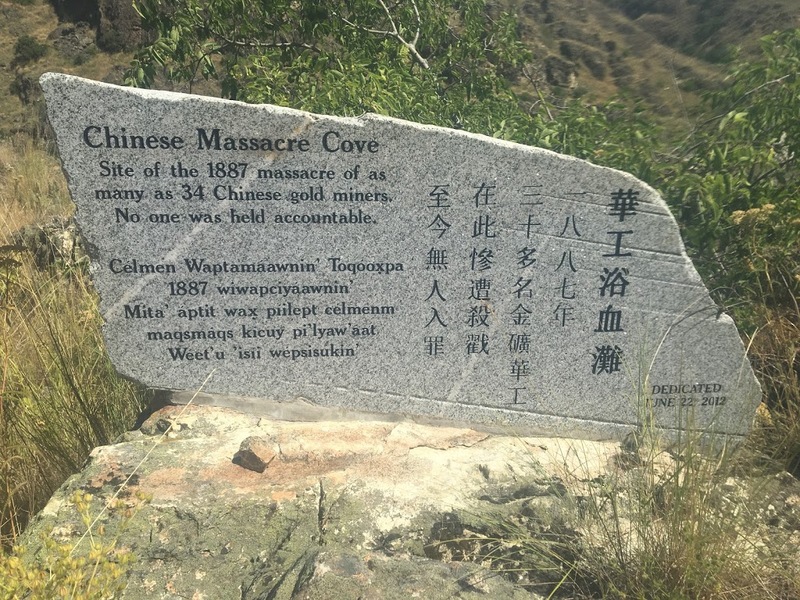
    <summary type="html"><![CDATA[<p><strong><em>Chinese Massacre Cove is located along a desolate and remote part of the Snake River—a dusty river bank in the middle of Hells Canyon—straddling the Oregon-Idaho border. Prospective visitors can only get there by either an arduously hot hike or by riverboat. Once there, the spot does not look much different from other parts of the river, except for an inscribed stone. This memorial stone describes the tragic events that took place here over 130 years ago.</em></strong></p><img src="https://www.intermountainhistories.org/files/fullsize/5693672d452077ca8fef11df17598de5.jpg" alt="Chinese Massacre Cove" /><br/><p>Many Chinese immigrants to the United States in the 19th century came to work as laborers and miners. They faced considerable discrimination and challenging working conditions in the American West. Usually reworking claims that American miners had deserted for more promising land, the Chinese also were at times prohibited by law to own mining claims and were forced to pay a special “Chinese” monthly tax. </p><p>The Chinese mining the Snake River tract of land, known today as Chinese Massacre Cove, were likely working under similar circumstances as their counterparts throughout the west. Not much is known about them—not even their names. However, what is known is that in May 1887 they were brutally murdered while working their mine. The motive is unknown, but most assume the murderers were after their gold. The exact details surrounding the massacre are ambiguous. Despite confessions by a few of the murderers, no one was ever convicted for the deaths of the 31-34 Chinese. </p><p>One of the worst massacres of Chinese people in the United States, Chinese Massacre Cove has received little public attention. Despite contemporary pleas by the Chinese delegates to track down the killers, few efforts were taken to incarcerate the ones responsible or to find out exactly what happened. Only recently have dedicated parties attempted to resurrect the tragedy, making the site an official historical area in 2009—a reminder of the often fatal discrimination Chinese workers faced in the American West. </p><p><em><strong><a href="https://www.intermountainhistories.org/items/show/127">For more (including 2 images) view the original article</a></strong></em></p>]]></summary>
    <published>2018-02-01T18:52:23+00:00</published>
    <updated>2026-04-17T19:32:00+00:00</updated>
    <link rel="alternate" type="text/html" href="https://www.intermountainhistories.org/items/show/127"/>
    <id>https://www.intermountainhistories.org/items/show/127</id>
    <author>
      <name>Dani Carmack, Brigham Young University</name>
    </author>
  </entry>
  <entry>
    <title type="html"><![CDATA[Colonel Patrick Edward Connor and the Bear River Massacre]]></title>
    <summary type="html"><![CDATA[<p><strong><em>On 29 January 1863 Colonel Patrick Edward Connor led a contingent of California militiamen against a Northwestern Shoshone village in present day Cache Valley, Idaho.  Connor and his men destroyed and burned the village, killing roughly 250 Indian men, women, and children over the space of four hours. The militiamen hopelessly outmatched the Northwestern Shoshone warriors who had only “bows and arrows, tomahawks, and a few rifles.”  Connor’s men, on the other hand, possessed 16,000 rounds of ammunition for their rifles and handguns, and additional ammunition for their mountain howitzers.  Historians refer to the events of this fateful day as the Bear River Massacre.</em></strong></p><img src="https://www.intermountainhistories.org/files/fullsize/b898db3530c02cc31fcbf5599aab4c2a.jpg" alt="Chief Sagwitch " /><br/><p> President Abraham Lincoln placed Connor in charge of the 3rd California Volunteer Infantry at the outbreak of the American Civil War in 1861. Fearing that the Confederates would try to isolate the newly formed state of California from the rest of the Union, Lincoln ordered Connor and his men to Salt Lake City to protect the overland mail routes from Indian attack. Incensed by this assignment, Connor pleaded with his superior officers to allow him to take his men east to fight in the main theater of the Civil War. He argued that the men under his command wanted to "serve their country in shooting traitors instead of eating rations and freezing to death around sage brush fires..." They longed for “the privilege of going to the Potomac and getting shot."  His request denied, he stayed in Utah Territory to protect the mail routes.  He ordered his men to construct Fort Douglas in Salt Lake City.</p><p>After two years without any military action, Connor instigated an opportunity to fight. The Northwestern Shoshone periodically traded with emigrant parties on the Oregon Trail, one of the primary routes under Connor’s protection, or defended themselves against unscrupulous miners traveling between Utah Territory and the future states of Idaho and Montana. Mormon settlement in Utah Territory and increased traffic along the Oregon Trail limited the resources available to the Northwestern Shoshone.  By the 1860s, the Shoshones had few choices but to exact a toll from emigrants and settlers utilizing Indian resources without compensating the tribe. Northwestern Shoshone warriors attacked a group of eight miners early in January 1863, killing two of them. The survivors made their way to Salt Lake City where they testified to Chief Justice John F. Kinney that Shoshones had attacked them. Kinney issued a warrant for the arrest of several Indian chiefs from the Northwestern Shoshone tribe including chiefs Bear Hunter, Sagwitch, and Sanpitch. The territorial marshal, Isaac L. Gibbs, recognizing that he would not be able to pursue and arrest the Shoshone chiefs by himself, requested the aid of Connor and his men.  Connor accepted enthusiastically. </p><p>Connor made it abundantly clear that because his superiors denied him the chance to fight Confederates in the South, he intended to fight Indian warriors instead. “Connor anticipated that a major fight with the Indians would give his bored troops an opportunity to exhibit their fighting prowess and might gain him new and more exciting appointments.”  He later admitted, “it was not my intention to take any prisoners.”  His expedition had nothing to do with protecting the overland mail routes, or arresting the Shoshone chiefs--he simply wanted a chance to fight but instead orchestrated a massacre.</p><p><em><strong><a href="https://www.intermountainhistories.org/items/show/24">For more (including 2 images) view the original article</a></strong></em></p>]]></summary>
    <published>2017-02-15T17:49:51+00:00</published>
    <updated>2026-04-17T19:31:58+00:00</updated>
    <link rel="alternate" type="text/html" href="https://www.intermountainhistories.org/items/show/24"/>
    <id>https://www.intermountainhistories.org/items/show/24</id>
    <author>
      <name>Erik Peterson, Brigham Young University </name>
    </author>
  </entry>
  <entry>
    <title type="html"><![CDATA[Reexamining the Bear River Massacre  ]]></title>
    <summary type="html"><![CDATA[<p><strong><em>January 29, 1863, dawned bright and cold. Encased in snow and silence, the Shoshone Indian camp located near the banks of Bear River near present-day Franklin, Idaho, had little idea what that fateful day held in store for them. In the early dawn hours, screams, gun smoke, and the feverish sounds of a pitched battle pierced the air. Within a few minutes, California militiamen had burned the Shoshones’ homes, shot their husbands and sons, raped and killed women, and blood stained the white snow, bringing immense sorrow and grief to the Shoshones. </em></strong></p><img src="https://www.intermountainhistories.org/files/fullsize/d3796127175afa2318b9c9a5b1ba1316.jpg" alt="Bear River Massacre site, looking east " /><br/><p>Colonel Patrick Edward Connor, upon hearing miner’s charges that Shoshones had stolen good and animals from them, had led his California Volunteers north from Fort Douglas in Utah Territory to Bear Hunter’s Shoshone village adjacent to the Bear River.  Connor, already antagonistic towards Indians and Mormons, had decided to attack the Indians in their winter encampment in order to participate in some form of military combat during the Civil War. </p><p>Connor’s men approached the Indian encampment early that morning. Upon seeing the approaching militia, the Indians quickly gathered up their weapons and the battle commenced. Once their ammunition ran out, the Indians asked to surrender, but received no mercy. The battle quickly turned into a massacre as the militia slaughtered 250 Shoshone men, women, and children while they California Volunteers suffered eighteen casualties. </p><p>At the sight of the confrontation, a national monument was to be erected, bearing the words “Battle of Bear River.” Mae T. Parry, a granddaughter of one of the chief Indians involved in the massacre, has begun to fight for the name of the Bear River Battle to be called the Bear River Massacre. “When you attack a sleeping village of Indian men, women and children, you can't call that a battle” Parry noted.  Her ongoing fight to right the wrongs of history reflects the ongoing struggles of her people against the American government and for the inclusion of Indian point-of-view into the national narrative. </p><p>In 2008 the Shoshone Nation acquired the site and commemorated the 150 year anniversary at the site in 2013. </p><p><em><strong><a href="https://www.intermountainhistories.org/items/show/23">For more (including 5 images) view the original article</a></strong></em></p>]]></summary>
    <published>2017-02-15T17:34:06+00:00</published>
    <updated>2026-04-17T19:31:58+00:00</updated>
    <link rel="alternate" type="text/html" href="https://www.intermountainhistories.org/items/show/23"/>
    <id>https://www.intermountainhistories.org/items/show/23</id>
    <author>
      <name>Kiya Mercado, Brigham Young University  </name>
    </author>
  </entry>
  <entry>
    <title type="html"><![CDATA[Death at Mountain Meadows ]]></title>
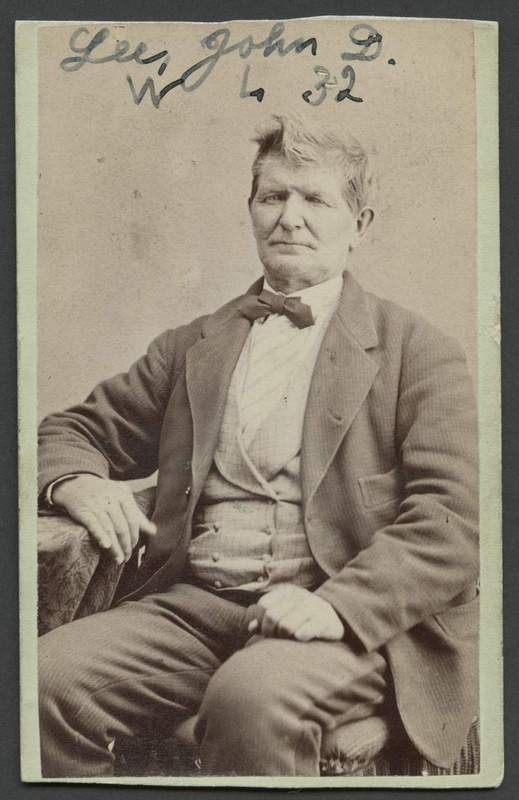
    <summary type="html"><![CDATA[<p><strong><em>The Fancher Party set out from Arkansas in April 1857, determined to reach the fertile fields of California- but they never reached their destination. Instead, they met their deaths at the hands of Mormon settlers and Paiute Indians near Mountain Meadows, an area just south of present day Cedar City, Utah on September 11, 1857. </em></strong></p><img src="https://www.intermountainhistories.org/files/fullsize/7681cb75268f4cde17eeec5e1d4a5372.jpg" alt="John D. Lee " /><br/><p>The mid-1850s relationship between Latter-day Saints (or Mormons) and the United States government, who felt that they were growing too powerful, was tense. In response to the growing power of the leaders of the LDS Church in Utah, the federal government sent a large Army to Utah in 1857 to assess the situation and suppress any potential rebellions against the United States. With the army's approach, fear and anxiety spread among Mormon settlers in Utah Territory.</p><p>It was in this atmosphere that the Fancher party crossed Utah Territory on their way to California. Contention abounded between the Fancher Party and the Mormon communities through which they passed on their journey west. The emigrants chided Mormon settlers that the army was coming to suppress the religious group, and boasted that members in their group had persecuted Joseph Smith, the Church’s first leader. Their threats to steal from Mormon communities further enraged the Saints, creating a climate that resulted in extra-legal vigilantism.</p><p>In response to the perceived threats, LDS leaders in Cedar City and Parowan took matters into their own hands. Isaac C. Haight, William Dame, and John D. Lee solicited the aid of local Paiute Indians to steal the settlers’ stock while the local community plotted to attack the emigrant train encamped at ‘the Meadows.’ Under the ruse of a white flag, Lee led the Indians in the raid.  Then, the local men disarmed the wagon train and killed around 120 emigrants on September 11, 1857. Only seventeen members of the party survived, all children too young to remember the attack. After the massacre, word came from Brigham Young in Salt Lake City for the Saints and the Paiutes to let the emigrant train pass unmolested.  Unfortunately, his letter came too late to save the emigrant party from disaster. Some debate Young's knowledge and timing of the letter.</p><p>A series of cover-up stories allowed those responsible for the massacre to escape prosecution for years. John D. Lee faced trial in 1875, though the court did little to address the situation. A second trial commenced in 1878.  This time the court attributed full responsibility for the massacre to Lee, ruling that his actions qualified as murder. The jury sentenced Lee to death and the federal representatives executed Lee on March 23, 1877.  The involvement and role of Paiute auxiliaries is still debated to the present. The other men responsible for the massacre escaped legal punishment. Most of the massacre survivors eventually rejoined relatives in Arkansas and California.  Representatives of the participants dedicated a memorial commemorating the tragedy and honoring the families who died at Mountain Meadows in 1999.</p><p><em><strong><a href="https://www.intermountainhistories.org/items/show/22">For more (including 5 images) view the original article</a></strong></em></p>]]></summary>
    <published>2017-02-15T17:21:51+00:00</published>
    <updated>2026-04-17T19:31:58+00:00</updated>
    <link rel="alternate" type="text/html" href="https://www.intermountainhistories.org/items/show/22"/>
    <id>https://www.intermountainhistories.org/items/show/22</id>
    <author>
      <name>Rachel Hendrickson, Brigham Young University </name>
    </author>
  </entry>
  <entry>
    <title type="html"><![CDATA[Memorializing Mountain Meadows]]></title>
    <summary type="html"><![CDATA[<p><strong><em>This monument honoring the victims of the Mountain Meadows Massacre is a sober one. It tells a story of fear, radicalism, and tragedy. </em></strong></p><img src="https://www.intermountainhistories.org/files/fullsize/52f1afbf2035519af22f18d37ca1543e.jpg" alt="Mountain Meadows Massacre Monument" /><br/><p>In the mid-1850s, the Mormons of Utah were not on friendly terms with the United States of America. Previous persecutions from the government caused Mormons to be distrustful of the United States. The United States saw the Mormon theocracy that existed in Utah and feared its disloyalty. This caused the Utah War, a cold war between the territorial and federal governments. Droughts and pestilence in the mid-1850s caused an extremist movement in Utah called the Mormon Reformation with powerful rhetoric, including a religious capital punishment. The atmosphere of Utah at the time was hostile. </p><p>The Baker-Fancher party of emigrant families was passing through the Southern end of Utah and rumors went with them. Local Mormons feared their intentions and assembled militia and local Paiutes to attack. In a series of attacks from September 7-11, 1857, 120 men, women, and children were killed, leaving only 17 small children alive. After much controversy over who was at fault for the massacre and the extensive efforts to cover up and understand, John D. Lee, one of the men who led the assault, was ultimately convicted and sentenced to death. </p><p>The first monument was built by James H. Carleton in 1859 when he was investigating the massacre for the United States. In shock of what he had seen, he felt the need to build a monument by stacking stones atop one another with a cross at the top. The monument was repeatedly destroyed and rebuilt over the years. Calls for a more honorable and permanent monument were made by the descendants of the Baker-Fancher party and Mormon President Gordon B. Hinckley. While the permanent monument was being built in August 1999, a backhoe dug up the bones of 28 massacre victims. Much controversy went behind whether to study them or to honor them through reburial in time for the dedication. Utah Governor Mike Lee made the decision to not spoil the commemoration of the dead with controversy. The decision was made to honor the dead and allow for the healing of old wounds. </p><p>Historian Levi Peterson likens learning about the massacre to a Greek tragedy. Tragedies tell a story of an honorable hero who falls under a gross misunderstanding. When we view another in the midst of a tragedy, we are capable of escaping our own tragic emotions and seek for healing through catharsis. As one views this monument, one may come seeking healing of their own mistakes.</p><p><em><strong><a href="https://www.intermountainhistories.org/items/show/9">For more (including 4 images) view the original article</a></strong></em></p>]]></summary>
    <published>2017-01-11T00:17:39+00:00</published>
    <updated>2026-04-17T19:31:58+00:00</updated>
    <link rel="alternate" type="text/html" href="https://www.intermountainhistories.org/items/show/9"/>
    <id>https://www.intermountainhistories.org/items/show/9</id>
    <author>
      <name>Jason Colver, Brigham Young University</name>
    </author>
  </entry>
</feed>