<?xml version="1.0" encoding="UTF-8"?>
<feed xmlns="http://www.w3.org/2005/Atom">
  <title type="text">Intermountain Histories</title>
  <updated>2026-04-17T19:32:21+00:00</updated>
  <generator uri="http://framework.zend.com" version="1.12.20">Zend_Feed_Writer</generator>
  <link rel="alternate" type="text/html" href="https://www.intermountainhistories.org/"/>
  <link rel="self" type="application/atom+xml" href="https://www.intermountainhistories.org/items/browse?output=rss2"/>
  <id>https://www.intermountainhistories.org/</id>
  <author>
    <name>Intermountain Histories</name>
    <uri>https://www.intermountainhistories.org</uri>
  </author>
  <link rel="hub" href="https://pubsubhubbub.appspot.com/"/>
  <entry>
    <title type="html"><![CDATA[Pearl Hart: The Bandit Queen]]></title>
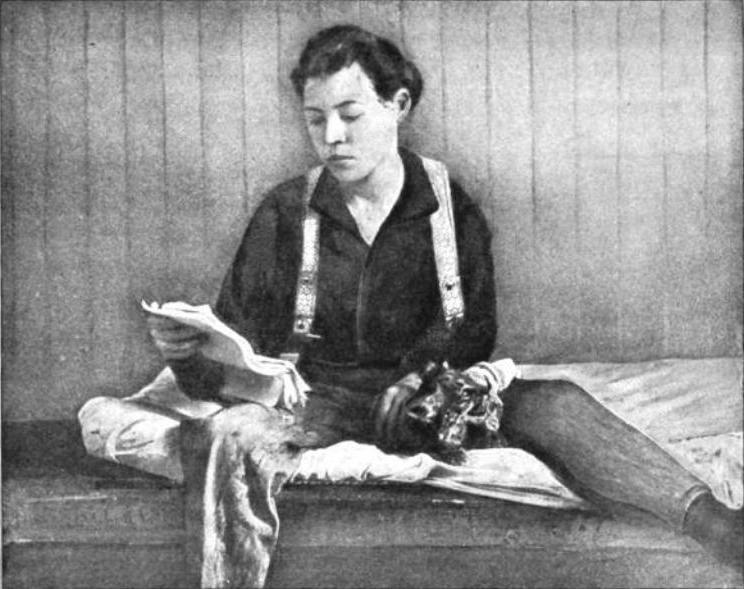
    <summary type="html"><![CDATA[<p><strong><em>Best remembered for committing a stagecoach robbery, and her rare identity as a “Lady Outlaw” of the Wild West, the life of Pearl Hart might not have been as adventurous or romantic as it appears on the surface. </em></strong></p><img src="https://www.intermountainhistories.org/files/fullsize/22b8112b8583aaa5d0d96bbc1c1ccaca.jpg" alt="Pearl Hart reading a paper in her jail cell" /><br/><p><span style="font-weight:400;">Lillie Naomi Davy, later known as “Pearl Hart,” was born into a violence that she would spend the rest of her life attempting to escape. Born in 1871, she was the third of at least eight children and spent most of her childhood in rural Lindsay, Ontario. Her father was relentlessly abusive, and her mother had little power over the situation. Lillie and her siblings were often left to fend for themselves, turning to mischief and even crime. In her youth she was described as, “livesome, blythe, and witty.” At eleven-years-old Lillie and her thirteen-year-old brother William stole a cow from a neighboring farm and re-sold it before they were caught. Lillie and her sisters Catherine and Saphronia frequently ran away from home, usually to the western United States. They cut their hair short and dressed in men's clothes, which helped them fly under the radar. Once they’d been discovered, which they always were, the sisters were usually sent back to New York, where their mother had moved prior to their father’s imprisonment for violent crime. </span>
<span style="font-weight:400;">Lillie was only fifteen when she started seeing Charles Dean, who became her first husband only a year later, although he was thirty-five and had been married to another woman when they had initially met. When he grew increasingly violent towards her, Lillie ran away with her sister Catherine once again. In the next several years Lillie remarried, or at least claimed to be re-married, for there was no legal documentation of divorce from Charles, to a man named Dan Bandman. She admired him for his college education and musical talents, though it did not take long for his charm to wear thin and the violence that so haunted young Lillie’s life to once again threaten her. </span>
<span style="font-weight:400;"></span><span style="font-weight:400;">The western frontier beckoned hope to anyone looking for an escape. There was a promise of freedom, opportunity, and prosperity for those who had the guts and grit to make it on their own. Work in the west was mostly limited to hard labor for men in fields such as mining, logging, and construction. Women, especially the unmarried, had far fewer options. The most profitable by far being prostitution. Lillie and Catherine worked for a time in a brothel run by the mistress Pearl Hart, someone they both likely admired, for Catherine began referring to herself as “Minnie Hart,” and in the following years Lillie took on the alias of “Pearl Hart” herself. Like her contemporaries “Butch Cassidy” and “Billy the Kid,” this new title was more than just a new name, it was an attempt to reinvent her persona and conceal her past identity. </span>
<span style="font-weight:400;">From late adolescence to early adulthood, Pearl never stayed anywhere long and did whatever she could to survive––which often meant working in dangerous conditions or returning to an equally dangerous life with an abusive husband. </span>
<span style="font-weight:400;"></span><span style="font-weight:400;">In 1899 Pearl became desperate to make a decent sum of money, and quick, presumably because she had just discovered her mother was dying and wanted to get back east to say goodbye. After a brief, and fruitless, stint working in the mines of Globe, Arizona Pearl teamed up with a man known as “Joe Boot.” It is unclear what kind of relationship they had, or who the mastermind behind the operation was, but most signs point to Pearl as the instigator. After they had been taken into custody, Pearl described Joe as cowardly, stating that his hands were “shaking like leaves” the whole time. Although they had been somewhat kind to the victims of their heist, giving them back half of the money so that the travelers would not be left completely destitute, Pearl was sentenced to five years at Yuma Territorial Prison. </span>
<span style="font-weight:400;"></span><span style="font-weight:400;">Following her stint in prison, Pearl became more elusive and there are not many records of her exploits––criminal or otherwise. While her incarceration kept her from ever reuniting with her mother, she did reconnect with some of her siblings. One of her sisters wrote a play based on the exploits of “Pearl Hart,” the legendary character she had become. She acted in the play as herself, fulfilling a dream she had once had of becoming an actress. </span>
<span style="font-weight:400;">Pearl spent much of her life in seemingly hopeless and tumultuous circumstances, but she might have found joy in stage performance. Or in time spent reminiscing with her sisters about their adolescent larks––dressing in boys clothes and hopping trains to unexplored cities––before they had to face the reality of their stations in life. </span></p><p><em><strong><a href="https://www.intermountainhistories.org/items/show/929">For more (including 3 images) view the original article</a></strong></em></p>]]></summary>
    <published>2025-12-09T17:24:32+00:00</published>
    <updated>2026-04-17T19:32:21+00:00</updated>
    <link rel="alternate" type="text/html" href="https://www.intermountainhistories.org/items/show/929"/>
    <id>https://www.intermountainhistories.org/items/show/929</id>
    <author>
      <name>Megan Bailey, Brigham Young University</name>
    </author>
  </entry>
  <entry>
    <title type="html"><![CDATA[Davis County Memorial Courthouse <br />
]]></title>
    <summary type="html"><![CDATA[<p><strong><em><span style="font-weight:400;">The Davis County Courthouse was first built in 1890. The federal-style courthouse was then remodeled three different times to account for the conuty's growing population. The first phase was completed in 1932, and others were completed in 1957 and 1979, with renovations in 1997.</span></em></strong></p><img src="https://www.intermountainhistories.org/files/fullsize/e82dc2bdd36fa1a5b143723746da6127.jpg" alt="The First Davis County Courthouse" /><br/><p><span style="font-weight:400;">On March 22, 1852, the Davis County Commissioner told the county clerks to create three blueprints for the county’s courthouse to be approved. The winning design was a small two-story 35x45 foot adobe building. This courthouse was built upon a rocky knoll just south of State Street. The building was erected using donations and taxes, and the people of the North Cottonwood LDS Ward had donated so much to the courthouse that the ward was permitted to use an upper room of the courthouse for meetings, and parties if the room was not in use. Rooms of this first courthouse were also used as a general store, practice  hall, and dance hall. </span>
<span style="font-weight:400;">On May 20, 1889, a new courthouse was approved by the county commissioner; this courthouse would be built just a few feet south of where the existing courthouse stood so State Street could be expanded without obstruction. The second courthouse was finished on August 18, 1890 and led by architect William Allen. The original courthouse was torn down in September of 1890.</span>
<span style="font-weight:400;">Davis County continued to grow, and before long more room in the courthouse was required. In 1929, the county commissioner announced the expansion of the courthouse. The county hired architect Theo Pope and contractors F.R. Knowlton and George Rupert for the project. This expansion was paid for by a memorial levy, thus the building was named the Davis County Memorial Courthouse. The second building was to remain in place, only the large tower at the front being removed. The entrance was increased and redesigned. Two wings extending off the original structure gave the building a neoclassical look. The expansion finished in 1932. In August 1956, plans to increase the courthouse were again approved with Theo Pope serving as architect once again. Another expansion of the courthouse occurred in 1979. The County Commissioner met again with Pope in May to renovate the jail from one story to two and to build a service tunnel between the courthouse and the library. </span>
<span style="font-weight:400;">After 50 years of expansion, Davis County continued to accomodate a growing population. Iin 1990, the jail and courts had outgrown the Memorial Courthouse and moved to new facilities west of downtown Farmington. In 1996, the Memorial Courthouse had a small renovation, and the1889 building's  ceiling was uncovered. In 2010, the 1929 portion of the Memorial Courthouse joined both the Farmington Historic Landmark Register and the National Register of Historic Places. In 2010, the Farmington City Council voted to list the Davis County Memorial Courthouse as a city historic resource. In 2021, the newer section of the building was razed due to structural concerns. </span></p><p><em><strong><a href="https://www.intermountainhistories.org/items/show/685">For more view the original article</a></strong></em></p>]]></summary>
    <published>2022-10-28T17:24:48+00:00</published>
    <updated>2026-04-17T19:32:15+00:00</updated>
    <link rel="alternate" type="text/html" href="https://www.intermountainhistories.org/items/show/685"/>
    <id>https://www.intermountainhistories.org/items/show/685</id>
    <author>
      <name>Marina Kenner, Weber State University </name>
    </author>
  </entry>
  <entry>
    <title type="html"><![CDATA[Queen Aggie: Boise’s Black Madam]]></title>
    <summary type="html"><![CDATA[<p><strong><em>Levy’s Alley was Boise’s most notorious restricted district. After Davis Levy’s death, Agnes Bush became one of its most famous proprietors.</em></strong></p><img src="https://www.intermountainhistories.org/files/fullsize/0cad4d80950205d12f20127cfaf8287c.jpg" alt="Parlor" /><br/><p>Named for Davis Levy, the original owner of many of the cribs that lined the alley in the 1880s, Levy’s Alley ran behind the 600 block of Main Street in downtown Boise. While the alley was not the only restricted district in the city, it was the most notorious, and the majority of Boise’s most famous madams and sex workers lived and worked there. One such person was Agnes Bush, also known as “Queen Aggie,” a Black woman who operated multiple cribs and parlor houses in Boise.
Bush was one of Levy’s prior tenants, and after he died, she acquired some of the property for herself and expanded a pleasure business of her own. Bush soon ran multiple rooms in the district, by then nicknamed “Levy’s Alley” after Davis, which she rented out by individual women known as “crib girls.” She was known not only as a successful businesswoman but also as a prominent citizen, and the <em>Idaho Daily Statesman</em> frequently wrote about her charitable acts for the poor and children in need. Bush also made important donations to the city and formed long-standing financial and “friendly” ties with the press and local law enforcement. These relationships were supplemented by expensive gifts such as a diamond-encrusted badge she gave to Boise police chief B. F. Francis and a $250 diamond ring to local journalist C. Miles. These gifts and activities both ensured and announced Bush’s prominent role in Boise, for which she earned the nickname “Queen Aggie.”
Agnes Bush stands out because she was a Black woman. As a prominent figure in the Boise community with ties to law enforcement, as well as significant property holdings and wealth, she stands as a curious anomaly in the history of the Treasure Valley and the broader region. Though there was white supremacist activity in the area given Boise’s proximity to Oregon (which white residents established officially as a white-only state in its 1859 constitution), Bush was a major player in her community. Indeed, local government and law enforcement typically tolerated sex workers in Boise until 1909, when national sentiments turned against the traditional practice of relegating sex workers to restricted districts in favor of completely expelling such para-legal practices in the name of public health. That year, Congress passed the Mann Act, and local Boise officials began targeting their city’s sex workers for fear of federal intervention.
After being run out of the city, Bush moved to Portland, Oregon to live with one of her sons while she suffered from partial paralysis. In 1910, the <em>Statesman</em> reported her death in Portland and revealed her “real name,” Frances Richardson. Despite how her story ended, Bush’s success and her ties to the community suggest the rich tapestry of people that comprised the state of Idaho’s early years and reflect the fascinating and dynamic time in which she lived.</p><p><em><strong><a href="https://www.intermountainhistories.org/items/show/624">For more (including 3 images) view the original article</a></strong></em></p>]]></summary>
    <published>2022-06-25T23:56:23+00:00</published>
    <updated>2026-04-17T19:32:13+00:00</updated>
    <link rel="alternate" type="text/html" href="https://www.intermountainhistories.org/items/show/624"/>
    <id>https://www.intermountainhistories.org/items/show/624</id>
    <author>
      <name>Gabriel Herring, College of Idaho</name>
    </author>
  </entry>
  <entry>
    <title type="html"><![CDATA[Polygamists in the Sugar House Pen]]></title>
    <summary type="html"><![CDATA[<p><strong><em>In the 1880s, Latter-day Saints convicted for polygamy filled Western prisons. One of these was “the Pen,” or Utah Territorial Penitentiary.</em></strong></p><img src="https://www.intermountainhistories.org/files/fullsize/98499b6cc99aca4386a3f83d7a5c4484.jpg" alt="Cannon and the Brethren" /><br/><p><span style="font-weight:400;">In 1857, Latter-day Saints in Britain could buy the fourth volume of the </span><i><span style="font-weight:400;">Journal of Discourses</span></i><span style="font-weight:400;"> and find a stirring declaration attributed to Brigham Young. The prophet-president of The Church of Jesus Christ of Latter-day Saints (sometimes nicknamed “Mormons” at the time) decried the United States Congress’ agitations against polygamy, saying, “True we have more wives than one, and what of that?” Young questioned if Congress could even enforce the law. He hyperbolically supposed a prison large enough to contain every polygamist lawbreaker in Utah would eventually have to encompass the entire Great Basin, “roofed… over from the summit of the Rocky Mountains to the summit of the Sierra Nevada.” When federal prosecution of polygamy cases escalated in the 1870s and 1880s, officials instead relied on western prisons like the Utah Territorial Penitentiary—sometimes nicknamed “the Pen.”</span>
<span style="font-weight:400;">Completed in 1854, the Territorial Penitentiary was southeast of Salt Lake City in Sugar House, Utah. Just two years previous, the territorial Legislative Assembly had requested federal money for building a prison in order “to prevent crime, but also to reform the offenders.” Decades later, federal officials were now trying to use the penitentiary to prevent polygamy and reform the Mormons.</span>
<span style="font-weight:400;">This included Mormons such as George Q. Cannon, who lived in hiding “underground” from 1885 to 1888. Cannon was the First Counselor in the First Presidency of the Church—a high office held only by apostles—and with five wives and thirty-two children, he was an easy target for federal marshals. Despite the dangers, though, hiding grated on Cannon. In his journal, he wrote he was “not anxious to become a martyr,” yet also “always felt to urge our people to stand up courageously to their principles” and wanted to live up to the same standard. When a prosecutor and marshal tried to extort the Church—money in exchange for not prosecuting Cannon—Cannon resolved to turn himself in, deciding, “I had much rather go to the penitentiary and serve the full term” than have the Church pay blackmail money to do him a special favor other Latter-day Saint polygamists could not afford.</span>
<span style="font-weight:400;">Cannon entered the Territorial Penitentiary in Sugar House in September 1888, and he found himself in good company. Fifty other Mormon polygamists were also in the Pen “for living with their wives,” as Cannon wrote, and they even took a few photographs together when they had visitors. Perhaps with some irony, Cannon observed in his journal that he and “the brethren”—as he liked to call his fellow Latter-day Saint incarcerees—resided in the same prison as twenty-two men either accused or convicted of murder. </span>
<span style="font-weight:400;">Conditions in the Pen were scant. Winters were cold, but fires were prohibited for fear of arson. One inmate remembered waking up on winter mornings with his beard frozen solid. The prison provided spoons but no other utensils, so “the brethren have improvised knives out of spoon handles and other scraps of metal they have got hold of and made wooden forks,” Cannon wrote. Meals themselves were mostly coffee, bread, meat, gravy, and “mush.” Cannon did not drink coffee, and he often forewent meat. He substituted milk and butter when he could.</span>
<span style="font-weight:400;">Unlike some other prisons in the Western territories, the Pen did not make labor part of the sentence, leaving inmates with copious free time. Cannon filled the extra time by researching and writing a history he called </span><i><span style="font-weight:400;">The Life of Joseph Smith the Prophet</span></i><span style="font-weight:400;">, a project he and his sons had been writing for the last six years.</span>
<span style="font-weight:400;">On Sundays, Cannon and the other imprisoned Latter-day Saints held Sunday School together, reading the Bible and singing hymns. In October 1888, they even procured an organ from the Church’s Sunday School Union for musical accompaniment. Other ministers came to the Pen to give sermons in the afternoon, and Cannon sometimes assessed them. One Episcopal preacher’s “discourse was a very weak effort,” Cannon thought, but a few months later a Methodist “preached the best Methodist sermon” Cannon had ever heard.</span>
<span style="font-weight:400;">Cannon’s prison sentence was short—only five months—and he left the Pen in February, 1889. In his journal, he was optimistic. He wrote, “The Lord manifested to me in a very plain manner, before I came in, that I ought to go, and that if I did, it would be easier for the brethren who should follow.” Now, five months later, Cannon noticed polygamists receiving shorter sentences, prison officials granting more privileges to inmates, and even the quality of the food improving. “Our lot was far from being a hard one,” Cannon thought. The Latter-day Saints would continue to endure, he was certain.</span></p><p><em><strong><a href="https://www.intermountainhistories.org/items/show/503">For more (including 5 images) view the original article</a></strong></em></p>]]></summary>
    <published>2021-09-24T04:58:21+00:00</published>
    <updated>2026-04-17T19:32:10+00:00</updated>
    <link rel="alternate" type="text/html" href="https://www.intermountainhistories.org/items/show/503"/>
    <id>https://www.intermountainhistories.org/items/show/503</id>
    <author>
      <name>Makoto Hunter, Brigham Young University</name>
    </author>
  </entry>
  <entry>
    <title type="html"><![CDATA[The United States v. Udall Cases and the St. Johns Ring]]></title>
    <summary type="html"><![CDATA[<p><strong><em>In the 1880s, David Udall—bishop of the St. Johns Ward of The Church of Jesus Christ of Latter-day Saints—found himself and his community increasingly at odds with the St. Johns Ring, a group of sheriffs, court officers, and town leaders who brought the power of public opinion and the authority of the courts to bear in their crusade against Mormon polygamy.</em></strong></p><img src="https://www.intermountainhistories.org/files/fullsize/6957fe46c0ddc29d6012b614f16e12bc.jpg" alt="Courthouse in Prescott" /><br/><p><span style="font-weight:400;">When authorities arrested Latter-day Saint bishop David King Udall on perjury charge in May 1884, his second wife Ida Hunt Udall called it a “trumped-up charge, simply got through malice on the part of the ‘ring.’” Though Ida dismissed the case as spiteful and unfounded, within the year David was in court both this perjury charge and two more trials, including a polygamy charge and second perjury case. Ida saw the “St. Johns Ring” operating behind each charge—an anti-polygamy group in St. Johns, Arizona who thoroughly controlled the town.</span>
<span style="font-weight:400;">Solomon Barth, a German Jew who founded St. Johns with Mexican farmers, led the Ring. As the town’s founder, Barth became its de facto leader, and his marriage to Refugio Landavazo y Sanchez, a prominent Spanish-American, extended his influence to the local Hispanic community. Barth regularly served as a grand jury foreman, and his employees often filled grand jury seats. With his intersecting business and political influence, Barth could influence his employees’ votes as grand jurors.</span>
<span style="font-weight:400;">Others in positions of civic authority joined Barth in the St. Johns Ring. Ebenezer S. Stover, Tomas Perez, and John Lorenzo Hubbell all served as sheriff; Charles L. Gutterson was the local United States District Attorney, Alfred Ruiz was district clerk, and George A. McCarter was the local United States Court Commissioner. McCarter’s position was particularly powerful. He determined the priority for pressing charges and often chose cases prosecuting Latter-day Saints.McCarter was also editor of the </span><i><span style="font-weight:400;">Apache Chief</span></i><span style="font-weight:400;"> (renamed </span><i><span style="font-weight:400;">St. Johns Herald</span></i><span style="font-weight:400;"> in 1884), a newspaper regarded as heavily anti-polygamy and anti-Mormon. In an 1884 journal entry, Ida reported the newspaper wrote about her “frequently,” describing her in “glowing colors” as a “prostitute, mistress, etc.” Even after McCarter sold the paper in 1885, it still declared itself “the only exclusively anti-Mormon paper in Arizona.”</span>
<span style="font-weight:400;">Although the St. Johns Ring justified their actions as the duties of elected public office, St. Johns’ Mormons accused Ring members of holding their offices through voter fraud. For example, David reported being barred from voting in November 1882. The election official simply told him, “We have decided that no polygamist should vote today.” David recalled, “There was no redress; I turned and walked away.” With the sheriffs in the Ring, investigations into the voter suppression did not materialize.</span>
<span style="font-weight:400;">By 1882, Mormons faced frequent “nuisance suits,” including larceny, unlawful assembly, and perjury. With Barth serving as grand jury foreman, indictments were frequent.</span>
<span style="font-weight:400;">Under these difficult circumstances, David testified before a grand jury for the perjury complaint filed against him. In David’s June 1884 grand jury, however, an independent St. Johns local named David Campbell served as jury foreman, not Barth. After hearing David’s testimony about the supposed perjury—an error caused by a misunderstanding on district clerk Ruiz’s part—Campbell convinced the grand jury to dismiss the case.</span>
<span style="font-weight:400;">The dismissal was only a temporary respite. By August, David was charged and arrested for unlawful cohabitation, despite his second wife Ida going into hiding two months earlier. All but one of the witnesses signing the indictment were members of the St. Johns Ring, whom Ida in her journal insisted, “knew nothing whatever of our family affairs, except from hearsay.”</span>
<span style="font-weight:400;">In November, David stood trial in Prescott, Arizona. However, the prosecution failed to subpoena Ida and compel her testimony, and without further evidence the court found David not guilty. David was fortunate; three Latter-day Saint neighbors were convicted in the same timespan. By January 1885, Church prophet-president John Taylor was advising members to flee Arizona and migrate to Mexico, beyond the reach of the U.S. government. David stayed in St. Johns, but some forty other families packed up and left town.</span>
<span style="font-weight:400;">David, perhaps, should have also left. In the summer of 1885, a grand jury convened to attempt a second indictment for the previously dismissed perjury charge, and this time the court did not inform David. Without his testimony, the grand jury indicted David for perjury.</span>
<span style="font-weight:400;">At the trial itself, Judge Howard Sumner presided. Sumner was a respected jurist and frequent speaker on the evils of polygamy. In David’s trial, Sumner sustained the prosecution’s objections to defense testimony and evidence, effectively excluding all possible proof that might have exonerated David. The jury returned a guilty verdict after 30 minutes. In response, David wrote this prayer: “Oh God, please deliver me… If I am to suffer imprisonment, let it be for my religion and not for the heinous crime that will be a disgrace to me and my family throughout life.” By September 1885, David was serving his prison sentence in Detroit, Michigan.</span>
<span style="font-weight:400;">This was the St. Johns Ring’s last anti-Mormon victory. Some unknown disagreement between Barth and the others caused him to split from the Ring. Meanwhile, former sheriff Hubbell had begun forming business relationships with Mormons, and district clerk Ruiz had actually tried to testify on David’s behalf before Sumner ruled against the defense. The two of them left the Ring, and they even signed on to a letter to President Grover Cleveland asking him to pardon David. Cleveland did, freeing David in December 1885.</span>
<span style="font-weight:400;">By 1887, the Ring fell apart. McCarter was dismissed as court commissioner due to alcoholism, and Barth went to prison for two years as the territorial court turned against him and found him guilty of destroying county records. Meanwhile, by 1888 David moved to Round Valley, Arizona, where he lived for several years before eventually moving back to St. Johns with his family and going on to <a href="https://www.intermountainhistories.org/items/show/504?tour=39&index=7">build a home there</a> and become a stake president for the Church. After his prison sentence, Barth also returned to St. Johns. Having apparently mellowed out toward Mormons by the time he died in 1928, Barth requested his funeral be held in a Latter-day Saint chapel. Levi Udall, David’s son, conducted the service.</span></p><p><em><strong><a href="https://www.intermountainhistories.org/items/show/500">For more (including 8 images) view the original article</a></strong></em></p>]]></summary>
    <published>2021-09-23T10:37:53+00:00</published>
    <updated>2026-04-17T19:32:10+00:00</updated>
    <link rel="alternate" type="text/html" href="https://www.intermountainhistories.org/items/show/500"/>
    <id>https://www.intermountainhistories.org/items/show/500</id>
    <author>
      <name>Makoto Hunter, Brigham Young University</name>
    </author>
  </entry>
  <entry>
    <title type="html"><![CDATA[George Reynolds’s Polygamy Convictions]]></title>
    <summary type="html"><![CDATA[<p><strong><em><i><span style="font-weight:400;">Reynolds v. United States</span></i><span style="font-weight:400;"> would eventually resolve the dispute over polygamy and religious freedom in favor of the United States government. But before the case could get to the Supreme Court, George Reynolds needed to be convicted—and he wanted to fight the charge. </span></em></strong></p><img src="https://www.intermountainhistories.org/files/fullsize/227143f7e6fb8fc3a97c8b41e9bab676.jpg" alt="George Reynolds and sons" /><br/><p><span style="font-weight:400;">Although Congress passed the Morrill Anti-bigamy Act in 1862, twelve years later in 1874 no court had yet found a single member of The Church of Jesus Christ of Latter-day Saints (sometimes nicknamed “Mormons” in that time) guilty of having multiple wives. While the rest of America condemned Mormon polygamy as a barbaric heresy and theocratic threat to democracy, Church leaders insisted the First Amendment to the Constitution protected their plural marriages under the free exercise of religion. Meanwhile, most Latter-day Saint polygamists lived in remote western U.S. territories. Latter-day Saints held electoral majorities for years, effectively guaranteeing territorial law enforcement, judges, and juries were friendly to Latter-day Saints.</span>
<span style="font-weight:400;">However, in June 1874 Congress passed the Poland Act, granting United States district courts exclusive criminal jurisdiction in the territories, thereby putting judges, juries, and polygamy cases in the hands of the federal government instead of territorial voters. Within a year, federal prosecutors finally had a trial for an anti-polygamy case against George Reynolds, a clerk in the office of the Church’s First Presidency who had married a second wife earlier that year. Reynolds originally agreed to be indicted as a “test case” negotiated between the Church and federal prosecutors to settle the Church’s First Amendment claims, but the agreement fell apart after his October 1874 indictment. By the time of Reynolds’s trial in March 1875, Reynolds was fighting for a not guilty verdict.</span>
<span style="font-weight:400;">Court convened on March 31, 1875 for </span><i><span style="font-weight:400;">United States v. Reynolds</span></i><span style="font-weight:400;">. Although Latter-day Saints were among the jury, they agreed to respect the trial court’s ruling on the Morrill Act’s constitutionality for the sake of deciding the verdict. But Carey, the prosecutor, soon found himself at an impasse anyway. He declared his intent to prove Reynolds lawfully married Mary Ann Tuddenham in 1865 and unlawfully married Amelia Jane Schofield in 1874, but the fourteen witnesses he subpoenaed—including friends and family of Reynolds—had planned ahead of time to give testimonies that would obscure as much as possible Reynolds’s relationship to Schofield. Historian Bruce van Orden observed, “their testimonies bordered not merely on evasion but on lying.” Daniel H. Wells, who had officiated the marriage, testified he could not clearly remember the ceremony. Reynolds’s sister Julia, who shared his home, admitted that a woman besides Reynolds’s first wife did live in the house but insisted she did not know if the second woman and Reynolds were married. In later polygamy cases, other families made similar efforts to dance on the edge of “truth” to avoid implicating husbands and wives.</span>
<span style="font-weight:400;">Before the end of the trial’s first day, the prosecution team privately agreed they were failing to prove the case—but they were not ready to give up. There was one potential witness they had not subpoenaed already: Amelia Jane Schofield, Reynolds’s second wife. Since the government did not recognize their marriage as lawful, they could justify subpoenaing Amelia to testify against her husband. The prosecution quietly obtained a subpoena, and while they waited for a deputy marshal to escort Amelia to the courthouse, Carey asked for and received a brief recess.</span>
<span style="font-weight:400;">Not long after, Amelia arrived. Benjamin R. Cowen (sometimes spelled Cowan), Assistant Secretary of the Interior, was in the courtroom audience and believed “the ghost of Joe Smith would scarcely have produced a more profound sensation.” Now several months into her pregnancy, Amelia was obviously carrying someone’s child, and “she must either have sworn herself the lawful wife of George Reynolds or tacitly confessed to being his concubine,” Cowan thought.</span>
<span style="font-weight:400;">In the end, her cross-examination was even simpler. Because the prosecution had not previously subpoenaed Amelia, she had not been part of the other witnesses’ preparation. Carey asked Amelia who she was married to, and she calmly testified that Reynolds was her husband.</span>
<span style="font-weight:400;">Court reconvened on April 1, 1875, and Carey rested his case. J.G. Sutherland, Reynolds’s defense attorney, pivoted his strategy and admitted Reynolds and Amelia indeed were married, but he asserted the First Amendment protected their marriage as a religious practice. The prosecution objected to the statement as irrelevant, and the judge upheld the objection—establishing grounds for Reynolds to eventually bring his case to the Supreme Court. The jury—Mormons and all—returned a guilty verdict after deliberating for thirty minutes.</span>
<span style="font-weight:400;">Several legal snafus followed the trial, including an appellate court decision to overturn the trial’s verdict for irregularities in the original indictment. But after a second trial in which Reynolds’s defense again insisted the First Amendment protected his practice and a second judge again declared this defense invalid, a second jury again declared Reynolds guilty. On December 21, 1875, Judge Alexander White sentenced Reynolds to serve two years in prison.</span>
<span style="font-weight:400;">Reynolds and the Church immediately appealed the decision, and the government postponed his sentence in the meantime. But when the Supreme Court upheld the Morrill Act as constitutional in 1879, Reynolds’s two-year prison sentence caught up to him. On June 16, 1879, Reynolds handed himself over to federal marshals. Latter-day Saints called him a “living martyr,” “imprisoned for conscience’ sake.”</span></p><p><em><strong><a href="https://www.intermountainhistories.org/items/show/498">For more (including 6 images) view the original article</a></strong></em></p>]]></summary>
    <published>2021-09-23T08:48:23+00:00</published>
    <updated>2026-04-17T19:32:10+00:00</updated>
    <link rel="alternate" type="text/html" href="https://www.intermountainhistories.org/items/show/498"/>
    <id>https://www.intermountainhistories.org/items/show/498</id>
    <author>
      <name>Makoto Hunter, Brigham Young University</name>
    </author>
  </entry>
  <entry>
    <title type="html"><![CDATA[J. Reuben Clark Law Building (JRCB)]]></title>
    <summary type="html"><![CDATA[<p><strong><em>Just east of the Harris Fine Arts Center lies the J. Reuben Clark Building, home to BYU’s Law School. The building was completed in 1975 and the school has since become an internationally recognized institution, ranked 39th in the U.S. for Best Law Schools.</em></strong></p><img src="https://www.intermountainhistories.org/files/fullsize/c6028914ed091a327906e3cdb6244fc5.jpg" alt="Rex E. Lee and Bruce C. Hafen examine a model of the J. Reuben Clark Law School Building, 1971" /><br/><p>In 1970, BYU President and former attorney Ernest L. Wilkinson suggested to leaders of the Church of Jesus Christ of Latter-day Saints the creation of a law school, and in March 1971, Harold B. Lee announced that one would be established at BYU in the coming years. In November 1971, Rex E. Lee, who would later become president of BYU, was named the first dean of the J. Reuben Clark Law School. Ground was broken for the law school building in May 1973.</p><p>Classes began in the fall of 1973 and were held in the nearby St. Francis of Assisi School, which the law school leased in 1972 after the Catholic school there was discontinued. Law students attended classes in St. Francis of Assisi until the J. Reuben Clark Building’s completion and dedication in 1975. The first class graduated in 1976.</p><p>The school’s namesake, J. Reuben Clark Jr., studied law at Columbia University and was made Assistant Solicitor to the State Department in 1906 under Theodore Roosevelt. He became Solicitor to the State Department in 1910 under William Howard Taft. Clark was appointed Ambassador to Mexico in 1930 by Calvin Coolidge, a position he held until 1933 when he was sustained as second counselor to President Heber J. Grant in the First Presidency of the Church of Jesus Christ of Latter-day Saints. In BYU President Dallin H. Oaks’ opening remarks at the groundbreaking ceremony, he said: “The life of J. Reuben Clark exemplifies the excellence of mind and character we seek to foster in the law school that now bears his name. Every person—and especially every young student of the law—can identify with the life of this great man and appropriately aspire to the greatness he attained.”</p><p>The BYU Law Library remained nameless until 1995, when it was dubbed the Howard W. Hunter Law Library at the groundbreaking for renovations that would double the library’s size. Hunter, a member of the BYU Board of Trustees, approved the creation of the school, participated in the selection of the first dean, and helped with fundraising efforts for the school. In 1989 the Howard W. Hunter Professorship was established in his honor. Hunter himself was a lawyer; he had studied at Southwestern University in Los Angeles, graduated cum laude, and had run his own practice for 19 years before entering full-time Church service.</p><p>President Oaks said of the purpose of the school: “Religious commitment, religious values, and concern with ethics and morality are part of the reason for this school’s existence, and will be in the atmosphere of its study.” At the dedication of the law building in 1975, Oaks and others expressed dismay at the negative perception of lawyers’ moral standards. Most speakers expressed hope for BYU’s law students in developing strong ethics and character through studying the laws of man “in the light of the laws of God.”</p><p><em><strong><a href="https://www.intermountainhistories.org/items/show/372">For more (including 5 images) view the original article</a></strong></em></p>]]></summary>
    <published>2019-11-22T03:36:43+00:00</published>
    <updated>2026-04-17T19:32:07+00:00</updated>
    <link rel="alternate" type="text/html" href="https://www.intermountainhistories.org/items/show/372"/>
    <id>https://www.intermountainhistories.org/items/show/372</id>
    <author>
      <name>Allie Patterson, Brigham Young University</name>
    </author>
  </entry>
</feed>
