“Disregarding whatever pecuniary gain there may be, it is a real inspiration to be part of a modern pioneer colony conquering the wilderness. At least it is an inspiration in the retrospect.” Cecelia Weiss recognized and exhibited the determination and grit required of a homesteader in the desert mountains of southern Utah.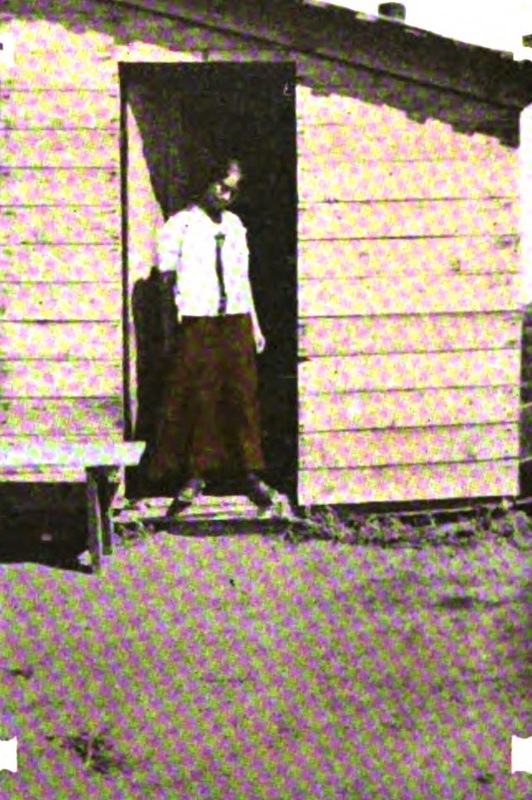
With the introduction and improvement of dry farming in the late nineteenth century, land previously considered worthless could suddenly be used. Land fever took hold of many prospective homesteaders, including Cecelia Weiss. Following the lead of her sister, in 1912 Cecelia filed for 320 acres of sagebrush in Iron County of southwestern Utah. With neighboring claims and most others in the region filed by men (only two of whom had wives), they quickly became known as “The Girls.” The two depended on one another and Cecelia recalled, “Without my sister’s companionship I think I would have deserted before the first season was half over.”
Upon acquiring her land, Cecelia hired out the building of a simple home. It was “not entirely weather-proof, but as it rarely rained in summer it afforded sufficient protection.” Cecelia was spared the “privilege of naming [her] residence.” It had scarcely been completed when a homesteader passed by, remarking that the “piano box” was finished and the “nickname clung to it ever since.”
In her accounts, Cecelia wrote, “my 320 acres do not support me — yet. I support them.” Establishing a home and a farm was no simple, or cheap, task. Cecelia returned to the city every winter, during the five month furlough allowed under homestead law, to earn the necessary funds to continue work in the summer. A Russian immigrant, she quipped that, unlike in her home country, “there are no relief commissions for girl homesteaders, and the Red Cross pays no attention to them.”
Together, the sisters worked on improvements for their land. There was no running water for miles, so they were dependent on a neighbor who could afford the expense of digging and establishing a well. Cecelia wrote, “Until I had to walk a mile and a half and carry every drop I had no conception of the value of water.” Out of necessity, “water conservation became a religion.” Putting up fences was “always one of the worst jobs of a homesteader.” When Cecelia and her sister first began digging post holes and setting the posts, they could only manage one in the morning and one in the evening, with their best effort and leaving them exhausted. Before long though, they increased to ten in the morning and ten more at night. Together, they set 600 posts and saved $75 that it would have cost to hire the work out.
To meet ownership requirements for the land, Cecelia needed to cultivate 40 acres. She paid cash for the heavy labor of clearing, plowing, seeding, and hauling. It was a helpful arrangement, but, worse than increasing her costs, it added to her “hours of leisure.” She despised the abundant spare time, writing, “I never knew how much time there is in the world, how it refuses to be prodded and hurried in its snaily crawl, until I contracted with Uncle Sam to spend seven consecutive months in the sagebrush, with the nearest neighbor almost out of sight and not sufficient work to make me forget the heat.”
Her garden became a “source of great delight.” The arid soil was not in great condition for growing, and she had to compete with rabbits and gophers, but what she was able to raise was a help. Food became less of an issue when a store was established in the nearby town, Beryl.
Even with her sister nearby, homesteading could be lonely. “In the sagebrush,” Cecelia commented, “It is not sufficient that [a young woman] should avoid evil itself; she must avoid the appearance of evil.” She records having to be careful that if a young man came to call, they would sit outside on “a hard wooden bench in the broiling sun” because it was not proper to invite him inside her one bedroom home alone. Cecelia felt “handicapped by the fear of gossip and scandal” that would “spring up overnight without provocation” in a place “where folks have nothing to do for recreation but scan the empty miles and sit and think about their neighbor.” A young girl like Cecelia, without the protection of a chaperon, made “the best material for such stories.”
Life was “not all thirst, desolation and dreariness” and, “in spite of everybody,” they made time to enjoy themselves. Cecelia found “many congenial friends” among the other settlers. Trips to call on neighbors, when managed, were all day affairs because “distances between homes [were] too great to be taken lightly” and to be travelled during midday heat. Parties “in the land of hope and thirst” were just as exciting and enjoyable as those in the city. They also often served additional practical purposes. When a big job or task was at hand, one might send for friends and neighbors to make light work of it. Food and festivities would take place after its completion.
In 1916, Cecelia received the title to her land. If she chose to sell, she could have made a neat profit of $2,200, but that was not what Cecelia wished for. She “would rather make a real farm out of the sagebrush tract.” While others saw the patent as an end goal, to her it only marked the beginning, a continuation of a dream. She wrote, “It has taken pluck to stick to the venture and see it through. There have been times when it has been very hard to stay, but I have never thought of quitting.” To develop a farm from raw land took “money, grit, perseverance, and self-denial,” but “in spite of drouth and loneliness, this plucky girl ‘won through.’”
For more (including 3 images) view the original article
]]>
