<?xml version="1.0" encoding="UTF-8"?>
<feed xmlns="http://www.w3.org/2005/Atom">
  <title type="text">Intermountain Histories</title>
  <updated>2026-04-17T19:32:21+00:00</updated>
  <generator uri="http://framework.zend.com" version="1.12.20">Zend_Feed_Writer</generator>
  <link rel="alternate" type="text/html" href="https://www.intermountainhistories.org/"/>
  <link rel="self" type="application/atom+xml" href="https://www.intermountainhistories.org/items/browse?output=rss2"/>
  <id>https://www.intermountainhistories.org/</id>
  <author>
    <name>Intermountain Histories</name>
    <uri>https://www.intermountainhistories.org</uri>
  </author>
  <link rel="hub" href="https://pubsubhubbub.appspot.com/"/>
  <entry>
    <title type="html"><![CDATA[The Donners in Echo Pass and Weber Canyon]]></title>
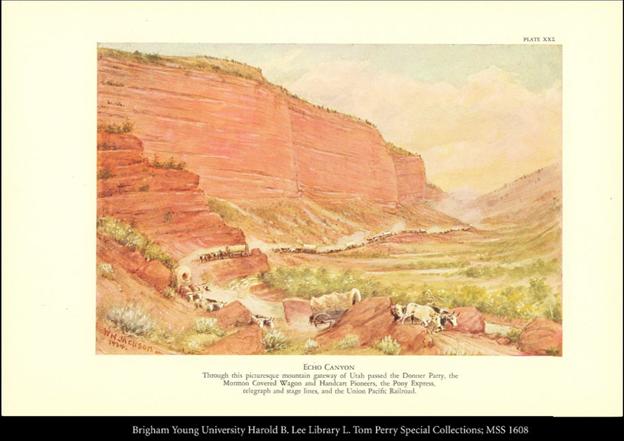
    <summary type="html"><![CDATA[<p><strong><em>Having separated from the main Oregon/California trail after the Continental Divide, the Donner Party reached the mouth of Echo Canyon in Eastern Utah in early August, 1846. This marked the beginning of uncharted territory and an arduous journey through the Wasatch mountain range in present-day Utah. Invaluable time was wasted cutting brush and trees, passing through thin crevices, or crossing mountain rivers and streams.</em></strong></p><img src="https://www.intermountainhistories.org/files/fullsize/ed935523348f738fe9a49853a294f593.jpg" alt="Pioneer Wagons in Echo Canyon" /><br/><p>Traveling through the narrow ravines and steep peaks was not a challenge for the traditional route to California or Oregon Country. Lansford Hastings, a frontier explorer and creator of this cutoff through the Wasatch Mountains and Great Basin desert, had taken smaller groups of emigrants through the cutoff earlier in the season, but their smaller size required less assistance than the Donner Party needed. One arduous landmark in Weber Canyon featured a creek with jagged boulders enclosed by steep canyon walls as the only passable route. The party had to hoist wagons over each individual boulder to continue. Aware of these challenges, Hastings had left the party a note instructing them to send someone ahead to get alternate route directions from him once they reached the Weber River. Leader James Reed and others left on August 6th, and returned August 10th with Hiram Miller’s diary recording<em>“Reed having examined the new rout </em>[route]<em> entirely an </em>[and]<em> reported in favour, which induced the company to proceed.”</em>
Pace slowed as the party wound its way through the mountain range. The trail was rocky and overgrown, necessitating bushwhacking and the clearing of trees and other debris. Virginia Reed said, <em>“There was absolutely no road, not even a trail. The cañon </em>[canyon]<em> wound around among the hills. Heavy underbrush had to be cut away and used for making a roadbed.” </em>They might criss-cross a stream up to 13 times in a single day just to proceed, or spend multiple days clearing debris only to make no forward progress. In a cruel twist of irony, the large migration of Latter-Day Saints from Nauvoo, Illinois used the same path the Donners had blazed to swiftly reach the Salt Lake Valley one year later in 1847. The Saints advance party recorded that they <em>“followed the gouges of the Donner wheels to the top”</em> of what is known as Donner Hill, which is <em>“as near vertical as wagons have ever managed.”</em> The Donners only summited this steep hill because they failed to clear the last gorge of debris after several days of trying. The Saints cleared the gorge in the span of a day. The gorge is now the proud ‘Emigration Canyon’, from which the migration of Latter-day Saints made their main path to reach the Salt Lake Valley.
Three weeks after their arrival at Echo Pass, the party looked back from the floor of the Salt Lake Valley and saw they had traveled only 35 miles. At the same time, parties who had left earlier in the year were already leaving the Great Salt Lake Desert, moseying along the Humboldt River in modern-day Northern Nevada, and descending into Sacramento. Compounded by a markedly late-season start to begin with, the Donner Party’s delay threatened their ability to reach and cross the Sierra Nevada Mountains before Winter. It was well-known that this last mountain range before central-California would be impassable once snow began to fall. If they could not make up for lost time, it would certainly result in the parties entrapment in the mountains.</p><p><em><strong><a href="https://www.intermountainhistories.org/items/show/932">For more (including 4 images) view the original article</a></strong></em></p>]]></summary>
    <published>2026-02-02T17:22:14+00:00</published>
    <updated>2026-04-17T19:32:21+00:00</updated>
    <link rel="alternate" type="text/html" href="https://www.intermountainhistories.org/items/show/932"/>
    <id>https://www.intermountainhistories.org/items/show/932</id>
    <author>
      <name>Samuel Watson, Brigham Young University</name>
    </author>
  </entry>
  <entry>
    <title type="html"><![CDATA[Echo, Utah: Gateway to the West]]></title>
    <summary type="html"><![CDATA[<p><strong><em>Echo, Utah, once a town of significant geographical and social importance in territorial Utah has become a virtual ghost town, physically isolated from the interstates that run a short distance from its once bustling main street.  In its history, it was a key location along the Hastings Cutoff Trail, the Donner Party passed by in 1846 as well as some 75,000 Latter-day Saint emigrants between 1847 and 1869.  The Pony Express, various stage and mail lines, the Overland Telegraph, the Transcontinental Railroad, and the Lincoln Highway all utilized Echo’s location for their routes.</em></strong></p><img src="https://www.intermountainhistories.org/files/fullsize/d77510f3151bbfb69069140fd8469d07.jpg" alt="James Bromely&#039;s Stage Station" /><br/><p>Echo is located at the mouth of the steep sided Echo Canyon,, the bottleneck that directed overland travelers toward the Ogden and Salt Lake valleys.  While the Donner Party was the first major American overland group since the mountain men to pass through, the Latter-day Saints or Mormons were the first to make note of its geographical significance when their first wagon train encamp there for almost a week in July 1847. They viewed the spot as an ideal resting spot for overland travelers--a long, broad valley covered in grass and trees. James Bromely noted the location’s desirability and established a large stage station there in 1854, forming the first permanent vestige of a town.</p><p>Echo became a strategic location during the Utah War in 1857-1858 as a base of operations for the Mormon Nauvoo Legion defending the Utah Territory from the invading US Army.  U.S. military leaders recorded that the narrow canyon and dramatic geological formations made the location perfect for both fortified defense and ambush. Travelers, having heard of Echo’s militant reputation, feared passing through the town for decades.</p><p>The Transcontinental Railroad entered Echo in 1868, building its own Hell-on-wheels style town to the northwest of the existing Mormon settlement. Echo became an important junction connecting the coal mines of Summit County and the gold and silver mines in Park City with the Union Pacific Main Line until the railroad consolidated its locomotive facilities in Ogden during World War II.  After the construction of Interstate-80 in 1986, the town did not receive an interstate exit.  Cut off from easy access, and with the railroad abandonment of its branch lines in 1988, the town withered and died.</p><p><em><strong><a href="https://www.intermountainhistories.org/items/show/18">For more (including 3 images) view the original article</a></strong></em></p>]]></summary>
    <published>2017-02-13T18:43:52+00:00</published>
    <updated>2026-04-17T19:31:58+00:00</updated>
    <link rel="alternate" type="text/html" href="https://www.intermountainhistories.org/items/show/18"/>
    <id>https://www.intermountainhistories.org/items/show/18</id>
    <author>
      <name>Joshua Bernhard, Brigham Young University  </name>
    </author>
  </entry>
</feed>
