<?xml version="1.0" encoding="UTF-8"?>
<feed xmlns="http://www.w3.org/2005/Atom">
  <title type="text">Intermountain Histories</title>
  <updated>2026-04-17T19:32:17+00:00</updated>
  <generator uri="http://framework.zend.com" version="1.12.20">Zend_Feed_Writer</generator>
  <link rel="alternate" type="text/html" href="https://www.intermountainhistories.org/"/>
  <link rel="self" type="application/atom+xml" href="https://www.intermountainhistories.org/items/browse?output=rss2"/>
  <id>https://www.intermountainhistories.org/</id>
  <author>
    <name>Intermountain Histories</name>
    <uri>https://www.intermountainhistories.org</uri>
  </author>
  <link rel="hub" href="https://pubsubhubbub.appspot.com/"/>
  <entry>
    <title type="html"><![CDATA[Yukio Shimomura: Topaz Internment Camp<br />
]]></title>
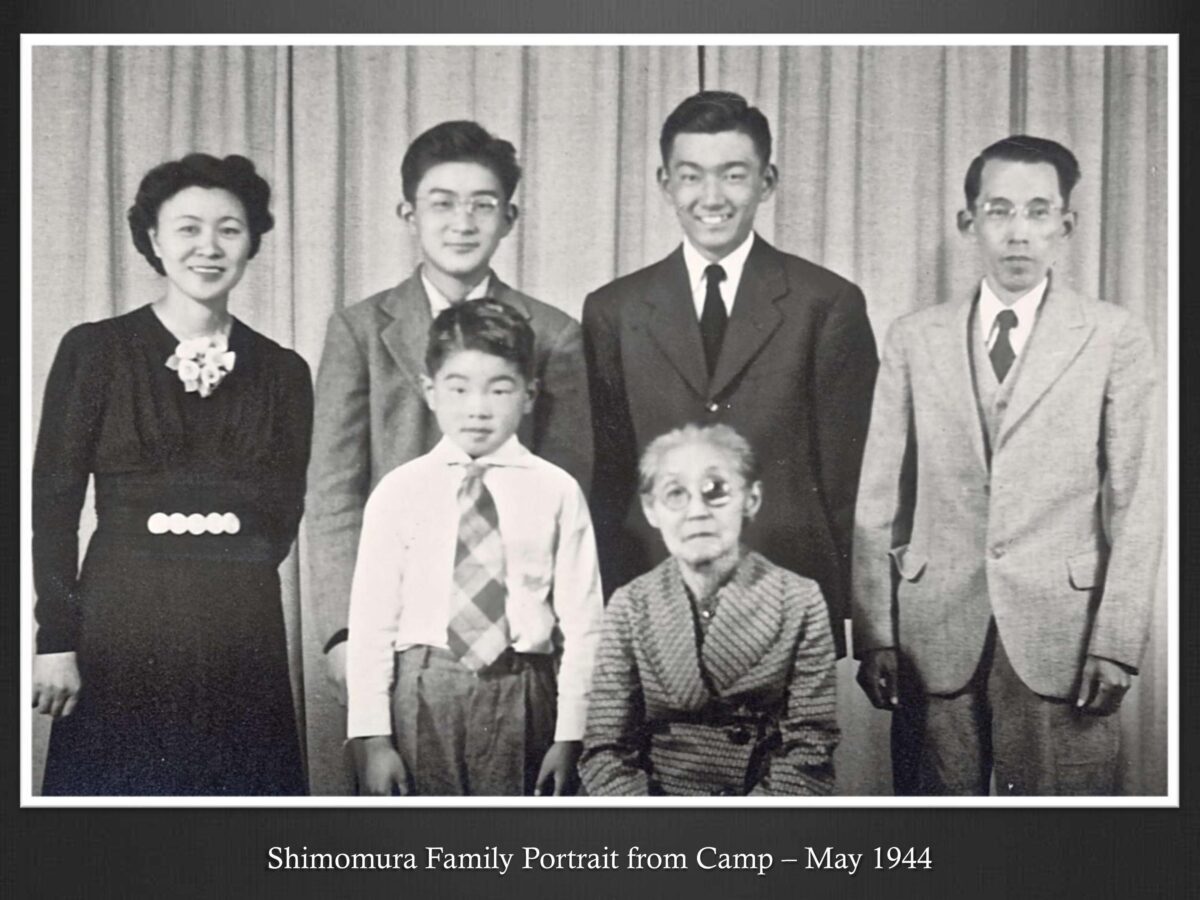
    <summary type="html"><![CDATA[<p><strong><em><span style="font-weight:400;">Following the attack on Pearl Harbor, President Franklin Roosevelt issued Executive Order 9066 on February 19, 1942. This order authorized the forced evacuation of all Japanese descendents into internment camps. Families were forced to leave everything behind to go to an unfamiliar location for an unknown length of time. Yukio Shimomura was a young boy who was sent to Topaz and in 2023 still remembers his experiences. </span></em></strong></p><img src="https://www.intermountainhistories.org/files/fullsize/d39b15a82bd920eefe950be6ed920dde.jpg" alt="Shimomura Family Portrait from Camp - May 1944" /><br/><p><span style="font-weight:400;">On December 7th, 1941, the Japanese military bombed Pearl Harbor bringing the United States into the Second World War. On February 19th, 1942, President Franklin Roosevelt issued Executive Order 9066, forcing all people of Japanese descent living on the West Coast to relocate to internment camps. They took only what they could carry and left their homes in May 1942, having no idea where they were going or whether they would ever return. Yukio Shimomura was one of the victims of this order.</span>
<span style="font-weight:400;">Prior to arriving in Topaz, Utah, many of the Japanese Americans were held in the Tanforan Race Track in San Bruno, California, where they lived in washed-out horse stables lined with linoleum. Yukio Shimomura explained the experience: “All you had was one lightbulb…. Using scrap wood, many made nightstands and other shelves to hold their stuff. Beds were bags filled with hay, and if you couldn’t sleep on that, you slept on the floor… Lots of lines. Lines, lines, lines for everything. We were only there a short time, but it was traumatic… For those living in the horse stalls, they had it bad; they stunk when they came out… you could separate them from those living in the barracks [by their smell]… we were lucky.” Shimomura and his family stayed at Tanforan for a short time before being relocated to the Topaz Internment Camp near Delta, Utah. They remained there for three years behind barbed wire and armed guards. </span>
<span style="font-weight:400;">In Topaz, the Japanese “internees” were separated into blocks and barracks. Each block had twelve barracks, a recreation hall, latrines for men and for women, and a mess hall. The barracks were sectioned into six apartments of different sizes to accommodate families of two, four, or more people. Larger families were given two or more rooms. The six rooms came in three sizes, 20’ by 14’, 20’, or 26’.</span> <span style="font-weight:400;">Shimomura later explained that the walls separating the rooms did not reach the ceiling so that you could hear everything from everyone all the time. He remembered, “there were 300 children born in the camp, so you figure couples realized they had to do what they needed to do.” Privacy was absent in the camp, as there were no doors or stalls in any of the bathrooms or showers. </span>
<span style="font-weight:400;">At the camp, many tried to make life as normal as possible. This included working at different jobs around the camp for roughly $14 to $19 a month, depending on the job. Children went to school, played around the camp, and all lent a helping hand in whatever needed to be done. No matter how hard they tried to make life as normal as possible, the internees understood they were not free. “Topaz was chaotic,” Shimomura summarized as he explained the death of an elderly man who did not understand the order given to turn around when approaching the barbed wire fence. After a third confusing warning, he was shot and killed. While this was the only shooting to occur at Topaz, it scarred all who were there. </span>
<span style="font-weight:400;">In January 1943, President Roosevelt asked for volunteers at Topaz to serve in the United States Army. Shimomura remembers that all who were at the camp were given a questionnaire to determine their loyalty to the United States, with question 28 asking, “Will you swear unqualified allegiance to the United States of America and faithfully defend the United States from any or all attack by foreign or domestic forces and forswear any form of allegiance or obedience to the Japanese emperor or any other foreign government, power or organization?” If the answer was yes, internees could leave the camp for military service. One hundred and five young men, including some young fathers, signed up to fight and were allowed to leave the camp for the first time. The loyalty of Japanese American soldiers who served in the war raised questions about the purposes of the internment camps. In 1943, many others gained sponsors and were allowed to leave the camp to attend universities or enter employment.</p><span style="font-weight:400;">The Topaz Internment camp closed its doors in October 1945, and the barracks were moved by the end of 1947. The Japanese American Citizen League erected a monument in 1976 to commemorate those who had stayed there. In August of 1988, President Ronald Reagan signed the Civil Liberties Act that was later enforced by President George H.W. Bush. It issued a formal apology and gave $20,000 to all those who were still alive, like Shimomura, a small compensation for all they had lost and suffered as a result of internment. </span></p><p><em><strong><a href="https://www.intermountainhistories.org/items/show/793">For more (including 4 images) view the original article</a></strong></em></p>]]></summary>
    <published>2024-03-18T19:58:54+00:00</published>
    <updated>2026-04-17T19:32:17+00:00</updated>
    <link rel="alternate" type="text/html" href="https://www.intermountainhistories.org/items/show/793"/>
    <id>https://www.intermountainhistories.org/items/show/793</id>
    <author>
      <name>Abby Tribe, Brigham Young University </name>
    </author>
  </entry>
  <entry>
    <title type="html"><![CDATA[Topaz Museum: A Jewel Amidst the Desert]]></title>
    <summary type="html"><![CDATA[<p><strong><em>The Topaz Museum is located a short drive from the Topaz internment site and boasts an impressive collection of artifacts and first-hand accounts of Japanese Americans interned at the camp during World War II.</em></strong></p><img src="https://www.intermountainhistories.org/files/fullsize/d3903425eda7df4d660c63793d9b7d64.jpg" alt="Topaz Museum" /><br/><p><span style="font-weight:400;">One of Utah’s best kept secrets about one of America’s darkest decisions is located in Delta, Utah. The Topaz Museum is a short drive from the Topaz internment camp site and boasts an impressive collection of artifacts and first-hand accounts of Japanese Americans interned at the camp during World War II. The Topaz Museum opened in 2017 and, thanks to generous local and national donations, is maintained so that all who visit can study and explore what life was like for those who lived at Camp Topaz. Many of the artifacts and accounts have been donated by families and descendants of the Japanese Americans who lived there. The museum is operated by Delta locals who have a passion for sharing one of the tragic lessons in American history. </span>
<span style="font-weight:400;">After the surprise attack at Pearl Harbor, the United States government, led by President Franklin D. Roosevelt, passed Executive Order 9066 which effectively ordered all people of Japanese descent to be evacuated from the Pacific coast. This led to the forced removal of nearly 112,000 Japanese Americans. Initially, these people were relocated into temporary holding facilities while the government constructed 10 permanent relocation camps. These temporary holding centers were converted horse stalls at the Tanfran racetrack in San Bruno, California. They were transported in train cars under armed guard to Delta in early 1942. For many of these people, Topaz would remain their home for the next three years. </span>
<span style="font-weight:400;">The Topaz Museum uses photographs, personal accounts, newspapers, and visual reconstructions to help visitors sense what the Japanese Americans at Topaz experienced while they were interned. The museum’s curators have organized immersive exhibits to help patrons experience facets of this history. As visitors walk into the exhibit area they are confronted with scenes and accounts from Japanese Americans who were forcibly removed from their homes, lands, and businesses on the west coast and relocated to Topaz. The museum also depicts life in Topaz, using interactve exhibits to give visual representation of life for those interned. Patrons see vintage furniture, equipment, and bedding donated by families of internees. Exhibits give accounts of how the Japanese Americans interned in Topaz made the best of their difficult situation. The museum gives accounts of the local government that was formed, the schools and children educated in Topaz, the many different talents that were cultivated such as art and music, and the young men and women who answered the call to serve in the military of the same country responsible for their internment. The museum concludes its exhibits by reviewing the attempts at restitution by the American government and the safeguards created to prevent this violation of civil rights from happening again. </span></p><p><em><strong><a href="https://www.intermountainhistories.org/items/show/658">For more (including 3 images) view the original article</a></strong></em></p>]]></summary>
    <published>2022-09-19T18:22:35+00:00</published>
    <updated>2026-04-17T19:32:14+00:00</updated>
    <link rel="alternate" type="text/html" href="https://www.intermountainhistories.org/items/show/658"/>
    <id>https://www.intermountainhistories.org/items/show/658</id>
    <author>
      <name>Michael Pouliot, Brigham Young University</name>
    </author>
  </entry>
  <entry>
    <title type="html"><![CDATA[Japanese Internment Experiences in Utah vs. Arkansas]]></title>
    <summary type="html"><![CDATA[<p><strong><em>Japanese internment is an unfortunately an event in America’s history, too often glossed over. Many people are unaware of the unjust imprisonment of many Japanese families in the U.S. during World War II. No matter the location, Japanese families and individuals experienced hardships in internment camps; hardships that differed depending on the location of the camp.</em></strong></p><img src="https://www.intermountainhistories.org/files/fullsize/7bfcd00402922a18478d86d32b05232c.jpg" alt="Mother Knitting" /><br/><p>Following Japan’s attack on Pearl Harbor in December of 1941, President Roosevelt issued executive order 9066, calling for the relocation of Japanese Americans living within the U.S.  Following this order, ten relocation camps were created within the United States; eight located in the western region, two in the south. The differences in conditions of camps in the west versus the south can be effectively illustrate by comparing the Topaz Internment Camp near Delta, Utah, to the the Jerome and Rohwer camps, located in the southern Arkansas delta region. </p><p>Residents of both Topaz and the Arkansas camps experienced great hardship when faced with climates drastically different from the temperate California environment. The extreme desert temperatures at Topaz frequently fluctuated between below freezing at night to over 90 degrees in midday, which inflicted great hardship upon its residents who were exposed to the elements in partially completed barracks. In central Utah desert, internees were required to perform labor essential to cultivate agriculture in their barren, dusty environment. One resident described this when he stated, “They made cowboys out of the Japanese.” </p><p>While Utah internees faced hardships in the form of weather extremities, the plight of Arkansas internees was attributed primarily to their miserable swampy environment; one that was unfamiliar to California natives. The locations of the Jerome and Rohwer camps were outliers to the western location of the other eight camps. These camps were built due to the availability of land that had been abandoned by landowners who were overwhelmed at the prospect and draining and clearing the unrelenting swampland. This feat was left to Japanese internees, who were tasked with the responsibility of draining and clearing the land (Ward). </p><p>Japanese internees in Utah and Arkansas also experienced drastically different experiences concerning interactions with those outside the camps. The presence of internees in Arkansas presented a unique problem to the racially stratified Jim Crow South. The sudden appearance of a new ethnic minority in a society previously separated into primarily black and white races, was the source of confusion and objection among many native residents. Fierce prejudice arose among many Arkansas natives, including Governor Homer Adkins. </p><p>Despite the compliance of states housing the other camps, Adkins staunchly refused to allow Japanese students to enroll in Arkansas universities, and in many cases refused to allow internees to work on projects outside of the camp (Ward). When referring to the prospect of Japanese working outside the camp Adkins once stated, “I don't mind them leaving to work in other states, but as a matter of policy I am not going to recommend that Japanese work in any capacity in this state." Adkins’s commitment to confine internees in their camps  was a prejudiced policy not replicated at Topaz, where students were allowed to attend outside universities, and many workers were granted release to work in areas surrounding the camp in areas as far away as Provo. </p><p><em><strong><a href="https://www.intermountainhistories.org/items/show/145">For more (including 5 images) view the original article</a></strong></em></p>]]></summary>
    <published>2018-03-14T18:23:41+00:00</published>
    <updated>2026-04-17T19:32:01+00:00</updated>
    <link rel="alternate" type="text/html" href="https://www.intermountainhistories.org/items/show/145"/>
    <id>https://www.intermountainhistories.org/items/show/145</id>
    <author>
      <name>Stephanie King, Brigham Young University</name>
    </author>
  </entry>
</feed>
