<?xml version="1.0" encoding="UTF-8"?>
<feed xmlns="http://www.w3.org/2005/Atom">
  <title type="text">Intermountain Histories</title>
  <updated>2026-04-17T19:32:18+00:00</updated>
  <generator uri="http://framework.zend.com" version="1.12.20">Zend_Feed_Writer</generator>
  <link rel="alternate" type="text/html" href="https://www.intermountainhistories.org/"/>
  <link rel="self" type="application/atom+xml" href="https://www.intermountainhistories.org/items/browse?output=rss2"/>
  <id>https://www.intermountainhistories.org/</id>
  <author>
    <name>Intermountain Histories</name>
    <uri>https://www.intermountainhistories.org</uri>
  </author>
  <link rel="hub" href="https://pubsubhubbub.appspot.com/"/>
  <entry>
    <title type="html"><![CDATA[Everett Ruess in Navajo Country and Canyon de Chelly National Monument ]]></title>
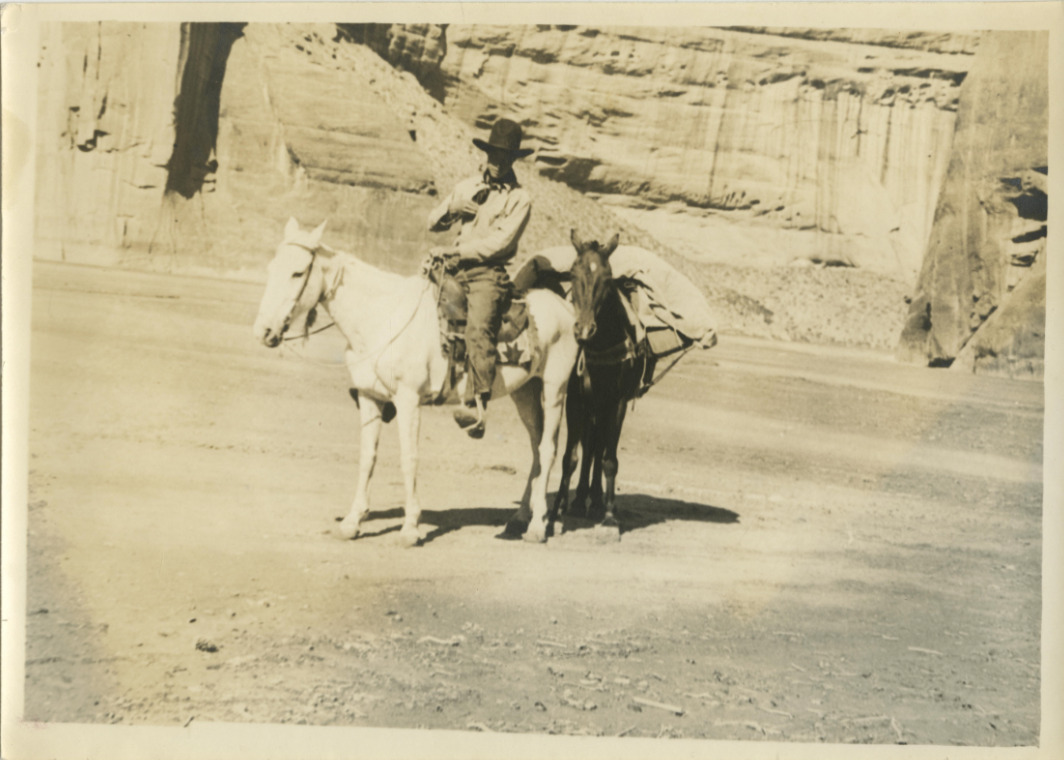
    <summary type="html"><![CDATA[<p><strong><em>In 1932 Everett Ruess set out to central Arizona where he enjoyed the mountainous desert, and later began his journey to his beloved northern Arizona wilderness.</em></strong></p><img src="https://www.intermountainhistories.org/files/fullsize/0dcf36256a9e8c5f10ae900bf7f4e951.jpg" alt="Everett and his horses, 1932" /><br/><p><span style="font-weight:400;">Canyon de Chelly (d’`SHAY) is located in the Navajo Nation and contains the architecture, artifacts, and culture of the communities that have lived there for millennia. Archeologists believe the canyon first had residents roughly 5,000 years ago with the Archaic people. The canyon contains the iconic Spider Rock, White House Ruins, and petroglyphs, and was established as a national monument in 1931 by former President Herbert Hoover. A tributary of Canyon de Chelly is Canyon del Muerto (</span><i><span style="font-weight:400;">Canyon of Death</span></i><span style="font-weight:400;">), named after prehistoric native burials found by the Smithsonian in the canyon in the late nineteenth century. The canyon serves as a monument of the native population, as well as their resilience in defending their sacred land from European settlers.</span>
<span style="font-weight:400;">Everett began his 1932 journey in central Arizona, making his way up to the Mogollon Rim, and eventually Chinle, Arizona, just west of Canyon de Chelly National Monument. Everett had been here just one year prior, before he eventually stayed in Flagstaff and the Grand Canyon, then headed back to southern California. On July 12th, the day before entering Canyon de Chelly, he wrote a lengthy letter to his brother Waldo expressing his appreciation for the outdoors and his belief that “there can be no other life for me but that of the lone wilderness wanderer.” </span>
<span style="font-weight:400;">The next morning, Everett wrote that he went “over the hill to Canyon de Chelly, their [Navajo] homeland.” The canyon welcomed Everett with powerful winds, stalling his progress. As he made his way East through Canyon del Muerto, he passed by the White House Ruin and noted the “tall monument” of Spider Rock in his journal. Everett made the journey back from the belly of de Chelly to Canyon del Muerto, where he noted the lack of water. As he had been in the canyon before in 1931, the towering walls of the canyon and the winds that del Muerto presented were very familiar. In roughly four days Everett made his way up through Canyon del Muerto with his horses Nulfo and Jonathan. The trail out of the canyon was not easy for them. He noted that Jonathan was hobbling in circles before eventually collapsing to the ground beneath him, and noting that the place really was the Canyon of Death for “gentle old Jonathan.”</span>
<span style="font-weight:400;">Everett emerged from Canyon de Chelly National Monument with Nulfo by his side, heading toward their next journey to Mesa Verde in Colorado. He remained here for about another month until hitchhiking his way back to Los Angeles where he began a semester at the University of California Los Angeles (UCLA). Despite the remarkable characteristics of his journey, he was still a human who experienced indecision like any other eighteen-year-old. While at UCLA, Everett reminisced on his time at Canyon de Chelly and the rest of the region which provoked him to write a letter explaining that he did not belong in college, but rather in the wilderness which he returned to a few months later.</span></p><p><em><strong><a href="https://www.intermountainhistories.org/items/show/830">For more (including 5 images) view the original article</a></strong></em></p>]]></summary>
    <published>2024-05-25T03:51:26+00:00</published>
    <updated>2026-04-17T19:32:18+00:00</updated>
    <link rel="alternate" type="text/html" href="https://www.intermountainhistories.org/items/show/830"/>
    <id>https://www.intermountainhistories.org/items/show/830</id>
    <author>
      <name>Matthew T. Lankton</name>
    </author>
  </entry>
  <entry>
    <title type="html"><![CDATA[Kit Carson’s 1864 Interactions with Navajos]]></title>
    <summary type="html"><![CDATA[<p><strong><em>Kit Carson’s siege of Canyon de Chelly led to the Long Walk relocation of the Navajo peoples. Having since returned to their homeland, the Navajos have proved their endurance through conquest and cultural genocide.</em></strong></p><img src="https://www.intermountainhistories.org/files/fullsize/8a4e53e9ca09e9d130768a68addeb683.jpg" alt="Navajo on Long Walk" /><br/><p>The natural fortress of Canyon de Chelly in modern-day Arizona housed was one of the largest gatherings of Navajo, or Diné, people. The area supported many family communities and contained plentiful resources. Early explorers even considered Canyon de Chelly a dangerous area because of the enormous Navajo population. However, as immigrants moved west in the early nineteenth century, the Navajos faced oppression from settlers and United States military forces. By the 1860s, the Navajos had encountered these groups on multiple occasions and frequently negotiated trade, land inquiry, and intertribal relations. </p><p>Indian agent Christopher “Kit” Carson primarily handled dealings between the federal government and Navajo people. The U.S. government authorized a campaign of total warfare against the Navajos to limit their independence and force their removal from the territory. Kit Carson was instructed to lead attacks against various communities of Navajo families and, in 1864, accomplished this goal by cutting off natural resources, exterminating food and shelter, gathering the Navajos together and communally leading them away from their traditional homelands, and incarcerating opposing forces. </p><p>Skirmishes and confrontations between the two parties led to the largest tribal surrender in American history. After a month of conflict, Kit Carson and his armies initiated the Navajo Long Walk, a 250-450-mile journey from their homeland to internment camps at Bosque Redondo in New Mexico.  </p><p>The Long Walk remains a defining moment in Diné history. Navajo war leaders and federal government authorities such as William T. Sherman convened to negotiate the future of the relocated Navajo people. The Navajo Treaty of 1868 allowed survivors to return to their traditional homelands and start over. The destruction at Canyon de Chelly and the subsequent removal caused permanent damage to Navajo family structures and instigated a gradual cultural genocide. Despite their significant losses of population, the Navajo people have managed to withstand the legacy of conquest by preserving their culture and homeland. The Navajos are the largest group of American Indians today.</p><p><em><strong><a href="https://www.intermountainhistories.org/items/show/394">For more (including 4 images) view the original article</a></strong></em></p>]]></summary>
    <published>2020-03-02T22:52:45+00:00</published>
    <updated>2026-04-17T19:32:07+00:00</updated>
    <link rel="alternate" type="text/html" href="https://www.intermountainhistories.org/items/show/394"/>
    <id>https://www.intermountainhistories.org/items/show/394</id>
    <author>
      <name>Sheiyenne Baloo, Brigham Young University</name>
    </author>
  </entry>
</feed>
