<?xml version="1.0" encoding="UTF-8"?>
<feed xmlns="http://www.w3.org/2005/Atom">
  <title type="text">Intermountain Histories</title>
  <updated>2026-04-17T19:32:19+00:00</updated>
  <generator uri="http://framework.zend.com" version="1.12.20">Zend_Feed_Writer</generator>
  <link rel="alternate" type="text/html" href="https://www.intermountainhistories.org/"/>
  <link rel="self" type="application/atom+xml" href="https://www.intermountainhistories.org/items/browse?output=rss2"/>
  <id>https://www.intermountainhistories.org/</id>
  <author>
    <name>Intermountain Histories</name>
    <uri>https://www.intermountainhistories.org</uri>
  </author>
  <link rel="hub" href="https://pubsubhubbub.appspot.com/"/>
  <entry>
    <title type="html"><![CDATA[Our Lady of the Rockies]]></title>
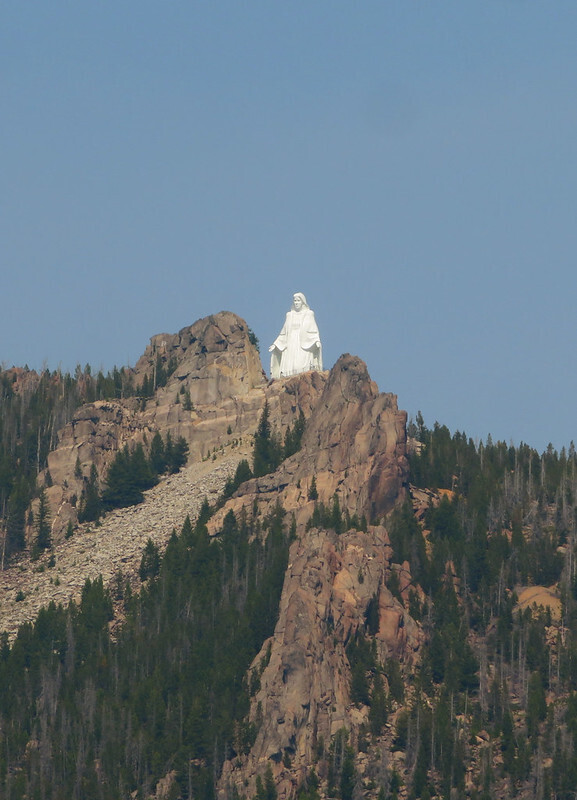
    <summary type="html"><![CDATA[<p><strong><em><em>Our Lady of the Rockies </em>looks out across the city of Butte, Montana with arms stretched wide from a vantage of some 3,500 feet above the city, and weighing over 50 tons.</em></strong></p><img src="https://www.intermountainhistories.org/files/fullsize/c4ae7467ddb2ea3d296e2b06e342e9ae.jpg" alt="Our Lady of the Rockies. " /><br/><p>The statue project began with Bob O’Bill, who, in 1979 made a plea with God in hopes that his bed-ridden wife Joyce would make a full recovery. When she did, O’Bill began to discuss with his peers the logistics of building the statue. As word spread about the building project, an overwhelming amount of support arose, making the statue a community project. The initial plan for the six-foot statue with community support soon grew to a project that would be over 90 feet tall. Though some thought that the project was strictly Catholic, project sponsors took care to present it as a community effort which symbolized “the dignity of motherhood and the sacrificial love a mother has for her child.” Community pride has always been strong in Butte, extending back in Butte's mining history in the 19th century. Whenever the future was uncertain, the community of Butte banded together and cared for each other. This bond and the meaning behind the statue are both driving factors in what makes Butte’s community so special. </p><p>Supplies including paint, food for workers, and enough iron and steel to build the statue, were all gifted to the project by donors. A major contributor to the project, Joe Roberts, was connected to O’Bill through Ann Nettles, who knew Joe to be a guy whot took up outlandish projects. Once he familiarized himself with the project and got over how crazy he thought it to be, Robert’s Rocky Mountain Equipment Co. discussed a plan to put up the statue, ensuring that it was done safely with high stability. Roberts grew to have a major role in the project, raising funds, donating the use of his equipment, and even providing one thousand dollars to start off the construction fund. From there the community took care of the rest. </p><p>After six years of trouble-shooting technical difficulties, the statue was finally ready to assemble on the mountain top. On December 17, 1985, the statue was lifted in four sections by the Nevada Air National Guard Team and assisted by the Army Reserve stationed in Butte, as well as the Montana National Guard. Today Our Lady of the Rockies continues to show civic generosity through the volunteers that keep the statue up and running so that it may be able to show hope and optimism to inspire generations to come.</p><p><em><strong><a href="https://www.intermountainhistories.org/items/show/862">For more (including 4 images) view the original article</a></strong></em></p>]]></summary>
    <published>2024-10-18T13:00:52+00:00</published>
    <updated>2026-04-17T19:32:19+00:00</updated>
    <link rel="alternate" type="text/html" href="https://www.intermountainhistories.org/items/show/862"/>
    <id>https://www.intermountainhistories.org/items/show/862</id>
    <author>
      <name>Logyn J. Klebe, Rocky Mountain College</name>
    </author>
  </entry>
  <entry>
    <title type="html"><![CDATA[The Salt Lake Theatre: Brigham Young&#039;s Love Letter to Theater Out West]]></title>
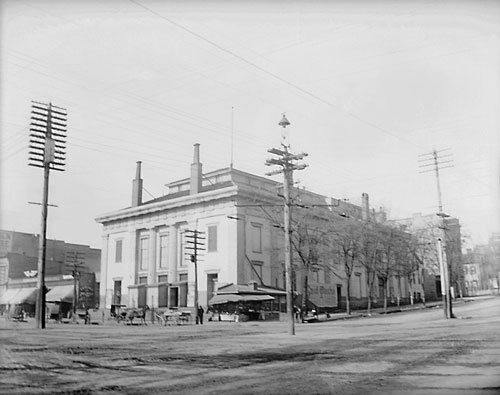
    <summary type="html"><![CDATA[<p><strong><em>The creation of the Salt Lake Theatre was led by Brigham Young and supported by the Church of Jesus Christ of Latter Day Saints in 1862. The Theatre was the most decorated building in Utah territory before the Salt Lake City Temple and Tabernacle were constructed. Its 66-year run brought entertainment and enjoyment to early Utah settlers.</em></strong></p><img src="https://www.intermountainhistories.org/files/fullsize/5d59a9a867f7c3f8c5b35d2310be0c7e.jpg" alt="An Exterior View of the Salt Lake Theatre. Salt Lake City, Utah, 1900. " /><br/><p>Early LDS church leaders were fond of artistic expression to bring culture, entertainment, and refinement to the Salt Lake Valley. In 1852, just a few years after settling in Utah, Brigham Young decided it was time to bring theater back into the lives of the saints, forming The Deseret Dramatic Association. These Saint-actors performed at the Social Hall for five years, marking a vital advancement to society in the West. Unfortunately, the Utah War made the stage go dark for a few years. It returned when Phill Margaretts created The Mechanics Dramatic Association in 1859, which sponsored plays that were not affiliated with the church. In response, Brigham Young decided it was time to create a permanent stage where he could control the actors, scripts, and overall impression of the theater.</p><p>It was the perfect timing in Utah History for the construction of a gathering place to enjoy the arts. Initially, Brigham Young intended to build a dance hall. Instead, he determined to create “a model playhouse for producing professional theatre.” Construction of the Salt Lake Theatre began in July 1861 and was completed by March the following year at a cost of around $100,000. The architect was William H Folsom, with E. L. T. Harrison designing the interior. The theatre had room to hold an audience of 1500. Throughout Utah’s territorial history, the LDS church and the growth of Utah’s economy went hand and hand. The theater was just one of many buildings and ventures that were sponsored by the church. Because Young used church funds to finance the Salt Lake Theatre he guided its operation.</p><p>A dedication was held to honor this “temple of drama,” built to bring wholesome amusement and moral guidance to its patrons. The theater became a huge success. Thomas Lyne, a professional actor who had joined the church and promoted theater in Nauvoo, was instrumental in the popularity of plays presented there. The success of The ‘Mormon theater’ sparked the interest of many famous actors and drew them to Utah throughout its 66-year run. Several famous actresses, including Maude Adams, who later pioneered the role of Peter Pan on Broadway, played their first roles in Salt Lake City. The building was used not only for local arts but it hosted political events and eventually touring performing groups coming through Salt Lake City. Despite Young’s original vision, over time the theater welcomed people of all religious backgrounds and secular attitudes. Throughout its history, the theater played a significant role in the culture of Salt Lake City. Unfortunately, the creation of many new vaudeville theaters and Utah’s economic downturn of 1920s drove the theater into deep debt. People desperate for basic needs could not afford to attend shows. In addition, the building needed renovations. The president of the Church, Heber J. Grant, closed the theater and sold the building. In 1928 it was demolished–a great loss of a cultural icon to Utah and the United States.</p><p><em><strong><a href="https://www.intermountainhistories.org/items/show/779">For more (including 4 images) view the original article</a></strong></em></p>]]></summary>
    <published>2024-02-23T15:13:08+00:00</published>
    <updated>2026-04-17T19:32:17+00:00</updated>
    <link rel="alternate" type="text/html" href="https://www.intermountainhistories.org/items/show/779"/>
    <id>https://www.intermountainhistories.org/items/show/779</id>
    <author>
      <name>Mikenzie Moon, Brigham Young University</name>
    </author>
  </entry>
  <entry>
    <title type="html"><![CDATA[State Capitol Rotunda Murals: Salt Lake City, Utah]]></title>
    <summary type="html"><![CDATA[<p><strong><em>Utah’s State Capitol building features several artworks in its interior. Four large murals covering the Capitol Rotunda completed in 1935 particularly display the hopeful imagery typically found in art funded by New Deal-era projects.   </em></strong></p><img src="https://www.intermountainhistories.org/files/fullsize/8354ef98e35f8f660395b21e7783d729.jpg" alt="State Capitol Dome" /><br/><p><p style="font-weight:400;">The Utah Capitol’s ornate rotunda includes twelve murals that the Public Works of Art Project funded during the New Deal era. The pieces fill the dome and the spaces between the rotunda’s arches. Painted along the dome’s base, four illustrations display scenes from Utah’s pioneer settlement history, including: <em>Father Escalante Discovers Utah Lake – 1776</em>, <em>Peter Skene Ogden at Ogden River – 1828, Fremont First Sees Great Salt Lake – 1843</em>, and <em>Brigham Young and Pioneers Entering the Valley</em>. Prominent architect Richard K.A. Kletting, known for creating several Utah buildings, completed the Capitol in 1915 after winning a competition. Inspired by Greek and Roman architecture, Kletting designed the Capitol in the Corinthian style, seen through features such as its distinct exterior columns. With its large scale, Utah marble, and commanding city view, the building’s construction cost a grand $2,739,529.
<p style="font-weight:400;">Lee Greene Richards led the mural project, while Henry Rasmussen, Ranch S. Kimball, and Gordon Cope assisted him, with Waldo Midgely creating the murals’ borders. Richards grew up in Salt Lake City in an artistic family. He studied under J.T. Harwood in Salt Lake City, and at Paris’s <em>Académie Julian</em> and <em>École des Beaux-Arts</em>. While visiting England on a mission for The Church of Jesus Christ of Latter-day Saints, Richards developed a passion for portraiture, although he also became a popular muralist who captured Utah’s settler history in the rotunda murals. The Capitol rotunda’s murals opened in 1935 with ceremonies headed by former Utah Governor, Henry H. Blood.
<p style="font-weight:400;">The muralists conducted lengthy research to ensure that their chosen depictions were significant and accurately portrayed. While researching <em>Peter Skene Ogden at Ogden River –1828</em>, for example, Richards ensured that he depicted period-accurate weapons. In the murals including Brigham Young, however, Richards decided to artistically represent the Salt Lake City founder with his more recognizable beard, despite pioneer depictions from this period showing that Young was clean-shaven.
<p style="font-weight:400;"><em>Father Escalante Discovers Salt Lake – 1776,</em> depicts the Spanish expedition of Atanasio Domínguez and Silvestre Vélez de Escalante accompanied by a small group and one of three Ute people who guided them. Flanked by the area’s foliage, the background exhibits the scenic waters of the Great Salt Lake. In <em>Peter Skene Ogden at Ogden River – 1828</em>, Ogden and his company are in the vividly colored Ogden Valley using weapons like the Hawken rifle, the preferred weapon of choice along the western frontier. <em>Fremont First Sees Great Salt Lake –1843, </em>features John. C. Fremont and his party overlooking the lake’s expanse, positioned in an adventurous pose overlooking the scene. <em>Brigham Young and Pioneers Entering the Valley, </em><span>focuses </span><span>on Brigham young and his distinctive beard standing proudly as he reaches the Salt Lake Valley, joined by pioneers, cattle, and covered wagons</span>.
<p style="font-weight:400;">Examining these murals reveals the aims of the New Deal-era art projects in not only employing artists but also in creating a western American artistic identity. Indeed, the Public Works of Art Project-funded murals did not typically illustrate the Great Depression’s despair. Conversely, muralists like Richards chose to focus on themes of a settling, pioneering past. In choosing to depict scenes of Utah’s pioneer settlement, then, this optimistic vision guided Richards and his co-painters.<span>  </span></p><p><em><strong><a href="https://www.intermountainhistories.org/items/show/717">For more (including 4 images) view the original article</a></strong></em></p>]]></summary>
    <published>2023-03-01T18:13:30+00:00</published>
    <updated>2026-04-17T19:32:15+00:00</updated>
    <link rel="alternate" type="text/html" href="https://www.intermountainhistories.org/items/show/717"/>
    <id>https://www.intermountainhistories.org/items/show/717</id>
    <author>
      <name>Lindsey Cillis, Northern Arizona University</name>
    </author>
  </entry>
  <entry>
    <title type="html"><![CDATA[A Typical Western Town Mural: Helper, Utah]]></title>
    <summary type="html"><![CDATA[<p><strong><em><p style="font-weight:400;">Jenne Magafan painted <em>A Typical Western Town</em> from 1939-1941 under the Treasury Section of Fine Arts, a New Deal project that aimed to employ artists and craft an American arts culture. Magafan installed the painting in the Helper, Utah, Main Post Office, where visitors can still see it today.  </em></strong></p><img src="https://www.intermountainhistories.org/files/fullsize/b4ec8a9d622b6e0ef2ea18561a4bf3a2.jpg" alt="A Typical Western Town" /><br/><p><p style="font-weight:400;">In 1941, New Deal-era artist Jenne Magafan of Colorado completed her mural, <em>A</em><em> Typical Western Town</em>, in the Helper, Utah, Main Post Office. The post office building opened in 1938 and was placed by researchers on the National Register of Historic Places in 1989. With its initial installment, <em>A Typical Western Town</em> was the first post office mural that Utah received with funding from the Section of Fine Arts.
<p style="font-weight:400;">Magafan won the chance to install the oil-on-canvas mural through the Forty-Eight State competition as a part of the Treasury Section of Fine Arts. A well-known painter of the New Deal era who studied in a variety of institutions like the Colorado Springs Fine Art Center, Magafan practiced art with the mentorship of artists including Frank Mechau. The Section of Fine arts also commissioned Magafan for Post Office murals in Anson, Texas, and Glenwood Springs, Colorado. After completing the Helper mural, Magafan and her twin sister and fellow artist, Ethel, hung the painting over the postmaster’s office door.<span>   </span>
<p style="font-weight:400;">Magafan reflects the later nineteenth-century commotion of Helper’s industrial history in her mural riddled with motion. Helper, located in central Utah, was uniquely named after the additional locomotives that trains needed to ascend Soldier Summit, located between Helper and Salt Lake City, Utah. Helper once bustled as an activity center for many surrounding coal mining towns. Indeed, the history of coal mining in Carbon County is significant as it was crucial to the state’s economic development. Helper especially transformed into an economic hub after the Denver and Rio Grande Western Railroad’s completed its Castle Valley branch in 1883. Geologists discovered rich coal deposits in nearby Sunnyside along the path to Soldier Summit by Price Canyon, further cementing Carbon County as the coal mining center of Utah.
<p style="font-weight:400;">The five feet by twelve feet mural depicts a usual western town, likely during the bustling heights of Carbon County’s coal industry during the later nineteenth-century. In the central foreground, two men on horseback come to a stop as a curious dog barks at them. To the right, a “Blacksmith” sign stands above the shop’s worker, who appears to be repairing a wagon wheel. The left side includes a group of people conversing and a woman as she approaches a post office and grocery store. A saloon is placed next to the office. The background includes a wide blue sky. The focus is dedicated to the bustling and optimistic happenings of the town. Unlike other typical TSFA murals, <em>A Typical Western Town</em> does not feature specific natural landscapes. Rather, the lively, populated town that the work exhibits could reflect the thriving industrial history of Helper.<span>  </span>

</p><p><em><strong><a href="https://www.intermountainhistories.org/items/show/716">For more (including 4 images) view the original article</a></strong></em></p>]]></summary>
    <published>2023-02-28T18:05:13+00:00</published>
    <updated>2026-04-17T19:32:15+00:00</updated>
    <link rel="alternate" type="text/html" href="https://www.intermountainhistories.org/items/show/716"/>
    <id>https://www.intermountainhistories.org/items/show/716</id>
    <author>
      <name>Lindsey Cillis, Northern Arizona University</name>
    </author>
  </entry>
  <entry>
    <title type="html"><![CDATA[The Arrival Celebration and The Round-Up Murals: Blackfoot, Idaho]]></title>
    <summary type="html"><![CDATA[<p><strong><em>Andrew Standing Soldier completed the expansive Blackfoot Main Post Office murals in 1939 at the age of twenty-two. Covering nearly every office wall, the murals depict scenes of the Shoshone-Bannock peoples and their lives in Idaho’s Eastern Snake River Plain.  </em></strong></p><img src="https://www.intermountainhistories.org/files/fullsize/b132395541509c3a7b7c56f12a0d2633.jpg" alt="Post Office Mural" /><br/><p><p style="font-weight:400;">Andrew Standing Soldier, a Sioux artist of the Oglala Lakota Nation, completed <em>the </em><em>Arrival Celebration</em> and <em>The Round-Up</em> when he was twenty-two, installing the murals in Blackfoot, Idaho’s Main Post Office. Gilbert Stanley Underwood constructed the Blackfoot MPO in 1936 in the Art Deco style, seen specifically through details such as the foliage motif that decorates the building’s exterior columns. When researchers placed the building onto the National Register of Historic Places in 1989, it was the sole federally-constructed post office in Idaho built in the Art Deco style. The building continues to operate as a post office today.
<p style="font-weight:400;">Andrew Standing Soldier was born in 1917 on South Dakota’s Pine Ridge Reservation. He was taught to draw by his father, Martin Standing Soldier. During the 1930s, he studied art under the Swedish muralist Olle Nordmark, a Pine Ridge artist-in-residence who was known for his mural work in New York. Nordmark went on to supervise Standing Soldier during the creation of the MPO murals. With his individualistic, western-focused style and well-drawn horses, Standing Soldier painted the post office murals through a government commission after he submitted sketches of his ideas.
<p style="font-weight:400;">Standing Soldier painted the five-panel <em>Arrival Celebration</em> and <em>Round-Up</em> with a realistic and Regionalist style under the Treasury Section of Fine Arts (TSFA), as a part of a six-mural project in Idaho funded by New Deal-era projects. The works cover all of the post office’s walls excluding the front wall and contains scenes based on life sketches depicting the everyday life of the Shoshone-Bannock peoples who live on the Fort Hall, Idaho, reservation. Their ancestral lands make up present day Idaho, Montana, Nevada, Oregon, Utah, Wyoming, and parts of Canada.
<p style="font-weight:400;"><em>The Arrival Celebration</em> and <em>The Round-Up</em> depict the western life of the Shoshone-Bannock peoples as they go about their day. In the background, he painted the distinct scenery of the vast Eastern Snake River Plain and the feeding ground that it provided for cattle. Along the mural’s wide expanse, the artist included scenes such as families travelling with horse-drawn wagons, people conversing on horseback, preparing covered wagons, cutting wood, and making meals with cattle roaming in the background. Standing Soldier also filled the scene with depictions of the traditional tipi dwellings of the tribes. <em>The Round-Up</em> portion of the mural shows a group of people as they work to rope and brand cattle.
<p style="font-weight:400;">His murals reflect the aims of the Treasury Section of Fine Arts in employing artists as well as establishing a western identity in art that everyday people could see for free in their day-to-day lives as they ran errands at the post office. Indeed, most New Deal-funded murals did not portray the Great Depression’s troubles, but rather displayed regional scenes of optimistic imagery and scenes of conviviality like the group cooking scene portrayed in Standing Soldier’s work.

</p><p><em><strong><a href="https://www.intermountainhistories.org/items/show/715">For more (including 4 images) view the original article</a></strong></em></p>]]></summary>
    <published>2023-02-27T23:04:14+00:00</published>
    <updated>2026-04-17T19:32:15+00:00</updated>
    <link rel="alternate" type="text/html" href="https://www.intermountainhistories.org/items/show/715"/>
    <id>https://www.intermountainhistories.org/items/show/715</id>
    <author>
      <name>Lindsey Cillis, Northern Arizona University </name>
    </author>
  </entry>
  <entry>
    <title type="html"><![CDATA[The Harvest Mural: Grand Junction, Colorado]]></title>
    <summary type="html"><![CDATA[<p><strong><em>Louise Emerson Ronnebeck’s The Harvest, completed in 1940, is representative of the Regionalist-style Treasury Section of Fine Arts-funded work with its depiction of a storied local industry and a significant regional history.    </em></strong></p><img src="https://www.intermountainhistories.org/files/fullsize/6309826ace319719f4fd1829db78a770.jpg" alt="The Harvest by Louise Emerson Ronnebeck" /><br/><p><p style="font-weight:400;">Louise Emerson Ronnebeck’s <em>The</em> <em>Harvest</em> is a Regionalist-style mural found in James A. Wetmore’s 1918-designed Wayne N. Aspinall Federal Building United States Courthouse in Grand Junction, Colorado. Completed in 1940 under the Treasury Section of Fine Arts, the mural hangs in the building’s post office today.
<p style="font-weight:400;">Art programs like the The Treasury Section of Fine Arts (TSFA) allowed for greater opportunities for women artists to work. In the typical process of creating TSFA murals, Ronnebeck, a prominent artist during the New Deal era, won the opportunity to paint <em>The </em><em>Harvest</em> through an anonymous contest after she submitted a sample sketch. In 1940, when leading architect Louis A. Simon expanded the Wayne N. Aspinall Federal Building, Ronnebeck installed <em>The Harvest</em> to adorn the postmaster’s office door pediment with its distinct V-shaped bottom.<span>  </span>
<p style="font-weight:400;">Ronnebeck’s work prominently represents the history of the Ute people’s forced removal from Colorado throughout the nineteenth century. Before the 1860s, Ute people had lived in southwest Colorado for centuries and had established seasonal hunting grounds in the area. They also faced minimal encroachment from European and American settlers prior to the 1860s, until mineral interest drew more into the area. The United States government desired to increase land possession in the region. As such, they forced all seven Ute bands into a single reservation. Still, settlers intruded into reservation boundaries seeking minerals, further increasing hostility between the groups. Events like the Meeker Incident, in which a Ute group killed Agent Nathan Meeker, ten men, and took five others hostage, represented the hostility’s heights. The event culminated in an us-or-them sentiment. Settlers refused to leave, and by 1881, efforts to force the last Ute bands away from Colorado succeeded, with Southern Utes remaining within a sparse boundary.<span> </span>
<p style="font-weight:400;">As six million acres once inhabited by the Utes became available for settlement, the Mesa County region attracted settlers who established local industries like orcharding, depicted through <em>The Harvest’s </em>Regionalist-style. Indeed, peaches make up more than seventy-five percent of Colorado’s fruit production today. Festivals such as 1909’s Peach Day display the fruit’s significant settler history in the area, dating back to the development of irrigation systems in the Grand Valley during the late 1800s and early 1900s. Numerous peach orchard establishments led to the Mesa area’s status as a highly concentrated peach district.
<p style="font-weight:400;"><em>The Harvest</em> depicts a couple in the foreground harvesting a peach crop. On the couple’s sides, Ronnebeck represents episodes of western settler and Native history. On the left, settlers move into the area with their horses. On the right, Ute people leave as settlers force them out into the painting’s background featuring Grand Junction’s mesas. As such, <em>The</em> <em>Harvest</em> is characteristic of New Deal-era TSFA murals. Most of them did not choose to focus on the Great Depression or generalized art focusing on universal features. Instead, paintings like <em>The</em> <em>Harvest</em> chose to focus on thriving local industries and impactful regional histories.

</p><p><em><strong><a href="https://www.intermountainhistories.org/items/show/714">For more (including 3 images) view the original article</a></strong></em></p>]]></summary>
    <published>2023-02-27T21:38:33+00:00</published>
    <updated>2026-04-17T19:32:15+00:00</updated>
    <link rel="alternate" type="text/html" href="https://www.intermountainhistories.org/items/show/714"/>
    <id>https://www.intermountainhistories.org/items/show/714</id>
    <author>
      <name>Lindsey Cillis, Northern Arizona University</name>
    </author>
  </entry>
  <entry>
    <title type="html"><![CDATA[Cattle Round-Up Mural: Winnemucca, Nevada]]></title>
    <summary type="html"><![CDATA[<p><strong><em>The Treasury Section of Fine Arts financed Polly Duncan to paint Cattle Round-Up in the Winnemucca Main Post Office as a part of its 1940 expansion plan. It is a model example of the regionally focused murals completed as a part of the New Deal’s Federal Art Project, and can now be found in the new Winnemucca Post Office on Hanson Street.   </em></strong></p><img src="https://www.intermountainhistories.org/files/fullsize/fcf3a160fc91d54cd57acb409f85430a.jpg" alt="&quot;Cattle Round-Up&quot; by Polly Duncan" /><br/><p><span style="font-weight:400;">Polly Duncan’s </span><i><span style="font-weight:400;">Cattle Round-Up</span></i><span style="font-weight:400;">, added to the Winnemucca Main Post Office as a part of its </span><span style="font-weight:400;">1940 renovation project, provides a model example of the New Deal’s Federal Art Project and its goals. Constructed in 1921 by James A. Wetmore, the Neo-Classical Winnemucca Main Post Office was the original home of </span><i><span style="font-weight:400;">Cattle Round-Up</span></i><span style="font-weight:400;"> and was the first federally constructed post office in the northern Nevada town. Today, </span><i><span style="font-weight:400;">Cattle Round-Up</span></i><span style="font-weight:400;"> can be viewed in the city’s new post office building located on Hanson Street.     </span>
<span style="font-weight:400;">Polly Duncan, a Denver-based artist, completed the mural in 1942 under the Federal Works Agency Section of Fine Arts. Duncan worked in the 1930s under the mentorship of established Coloradan muralist Frank Mechau, who highlighted the beauty of natural western landscapes in his works. Accompanied by a collective of other young artists, she lived in a cottage located in Redstone, Colorado. She assisted Mechau on his own artistic endeavors during the winter of 1936. </span>
<span style="font-weight:400;">Only one of three WPA murals in Nevada, the oil-on-canvas work depicts several cowboys in the foreground as they herd Hereford cows into a shed. In the background, the rest of the herd can be seen against the backdrop of the Nevada landscape with its expansive fields, reflecting the area’s significant local history in cattle ranching. </span>
<span style="font-weight:400;">Emigrants first brought the cattle into the area during the 1840s on the Applegate and California trails, where groups founded cattle ranches in the 1850s. The vastness of the Humboldt River Valley landscape, with plenty of space for grazing, made the area a desirable location to raise cattle, and by the 1870s, the industry was thriving with the help of the Central Pacific Railroad’s shipping capabilities. The Hereford cattle depicted in Duncan’s mural were a particularly popular choice of livestock in 1890s Winnemucca for their faster maturation, which in turn enabled greater profits.   </span>
<span style="font-weight:400;">The mural is a common example of the type of artwork produced under the Section of Fine </span><span style="font-weight:400;">Arts-Federal Works Agency and represented the federal government’s goal to provide aid to local communities through employing artists to depict optimistic American images. Indeed, the New Deal-era murals did not typically portray the Great Depression’s difficulties or create generalized images of a geographic American identity. Rather, they often represented local communities. As such, the mural reflects the goals of building American cultural identity in the Intermountain West and democratizing American art as everyday people were able to interact with the image on their regular visits to the post office.  </span></p><p><em><strong><a href="https://www.intermountainhistories.org/items/show/713">For more (including 6 images) view the original article</a></strong></em></p>]]></summary>
    <published>2023-02-25T01:45:12+00:00</published>
    <updated>2026-04-17T19:32:15+00:00</updated>
    <link rel="alternate" type="text/html" href="https://www.intermountainhistories.org/items/show/713"/>
    <id>https://www.intermountainhistories.org/items/show/713</id>
    <author>
      <name>Lindsey Cillis, Northern Arizona University</name>
    </author>
  </entry>
  <entry>
    <title type="html"><![CDATA[Daniel, Wyoming Rendezvous of 1837]]></title>
    <summary type="html"><![CDATA[<p><strong><em>Alfred Jacob Miller attended the enormous 1837 rendezvous with Scottish adventurer Sir William Drummond Stewart. His paintings of the gathering have helped in creating a romantic image of the West that persists today.</em></strong></p><img src="https://www.intermountainhistories.org/files/fullsize/fa78dd356f020a8a54f55205fb588986.jpg" alt="Rendezvous in 1837" /><br/><p>Near what is today the small western Wyoming town of Daniel, fur traders held the rendezvous of 1837 along the Green River, in the shadow of the Wind River Range of mountains. Over the years, trappers and traders held eight rendezvous in Green River Valley, out of a total fifteen held between 1825 and 1840.
The 1837 rendezvous was one of the largest ever held. Alfred Jacob Miller, an artist known for his paintings of the American West, attended the rendezvous with Sir William Drummond Stewart, a British military officer and adventurer who was touring the American West. Stewart hired Miller to sketch their trip through the West. When Miller arrived at Green River, he was struck by the sight of hundreds of white lodges stretched out into the distance. He camped out under the Wind Mountains among over 3,000 Native Americans, many of whom were from the Snake tribe. Osborne Russell, a fur trapper, also recorded detailed descriptions of the events.
Fur trappers dedicated the first day to festivities and celebration; men gambled, raced horses, and gathered in small groups to tell their stories. The mountain men used animal skin for clothes and bedding, and their diets consisted mainly of meat from any animals they could catch. The American Fur Company arrived the second day to raise their tents and begin trading, and Thomas Fitzpatrick arrived on July 5 with the supply train: twenty mule-drawn carts. Trappers again complained about the highly inflated costs of goods in the mountains. There was a high demand for alcohol, and a one gallon sold for $64. The St. Louis traders brought newspapers as well as letters from friends and family members for the mountain men.
In addition to the relationships white men made with each other, Miller also observed white–Native American relations at the rendezvous, including gift exchanges and the smoking of a ceremonial pipe. He even observed the marriage between native woman and a half-Native American trapper named Francois. Francois paid the bride’s family in currency and material goods, giving the marriage an economic context. Miller also took frequent trips to a chain of lakes to take sketches of the scenery. Trading lasted a few days, after which traders packed up the furs and shipped them to St. Louis, or “the States” as Russell called them.
Daniel, Wyoming is now a very small town with a population of 150 in Sublette County, which is named after fur trader William Sublette. The Upper Green River Rendezvous Site became a National Historic Landmark in 1963 and was added to the National Register of Historic Places in 1966. Annual rendezvous reenactments are held in the nearby town of Pinedale, seat of Sublette County.</p><p><em><strong><a href="https://www.intermountainhistories.org/items/show/613">For more (including 5 images) view the original article</a></strong></em></p>]]></summary>
    <published>2022-06-11T01:34:37+00:00</published>
    <updated>2026-04-17T19:32:13+00:00</updated>
    <link rel="alternate" type="text/html" href="https://www.intermountainhistories.org/items/show/613"/>
    <id>https://www.intermountainhistories.org/items/show/613</id>
    <author>
      <name>Emily Roth, Northern Arizona University</name>
    </author>
  </entry>
  <entry>
    <title type="html"><![CDATA[The Rebels of Dixie State]]></title>
    <summary type="html"><![CDATA[<p><strong><em>In the 1980s, St. George locals commissioned a Utah artist to create a larger version of an earlier work depicting two Union soldiers. There was one request: change the soldiers to Confederates.</em></strong></p><img src="https://www.intermountainhistories.org/files/fullsize/75e7666a3274b5f2fe5a5ecb51ac8965.jpg" alt="The Rebels in Leeds" /><br/><p><span style="font-weight:400;">A statue on Dixie State College campus depicted a scene right out of American history: a Civil War soldier rode on horseback through a battlefield, reaching down to grab a comrade by the arm and lift him out of danger. The artist, Jerry Anderson of southern Utah, said his message was “one man helping another” and that the statue “represented every war in every country.”</span>
<span style="font-weight:400;">For a growing proportion of the St. George community in 2012, though, three sticking points of the statue overshadowed this supposed message. The statue’s name was </span><i><span style="font-weight:400;">The Rebels</span></i><span style="font-weight:400;">, the boys depicted were not Union soldiers, and the rider brandished a large Confederate battle flag.  Why, people asked, was this Confederate statue on the campus of Dixie State College in St. George, Utah?</span>
<span style="font-weight:400;">The story began in 1982 when Anderson finished his latest work: a small statue titled </span><i><span style="font-weight:400;">Retreat</span></i><span style="font-weight:400;">. Based on the song “Two Little Boys,” it depicted two Union soldiers in a pose similar to </span><i><span style="font-weight:400;">The Rebels</span></i><span style="font-weight:400;">, one reaching down to rescue another. In 1983, a group of St. George residents commissioned Anderson to create a similar work at a larger scale, with one change requested: replace the Union soldiers with Confederates. The commissioners wanted to donate the statue to the city of St. George, and they told Anderson they wanted it to visually relate to Dixie College’s mascot: Rodney the Rebel. Formerly the Flyers, the mascot became Rodney the Rebel in the 1950s, during the era of Southern Dixiecrat revivals of Confederate imagery to promote segregation (see tour introduction “Confederate Imagery in the Intermountain West”). Anderson complied with the request.</span>
<span style="font-weight:400;">After four years of work, Anderson completed the statue, and it was dedicated at the Dixie Center Plaza on March 14, 1987 as part of a Dixie “Secession” Fair held as a fundraiser by the Chamber of Commerce (see “The Dixie ‘Secessions’ of 1987 and 1988”). Then called </span><i><span style="font-weight:400;">Two Little Boys</span></i><span style="font-weight:400;">, the statue later came to be known by its current name, </span><i><span style="font-weight:400;">The Rebels</span></i><span style="font-weight:400;">.</span>
<i><span style="font-weight:400;">The Rebels</span></i><span style="font-weight:400;"> passed the next two decades seemingly quietly. When the city built a new convention center, it sold the old center’s property to the state of Utah, which added the land to Dixie State College.</span>
<span style="font-weight:400;">In 2005, the Dixie mascot changed to the Red Storm, and later again to Brooks the Bison (the current mascot), but </span><i><span style="font-weight:400;">The Rebels</span></i><span style="font-weight:400;"> kept its place on campus and its name.</span>
<span style="font-weight:400;">In 2012, however, controversy thrust </span><i><span style="font-weight:400;">The Rebels</span></i><span style="font-weight:400;"> into the statewide spotlight. Dixie State College was in the middle of a four-year process to transition into a university by 2013, and university status would require a new name for the institution. While some favored Dixie State University as an obvious choice, others requested a name that did not include “Dixie.” Newspaper editorials, students, and other community members criticized the name “Dixie” for its ties to the Confederate States of America, itself from the “Dixie” American South for which southern Utah had been nicknamed, and advocates cited </span><i><span style="font-weight:400;">The Rebels</span></i><span style="font-weight:400;"> as evidence of a connection between the Dixie name and Confederate imagery. By late November 2012, community members staged anti-racism rallies around the statue, and in one demonstration a protester threw a sheet over the statue’s Confederate flag. (For more, see <a href="https://www.intermountainhistories.org/items/show/496?tour=38&index=4">“The Confederate Connections at Dixie State University.”</a>)</span>
<span style="font-weight:400;">On December 6, 2012, Dixie State College moved the statue into storage as a precaution against damage or vandalism. Dixie State President Stephen Nadauld said, “The statue has become a lighting rod… We are nervous something might happen to the statue.”</span>
<span style="font-weight:400;">Anderson criticized the decision and accused the college of being “wusses.” In an interview with local news, Anderson said the college “should have kept it up,” and he used racially charged language to make his point. “Let the black people, or whoever is fighting against it, try to disfigure it in some way, and put them in jail where they belong,” he said. “They don’t stand up for what we, in St. George, believe in.”</span>
<i><span style="font-weight:400;">The Rebels</span></i><span style="font-weight:400;"> stayed in storage for two years while the college became a university and investigated the statue’s ownership. Anderson’s clients originally donated the statue to the city of St. George, and while the state of Utah had purchased the land it sat on, the college was unsure if that included the statue.</span>
<span style="font-weight:400;">Two years later, in 2015, a judge finally declared Dixie State University the legal owners of </span><i><span style="font-weight:400;">The Rebels</span></i><span style="font-weight:400;">. On January 13, Dixie State announced it would move the statue out of storage and return it to Anderson in exchange for him donating another work to display on campus. When asked about the statue’s departure from Dixie State campus, Anderson said, “You've got to make everybody happy, is what I've learned from it all.”</span>
<span style="font-weight:400;">Anderson moved the statue to his personal gallery in Leeds, Utah, where he displayed it by the front door as recently as February 2020. By January 2021, Anderson gave </span><i><span style="font-weight:400;">The Rebels</span></i><span style="font-weight:400;"> to an unidentified friend, where it most likely remains.</span></p><p><em><strong><a href="https://www.intermountainhistories.org/items/show/495">For more (including 5 images) view the original article</a></strong></em></p>]]></summary>
    <published>2021-09-18T07:47:32+00:00</published>
    <updated>2026-04-17T19:32:10+00:00</updated>
    <link rel="alternate" type="text/html" href="https://www.intermountainhistories.org/items/show/495"/>
    <id>https://www.intermountainhistories.org/items/show/495</id>
    <author>
      <name>Makoto Hunter, Brigham Young University</name>
    </author>
  </entry>
  <entry>
    <title type="html"><![CDATA[BYU Museum of Art (MOA)]]></title>
    <summary type="html"><![CDATA[<p><strong><em>BYU’s Museum of Art has provided students and locals with free access to world-class art exhibitions since 1993.</em></strong></p><img src="https://www.intermountainhistories.org/files/fullsize/cc6d72c6614fa87d654515751076703c.jpg" alt="Main Entrance" /><br/><p>Ground was broken for the Brigham Young University Museum of Art in 1991, and the museum was opened in October 1993. The museum cost $15 million and was financed entirely by private donations. It was designed by LA architect James Langenheim and former directors of lighting and design at the Metropolitan Museum of Art LeMar Terry and Stuart Oliver. Other personnel from the Smithsonian Institution, the Getty Museum, and the National Gallery of Art also contributed to the museum’s construction and design. </p><p>The museum’s four stories contain exhibition galleries, an auditorium, classrooms, a small theater, a print study room, a gift shop, a café, security and administration offices, and design, fabrication, imaging, registration, and storage areas. The grounds are decorated by a sculpture garden and reflection pool. The museum is staffed by student security guards who monitor the art and patrons. </p><p>Exhibitions have featured the works of M.C. Escher, Tiffany Glass, and Norman Rockwell, along with Pulitzer Prize photographs and other well-known local, national, and international artists. The museum found itself at the center of minor controversy following an administrative decision to leave out certain pieces of a traveling exhibit titled “The Hands of Rodin: Tribute to B. Gerald Cantor” when it came to BYU. Students protested the decision to keep “The Kiss,” “Saint John the Baptist Preaching,” “The Prodigal Son,” and “Monument to Balzac” out of the public eye, but the university defended its decision, contending that the museum services varying audiences and that the pieces might not be appropriate for every patron. </p><p>BYU’s collection of art started long before the museum was opened. The collection began in 1909 when a painting of a sycamore tree by Utah painter John Hafen was donated. In 1937, Herald R. Clark purchased 85 prints from artist Maynard Dixon. In 1960, the school received artist Mahonri Young’s art collection which included over 10,000 works. Several BYU presidents had commented on the value and extensive nature of the collection, but real efforts to create a public home for the collection did not begin until the 1980s. At the dedication of the campus Life Science Museum, Monte L. Bean said: “I’m going to recommend that we look forward to having a new art center…One day, they tactfully showed me all of the hundreds of beautiful paintings that are sealed in the room downstairs in the archives…and none of you people are enjoying them.” During the dedication of the art museum, BYU President Rex Lee noted, “We have an art museum to match the quality of our collection.”</p><p><em><strong><a href="https://www.intermountainhistories.org/items/show/417">For more (including 4 images) view the original article</a></strong></em></p>]]></summary>
    <published>2020-04-11T01:55:00+00:00</published>
    <updated>2026-04-17T19:32:08+00:00</updated>
    <link rel="alternate" type="text/html" href="https://www.intermountainhistories.org/items/show/417"/>
    <id>https://www.intermountainhistories.org/items/show/417</id>
    <author>
      <name>Allie Patterson, Brigham Young University</name>
    </author>
  </entry>
  <entry>
    <title type="html"><![CDATA[Spiral Jetty and Developments on Utah’s Land<br />
]]></title>
    <summary type="html"><![CDATA[<p><strong><em>Robert Smithson’s Spiral Jetty is a larger than life spiral that has been constructed at Rozel Point on the Great Salt Lake in 1970. Constructed from the earth on which it was made, the Spiral Jetty represents Smithson’s personal philosophies that challenged the boundaries of art and the relationship between nature and humanity. Smithson’s Spiral Jetty serves to represent a common history of the use and development of Utah’s land, specifically in regards to the early Pioneers of the Church of Jesus Christ of Latter Day Saints and Utah’s mining heritage. </p></strong></p><img src="https://www.intermountainhistories.org/files/fullsize/cd252d38c99380cc3de51de2d965df25.jpg" alt="Spiral Jetty by Robert Smithson" /><br/><p>In 1970, Robert Smithson constructed his landart piece titled, Spiral Jetty, at Rozel Point on the Great Salt Lake in Utah. Smithson is known as an artist who sought to challenge the role that art played in the world and the ways in which society defined it and being at the forefront of new developments in landart and earthworks. Fascinated by high salt content the reddish tone of the Great Salt Lake, Smithson ventured to its shores and was enthralled by the awe inspiring effect of the desolate and raw landscape surrounding Rozel Point and the ways in which the world seemed to spiral around the lake’s surface in an all encompassing manner. Smithson sought to build his jetty out of the same earth to mimic the powerful effect of the land. Smithson hired contractor Bob Phillips to use his construction equipment to move 6,650 tons of basalt and earth into a spiral that extended into the lake’s salty, pink waters. Smithson took photographs of his Spiral Jetty, created a thirty-two-minute film of its creation, and wrote an essay in 1972 about the earthwork’s conception and formation. In 1971, Smithson’s Spiral Jetty became submerged in the salty water of the Great Salt Lake and did not emerge again until 2002. Because Smithson employed the use of photography, film, and writing to capture the essence of the Spiral Jetty, the earthwork’s image and reputation did not drown with the sculpture itself. </p><p>Additionally, Smithson acknowledge the effects that time and the environment would have upon his Spiral Jetty and incorporated the transformative powers of the Great Salt Lake as a key element of his composition and entropic message. As the Spiral Jetty is continually worn away through time and the salty water, the spiral’s meaning, the world’s understanding of it, and its seemingly endless conceptual depth continues to develop and expand beyond the physical structure and embody the thought provoking intentions of Smithson’s creation. Emphasizing the earth’s connection to all life, Smithson presented his piece, in part, as an allegory for humanity’s relationship to the world, nature, and time.</p><p>Though his earthwork is unique in its composition, Smithson’s Spiral Jetty is reminiscent of previous usages and developments of the Utah’s land. Smithson’s interest in societal isolation and environmental separatism reflects the early pioneers of The Church of Jesus Christ of Latter-day Saints and their desire to leave the world they considered to be sinful. As these pioneers relied on the guiding influence of God in their journey, Smithson relied on the transformative effects of nature that enabled the jetty’s evolution through time. The Spiral Jetty is also connected to Utah’s rich history of mining. Smithson was fascinated by the earth’s geology and incorporated such interests in his Spiral Jetty. Utah’s mineral rich earth provides the perfect landscape for mining and smelting and, as a result, the state’s landscape is littered with mines that extract its resources. The Spiral Jetty resembles a similar physical connection to the earth as is seen in these mines. The Spiral Jetty, therefore, evokes a connection in its similarities and differences with previous uses and developments of the land and represents the way that Utah, and the American West, is ever changing.</p><p><em><strong><a href="https://www.intermountainhistories.org/items/show/311">For more (including 4 images) view the original article</a></strong></em></p>]]></summary>
    <published>2019-02-22T11:48:15+00:00</published>
    <updated>2026-04-17T19:32:05+00:00</updated>
    <link rel="alternate" type="text/html" href="https://www.intermountainhistories.org/items/show/311"/>
    <id>https://www.intermountainhistories.org/items/show/311</id>
    <author>
      <name>Susan Keenan Redd, Brigham Young University</name>
    </author>
  </entry>
  <entry>
    <title type="html"><![CDATA[The Polysophical Society]]></title>
    <summary type="html"><![CDATA[<p><strong><em>The Polysophical Society was an intellectual and cultural society held in the home of Lorenzo Snow from 1854-1856. </p></strong></p><img src="https://www.intermountainhistories.org/files/fullsize/83495cfadd7d9042ba0f89d135a943e8.jpg" alt=" Lorenzo Snow Brigham Street Home" /><br/><p>On December 20, 1854, siblings Lorenzo Snow and Eliza R Snow formed the Polysophical Society, where plays, poetry, music, orations, and other spectacles were performed. Eliza described that it was a “gathering for social, literary, and a general cultivation for mind and manners” and a “magnificent moral, intellectual, and spiritual picnic.” The group meet weekly in the home of Lorenzo Snow on the Southeast corner of South Temple and Third East in Salt Lake City. One of its members, Henry Naisbitt, described the society as “the first nucleus of a varied intellectual character in the Church and its speedily drew toward itself the lion’s share of that latent talent which through the gathering, gravitated to Salt Lake City.”</p><p>For a typical Polysophical Society meeting, Lorenzo’s home was “decorated in a manner to correspond to the occasion” according to Eliza. Each member was allowed no more than fifteen minutes for their performance. The acts were typically all planned and arranged beforehand. Many different types of instruments were played such as the guitar, organ, piano, violin, bagpipe, flute, and clarinet. Dramatic productions were often performed in French, Italian, or English. Many of the members also wrote poetry for the meetings. Eliza, as well as other poets such as Martha S. Heywood, penned several poems discussing a range of spiritual, social, and economic issues that they read for the society.</p><p>Eliza described, that “throughout the city quite a sensation was created...many came to my brother and with persistent earnestness begged admittance.” Soon the meetings were too large to be held in Lorenzo’s home and were often held in the Seventies Hall and the Social Hall. Prominent Church members such as Wilford Woodruff, Orson Pratt, and Brigham Young were members of the society. This original group inspired other polysophical groups to be formed within different wards in the Church.</p><p>However, in the fall of 1856, the Polysophical Society was shut down after only two years of existence. This was not the choice of its members, but the decision of Mormon Church leaders Jedediah Grant and Heber C. Kimball, who said the group had an “adulterous spirit” and was “a stink in [the] nostrils.” Despite the original society’s demise however, by the 1880s many ward and city polysophical societies spring up again and continued to inspire its members with intellectual, cultural, and spiritual refinement.</p><p><em><strong><a href="https://www.intermountainhistories.org/items/show/310">For more (including 3 images) view the original article</a></strong></em></p>]]></summary>
    <published>2019-02-22T11:19:34+00:00</published>
    <updated>2026-04-17T19:32:05+00:00</updated>
    <link rel="alternate" type="text/html" href="https://www.intermountainhistories.org/items/show/310"/>
    <id>https://www.intermountainhistories.org/items/show/310</id>
    <author>
      <name>McKenzi Christensen, Brigham Young University</name>
    </author>
  </entry>
  <entry>
    <title type="html"><![CDATA[Eccles Community Arts Center<br />
]]></title>
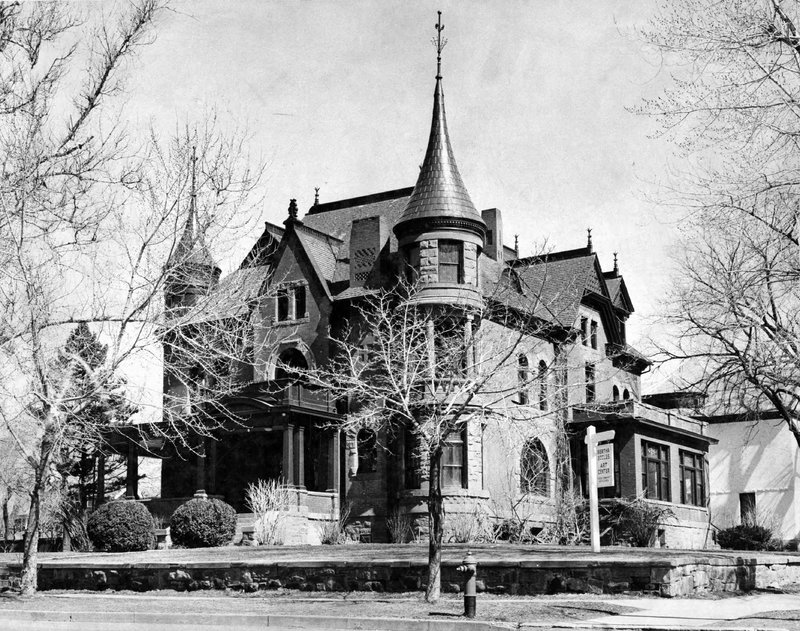
    <summary type="html"><![CDATA[<p><strong><em>The Bertha Eccles Community Art Center embodies the legacy of its owner as a leader in the cultural and educational activities in Ogden, Utah.</em></strong></p><img src="https://www.intermountainhistories.org/files/fullsize/204b067ecd1b651a2feb2277234be780.jpg" alt="Bertha Eccles residence" /><br/><p>The present-day Bertha Eccles Community Art Center is a Queen Anne styled Victorian home built in 1893. It's red brick was imported from the Midwest and red sandstone from northern Utah.  The original owner, James Clarence Armstrong was a wealthy banker and Weber County commissioner in the 1890's.  Samuel A. Whitaker most likely designed the home.  Armstrong sold the home in 1896 to David Eccles, another prominent businessman in northern Utah. Eccles met his first wife, Bertha Marie Jensen at the Weber Stake Academy which eventually became what is now Weber State University. The Eccles extensively remodeled the interior with woodwork of maple, quartered oak, and maple.</p><p>Eccles second wife, Ellen Stoddard, lived in Oregon and then in Logan. Between his two polygamous wives, Eccles fathered 21 children. He also founded at least 56 companies in five western states. Those businesses included sugar factories, banks, railroads, coal mining companies, and lumber yards. During the 50 years Bertha Eccles lived in the home, it became a prominent center for Ogden’s educational and cultural activities. Mrs. Eccles was one of the founders of the Girl Scout movement in Utah and was involved in the Children’s Aid Society, the Red Cross, the Drama Club, and the Child Culture Club.</p><p>After her death, the home was given to the L.D.S. Church. Then, in 1948, the home was turned over to Weber State College which converted it into a women’s dormitory and social center. When the college moved to a new campus, 1954 to 1956, the house reverted back to the L.D.S. church which then gifted it to the Ogden Arts Council which had been formed in 1953 as a coalition of several groups and clubs in Ogden interested in civic and cultural developments in the community. The Bertha Eccles Community Art Center opened in October 1959. In 1976, the name of both the facility and the non-profit organization that supports it was changed to the Eccles Community Art Center. A gallery store was renovated in the 1913 carriage house and opened in May 1985. In 1999, a complex was built on the grounds to accommodate the offices of the Ogden Symphony Ballet Association as well as to house ongoing educational programs. </p><p>Besides displaying artwork, the Center provides space for the Junior League of Ogden, the Palette Club, the Weber County Heritage Foundation, and the Symphony Guild, and other organizations. Classes in graphics, ceramics, painting, drawing, sculpture, drama, and ballet, are taught during the year. Following Bertha Eccles inspirations, this building continues to serve the community and supports various cultural activities. </p><p><em><strong><a href="https://www.intermountainhistories.org/items/show/265">For more (including 4 images) view the original article</a></strong></em></p>]]></summary>
    <published>2019-02-01T05:22:40+00:00</published>
    <updated>2026-04-17T19:32:04+00:00</updated>
    <link rel="alternate" type="text/html" href="https://www.intermountainhistories.org/items/show/265"/>
    <id>https://www.intermountainhistories.org/items/show/265</id>
    <author>
      <name>Faith Connors, Weber State University</name>
    </author>
  </entry>
  <entry>
    <title type="html"><![CDATA[The Sundance Film Festival: Where Skis Meets Cinema]]></title>
    <summary type="html"><![CDATA[<p><strong><em>The largest independent film festival in America is not hosted in New York City or Los Angeles. Rather, the Sundance Film Festival, which began in 1978 and attracted more than 70,000 attendees in 2017, is based out of Park City, Utah. Unknown filmmakers hoping to become the next Academy Award winners flock to Salt Lake City every winter to show Hollywood producers the film that could be the next box office hit.</em></strong></p><img src="https://www.intermountainhistories.org/files/fullsize/e4432f70ad74e28de5be8515e83307b7.jpg" alt="Park City, looking south. Before its transformation into a Hollywood-esque town, Park City was known for little more than mining." /><br/><p>America’s largest independent film festival, originally known as the U.S. Film Festival, brought more than $150 million in economic impact to Utah in 2017. In the same year, the Sundance Film Festival supported almost 3,000 jobs and attracted visitors from 46 states and 18 foreign countries. Incumbent Governor Gary R. Herbert, a longtime supporter of Sundance, proudly said that his state’s “collaboration with [the festival] highlights the exceptional cultural, recreational, tourism, and business opportunities available here in Utah.”</p><p>The founders of Sundance—Sterling Van Wagenen, John Earle, and Cirina Hampton Catania—envisioned an event that would attract independent filmmakers to Utah. They even convinced Robert Redford, an acclaimed actor who received an Academy Award nomination for his role in The Sting (1973), to serve as the festival’s first board chairman. But organizers struggled to turn a profit from the festival until 1981, when it was moved to Park City. There, the U.S. Film Festival became successful and changed its name to Sundance, after Redford’s character in Butch Cassidy and the Sundance Kid.</p><p>Quentin Tarantino’s Reservoir Dogs, which appeared at the festival in 1992 and has been named the “greatest independent film of all time,” was one of Sundance’s earliest success stories. Damien Chazelle, who won an Academy Award for Best Director for his film La-La Land (2016), made a breakthrough at Sundance in 2013, and Ryan Gosling had his adult acting career launched at the festival with Half Nelson’s 2006 premiere. Some box office hits and critically acclaimed films that Sundance has propelled to fame are The Blair Witch Project (1999), Napoleon Dynamite (2004), Saw (2004), Little Miss Sunshine (2006), and Whiplash (2014). As a result, over 4,000 feature-length films were submitted for consideration in 2017, but “only 113 feature films were selected to play at the festival.”</p><p>Despite the festival’s success, it disdains commercialism and does not want to become a playground for A-list actors or a venue that is overflowing with paparazzi. Although it is connected with Hollywood, Sundance enjoys its place in the intermountain community. Over the past two decades, nearly “20 million feet of 35mm film has been screened at the festival, [which] would stretch from New York City to Paris.” But the Sundance Institute does not have its vision set on New York City, Paris, Hollywood, or Cannes. It found its niche in Utah and longs to remain in the Beehive State. </p><p><em><strong><a href="https://www.intermountainhistories.org/items/show/209">For more (including 3 images) view the original article</a></strong></em></p>]]></summary>
    <published>2018-06-08T16:52:43+00:00</published>
    <updated>2026-04-17T19:32:03+00:00</updated>
    <link rel="alternate" type="text/html" href="https://www.intermountainhistories.org/items/show/209"/>
    <id>https://www.intermountainhistories.org/items/show/209</id>
    <author>
      <name>Marc Jonathan Wein, Brigham Young University</name>
    </author>
  </entry>
  <entry>
    <title type="html"><![CDATA[Harris Fine Arts Center (HFAC)]]></title>
    <summary type="html"><![CDATA[<p><strong><em>"Behold the greatest university campus in all the world — in embryo. Truly the campus is the setting of what will undoubtedly be the greatest university in the world, a place to train for our leaders." —Franklin S. Harris</em></strong></p><img src="https://www.intermountainhistories.org/files/fullsize/db2a45426cbf32f2c9d0cec8c0423948.jpg" alt="Franklin S. Harris, ca. 1945" /><br/><p>The Franklin S. Harris Fine Arts Center (HFAC) is named for former BYU president Franklin Stewart Harris. Born in Benjamin, Utah Territory, in 1884, he began his studies at BYU and finished with a doctorate in agronomy from Cornell University. In 1921, while teaching at Utah State University, Harris was offered the position of BYU president. He was thirty-six years old at the time. </p><p>Franklin was president from July 1921 to June 1945—the longest administration in BYU history. His mission as president was to expand the school and its legacy. From the beginning to the end of his term, enrollment rose from 438 students to over 4,000. Franklin also helped establish BYU as an accredited four-year university. The list of his accomplishments also includes creating the College of Fine Arts with Garrit de Jong as its first dean. Harris believed art and music to be the center of a rich life. After years of dedicated service, Franklin S. Harris died on April 18, 1960.</p><p>In October 1962, the BYU Board of Trustees announced that a new building would be built and named after the former BYU president. The president at the time, Ernest L. Wilkinson, attributed the growth of the arts at BYU to President Harris. Wilkinson said, “His administration was responsible for the acquirement of hundreds of important paintings and art objects . . . The distinguished position enjoyed by the University as a music center both for the study and enjoyment of music is largely the result of the support he gave to the fine arts.” Construction began on June 18, 1962, and the Harris Fine Arts Center was dedicated on April 3, 1965. </p><p>The completion of the HFAC brought together the five departments of the College of Fine Arts and Communications: Arts, Communications, Dramatic Arts, Speech, and Music.  The sixty-four classrooms, fifty-seven music practice rooms, five performance halls, TV production rooms, and main foyer (that was also a gallery where students could display their work) made the HFAC the largest academic building at the time. The unique letter and numbering system for classrooms also gained the HFAC the reputation of being the most confusing. In 2015, the Student Theatre Association used that reputation to institute a yearly “DisOrientation” to help new students find their way around the building and the academic options inside. </p><p>In addition to traditional classes and performances, the HFAC hosts other colleges and events. On August 27, 1973, the Pardoe Drama Theatre held the first class of the J. Reuben Clark Law School. In 1974, the HFAC hosted the Mormon Arts Ball. The main foyer was transformed into a ballroom and the halls and theaters were full of performances: the Philharmonic Orchestra, the A Cappella Choir, violinists, pianists, and vocalists, one-act plays, readers theaters, and multi-media presentations. </p><p>The HFAC also uses connections with the community to promote the arts. In 2005, the Provo City Library collaborated with BYU to start a program called ProvoReads. Children are encouraged to read and finish a book by being rewarded with two free tickets to a BYU performance of each year’s book, such as Sara, Plain and Tall and Holes. The HFAC also helped the Food and Care Coalition with a unique fundraising idea in 2007. Art students were encouraged to make a piece to be put in a vending machine in the HFAC to be sold for the price already in the machine. The project helped art students work with a focus on service and helped the community interact with art in a new way while raising money for a local charity. </p><p>The HFAC student community often exhibits art work on the foyer halls, but music students also use the area to show off their hard work. On Fridays at 12:00 p.m., anyone passing through the HFAC can listen to the Concerts at Noon. In 2012, the program was started to give performance majors a chance to present their pieces in a low pressure environment before taking to the stage. Students gather to hear the music and support their classmates every Friday, except on holidays and during finals. Every December, the Concert at Noon is turned into a Christmas sing-along. </p><p>The HFAC now houses the School of Music, the Department of Theatre and Media Arts, Department of Art, Department of Design, the Dean’s office, Arts Production, and the CFAC Advisement Center. With over three hundred performances a year, the HFAC continues to honor Harris and create a center to enrich the lives of students and the community.</p><p><em><strong><a href="https://www.intermountainhistories.org/items/show/194">For more (including 20 images) view the original article</a></strong></em></p>]]></summary>
    <published>2018-06-01T23:09:45+00:00</published>
    <updated>2026-04-17T19:32:02+00:00</updated>
    <link rel="alternate" type="text/html" href="https://www.intermountainhistories.org/items/show/194"/>
    <id>https://www.intermountainhistories.org/items/show/194</id>
    <author>
      <name>Emily Cook, Brigham Young University</name>
    </author>
  </entry>
  <entry>
    <title type="html"><![CDATA[Sego Canyon Fremont Culture Rock Art]]></title>
    <summary type="html"><![CDATA[<p><strong><em>Sego Canyon in Utah has rock art that dates back thousands of years. Four distinct time periods are represented in this collage of ancient artwork. </em></strong></p><img src="https://www.intermountainhistories.org/files/fullsize/3e11325fe3310d6ae0aa0d5b082a1295.jpg" alt="Sego Canyon Rock Art" /><br/><p>One of the most unique and easily accessible locations of ancient rock art in Utah is the Sego Canyon site near Thompson Springs in eastern Utah. Encompassing only three panels of rock art, four successive and distinct periods of human use are illustrated: Archaic, Fremont, Ute, and Anglo-American. Archaic, or Barrier Canyon style. The last of these styles may date as far back as 7000 BC and often features pictographs of large, rounded anthropomorphic figures. Fremont style paintings, dating from 600 AD to around 1250 AD, are pecked into the rock and depict angled anthropomorphic figures and abstract shapes. Ute style dates from 1300 AD to the mid-1800s and depicts animals, war figures, and shields painted in red and white. As American settlers arrived in the late nineteenth century, many sheepherders and cattlemen added their own additions to the artwork.</p><p>The site sits halfway between Thompson Springs, a center of ranching and railroading on the Denver & Rio Grande Western Railway, and the current ghost town of Sego, built to extract coal from the mines in the Book Cliffs first explored by Henry Ballard in 1881. G.K. Gilbert of the U.S. Geological Survey described the rock art in his 1883 report. In 1911, construction began on a railroad called the Ballard & Thompson Railway, which ran right in front of the largest of the three panels. After decades of vandalism by railroaders, miners, and ranchers, including a period where the cliff face was quarried out for building-stone, the BLM acquired the site in 1988. A restoration effort began in 1993 wherein they removed modern graffiti and patched the bullet holes to make the panels more visible.</p><p><em><strong><a href="https://www.intermountainhistories.org/items/show/182">For more (including 2 images) view the original article</a></strong></em></p>]]></summary>
    <published>2018-05-26T00:16:38+00:00</published>
    <updated>2026-04-17T19:32:02+00:00</updated>
    <link rel="alternate" type="text/html" href="https://www.intermountainhistories.org/items/show/182"/>
    <id>https://www.intermountainhistories.org/items/show/182</id>
    <author>
      <name>Joshua Bernhard, Brigham Young University</name>
    </author>
  </entry>
  <entry>
    <title type="html"><![CDATA[Abby Williams Hill’s Artemisia Geyser Pool]]></title>
    <summary type="html"><![CDATA[<p><strong><em>Abby Williams Hill was captivated by the Artemisia Geyser Pool, and for good reason. Though it may not garner as much attention as Old Faithful, Artemisia provides onlookers a unique experience since it does not give any warning signs to indicate when it will erupt. The feeling of surprise and awe of the geyser’s eventual eruption is captured in one of Hill’s best paintings.</em></strong></p><img src="https://www.intermountainhistories.org/files/fullsize/d36be929f8f3d34f4f993d564b77d337.jpg" alt="Artemisia Pool" /><br/><p>The Artemisia Geyser Pool sits just below the Gem Pool and Atomizer Geyser in the Upper Basin of Yellowstone Park. The three of these make up the Cascade Group that erupts for a duration of 15–25 minutes once or twice a day. Artemisia is unique because it does not give any visible warning that indicates when it will erupt. When Artemisia does erupt, however, the force is strong, causing the surrounding area to thump due to the steam bubbles coming from the geyser. Though it has not been the focus of many artists that have come through Yellowstone, Artemisia captivated the painter Abby Williams Hill and was the subject of one of her best paintings. </p><p>Though she was originally from Iowa and spent time in New York training to become an artist, Abby Williams Hill is best known for her work in the American West. After marrying Frank Hill, she moved with him to Tacoma, Washington. There, she became well-known as an artist, and in the early 1900s she was commissioned by the Northern Pacific Railroad to paint the American West as she traveled through it via the railroad. At the time of the assignment, Hill was forty-five, with one son and three adopted daughters. She brought her family along with her on her assignments so they could explore the sites together. Her assignment for the railroad specifically was to paint twenty-two works in the short span of eighteen weeks, in the en plein air style. En plein air is a French term that means outdoors. This style of painting was started and finished while the artist was still outside observing the location, unlike the studio paintings of the past where the artist would sketch while at the location and return back to the studio to finish the work. As a woman, Hill is an interesting and important figure, since many women artists of the time did not receive these types of opportunities, or the recognition that followed. </p><p>In her diary on September 3, 1906, Abby Williams Hill wrote about the Artemisia Geyser Pool, “I have been sketching the Artemisia. We thought it would play, but there was almost no movement of water. There is a small geyser on the formation below it. Ione [Hill’s daughter] and I went to look at it and judging it would soon play, stood to watch it. There came a jarring of the earth and a thumping under our feet. Looking up we saw a ridge of water moving down over the hill towards us as if all the water in the Artemisia had been raised and pushed off over the hill. We ran with all our might, jumped the little gully and climbed the hill where we sat down, but the thumping was so great we ran further. By this time, the water was agitated and soon a great mass was raised a hundred feet, rivers of boiling water poured out. The steam shut off a view of everything else and it was as if we were looking at an eruption in the ocean. The vibration and thumping continued with increased and startling force. It seemed as if a new crater was about to yawn under us.” </p><p>Her painting of Artemisia Geyser Pool depicted a place untouched by humans, yet since she painted in the twentieth century, after Yellowstone was open to the public, this was an unrealistic reality. Historian Laura Edgar writes, “Despite the obvious presence of tourists and the facilities that catered to them, Hill’s paintings depicted only virgin landscapes devoid of any representation of human intervention. She felt strongly that the increased presence of humans in the national parks harmed the pristine natural environment; this opinion grew stronger as the decades passed, resulting in a flurry of correspondence with the US Department of the Interior in the late 1920s and 1930s.” Hill’s painting hearkened back to the time when Yellowstone was first explored by artists. </p><p><em><strong><a href="https://www.intermountainhistories.org/items/show/162">For more (including 3 images) view the original article</a></strong></em></p>]]></summary>
    <published>2018-05-07T23:08:52+00:00</published>
    <updated>2026-04-17T19:32:01+00:00</updated>
    <link rel="alternate" type="text/html" href="https://www.intermountainhistories.org/items/show/162"/>
    <id>https://www.intermountainhistories.org/items/show/162</id>
    <author>
      <name>Emma Tolman, Brigham Young University</name>
    </author>
  </entry>
  <entry>
    <title type="html"><![CDATA[William Henry Jackson’s Hot Spring and Castle Geyser]]></title>
    <summary type="html"><![CDATA[<p><strong><em>Providing the earliest photographs of Yellowstone as he participated in the Hayden Geological Survey, William Henry Jackson was influential in creating America’s first National Park. Hayden, the leader of the survey, remarked that “collecting photographs was similar to collecting fossils and natural history specimens,” a convincing way to influence the United States government to protect these specimens found in Yellowstone. One of Jackson’s best photographs is Hot Springs and Castle Geyser. Castle Geyser is located in the Upper Basin of Yellowstone National Park, near Old Faithful Geyser. </em></strong></p><img src="https://www.intermountainhistories.org/files/fullsize/9452e04037751e30e91a3fc86069e9fb.jpg" alt="Hot Springs and Castle Geyser (color)" /><br/><p>As a member of the Hayden Geographical Survey in 1871, William Henry Jackson was the first photographer in Yellowstone. His photographs informed the government of the landscape and geological sites in Yellowstone, and provided artists on the survey like Thomas Moran with references to the sites so they could complete their works after the survey in their studios. Moran credits the accuracy of his paintings to Jackson’s photographs. Jackson’s photographs were also important to the creation of Yellowstone National Park. “As an intelligent, ambitious, and gifted individual working in a medium of great influence, Jackson became a powerful progenitor of the changes in the American conception of the West and of landscape in general,” writes the historian Peter Bacon Hales.</p><p>William Henry Jackson wrote, “Pictures were essential to the fulfillment of the doctor's plan for publicizing this Survey; but the basic purpose was always exploration. I cannot be too careful in emphasizing the fact that in this [the 1871 expedition] and all the following expeditions I was seldom more than a sideshow in a great circus.” Perhaps humble, perhaps realistic, Jackson saw himself as a small part to a greater whole, yet his photographs have been cited again and again by participants in the survey, as well as historians today, as highly influential in the creation of Yellowstone National Park.</p><p>Hot Spring and Castle Geyser provides an excellent example of his work. Since much of Europe and the eastern United States do not have geysers as a part of their geological makeup, Hot Spring and Castle Geyser documented a unique aspect of Yellowstone. In fact, Yellowstone has the largest concentrated number of geysers in the world. Castle Geyser may be the oldest geyser in Yellowstone, and although its eruption schedule may not be as predictable as Old Faithful Geyser, Castle Geyser erupts about every 10–12 hours a day. Jackson’s photograph Hot Spring and Castle Geyser was the first photograph that shared geysers with a wide audience.</p><p><em><strong><a href="https://www.intermountainhistories.org/items/show/161">For more (including 5 images) view the original article</a></strong></em></p>]]></summary>
    <published>2018-05-07T22:34:56+00:00</published>
    <updated>2026-04-17T19:32:01+00:00</updated>
    <link rel="alternate" type="text/html" href="https://www.intermountainhistories.org/items/show/161"/>
    <id>https://www.intermountainhistories.org/items/show/161</id>
    <author>
      <name>Emma Tolman, Brigham Young University</name>
    </author>
  </entry>
  <entry>
    <title type="html"><![CDATA[Thomas Moran&#039;s Grand Canyon of the Yellowstone]]></title>
    <summary type="html"><![CDATA[<p><strong><em>Thomas Moran immersed himself  deeply in his Yellowstone work. He documented over thirty different sites, one of his best was the Grand Canyon of the Yellowstone.  Enthralled with Yellowstone, Moran started signing some of his works with a “Y” in the middle of his name, Thomas “Yellowstone” Moran.</em></strong></p><img src="https://www.intermountainhistories.org/files/fullsize/bdfbcb15bf2f510059e59a2e5d60ff65.jpg" alt="The Grand Canyon of the Yellowstone" /><br/><p>The Grand Canyon of the Yellowstone, carved out by the Yellowstone River, stretches 1,500 – 4,000 feet wide, and 800 – 1,200 feet deep. After the Yellowstone Caldera, essentially a giant volcano, erupted more than 600,000 years ago, the canyon was formed through lava flow and the increased rate of erosion caused by these flows. The Canyon has captivated visitors for a long as the park has been open, not only because of its striking form, but also because of its reputation as the subject of one of Thomas Moran’s grandest paintings.</p><p>Thomas Moran’s Grand Cañon [sic] of the Yellowstone is one of his most recognizable paintings. Moran was a part of the Hayden Geological Survey in 1872. The survey was federally funded, and its purpose was to document the landscape and geological features of the Yellowstone area. This expedition, with Moran’s artwork as a central component, was influential in establishing Yellowstone as the first national park in America. </p><p>Thomas Moran’s painting mirrors the grandness of the canyon with its giant canvas size of 7 feet by 12 feet.  Peter H. Hassrick writes that, “Some observers, when they saw the large canvas, wondered aloud when the image would move.” This type of enormous painting was a key characteristic of the Rocky Mountain School of artists. The goal of the Rocky Mountain School, patterned after the Hudson River School, was to create art that transported people into the imagined space, that would encourage them to visualize themselves in the depicted location. Admittedly a lofty goal, the artists usually combined different views of the area into one whole creating, an image that one could never witness in real life.</p><p>Writing to Ferdinand Vandeveer Hayden, leader of the Hayden Geological Survey, Thomas Moran said of the Grand Canyon of the Yellowstone, “I have always held that the Grandest, Most Beautiful, or Wonderful in Nature, would, in capable hands, make the grandest, most beautiful, or wonderful pictures, and that the business of a great painter should be the representation of great scenes in Nature . . . I cast all my claims to being an Artist, into this one picture of the Great Cañon and am willing to abide by the judgment upon it.” </p><p><em><strong><a href="https://www.intermountainhistories.org/items/show/160">For more (including 5 images) view the original article</a></strong></em></p>]]></summary>
    <published>2018-05-07T22:04:07+00:00</published>
    <updated>2026-04-17T19:32:01+00:00</updated>
    <link rel="alternate" type="text/html" href="https://www.intermountainhistories.org/items/show/160"/>
    <id>https://www.intermountainhistories.org/items/show/160</id>
    <author>
      <name>Emma Tolman, Brigham Young University</name>
    </author>
  </entry>
  <entry>
    <title type="html"><![CDATA[Albert Bierstadt&#039;s Old Faithful]]></title>
    <summary type="html"><![CDATA[<p><strong><em>Albert Bierstadt was fascinated by the geysers of Yellowstone. In all his life, he had never seen anything as captivating as these bubbly, explosive fountains. His painting of Old Faithful is one of his best works.</em></strong></p><img src="https://www.intermountainhistories.org/files/fullsize/d2c03b869049797a3d1bfc53ed6f9781.jpg" alt="Old Faithful" /><br/><p>Old Faithful is a geological wonder with its consistent eruption schedule. It is not the largest or most regular geyser in Yellowstone National Park, yet it has become one of the most popular sites in Yellowstone. Albert Bierstadt, like tourists of today, was amazed by Old Faithful and his painting captures this feeling. </p><p>Albert Bierstadt was born in Germany in 1830 but moved to the United States at the age of one. Early on in his life, Bierstadt showed interest in art. To jumpstart his career he returned to Germany to study art and later trained with the Hudson River School in New York. The Hudson River School’s style was focused on grand paintings of landscapes with a glowing light. Using the skills he learned in his training, Bierstadt began painting landscapes in the West. Well-known for his works in Yosemite, Bierstadt decided he wanted to explore another American geological wonder. Though Albert Bierstadt was not on the Hayden Geographical Survey of 1872, he was visiting Yellowstone at the same time as Moran and Jackson. He also believed that he was a more accomplished artist than those on the Hayden Survey. </p><p>One of his grandest works in Yellowstone was his Old Faithful. As noted in the introduction, Bierstadt was enthralled by the geysers in Yellowstone. Peter Hassick expands on Bierstadt’s captivation, “Bierstadt’s admitted fascination with Yellowstone’s geysers is reflected in the number of paintings that he produced using them as themes. . . . Contrasted with his conventional, monumental landscapes infused with Claudian glow and other theatrical effects, these studies are intimate and naturalistic.” </p><p>Albert Bierstadt said of his experience in Yellowstone, “This is not the first season I have spent about the Rocky Mountains, but it is my first introduction to the geysers of the Yellowstone. To use the word wonderful is simply to use a relative term. But I have never been so impressed with the infinite divinity of the types of nature as I was by the same geysers. I went West with the fixed intention of spending the greater part of my time about the geysers, and also to study them as thoroughly as I could in the protracted period I had allotted to myself. I have always had an inclination towards geological studies, and here I had a whole world of geological phenomena spread before me.” </p><p><em><strong><a href="https://www.intermountainhistories.org/items/show/159">For more (including 3 images) view the original article</a></strong></em></p>]]></summary>
    <published>2018-05-06T03:49:56+00:00</published>
    <updated>2026-04-17T19:32:01+00:00</updated>
    <link rel="alternate" type="text/html" href="https://www.intermountainhistories.org/items/show/159"/>
    <id>https://www.intermountainhistories.org/items/show/159</id>
    <author>
      <name>Emma Tolman, Brigham Young University</name>
    </author>
  </entry>
  <entry>
    <title type="html"><![CDATA[Springville Art Museum]]></title>
    <summary type="html"><![CDATA[<img src="https://www.intermountainhistories.org/files/fullsize/5ce834410d6a5697a04bbb68d13cdd6f.jpg" alt="Exterior of Museum" /><br/><p>If you enjoy art and live in Utah County, then the Springville Art Museum is a must visit location. The Springville Art Museum was built in 1937 by the WPA (Works Progress Administration) and dedicated by David O. McKay. It is located on 126 East and 400 South in Springville Utah. It is the first and the oldest art museum in Utah for the visual fine arts. The history of the Museum dates back to 1903 when the founders, John Hafen and Cyrus E. Dallin donated artwork to Springville High School. This helped to encourage the arts throughout the area and to have a location where people could come and enjoy the artwork of others and receive their own inspiration. </p><p>The Museum has over 2,500 art pieces in 29 galleries included in its collection and also hosts and displays over 15 exhibitions annually from artists around the globe. The building has had two additions.  In 1964 a two story wing was added and in 1998, 20,000 square feet was added on for space that is focused on education for children and also extra room for the permanent collection. Many families, including Emma and George Smart, Alice and Merlin Steed, Theodore Wassmer and Judy Lund-Wassmer, donated art pieces that have added to the total of around 2,500 pieces that are housed in the museum year round. </p><p>The Springville Art Museum is still visited by thousands of people today who go to see the art pieces and exhibits on display. They also host different kinds of events at the Museum including dances, parties, art events, and other types of festivities. The community is very involved in the Museum from the children attending local high schools having some of their art put on display at the venue as well, which is always an exciting thing for aspiring artists. It truly is a wonderful place to go and view art and even admire the building itself for the historical meanings it has there in Springville Utah. </p><p><em><strong><a href="https://www.intermountainhistories.org/items/show/101">For more (including 2 images) view the original article</a></strong></em></p>]]></summary>
    <published>2018-01-18T18:54:55+00:00</published>
    <updated>2026-04-17T19:31:59+00:00</updated>
    <link rel="alternate" type="text/html" href="https://www.intermountainhistories.org/items/show/101"/>
    <id>https://www.intermountainhistories.org/items/show/101</id>
    <author>
      <name>Summer Sutherland, Brigham Young University</name>
    </author>
  </entry>
  <entry>
    <title type="html"><![CDATA[The Great Gallery: Defining Barrier Canyon Rock Art]]></title>
    <summary type="html"><![CDATA[<p><strong><em>Hidden within the confines of Horseshoe Canyon, vestiges of an ancient people from 7,000 years ago repose on the canyon wall. The figures, as large as 7 feet tall, tantalize historians today with the mystery of their purpose and meaning, defining an entire style of indigenous American rock art.  </em></strong></p><img src="https://www.intermountainhistories.org/files/fullsize/267e4d38115d6911f57060ea9fd0cbc5.jpg" alt="Discovery of the Great Gallery" /><br/><p>The Great Gallery itself consists of a ~200-300 foot stretch of a rock wall on the side of Horseshoe Canyon in Canyonlands National Park in southeastern Utah. It features approximately 80 figures created with a red ocher-tinted paint. The pictographs and petroglyphs have been attributed to the Archaic people, a civilization that lived in Horseshoe Canyon over 7,000 years ago.  These pictographs are similar to a variety of other rock art found in the Four Corners region but their influence and prominence in studies as well as the multitude of similar artwork in the canyon led Polly Schaafsma in the 1970s to name this entire strain of rock art the Barrier Canyon Style (as Horseshoe Canyon was previously named).</p><p>Due to the ancient nature of the rock art, no single interpretation of the Great Gallery is guaranteed to be true. Many ethnographers have suggested that these murals were created for a variety of purposes such as hunting rituals, illustrating myths and traditions, recreation, or shamanistic magic.  As for what the symbols themselves mean, the majority of the tall angular figures without appendages are thought to represent people. Some of the larger, more decorative figures are understood to be shamans. Their special decorative heads represent either the headdresses the shamans wore or the spiritual power these shamans possessed. Other figures included are those of animals or plants important to the Archaic people.  </p><p>Evidence of the Archaic people has been found in Utah dating back to 6,500 BC. They were a hunter-gatherer culture that migrated throughout the desert climate of the Colorado Plateau. This culture’s most recognizable and distinctive features include their rock art, twig figurines similar to the figures seen in the Great Gallery, and the baskets they wove. They used a spear thrower called an atlatl in order to hunt down their food and grinding stones to crush seeds to eat, allowing for a varied diet.</p><p>As stated before, the Great Gallery is a particularly important selection of Barrier Canyon Style rock art. In fact, the Great Gallery pictographs were deemed so important, that a faithful replica was commissioned in the 1940s under Franklin D. Roosevelt’s New Deal program the Works Progress Administration. The mural, created by prominent Utah artist Lynn Fausett, was originally placed in the Museum of Modern Art in New York City before being moved to Denver during WWII for safe keeping and then traveling around the country until it finally settled at the Utah Museum of Natural History in 1969.  A variety of methods have been used to date the art including radiocarbon dating and superposition, but these often do not help form a consensus.  For instance, in 2014, a team of scientists led by geologist Joel Pederson used a method of rock dating called optically stimulated luminescence (OSL) used damage from a rock slide to determine that this section of the Great Gallery must have been created between 900 and 2,000 years ago.  Other scientists maintain that radiocarbon dating of other artifacts in the area that look almost exactly like those in the pictographs support a much earlier dating.  Time will reveal the answers to these mysteries as we understand more about the Great Gallery.</p><p><em><strong><a href="https://www.intermountainhistories.org/items/show/97">For more (including 3 images) view the original article</a></strong></em></p>]]></summary>
    <published>2018-01-16T19:51:49+00:00</published>
    <updated>2026-04-17T19:31:59+00:00</updated>
    <link rel="alternate" type="text/html" href="https://www.intermountainhistories.org/items/show/97"/>
    <id>https://www.intermountainhistories.org/items/show/97</id>
    <author>
      <name>Brandon Sheeder, Brigham Young University</name>
    </author>
  </entry>
</feed>