<?xml version="1.0" encoding="UTF-8"?>
<feed xmlns="http://www.w3.org/2005/Atom">
  <title type="text">Intermountain Histories</title>
  <updated>2026-04-17T19:32:01+00:00</updated>
  <generator uri="http://framework.zend.com" version="1.12.20">Zend_Feed_Writer</generator>
  <link rel="alternate" type="text/html" href="https://www.intermountainhistories.org/"/>
  <link rel="self" type="application/atom+xml" href="https://www.intermountainhistories.org/items/browse?output=rss2"/>
  <id>https://www.intermountainhistories.org/</id>
  <author>
    <name>Intermountain Histories</name>
    <uri>https://www.intermountainhistories.org</uri>
  </author>
  <link rel="hub" href="https://pubsubhubbub.appspot.com/"/>
  <entry>
    <title type="html"><![CDATA[Chinese Pioneers of the Boise Basin]]></title>
    <summary type="html"><![CDATA[<p><strong><em>Late nineteenth-century gold rush communities in southern Idaho’s Boise Basin were often home to diverse and international populations.  Among this population were many Chinese immigrants who, although mostly male, also included women and children.  Though their tenure in the region was brief, the Chinese men, women, and children of the Boise Basin helped to shape the communities and the landscape that define the region today.</em></strong></p><img src="https://www.intermountainhistories.org/files/fullsize/12f925087aceef9a1efafe05e79738ee.jpg" alt="Chinese Street Scene" /><br/><p>Chinese immigrants began arriving in the mountainous and mineral-rich Boise Basin in the 1860s. Their population expanded following the repeal of a local law excluding Chinese miners from the Basin and the departure of European Americans as easy-to-work claims were exhausted. In many cases, Chinese immigrants purchased claims abandoned by others, thus revitalizing local economies. Others entered the Boise Basin as entrepreneurs and began providing goods and services to a growing population. Between 1870 and 1890, places like Centerville, Pioneerville, Placerville, and Idaho City were home to over 1,500 Chinese individuals who accounted for nearly 50 percent of the local population. </p><p>As in other historical Western communities, most Chinese immigrants were men. Despite arriving in smaller numbers and facing disproportionally restrictive legal and social barriers, Chinese women and children were nonetheless a part of the Western landscape in the late nineteenth and early twentieth centuries.  By 1870 at least 54 Chinese women and 10 Chinese children were living in Centerville, Pioneerville, Placerville, and Idaho City. Late nineteenth-century census data describe most single Chinese women as prostitutes or placer miners. These were not exclusive employment strategies, however. Both as wives and domestic laborers, Chinese immigrant women were part of households that earned a living by informally peddling goods or by operating stores, restaurants, groceries, or laundries.</p><p>In addition to domestic and economic activities, historical Boise Basin newspapers indicate that Chinese immigrant women also regularly participated in weddings, funerals, and festivals, as well as local community and cultural events that would have made them an undeniable part of the social and economic fabric of the Boise Basin. Unlike in San Francisco and other urban locations, Chinese children in Idaho City were not excluded from public schools.  As members of the diverse Boise Basin community, Chinese women and children interacted with their neighbors in a variety of capacities and helped to define the local character.  For example, For Cue Di Sang, the granddaughter of Idaho City merchant Loke Kee and a second-generation Idahoan, formed a friendship with her European American neighbors that continued through correspondence for decades after her family relocated to China.  </p><p>Chinese exclusion laws and changes in mining technology drove most Chinese from the Boise Basin in the early twentieth century. Mining has continued at a small scale but, currently, most economic activity centers around tourism and recreation in the Boise National Forest. The demographics have changed, but the legacy of the Chinese men, women, and children who contributed to the social and economic history of these communities endures in local historical museums like the Boise Basin Museum and the Pon Yam House in Idaho City.  Over a century of mining, much of which was carried out by Chinese immigrants, has left an undeniable imprint on the landscape of the Basin.  Visitors can see the sheer scale of this impact in the vast array of mining features that are the backdrop for recreation activities in the Boise National Forest today.  </p><p><em><strong><a href="https://www.intermountainhistories.org/items/show/141">For more (including 5 images) view the original article</a></strong></em></p>]]></summary>
    <published>2018-02-06T21:47:10+00:00</published>
    <updated>2026-04-17T19:32:01+00:00</updated>
    <link rel="alternate" type="text/html" href="https://www.intermountainhistories.org/items/show/141"/>
    <id>https://www.intermountainhistories.org/items/show/141</id>
    <author>
      <name>Renae Campbell, University of Idado</name>
    </author>
  </entry>
  <entry>
    <title type="html"><![CDATA[Fort Sherman on Lake Coeur d&#039;Alene]]></title>
    <summary type="html"><![CDATA[<p><strong><em>Thought of as a resort destination today, the town of Coeur d’Alene got its start with the building of Fort Sherman. While often told as a peaceful story, the building of the fort illustrated the military presence that helped ensure the forced removal of Native people and the control of labor unions. </em></strong></p><img src="https://www.intermountainhistories.org/files/fullsize/60f935d4e12337cb546ae353a2704d60.jpg" alt="The Fort Sherman Chapel" /><br/><p>In 1877, United States General William Tecumseh Sherman went on an inspection tour throughout the west. One of his stops brought him to the banks of Lake Coeur d’Alene in northern Idaho. General Sherman fell in love with the scenery in the area and was impressed enough to suggest building a military fort there. Within a year, a military post was established following Sherman’s advice, originally taking the name of Camp Coeur d’Alene. The name was changed to Fort Coeur d’Alene in 1879, and eventually to Fort Sherman in 1887 to honor General Sherman as he retired from military duty.</p><p>While stationed at Fort Sherman, US soldiers had three major duties. They were asked to help keep the peace in northern Idaho between those settling in the area and the Native people who were attempting to retain their lands and resources. Other duties included protecting the railroad and telegraph lines, as well as protecting the Canadian border from any conflict with the province of British Columbia. Overall, the troops stationed here generally didn’t encounter much need for military interference. They were only sent out from the fort twice keep peace within northern Idaho. First, they dispatched in 1878 to fight against Bannocks in the Bannock Indian War, taking place in southern Idaho. Second, they were called to the Coeur d’Alene miner strike of 1892. The miners were fighting against the reduction of wages and increase of hours, and spurred on by the discovery union information was being passed to mine owners. The military from Fort Sherman came to aid civil authorities against the miners and prevent insurrection and violence. Both times, the troops were gone for around a month, returning back after very little conflict.</p><p>As Fort Sherman grew, the community surrounding it did as well. A hospital, school, chapel, and library were built on the fort, making it more comfortable for the soldiers and their families. Yet this expansion of the settler community threatened the land of  Coeur d’Alene Indians. The tribe started to be forcibly removed prior to the building of the fort in 1873, but were officially moved in 1885 to a reservation forty miles away, on the southern tip of the lake. </p><p>Fort Sherman was officially declared abandoned in March, 1900, and the buildings and property were sold at a public auction in 1905. Today, only two of the original buildings remain, the chapel and the one of the officer’s quarters. The Fort Sherman Chapel now stands as Coeur d’Alene’s oldest church and school and is also listed on the National Register of Historical Places in order to ensure its preservation. The rest of the land bought from Fort Sherman was used to build the North Idaho College campus, instead of returning it back to the Coeur d’Alene tribe. Today, the campus is full of memorials, commemorating the settlers that removed Native people from their homes.</p><p><em><strong><a href="https://www.intermountainhistories.org/items/show/106">For more (including 3 images) view the original article</a></strong></em></p>]]></summary>
    <published>2018-01-23T20:56:05+00:00</published>
    <updated>2026-04-17T19:31:59+00:00</updated>
    <link rel="alternate" type="text/html" href="https://www.intermountainhistories.org/items/show/106"/>
    <id>https://www.intermountainhistories.org/items/show/106</id>
    <author>
      <name>Christopher Gibbons, University of Idaho</name>
    </author>
  </entry>
  <entry>
    <title type="html"><![CDATA[Investigating Women&#039;s Labor on the Stonebraker Family Homestead]]></title>
    <summary type="html"><![CDATA[<p><strong><em>Situated in a remote corner of the Payette National Forest, the Stonebraker family homestead and ranch came to represent many firsts for westering families in central Idaho. The men of the migratory family that called the Chamberlain Basin home flexed their entrepreneurial talents, prospering from opportunities supplied by nearby mining communities. Their well-photographed history portrays the complicated work of homesteading Stonebraker women.</em></strong></p><img src="https://www.intermountainhistories.org/files/fullsize/57e66544b1d7871a33f3a5b3031e5346.jpg" alt="Women with Binoculars at Stonebraker Ranch" /><br/><p>William Allan Stonebraker and his family were among the first non-Native American migrants to homestead in Idaho’s Chamberlain Basin along the Salmon River. Their 409-acre homestead and ranch, established in 1898, generated lucrative ventures for the Stonebraker family. In its early days, the homestead survived by raising beef cattle for neighboring gold rush communities like Thunder Mountain. In 1900, William, already a practiced freighter, struck gold when he won a trail construction contract connecting Grangeville to Thunder Mountain— later known as the Three Blaze Trail. Eventually, he worked as a pack train operator along this route, started his own pack train business in Stites, and lead hunting excursions from his homestead. In the 1920s, following these endeavors, he adapted his homestead into a dude-ranch. All the while, William brought along his camera.</p><p>The experiences of the Stonebraker men and their expeditions in mining, ranching, and big game hunting are well documented in the Stonebraker Photograph Collection, donated to the University of Idaho library in 2003. However, little is shown of the Stonebraker women who remained on the family homestead during their husband’s and brother’s entrepreneurial outings. Out of 540 photographs, less than 50 images of William’s first wife, Lillian Carter, second wife, Golda, and various sisters, friends, and daughters survive in the collection taken by William between 1900 and 1934. The photographs that exist offer a glimpse into these women’s lives as homesteaders.</p><p>In the late nineteenth century, white women in working-class families traditionally performed homemaking tasks like child rearing, cooking, cleaning, baking, sewing, and laundry. For women homesteaders, household labor also included planting, feeding, plowing, herding, cultivating, harvesting, culling, gathering, processing, storing, preparing, and selling or serving the food products gleaned from their homesteads. Photographs in the collection depict the Stonebraker women in trousers and work boots, indicating that they worked outside and handled livestock, particularly in the homestead’s later years as a dude-ranch. Farm work and interactions with livestock signify that the Stonebraker women occasionally transcended the rigid gender notions of nineteenth century homemaking. </p><p>Homesteading often demanded from the Stonebraker women increased responsibilities in outside work that surpassed the antebellum domesticity ideals of the time. Their work in the Chamberlain Basin would end abruptly following William’s death in 1932. Golda sold the Stonebraker homestead shortly thereafter and, eventually in 1975, the homestead was acquired by the Forest Service. The cabin on the Stonebraker property still stands today, however it is reachable only by “horseback, foot, or air”, serving to remind of the homestead’s remoteness and enduring testament to the forgotten women who worked to keep it operating.</p><p><em><strong><a href="https://www.intermountainhistories.org/items/show/109">For more (including 3 images) view the original article</a></strong></em></p>]]></summary>
    <published>2018-01-27T05:14:29+00:00</published>
    <updated>2026-04-17T19:32:00+00:00</updated>
    <link rel="alternate" type="text/html" href="https://www.intermountainhistories.org/items/show/109"/>
    <id>https://www.intermountainhistories.org/items/show/109</id>
    <author>
      <name>Alleah E. Schweitzer, University of Idaho</name>
    </author>
  </entry>
  <entry>
    <title type="html"><![CDATA[Prostitution in the Mining Community of Wallace, Idaho]]></title>
    <summary type="html"><![CDATA[<p><strong><em>In the late-nineteenth century, silver was discovered in northern Idaho and mining quickly became a thriving industry in the region. The town of Wallace, Idaho, was established to meet the needs of the incoming miners to the area. With this influx of young, single men there was a perceived “lack of women.” The few women that were there provided many services to the miners such as laundry, cooking,and sex work.</em></strong></p><img src="https://www.intermountainhistories.org/files/fullsize/47055f84d3a98e34a6228ad6cda12fb3.jpg" alt="Sanborn Fire Insurance Map" /><br/><p>In the period between the late-nineteenth and early-twentieth centuries, silver mining in Wallace, Idaho was in full swing. During this era, many brothels were established. Prostitution contributed a great deal to the economic prosperity of Wallace by meeting miner's desires, contributing to local industry, and providing economic opportunities for women. </p><p>Prostitution was central to the economic system of many small mining towns. Wallace recognized this fact and decriminalizing prostitution while remaining illegal at the state level. Prostitution in Wallace was highly regulated to appease the consciousness of some citizens. Houses of prostitution operated with a strict code of conduct, paid taxes, and workers submitted to frequent health examinations. These regulations pacified critics without eliminating the practice of prostitution.</p><p>The main argument for the need of prostitution was that it kept other “respectable” women safer from the rugged miners. According to the mayor of Wallace in 1905, prostitution was a “necessary evil” to keep refined women from being raped by uncontrollable male sexuality. Ultimately, by allowing women to participate in sex work, Wallace officials ensured a strong economy. Another major factor that led to community acceptance was the income and tax revenue made by prostitutes. In 1913 “tax revenues form prostitution, gambling and the sale of liquor enabled Wallace to pave its streets and fund a general infrastructure upgrade” making the town better for everyone. Because of regulations put on brothels at the turn of the century, Wallace generated considerable revenue. </p><p>Prostitution in this period gave women economic opportunity and even political influence in a society where the same were sometimes limited. The struggles and the risk of disease and pregnancy, however, made it a difficult way to earn a living. At the Oasis brothel, for example, women could have up to sixty customers a night and worked long, unrelenting shifts. The women would also be seen by a doctor weekly to check for diseases and pregnancy. If a prostitute contracted an STD or fell pregnant she could be out of a job. For some, these risks outweighed the economic incentives of sex work while for others, it did not. </p><p>Prostitution was not officially criminalized in Wallace until the early 1990s.</p><p><em><strong><a href="https://www.intermountainhistories.org/items/show/111">For more (including 3 images) view the original article</a></strong></em></p>]]></summary>
    <published>2018-01-27T05:54:53+00:00</published>
    <updated>2026-04-17T19:32:00+00:00</updated>
    <link rel="alternate" type="text/html" href="https://www.intermountainhistories.org/items/show/111"/>
    <id>https://www.intermountainhistories.org/items/show/111</id>
    <author>
      <name>Caila Zimmerman, University of Idaho</name>
    </author>
  </entry>
  <entry>
    <title type="html"><![CDATA[Psychiana: Prophesies from Moscow, Idaho]]></title>
    <summary type="html"><![CDATA[<p><strong><em>International response to the Psychiana movement exceeded the wildest expectations of most anyone in Moscow, Idaho. Even the movement’s founder and prophet, Frank Bruce Robinson, was surprised by the speed with which his new religion swept the globe. However, after decades of astonishing success, Psychiana Inc. would quickly and unexpectedly dissolve. Consequently, the largest religious movement to be born in the Intermountain West maintains a complicated legacy. </em></strong></p><img src="https://www.intermountainhistories.org/files/fullsize/0ab902d91e3a47500cf92fc94a8ec688.jpg" alt=" Packet featuring atom bomb as volcano
" /><br/><p>The Psychiana movement began in 1929 with a simple advertisement in Psychology magazine. Promising to teach anyone to “literally and actually” speak to God, the ad was answered by an overwhelming barrage of letters requesting subscription to the new mail-order religion. Within two decades, Psychiana would be counted as the world’s seventh largest religion. Though largely forgotten today, Psychiana remains one of the largest and most consequential religious movements founded in the Intermountain West. </p><p>The religion’s founder and prophet, Frank Bruce Robinson, settled in Moscow, Idaho in 1928. Having left bible training college unsatisfied, Robinson tired of traditional Christianity and established himself as a druggist. As early as 1925, he began to record thoughts on a new religion that blended elements of Christianity and New Age spiritualism. After a short time in Moscow, Robinson began to host lectures preaching the power of positive thought. Urged by local followers, Robinson placed the fateful Psychology magazine advertisement that catapulted his movement into the international spotlight. </p><p>The lessons of Psychiana were compiled into a series of lessons and mailed individually to the subscriber. In all, Robinson composed more than twenty lessons that could be collectively purchased for roughly twenty to forty dollars. In addition, Robinson offered his autobiography and a variety of self-help pamphlets for purchase. Soon after founding the religion, Robinson left the pharmacy business to manage Psychiana’s mammoth office headquarters. With more than one hundred employees, Robinson became the largest private employer in Latah County. </p><p>Psychiana garnered 36,000 subscribers in sixty-seven countries within its first year of operation. By the early 1930s, the Moscow post office sent and received more than 60,000 pieces of Psychiana correspondence each day. Eventually, they had to construct a larger post office. Robinson’s message of enlightenment and prosperity appealed broadly and worldwide economic misery and political anxiety only served to enlarge Psychiana’s audience. Letters poured in affirming the power of Robinson’s philosophy. Curiously, Benito Mussolini numbered among Robinson’s admirers and the two communicated regularly by telegram.</p><p>Robinson’s business dramatically quickened as uncertainty from the global depression of the 1930s gave way to outright fear of a world war in the 1940s. Robinson went so far as to sell lapel pins that proclaimed Psychiana’s ability to defeat Adolf Hitler. By the end of the Second World War, Psychiana had rapidly and steadily grown for almost two decades. In 1948, Frank Bruce Robinson died of a heart attack at the age of sixty-two. The death of his movement would come soon after. </p><p>Business declined after Robinson’s death, forcing his son to close Psychiana’s doors in 1952. As mysteriously as it had emerged onto the world’s stage, Psychiana disappeared into the void of discarded philosophies. Considered by many to be a passing New Age fad, Psychiana nonetheless altered the lives of countless people and occupies an important position in the history of the Intermountain West.</p><p><em><strong><a href="https://www.intermountainhistories.org/items/show/110">For more (including 5 images) view the original article</a></strong></em></p>]]></summary>
    <published>2018-01-27T05:42:55+00:00</published>
    <updated>2026-04-17T19:32:00+00:00</updated>
    <link rel="alternate" type="text/html" href="https://www.intermountainhistories.org/items/show/110"/>
    <id>https://www.intermountainhistories.org/items/show/110</id>
    <author>
      <name>Samuel Sharp, University of Idaho</name>
    </author>
  </entry>
  <entry>
    <title type="html"><![CDATA[Saving Jazz in Moscow, Idaho]]></title>
    <summary type="html"><![CDATA[<p><strong><em>Throughout the 1960’s jazz was admired across the nation. In the small college town of Moscow, Idaho, the love for the upbeat New Orleans sound was no different. </em></strong></p><img src="https://www.intermountainhistories.org/files/fullsize/1c996a312d406a7b5865769489bb4ad9.jpg" alt="Award to Lionel Hampton" /><br/><p>In 1968, a small group of students and one guest artist gathered together to perform Jazz music and compete in Moscow, Idaho’s first Jazz Festival. Hosted by David Seiler and Robert Spevack, the festival was embraced by the community. According to University of Idaho graduate, Amanda Nagel, the goal of Seiler and Spevack was to combat the death of Jazz to the rise of Rock-N-Roll through “educating young students and instituting a love for jazz for a new generation.” </p><p>In 1977, Dr. Lynn “Doc” Skinner became the new director for the University of Idaho’s Jazz Festival. It was Doc’s plan to transform the small event into a celebrated festival that would bring big names to the northern Idaho. The intimate, single day event grew into a three-day event that brought renowned artists and thousands of students from all over the country to the University of Idaho. Through workshops, clinics, and concerts, students and faculty have been exposed to a variety of different jazz genres.</p><p>The Jazz Festival was graced with the appearance from the Queen of Jazz herself, Ella Fitzgerald. Her 1982 headlined attendance led to the national recognition of the UI Jazz Festival. Shortly after her visit, the University’s student newspaper, The Argonaut, stated, “The evening was a rare one in Moscow. The appearance of a unique and great talent is something to be appreciated. To use one of the titles, Ella, ‘There Will Never Be Another You.’” It was after the presence of Ms. Fitzgerald that big names became ordinary for the U of I Jazz Festival. </p><p>In 1985, the festival was renamed in the honor of Lionel Hampton. That year his band performed on the intimate stage of the Memorial gym, playing through the night, nearly to sunrise. Charles Gallagher, a writer for the Argonaut, describes the event stating, “The performance reminded one of an old black and white movie depicting a smoky jazz hall in Chicago 50 years ago.” Hampton was so impressed by the enthusiasm from the young musicians that he pledged to be the ambassador for the University of Idaho’s Jazz Festival. According to a 1985 January edition of the Argonaut, Hampton began his commitment by donating $50,000 to establish a foundation for the festival. At his 1985 attendance, the University of Idaho recognized Hampton by formally renaming the event to the Lionel Hampton Jazz Festival. </p><p>To date, the Lionel Hampton Jazz Festival has brought thousands of jazz music enthusiasts together to learn from and listen to artists like Ray Brown, Sarah Vaughn, Doc Severinsen, and Al Jarreau. The international superstar appearing in shows coast-to-coast as the United States’ Ambassador of Jazz, Dizzy Gillespie appeared at the Jazz Festival on multiple occasions. Known for his swollen-like-balloons cheeks while he played the trumpet, Dizzy not only embraced the event as a professional and instructor he dedicated some of his most prized possessions to the Jazz collection at the University. </p><p>It was the appreciation and perseverance of Jazz from people like Lionel Hampton, Ella Fitzgerald, and Dizzy Gillespie that allowed for its endurance throughout musical history. Entering its 50th year anniversary, the Lionel Hampton Jazz Festival has allowed for many diverse artists visit the Northwest region and continues to enable the admiration of jazz for generations.</p><p><em><strong><a href="https://www.intermountainhistories.org/items/show/107">For more (including 4 images) view the original article</a></strong></em></p>]]></summary>
    <published>2018-01-23T21:07:59+00:00</published>
    <updated>2026-04-17T19:32:00+00:00</updated>
    <link rel="alternate" type="text/html" href="https://www.intermountainhistories.org/items/show/107"/>
    <id>https://www.intermountainhistories.org/items/show/107</id>
    <author>
      <name>Annysia Hoffman, University of Idaho</name>
    </author>
  </entry>
  <entry>
    <title type="html"><![CDATA[Soaked Timber in Idaho&#039;s Clearwater River]]></title>
    <summary type="html"><![CDATA[<p><strong><em>Between 1900 and 1930, half of all men in northern Idaho and eastern Washington were employed in the lumber industry,  outranking all other product manufacturing during that time. Without safer, modernized technology such as log-loaders, eastern businessmen and timberland owners, including the famous Frederick Weyerhaeuser, were forced to rely on waterways to transport lumber. The process of transporting logs downriver, known as river log-driving, was prevalent on the Clearwater River in north central Idaho before becoming obsolete in 1971.</em></strong></p><img src="https://www.intermountainhistories.org/files/fullsize/efba046a663ae077f06dcd296e4b1b87.jpg" alt="Breaking a Log Jam" /><br/><p>Lumber companies in the Inland Empire (interior Pacific Northwest) competed for ownership of waterways. One such company, the Clearwater Timber Company (merged with the Pine Tree Lumber Company in 1903 to become the Potlatch Timber Company), gained possession of lands around the Clearwater River, and proceeded to dot the river with small lumber camps at the turn of the century. Composed of about twenty to forty men each, these camps oversaw the cutting and transporting lumber downriver toward mills in towns such as Lewiston and Ahsahka, Idaho. Prior to the drives, loggers built guiding channels (flumes) to conduct logs to the river, and constructed barriers (booms) to act as makeshift dams for log collection.</p><p>William Dyche, a Clearwater logger, recounted an experience with a 1913-1914 log drive in which he was appointed as camp superintendent. Dyche’s camp was placed in the middle of the northern Idaho wilderness, and appointed by a businessman from Minnesota to create a path and guide logs through the water. Given about a week to start the drive, groups of men were appointed tasks such as flume and boom creation or to act as “river-hogs”; guides who literally rode floating lumber. Loggers constructed about a quarter mile of flume daily while others fell timber in preparation for the drive. While many workers were inexperienced and paid inadequately, only two lumbermen left, one because of injury. Logs were rolled down flumes and guided in the river by “hogs,” who donned spiked boots for traction and carried poles called peavies designed to direct lumber in the water. Periodically, lumber camps located along the same stretch of river would make the mistake of sending logs downriver simultaneously, resulting in severe jams. The Forest Service was heavily involved in the industry, and because of this, tons of dynamite delivered by the USFS were used to clear log-jams.</p><p>As logging technology developed, practices became relatively safer. The famed Idaho logger, Charles “Red” McCollister, worked on the Clearwater from 1950 to 1971 and later compiled a photo-essay of the last major whitewater log-drive in the United States on the river in 1971. Evident in the photographs are floating camps, called “wanigans.” Instead of making camp on the riverside in regularly freezing temperatures, men shared buoyant rooms, usually heated with a stove. A kitchen drifted alongside the bunkhouses as well, providing three meals a day for loggers. In some situations, though, loggers were forced to resort to past practice, dangerously climbing out of motorboats onto logs in attempts to restore flow or free a jam.</p><p>Although the tradition of log-driving is now gone, replaced by practice freer from danger, using the river as a lumber guide was common in a region known for its lumber industry. Without the dangerous occupation, north central Idaho would be without communities like Potlatch. Early in the 20th century, the lumber industry reigned supreme in Idaho. Without it, Idaho’s communities and economy would have suffered a major loss, as logging attracted needy workers and helped to literally build small towns which still exist today.</p><p><em><strong><a href="https://www.intermountainhistories.org/items/show/104">For more (including 5 images) view the original article</a></strong></em></p>]]></summary>
    <published>2018-01-18T20:42:33+00:00</published>
    <updated>2026-04-17T19:31:59+00:00</updated>
    <link rel="alternate" type="text/html" href="https://www.intermountainhistories.org/items/show/104"/>
    <id>https://www.intermountainhistories.org/items/show/104</id>
    <author>
      <name>Colton Clark, University of Idaho</name>
    </author>
  </entry>
  <entry>
    <title type="html"><![CDATA[The 21 Ranch]]></title>
    <summary type="html"><![CDATA[<p><strong><em>The 21 Ranch is a local icon in Nez Perce County, Idaho. Listed on the National Register of Historic Places, this property continues to be the object of public fascination and interest.</em></strong></p><img src="https://www.intermountainhistories.org/files/fullsize/6635b11c3cf4693ad16ef9091a722d28.jpg" alt="Blast from the Past" /><br/><p>In 1820, Joseph Shissler and John Siers purchased the first one hundred and sixty acres of what was to become the 21 Ranch. Originally a squatter’s claim on the land of the Nez Perce Tribe, or Nimi'ipuu, the property now borders the reservation’s boundaries as outlined in the 1855 Treaty. The property’s location twenty-one miles outside of Lewiston in Waha earned the ranch its namesake. In the 1860s, after gold was discovered, demands for permanent settlements in the Lewiston area increased. In 1862 the U.S. government approved “to secure Homesteads to actual Settlers on the Public Domain,” for Shissler and Siers according to documentation from the U.S. Department of the Interior, sanctioning their claim. While little documentation survived detailing the relationship between the ranch and the reservation, records reveal a dispute over water rights on Lapwai Creek wherein the Supreme Court ruled the Nez Perce Tribe had senior rights. </p><p>The Waha area was a popular summer retreat in the late 19th century and many residents passed the 21 Ranch as they escaped the Lewiston heat. Owner Frank Ward built a house on the ranch in 1891, regarded as a handsome example of Victorian style architecture.  A subsequent owner, Alvin McCormack, added the house to the list of National Register of Historic Places in 1977. He claimed on the application, “The 21 Ranch house is architecturally significant as one of the most pretentious ranch houses in Idaho… The house is clearly visible for many miles, making it a local landmark.” Touted as a successful agricultural operation, the local newspaper praised its model fruit farming practices and the ranch’s purchase of the most modern power sprayer in the early 1900s. The 21 Ranch’s reputation for innovative farming techniques kept it in the public eye for decades, as did the ranch’s reputation for potentially criminal activities.</p><p>The ranch gained notoriety when a shootout occurred in front of the barn on May 19, 1895 leaving two dead. John Siers, one of the original purchasers and a veteran of the Mexican War, died in the altercation. It developed as a dispute over property with a neighbor, Mrs. Goddard. She and her son ambushed Siers and Mrs. Goddard shot him in the back. The newspapers called the murders a tragedy for Lewiston and reported shock at Mrs. Goddard’s acquittal. The ranch went on to garner even more attention over the twentieth century, with rumors of the notorious Plummer Gang’s buried treasure featuring heavily in real estate advertisements. In 1997, the ranch made headlines again when, a woman mysteriously disappeared from Lewiston on December 1, leaving behind traces of blood in her kitchen. Authorities found her the next day in a trailer on the 21 Ranch with no signs of distress. </p><p>An architectural and agricultural marvel and a place of sensationalized violence, the ranch continues to attract local attention. Like so many places in the American West, the 21 Ranch demonstrates the intertwined histories of domesticating the land and participating in violent encounters, keeping this spot in the public gaze for over a century.</p><p><em><strong><a href="https://www.intermountainhistories.org/items/show/142">For more (including 4 images) view the original article</a></strong></em></p>]]></summary>
    <published>2018-02-06T21:51:35+00:00</published>
    <updated>2026-04-17T19:32:01+00:00</updated>
    <link rel="alternate" type="text/html" href="https://www.intermountainhistories.org/items/show/142"/>
    <id>https://www.intermountainhistories.org/items/show/142</id>
    <author>
      <name>Brittany Harrington, University of Idaho</name>
    </author>
  </entry>
  <entry>
    <title type="html"><![CDATA[The Horse Heaven CCC Camp: Life, Work, Masculinity and Education in the Northern Idaho Forest]]></title>
    <summary type="html"><![CDATA[<p><strong><em>Horse Heaven was one of the most remote CCC camps in North Idaho. It was constructed to be a ‘forest camp’ meaning that the majority of projects conducted by the workmen were related to forestry. </em></strong></p><img src="https://www.intermountainhistories.org/files/fullsize/ddaf8ea492186afe8db42a8777a96295.jpg" alt="Hill Side View" /><br/><p>The Civilian Conservation Corps (CCC) was one of the most popular of the 1930s New Deal programs, designed to employ young me, promote economic recovery by sending funds back to their families, and completing public works projects. The Horse Heaven camp, like many of the Pacific Northwest’s CCC camps, was dedicated to forestry and conservation projects. Its location near Enaville, Idaho in the Coeur d’Alene National Forest, allowed for easy access to areas in need of forestry projects. Men at this camp had loaded into cars and driven deep into the wilderness with 40,000 pounds of supplies to build the camp from the ground up. Due to the rugged trail they had to traverse, the thirty mile trip took them six hours by car. After their trek deep into the dense woodland, the caravan camped in a clear valley meadow that had been set aside for the CCC. They had to build their camp, number F-156, from nothing but the supplies they brought with them. Once they were finished one of the camp’s leaders, Major Clarke, called it one of the most beautiful in the area. Form their central location, the men of the camp were able to work on projects like road building and limiting the spread of blister rust, a deadly fungus, in the white pine population. More than just the effect on the local forest and the education of the men at the camps, the CCC was known for improving their outlook as well. </p><p>The Great Depression challenged concepts of masculinity of the time, but through camp activities the workmen of the CCC were able to rebuild their confidence. Men who had no work could not fulfill their prescribed roles as breadwinners, and those same men with little no money for food found themselves weakening physically. The CCC worked to effectively combat these doubts. It gave young men food and a steady job that allowed them to send money home to their families. The work they did was largely outdoors and very physical. When this was coupled with a steady nutritious diet, it allowed formerly weak and sickly men to regain their strength, further improving their self-image. Along with that, the residents of the CCC camps had the opportunity to educate themselves when not at work. Each camp in the CCC had a library and offered classes in diverse topics like public speaking and radio operation. Some classes would even be taught from visiting professors from nearby colleges. This gave the workmen at Horse Heaven camp the opportunity to exercise their minds as well as their bodies.</p><p>Horse Heaven camp was one of many CCC camps in North Idaho and across the United States. These camps served as the center of conservation efforts in their time, but their impact was far larger than just environmental. These camps served to preserve the self-respect of men who had been struggling with economic circumstance.  </p><p><em><strong><a href="https://www.intermountainhistories.org/items/show/105">For more (including 3 images) view the original article</a></strong></em></p>]]></summary>
    <published>2018-01-22T20:21:54+00:00</published>
    <updated>2026-04-17T19:31:59+00:00</updated>
    <link rel="alternate" type="text/html" href="https://www.intermountainhistories.org/items/show/105"/>
    <id>https://www.intermountainhistories.org/items/show/105</id>
    <author>
      <name>Nicholas C. Cousino, University of Idaho</name>
    </author>
  </entry>
  <entry>
    <title type="html"><![CDATA[The Unique Kooskia Internment Camp]]></title>
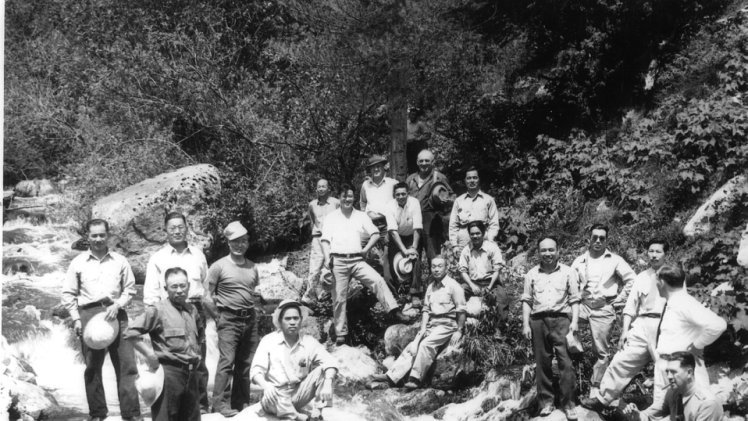
    <summary type="html"><![CDATA[<p><strong><em>In use during the years 1942-1945, the Kooskia Internment Camp held 265 Japanese men. During these years they worked in the camp as well as a labor force building the Lewis-Clark Highway that is still in use today. Here, they lived, slept, and worked far away from their families.</em></strong></p><img src="https://www.intermountainhistories.org/files/fullsize/c4116af5774546b8b324775deccd9ae9.jpg" alt="Kooskia picnic" /><br/><p>Executive Order 9066 placed over 100,000 people of Japanese ancestry into internment camps like the one at Kooskia. Signed by President Franklin Delano Roosevelt on February 19, 1942, it went into immediate effect. Along with internment and work camps like Kooskia, there were concentration, isolation, and prison camps where the government kept Japanese people from the rest of the U.S. population. The camp of Kooskia, however, was different from other interment camps.</p><p>Whereas other camps contained both Isei (first generation Japenese immigrants) and Nisei (second generation Japanese-Americans), the internees of Kooskia were not American citizens but all resident aliens. Therefore, the United States government treated them as prisoners of war and their conditions and treatment were governed by the Geneva Convention. The internees also displayed a healthy amount of knowledge concerning their rights under the Geneva Convention, surprising the administrators at Kooskia. The internees there had more freedoms and privileges than any of the other internees in the other camps. For instance, there were no barbwire fences or guard towers because the location was quite remote, allowing the workers to walk about freely. </p><p>The Kooskia Scrapbook held at the University of Idaho documents these men working and building a life for themselves. The men not only worked, but they also played, relaxed and had plenty of leisure time and activities to fill that time. They could participate in several different sports available to them. There was softball, wrestling, foot racing, and table tennis. Other non-physical competitive activities were board games like checkers and go, a Japanese version of chess. Other recreational activities included boating, fishing, hiking, and more cultural activities like drawing, woodworking, stonecrafting, and weaving. They also read books and magazines, wrote letters and poetry to their families and each other, and they had access to movies. A last part of recreational living was the mixture of musical instruments available to the internees to play. These activities attest to the internees ability to make the best of a bad situation. What is not pictured in the scrapbook, however, are the pain, suffering, and inherent injustice that these and other internees faced. </p><p><em><strong><a href="https://www.intermountainhistories.org/items/show/108">For more (including 4 images) view the original article</a></strong></em></p>]]></summary>
    <published>2018-01-23T21:34:56+00:00</published>
    <updated>2026-04-17T19:32:00+00:00</updated>
    <link rel="alternate" type="text/html" href="https://www.intermountainhistories.org/items/show/108"/>
    <id>https://www.intermountainhistories.org/items/show/108</id>
    <author>
      <name>Keven R. Mack, University of Idaho</name>
    </author>
  </entry>
</feed>