<?xml version="1.0" encoding="UTF-8"?>
<feed xmlns="http://www.w3.org/2005/Atom">
  <title type="text">Intermountain Histories</title>
  <updated>2026-04-17T19:32:19+00:00</updated>
  <generator uri="http://framework.zend.com" version="1.12.20">Zend_Feed_Writer</generator>
  <link rel="alternate" type="text/html" href="https://www.intermountainhistories.org/"/>
  <link rel="self" type="application/atom+xml" href="https://www.intermountainhistories.org/items/browse?output=rss2"/>
  <id>https://www.intermountainhistories.org/</id>
  <author>
    <name>Intermountain Histories</name>
    <uri>https://www.intermountainhistories.org</uri>
  </author>
  <link rel="hub" href="https://pubsubhubbub.appspot.com/"/>
  <entry>
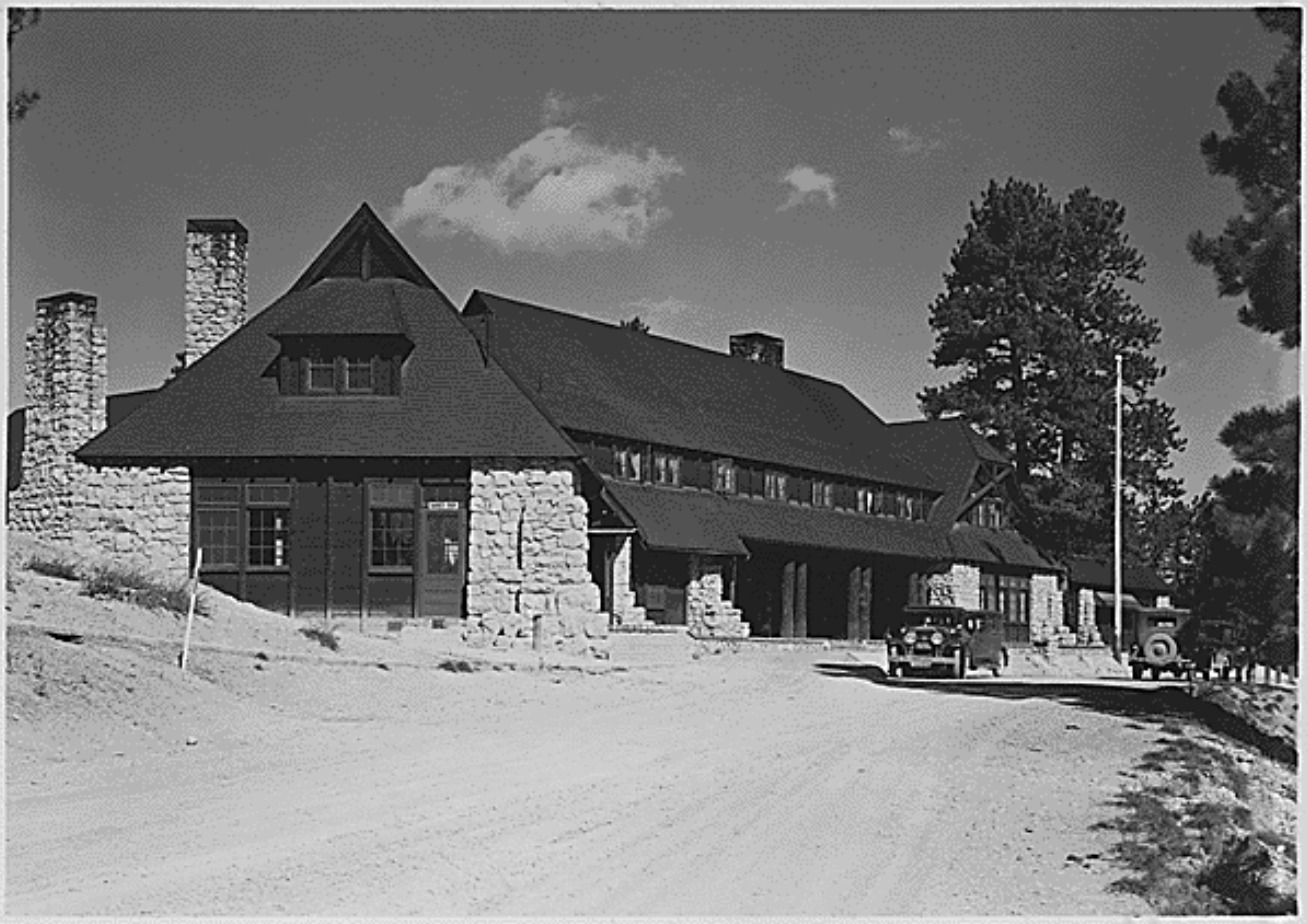
    <title type="html"><![CDATA[Bryce Canyon Lodge and Deluxe Cabins - Bryce Canyon National Park]]></title>
    <summary type="html"><![CDATA[<p><strong><em><span style="font-weight:400;">In 1923, the Union Pacific Railroad created the Utah Parks Company, which connected its rail line to attractions such as Zion National Park and the North Rim of Grand Canyon National Park. The Bryce Canyon Lodge and Deluxe Cabins linked Bryce Canyon State Park to this system of resorts in 1925. </span></em></strong></p><img src="https://www.intermountainhistories.org/files/fullsize/2d65ab73bf5bf337b81a40dba1d6d45e.jpg" alt="Bryce Canyon Lodge, c. 1929" /><br/><p><span style="font-weight:400;">In 1874, Bryce Canyon became part of a cattle ranch owned by Ebenezer Bryce. His ranch was unsuccessful, but automobile tourism revitalized the area when passable roads reached what is now Zion National Park in 1917. In 1921, Utah’s state legislature accepted a proposition from Park Service director Stephen Mather that protected Bryce Canyon as a state park. Utah made no attempt to develop the area for public use, but the Union Pacific Railroad spurred development in Bryce Canyon by creating the Utah Parks Company in 1923. This connected the Union Pacific’s Cedar City spur line to Bryce Canyon, the North Rim of Grand Canyon National Park, and Zion via bus lines. By establishing a network of parks and resorts, the Union Pacific aimed to compete with other successful railroad companies such as the Northern Pacific, Atchison-Topeka Santa Fe, and Great Northern. These companies had established successful tourist attractions at the South Rim of Grand Canyon, Yellowstone National Park, and Glacier National Park. As tourism brought in profit, road construction improved access to rural points of interest like Bryce Canyon. In 1924, Congress established Utah National Park, and the Utah Parks Company constructed Bryce Canyon Lodge and Deluxe Cabins in the same year to provide visitors with accommodations. Congress enlarged Utah National Park and renamed it Bryce Canyon in 1928. </span>
<span style="font-weight:400;">The Utah Parks Company enlisted Gilbert Stanley Underwood, one of the Union Pacific’s consulting architects, to design Bryce Canyon Lodge. Underwood’s designs are notable for their commitment to rustic architecture, which used natural materials and textures to blend a building with its natural surroundings. He utilized locally quarried stone and large, exposed wooden details throughout the structure, figuratively connecting the building to its location. After the company completed the original building in 1925, it added two new wings in 1926 to make room for an increasing number of visitors. The Utah Parks Company constructed fifteen deluxe guest cabins the following year in a pine grove near the main structure. Their design used rough stone and natural wood to imitate the design of Bryce Canyon Lodge. </span>
<span style="font-weight:400;">During the 1950s, the National Park Service renovated Bryce Canyon Lodge to make room for updated amenities. The hotel originally housed a barber shop, but the Park Service replaced it with a soda fountain. The Park Service also enlarged a road at the hotel’s front entrance to make room for larger vehicles, but the Park service expanded a plaza outside Bryce Canyon Lodge’s front entrance by removing the original bus lane in 1989. In 1985, the Park Service removed sixty-one of the lodge’s original sixty-seven standard cabins. The Sunrise Motel and Sunset Motel replaced them. In 1995, the National Register of Historic Places officially listed forty-two buildings in Bryce Canyon, including Bryce Canyon Lodge. This restricted future renovations, allowing the complex to retain most of its architectural significance. Today, Bryce Canyon Lodge operates as a historic hotel alongside five standard cabins and fifteen deluxe cabins. </span></p><p><em><strong><a href="https://www.intermountainhistories.org/items/show/843">For more (including 5 images) view the original article</a></strong></em></p>]]></summary>
    <published>2024-05-29T21:42:39+00:00</published>
    <updated>2026-04-17T19:32:19+00:00</updated>
    <link rel="alternate" type="text/html" href="https://www.intermountainhistories.org/items/show/843"/>
    <id>https://www.intermountainhistories.org/items/show/843</id>
    <author>
      <name>Kaylen Wilson, Northern Arizona University </name>
    </author>
  </entry>
  <entry>
    <title type="html"><![CDATA[Zion Lodge]]></title>
    <summary type="html"><![CDATA[<p><strong><em>There are sixty-one registered historic structures in Zion National Park, the buildings of the Zion Lodge complex being among them.</em></strong></p><img src="https://www.intermountainhistories.org/files/fullsize/b99f86cd2dbd3a60e1905a3de5eb0e89.jpg" alt="Probable dedication of Zion Lodge" /><br/><p>The Union Pacific Railroad and its subsidiary, the Utah Parks Company, completed a railway line near Cedar City in 1923, granting visitors of Zion National Park an easy and convenient method of travel from the railway station to the park by motorbus. The Union Pacific also collaborated with the Park Service to build hotels along its routes to attract customers for each company, resulting in the construction of Zion Lodge, an in-park hotel where guests could stay during their travels. Stephen Mather, director of the National Park Service, initially balked at Union Pacific’s desired size for the lodge and requested something smaller. In the end, each side compromised to build a medium-sized lodge that blended into its natural surroundings inside the heart of the canyon. 
Gilbert Stanley Underwood, an American architect who studied at Yale and Harvard, worked with the Utah Parks Company to design the structure, and construction began in 1923. Underwood envisioned the lodge as a warm and inviting atmosphere for guests. The building incorporated 265,000 board feet of lumber from the Colorado Plateau brought down by the Cable Mountain Draw Works, a mechanism of wires and pulleys extending from the top of the canyon to an area 2,000 feet below. Construction teams finished the lodge in May 1925, and the park held a small dedication ceremony on the front lawn. The later addition of individual cabins to the lodging accommodations in Zion signaled a milestone in park success and development.
The original lodge featured natural wood design, locally sourced stone for the entrance columns, and a green roof that harmonized the building with its surrounding canyon and forest environment. The original structure served visitors and staff for over forty years until it was lost to a fire on January 26, 1966. But in only 108 days, crews constructed a new building to replace the original lodge. The new lodge continues to offer a variety of accommodations.
In addition to being the only place inside Zion that serves food, at the lodge visitors can also attend or embark on ranger-led activities such as patio talks, guided hikes, shuttle bus tours, and outdoor evening programs. To access the lodge, visitors who are staying overnight must present a permit that allows car access up the Zion Canyon Scenic Drive. Otherwise, catching a ride on the shuttle takes visitors to the lodge and nearby trailheads. The park’s swift move to replace Zion Lodge after the fire and maintain accommodations shows the Service’s commitment to visitors and the importance of the lodge to Zion National Park.</p><p><em><strong><a href="https://www.intermountainhistories.org/items/show/602">For more (including 4 images) view the original article</a></strong></em></p>]]></summary>
    <published>2022-06-09T22:21:29+00:00</published>
    <updated>2026-04-17T19:32:13+00:00</updated>
    <link rel="alternate" type="text/html" href="https://www.intermountainhistories.org/items/show/602"/>
    <id>https://www.intermountainhistories.org/items/show/602</id>
    <author>
      <name>Jennifer John, Northern Arizona University</name>
    </author>
  </entry>
  <entry>
    <title type="html"><![CDATA[Zion Human History Museum at Zion National Park]]></title>
    <summary type="html"><![CDATA[<p><strong><em>Zion Human History Museum at Zion National Park began its existence in 1961 as a visitor center, one among many such centers built as part of the Mission 66 initiative to renew national parks.</em></strong></p><img src="https://www.intermountainhistories.org/files/fullsize/fe2d6602811fd2201e5b4fde4ded078a.jpg" alt="Visitor Center plans" /><br/><p>By the early 1900s, the scenic qualities of the two-thousand-foot Navajo Sandstone cliffs in Zion Canyon had been recognized as a potential destination for tourism. In 1909, President Theodore Roosevelt signed an executive order designating Mukuntuweap (Zion) National Monument in Zion Canyon. However, accessing the monument was difficult due to poor road conditions and no railway connection. In 1917, the Utah State Road Commission constructed a new highway which allowed motorists to reach the first visitor lodging in Zion Canyon, Wiley Camp. In 1919, President Woodrow Wilson signed a congressional bill changing the name of the monument to Zion and designating it a National Park. In the 1930s, the newly completed Zion Mount Carmel highway allowed motorists access to travel through Zion to Bryce Canyon. The highway was one of the greatest engineering feats of its time and included a 1.1-mile tunnel through the vertical sandstone cliffs.</p><p>Staff at Zion National Park had been proposing a new information point in the late 1940s before the start of the Mission 66 program which funded the Park Service to establish new modern visitor centers that could accommodate new visitor demands after World War II. By the time President Dwight D. Eisenhower signed the bill to fund the project, Zion Park Staff were no longer discussing whether a new hub was needed, but where it would be located. Controversy over where to locate the new building continued for a year as Park Service Director Conrad Wirth wanted to place it across the road from the museum located near the entrance of the park, but Zion Superintendent Paul Franke argued the main reason for a new setting was due to traffic and overcrowding on the main entry roadway. He argued that the new visitor center needed to be in an area that could accommodate the high volumes of park traffic without causing interference with the main road. The new location placed it outside of the canyon where natural beauty and scenic attractions could be incorporated into the design of the building. </p><p>Park Service designer Cecil Doty presented preliminary designs for the tourist point in 1957. During the next year, Doty's designs for the Zion Visitor Center were handed over to the architectural firm of Cannon and Mullen of Salt Lake City. Construction began in April 1959 but in October a steel strike delayed the modern steel framework in the lobby, and the architects were forced to change their material to aluminum in order to open on time. Cannon and Mullen completed construction in June 1960 and opened to the public that same month. The Park Service dedicated the Zion Visitor Center on June 17, 1961, a year after it had been open to the public. The construction features a large auditorium, exhibit room, lobby for visitors, and an office wing for the park employees. Designs in the lobby featured big glass windows that enabled visitors to view the surrounding canyons and encouraged them to walk outside onto the balcony to get a view of the beautiful mountain range. To blend the modern style of the center with its surrounding environment, the architects incorporated red stone veneers around the bathrooms and the top of the building. The Zion Visitor Center has been renovated and reopened as the Zion Human History Museum.</p><p>Since then, the Zion Visitor Center has been renovated and reopened as the Zion Human History Museum. The museum features permanent exhibits about people who once dwelled in what is now Zion National Park, including southern Paiutes and nineteenth-century pioneers, and about how the area became a national park. Temporary exhibits also offer a range of historic information about the park and its lands and people.</p><p><em><strong><a href="https://www.intermountainhistories.org/items/show/519">For more (including 3 images) view the original article</a></strong></em></p>]]></summary>
    <published>2021-10-16T04:38:01+00:00</published>
    <updated>2026-04-17T19:32:11+00:00</updated>
    <link rel="alternate" type="text/html" href="https://www.intermountainhistories.org/items/show/519"/>
    <id>https://www.intermountainhistories.org/items/show/519</id>
    <author>
      <name>Jennifer John, Northern Arizona University</name>
    </author>
  </entry>
  <entry>
    <title type="html"><![CDATA[The Larson Homestead in Kolob Canyon]]></title>
    <summary type="html"><![CDATA[<p><strong><em>Gustive O. Larson was a prominent Utah historian. He started a homestead in southern Utah in the 1930s but lost it when the Kolob National Monument was established. During his four summers on the homestead, Gustive learned about Utah history, overcame a severe illness, and built a cabin that stands today.</em></strong></p><img src="https://www.intermountainhistories.org/files/fullsize/fa6d43239eb30b5d24b6a17c13bab6f7.jpg" alt="Larson Cabin " /><br/><p>Gustive O. Larson was born in Holladay, Utah in August 1897. He met Virginia Bean while teaching in Richfield, Utah and married her on February 12, 1926. She supported him as he conducted extensive research into Utah history and participated in the community. Gustive published several books and papers, served as president of the Utah Valley chapter of the Utah State Historical Society twice, served as the chairman of the Iron County chapter of the American Red Cross for nine years, and served as chairman of the Cedar City Library Board. In the early 1930s, Gustive tried homesteading and gained valuable knowledge and experience.</p><p>Gustive set up his homestead in Dry Creek, now known as Kolob Canyon, located in the North West District of Zion National Park. Arthur Fife and William R. Palmer also established homesteads in the canyon. Gustive worked with these two men during the summers to carve out his homestead. Gustive finished his cabin in 1931 and in his personal history said his family was optimistic “to make good our claim to this beautiful little wilderness spot.” In 1932, Gustive’s salary dropped due to the depression and teacher salary cuts in Cedar City where he worked. However, Gustive was pleased with the progress being made on the homestead and the fencing that had been put up the second summer. He described the 1932–1933 school year as difficult because of his failing health and luckless speculation on the stock market. In 1933, Gustive had his appendix and gallbladder removed and his health returned.</p><p>The Larson’s were called to serve a mission for the LDS church in Sweden in 1936. In 1937, while the Larson’s were gone, the US government established the Kolob National Monument. This monument overlapped the three homesteads in the area and would eventually be incorporated into Zion National Park. When Gustive returned from Sweden, he tried to claim his homestead and was denied. The homestead laws required a family to live on the land and improve it for five years. In the summer of 1934, Gustive took several classes at UCLA and brought his family with him instead of living on the homestead. This caused the denial of his claim and the Larson’s were forced to abandon the homestead.</p><p>Though Gustive did not retain the homestead, he gained valuable knowledge from the experience. He started a friendship with his neighbor William R. Palmer, who studied Indian culture and wrote a historical radio series. This friendship influenced Gustive’s own work in the history field. Gustive and his son learned much about the outdoors from Arthur Fife who lived down the canyon. Gustive dealt with damage caused to his property by other neighbors’ goat herds and coordinated with the CCC, who were preparing to develop the region. Zion National Park has preserved the Larson cabin, which is located on the Taylor Creek trail today.</p><p><em><strong><a href="https://www.intermountainhistories.org/items/show/199">For more (including 3 images) view the original article</a></strong></em></p>]]></summary>
    <published>2018-06-07T00:54:45+00:00</published>
    <updated>2026-04-17T19:32:02+00:00</updated>
    <link rel="alternate" type="text/html" href="https://www.intermountainhistories.org/items/show/199"/>
    <id>https://www.intermountainhistories.org/items/show/199</id>
    <author>
      <name>Samuel Hauber, Brigham Young University</name>
    </author>
  </entry>
  <entry>
    <title type="html"><![CDATA[Creation and Development of Zion National Park]]></title>
    <summary type="html"><![CDATA[<img src="https://www.intermountainhistories.org/files/fullsize/19b24361da3b311b6deffb13f0fe58af.jpg" alt="Stephen Mather" /><br/><p>Zion National Park has its origins in the Progressive Era, when when President Taft declared the area where Zion is now (near Springdale, UT) as Mukuntuweap National Monument to preserve Zion’s main canyon. The National Parks Service, which was created by Congress in 1916, changed the name to Zion in 1918 as the original Pauite name, meaning “straight canyon,” was unpopular. Zion, the Hebrew word for sanctuary and one that resontated with surrounding Mormon (LDS) communities, was thought a much better name to capture its beauty. Only one year later Congress changed this monument into Utah’s first national park: Zion National Park.</p><p>The first director of the National Parks Service, Stephen Mather, recognized that Zion’s isolated location made it hard for people to visit, so he promoted road construction through the park. One road had already been built in 1917, which went from the present day visitor’s center to the Grotto area. This, along with the very first visitor’s center, Camp Wylie, offered visitors places to plan their day in the park. One of the first projects after Zion was made a national park was the Mt. Carmel Highway and tunnels. Construction began in 1927 and was completed and open for the public a little under three years later in 1930. The 1.1 mile long Mr. Carmel tunnel stood firm until one of the sandstone pillars collapsed in 1958 and had to be closed a few weeks for construction. The tunnel is now electronically monitored around the clock in order to give warning of any recurrence or weaknesses.</p><p>In 2012, Zion National Park was the 6th most visited national park with 2,973,607 visitors. These numbers kept growing, and in 2016 the park had 4,317,028 visitors. These visitors enjoy driving, hiking, and rappelling through Zion’s magnificent canyons. </p><p><em><strong><a href="https://www.intermountainhistories.org/items/show/49">For more (including 4 images) view the original article</a></strong></em></p>]]></summary>
    <published>2017-05-27T15:47:16+00:00</published>
    <updated>2026-04-17T19:31:58+00:00</updated>
    <link rel="alternate" type="text/html" href="https://www.intermountainhistories.org/items/show/49"/>
    <id>https://www.intermountainhistories.org/items/show/49</id>
    <author>
      <name>Rachel Nyfeler, Brigham Young University</name>
    </author>
  </entry>
</feed>
