<?xml version="1.0" encoding="UTF-8"?>
<feed xmlns="http://www.w3.org/2005/Atom">
  <title type="text">Intermountain Histories</title>
  <updated>2026-04-17T19:32:19+00:00</updated>
  <generator uri="http://framework.zend.com" version="1.12.20">Zend_Feed_Writer</generator>
  <link rel="alternate" type="text/html" href="https://www.intermountainhistories.org/"/>
  <link rel="self" type="application/atom+xml" href="https://www.intermountainhistories.org/items/browse?output=rss2"/>
  <id>https://www.intermountainhistories.org/</id>
  <author>
    <name>Intermountain Histories</name>
    <uri>https://www.intermountainhistories.org</uri>
  </author>
  <link rel="hub" href="https://pubsubhubbub.appspot.com/"/>
  <entry>
    <title type="html"><![CDATA[The Plane of the People]]></title>
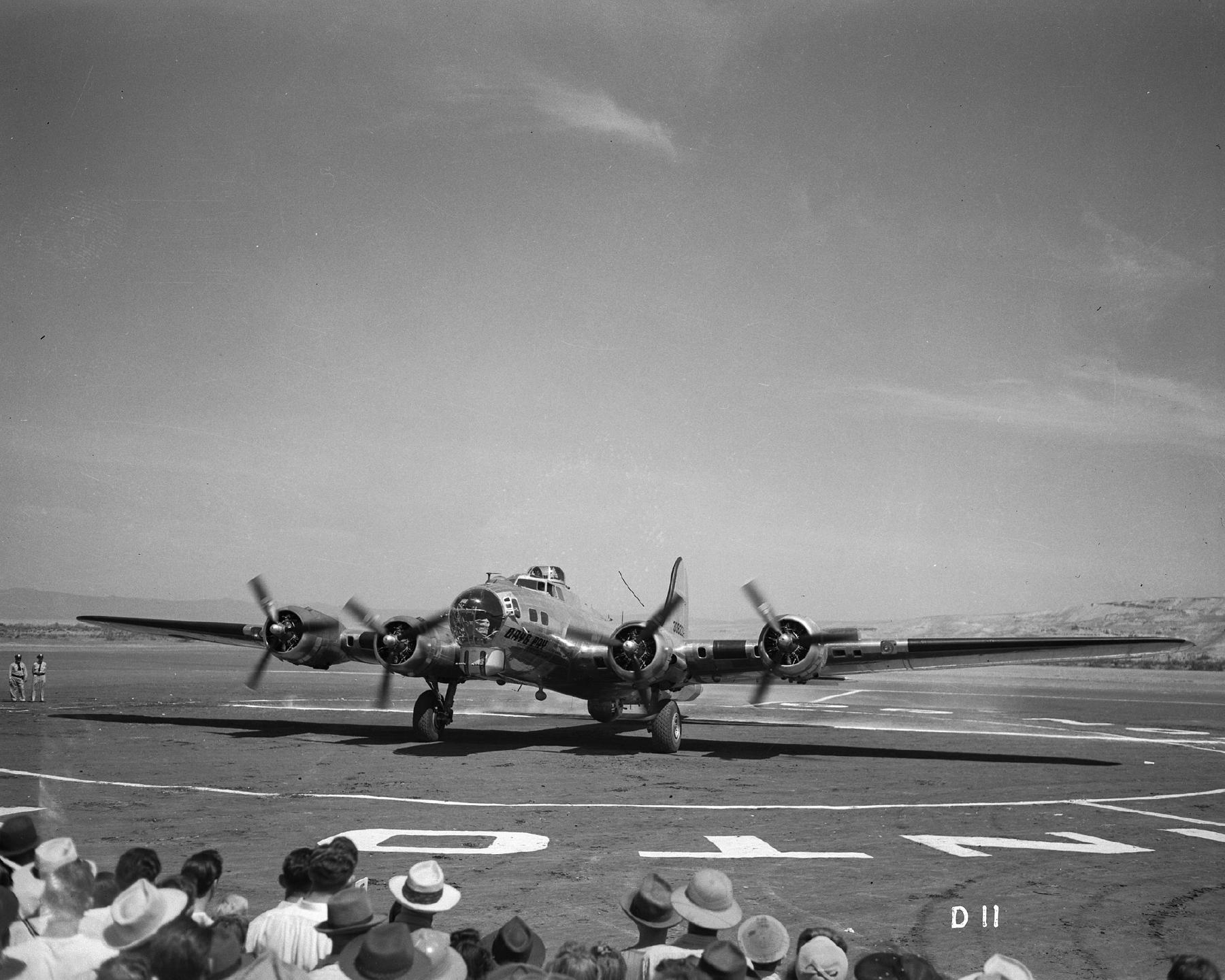
    <summary type="html"><![CDATA[<p><strong><em>During World War II the people of the Hanford Site came together to buy a bomber to support the war effort. The “Give a Bomber” campaign created a legacy that continues to bind a town together.</em></strong></p><img src="https://www.intermountainhistories.org/files/fullsize/5cc1c2fd94c0b5b7485b37b7f3d037e9.jpg" alt="The Day’s Pay B-17 Bomber at the celebration" /><br/><p><span style="font-weight:400;">Would you give up a day's pay to help your country? The workers of Hanford, Washington, where the plutonium was made for the Manhattan Project, decided to contribute their wages to buy a bomber to send overseas. Demonstrating their enthusiasm, 51,000 employees gave up a day’s pay for a certificate acknowledging their “share” of the bomber. The campaign’s slogan “Give a day’s pay and send a bomber on its way,” influenced the name of the plane as “Days Pay” was the overwhelming winner when the “Give a Bomber” committee held a contest to pick a name for th</span><span style="font-weight:400;">e plane. The workers asked the Army Air Force what type of plane it needed. The answer came back asking for the B-17 Flying Fortress, with the cost of the bomber being approximately $300,000 in 1944 (costing $5,257,107.95 in 2024).</span>
<span style="font-weight:400;">On July 23, 1944, workers christened the new plane and dedicated it to Colonel David Wade, along with Mrs. Katie Belle Harris, whose son had been lost in action. The Day’s Pay then became a part of the 8th Army Air Force in England, where it flew more than 60 missions in Germany. The plane was hit to the point of critical condition multiple times, but, what was very rare for the time was that every man on that bomber returned home safely and unharmed, which made the Day’s Pay a lucky plane.</span>
<span style="font-weight:400;">The employees who bought Day’s Pay continued to keep track of it as it flew missions, with the employee newspaper, the </span><i><span style="font-weight:400;">Sage Sentinel,</span></i><span style="font-weight:400;"> reporting on its mission progress. The paper also published a list of the plane’s crew, which allowed the employees to send Christmas cards and care packages to “their” boys overseas as well as check in on “our” plane. Unfortunately after the war, on December 4, 1947, it was taken to Kingman Field, Arizona, and reduced to scrap. </span>
<span style="font-weight:400;">But the legacy of the Day’s Pay lives on in the Richland police department’s badge, the name of a local microbrewery, and other businesses. The largest showing of the Day’s Pay comes from Richland High School, where a mural of the Day’s Pay covers one side of the gymnasium and the football team wears a simplified B-17 bomber sticker on the backs of their helmets. The Richland High School class of 2021 raised money to have a B-17 bomber fly over for graduation, demonstrating that the Day’s Pay is alive and instills community pride to this day.</span></p><p><em><strong><a href="https://www.intermountainhistories.org/items/show/870">For more (including 5 images) view the original article</a></strong></em></p>]]></summary>
    <published>2024-10-22T21:07:24+00:00</published>
    <updated>2026-04-17T19:32:19+00:00</updated>
    <link rel="alternate" type="text/html" href="https://www.intermountainhistories.org/items/show/870"/>
    <id>https://www.intermountainhistories.org/items/show/870</id>
    <author>
      <name>Mason Williamson, Rocky Mountain College</name>
    </author>
  </entry>
  <entry>
    <title type="html"><![CDATA[The Atomic Legacy of Hanford]]></title>
    <summary type="html"><![CDATA[<p><strong><em>Rural farming towns in Eastern Washington were transformed into the backbone of the Manhattan Project. Hanford and Richland were bought by the government to aid in the project. The Hanford site, while being talked about the least, was crucial for the successes of the Manhattan Project, and changed the trajectory of the area.</em></strong></p><img src="https://www.intermountainhistories.org/files/fullsize/d3448cee385cf3b26312497fc10886dc.jpg" alt="The Hanford Construction Camp in Richland" /><br/><p>Hanford, a rural area in the Columbia Basin and Benton County in Washington, was once a farming town before the involvement of the United States Government and the Manhattan Project during World War II. Hanford and the neighboring towns were chosen by Brigadier General Leslie R. Groves to be the area that would produce plutonium for the Manhattan Project to build an atomic bomb. Hanford Engineer Works (later known as the Hanford site) was born in March 1943 with the government contracting the DuPont Corporation along with the U.S. Army Corps of Engineers. Before construction could begin the government had to relocate the local residents, evicting 1,500 people from their homes, taking sacred fishing grounds of the local Native tribe Wanapum, disinterring 177 bodies from the White Bluffs cemetery, and relocating the bodies to Prosser. The displaced residents either moved away or stayed to work on the project. The residents, mostly farmers, were given 30 days to evacuate and were compensated for their homes and businesses. The government also bought the neighboring towns of Richland to house the white workers and the town of Pasco to house the black and ethnic workers.</p><p>The Hanford Construction Camp provided temporary housing to house the builders and their families while building the facility and new Richland that would house the site’s employees. The government contracted Gustav Albin Pehrson, a Swedish-born architect from Spokane to see that Richland was made into a town for the arriving 16,000 employees and their families. Construction took 18 months, assisted by Pehrson’s assembly line style of prefabrication techniques. The cookie cutter houses he had created were called “letter houses,” “ABC houses,” or “alphabet houses” due to Pehrson assigning each style of house a letter of the alphabet. Many of these houses are still standing to this day.</p><p>Once construction was completed in 1944, Hanford began creating the plutonium. Due to the secrecy of the project the workers had no idea what they were making until they learned of the nuclear bombs that were dropped on Japan. They soon realized what they had helped create at Hanford and embraced their contribution, with their new city slogan, "Richland: The Atom-Bustin' Village of the West." After the war, the military turned over control of the site to General Electric and the nuclear program to the Atomic Energy Commission (AEC). The town of Richland was bought back by the residents from the government on July 15, 1958, becoming the eleventh largest town in the state. During the Cold War, Hanford was again producing weapons-grade plutonium, and the AEC was commissioned to research, develop, produce, and regulate nuclear power, which has led to a multitude of health and environmental consequences that are still being dealt with today.</p><p><em><strong><a href="https://www.intermountainhistories.org/items/show/869">For more (including 5 images) view the original article</a></strong></em></p>]]></summary>
    <published>2024-10-22T03:35:21+00:00</published>
    <updated>2026-04-17T19:32:19+00:00</updated>
    <link rel="alternate" type="text/html" href="https://www.intermountainhistories.org/items/show/869"/>
    <id>https://www.intermountainhistories.org/items/show/869</id>
    <author>
      <name>Mason Williamson, Rocky Mountain College</name>
    </author>
  </entry>
  <entry>
    <title type="html"><![CDATA[Serving My People and the Earth Mother: Bear Tribe Medicine Society]]></title>
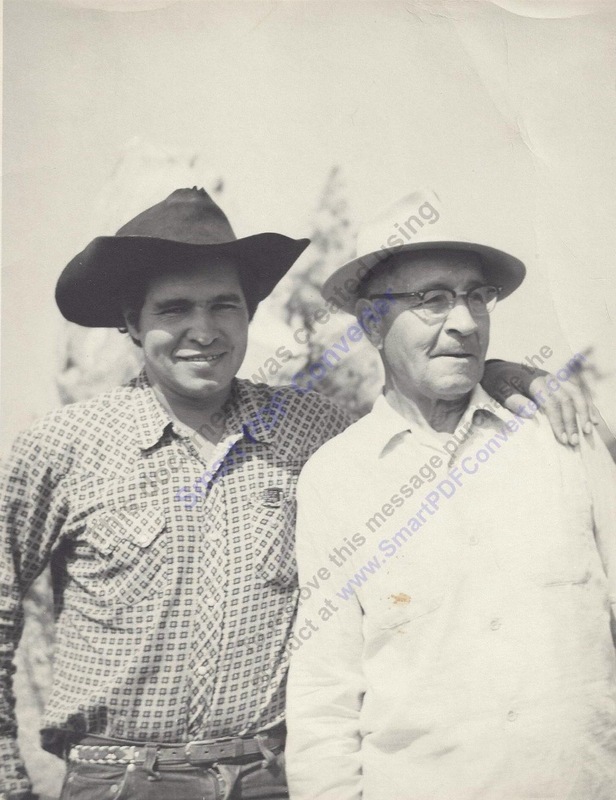
    <summary type="html"><![CDATA[<p><strong><em>Bear Tribe Medicine Society was an interracial center founded in 1971 by Sun Bear, an Ojibwe man who had a vision of people of all ethnicities coming together to learn to live in harmony with the Earth. It was controversial among some Native American groups who felt that he was commercializing Native spirituality.</em></strong></p><img src="https://www.intermountainhistories.org/files/fullsize/8e7de5dc5d0dc54c37cd2525860f464c.jpg" alt="Sun Bear" /><br/><p><p style="font-weight:400;">Bear Tribe Medicine Society was founded by Sun Bear (1929-1992), a half-Ojibwe man born as Vincent LaDuke on the White Earth Reservation in Minnesota. After travelling the country, he landed in California, where he worked as a Hollywood actor. He also was involved with various self-help and fundraising activities for Native communities.
<p style="font-weight:400;">Sun Bear related that he learned the ways of medicine men from his uncles and older brothers on the reservation, and then studied with other tribes around the country. He worked as a medicine man exclusively for Native people until 1971, when he had visions of catastrophic changes to the Earth due to the imbalances created by modern secular society, and a revelation that he should start working with non-Native people. He later stated that his purpose was to look for ways to serve his people and the Earth Mother and clarified that “his people” referred to not only Native people but others seeking a more harmonious way of living. He went on to establish the Bear Tribe Medicine Society, described as an “ecologically oriented cooperative community striving to relearn a harmonious relationship to the Earth Mother, the Great Spirit, and the mineral, plant, animal, and human kingdoms of the earth.”
<p style="font-weight:400;">As of 1988, the Society had a full-time community of fifteen to twenty<span> </span>members who lived on a forty-acre farm on Vision Mountain in Tumtum, near Spokane, Washington, as well as 320 apprentices who lived across the country. The society offered a ten-day screening program in order to select new apprentices. The community valued self-sufficiency. Aside from organizing seminars and workshops, members engaged in various economic activities including publishing a magazine and books and organizing events where Native craftspeople from reservations could earn income. They raised 80-90% of their own food and collected timber left by local loggers for fuel.
<p style="font-weight:400;">Upon Sun Bear’s death in 1992, leadership of the Bear Tribe Medicine Society passed to his assistant Wabun Wind, who led the group for four years until passing the role on to Wind Daughter, a long-time student. She continues to lead the community under the name of Panther Lodge Bear Tribe Medicine Society in Mobile, AL.
<p style="font-weight:400;">Sun Bear encountered criticism from some Native American groups who labelled him as a “plastic medicine man” and claimed that he was commercializing Native American spiritual practices. They felt that he was not a recognized leader in any tribe and that one cannot simply start one’s own tribe. Sun Bear contended that he was not teaching truly Indian spirituality but rather something else, as he took inspiration from the practices of various tribes and added to them with his own ideas. In response to the claim that Sun Bear was profiting from traditional cultural practices, one author commented that Sun Bear drove a beat-up car and lived on a small stipend.
<p style="font-weight:400;">Winona LaDuke, the daughter of Sun Bear and a Jewish-American woman, is an activist who became the first Green Party candidate and the first Native-American woman to receive an electoral college vote for vice president of the United States.</p><p><em><strong><a href="https://www.intermountainhistories.org/items/show/707">For more (including 4 images) view the original article</a></strong></em></p>]]></summary>
    <published>2023-02-22T16:19:26+00:00</published>
    <updated>2026-04-17T19:32:15+00:00</updated>
    <link rel="alternate" type="text/html" href="https://www.intermountainhistories.org/items/show/707"/>
    <id>https://www.intermountainhistories.org/items/show/707</id>
    <author>
      <name>Evan Železny-Green, Northern Arizona University</name>
    </author>
  </entry>
  <entry>
    <title type="html"><![CDATA[Culture, Coulee, and the Columbia National Wildlife Refuge]]></title>
    <summary type="html"><![CDATA[<p><strong><em>For thousands of years, the Columbia River has been a home to unique ecosystems and indigenous tribes from all across the region. The Grand Coulee Dam became another way for the river to support human life, though its legacy has been complicated.</em></strong></p><img src="https://www.intermountainhistories.org/files/fullsize/0e3a173212c0e651de5a1cbf4b33e802.jpg" alt="Fish River Road" /><br/><p>The Columbia River has a unique and essential history involving indigenous people from across the Columbia Plateau, spanning thousands of years and dozens of tribes. A gathering place and trade site for many, the Columbia River has long provided its inhabitants with food, shelter, and other natural resources. Chief among these is the wild salmon population that runs through the river’s reaches, which confederated Columbia tribes such as the Yakama, Warm Springs, Chinook, and Wasco among others have fished for as long as living memory. Even more important, however, is the abundant fresh water—a source that homesteaders and developers in the area have repeatedly been eager to utilize.</p><p>In the early twentieth century, farmers attempting to settle the Columbia Plateau faced roadblocks due to the region’s low rainfall. When other attempts to irrigate the landscape failed, interested parties began to formulate proposals for a dam on the Grand Coulee riverbed. However, as the idea gained popularity, its proponents coalesced around two different preferences for the dam’s primary design and purpose: irrigation and electricity generation. Changes to the dam’s design continued even after initial construction began in 1933. None of these contests, however, considered the needs of the Columbia’s other inhabitants. Though the dam would severely alter salmon migration patterns, designers gave no consideration to how this would impact the tribes of the Columbia River.</p><p>Grand Coulee Dam’s changes to the Columbia Plateau water levels had unforeseen ecological impacts. Though surrounded by desert scrub and sagebrush plains, water from the newly formed Roosevelt Lake flooded parts of the landscape carved out during the last Ice Age. The resulting wetlands attracted species that could now live comfortably in the area, mainly waterfowl, and pushed naturally occurring desert species to higher elevations. Ironically, these waterfowl inspired the United States to create Columbia National Wildlife Refuge.</p><p>Not even damming the river could stop Columbia tribes from fishing in the waters they had used for so long. However, some of the Grand Coulee Dam’s effects were irreversible. Areas south of the dam, including parts of Columbia Refuge, still run with salmon, but tribes living north of the dam have lost the fish’s spawn sites, preventing them from performing certain rituals. Multiple dams along the river have also flooded traditional fishing sites, such as Kettle Falls near Grand Coulee and the now-submerged Celilo Village near Dalles Dam. Regardless of the rights that Columbia tribes have retained, their losses are significant.</p><p>The Grand Coulee Dam has drawn an abundance of life to the Columbia River and its basins, providing environments and opportunities that were once unimaginable. Yet the various ancestral homelands—of Yakama, Colville, Spokane, and more—surrounding the Columbia Refuge on all sides provide a constant reminder of what used to be.</p><p><em><strong><a href="https://www.intermountainhistories.org/items/show/549">For more (including 3 images) view the original article</a></strong></em></p>]]></summary>
    <published>2021-12-17T03:45:17+00:00</published>
    <updated>2026-04-17T19:32:11+00:00</updated>
    <link rel="alternate" type="text/html" href="https://www.intermountainhistories.org/items/show/549"/>
    <id>https://www.intermountainhistories.org/items/show/549</id>
    <author>
      <name>Len Truelsen, Northern Arizona University</name>
    </author>
  </entry>
</feed>