<?xml version="1.0" encoding="UTF-8"?>
<feed xmlns="http://www.w3.org/2005/Atom">
  <title type="text">Intermountain Histories</title>
  <updated>2026-04-17T19:32:20+00:00</updated>
  <generator uri="http://framework.zend.com" version="1.12.20">Zend_Feed_Writer</generator>
  <link rel="alternate" type="text/html" href="https://www.intermountainhistories.org/"/>
  <link rel="self" type="application/atom+xml" href="https://www.intermountainhistories.org/items/browse?output=rss2"/>
  <id>https://www.intermountainhistories.org/</id>
  <author>
    <name>Intermountain Histories</name>
    <uri>https://www.intermountainhistories.org</uri>
  </author>
  <link rel="hub" href="https://pubsubhubbub.appspot.com/"/>
  <entry>
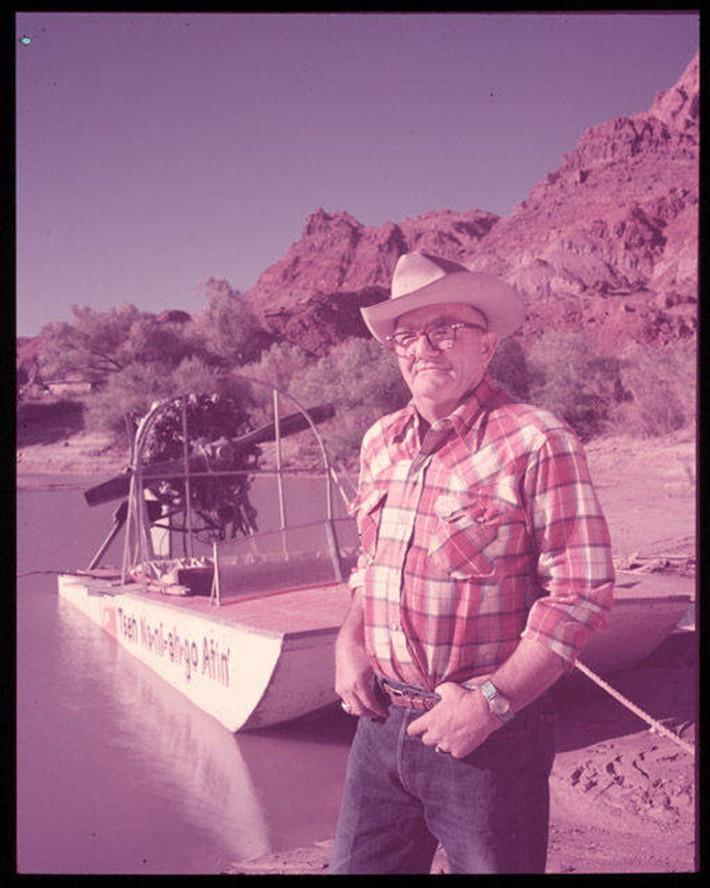
    <title type="html"><![CDATA[Art Greene and Lake Powell]]></title>
    <summary type="html"><![CDATA[<p><strong><em>Lake Powell is one of the largest reservoirs in the country by both volume and length, with almost a hundred side canyons extending into the surrounding arid, red-hued lands of southern Utah. Its waters quickly became a hub for outdoor recreation, with concessionaires like Art Greene pioneering desert boat-driven tourism.</em></strong></p><img src="https://www.intermountainhistories.org/files/fullsize/b3e159b1b55fa0b91b08098f58109e64.jpg" alt="Art Greene and his commercial river craft, the Tseh Na-ni-ah go Atin (Diné for “trail to the rock that goes over”, in reference to Rainbow Bridge), ca. 1949-1956" /><br/><p>The Glen Canyon Dam, which spans the Colorado River by the Utah-Arizona border, created Lake Powell in 1963. The lake submerged Glen Canyon to hold water and generate energy, and it remains a contested environmental issue. Nonetheless, Lake Powell attracts millions of visitors a year. Congress created the Glen Canyon Recreation Area (GCRA) in 1972 to center the region around leisure just as much as conservation. GRCA also borders Rainbow Bridge National Monument, only accessible by boat or a lengthy hike from the Navajo Nation. Rainbow Bridge, whose establishment predates that of GCRA, holds spiritual significance for nearby Indigenous tribes and attracts visitors looking for a trip “off the beaten path.” As Lake Powell’s waters rose, however, Rainbow Bridge and other surrounding features became more accessible for those traveling by boat.
            Art Greene was an early entrepreneur in the Glen Canyon who provided visitor services before Lake Powell was even created. Previously working as a river guide, cowboy, and oil rigger, to name a few, Greene and his family moved to Arizona from Colorado in 1943. They went on to manage the Marble Canyon Lodge, then bought the Cliff Dweller’s Lodge just down the road in 1949. The lodges, located near the Utah-Arizona border, catered to early river runners and outdoor enthusiasts. Greene launched the first commercial river trips upriver from Lee’s Ferry to Rainbow Bridge (a route that would be interrupted by the dam’s creation). Earl Johnson, his son-in-law, was the main supervisor of the river trips.
As early as 1945, Greene had noticed dam site surveyors in the area, and, after suspecting that the dam would disrupt his business downriver, he jumped at the prospect of lucrative lake tourism. The family acquired a commercial lease on the state grazing land nearby, planning lodging and recreation facilities. The Greenes also built a road, airstrip, and employee infrastructure in the area. The National Park Service (NPS), which had taken over administration duties from the Bureau of Reclamation, granted the Greene family a concession in 1959 to continue construction of the recreation area, now called Wahweap Marina.
By 1966, the family had worked with NPS to develop lodgings and boat ramps, a $3 million project to provide full access to America’s newest “playground”. Earl Johnson ran lake tours aboard boats like the <em>Rainbow</em> <em>Trail</em> for the family’s Canyon Tours, Inc. These tours ranged from daily trips to Rainbow Bridge to five-day overnight excursions. Tour boats brought passengers to features like the Glen Canyon Dam and the various side canyons of Lake Powell. Alongside guided tours, Canyon Tours owned a fleet of rental crafts for private use. As tourist rates increased, the family operation sold its concession to the Del Webb Corporation, a national developer of real estate and recreation properties, in 1976.
Today, Lake Powell’s low water levels not only hinder its water storage and power generating capacity, but also the ability to access features like Rainbow Bridge by boat. Guided tours persist, but are completely dependent on evaporation and drought conditions. Lake Powell still functions as a recreation hub for desert-dwellers in search of rare days on the water, as well as visitors from outside the West looking for deserts, canyon walls, and wide-open spaces.</p><p><em><strong><a href="https://www.intermountainhistories.org/items/show/893">For more (including 6 images) view the original article</a></strong></em></p>]]></summary>
    <published>2025-09-23T15:30:20+00:00</published>
    <updated>2026-04-17T19:32:20+00:00</updated>
    <link rel="alternate" type="text/html" href="https://www.intermountainhistories.org/items/show/893"/>
    <id>https://www.intermountainhistories.org/items/show/893</id>
    <author>
      <name>Anaëlle DePoint, Northern Arizona University</name>
    </author>
  </entry>
  <entry>
    <title type="html"><![CDATA[A Beach in the Desert: Wahweap Beach]]></title>
    <summary type="html"><![CDATA[<p><strong><em>Originally discovered by the Indigenous tribes in the region and created by the growing reservoir behind Glen Canyon Dam, Wahweap Beach developed into a sought-after vacation spot through the construction of Wahweap Lodge by the Greene Family.</em></strong></p><img src="https://www.intermountainhistories.org/files/fullsize/aeab139905fd748f1dace82ace64c1bb.jpg" alt="Wahweap Beach, ca. 1961-1969" /><br/><p>In the middle of northern Arizona and southern Utah’s high desert sits the Wahweap Beach on the artificial oasis of Lake Powell. Wahweap Beach is the most popular recreational and lodging area on Lake Powell with a little over a million visits and about 425,000 overnight stays in 2021 alone. Along with swimming and sunbathing, beachgoers can kayak, paddleboard, jet ski, and powerboat. Wahweap includes amenities such as an RV-friendly campground, picnic tables, boat rentals, and the Lake Powell Resort, making for many options for how to spend time at the beach.</p><p>However, Wahweap Beach did not always exist. It began due to the rising waters of Lake Powell after the construction of Glen Canyon Dam from 1957 to 1964. Originally, “Wahweap” comes from the Paiute language, meaning “bitter water.” The name warned passing natives about the unsafe drinking water as Wahweap only saw running water during spring run-off and summer monsoons. Toward the end of the thirteenth century, the Ancestral Pueblo people fled the area of modern-day Lake Powell and later, the Navajo (Diné), Ute, and Paiute tribes moved into the area.</p><p>In the early days of Lake Powell, the Bureau of Reclamation owned the land, although it granted leases to Navajo farmers for cattle grazing. Bill Greene and his family purchased the lease that designated Wahweap Beach in 1957 from a Navajo man named Curly Tso. The family decided to invest and worked to acquire land concessions from the Arizona State Land Department. Despite strong competition, the family had the help of Barry Goldwater, Arizona senator, and Stewart Udall, House of Representatives member for Arizona’s 2nd District, and gained a concession to the land in 1959 from the National Park Service (NPS). This allowed the Greene family full control of the recreational use at the southern tip of the lake.</p><p>Construction then began on Wahweap Lodge and Marina, now called Lake Powell Resort, by the Greene’s family business, Canyon Tours, Inc. Bill Greene put in a temporary boat launch facility in 1963, and by 1965, Canyon Tours, Inc. finished building Wahweap Lodge which included forty-four guest rooms. These facilities began attracting tourists to its shores to swim, boat, and fish, thus creating the beach life at Wahweap.</p><p>The expected tourist turn-out was so great that in 1962, the NPS already had plans to develop a visitor center at Wahweap Beach. The Parks’ Services Interpretive Prospectus Glen Canyon National Recreational Draft proposed scientific, historical, and recreational-themed exhibits included at Wahweap. Ultimately, other locations such as the Bull Frog Visitor Center across the lake took on the role of interpretation, and included exhibits on human, geological, and natural history. Today, Wahweap is the most active beach and as of June 2023, its swimming spot, also referred to as “Swim Beach,” has been relocated by Glen Canyon National Recreation Area due to the reservoir’s declining water levels. Wahweap is now further from the boat ramps at the Marina, making for a more secluded beach on which to swim and lounge.</p><p><em><strong><a href="https://www.intermountainhistories.org/items/show/826">For more (including 4 images) view the original article</a></strong></em></p>]]></summary>
    <published>2024-05-22T23:55:14+00:00</published>
    <updated>2026-04-17T19:32:18+00:00</updated>
    <link rel="alternate" type="text/html" href="https://www.intermountainhistories.org/items/show/826"/>
    <id>https://www.intermountainhistories.org/items/show/826</id>
    <author>
      <name>Olivia Hall, Northern Arizona University</name>
    </author>
  </entry>
</feed>
