<?xml version="1.0" encoding="UTF-8"?>
<feed xmlns="http://www.w3.org/2005/Atom">
  <title type="text">Intermountain Histories</title>
  <updated>2026-04-17T19:32:12+00:00</updated>
  <generator uri="http://framework.zend.com" version="1.12.20">Zend_Feed_Writer</generator>
  <link rel="alternate" type="text/html" href="https://www.intermountainhistories.org/"/>
  <link rel="self" type="application/atom+xml" href="https://www.intermountainhistories.org/items/browse?output=rss2"/>
  <id>https://www.intermountainhistories.org/</id>
  <author>
    <name>Intermountain Histories</name>
    <uri>https://www.intermountainhistories.org</uri>
  </author>
  <link rel="hub" href="https://pubsubhubbub.appspot.com/"/>
  <entry>
    <title type="html"><![CDATA[Camp Floyd Cemetery]]></title>
    <summary type="html"><![CDATA[<p><strong><em>Although Camp Floyd was one of the largest United States military installations before the Civil War, it was abandoned just three years after being created. Evidence of the camp’s over-3,000 residents is now almost non-existent, except for the Camp Floyd Cemetery that remains today in Fairfield, Utah. </em></strong></p><img src="https://www.intermountainhistories.org/files/fullsize/83e417a02d918c705de46f13a17d6a0d.jpg" alt="Unknown soldiers" /><br/><p>In 1858, President James Buchanan sent United States Army General Albert Johnston and 2,500 troops to the Utah Territory to protect newly-appointed territorial leaders and put an end to a suspected rebellion. In response, the Brigham Young, territorial governor and president of The Church of Jesus Christ of Latter-day Saints (sometimes called Mormons) declared martial law and mobilized for war. What became known as the “Utah War'” or “Utah Expedition” began.  Johnston’s army survived a harsh winter and a few raids from Latter-day Saints before they ultimately concluded that the Mormons were not in rebellion against the United States. The troops subsequently passed through the Salt Lake Valley and established a camp at Fairfield, a sparsely populated village that was far from major Latter-day Saint settlements. Johnston’s army called it “Camp Floyd'' after the then secretary of war, John B. Floyd.
Camp Floyd became a lively town with a population of more than 7,000 people at its peak. Then, in 1861, the United States redeployed the soldiers to the eastern theater of the escalating Civil War, leaving Camp Floyd completely abandoned. Almost nothing of the soldiers’ homes or the dugouts where they lived remains today. At the site, the old commissary building now serves as a state park museum, along with the Stagecoach Inn which was used in the overland trade that continued after the soldiers abandoned Camp Floyd. The only other evidence that remains of this once bustling military settlement is the cemetery where the soldiers and officers who perished there were buried.
Scholars believed that 84 people were buried in or close to the Camp Floyd Cemetery. Research has revealed that some of the people who buried there were not Camp Floyd soldiers. The actual location of all these 84 people’s remains is unknown. In 1913, those buried here were commemorated by one large headstone that was made from the stones of army barracks at Camp Floyd. After the land was turned over to the Utah State Park and Recreation Commission in 1959, the American Legion placed 84 headstones, evenly spaced throughout the cemetery. In 2009, researchers used ground penetrating radar technology, revealing the location of 33 bodies. In light of that discovery, in 2011, Camp Floyd State Park replaced the headstones to specifically mark the identified locations of the unidentified bodies. The park also added a sign at the entrance describing the people buried.</p><p><em><strong><a href="https://www.intermountainhistories.org/items/show/562">For more (including 4 images) view the original article</a></strong></em></p>]]></summary>
    <published>2021-12-18T07:05:42+00:00</published>
    <updated>2026-04-17T19:32:12+00:00</updated>
    <link rel="alternate" type="text/html" href="https://www.intermountainhistories.org/items/show/562"/>
    <id>https://www.intermountainhistories.org/items/show/562</id>
    <author>
      <name>Larissa Barnes, Brigham Young University</name>
    </author>
  </entry>
  <entry>
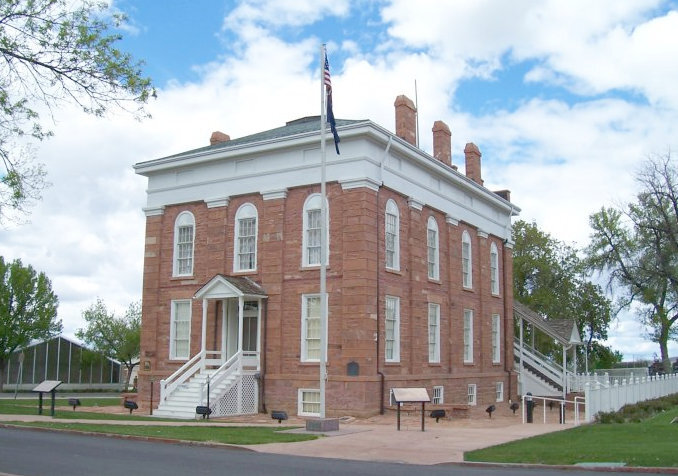
    <title type="html"><![CDATA[Fillmore: Utah Territory’s First Capital]]></title>
    <summary type="html"><![CDATA[<p><strong><em>Controversy arose during Brigham Young’s time as governor of the Utah territory while Fillmore served as the territorial capital of Utah. Although poised to grow into a prolific settlement with a grand statehouse, Fillmore could not fulfill or maintain the territory’s expectations. Instead, the small farming community’s duration as territorial capital proved short lived, lasting from 1851 to 1856 when it was replaced by Salt Lake City. Though the legislature only met here once in 1855, Fillmore played an important role in Utah’s territorial history.</em></strong></p><img src="https://www.intermountainhistories.org/files/fullsize/18f99296cb52e1568c4b646dc915584c.jpg" alt="The statehouse in Fillmore" /><br/><p>Nestled in the Pahvant Valley of south-central Utah, Fillmore was envisioned as Utah’s magnificent territorial capital in the geographic center of Utah Territory 148 miles south of Salt Lake City and 162 miles north of Saint George. Jesse W. Fox surveyed the town on October 28, 1851. Anson Call led the colonization party of thirty families that built homes, the sawmill, and the gristmill. Renowned church architect Truman O. Angell—designer of the Salt Lake City and St. George temples—fashioned a lovely design for the territorial statehouse. Though somewhat desolate, Fillmore developed modestly within several years. Construction of the statehouse began in 1852 and the completed west wing housed the first legislative session in 1855. Farmers channeled irrigation systems from the Sevier River bringing water to their crops and livestock.
Ute resistance to Latter-day Saint intrusions into their traditional homeland suppressed the town’s expansion. Ute leader Chief Kanosh tried to maintain amicable relations with the pioneers, but finite resources limited his generosity. Tension between Mormon settlers and their Indian neighbors led to several confrontations in the 1850s and ’60s: the Gunnison massacre of 1853; the Walker War of 1853–55; the Tintic War of 1856; and the Black Hawk War of 1865–67. The Saints erected Fort Fillmore in 1853–54 and nearby Cove Fort in 1867 as protection against Indian raids.
Notwithstanding Fillmore’s designation as the official territorial capital, Brigham Young and other Church leaders continued to govern the Saints from Salt Lake City. The mountainous expanse of distance between Fillmore and Salt Lake coupled with insufficient resources meant Fillmore had not developed the prestige nor population needed to become the capital city. In December 1855, legislators met in the completed west wing of the state house in Fillmore and decided to officially build a new capitol in Salt Lake City following the final legislative session in the statehouse in 1856. The town of Fillmore was left to maintain its welfare in arid southern Utah, and the statehouse forever remained incomplete.
The Utah War from 1856–57 exacerbated Fillmore’s remote conditions. In March 1857, President James Buchanan sent 2,500 United States troops to Salt Lake City to quell the supposed Mormon rebellion and depose Brigham Young as governor. The federal government distrusted the Mormons and persecuted them for their practice of polygamy. The situation deteriorated when Church leaders pressed for the nation to admit their proposed state of Deseret into the Union and moved the territorial capital to Salt Lake City, a populace entirely governed by the Church. The national government determined to replace Young as territorial governor with Alfred Cumming to ensure that the United States government could maintain control. Fortunately, Thomas Kane helped negotiate peace in exchange for Utah’s acceptance of the new governor in 1858, and the Saints received amnesty for their alleged crimes.
Fillmore remained too small to hold its position as Utah’s capital. Salt Lake City had better resources, a larger population, and the added advantage of not being isolated in the heart of indigenous territory. Preserved by the devoted families living there, historic Fillmore stands as a reflection of Utah’s territorial past, a shadow of unfulfilled ambitions.</p><p><em><strong><a href="https://www.intermountainhistories.org/items/show/466">For more (including 3 images) view the original article</a></strong></em></p>]]></summary>
    <published>2021-09-09T23:28:33+00:00</published>
    <updated>2026-04-17T19:32:09+00:00</updated>
    <link rel="alternate" type="text/html" href="https://www.intermountainhistories.org/items/show/466"/>
    <id>https://www.intermountainhistories.org/items/show/466</id>
    <author>
      <name>Rebekah Cannon, Brigham Young University</name>
    </author>
  </entry>
  <entry>
    <title type="html"><![CDATA[Camp Floyd and the Mormons]]></title>
    <summary type="html"><![CDATA[<p><strong><em>Driven from state to state, early coverts of The Church of Jesus Christ of Latter day Saints faced constant persecution for their religious beliefs in antebellum America.  Eventually, they fled west to the Rocky Mountains.  Within ten years, however, the federal government sent troops after them, fearing that Brigham Young, the Mormon prophet, was becoming too autonomous and powerful in the Utah Territory.  General Albert Johnston’s presence in the Utah Territory caused a great war of ideas—and sometimes arms—between the determined Saints and unsympathetic soldiers.  The establishment of Camp Floyd increased interactions between soldiers and Mormons and church leaders cautioned against the potential negative effects to the moral, social, and economic conditions on the Mormon Zion.</em></strong></p><img src="https://www.intermountainhistories.org/files/fullsize/8b854548a43b555632b0bbf8cffae768.jpg" alt="General Albert Sidney Johnston " /><br/><p>For nearly a decade prior to the army’s arrival in 1857, the Mormons had lived relatively isolated and undisturbed by outside influences. Of early concern to church leaders, Fairfield, a satellite town of Camp Floyd, was viewed as bringing moral decay to some Mormons.  Termed “Frogtown” by the Saints and army, it became a den of gambling houses, dance halls, brothels, and saloons frequented by soldiers, teamsters, emigrants, and even some settlers. Theft, prostitution, and murder frequently filled the streets and back halls. Church leaders mourned the spread of moral and social deterioration throughout the valley.  One member said, “Camp Floyd Fairfield was full of rotteness and evil of every description and I'm sorry to say our people of both sexes mixed up with them largely and of how bad it did look to see young ladies whose parents were faithful.”  </p><p>Despite the fear of moral and social turmoil that the army brought to Mormon communities, the Saints benefited economically from the army's occupation in the territory. The soldiers began building the immense fort at Camp Floyd as soon as they arrived. The fort consisted of buildings for headquarters, infantry and artillery units, storehouses, stables, corrals, workshops, powder magazines, a theatre, aqueduct, and so on. </p><p>At its height, Camp Floyd was perhaps the largest military installation in the United States prior to the Civil War. The Saints helped build the fort, laboring as artisans, carpenters, and mechanics, which allowed them to profit from trade with the army as Camp Floyd provided business opportunities for enterprising Saints. John Carson, for example, built the Stagecoach Inn, offering a simple yet comfortable environment for higher class visitors and military personnel alike. The inn later became an Overland Stage and Pony Express stop. </p><p>The commencement of the Civil War in 1861 struck the death knell for the army's military occupation in Utah Territory, and with it went a major source of conflict for the territory’s inhabitants. Johnston's army had opened the floodgates for travelers to pour into the territory, effectively ending the Mormons' isolation. Moral decay and social tension spread at an alarming rate from the camp to the Saints. Amidst all the social discord, however, the military presence had a positive impact on the territory's economy without which the Mormons would have struggled to keep their agricultural market afloat.  Conversely, the success of the fort depended upon Mormon laborers and consumers.  In the end, the Saints and Gentiles needed each other for Utah to grow and develop into a thriving territory.</p><p><em><strong><a href="https://www.intermountainhistories.org/items/show/25">For more (including 3 images) view the original article</a></strong></em></p>]]></summary>
    <published>2017-02-15T18:01:44+00:00</published>
    <updated>2026-04-17T19:31:58+00:00</updated>
    <link rel="alternate" type="text/html" href="https://www.intermountainhistories.org/items/show/25"/>
    <id>https://www.intermountainhistories.org/items/show/25</id>
    <author>
      <name>Lorin Groesbeck, Brigham Young University </name>
    </author>
  </entry>
  <entry>
    <title type="html"><![CDATA[Death at Mountain Meadows ]]></title>
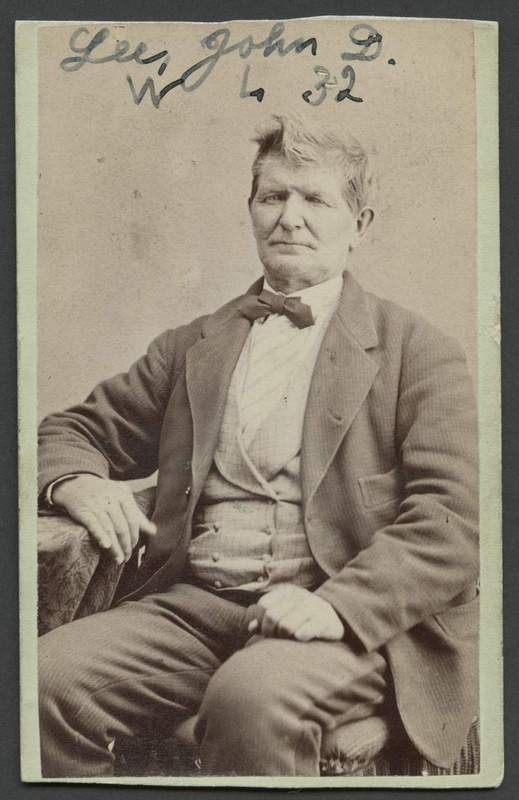
    <summary type="html"><![CDATA[<p><strong><em>The Fancher Party set out from Arkansas in April 1857, determined to reach the fertile fields of California- but they never reached their destination. Instead, they met their deaths at the hands of Mormon settlers and Paiute Indians near Mountain Meadows, an area just south of present day Cedar City, Utah on September 11, 1857. </em></strong></p><img src="https://www.intermountainhistories.org/files/fullsize/7681cb75268f4cde17eeec5e1d4a5372.jpg" alt="John D. Lee " /><br/><p>The mid-1850s relationship between Latter-day Saints (or Mormons) and the United States government, who felt that they were growing too powerful, was tense. In response to the growing power of the leaders of the LDS Church in Utah, the federal government sent a large Army to Utah in 1857 to assess the situation and suppress any potential rebellions against the United States. With the army's approach, fear and anxiety spread among Mormon settlers in Utah Territory.</p><p>It was in this atmosphere that the Fancher party crossed Utah Territory on their way to California. Contention abounded between the Fancher Party and the Mormon communities through which they passed on their journey west. The emigrants chided Mormon settlers that the army was coming to suppress the religious group, and boasted that members in their group had persecuted Joseph Smith, the Church’s first leader. Their threats to steal from Mormon communities further enraged the Saints, creating a climate that resulted in extra-legal vigilantism.</p><p>In response to the perceived threats, LDS leaders in Cedar City and Parowan took matters into their own hands. Isaac C. Haight, William Dame, and John D. Lee solicited the aid of local Paiute Indians to steal the settlers’ stock while the local community plotted to attack the emigrant train encamped at ‘the Meadows.’ Under the ruse of a white flag, Lee led the Indians in the raid.  Then, the local men disarmed the wagon train and killed around 120 emigrants on September 11, 1857. Only seventeen members of the party survived, all children too young to remember the attack. After the massacre, word came from Brigham Young in Salt Lake City for the Saints and the Paiutes to let the emigrant train pass unmolested.  Unfortunately, his letter came too late to save the emigrant party from disaster. Some debate Young's knowledge and timing of the letter.</p><p>A series of cover-up stories allowed those responsible for the massacre to escape prosecution for years. John D. Lee faced trial in 1875, though the court did little to address the situation. A second trial commenced in 1878.  This time the court attributed full responsibility for the massacre to Lee, ruling that his actions qualified as murder. The jury sentenced Lee to death and the federal representatives executed Lee on March 23, 1877.  The involvement and role of Paiute auxiliaries is still debated to the present. The other men responsible for the massacre escaped legal punishment. Most of the massacre survivors eventually rejoined relatives in Arkansas and California.  Representatives of the participants dedicated a memorial commemorating the tragedy and honoring the families who died at Mountain Meadows in 1999.</p><p><em><strong><a href="https://www.intermountainhistories.org/items/show/22">For more (including 5 images) view the original article</a></strong></em></p>]]></summary>
    <published>2017-02-15T17:21:51+00:00</published>
    <updated>2026-04-17T19:31:58+00:00</updated>
    <link rel="alternate" type="text/html" href="https://www.intermountainhistories.org/items/show/22"/>
    <id>https://www.intermountainhistories.org/items/show/22</id>
    <author>
      <name>Rachel Hendrickson, Brigham Young University </name>
    </author>
  </entry>
  <entry>
    <title type="html"><![CDATA[Memorializing Mountain Meadows]]></title>
    <summary type="html"><![CDATA[<p><strong><em>This monument honoring the victims of the Mountain Meadows Massacre is a sober one. It tells a story of fear, radicalism, and tragedy. </em></strong></p><img src="https://www.intermountainhistories.org/files/fullsize/52f1afbf2035519af22f18d37ca1543e.jpg" alt="Mountain Meadows Massacre Monument" /><br/><p>In the mid-1850s, the Mormons of Utah were not on friendly terms with the United States of America. Previous persecutions from the government caused Mormons to be distrustful of the United States. The United States saw the Mormon theocracy that existed in Utah and feared its disloyalty. This caused the Utah War, a cold war between the territorial and federal governments. Droughts and pestilence in the mid-1850s caused an extremist movement in Utah called the Mormon Reformation with powerful rhetoric, including a religious capital punishment. The atmosphere of Utah at the time was hostile. </p><p>The Baker-Fancher party of emigrant families was passing through the Southern end of Utah and rumors went with them. Local Mormons feared their intentions and assembled militia and local Paiutes to attack. In a series of attacks from September 7-11, 1857, 120 men, women, and children were killed, leaving only 17 small children alive. After much controversy over who was at fault for the massacre and the extensive efforts to cover up and understand, John D. Lee, one of the men who led the assault, was ultimately convicted and sentenced to death. </p><p>The first monument was built by James H. Carleton in 1859 when he was investigating the massacre for the United States. In shock of what he had seen, he felt the need to build a monument by stacking stones atop one another with a cross at the top. The monument was repeatedly destroyed and rebuilt over the years. Calls for a more honorable and permanent monument were made by the descendants of the Baker-Fancher party and Mormon President Gordon B. Hinckley. While the permanent monument was being built in August 1999, a backhoe dug up the bones of 28 massacre victims. Much controversy went behind whether to study them or to honor them through reburial in time for the dedication. Utah Governor Mike Lee made the decision to not spoil the commemoration of the dead with controversy. The decision was made to honor the dead and allow for the healing of old wounds. </p><p>Historian Levi Peterson likens learning about the massacre to a Greek tragedy. Tragedies tell a story of an honorable hero who falls under a gross misunderstanding. When we view another in the midst of a tragedy, we are capable of escaping our own tragic emotions and seek for healing through catharsis. As one views this monument, one may come seeking healing of their own mistakes.</p><p><em><strong><a href="https://www.intermountainhistories.org/items/show/9">For more (including 4 images) view the original article</a></strong></em></p>]]></summary>
    <published>2017-01-11T00:17:39+00:00</published>
    <updated>2026-04-17T19:31:58+00:00</updated>
    <link rel="alternate" type="text/html" href="https://www.intermountainhistories.org/items/show/9"/>
    <id>https://www.intermountainhistories.org/items/show/9</id>
    <author>
      <name>Jason Colver, Brigham Young University</name>
    </author>
  </entry>
</feed>