<?xml version="1.0" encoding="UTF-8"?>
<feed xmlns="http://www.w3.org/2005/Atom">
  <title type="text">Intermountain Histories</title>
  <updated>2026-04-17T19:32:20+00:00</updated>
  <generator uri="http://framework.zend.com" version="1.12.20">Zend_Feed_Writer</generator>
  <link rel="alternate" type="text/html" href="https://www.intermountainhistories.org/"/>
  <link rel="self" type="application/atom+xml" href="https://www.intermountainhistories.org/items/browse?output=rss2"/>
  <id>https://www.intermountainhistories.org/</id>
  <author>
    <name>Intermountain Histories</name>
    <uri>https://www.intermountainhistories.org</uri>
  </author>
  <link rel="hub" href="https://pubsubhubbub.appspot.com/"/>
  <entry>
    <title type="html"><![CDATA[The Logan Temple]]></title>
    <summary type="html"><![CDATA[<p><strong><em><span style="font-weight:400;">Those descending out of Sardine Canyon are welcomed into Cache Valley by the Logan Temple. Perched atop the east bench of the valley, it stands 170 feet tall. For nearly a century and a half, the temple has been an icon of the valley and a testament to the diligence of the pioneers who built it.</span></em></strong></p><img src="https://www.intermountainhistories.org/files/fullsize/61cf1188f0d820b0bea3b8f3c5a1bb52.jpg" alt="Aerial view of the Logan  UtahTemple" /><br/><p><span style="font-weight:400;">The first settlement attempt of Cache Valley occurred in 1856. Having endured the brutal winter, more Latter-day Saints migrated north, and Cache Valley became an established community. But even before the area was well established, prophecies were given by church leaders on the future construction of a temple.</span>
<span style="font-weight:400;">In an 1863 meeting, Wilford Woodruff of the church’s Quorum of the Twelve Apostles said that the day would come when great cities would fall but that Logan and its temple would outlast them. Ground was finally broken on the temple in 1877, beginning a seven-year construction process. Financing the temple was a challenge for these pioneers, but they rose to the occasion. The total expenses for the temple amounted to just over $600,000, with half consisting of labor costs. Through various programs and 100% volunteer labor, the Saints were able to complete the temple and have it ready for dedication exactly seven years after breaking ground.</span>
<span style="font-weight:400;">The dedication services were held from May 17th to 19th, 1884. Church president John Taylor presided and offered the dedicatory prayer. As part of that prayer, he said, “We feel, O Lord God, our weakness and unworthiness before Thee, and our inability to do anything without Thy guidance and assistance; but as Thou hast given us a commandment…we have built this house, and present it to Thee, and pray that Thou wilt accept it in the name of Thy Son Jesus Christ.” This prayer reflects the attitudes of those that built the temple, who believed their total reliance was on God and saw the majestic building as a humble offering.</p><p>As part of the Golden Jubilee celebration of the Logan Temple in 1934, poet Harrison R. Merrill wrote of the temple:</p><p><i>“Against the turquoise Utah skies</i><i>Two solemn temple towers rise,</i><i>Twin beacons marking well the place</i><i>Where children of a mighty race</i><i>Of Pioneers assemble. They came from far</i><i>The temple gleams – A guiding star.”</i></p>
<span style="font-weight:400;">The temple has since undergone major renovations, including a complete gutting of the interior in 1976. The renovation aimed to improve efficiency in temple ordinance work but came at the expense of historic pioneer craftsmanship. Many lament the loss of pioneer heritage, but plans are in place to restore some of the original style. In 2019, church president Russell M. Nelson stated, “Ours is a sacred responsibility to care for [pioneer-era temples]. Therefore, these pioneer temples will soon undergo a period of renewal and refreshing and, for some, a major restoration. Efforts will be made to preserve the unique historicity of each temple wherever possible.” As of December 2024, no additional plans for renovations have been announced.</span></p><p><em><strong><a href="https://www.intermountainhistories.org/items/show/884">For more (including 3 images) view the original article</a></strong></em></p>]]></summary>
    <published>2025-01-29T00:24:55+00:00</published>
    <updated>2026-04-17T19:32:20+00:00</updated>
    <link rel="alternate" type="text/html" href="https://www.intermountainhistories.org/items/show/884"/>
    <id>https://www.intermountainhistories.org/items/show/884</id>
    <author>
      <name>Cameron Carlson, Brigham Young University</name>
    </author>
  </entry>
  <entry>
    <title type="html"><![CDATA[Honeymoon Trail]]></title>
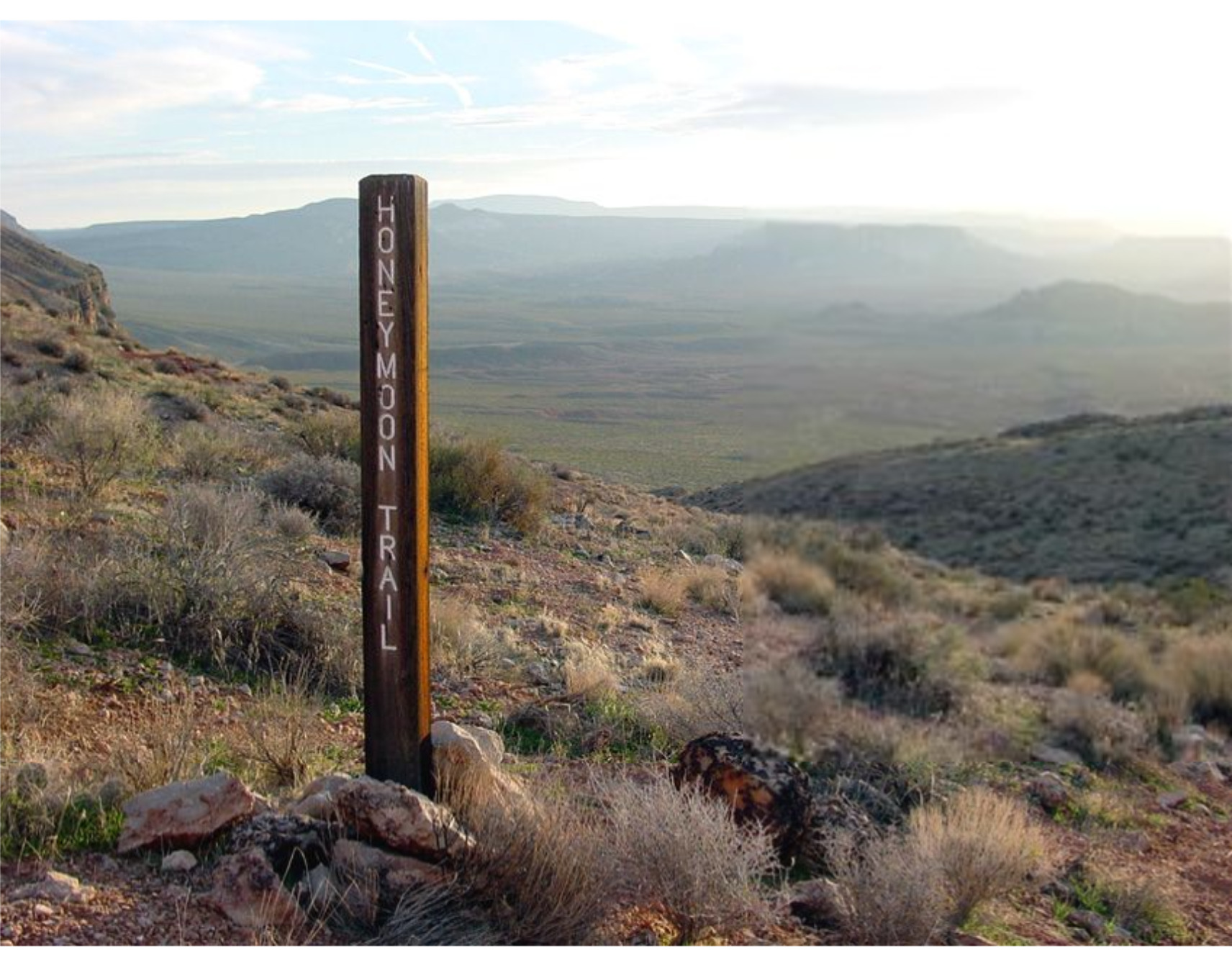
    <summary type="html"><![CDATA[<p><strong><em>The Honeymoon Trail connected Latter-day Saint communities in Arizona to St. George and was originally known as the Mormon Wagon Road. Will C. Barnes, an American historian, coined the term Honeymoon Trail as he studied the hundreds of couples who trekked along the trail to the St. George Temple to get married. Couples continued to make the hazardous journey until 1927, when the Mesa, Arizona temple opened. </em></strong></p><img src="https://www.intermountainhistories.org/files/fullsize/b5f9fbc2448e80d9a7874c071208e8c7.jpg" alt="Honeymoon Trail" /><br/><p><span style="font-weight:400;">In 1871, leaders of the Church of Jesus Christ of Latter-Day Saints announced that a temple would be built in St. George in 1871. While this was exciting for members in southern Utah, it was also exciting to the members scattered throughout Arizona who wanted to be married for eternity in a ceremony that could only take place in a temple. After the temple in St. George was completed in 1877, couples in Arizona traveled to St. George to participate in the marriage ceremony. Depending on their starting point in northern or southern Arizona, some couples traveled over 400 miles to be married.</span>
<span style="font-weight:400;">The Honeymoon Trail was difficult to traverse under the best conditions and was sometimes made worse by the weather. Couples had no choice but to cross deep muddy washes and traverse canyons and hills. They could choose between a shorter route across mountains or avoid them by extending their journey by many miles. Although the trail did have a hazardous river crossing, most of the trail lacked adequate drinking water. It was common for oxen to die from dehydration. Some couples made the most of this loss by trading dying or dead oxen to people along the trail for other needed goods. Some couples endured snowstorms while others endured sandstorms. For instance, Joseph Fish, who undertook the trail to marry Julia Reidheid, suffered vision loss due to the sandstorms encountered on the journey. Despite their father’s challenging experience, some of Fish’s children still chose to traverse the same trail to reach the temple, fully aware of the risks they would face.</span>
<span style="font-weight:400;">The physical trail was not the only danger faced by couples. Tensions stemming from the Black Hawk War, a violent confrontation between Latter-Day Saint settlers and the Ute, Paiute, and Navajo nations from 1865 until 1872, led to ongoing confrontations. Some travelers lost horses to Indigenous raiders. However, many of the interactions between travelers and the Natives were friendly. Still, stories of past violence exaggerated the expectations of hostile interactions and caused the travelers to fear. Not only were Natives a concern, but running into strangers and outlaws also brought fear to the lawless wilderness. Danger surrounded the couples and groups who journeyed to the temple in St. George. </span>
<span style="font-weight:400;">The efforts and dedication of the Saints of Arizona were observed by Church leaders. In 1918 they announced that a temple would be built in Mesa Arizona. At the time there were only six operating temples, marking a tremendous victory for the members scattered throughout Arizona. The completion of the Mesa Temple in 1927 brought to an end the colorful history of the Honeymoon Trail.</span></p><p><em><strong><a href="https://www.intermountainhistories.org/items/show/777">For more (including 4 images) view the original article</a></strong></em></p>]]></summary>
    <published>2024-02-02T00:19:57+00:00</published>
    <updated>2026-04-17T19:32:17+00:00</updated>
    <link rel="alternate" type="text/html" href="https://www.intermountainhistories.org/items/show/777"/>
    <id>https://www.intermountainhistories.org/items/show/777</id>
    <author>
      <name>Margie Brown, Brigham Young University</name>
    </author>
  </entry>
  <entry>
    <title type="html"><![CDATA[George Edward Anderson Photographs]]></title>
    <summary type="html"><![CDATA[<p><strong><em><span style="font-weight:400;">George Edward Anderson is known for pioneering early 20</span><span style="font-weight:400;">th</span><span style="font-weight:400;"> century photography in Utah. His collection shows what was important to Utahns, particularly to members of the Church of Jesus Christ of Latter Day Saints.</span></em></strong></p><img src="https://www.intermountainhistories.org/files/fullsize/718d4ca9986add3c0b25a832b99c478b.jpg" alt="George Edward Anderson" /><br/><p><span style="font-weight:400;">George Edward Anderson was born on October 28, 1860 to parents George Anderson and </span><span style="font-weight:400;">Mary Ann Anderson in Salt Lake City. He was raised a member of the Church of Jesus Christ of Latter Day Saints. As a boy he was apprenticed to Charles R. Savage, a pioneer in photography in Utah, and set up his own studio at the age of 17. In 1886, he established the <em>Temple Bazar </em>studio in Manti, and in 1888 moved it to Springville to the southwest corner of Main and 3rd South Streets. He also operated traveling tent studios.</p><span style="font-weight:400;">Early in his career he took many studio photographs of prominent and everyday Utahns. Later he began to travel and take photographs of significant historical LDS sites. However, his travels took a toll on his relationship with his wife, Olive Lowry Anderson, so he remained home for a period. However his church commissioned him to document new temple dedications in photography. Before going to what would be his last photo shoot, his wife urged him to stay home. He ignored her warning, traveling to the Mesa Arizona Temple dedication. Shortly after the ceremony, he suffered heart failure and died on May 9, 1928 after being transported home. In his obituary the Salt Lake Telegram recounted his accomplishments in photography: “he established a studio at Springville and also had studios at Spanish Fork and Manti... He devoted considerable time to a collection of L.D.S. church historical pictures.”</span>
<span style="font-weight:400;">After Anderson’s death, his collection of photographs changed hands many times. The significance of his images were apparent to many different groups, particularly the Church of Jesus Christ of Latter-Day Saints. A group of LDS seminary teachers in Provo bought Anderson’s collection from his wife in 1928, the year he died. Later Church Historians became aware of the collection and bought it from the seminary teachers. Representatives of the Church of Jesus Christ of Latter Day Saints worked to gather all of the negatives from Anderson’s collection and brought all of his photographs into one collection. After digitizing these negatives, the Church destroyed all but 444 of the glass negatives from the collection. Finally, the collection found a home in the L. Tom Perry Special Collections at Brigham Young University.</span></p><p><em><strong><a href="https://www.intermountainhistories.org/items/show/776">For more (including 6 images) view the original article</a></strong></em></p>]]></summary>
    <published>2024-01-25T05:07:20+00:00</published>
    <updated>2026-04-17T19:32:17+00:00</updated>
    <link rel="alternate" type="text/html" href="https://www.intermountainhistories.org/items/show/776"/>
    <id>https://www.intermountainhistories.org/items/show/776</id>
    <author>
      <name>Starrla Kay Pearson, Brigham Young University</name>
    </author>
  </entry>
  <entry>
    <title type="html"><![CDATA[Stalwart as Stone: Legacy of the Mason John Rowe Moyle]]></title>
    <summary type="html"><![CDATA[<p><strong><em>Having carved his legacy into the Salt Lake Temple, John Rowe Moyle carved too a living in what could sometimes be an unforgiving land. He proved himself constantly as unmoving as the stones he carved in his determination to better those around him despite any obstacle.</em></strong></p><img src="https://www.intermountainhistories.org/files/fullsize/7034311df1a23fd605d31f02397f502f.jpg" alt="A Picture of John Rowe Moyle" /><br/><p><span style="font-weight:400;">On April 6, 1893, thousands gathered in awe outside the newly dedicated Salt Lake Temple. Embossed upon the eastern edifice of the temple gleamed the golden words, “Holiness to the Lord, the House of the Lord.” Yet the stonecutter who’d carved those words was not among the assembled that day. John Rowe Moyle had died four years prior on February 15, 1889. </span>
<span style="font-weight:400;">Moyle had immigrated to Utah Territory in the 1850’s from England with the Ellsworth Handcart Company. He settled in Alpine with his wife and children. Miner and mason alike, he seemed a natural choice to help carve one of the temple’s most prominent features. Moyle had stalwartly taken up the task. Despite old age, he made the 22 mile hike over the mountains to Salt Lake City every week and then back to spend the weekend with his family. This trek was made all the more difficult when Moyle lost his leg during an accident milking his cow. But Moyle never shirked his duty. Crafting a leg, he re-learned to walk and once more set about carving the words which are now immortalized in one of Utah’s most iconic landmarks. </span>
<span style="font-weight:400;">Moyle left his mark on more than just the temple, though, and he overcame more hardships than the arduous journey to Salt Lake City. Now renamed Moyle Park, his homestead still stands in Alpine. Around the farm are a stone tower and walls which serve to protect it. Moyle’s farm is the only one in the state of Utah to have received such fortifications. Other forts were reserved for the defense of entire towns. Moyle had worked on his family’s home with the same fervor he had worked on the temple. Moyle Park stands as a memorial to John Rowe Moyle’s unwavering determination and selfless duty to church and family.</span></p><p><em><strong><a href="https://www.intermountainhistories.org/items/show/655">For more (including 3 images) view the original article</a></strong></em></p>]]></summary>
    <published>2022-09-16T18:32:18+00:00</published>
    <updated>2026-04-17T19:32:14+00:00</updated>
    <link rel="alternate" type="text/html" href="https://www.intermountainhistories.org/items/show/655"/>
    <id>https://www.intermountainhistories.org/items/show/655</id>
    <author>
      <name>Avery Morgan, Brigham Young University</name>
    </author>
  </entry>
  <entry>
    <title type="html"><![CDATA[Charles Walker: St. George Poet]]></title>
    <summary type="html"><![CDATA[<p><strong><em>Charles Walker was called to the Cotton Mission in St. George and made his living there as a blacksmith and stonemason. He helped construct the St. George Temple and was renowned for his poems and songs</em></strong></p><img src="https://www.intermountainhistories.org/files/fullsize/153a43781a51f0e34aef0043afac9d06.jpg" alt="Charles L. Walker" /><br/><p>The scorching temperatures, sparse vegetation, and endless red rock of Saint George, Utah were all that greeted early settlers in the Cotton Mission. Charles Walker, born 1832 in Leek, England, was one of the individuals called by Brigham Young to settle the area and produce cotton to supplement the income for The Church of Jesus Christ of Latter-Day Saints. Upon arriving in 1862, Walker remarked, “St. George is a barren looking place. The soil is red and sandy. On the North ranges a long high red rocky bluff. On the East is a long black ridge of volcanic production. On the west the same. On the south runs the Virgin river, a shallow, rapid stream from which a great portion of the land is irrigated. To look on the country it [is a] dry, parched, barren waste with here and there a green spot on the margins of the streams.” While his observation seemed bleak, Walker exuded optimism with the work that he believed God had called him to do. He wrote in his personal journal, “Well it’s all right; we shall know how to appreciate a good country when we get to it, when the Lord has prepared the way for his people to return and build up… Zion.” Walker’s time in St. George reflected the stalwart nature of those called to settle far Western settlements, and his life in the area would have a significant impact on those around him.
The initial hope that settlers could grow cotton as a cash crop was dashed by poor soil quality. In an attempt to keep the community thriving, Brigham Young ordered the construction of a large public works project to bolster the economy: a new temple. Walker transitioned to stonemasonry and worked on the temple constantly. When the temple was completed, Walker participated in the, and a song he wrote for the occasion was sung at the event. When Walker was not busy with blacksmithing or working on the temple, he spent time with his family and saw to his various church callings. One labor that endeared him to the hearts of his neighbors was his gifted ear for writing hymns, the most famous of which is “Dearest Children, God is Near You.”
Walker later adopted polygamy as practiced by Latter-day Saints in the nineteenth century, marrying his second wife, Sarah Smith. His first wife, Abigail Middlemass, helped him select Sarah, and the trio lived together for the rest of Walker’s life. Each wife gave birth to eight children, sixteen total, with twelve of them reaching adulthood. Walker noted that his peculiar family situation allowed him to labor on the temple and work in his shop more because the burden of running the household was shared between his spouses. Walker also kept himself busy as an assistant marshal for the city and a leader in the local militia. He passed away in 1904, leaving behind a legacy of faithfulness and work ethic on the Utah Frontier.</p><p><em><strong><a href="https://www.intermountainhistories.org/items/show/464">For more (including 3 images) view the original article</a></strong></em></p>]]></summary>
    <published>2021-09-09T22:12:39+00:00</published>
    <updated>2026-04-17T19:32:09+00:00</updated>
    <link rel="alternate" type="text/html" href="https://www.intermountainhistories.org/items/show/464"/>
    <id>https://www.intermountainhistories.org/items/show/464</id>
    <author>
      <name>Dalton Bennett, Brigham Young University</name>
    </author>
  </entry>
  <entry>
    <title type="html"><![CDATA[The Endowment House]]></title>
    <summary type="html"><![CDATA[<p><strong><em> Until the completion of the Salt Lake Temple in 1893, another structure on Temple Square, the Endowment House, was the city’s most holy place of worship for members of The Church of Jesus Christ of Latter-day Saints. </em></strong></p><img src="https://www.intermountainhistories.org/files/fullsize/50386dc39e6854ac508834cc72651fc4.jpg" alt="The Endowment House on Temple Square." /><br/><p>In July 1847, immediately after arriving with the first group of Latter-day Saints in the Salt Lake Valley, Brigham Young announced the site of a temple. As construction of the Salt Lake Temple stretched over the following four decades, the Endowment House located on Temple Square temporarily served as a location for all temple ceremonies in the valley.</p><p>While previous temples were built to accommodate large congregations, Truman Angell Sr. designed the rooms of the Endowment House specifically for participation in temple rituals. These include the endowment and marriage ceremonies. Angell’s idea was later adopted in all temples of the Church. Construction on the adobe building began in fall 1854 on the northwest corner of Temple Square . The structure was dedicated by Heber C. Kimball on May 5th, 1855. While initially called the “Temple Pro Tempore” or “The House of the Lord,” it soon became known by the Saints as “the Endowment House.”</p><p>A year later, an expansion to the Endowment House included a baptismal font. At one point, the font was supplied with water from City Creek via a quarter mile of pipe. The font was constructed for “the purpose of baptizing people for the remission of sins, for their health, for the renewal of covenants, and for their dead family and friends.” In an 1880 extension to the building, a greenhouse was also added to the structure. </p><p>In contrast to the mundane appearance of the structure’s façade, the interior of the building was beautifully decorated with the best the Saints could offer. Many religious symbols were included in the decoration. The facility had modern amenities such as indoor restrooms and a dining room.</p><p>On Sunday October 8th, 1876, Church President Brigham Young announced the closure of the Endowment House, emphasizing the importance of focusing on creating permanent temple structures in Utah. The Endowment House was reopened specifically for marriage ceremonies two months after his death, but only on the last Thursday of each month. Later, in October 1879, the “Temple Pro Tempore” resumed its previous regular schedule.   </p><p>Largely in response to the Edmunds-Tucker Act of 1887, a federal law against polygamy, Church leaders voted on October 18th, 1889 to demolish the Endowment House. It was torn down soon after. The area became a nursery to support Temple Square’s growing gardens. In the early 1960’s the North Visitors' Center was built on the site of the Endowment House. </p><p>Early visitors to Temple Square described the Endowment House as “not much to look at” and were disappointed to learn that this humble structure was the where the famous “Mormon polygamous marriages” were performed. To the faithful however, the rituals in which they participated gave them feelings of “joy beyond description” culminating in what some described as “the most glorious day of their lives.” While today largely forgotten, Salt Lake City’s Endowment House was once the center of national controversy as the site of thousands of plural marriages. However, the building’s legacy quietly lives on as untold numbers of Utahans are descended from couples that were married within its walls. </p><p><em><strong><a href="https://www.intermountainhistories.org/items/show/426">For more (including 4 images) view the original article</a></strong></em></p>]]></summary>
    <published>2020-09-25T04:48:57+00:00</published>
    <updated>2026-04-17T19:32:08+00:00</updated>
    <link rel="alternate" type="text/html" href="https://www.intermountainhistories.org/items/show/426"/>
    <id>https://www.intermountainhistories.org/items/show/426</id>
    <author>
      <name>Ryan J. Hallstrom, Brigham Young University</name>
    </author>
  </entry>
  <entry>
    <title type="html"><![CDATA[The Salt Lake Temple]]></title>
    <summary type="html"><![CDATA[<p><strong><em>The Salt Lake Temple has become one of America’s most recognizable religious buildings. Hewn out of local granite, it prominently stands at the center of Utah’s capital city</em></strong></p><img src="https://www.intermountainhistories.org/files/fullsize/8d309b70f3e051fbd9d2babd65be04c1.jpg" alt="The Salt Lake Temple ornate granite exterior. " /><br/><p>The site of the Salt Lake Temple was identified just days after Brigham Young and the first group of Latter-day Saint pioneers entered the Salt Lake Valley on July 24th, 1847. While Young claimed to have received the basic design of the building from God, the plans for the temple evolved throughout the forty years of its construction (1853-1893). Young invited all to contribute, stating that,“[if] any good man on earth will suggest any improvements, we will receive them and adopt them.”  </p><p>Initially, the interior was planned to feature two large assembly rooms, patterned after previously built temples. However, after the construction of the Endowment House and the St. George Temple, it was clear that more space needed to be allotted for rituals. Consequently, the original plan was adapted to include several large ordinance rooms in place of a lower assembly hall. </p><p>While work on the temple began in 1853, construction was slow as the Saints tried to eke out an existence in their new territory. Resources and manpower were constantly diverted to other more urgent projects such as the Transcontinental Railroad. It took 14 years until the temple walls reached above ground level. Stones for the temple were pulled out of nearby canyons by wagon teams until the 1870’s when blocks began to be transported by rail, speeding up the building process. Finally, in 1892, a large celebration was held as the final stone of the temple was put into place. A few hours after the capstone was fastened, the golden statue of the Book of Mormon prophet Moroni was placed on top of the capstone. At this capstone ceremony, President Woodruff requested that the interior work be completed in just one year, bringing the total period of construction to forty years. </p><p>April 6, 1893 marked the first of 31 dedication sessions. The President of the Church, Wilford Woodruff, offered the dedicatory prayer. The completion of this massive granite structure captivated the nation. As dignitaries and reporters flocked to Salt Lake City to witness the celebrations, they sent back favorable reports of the “Mormons.” The Ohio Democrat touted, “The architecture of the building is without a known parallel in ancient or modern times” and credited the structure to the “courage and determination” of the “Mormons”. H. R. Harper, editor of The Chattanooga, Tennessee News, later recalled that because of his warm reception during the dedication by “honest, industrious and God-fearing people, who have done great things for the amelioration [improvement] of mankind...” he decided to stay longer than he had planned in Salt Lake City.  The positive publicity surrounding the temple dedication undoubtedly contributed to helping Utah achieve statehood in 1896. </p><p>The Salt Lake Temple features rich religious symbolism, pointing to the importance of the building to members of the faith. Some of the symbols incorporated into the building include: the all-seeing eye, angels, the big dipper constellation, beehives, and stars. These symbols are meant to enhance the religious experience of worshipers. In 1915, one Salt Lake City resident noted, “Every stone [of the temple] is a sermon to me.” </p><p>Although periodic renovations have been necessary to allow the building to accommodate the needs of worshipers, overall, the original pioneer craftsmanship has been preserved. With its iconic spires being featured in media across the globe, the Salt Lake Temple is recognized world-wide as a symbol of the Church of Jesus Christ of Latter-day Saints.</p><p><em><strong><a href="https://www.intermountainhistories.org/items/show/419">For more (including 6 images) view the original article</a></strong></em></p>]]></summary>
    <published>2020-09-24T04:45:04+00:00</published>
    <updated>2026-04-17T19:32:08+00:00</updated>
    <link rel="alternate" type="text/html" href="https://www.intermountainhistories.org/items/show/419"/>
    <id>https://www.intermountainhistories.org/items/show/419</id>
    <author>
      <name>Ryan J. Hallstrom, Brigham Young University</name>
    </author>
  </entry>
</feed>