<?xml version="1.0" encoding="UTF-8"?>
<feed xmlns="http://www.w3.org/2005/Atom">
  <title type="text">Intermountain Histories</title>
  <updated>2026-04-17T19:32:19+00:00</updated>
  <generator uri="http://framework.zend.com" version="1.12.20">Zend_Feed_Writer</generator>
  <link rel="alternate" type="text/html" href="https://www.intermountainhistories.org/"/>
  <link rel="self" type="application/atom+xml" href="https://www.intermountainhistories.org/items/browse?output=rss2"/>
  <id>https://www.intermountainhistories.org/</id>
  <author>
    <name>Intermountain Histories</name>
    <uri>https://www.intermountainhistories.org</uri>
  </author>
  <link rel="hub" href="https://pubsubhubbub.appspot.com/"/>
  <entry>
    <title type="html"><![CDATA[Hazel Hunkins-Hallinan: Silent Sentinel Suffragist ]]></title>
    <summary type="html"><![CDATA[<p><strong><em>Billings native Hazel Hunkins-Hallinan, alongside other members of the National Women’s Party, peacefully picketed the White House fence from 1917-1919 to advocate for a federal amendment for women’s right to vote. Known as the “Silent Sentinels,” they proved to be a continual reminder to President Woodrow Wilson of the issue of suffrage.</em></strong></p><img src="https://www.intermountainhistories.org/files/fullsize/bffa4510a4cca3ac68232b815d975d58.jpg" alt="[Untitled]" /><br/><p><span style="font-weight:400;">Hazel Hunkins grew up in Billings, Montana, and as a young girl, she was seen as “different” because she wanted to do what boys could do from climbing trees to becoming a doctor. After graduating valedictorian from Billings High School, Hunkins obtained her chemistry degree from Vassar College. However, when she applied to chemistry labs across the country they all replied that although she was qualified, they “don’t hire women.” </span>
<span style="font-weight:400;">This response sparked a fire in her, and when she met Anne Louise Rowe of the National Women’s Party (NWP), Hunkins realized that she “was one of millions who had been shoved aside because of my sex” and she had to do something about the exclusion of women. Within six months of joining the NWP, she became the Montana State Chairman. When the NWP began their constant picketing of the White House in 1917, Hunkins participated in the demonstrations. The pickets were peaceful—holding purple, gold, and white suffrage banners and signs like “Mr. President, how long must women wait for liberty?” </span>
<span style="font-weight:400;">Hunkins led a protest at Lafayette Square, carrying the American flag and leading the way to the Park. Once at the statue, she made the simple statement: “Here, at the statue of Lafayette, who fought for the liberty of this country, and under the American flag, I am asking for the enfranchisement of American Women.” She was immediately arrested. Other women followed Hunkins’ lead, each suffragist making her own statement until 47 women were arrested.</span>
<span style="font-weight:400;">Lafayette Square confirmed the NWP efforts were unpopular; however, once World War started, they were scrutinized even more, as people thought the women needed to support the war effort rather than picket a wartime president. The NWP, instead of wavering in their resolve, started new demonstrations like the watchfires of freedom—where President Wilson’s speeches about democracy in Europe were read aloud and burned because American women did not have democracy at home.</span>
<span style="font-weight:400;">The arrests of NWP women continued, often being charged with newly fabricated crimes like “obstruction of a public sidewalk.” Rather than paying fines, they chose jail because as Hunkins stated, “Women cannot be law-breakers until they are law-makers.” The prison conditions were awful—cold, damp areas, without proper clothing, blankets, and food—so the suffragists would often go on hunger strikes to protest these conditions, and in some cases, they would be force-fed. After one such hunger strike, Hunkins left the prison hardly able to walk. </span>
<span style="font-weight:400;">Despite all of the challenges they faced fighting public opinion and police officers’ efforts to stop their protests, in 1920 the 19th Amendment was finally ratified, giving American women the right to vote. After this triumph, Hazel Hunkins continued to push for women’s rights. When she moved to London with her husband, Charles Thomas Hallinan, she joined the British feminist Six Point Group. At age 87, Hunkins-Hallinan returned to America to participate in the March for Equal Rights. There she stated what she fought her whole life for, “Equal Rights is so clear cut; it’s fundamental—a basic change… For half a cent I would stay here and campaign.” </span></p><p><em><strong><a href="https://www.intermountainhistories.org/items/show/866">For more (including 4 images) view the original article</a></strong></em></p>]]></summary>
    <published>2024-10-21T17:33:32+00:00</published>
    <updated>2026-04-17T19:32:19+00:00</updated>
    <link rel="alternate" type="text/html" href="https://www.intermountainhistories.org/items/show/866"/>
    <id>https://www.intermountainhistories.org/items/show/866</id>
    <author>
      <name>Rosalyn Visser, Rocky Mountain College</name>
    </author>
  </entry>
  <entry>
    <title type="html"><![CDATA[Molly Brown: The &quot;Unsinkable” Suffragist and Workers’ Rights Activist]]></title>
    <summary type="html"><![CDATA[<p><strong><em>Famously called the “Unsinkable Molly Brown” for surviving the Titanic, the suffragist had a remarkable life before and after the tragedy.</em></strong></p><img src="https://www.intermountainhistories.org/files/fullsize/8513fb5a82d7726a5750959d63e83e46.jpg" alt="Portrait of Margaret “Molly” Brown" /><br/><p><span style="font-weight:400;">Margret Tobin Brown was born in Hannibal, Missouri in 1867 to Irish immigrants. Life in Hannibal greatly influenced her outlook, as she was surrounded by diversity and saw the struggles of the working class. Her parents valued education, so Margaret was able to attend school until she was 13 when she had to drop out to work in a factory. Like her father and countless others, she experienced low wages, instability, and dangers at work. </span>
<span style="font-weight:400;">Margaret dreamed of going West, and at age 18, she followed one of her older brothers, Daniel, who had moved to Leadville, Colorado, to strike rich in the mines. Women were not allowed to work in the mines, so they had to find jobs in the mining towns, as cooks, nurses, saloon girls, or store workers. Margret worked in a store, and while she did not have much, she participated in causes she believed in, like volunteering in soup kitchens.</span>
<span style="font-weight:400;">It was in Leadville that she met her husband James Joseph Brown, a mining engineer. They got married in 1886 and soon had two children. Surprisingly, in 1893, they became millionaires when the Little Jonny Mine that J.J. invested in struck gold. Now wealthy, they moved their family and built their home in Denver, Colorado which can be visited today. </span>
<span style="font-weight:400;">They became prominent figures in Denver, Margaret in the political realm and J.J. in the business sphere. Denver was rampant with various social issues—poverty, homelessness, and workers’ rights issues—and now Brown held a position where she could promote political action. She advocated for labor reform and became an involved member of the National American Women’s Suffrage Association (NAWSA). </span>
<span style="font-weight:400;">Margaret’s situation was unique because she separated from her husband in 1909 to live independently. In 1912, she embarked on the Titanic. When tragedy struck, she was pushed onto a lifeboat, even though she was still trying to help others. After the lifeboat was deployed, she protested, saying they needed to save more people, but the sailor refused. Although not allowed to testify in court because she was a woman, she became one of the most famous survivors. </span>
<span style="font-weight:400;">With her newfound fame after the Titanic, Brown used her position to raise awareness of the Ludlow Massacre of Colorado miners, who were striking for more rights. She understood the challenges workers and families faced, so she not only helped the affected families but also advocated for workers' rights and spoke about how women having the right to vote could help pass necessary reforms across the country. </span>
<span style="font-weight:400;">Brown did important work for Colorado and people began encouraging her to run for Congress in 1914. However, with growing tensions with World War, she decided not to run and shifted her focus to war relief programs. She became the self-sufficient woman of the 1920s, continuing to advocate for women’s and laborer’s rights until her death on October 26, 1932. </span></p><p><em><strong><a href="https://www.intermountainhistories.org/items/show/864">For more (including 4 images) view the original article</a></strong></em></p>]]></summary>
    <published>2024-10-18T23:42:20+00:00</published>
    <updated>2026-04-17T19:32:19+00:00</updated>
    <link rel="alternate" type="text/html" href="https://www.intermountainhistories.org/items/show/864"/>
    <id>https://www.intermountainhistories.org/items/show/864</id>
    <author>
      <name>Rosalyn Visser, Rocky Mountain College</name>
    </author>
  </entry>
  <entry>
    <title type="html"><![CDATA[Founding of Cache Valley Woman Suffrage Association]]></title>
    <summary type="html"><![CDATA[<img src="https://www.intermountainhistories.org/files/fullsize/c97e35b6b620861cc49ef8a031fb1953.jpg" alt="The Logan Tabernacle" /><br/><p>The Cache Valley Woman Suffrage Association (CVWSA) was established in the Logan Tabernacle on December 10, 1889. The CVWSA was a local division of the Utah Woman Suffrage Association and the National Woman Suffrage Association. Many other counties in Utah were also forming Woman Suffrage Associations at this time. The CVWSA was established to regain the voting rights Utah women had been stripped of in 1887. Utah women felt strongly about their right to vote, as can be seen in the Logan Journal article about the CVWSA founding meeting. The writer of the article even went so far as to call those that succeeded in stripping women’s right to vote in 1887 “Utah Carpet Bag Liberals.” Carpet Baggers was a term most commonly used in the Reconstruction South to describe someone perceived as politically disruptive or taking advantage of a situation for political or financial gain. In this context, “Utah Carpet Bag Liberals” is clearly an insult toward those who helped remove women’s suffrage. The women of Cache Valley, just like many women in Utah, were determined to regain the right to vote.</p><p>On December 10, 1889, at 10 am, the founding meeting was held for the CVWSA. Many prominent women in the community and in politics were there. Adeline Barber and Jane Hyde Molen, two local Relief Society Presidents, the women's organization in the Church of Jesus Christ of Latter-Day Saints, were officers of the association. Jane Hyde Molen, a prominent leader of the Democratic Party of Cache County and a member of the Cache County School Board, was named secretary. Women such as Adeline Barber and Jane Hyde Molen who had both political and religious leadership could easily spread information about the association. All officers elected to the CVWSA were women, though men were also in attendance in the meeting. Seventy-eight women joined the association that founding day. Over the years, the Logan Tabernacle was used to house many CVWSA meetings.</p><p>The 1895 Constitutional Convention of Utah was very concerned with the issue of women’s suffrage. Delegates from Cache County presented eight petitions on April 18th, signed by men and women, in favor of equal suffrage in the Utah Constitution. As a result of the hard work of men and women in Cache County and throughout the state, women’s right to vote was reinstated. A banquet was held in the Logan Tabernacle in January 1896 to celebrate the reinstatement of Utah women’s right to vote.</p><p><em><strong><a href="https://www.intermountainhistories.org/items/show/860">For more (including 3 images) view the original article</a></strong></em></p>]]></summary>
    <published>2024-10-17T23:24:35+00:00</published>
    <updated>2026-04-17T19:32:19+00:00</updated>
    <link rel="alternate" type="text/html" href="https://www.intermountainhistories.org/items/show/860"/>
    <id>https://www.intermountainhistories.org/items/show/860</id>
    <author>
      <name>Madison Harris, Utah State University</name>
    </author>
  </entry>
  <entry>
    <title type="html"><![CDATA[Suffrage at the Coconino County Courthouse in Flagstaff, Arizona]]></title>
    <summary type="html"><![CDATA[<p><strong><em>In 1912, the Arizona Territory became a state, and the Arizona Equal Suffrage Association invited prominent suffragette Anna Howard Shaw to visit the Coconino County Courthouse in Flagstaff to speak about women’s rights. Shaw, from Massachusetts, was a doctor, minister, and president of the National Women’s Suffrage League.</em></strong></p><img src="https://www.intermountainhistories.org/files/fullsize/6a7936a403c1c0c6baed9163ac721c1f.jpg" alt="Coconino Courthouse" /><br/><p>The United States created Arizona Territory by splitting New Mexico Territory in half in February 1863. Unlike some other western territories, Arizona forestalled legally granting women the right to vote or hold office, despite efforts by suffragists in 1881, 1883, and 1885. In 1891, after President Benjamin Harrison denied Arizona statehood and included equal suffrage law included in its proposed state constitution territorial suffragettes founded the Arizona Equal Suffrage Association, combining the fight for women’s rights with the continued fight for statehood. In February 1912, Arizona finally became a state under President William Taft; though the new state constituion did not immediately afford women the right to vote, the women of the Arizona Equal Suffrage Association saw the constitution’s initiative laws as an opportunity to continue the fight for women’s votes.
On October 18, 1912, the Arizona Equal Suffrage Association invited Dr. Anna Howard Shaw, president of the National Women’s Suffrage League, to visit Arizona and speak on the steps of the Coconino County Courthouse in Flagstaff. A month later, the initiative to introduce women’s suffrage to the ballot passed the legislature. On November 5, 1912, the state’s voters cast their ballots on the initiative, and the women’s suffrage initiative passed with a seventy percent majority victory, even with all of Arizona’s voters being men. This made the Arizona the tenth state to allow women to vote.
In April 2021, Coconino County unveiled a marker at the Flagstaff County Courthouse with the National Collaborative for Women’s History Site and Pomeroy Foundation to commemorate the centennial of women’s voting rights, marking the courthouse as a significant place for the history of women’s suffrage. Speakers that day included County Supervisors Matt Ryan and Patrice Hortsman as well as County Recorder Patty Hansen.</p><p><em><strong><a href="https://www.intermountainhistories.org/items/show/618">For more (including 3 images) view the original article</a></strong></em></p>]]></summary>
    <published>2022-06-23T08:45:45+00:00</published>
    <updated>2026-04-17T19:32:13+00:00</updated>
    <link rel="alternate" type="text/html" href="https://www.intermountainhistories.org/items/show/618"/>
    <id>https://www.intermountainhistories.org/items/show/618</id>
    <author>
      <name>Megan Salinas, Northern Arizona University</name>
    </author>
  </entry>
  <entry>
    <title type="html"><![CDATA[Suffrage at the City and Council Building in Salt Lake City]]></title>
    <summary type="html"><![CDATA[<p><strong><em>Utah’s Constitutional Convention and the Rocky Mountain Suffrage Convention, both major events in the story of women’s suffrage in Utah, were held here in 1895. Dr. Martha Hughes Cannon also served in office here after she became the country’s first female U. S. state senator.</em></strong></p><img src="https://www.intermountainhistories.org/files/fullsize/521903b93ed013636ed82163ece66a80.jpg" alt="Sisters in suffrage" /><br/><p>Although Utah was one of the earliest territories to codify women’s right to vote, it was not always easy for women to maintain this right. In 1887, the United States Congress passed the Edmunds–Tucker Anti-Polygamy Act; in addition to enhancing criminal penalties for polygamy and “unlawful cohabitation,” Edmunds–Tucker also revoked the voting rights of women in Utah Territory, a right which women had been exercising since 1870. This unequal state of affairs persisted until Utah’s Constitutional Convention met at the then-Capitol Building, today’s City and County Building, in 1895.
That March, delegates came together in Salt Lake City to pursue statehood and write a constitution. For Utah’s women, this was an opportunity to restore suffrage, and they campaigned to include gender equal suffrage as a clause in the constitution so that when Utah received statehood, they would also reobtain the right to vote and hold political office. Although the convention did not allow women to vote for delegates, Utah’s women—led by state suffrage leaders such as Sarah M. Kimball, Emmeline B. Wells, and Dr. Martha Hughes Cannon—still advocated for themselves. An assembled group of women marched into the building to hear their petition read, and Utah women also testified in a committee hearing about the benefits of allowing women to vote.
In this same year, Utah women also hosted the Rocky Mountain Suffrage Convention in the same building; prominent suffragist women like Susan B. Anthony and Anna Howard Shaw, among others, attended and gave speeches. In November 1895, the constitutional convention voted to approve the new state constitution, including an equal suffrage provision. When Utah officially achieved statehood in January 1896, women also reobtained the right to vote and hold public office.
Dr. Martha Hughes Cannon soon exercised that right when she ran for public office. Originally from the United Kingdom, Cannon immigrated to Utah to join the Latter-day Saints with her family in 1861. She later graduated with a medical degree in pharmaceuticals from the University of Pennsylvania; she was the only woman in her graduating class. In addition to running a private practice while also working as the resident physician at Deseret Hospital in Salt Lake City, in 1896 Cannon ran against her own husband for a state senate seat and won, making her the United States’ first female state senator.
Because the City and County Building also served as the first state capitol, Cannon took office and served there until 1900. In 1916, Utah completed a new state Capitol Building on a hill to the north. Today, the City and County Building is still in use for public purposes, and it also serves as a monument for women’s suffrage in the United States.</p><p><em><strong><a href="https://www.intermountainhistories.org/items/show/617">For more (including 4 images) view the original article</a></strong></em></p>]]></summary>
    <published>2022-06-23T08:02:09+00:00</published>
    <updated>2026-04-17T19:32:13+00:00</updated>
    <link rel="alternate" type="text/html" href="https://www.intermountainhistories.org/items/show/617"/>
    <id>https://www.intermountainhistories.org/items/show/617</id>
    <author>
      <name>Megan Salinas, Northern Arizona University</name>
    </author>
  </entry>
  <entry>
    <title type="html"><![CDATA[Suffrage at the Salt Lake Tabernacle]]></title>
    <summary type="html"><![CDATA[<p><strong><em>In 1871, national women’s suffrage leaders met at Temple Square in Salt Lake City, Utah, a year after Seraph Young cast the nation’s first vote by a woman under an equal suffrage law. Both Susan B. Anthony and Elizabeth Cady Stanton were present and spoke to the crowd that gathered. </em></strong></p><img src="https://www.intermountainhistories.org/files/fullsize/09accb9bcc5e5a535558ca686a74dbf4.jpg" alt="Tabernacle at Temple Square" /><br/><p>The Church of Jesus Christ of Latter-day Saints (sometimes nicknamed “Mormons”) built the Salt Lake Tabernacle as a space where members could gather in large groups. Its design was such that the acoustics carry a speaker’s voice a long distance, allowing many people to hear. This made the Salt Lake Tabernacle the perfect location for a historic gathering of women’s suffragists, including Susan B. Anthony and Elizabeth Cady Stanton. Susan B. Anthony and Elizabeth Cady Stanton were incredibly prominent suffragists in the nineteenth century. Anthony is the most widely known suffragist of her time and has become a historical icon, having traveled the country to help organize women’s rights organizations, circulate petitions, and give speeches that inspired women, and men as well, to join the movement. Stanton, another leader in the movement, also toured the United States speaking to women about suffrage. In 1871, both Anthony and Stanton visited Utah Territory. For both Anthony and Stanton, traveling to Utah to watch women exercise their right to vote was incredibly significant. They each bore speeches to women assembled at the Salt Lake Tabernacle in Temple Square, expressing the magnanimity of the privilege that they had received, their opposition to young marriages taking place in Utah, and their support for other women’s rights initiatives such as family planning. While in Salt Lake City, Anthony and Stanton also establish the Women’s Suffrage Association of Utah, an affiliate of Susan B. Anthony’s National American Woman Suffrage Association. Today, the Salt Lake Tabernacle is a National Register Historic Landmark District, both because of its significance as a religious site and as a site of women’s suffrage.</p><p><em><strong><a href="https://www.intermountainhistories.org/items/show/616">For more (including 4 images) view the original article</a></strong></em></p>]]></summary>
    <published>2022-06-23T07:30:55+00:00</published>
    <updated>2026-04-17T19:32:13+00:00</updated>
    <link rel="alternate" type="text/html" href="https://www.intermountainhistories.org/items/show/616"/>
    <id>https://www.intermountainhistories.org/items/show/616</id>
    <author>
      <name>Megan Salinas, Northern Arizona University</name>
    </author>
  </entry>
  <entry>
    <title type="html"><![CDATA[Suffrage at Council Hall in Salt Lake City]]></title>
    <summary type="html"><![CDATA[<p><strong><em>In 1869, Utah became the second territory to codify women’s right to vote, and in 1870 a young woman named Seraph Young became the first woman in the United States to cast a vote under an equal suffrage law.</em></strong></p><img src="https://www.intermountainhistories.org/files/fullsize/ec17009c35844913ef31aefc7de55ea3.jpg" alt="The first vote under equal suffrage" /><br/><p>Wyoming became the first United States territory to extend women the right to vote with the passage of an equality act in 1869. A few months later, Utah Territorial Secretary S. A. Mann signed a similar act, extending voting rights to women who were at least twenty-one-years old and were U. S. citizens or the wife, daughter, or widow of a U. S. citizen. Utah then beat Wyoming to the punch when a woman named Seraph Young—a young schoolteacher and grandniece of Brigham Young, former territorial governor and then-president of The Church of Jesus Christ of Latter-day Saints (nicknamed “Mormons”), the majority faith in Utah—made history on February 14, 1870, when she walked up the steps to Utah’s Council Hall in Salt Lake City and became the first woman to legally cast a vote, only a few days after Utah passed the equal suffrage act.
The seeming irony of women first voting in Utah was not lost to history. In the nineteenth century, Utah was nationally famous—or infamous—for the Latter-day Saints’ practice of religious polygamy, something many Americans at the time and later on as well considered irreconcilable with women suffragists’ vision of political rights and social equality. Latter-day Saints plural marriage primarily took the form of polygyny, meaning one man could have multiple wives, and many people believed this practice could only be oppressive to women. However, polygamy was not a hindrance to making Utah one of the earliest sites of women's suffrage. To anti-polygamists, Utah was the perfect place to experiment with women’s voting rights, as they hoped enfranchised women would rise up and end the practice through their votes. Inside Utah, however, it was this exact attitude that drove Utahns to adopt women’s suffrage, hoping that endorsing women’s voting rights would dispel the idea that their society oppressed women.
Although only a few women voted in this first special election in 1870, thousands more joined in by voting in Utah’s general election a few months later. A few years after her momentous vote, Seraph Young married veteran Seth L. Ford, and they later moved to New York City in the late 1870s to be close to his family. Even though Young was a part of such a momentous occasion, she was all but forgotten in popular memory until Utah women and Young’s descendants resurrected her story in the twenty-first century. In February 2020, Utah women gathered to march from City Creek Park to Council Hall, honoring Young and the other women who were so important to Utah’s history. A mural displayed at Council Hall also commemorates Young’s historic vote.</p><p><em><strong><a href="https://www.intermountainhistories.org/items/show/615">For more (including 4 images) view the original article</a></strong></em></p>]]></summary>
    <published>2022-06-23T06:04:16+00:00</published>
    <updated>2026-04-17T19:32:13+00:00</updated>
    <link rel="alternate" type="text/html" href="https://www.intermountainhistories.org/items/show/615"/>
    <id>https://www.intermountainhistories.org/items/show/615</id>
    <author>
      <name>Megan Salinas, Northern Arizona University</name>
    </author>
  </entry>
  <entry>
    <title type="html"><![CDATA[Suffrage in South Pass City]]></title>
    <summary type="html"><![CDATA[<p><strong><em>South Pass City, Wyoming, has long been considered “the birthplace of the women’s suffrage movement” in the West. It is here that women first secured a codified right to vote, and it was also home to the first woman Justice of the Peace. </em></strong></p><img src="https://www.intermountainhistories.org/files/fullsize/b97ab37a1b561f9bed835ce7511cda5a.jpg" alt="City of suffrage" /><br/><p>South Pass City, Wyoming, was the site of Wyoming’s first gold boom. In 1867, prospectors discovered gold, and soon a thousand people rushed to the area, hoping to strike it rich. Like most other gold strike towns, South Pass City boomed and then busted, and most of the newcomers abandoned the community by 1872. However, during the rush, South Pass City became one of the major sites of women’s suffrage in the United States, and is known by some as the birthplace of the women’s suffrage movement.
In 1869, during Wyoming’s first territorial legislation, a saloon keeper named William Bright presented a bill to recognize and affirm women’s right to vote in the territory. The governor at that time, Otis Campbell, passed this bill in December of the same year. This, for the first time, gave women not only the right to vote in Wyoming but to also hold office. In February of 1870, only a few months after the passing of the bill, residents elected South Pass City resident Esther Hobart Morris as Justice of the Peace. She was the first woman in the United States to hold judicial office.
Because of South Pass City’s role in women’s suffrage, the National Park Service designated it a National Historic Landmark in 1961, and the Wyoming 75th Anniversary Commission purchased the town for the state citizens as a “birthday present” in 1966. Four year later, the town was added to the National Register of Historic Places and still operates today as a state park. In 2019, the Wyoming legislature passed a joint resolution recognizing December 10, 2019, as Wyoming Women’s Suffrage Day, commemorating the 150th anniversary of the passage of the bill formally enabling women to vote. </p><p><em><strong><a href="https://www.intermountainhistories.org/items/show/614">For more (including 4 images) view the original article</a></strong></em></p>]]></summary>
    <published>2022-06-23T04:53:03+00:00</published>
    <updated>2026-04-17T19:32:13+00:00</updated>
    <link rel="alternate" type="text/html" href="https://www.intermountainhistories.org/items/show/614"/>
    <id>https://www.intermountainhistories.org/items/show/614</id>
    <author>
      <name>Megan Salinas, Northern Arizona University</name>
    </author>
  </entry>
  <entry>
    <title type="html"><![CDATA[“A Path Forward”: Celebrating Women&#039;s Suffrage in Utah]]></title>
    <summary type="html"><![CDATA[<p><strong><em>“A Path Forward” was built in 2020 in Salt Lake City, Utah, to celebrate 150 years since women first voted in Utah, and 100 years since the 19th Amendment gave women throughout the United States the right to vote. The memorial, located near the Utah State Capitol, highlights women’s suffrage leaders and movements for women’s rights in Utah, in the United States, and for women of color. </em></strong></p><img src="https://www.intermountainhistories.org/files/fullsize/1854c046bfba836fd7f45e298b4376f2.jpg" alt="Archways" /><br/><p>On February 14, 1870, Seraph Young voted in Utah two days after Utah’s territorial legislature granted women the right to vote. She was, in the words of <i>Better Days 2020</i>, the "first woman to vote under a women’s equal suffrage law" in the United States. Six months later, women in Utah had the opportunity to vote in the general election that took place. The hope for equality for women in Utah and the United States was on the horizon.
However, seventeen years later, the United States federal government revoked the voting rights of Utah women as part of the anti-polygamy Edmunds–Tucker Act of 1878, which disfranchised all women in Utah, including whether or not they Latter-day Saints. However, Utah’s women continued to campaign for their voting rights. In 1894, just four years after the practice of polygamy officially ended in the Church of Jesus Christ of Latter-Day Saints, the United States passed the Enabling Act, which invited Utah to apply for statehood. Utah became a state in 1896, and the constitutional convention included Article Four in the state constitution, which granted women the right to vote and hold office. Twenty-four years later, in 1920, Congress finally granted women across the United States the right to vote with the ratification of the 19th Amendment.
The fight for women’s rights in America did not end here. Other acts were passed through the years that protected and enforced voting rights for women of color. For example, the Voting Rights Act of 1965 secured African Americans’ right to.
The memorial “A Path Forward” takes visitors through a timeline of these milestones of women’s suffrage in Utah and the United States. Tourists first follow footsteps engraved on the ground of the monument honoring Seraph Young as the first woman to vote in a United States election. Next to the footsteps is a sculpted table displaying the Enabling Act. Article 4 of the Utah Constitution is etched on the ground next to the table. A series of arches, each one progressively wider than the previous, represents the expansion of women’s suffrage rights. The first arch includes quotes from suffragists who played a significant role in the women’s suffrage movement including Sojourner Truth, Emmeline B. Wells, Martha Hughes Cannon, Susan B. Anthony, and many more. Emmeline B. Wells wrote in her journal, “I desire to do all in my power to help elevate the condition of my own people, especially women.” The “A Path Forward” monument honors courageous suffragists who, like Wells, fought for women’s right to vote. Today, we have the opportunity to honor them and their valiant efforts.</p><p><em><strong><a href="https://www.intermountainhistories.org/items/show/561">For more (including 3 images) view the original article</a></strong></em></p>]]></summary>
    <published>2021-12-18T06:45:38+00:00</published>
    <updated>2026-04-17T19:32:12+00:00</updated>
    <link rel="alternate" type="text/html" href="https://www.intermountainhistories.org/items/show/561"/>
    <id>https://www.intermountainhistories.org/items/show/561</id>
    <author>
      <name>Kate Hill, Brigham Young University</name>
    </author>
  </entry>
  <entry>
    <title type="html"><![CDATA[Elizabeth P. Ensley: Suffragette and African American Women’s Club Leader<br />
]]></title>
    <summary type="html"><![CDATA[<p><strong><em>An active leader in African American women’s clubs and the women’s suffrage movement in Colorado, Elizabeth Piper Ensley worked to improve the rights of women and African Americans.</p></strong></p><img src="https://www.intermountainhistories.org/files/fullsize/e66a347e1047100dbbab4985d3bfcf57.jpg" alt="Banner with the National Association of Colored Women’s Clubs’ Motto
" /><br/><p>Elizabeth Piper Ensley came to Colorado in the 1890s. Born in Massachusetts in 1847, she studied abroad in Europe, taught school in Boston, and established a circulating library. In the 1880s, she and her husband, Howell N. Ensley, moved to Washington, D.C. and taught at Howard University, one of the top African American universities in the country. In the 1890s, the Ensleys moved to Denver, which had the largest African American population in the state. Elizabeth immediately became involved in activism, social work, the women’s suffrage movement, and local women’s clubs.</p><p>Elizabeth P. Ensley was one of the key members of the Non-Partisan Equal Suffrage Association of Colorado. She was one of the twenty-eight original members when the association was created in 1893 in the face of the campaign for the popular referendum. Ensley was elected treasurer of the Association, which had only $25.00 at its inception. As treasurer, she would have handled and overseen things like fundraising, management of funds, donations from national suffrage organizations, and funding for leaders who spoke around the state such as Carrie Chapman Catt. Under Ensley’s guidance, the Non-Partisan Equal Suffrage Association of Colorado became financially secure and carried out a successful statewide campaign, even in the midst of an economic depression in Colorado. Ensley was also instrumental in mobilizing African American women to join the suffrage campaign and persuading African American men to vote for women’s suffrage. When the popular referendum came in November of 1893, male voters passed women’s suffrage by a margin of six thousand votes, giving both black and white women the right to vote in Colorado.</p><p>Along with her leadership in the campaign for women’s suffrage in Colorado, Elizabeth Ensley was an active leader of African American women’s clubs. In 1894, the first year women could vote in Colorado, Ensley helped found both the Colored Women’s Republican Club and the Woman’s League of Denver, which worked to mobilize African American women to vote. That year, Elizabeth Ensley and the African American women of Denver voted to elect Joseph Henry Stuart to the Colorado Assembly, where he became one of Colorado’s first African American legislators and passed an important civil rights bill. Ensley noted the power of the African American women voters and their clubs in Colorado in an article she wrote entitled “Election Day” in December 1894 for The Woman’s Era, the official publication of the National Association of Colored Women’s Clubs and the first national newspaper written by and for African American women. She wrote, “The readers of the ERA will be interested to know what special part the colored women have taken in the election. Most of them have done admirable work in the interest of the Republican party. They also formed clubs of their own and heroically helped their brothers to elect a representative to the legislature.” Elizabeth Ensley continued to be an active member of women’s clubs in Colorado. In 1904, she called for the African American women’s clubs of the state to organize, and founded the Colorado Association of Colored Women’s Clubs, of which she was later vice president. The association's song, written by Eva Carter Buckner, well encapsulates Elizabeth Ensley’s lifelong mission to fight for the rights of women and African Americans:</p><p>“We’re Colorado’s colored women struggling for a place;</p><p>We’re loyal to our country and we’re loyal to our race;</p><p>We’re holding high the banner, in the dust it must not trail,</p><p>As we go marching on.</p><p>Onward, upward to the summit,</p><p>Onward, upward to the summit,</p><p>Onward, upward to the summit,</p><p>We’re advancing step by step.”</p><p><em><strong><a href="https://www.intermountainhistories.org/items/show/257">For more (including 2 images) view the original article</a></strong></em></p>]]></summary>
    <published>2019-01-18T07:58:47+00:00</published>
    <updated>2026-04-17T19:32:04+00:00</updated>
    <link rel="alternate" type="text/html" href="https://www.intermountainhistories.org/items/show/257"/>
    <id>https://www.intermountainhistories.org/items/show/257</id>
    <author>
      <name>Sarah Rounsville, Brigham Young University</name>
    </author>
  </entry>
  <entry>
    <title type="html"><![CDATA[First to Vote: Women’s Suffrage in Wyoming<br />
]]></title>
    <summary type="html"><![CDATA[<p><strong><em>In 1869, Wyoming’s territorial legislature passed a bill approving women’s suffrage, making the women in Wyoming the first in the United States to have the right to vote. Although debates continue over who should receive the credit, Wyoming’s status as the first territory and state to grant full suffrage for women remains a source of state pride.</p></strong></p><img src="https://www.intermountainhistories.org/files/fullsize/b0dddb555e0c94f563b54b4e12cd2918.jpg" alt="Esther Morris
" /><br/><p>Wyoming was organized as a territory of the United States in 1868. When the first territorial legislature met in the capital of Cheyenne in the late 1869, William H. Bright introduced a bill to give women the right to vote in Wyoming. Passed by both chambers of the territorial legislature, the bill proposed: “That every woman of the age of twenty-one years, residing in this territory, may, at every election to be holden under the laws thereof, cast her vote. And her rights to the elective franchise and to hold office shall be the same under the election laws of the territory, as those of electors.” Approved on December 10, 1869, the bill became a law and women in Wyoming became the first in the country to legally have the full right to vote.</p><p>When women in Wyoming gained the right to vote in 1869, they did so without an official campaign. Unlike most states, Wyoming did not have a suffrage association or organization prior to the passage of women’s suffrage. Still, the people of Wyoming knew about the idea of women’s suffrage. Female circuit lecturers, such as the nationally acclaimed orator Anna Dickinson, came to Wyoming and spoke on women’s rights and suffrage. Newspapers throughout the territory included news and information about the women’s suffrage movement across the country. Even without an organized women’s suffrage movement in Wyoming, supporters of women’s suffrage helped push the territorial legislature to take action.</p><p>It is unsure who was most responsible for the passage of women’s suffrage in Wyoming. Some argue that the legislators like William H. Bright who introduced and passed the bill should be given credit, while others claim that the Wyoming women who supported women’s suffrage had an instrumental role in influencing the legislators. Popular Wyoming history credits Esther Hobart Morris, who became the first woman elected to judicial office in the United States with her appointment as a justice of the peace in 1870, as the “mother of woman suffrage,” but historians debate the extent of her influence. A compromise between these two ideas about who was responsible for the passage of women’s suffrage in Wyoming can be seen in the women’s suffrage commemorative statue in front of the state Capitol Building in Cheyenne, Wyoming. The statue depicts Esther Hobart Morris and the inscription reads: “Esther Hobart Morris: Proponent of the legislative act which in 1869 gave distinction to the territory of Wyoming as the 1st government in the world to grant women equal rights.” Thus, the statue highlights the importance of women like Morris in pushing for women’s suffrage while also acknowledging the role of the territorial legislature both in the inscription and in the placement of the statue in front of the Capitol Building.</p><p>Women’s suffrage is an important part of Wyoming’s history and identity. During the process of applying for statehood, Wyoming women successfully demanded that female enfranchisement be officially included in the state constitution. When the United States Congress threatened to withhold statehood from Wyoming because of that clause in the state constitution, the territorial legislators sent a telegram stating that Wyoming would rather remain out of the Union for one hundred years rather than join without women’s suffrage. When Wyoming did gain statehood in 1890, it became the first state where women had the full right to vote. Wyoming’s support of women’s suffrage led to its nicknames as “The Suffrage State” and “The Equality State.” The state’s history of equal suffrage led Wyoming to send a copy of the Esther Morris statue to Washington, D.C., where it is displayed in the National Statuary Hall at the United States Capital. Even though debates continue over which historical individuals deserve credit, Wyoming’s status as the first territory and state in the United States where women had the right to vote remains a source of state pride.</p><p><em><strong><a href="https://www.intermountainhistories.org/items/show/256">For more (including 3 images) view the original article</a></strong></em></p>]]></summary>
    <published>2019-01-18T07:45:55+00:00</published>
    <updated>2026-04-17T19:32:04+00:00</updated>
    <link rel="alternate" type="text/html" href="https://www.intermountainhistories.org/items/show/256"/>
    <id>https://www.intermountainhistories.org/items/show/256</id>
    <author>
      <name>Sarah Rounsville, Brigham Young University</name>
    </author>
  </entry>
  <entry>
    <title type="html"><![CDATA[Frances Munds and Pauline O’Neill: Suffrage Leaders in Arizona<br />
]]></title>
    <summary type="html"><![CDATA[<p><strong><em>Meeting through their mutual involvement in women’s clubs and the Women’s Christian Temperance Union, Frances Willard Munds and Pauline O’Neill worked together to lead the campaign for women’s suffrage in Arizona and served as some of the first women in Arizona’s state legislature.</p></strong></p><img src="https://www.intermountainhistories.org/files/fullsize/30656bae9c68ffb9fbdf91562d44ce2e.jpg" alt="Frances W. Munds
" /><br/><p>In the late nineteenth century, Frances Willard Munds and Pauline Schindler O’Neill both moved to Prescott, Arizona, where they began a lifelong friendship and partnership in fighting for women’s suffrage and political rights. Munds and O’Neill met through their mutual participation in women’s clubs and Arizona’s branch of the Women’s Christian Temperance Union. The WCTU, which advocated for the prohibition of alcohol as well as for social issues like public health and prostitution, provided an avenue for women to get involved with social reform initiatives outside of the home. This led many women, including Munds and O’Neill, to join the women’s suffrage movement. </p><p>Pauline O’Neill and Frances Munds were influential leaders of the women’s suffrage movement in Arizona. O’Neill became the second president of the Arizona Equal Suffrage Association in 1899, succeeding Josephine Brawley Hughes, who had also been the president of the WCTU in Arizona. Munds acted as the association’s secretary, and the two women spent many long hours strategizing in the parlor of O’Neill’s home in Prescott along with other suffrage leaders. When O’Neill moved to Phoenix in 1901, she sold her house to Munds. The Victorian-style house, now known as the Sewall House, still stands in Prescott and is listed on the National Register of Historic Places. Both women continued their suffrage work and political lobbying from different cities. Pauline O’Neill took advantage of her husband’s position as state representative to serve as the suffrage movement’s legislative liaison. Frances Munds took over as president of the Arizona Equal Suffrage Association, and  led the suffrage campaign until its successful end in 1912.</p><p>Although the women of Arizona had campaigned for the right to vote for decades, it wasn’t until 1912 that they were successful. Arizona became a state in 1912, but without a provision for women’s suffrage in the new constitution. Under the leadership of Frances Munds and Pauline O’Neill, the Arizona Equal Suffrage Association lobbied the new state legislature to pass a bill allowing the men in Arizona to vote on women’s suffrage, but when the bill failed by one vote, the women took the issue into their own hands. In the intense heat of an Arizona summer, Munds and O’Neill led the suffragettes in a statewide effort to collect over 3,000 signatures on a women’s suffrage petition, which allowed for the issue to be placed before the voters as a constitutional amendment in the next election. For four months, Munds, O’Neill, and the rest of the Arizona Equal Suffrage Association waged a campaign to raise support for women’s suffrage, drawing on support from Mormons, newspapers, labor unions, Populists, and Progressive reformers. They carried out rallies, parades, and speaking events across the state, while local suffrage groups campaigned door-to-door. Munds and O’Neill also led the Arizona Equal Suffrage Association in political lobbying and maneuvering, obtaining endorsements from the different political parties by leveraging the potential power of the female vote in future elections. When the election came in November of 1912, women’s suffrage in Arizona passed by a margin of 13,452 votes to 6,202.</p><p>Thanks to the leadership and political efforts of Frances Munds and Pauline O’Neill, women’s suffrage passed in Arizona in 1912. However, this was not the end of their political involvement. Pauline O’Neill served two terms in the Arizona House of Representatives, where she supported legislation to help women and children, and worked in women’s clubs and social reform movements for the rest of her life. Frances Munds went to Budapest, Hungary in 1913 to represent Arizona at the International Woman Suffrage Alliance, served as a member of the Arizona Senate, and continued in to work in politics. Munds and O’Neill demonstrated that women’s role in politics extended beyond just voting to holding political office. In their work for women’s suffrage and their political leadership, Frances Willard Munds and Pauline O’Neill helped expand the possibilities for political participation for women in Arizona.</p><p><em><strong><a href="https://www.intermountainhistories.org/items/show/255">For more (including 3 images) view the original article</a></strong></em></p>]]></summary>
    <published>2019-01-18T07:32:52+00:00</published>
    <updated>2026-04-17T19:32:04+00:00</updated>
    <link rel="alternate" type="text/html" href="https://www.intermountainhistories.org/items/show/255"/>
    <id>https://www.intermountainhistories.org/items/show/255</id>
    <author>
      <name>Sarah Rounsville, Brigham Young University</name>
    </author>
  </entry>
  <entry>
    <title type="html"><![CDATA[Jeannette Rankin: Suffragette, Pacifist, and First US Congresswoman <br />
]]></title>
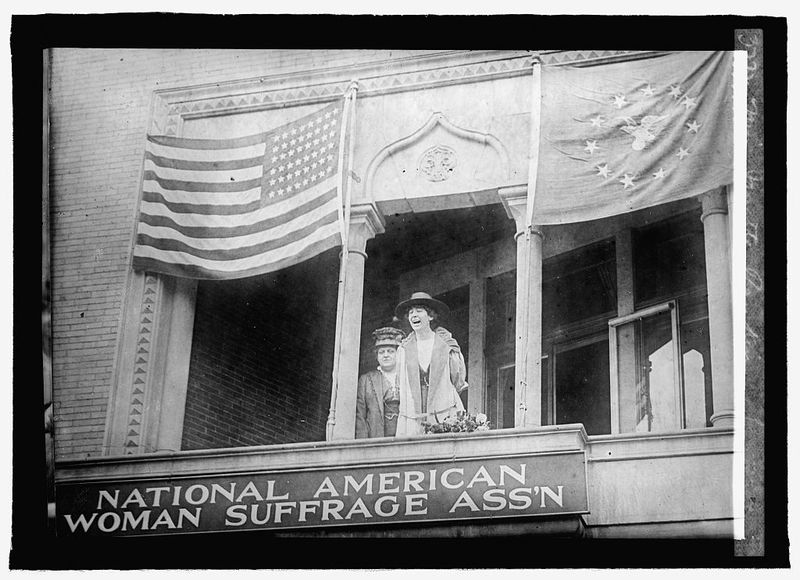
    <summary type="html"><![CDATA[<p><strong><em>A leader of the women’s suffrage movement on the national and state level, Jeannette Rankin helped lead her home state of Montana to enact women’s suffrage in 1914. She became the first woman elected to the US Congress when Montana elected her to the House of Representatives first in 1916 and again in 1940. Championing women’s suffrage, social welfare, and pacifism during her time as a Congresswoman, Jeannette Rankin remains the only member of Congress to vote against entering both World Wars, and continued her dedication to peace throughout the rest of her life.</em></strong></p><img src="https://www.intermountainhistories.org/files/fullsize/3e25e1f547dcdc63eb0bc72f82c20e65.jpg" alt="Jeannette Rankin speaking from the balcony of the National American Woman’s Suffrage Association " /><br/><p>Jeannette Pickering Rankin was born in 1880 in Missoula, Montana. She graduated from the University of Montana with a degree in biology and attended the New York School of Philanthropy to study social work. Her interest in social welfare and policy change convinced her of the necessity of women’s enfranchisement in order to implement social reform through political action. Rankin played an instrumental role as a skilled organizer and speaker in women’s suffrage campaigns in New York and Washington. She worked for the National American Women’s Suffrage Association as a national organizer, lobbyist, and field secretary. Even with all her work on women’s suffrage nationwide and in several states, Jeannette Rankin never forgot her home state.</p><p>Jeannette Rankin, with her experience working for the National American Women’s Suffrage Association and other state suffrage movements, became an important leader of the movement in Montana. Her organizational skills and renowned speaking ability proved instrumental in rallying people to the cause of women’s suffrage. In 1911, Rankin spoke to the state legislature in support of women’s suffrage, using the argument that “taxation without representation is tyranny” to argue that women, taxed like men, deserved the right to vote and represent themselves in government. In 1913, Jeannette Rankin became chair of the state suffrage organization. She obtained endorsements in support of women’s suffrage from the Democratic, Republican, and Progressive parties and personally interviewed each of Montana’s legislators. When the suffrage referendum passed in the state legislature in 1913, Rankin and the other Montana suffragettes such as Mary O’Neill and Belle Fligelman traveled over 9000 miles across the state to reach the far-flung communities of Montana and raise support for women’s right to vote. Through their efforts, Jeannette Rankin and the women of Montana succeeded in the passage of a popular referendum that granted them the right to vote in 1914.</p><p>For Jeannette Rankin, women’s involvement in politics did not end with the ballot box. In 1916, she ran for one of Montana’s at-large seats in the US House of Representatives and became the first woman in the United States elected to Congress, four years before the passage of the Nineteenth Amendment. Soon after, in April, 1917, Congress was called to an emergency session to vote on declaring war on Germany and entering World War I. Jeannette Rankin became one of fifty members in the House who voted against the war, declaring “I wish to stand for my country, but I cannot vote for war.” Speaking later in life about her decision, she declared “I felt the first time the first woman had a chance to say no to war, she should say it." Her vote gained both criticism and praise, including from within the women’s suffrage movement.</p><p>In addition to her important vote on World War I, Rankin used her time in Congress to continue to fight for women’s suffrage. As part of the U.S. House of Representatives, she had the unique opportunity to be the only woman to argue for national women’s suffrage as a member of Congress. Jeannette Rankin advocated for the creation of the Committee of Woman Suffrage and became a founding member. In 1918, she opened the debate in Congress over a national women’s suffrage amendment, asking, “How shall we answer their challenge, gentlemen? How shall we explain to them the meaning of democracy if the same Congress that voted for war to make the world safe for democracy refuses to give this small measure of democracy to the women of our country?” </p><p>After her first congressional term, Jeannette Rankin continued to be an ardent pacifist and advocate of social reform. Throughout the 1920s and 1930s, she participated in international peace organizations and lobbied for the passage of social welfare programs like the Sheppard-Towner Act. Rankin won a second term in Congress in 1940, and was the only member of Congress to vote against declaring war on Japan. This decision made her the only person in U.S. history to vote against entering both world wars. Widely reviled by members of Congress and across the country, Rankin nevertheless stood by her decision and her pacifist ideals. After her second term, she traveled the world advocating for peace. In the 1960s and 1970s, she mobilized once again to protest the Vietnam War. In 1968, she led an anti-war march in Washington, D.C. with a coalition of women’s peace groups named the Jeannette Rankin Brigade. Jeannette Rankin’s activism did not end with women’s suffrage or her Congressional terms, but continued throughout her life.</p><p><em><strong><a href="https://www.intermountainhistories.org/items/show/254">For more (including 6 images) view the original article</a></strong></em></p>]]></summary>
    <published>2019-01-18T07:15:35+00:00</published>
    <updated>2026-04-17T19:32:04+00:00</updated>
    <link rel="alternate" type="text/html" href="https://www.intermountainhistories.org/items/show/254"/>
    <id>https://www.intermountainhistories.org/items/show/254</id>
    <author>
      <name>Sarah Rounsville, Brigham Young University</name>
    </author>
  </entry>
  <entry>
    <title type="html"><![CDATA[The Non-Partisan Equal Suffrage Association of Colorado<br />
]]></title>
    <summary type="html"><![CDATA[<p><strong><em>In 1893, the Non-Partisan Equal Suffrage Association of Colorado led a campaign for women’s suffrage that mobilized women across the state. The suffragettes worked with multiple organizations and political parties to pass a popular referendum granting women the right to vote over two decades before the Nineteenth Amendment.</em></strong></p><img src="https://www.intermountainhistories.org/files/fullsize/2683405ec4c589036758d4feccad8860.jpg" alt="Ellis Meredith" /><br/><p>As in many states and territories, women in Colorado worked for years to achieve women’s suffrage. Attempts to secure the right to vote for women in Colorado began in the 1870s, soon after Wyoming and Utah enfranchised women. Although several bills on women’s suffrage came before the legislature, none passed until 1877, but the men of Colorado voted against it in a popular referendum. In 1893, the issue of women’s suffrage came before the state legislature once again. With support from the Populist party, a bill was passed in April through both Houses and the legislature authorized another popular referendum. By this time, Colorado activists and suffragettes had organized again and formed the Non-Partisan Equal Suffrage Association of Colorado. </p><p>The Non-Partisan Equal Suffrage Association of Colorado had only a few months to organize and conduct their campaign to convince the male voters of the state to vote in favor of women’s suffrage in November of 1893. Prominent leaders of the Association included journalists Ellis Meredith and Minnie Reynolds, teacher Martha Pease, physician Mary B. Bates, African American club leader Elizabeth P. Ensley, and American Woman Suffrage Association organizer Louise Tyler. With few funds, the Non-Partisan Equal Suffrage Association of Colorado met at first in the houses of members, but relocated its headquarters to rooms in Denver’s Tabor Grand Opera House after Elizabeth B. “Baby Doe” Tabor, wife of mining millionaire Horace Tabor, donated the use of the rooms. The Association also appealed to national suffrage leaders for assistance, sending Vice President Ellis Meredith to the annual National American Woman Suffrage Association convention in Chicago in June. She convinced NAWSA’s best organizer, Carrie Chapman Catt, to come assist in the Colorado campaign by arguing, “If Colorado goes for woman suffrage, you may count on a landslide in that direction throughout the West.”</p><p>In the campaign for women’s suffrage, the Non-Partisan Equal Suffrage Association of Colorado utilized a number of tactics. The Association worked together with multiple organizations, such as the Woman’s Christian Temperance Union, the Young Women’s League, the City League of Denver, and several women’s clubs, and also auxiliary suffrage organizations throughout the state to manage the campaign on a local level. The Association sent speakers to raise support, particularly Carrie Chapman Catt, who toured the state speaking at small meetings and large public rallies. Colorado suffragettes also utilized the press: Minnie Reynolds, as Chairwoman of Presswork, convinced the majority of Colorado’s newspapers to commit to the cause and reserve space in their papers for articles about the women’s suffrage campaign, which she and her fellow suffragette journalists like Ellis Meredith and Caroline Churchill wrote. The Association also worked across political and economic lines to appeal to the greatest number of male voters. The suffrage referendum was widely supported by the Populist party--but the Republican and Prohibitionist parties also endorsed the campaign for women’s suffrage. In addition, the Association appealed to men and women of all classes by working with trade unions and labor organizations, tying women’s suffrage to the cause of “free silver” as a way to enact economic reform, and presenting suffrage as social welfare measure that would help the working-class. Indeed, while middle and upper-class women made up the majority of the Association’s top leadership, working-class women did the work of canvassing home to home, distributing suffrage literature, and participating in local suffrage organizations.</p><p>By the time the popular referendum came in November 1893, the women of Colorado had worked to raise support for female enfranchisement by speaking across the state, organizing rallies, distributing suffrage literature, creating local suffrage organizations, getting political endorsements from various political parties, partnering with trade unions and women’s clubs, and writing newspaper articles. The Non-Partisan Equal Suffrage Association of Colorado acted as a central organization and headquarters for the movement throughout the state. On the day of the vote, the Association’s headquarters at the Grand Tabor Opera House in Denver remained open all day and organized groups of women to go to the polls, where they handed out suffrage literature and personally appealed to male voters. Early results were published the next morning, showing that the referendum for woman suffrage had passed by a margin of 35,798 to 29,451. Women across the state rejoiced, and the Non-Partisan Equal Suffrage Association of Colorado held an informal reception at their headquarters in the Grand Opera House, celebrating a success over twenty years in the making that resulted in Colorado becoming the first state to pass woman suffrage by popular referendum.</p><p><em><strong><a href="https://www.intermountainhistories.org/items/show/253">For more (including 3 images) view the original article</a></strong></em></p>]]></summary>
    <published>2019-01-18T07:01:55+00:00</published>
    <updated>2026-04-17T19:32:04+00:00</updated>
    <link rel="alternate" type="text/html" href="https://www.intermountainhistories.org/items/show/253"/>
    <id>https://www.intermountainhistories.org/items/show/253</id>
    <author>
      <name>Sarah Rounsville, Brigham Young University</name>
    </author>
  </entry>
  <entry>
    <title type="html"><![CDATA[The Woman’s Exponent<br />
]]></title>
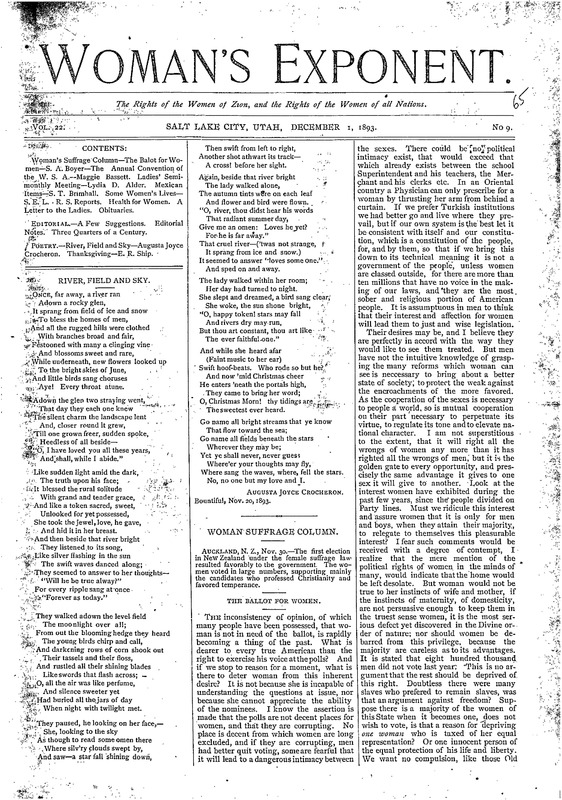
    <summary type="html"><![CDATA[<p><strong><em>Published in Salt Lake City from 1872 to 1914, the Woman’s Exponent, which acted as the unofficial newspaper of the Relief Society of the Church of Jesus Christ of Latter Day Saints, was an important advocate for women’s suffrage in Utah and one of the longest-running suffrage publications in the country.</p></strong></p><img src="https://www.intermountainhistories.org/files/fullsize/46e58cd8e9c52abdd7db00f69e643de3.jpg" alt="Front page of the December 1, 1893 issue of the Woman’s Exponent
" /><br/><p>Women’s suffrage has an interesting history in Utah. Women in Utah gained the right to vote, had it taken away, and regained it again years before the passage of the Nineteenth Amendment. The question of female enfranchisement was closely tied to the issue of polygamy. Before Utah became a state, the territorial legislature granted women the right to vote in 1870. However, in 1887, the federal government revoked this right in the Edmunds-Tucker Act because of the dispute with the LDS church over polygamy. Utah women organized on the local and territorial level to protest for the reinstatement of their right to vote. When the LDS church issued the 1890 Manifesto ending the practice of polygamy, the path both to statehood and women’s suffrage opened once again. The women of Utah mobilized in great numbers and successfully fought to have female enfranchisement written into the new constitution when Utah became a state in 1896.</p><p>The Woman’s Exponent was founded in 1872 and published bimonthly in Salt Lake City, Utah until 1914. Fully managed, written, and edited by women, the newspaper amplified women’s voices in Utah and helped communicate information between the women scattered in settlements across the territory. The newspaper printed news from across Utah and the United States, articles on topics ranging from domestic life to theology, stories and poetry, reports from LDS women’s organizations like the Relief Society, and information about women’s suffrage. Published in Salt Lake City, the Exponent occupied a number of different offices over the course of its forty-two years of existence. In the early years of its publication, the headquarters of the Exponent were located in the Council House until its destruction by a fire in 1883. Later, the Exponent had offices in the Constitution building on East Temple Street. Eventually, the offices of the Woman’s Exponent moved to the Bishop’s Building on 40 North Main Street. Unfortunately, all of these building were either destroyed in accidents or demolished to make room for new buildings and the expansion of Temple Square. The old location of the Bishop’s Building is closest to the current Relief Society Building on Temple Square.</p><p>The Woman’s Exponent was a major proponent of women's right to vote. Emmeline B. Wells, the main editor of the paper from 1877 until it ceased publication in 1914, was an active suffragette. She often acted as a liaison between Utah suffragettes and national suffrage leaders like Susan B. Anthony and Elizabeth Cady Stanton. Wells attended national suffrage conventions, met with Congressional committees and the President of the United States, served as the president of Utah’s suffrage association, and helped lobby Utah congressmen to support women’s suffrage. Her activism carried over to the Exponent, where, as editor, she helped publish articles, write editorials, and include news about women’s suffrage. </p><p>During the back-and-forth over women’s suffrage in Utah, the Woman’s Exponent played an important role in covering the issue and mobilizing the women of Utah to fight for their right to vote, especially after the Edmund-Tuckers Act of 1887. The Exponent often contained a Woman Suffrage column, which published news about women’s suffrage in Utah, the United States, and the world. An issue published on December 1, 1893, for example, contained news about women in New Zealand voting in their first election under new suffrage laws. The column included articles about the importance of winning the vote for women and also published information about local and state suffrage association meetings, rallies, speeches, and other events tied to the campaign for women’s suffrage. In 1889, the Exponent included a call for the women of Salt Lake City to meet and organize a Territorial Suffrage Association. Throughout 1895, the paper detailed the efforts of Utah suffragettes to lobby the territorial congress for the inclusion of women’s suffrage in the new state constitution. After the women of Utah regained the right to vote in 1896, the Woman’s Exponent continued as an important advocate for women’s rights and suffrage across the United States.</p><p><em><strong><a href="https://www.intermountainhistories.org/items/show/252">For more (including 3 images) view the original article</a></strong></em></p>]]></summary>
    <published>2019-01-18T06:49:08+00:00</published>
    <updated>2026-04-17T19:32:04+00:00</updated>
    <link rel="alternate" type="text/html" href="https://www.intermountainhistories.org/items/show/252"/>
    <id>https://www.intermountainhistories.org/items/show/252</id>
    <author>
      <name>Sarah Rounsville, Brigham Young University</name>
    </author>
  </entry>
  <entry>
    <title type="html"><![CDATA[Trujillo v. Garley: The Struggle for Native American Voting Rights<br />
]]></title>
    <summary type="html"><![CDATA[<p><strong><em>Although the Nineteenth Amendment gave women the right to vote in the United States, many minority women and men, remained disenfranchised for decades. In the long struggle for Native American civil and voting rights, the court case Trujillo v. Garley acted as a vital step by removing the constitutional provision that blocked Native Americans in New Mexico from voting.</p></strong></p><img src="https://www.intermountainhistories.org/files/fullsize/528d84d54e98a75f00e1331833fab0cb.jpg" alt="President Calvin Coolidge and several Native American representatives celebrating the signing of the 1924 Indian Citizenship Act
" /><br/><p>Even after the passage of the Nineteenth Amendment to the Constitution in 1920, not all women gained the right to vote. Native American women, along with men, remained disenfranchised for decades. The process of ensuring Native American civil and voting rights has stretched out over many years and pieces of legislation. In 1868, the Fourteenth Amendment, which declared “all persons born or naturalized in the United States, and subject to the jurisdiction thereof, are citizens of the United States and of the state wherein they reside,” gave African Americans citizenship and technically granted the right to vote to all male citizens, even though multiple states disenfranchised African Americans for decades. Native Americans were excluded from this amendment and from citizenship based on arguments that they did not pay taxes and that they existed under the jurisdiction of their native tribes and not the federal government. After the passage of the Nineteenth Amendment in 1920, the US Constitution read “The right of citizens of the United States to vote shall not be denied or abridged by the United States or by any State on account of sex,” but the same arguments about taxation and tribal jurisdiction meant that it did not extend to Native American women. It wasn’t until the passage of the Indian Citizenship Act in 1924 that all Native Americans born in the United States were granted citizenship, but this act did not ensure full citizenship rights, such as the right to vote. </p><p>Many western states, such as Arizona and New Mexico, contained large populations of Native Americans and a great amount of tribal land. However, these states did not allow Native Americans to vote or limited their voting rights. Some arguments that Western states used to disenfranchise Native Americans included that Native Americans who lived on reservations did not pay state taxes, or that this made them wards of the government who were therefore ineligible to vote. Both states and the federal government used the argument about the ward status of Native Americans as expressed in the Supreme Court case Cherokee v. Georgia: "Their relation to the United States resembles that of a ward to his guardian.They look to our government for protection, rely upon its kindness and its power; appeal to it for relief to their wants; and address the President as their great father." It wasn’t until the 1940s that significant strides were made to extend voting rights to Native Americans.</p><p>A high percentage of the Native American population served in World War II, but when they returned, they confronted the reality that they were not allowed to vote in the country they had served. This was the experience of Miguel Trujillo, a Marine in WWII, schoolteacher, and member of the Isleta Pueblo in New Mexico. In 1948, Trujillo felt he had the right to vote as a citizen and veteran, but the county registrar Eloy Garley refused to allow him to register. Trujillo took Garley to court and sued for the right to vote. Like several other states, New Mexico held that “Indians not taxed” could not vote. Trujillo challenged this by pointing out that although he did not pay property taxes since he lived on pueblo lands, he still paid other forms of taxes like federal income tax, gasoline taxes, and sales tax. The three-judge panel in Albuquerque, NM ruled in Trujillo’s favor and found that the provisions in the New Mexico constitution violated both the Fourteenth and Fifteenth Amendments. Judge Orie Phillips, speaking for the three-judge panel, stated: “[The constitution of New Mexico] says that “Indians not taxed” may not vote, although they possess every other qualification. We are unable to escape the conclusion that, under the Fourteenth and Fifteenth Amendments, that constitutes a discrimination on the ground of race. Any other citizen, regardless of race, in the State of New Mexico who has not paid one cent of tax of any kind or character, if he possesses the other qualification, may vote. An Indian, and only an Indian, in order to meet the qualifications to vote must have paid a tax. How you can escape the conclusion that makes a requirement with respect to an Indian as a qualification to exercise the elective franchise and does not make that requirement with respect to the member of any race is beyond me.” Thanks to this court case, Native Americans living in New Mexico legally had the right to vote, regardless of whether they lived on tribal lands.</p><p>Trujillo v. Garley removed the legal and constitutional barriers that prevented Native Americans living on tribal lands in New Mexico from voting. However, this wasn’t the end of the struggle for Native American voting rights. Also in 1948 in Arizona, the case of Harrison v. Laveen decided that “the term "persons under guardianship" has no application to the plaintiffs or to the Federal status of Indians in Arizona,” which removed the legal barrier preventing Native Americans in Arizona from voting. Utah was the last Western state, in 1957, to remove state statutes preventing Native Americans from voting. However, many state officials created other barriers to Native American suffrage, such as printing ballots only in English and not in native languages, putting ballot boxes and voting places far from reservations and native lands, gerrymandering districts in such a way to break up Native American communities, or requiring certain forms of ID that many Native Americans do not possess. While the 1965 Voting Rights Act helped, some of these barriers still exist today.. Native American women and men continue to work to encourage their people to vote and exercise their political influence, as recently demonstrated by the 2018 election of the first two Native American women to Congress, including Debra Haaland from New Mexico.</p><p><em><strong><a href="https://www.intermountainhistories.org/items/show/251">For more (including 2 images) view the original article</a></strong></em></p>]]></summary>
    <published>2019-01-18T06:26:13+00:00</published>
    <updated>2026-04-17T19:32:04+00:00</updated>
    <link rel="alternate" type="text/html" href="https://www.intermountainhistories.org/items/show/251"/>
    <id>https://www.intermountainhistories.org/items/show/251</id>
    <author>
      <name>Sarah Rounsville, Brigham Young University</name>
    </author>
  </entry>
  <entry>
    <title type="html"><![CDATA[Women’s Suffrage and Temperance in Idaho]]></title>
    <summary type="html"><![CDATA[<p><strong><em>The fight for women’s suffrage was closely tied to the temperance movement. Many women in Idaho supported both temperance and women’s suffrage, and although some suffragettes like Abigail Scott Duniway worried that the association between the two would prompt greater opposition from men, the WCTU helped win the right to vote for women in Idaho in 1896.</p></strong></p><img src="https://www.intermountainhistories.org/files/fullsize/3430039af5cc919129c52b625dbb981f.jpg" alt="Abigail Scott Duniway
" /><br/><p>In Idaho, like most states in the West, the Women’s Christian Temperance Union played an important role in the women’s suffrage movement. The WCTU advocated a variety of social reforms, such as prohibition of alcohol, for the purpose of creating a moral and clean society. Many Idaho women first became involved in the public sphere through participation in the WCTU, and later became suffragettes. The President of the Idaho Women’s Christian Temperance Union, Henrietta Skelton, encouraged local WCTU chapters in Idaho to incorporate women’s suffrage into their cause. The Idaho WCTU also helped push the territorial government to consider women’s suffrage. During Idaho’s Constitutional Convention in 1889, Henrietta Skelton gave a speech to the legislature requesting the following two clauses in the new state constitution: “No discrimination on account of sex shall be made; but citizens of both sexes, possessing the necessary qualifications, shall be equally eligible as electors;’ and “that manufacture, sale, or keeping of intoxicating liquors for use as a beverage is hereby prohibited.” For temperance activists in Idaho, women’s suffrage and prohibition were inseparable.</p><p>However, the connection of women’s suffrage to prohibition of alcohol by the WCTU created some problems. Due to this connection, liquor companies became some of the main opponents of female enfranchisement and some men viewed women’s suffrage in a negative light. When Henrietta Skelton argued for both suffrage and prohibition amendments in Idaho’s new state constitution, some suffragettes feared this would endanger the cause of women’s suffrage. One such suffragette was Abigail Scott Duniway. Abigail Scott Duniway had spent decades working for women’s suffrage in Washington, Oregon, and Idaho as a speaker and newspaperwoman, and previously spoke before Idaho’s legislature in 1887 in favor of women’s right to vote. In her autobiography, she recalled her reaction to the WCTU’s speech to the legislature: “I received a message from my Equal Suffrage co-workers in Boise, urging me to come to them at once. “The Woman’s Christian Temperance Union is spoiling everything,” the letter said. “They have arranged for a hearing before the convention, in advance of ours, asking for a clause in the new Constitution to prohibit the liquor traffic. They won’t get it, of course, but they will prohibit us from getting a Woman Suffrage plank, if you don’t come!” Duniway gave a speech to the legislature right after Skelton in which she attacked the idea that women’s suffrage and prohibition were connected and instead argued for the adoption of an independent women’s suffrage clause. Idaho did not give women the right to vote in the new state constitution, but Skelton and Duniway’s speeches reveal some of the tension in the relationship between women’s suffrage and temperance.</p><p>Despite the misgivings of Abigail Scott Duniway and other suffragettes, the Woman’s Christian Temperance Union remained an active part of the women’s suffrage movement in Idaho. The next president of the WCTU in Idaho, Rebecca Mitchell, convinced Lewis E. Workman, a Republican member of the state’s House of Representatives, to introduce another women’s suffrage bill to the legislature in 1893. Although that bill was not successful, the WCTU kept working with Idaho’s Equal Suffrage Association until women’s suffrage was successfully passed in 1896. The WCTU continued its social reform efforts with continued strength after women in Idaho won the right to vote. As public services and symbols of prohibition, they erected temperance water fountains, one of which still stands outside of Boise City Hall. In 1916, the WCTU achieved one of its main goals in Idaho when Governor Moses Alexander approved statewide prohibition.</p><p><em><strong><a href="https://www.intermountainhistories.org/items/show/250">For more (including 4 images) view the original article</a></strong></em></p>]]></summary>
    <published>2019-01-18T03:43:46+00:00</published>
    <updated>2026-04-17T19:32:04+00:00</updated>
    <link rel="alternate" type="text/html" href="https://www.intermountainhistories.org/items/show/250"/>
    <id>https://www.intermountainhistories.org/items/show/250</id>
    <author>
      <name>Sarah Rounsville, Brigham Young University</name>
    </author>
  </entry>
</feed>