<?xml version="1.0" encoding="UTF-8"?>
<feed xmlns="http://www.w3.org/2005/Atom">
  <title type="text">Intermountain Histories</title>
  <updated>2026-04-17T19:32:10+00:00</updated>
  <generator uri="http://framework.zend.com" version="1.12.20">Zend_Feed_Writer</generator>
  <link rel="alternate" type="text/html" href="https://www.intermountainhistories.org/"/>
  <link rel="self" type="application/atom+xml" href="https://www.intermountainhistories.org/items/browse?output=rss2"/>
  <id>https://www.intermountainhistories.org/</id>
  <author>
    <name>Intermountain Histories</name>
    <uri>https://www.intermountainhistories.org</uri>
  </author>
  <link rel="hub" href="https://pubsubhubbub.appspot.com/"/>
  <entry>
    <title type="html"><![CDATA[The Confederate Connections of Dixie State University]]></title>
    <summary type="html"><![CDATA[<p><strong><em>A Dixie State University alumni said, “I have been asked in each of my 7 post-grad interviews, ‘Where is Dixie?’” After all, who could know it was in southern Utah?</em></strong></p><img src="https://www.intermountainhistories.org/files/fullsize/1e2f92d9224feef966957a918dd7745b.jpg" alt="Dixie State University" /><br/><p><span style="font-weight:400;">“The name ‘Dixie’ is one of those distinctive things about this part of Utah,” historian Andrew Karl Larson wrote in his 1962 history of the Virgin River Basin of southern Utah. “It is a name much used, indeed overused, it would seem to the casual visitor. Businesses use it; its newspapers have been called after it; its junior college is named for it.”</span>
<span style="font-weight:400;">As of 2021, that “junior college” is Dixie State University—though likely not for much longer.</span>
<span style="font-weight:400;">In the mid-nineteenth century, members of The Church of Jesus Christ of Latter-day Saints grew cotton in southern Utah as part of a Church project to make Utah economically self-sufficient. Although the majority of settlers were from the northeastern United States, a community lore developed claiming many were from the American South, including former slave owners and overseers, chosen because they were familiar with cultivating cotton. The settlers dubbed the region “Dixie,” allegedly in reference to the similarly sunny, cotton-growing South. During the Civil War, although Church prophet Brigham Young assured the United States that “Utah has not seceded, but is firm for the Constitution,” a small number of Dixie settlers sympathized with their namesake. For example, local bishop Robert Dockery Covington rejoiced when he heard about Confederate victories. In a similarly sectional spirit, in April 1868—during Reconstruction—local newspaper </span><i><span style="font-weight:400;">Our</span></i> <i><span style="font-weight:400;">Dixie Times</span></i><span style="font-weight:400;"> ridiculed a Republican senator for “vot[ing] for negro equality.”</span>
<span style="font-weight:400;">The “junior college” was founded in 1911 as Dixie Academy. In 1916 it became Dixie Normal College and later Dixie College, even though school founder and trustee Edward Hunter Snow seemed unlikely to be a Confederate sympathizer. Snow was a northerner, and when he had preached as a Latter-day Saint missionary in the South years earlier, the Ku Klux Klan threatened to kill him.</span>
<span style="font-weight:400;">However, after Snow’s death in 1932, the campus community increasingly used “Dixie” to mean more than cotton and sunny skies. In 1952, Dixie College changed its mascot from “the Flyers” to “Rodney the Rebel.” In 1959, the community embraced the Confederate battle flag as a secondary school symbol. Then, in 1966, the yearbook’s name changed from </span><i><span style="font-weight:400;">The Dixie</span></i><span style="font-weight:400;"> to </span><i><span style="font-weight:400;">The Confederate</span></i><span style="font-weight:400;">.</span>
<span style="font-weight:400;">For the rest of the century, student costumes, activities, and displays made light of slavery and embraced the Confederacy. Students wore blackface as late as the 1990s and organized “slave days” and mock slave auctions. Confederate battle flags adorned school spirit imagery. These ongoing embraces of the Dixie-Confederate connection paralleled the broader mid-twentieth-century Dixiecrat campaign against the Civil Rights Movement.</span>
<span style="font-weight:400;">The school began moving away from Confederate imagery when it retired the battle flag as a school emblem in 1994. In 2005, it replaced Rodney the Rebel as a mascot, and it officially dropped the “Rebels” nickname in 2007 in favor of becoming the Red Storm and later the Trailblazers.</span>
<span style="font-weight:400;">Yet the Dixie name stayed. When the college transitioned into a university, the board of trustees voted unanimously on January 13, 2013 to name the school Dixie State University, despite growing grassroots interest in dropping “Dixie.” Multiple donors said they would withdraw funding if “Dixie” wasn’t in the name, and chairman Steve Caplin insisted, “No one on this board or in this administration is aware of any racial discrimination in our past.”</span>
<span style="font-weight:400;">Jeanetta Williams, president of the Salt Lake City chapter of the NAACP and a Black woman, was stunned. “Have they not seen all the blackface, the mock slave auction?” she asked.</span>
<span style="font-weight:400;">In 2020, pressure again mounted against the name during a nationwide reckoning on racial justice, and the university commissioned an impact study on “Dixie.” Released on December 13, the study revealed that over a third of out-of-state prospective students believed the Dixie name hurt the university’s reputation. Some expressed discomfort with the idea of wearing Dixie State memorabilia. The next day, the board of trustees voted unanimously to recommend the university change its name.</span>
<span style="font-weight:400;">Authorizing a name change fell to Utah’s state legislature, but some representatives and members of the community were reluctant, and others were hostile. While the legislature and community deliberated, the university’s Student Executive Council wrote an op-ed pleading for a new name. They quoted an anonymous alumni who reported,</span>
<p style="margin-left:50px;"><span style="font-weight:400;">I have been asked in each of my seven post-grad interviews, ‘Where is Dixie?’ …My first day at each of [three] jobs has been explaining the Dixie name as quickly as possible and only getting neutral or negative responses.</span>
<span style="font-weight:400;">On March 4, Utah’s legislature finally passed a bill authorizing a name change, and on March 16 Governor Spencer Cox signed the bill into law. On June 14, 2021, a university committee recommended “Utah Polytechnic State University” as a new name, but community backlash was nearly immediate and trenchantly hostile to a name some argued was too reminiscent of nineteenth-century polygamy. By June 29, the committee withdrew its polytechnic suggestion and instead proposed “Utah Tech University,” which the university decided to move forward with, pending approval from the Utah state board of higher education, legislature, and governor.</span>
<span style="font-weight:400;">After more than a century, the name “much used, indeed overused,” would be used one time less.</span></p><p><em><strong><a href="https://www.intermountainhistories.org/items/show/496">For more (including 7 images) view the original article</a></strong></em></p>]]></summary>
    <published>2021-09-18T08:24:43+00:00</published>
    <updated>2026-04-17T19:32:10+00:00</updated>
    <link rel="alternate" type="text/html" href="https://www.intermountainhistories.org/items/show/496"/>
    <id>https://www.intermountainhistories.org/items/show/496</id>
    <author>
      <name>Makoto Hunter, Brigham Young University</name>
    </author>
  </entry>
  <entry>
    <title type="html"><![CDATA[BYU Creameries]]></title>
    <summary type="html"><![CDATA[<p><strong><em>While BYU is perhaps best known for its academic achievements and sports programs, since the mid 1940’s the university has owned and operated a successful dairy farm and creamery.</p></strong></p><img src="https://www.intermountainhistories.org/files/fullsize/f11b2acd3cce1c171bba4c851c42cf96.jpg" alt=" Creamery on Ninth. 
" /><br/><p>Brigham Young University has operated a dairy farm since 1946. The first farm was located on 24 acres in Northern Provo. The farm operations included a creamery, producing milk and dairy products mostly for the university community. In the 1950s, the creamery was transferred from the College of Applied Science to BYU Auxiliary Services. Then in 1957 the school purchased approximately 600 acres of farmland in Spanish Fork to increase the school’s farming operations. Agriculture professor Grant Richards helped bring BYU’s dairy herd to a prize-winning level and by 1959, BYU’s pure-bred Holsteins were known to produce over twice as much milk and butter than the average American dairy cow. </p><p>In 1949, a dairy-processing plant was built just north of the Central Heating Plant. The College of Biological and Agricultural Sciences developed a curriculum in dairy processing, though these courses were eventually replaced by food science courses. The Dairy Products Laboratory building was completed in 1964 after nine months of construction. In 2009, the facility moved locations on campus and expanded to become the BYU Culinary Support Center. This new expanded operation is responsible for all on campus food, feeding tens of thousands of people daily. </p><p>The Creamery on Ninth opened in 2000. Kent’s Market, a grocery store located in the current Creamery’s location, had closed in 1999 after serving BYU students for 59 years. Heritage Halls residents and other students complained about the closure, so the university decided to refurbish the building and open a university-run grocery store and grill. The Creamery on Ninth opened on August 23, 2000 and quickly became a popular spot for BYU students and locals alike. Besides the flagship Creamery on Ninth store, soon creamery locations were established including Helaman Creamery, Creamery Outlet, Wyview Creamery, Takeaway Creamery, and Creamery Express. </p><p>While BYU's Creamery locations sell a wide variety of goods, the main attraction has always been the ice cream. With milk supplied from BYU’s dairy farm in Elberta, Utah, BYU Creamery Operations now produce over 200,000 gallons of ice cream per year. BYU’s ice cream formulas have 2-4% higher milk fat content than most ice cream recipes, giving it an unusually rich, creamy consistency. Although LaVell’s Vanilla holds the number one spot for half-gallon sales, the Creamery reports Graham Canyon to be its most popular flavor.</p><p>BYU Creameries play an integral role in the social fabric of BYU, providing convenient locations for students and staff to buy groceries and a fun place to relax after a long day of work. </p><p><em><strong><a href="https://www.intermountainhistories.org/items/show/460">For more (including 5 images) view the original article</a></strong></em></p>]]></summary>
    <published>2021-03-30T06:24:01+00:00</published>
    <updated>2026-04-17T19:32:09+00:00</updated>
    <link rel="alternate" type="text/html" href="https://www.intermountainhistories.org/items/show/460"/>
    <id>https://www.intermountainhistories.org/items/show/460</id>
    <author>
      <name>Allie Patterson, Brigham Young University; Ryan J. Hallstrom, Brigham Young University</name>
    </author>
  </entry>
  <entry>
    <title type="html"><![CDATA[CSU Students Protest and Hold a &quot;Beer-in&quot; in 1968]]></title>
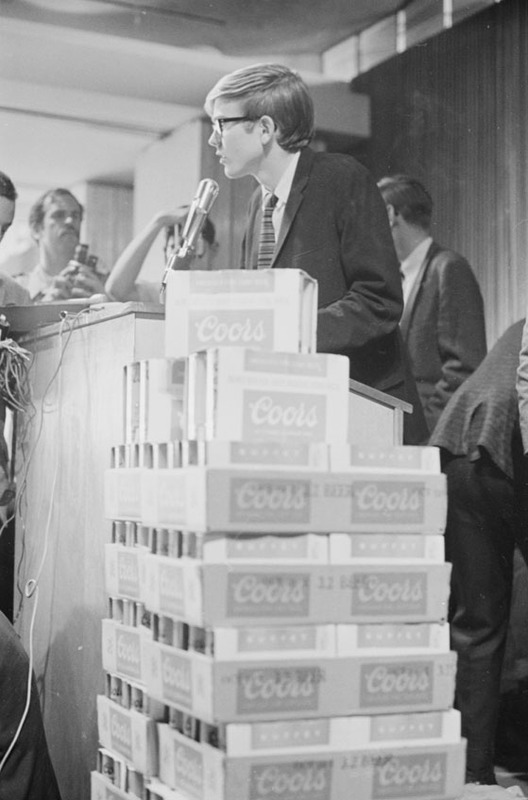
    <summary type="html"><![CDATA[<p><strong><em>Drinking culture in Fort Collins may seem pedestrian today, what with nineteen breweries dotting the city’s landscape, but the barbarous beer and bar culture of contemporary Ft. Collins was born of far more conservative roots. How did  After the repeal of the Volstead act and the resulting end of prohibition in 1933, Fort Collins maintained prohibition far longer than the majority of the country. How did the town's brew culture evolve? It all comes down to a single number: 3.2. </p></strong></p><img src="https://www.intermountainhistories.org/files/fullsize/c6befaad17dcba3f15d5ec36f11ec99f.jpg" alt="Beer-In 1968" /><br/><p>After the repeal of Prohibition in 1933, Fort Collins remained somewhat dry.  On March 22, 1933, the town passed the Cullen-Harrison Act, which allowed lawful distribution and consumption of beer that was 3.2% alcohol by weight - a fairly light brew. </p><p>Some thirty-five years later, students of Colorado State University borrowed demonstration tactics employed by civil rights activists to fight for greater student input in what they felt to be an unfair paternal relationship with university administrators—one of the first items on student protestors’ agenda was the accessibility and consumption of 3.2 beer on campus. How better to demonstrate their frustrations than staging a “beer-in” in the student center? Though the student body was far from unanimous on these matters, on Friday, October 18, 1968, the president of the Associated Students of Colorado State University (ASCSU), Doug Phelps, rallied more than 150 students in the Lory Student Center to stage a “beer-in” under the pretense of liberating the student center. </p><p>As early as November of 1965 students had expressed their displeasure with the lack of 3.2 drinking establishments in Fort Collins. A number of students attended the December 7, 1965, meeting that founded the Fort Collins Malt Beverage Association, a group comprised of city officials, existing tavern owners, and other Ft. Collins merchants. Almost exactly two years later, the ASCSU voted to poll the student body to glean student attitudes in support or opposition to the selling of 3.2 beer on campus. By February 1967, the subject had reportedly become a topic of daily discussion and debate. The State Board of Agriculture, the university governing entity, began debating the topic of 3.2 beer sales on campus by the Spring of 1968. In August of the same year, The State Board of Agriculture voted 4-1 against a request to allow the on-campus sale of 3.2 beer by the glass. On October 10, 1968, a helicopter commissioned by student body president Doug Phelps, flew over CSU campus dropping pamphlets urging students to convene for the “liberation” of the Lory Student Center as soon as possible. The resulting crowd discussed issues of student power, and Phelps announced that on October 18 at 3:00 P.M. he intended to drink beer in the student center in an act that was meant to symbolize the potential of student power to dictate Student Center policy. On October 18, 1968, Phelps and more than 150 other students made good on their promise by staging a beer-in in the Student Center Main Ballroom (only approximately 30 actually drank a beer). Students voiced their desire for beer to be sold in the newly constructed Student Center coffee shop which, perhaps not coincidentally, is the current location of the only on-campus drinking establishment, the beloved Ramskeller. </p><p><em><strong><a href="https://www.intermountainhistories.org/items/show/133">For more (including 4 images) view the original article</a></strong></em></p>]]></summary>
    <published>2018-02-01T19:51:26+00:00</published>
    <updated>2026-04-17T19:32:00+00:00</updated>
    <link rel="alternate" type="text/html" href="https://www.intermountainhistories.org/items/show/133"/>
    <id>https://www.intermountainhistories.org/items/show/133</id>
    <author>
      <name>William Bundy and Keegan Martin, Colorado State University</name>
    </author>
  </entry>
</feed>