<?xml version="1.0" encoding="UTF-8"?>
<feed xmlns="http://www.w3.org/2005/Atom">
  <title type="text">Intermountain Histories</title>
  <updated>2026-04-17T19:32:10+00:00</updated>
  <generator uri="http://framework.zend.com" version="1.12.20">Zend_Feed_Writer</generator>
  <link rel="alternate" type="text/html" href="https://www.intermountainhistories.org/"/>
  <link rel="self" type="application/atom+xml" href="https://www.intermountainhistories.org/items/browse?output=rss2"/>
  <id>https://www.intermountainhistories.org/</id>
  <author>
    <name>Intermountain Histories</name>
    <uri>https://www.intermountainhistories.org</uri>
  </author>
  <link rel="hub" href="https://pubsubhubbub.appspot.com/"/>
  <entry>
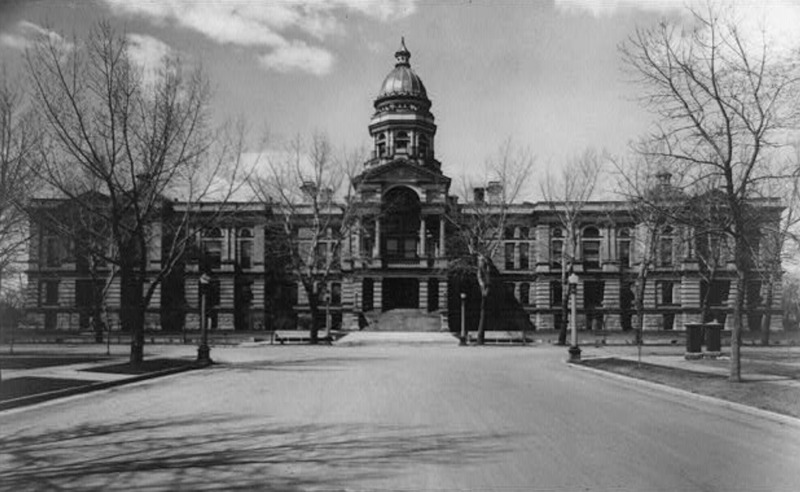
    <title type="html"><![CDATA[Wyoming State Capitol in Cheyenne]]></title>
    <summary type="html"><![CDATA[<p><strong><em>The Wyoming State Capitol building is the seat of the Wyoming State Legislature and the Governor’s Office. This modest and comparatively inexpensive Capitol of the smallest U.S. state by population is a working government building and symbol of Wyoming and its past.</em></strong></p><img src="https://www.intermountainhistories.org/files/fullsize/8ecc0a262ac751f87a33d08199fb94e9.jpg" alt="Wyoming Capitol" /><br/><p>The land that became Wyoming was originally the territory of Native peoples. Wyoming’s modern Native tribes include the Ute, Arapaho, Cheyenne, Shoshone, and Crow. The California Trail, Oregon Trail, and Mormon Trail all passed through Wyoming and brought droves of white settlers through the area on their way to the West Coast and Utah the mid-nineteenth century, though few took up residence in the Wyoming area itself. The U.S. Government negotiated the Treaty of Fort Laramie in an effort to protect settlers moving through the area by compensating tribes and building forts. The U.S. Government soon reneged on these treaty obligations and on those of a second Fort Laramie Treaty, causing an escalating cycle of violence. The U.S. Government eventually forced the remaining Native peoples of Wyoming into the reservation system.
Cheyenne began as a stop along the Union Pacific Railroad line in 1867 and quickly surpassed other population centers to become the Territorial Capitol and then State Capitol, as well as Wyoming’s largest city. Ranching, mining, and agriculture continued to draw a trickle of settlers, but the harsh environment, scarce arable land, and temperature extremes restricted the population. Wyoming became its own territory on July 25, 1868 under Andrew Johnson’s presidency and inaugurated its first government May 19, 1869. It achieved statehood July 10, 1890 despite disputes over whether it had achieved the minimum population threshold at that time. In 1886, the Territorial Legislature created a Capitol Commission to organize construction of a capitol building. It chose David W. Gibbs & Co. to design the Capitol and Adam Feick & Bros. to construct it at a bid of only $150,000, worth a little over $4,000,000 in 2020. The Territorial Legislature used the building even before its completion in 1890. By 1915, the State Legislature had outgrown the building and voted to add the House and Senate chambers to the structure, which were completed in 1917.
The Capitol is a Renaissance Revival structure made of both native and Colorado sandstone with a copper dome, which was later gilded in 1900. The interior is finished in marble with a beautiful cherrywood staircase with murals decorating many of the walls. An enormous stuffed bison stands in part of the rotunda, and a bronze bison sculpture stands outside. The bison was a critical part of the diet and culture of the Native people of Wyoming and the intentional near extinction of the animal by white hunters was a severe blow to them. Now, the bison is a symbol of the state and adorns its flag.
In 2016 the Capitol underwent a major renovation which restored decorative elements, added more accessibility with additional elevators and restrooms, and upgraded technology resources. These improvements, completed in 2019, will ensure that the State Capitol building can continue to function as the working seat of government for the people of Wyoming for many years to come.</p><p><em><strong><a href="https://www.intermountainhistories.org/items/show/509">For more (including 4 images) view the original article</a></strong></em></p>]]></summary>
    <published>2021-10-10T09:05:30+00:00</published>
    <updated>2026-04-17T19:32:10+00:00</updated>
    <link rel="alternate" type="text/html" href="https://www.intermountainhistories.org/items/show/509"/>
    <id>https://www.intermountainhistories.org/items/show/509</id>
    <author>
      <name>David Cady, Northern Arizona University</name>
    </author>
  </entry>
  <entry>
    <title type="html"><![CDATA[Utah State Capitol in Salt Lake City]]></title>
    <summary type="html"><![CDATA[<p><strong><em>The Utah State Capitol building in Salt Lake City stands as a symbol of Utah and its state and territorial history. Today it houses the two legislative chambers of the state government.</em></strong></p><img src="https://www.intermountainhistories.org/files/fullsize/39d0ca498073db59fd125d1d3e75efa1.jpg" alt="Utah State Capitol" /><br/><p>The land that became Utah was originally the territory of Native peoples. Its modern Native tribes include the Utes, Northern Shoshone, Western Shoshone (Goshute), Navajo, and Southern Paiutes. On July 21, 1847, two advance scouts of the first of many members of The Church of Jesus Christ of Latter-day Saints (often nicknamed “Mormons” in that time) arrived in the Salt Lake Valley. The last members of this first company of settlers, including Church president Brigham Young, entered the valley on July 24, which later was commemorated as the official date of arrival. The Latter-day Saints had migrated to Salt Lake Valley in search of independent self-governance and escape from the conflict and persecution they faced in places like Illinois and Missouri. This influx of Mormon migrants to the area set off a complex period of interaction with its Native inhabitants which was at times peaceful and at others violent. Over time, white settlers dispossessed Native people of their land, ending with the forced relocation of Utah’s Native people to reservations. The area and its landmarks were renamed and reimagined from a Mormon perspective.
The Latter-day Saints’ strong social and religious bonds helped the community based around Salt Lake survive and grow, but they also became an obstacle to statehood. Utah’s settlers applied for statehood in 1849, but although Utah was organized as a territory in 1850 by an act of Congress, the federal government was wary of adding the Latter-day Saints’ unique community to the national body politic as a full-fledged state. Territorial Utah applied for statehood again in 1856, 1862, 1876, 1882, and 1887, with its application rejected each time. Much criticism focused on the Church’s then-current practice of polygamy. After a complex process of policy and cultural shifts in the Church over the course of decades, it renounced polygamy in 1890. Six years later, after decades of applying for statehood, Utah was finally admitted on January 4, 1896.
The territorial and state governments of Utah used several different buildings before the creation of the Capitol. The current site, an area known as Arsenal Hill owing to its prior use as a munitions dump, was donated from the City of Salt Lake to the State of Utah in 1888. An initial Capitol Commission scrapped a design by notable state capitol designer Elijah E. Myers in 1891 because it was cost prohibitive. Funding for the project proved elusive until, in 1911 the Utah resident widow of railroad magnate Edward Henry Harriman paid $798,546 in inheritance tax to the state upon his death and the Legislature passed a $1,000,000 bond. Construction started the following year.
Richard Kletting won the design contest but had to compromise on its execution to see it opened by 1916. The building operated as seat of government for decades with incremental upgrades and maintenance but was found to be dangerously susceptible to earthquakes. From 2004 to 2008, the Capitol underwent a massive restoration project which strengthened it against earthquakes, restored artwork and public spaces, and included newly commissioned artwork to more closely match Kletting’s original, grander vision for the building. After the costs of renovation, it is the most expensive capitol complex in America. In keeping with the tradition of its community, Utah’s capitol began with a vision which took many years of hard work and setbacks to fully realize.
The grounds of the Capitol house a large collection of statuary and monuments honoring early pioneers, veterans of the Civil War and Vietnam War, Martin Luther King Jr, the Mormon Battalion, and others. The fourth floor of the Capitol building is now home to a gallery of rotating exhibits dedicated to the history of Utah.</p><p><em><strong><a href="https://www.intermountainhistories.org/items/show/508">For more (including 4 images) view the original article</a></strong></em></p>]]></summary>
    <published>2021-10-10T08:12:14+00:00</published>
    <updated>2026-04-17T19:32:10+00:00</updated>
    <link rel="alternate" type="text/html" href="https://www.intermountainhistories.org/items/show/508"/>
    <id>https://www.intermountainhistories.org/items/show/508</id>
    <author>
      <name>David Cady, Northern Arizona University</name>
    </author>
  </entry>
  <entry>
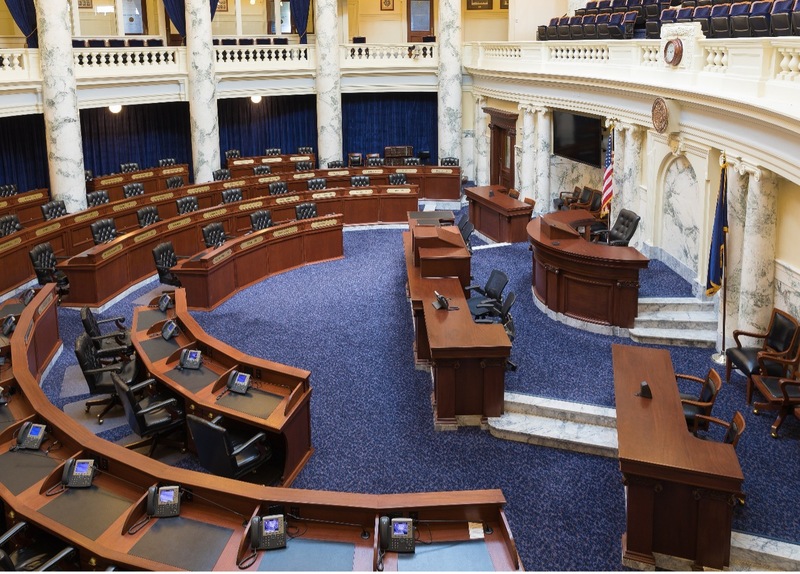
    <title type="html"><![CDATA[Idaho State Capitol in Boise]]></title>
    <summary type="html"><![CDATA[<p><strong><em>The Capitol building in downtown Boise houses the bicameral Legislature of the State of Idaho as well as several offices of the executive branch. It is an impressive building which speaks to the history of the state.</em></strong></p><img src="https://www.intermountainhistories.org/files/fullsize/f06979ab23734dfbc6f456e70ce3331c.jpg" alt="Chamber of the Idaho House of Representatives" /><br/><p>The land that would become Idaho was originally Native land. Today these Native tribes include the Coeur dAlene, Kootenai, Shoshone-Bannock, and Nez Perce. White settlers had been passing through along the Oregon trail earlier in the nineteenth century but became more established in the wake of gold rushes starting in 1860. Many more white immigrants arrived to farm in the 1890s and, along with the U.S. government, forced Native peoples onto reservations.
Idaho was formed largely by agricultural boosterism. White settlers who had envisioned a farming paradise were soon confronted by the difficulty of the land and the unpredictable Snake River. Many persevered, however, and helped Idaho grow. Boosterism even gave the state its name. The name is often taken as a Native word meaning “gem of the mountain” or similar, but it actually traces back to a white man named George Willing, who suggested it as a name of what became Colorado territory. Although the name was pulled as a candidate for Colorado after the truth was discovered, it remained popular and was applied to the Idaho Territory by territorial officials when Congress separated it from Washington Territory. It was established as a territory by Abraham Lincoln on March 4, 1863 with Boise decided as its capitol the following year. Benjamin Harrison signed Idaho into statehood on July 3rd, 1890, though it took fifteen years for the old Territorial Capitol building to be replaced by the new State Capitol building.
Construction of the Capitol took place in two distinct phases. Builders constructed the central dome and north wing from 1905–1912, after which it began to operate as the seat of government. In 1919, the legislature secured additional funds to build the east and west wings, completing them the next year. The Legislature tapped J.E. Tourtellotte and Charles Hummel to design the initial structure and chose native sandstone for the building’s superstructure. The state used convict labor to transport the blocks from a nearby quarry but employed craftsmen to finish the fine multicolored foreign marble of the building’s interior. Since its completion, the Capitol has been updated for comfort, safety, and technology to preserve it as a working seat of government.
While facing the front of the Capitol from beyond Jefferson Sreet, visitors can see a statue of Abraham Lincoln; behind that a memorial for Governor Frank Steunenberg, who was assassinated in 1905; and behind that a replica of the Liberty Bell, donated by the U.S. Treasury department in 1950. A Pioneer Monument to the east of the entrance honors the travelers of the Oregon Trail, and to the west stands an 1840 Confederate seacoast gun and the Grand Army of the Republic Monument dedicated to soldiers of the Union Army. A relic from the old Idaho Territorial Capitol stands on the fourth floor: a gilded pinewood statue of George Washington carved in 1869 by Charles L. Ostner. These objects and the building itself stand as a reminder of Idaho’s place in U.S. history.</p><p><em><strong><a href="https://www.intermountainhistories.org/items/show/507">For more (including 3 images) view the original article</a></strong></em></p>]]></summary>
    <published>2021-10-09T22:39:59+00:00</published>
    <updated>2026-04-17T19:32:10+00:00</updated>
    <link rel="alternate" type="text/html" href="https://www.intermountainhistories.org/items/show/507"/>
    <id>https://www.intermountainhistories.org/items/show/507</id>
    <author>
      <name>David Cady, Northern Arizona University</name>
    </author>
  </entry>
  <entry>
    <title type="html"><![CDATA[Montana State Capitol in Helena]]></title>
    <summary type="html"><![CDATA[<p><strong><em>The Montana State Capitol in Helena houses the State Legislature. Its intriguing history and grand design speak to the spirit of Montana.</em></strong></p><img src="https://www.intermountainhistories.org/files/fullsize/1f9fdd07bd4e9b5e8edbf7bbbe16aab5.jpg" alt="Montana Capitol" /><br/><p>The land that became Montana was originally the territory of Native peoples. Its current Native tribes include the Blackfeet, Assiniboine, Cheyenne, Crow, Shoshoni, Sioux, Gros Ventre, Salish, and Kootenai. A limited number of white settlers and missionaries had been in the area in the early nineteenth century, but it was not organized into a territory until May 28, 1864, during the Civil War. As with many western states, a gold rush brought the first significant wave of white settlers. White immigration and encroachment led to escalating violence and the invasion of the United States Army. The period of conflict after the Civil War, notably including the Battle of Little Bighorn, resulted in the forced removal of Native peoples onto reservation land.
Mining, fur, ranching, timber, and agriculture continued to draw white settlers to the territory and on November 8, 1889 Montana was admitted to the Union as the forty-first state. Helena became the Territorial Capitol after the Legislature moved it from Virginia City in 1875, but it was not officially ratified as the site by election until 1894. The following year, a Capitol Commission was authorized by the State Legislature and a design by George R. Mann was approved with construction beginning in 1896. The Capitol follows a neoclassical design and is made of sandstone and granite with a copper dome topped by a Columbia figure. State Representative Fred Whiteside exposed a plot by Commission members to use cheap materials and embezzle leftover funds from the project, after which the Commission disbanded and a second one was convened. The second commission chose Charles Bell and John Kent to complete the capitol, and the cornerstone was laid July 4, 1899.
The construction of the Capitol happened in two phases with the main section completed in 1902 and the wings constructed in 1911-1912. An outside firm known as F. Pedretti’s Sons decorated and furnished the 1902 section, but when the wings were built the state commissioned Montana artists to adorn them. One of these Montana artists, Charles M. Russell, created the 12-feet by 25-feet painting titled “Lewis and Clark Meeting the Flathead Indians at Ross’ Hole” which hangs in the chamber of the House of Representatives. Within the rotunda there are four portraits representing early Montana: a prospector, a trapper, and Native chief, and a cowboy. Various busts and statues of important <span>Montanans</span> fill the landings of the grand staircase, and murals adorn the walls of the main hall, notably one donated by the Northern Pacific Railroad to commemorate the completion of a portion of the transcontinental railroad in Gold Creek on September 8, 1883. In front of the Capitol steps stands a bronze statue of Thomas Francis Meagher, a Union general in the Civil War and a representative of the many Irish immigrants who settled in Montana. Earthquakes damaged the capitol in 1935, but Works Progress Administration workers restored or replaced the damaged elements. Updates and upkeep continue at Montana’s State Capitol, securing its place as a modern seat of government and a monument to its past.</p><p><em><strong><a href="https://www.intermountainhistories.org/items/show/506">For more (including 3 images) view the original article</a></strong></em></p>]]></summary>
    <published>2021-10-09T21:43:47+00:00</published>
    <updated>2026-04-17T19:32:10+00:00</updated>
    <link rel="alternate" type="text/html" href="https://www.intermountainhistories.org/items/show/506"/>
    <id>https://www.intermountainhistories.org/items/show/506</id>
    <author>
      <name>David Cady, Northern Arizona University</name>
    </author>
  </entry>
  <entry>
    <title type="html"><![CDATA[Colorado State Capitol in Denver]]></title>
    <summary type="html"><![CDATA[<p><strong><em>This unique building houses the Legislature and Governor of the Colorado State Government. Its architecture and construction reflect some of the history of early Colorado.</em></strong></p><img src="https://www.intermountainhistories.org/files/fullsize/e15b14846b6b51a30dc05f0aa7650b0d.jpg" alt="Colorado State Capitol Building" /><br/><p>The land that would become modern Colorado was acquired by the United States in two parts. Its eastern half was part of the Louisiana Purchase, and the west was ceded by Mexico at the end of the Mexican–American War. Native tribes, including the Ute, Arapaho, Jicarilla Apache, Comanche, and Navaho, had long called the area home, but encroachment and attacks by European Americans changed demographics in the mid-nineteenth century, displacing and dispossessing the original inhabitants. Prospectors discovered gold veins near present day Denver and Boulder in 1858 and founded Denver the following year. White miners, merchants, and families moved into what was then part of the Territory of Kansas to seek their fortune. Locals seeking political independence organized the Jefferson Territory, which was then established as the Colorado Territory by the U.S. Congress in 1861.
The 1886 projected cost of construction was $1,000,000, equivalent to $26,400,000 in 2020, but by the time of its completion, it had cost $3,700,000, equivalent to $97,400,000 in 2020. The Board of Capitol Managers fired the original designer, E.E. Myers, after successive cost overruns, and the capitol was completed under Frank Edbrooke in 1901. Myer’s original commission was to be based on a percentage of the total cost of construction, so there had been an incentive to spare no expense.
In 1876, Colorado’s founders christened it the “Centennial State” and used this association with the nation’s centennial for promotion. Builders laying the cornerstone of the Capitol in 1890 on July 4<sup>th</sup> furthered the association with America’s founding. The Colorado State Capitol is intentionally modeled after the Capitol building in Washington, D.C. as a neoclassical “Greek Cross.” The structure extensively uses several types of native Colorado marble, some of which can only be found in the state. These include the ultra-dense Yule marble and beautiful Rose Onyx, which is technically a type of metamorphosed limestone containing iron oxide. The interior contains murals, stained glass, and statuary. The exterior houses various monuments, cannon, and “mile high” markers for the approximate elevation.
The gold rush that prompted settlement in Colorado made it seem like anyone could become rich. Even though the rush’s profits never exceeded the total investment and only a relative few made their fortune, this vision of accessible wealth drove the early development of Colorado. A notable reflection of this history in the actual architecture of the Capitol is the beautiful golden dome which crowns it. In 1908, miners donated 200 ounces of gold to gild it in commemoration of the 1858 gold rush. The original copper dome that could be afforded in the original construction had been deemed by Coloradans to be insufficiently grand. Since then, the Capitol has been upgraded several times for safety, technology, and comfort.
With the gold rush long over, the Colorado State Capitol building in Denver is now the administrative center of a state which has outgrown its goldmining past to become dynamic and economically diverse. It is a building which speaks to the time of its creation as well as the present.</p><p><em><strong><a href="https://www.intermountainhistories.org/items/show/505">For more (including 4 images) view the original article</a></strong></em></p>]]></summary>
    <published>2021-10-09T04:10:41+00:00</published>
    <updated>2026-04-17T19:32:10+00:00</updated>
    <link rel="alternate" type="text/html" href="https://www.intermountainhistories.org/items/show/505"/>
    <id>https://www.intermountainhistories.org/items/show/505</id>
    <author>
      <name>David Cady, Northern Arizona University</name>
    </author>
  </entry>
</feed>