<?xml version="1.0" encoding="UTF-8"?>
<feed xmlns="http://www.w3.org/2005/Atom">
  <title type="text">Intermountain Histories</title>
  <updated>2026-04-17T19:32:17+00:00</updated>
  <generator uri="http://framework.zend.com" version="1.12.20">Zend_Feed_Writer</generator>
  <link rel="alternate" type="text/html" href="https://www.intermountainhistories.org/"/>
  <link rel="self" type="application/atom+xml" href="https://www.intermountainhistories.org/items/browse?output=rss2"/>
  <id>https://www.intermountainhistories.org/</id>
  <author>
    <name>Intermountain Histories</name>
    <uri>https://www.intermountainhistories.org</uri>
  </author>
  <link rel="hub" href="https://pubsubhubbub.appspot.com/"/>
  <entry>
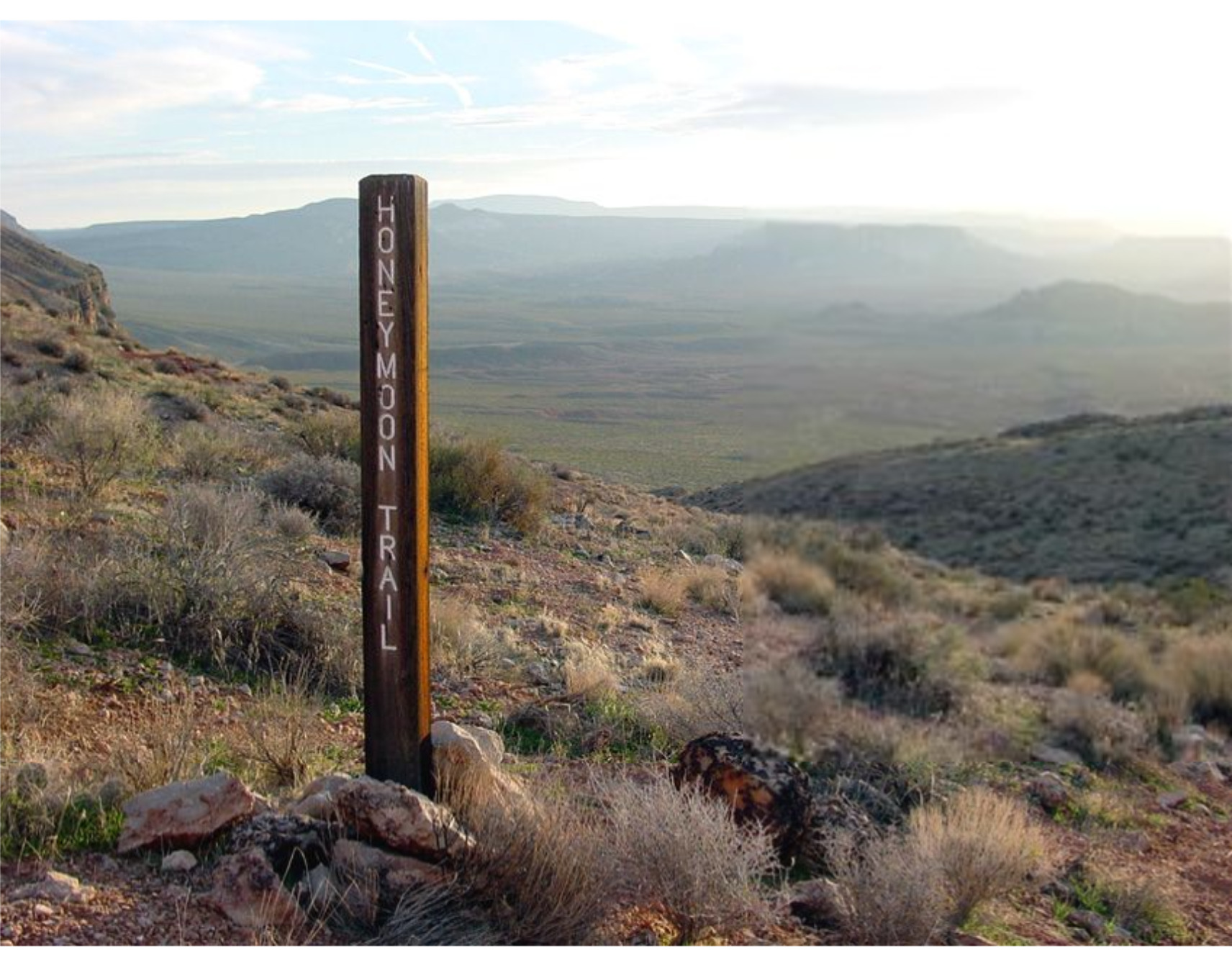
    <title type="html"><![CDATA[Honeymoon Trail]]></title>
    <summary type="html"><![CDATA[<p><strong><em>The Honeymoon Trail connected Latter-day Saint communities in Arizona to St. George and was originally known as the Mormon Wagon Road. Will C. Barnes, an American historian, coined the term Honeymoon Trail as he studied the hundreds of couples who trekked along the trail to the St. George Temple to get married. Couples continued to make the hazardous journey until 1927, when the Mesa, Arizona temple opened. </em></strong></p><img src="https://www.intermountainhistories.org/files/fullsize/b5f9fbc2448e80d9a7874c071208e8c7.jpg" alt="Honeymoon Trail" /><br/><p><span style="font-weight:400;">In 1871, leaders of the Church of Jesus Christ of Latter-Day Saints announced that a temple would be built in St. George in 1871. While this was exciting for members in southern Utah, it was also exciting to the members scattered throughout Arizona who wanted to be married for eternity in a ceremony that could only take place in a temple. After the temple in St. George was completed in 1877, couples in Arizona traveled to St. George to participate in the marriage ceremony. Depending on their starting point in northern or southern Arizona, some couples traveled over 400 miles to be married.</span>
<span style="font-weight:400;">The Honeymoon Trail was difficult to traverse under the best conditions and was sometimes made worse by the weather. Couples had no choice but to cross deep muddy washes and traverse canyons and hills. They could choose between a shorter route across mountains or avoid them by extending their journey by many miles. Although the trail did have a hazardous river crossing, most of the trail lacked adequate drinking water. It was common for oxen to die from dehydration. Some couples made the most of this loss by trading dying or dead oxen to people along the trail for other needed goods. Some couples endured snowstorms while others endured sandstorms. For instance, Joseph Fish, who undertook the trail to marry Julia Reidheid, suffered vision loss due to the sandstorms encountered on the journey. Despite their father’s challenging experience, some of Fish’s children still chose to traverse the same trail to reach the temple, fully aware of the risks they would face.</span>
<span style="font-weight:400;">The physical trail was not the only danger faced by couples. Tensions stemming from the Black Hawk War, a violent confrontation between Latter-Day Saint settlers and the Ute, Paiute, and Navajo nations from 1865 until 1872, led to ongoing confrontations. Some travelers lost horses to Indigenous raiders. However, many of the interactions between travelers and the Natives were friendly. Still, stories of past violence exaggerated the expectations of hostile interactions and caused the travelers to fear. Not only were Natives a concern, but running into strangers and outlaws also brought fear to the lawless wilderness. Danger surrounded the couples and groups who journeyed to the temple in St. George. </span>
<span style="font-weight:400;">The efforts and dedication of the Saints of Arizona were observed by Church leaders. In 1918 they announced that a temple would be built in Mesa Arizona. At the time there were only six operating temples, marking a tremendous victory for the members scattered throughout Arizona. The completion of the Mesa Temple in 1927 brought to an end the colorful history of the Honeymoon Trail.</span></p><p><em><strong><a href="https://www.intermountainhistories.org/items/show/777">For more (including 4 images) view the original article</a></strong></em></p>]]></summary>
    <published>2024-02-02T00:19:57+00:00</published>
    <updated>2026-04-17T19:32:17+00:00</updated>
    <link rel="alternate" type="text/html" href="https://www.intermountainhistories.org/items/show/777"/>
    <id>https://www.intermountainhistories.org/items/show/777</id>
    <author>
      <name>Margie Brown, Brigham Young University</name>
    </author>
  </entry>
  <entry>
    <title type="html"><![CDATA[Pine Valley: A Mountain Home and Child&#039;s Paradise]]></title>
    <summary type="html"><![CDATA[<p><strong><em>Pine Valley, Utah is an idyllic pioneer lumber settlement in Southern</p><p>Utah. Its mild climate and lush meadows drew settlers from the surrounding desert and created a prosperous, yet close-knit community. </em></strong></p><img src="https://www.intermountainhistories.org/files/fullsize/e00755ebcf86d12072de2204d7cea38f.jpg" alt="Map of Pine Valley" /><br/><p>In the summer of 1855, Gunlock Bill Hamblin and Isaac Riddle were herding cattle in the mountains of Southern Utah. One day, as Riddle followed a stray cow, he stumbled upon a beautiful valley seemingly untouched by man. The valley</p><p>was filled with lush green meadows, pine trees and fauna. It was named Pine Valley. </p><p> </p><p>Not long after the discovery of Pine Valley, Jehu Blackborn and Company built a sawmill and set to work. In 1860, Brigham Young called 300 members of the church to move to St. George and grow cotton as part of the Dixie Mission. Many of those who migrated grew tired of the heat and other challenging living conditions in the area and moved to Pine Valley. Pine Valley, 35 miles north of St. George, had a higher elevation and a milder summer which attracted many St. George families to seek refuge there. As a result, Pine Valley grew in size and popularity.</p><p>Robert Gardner Jr. and Erastus Snow were two of the settlers sent to the Dixie Mission. In 1862, on a trip from Cedar City to Saint George, they took a path through Pine Valley. They saw the operating sawmill and recognized room for growth. After telling Brigham Young of the potential for the area,  Young assigned them to build an additional sawmill in the valley. This project, known as the Pine Valley Mission, produced lumber for the Dixie Mission settlements and beyond. In Salt Lake, the timber was used to fashion the organ pipes for the Salt Lake Tabernacle. </p><p>The secluded nature of Pine Valley fostered a tight-knit community. At the center of town stands the Pine Valley chapel, built in 1867. The chapel housed religious services, school, dances, and other events. Laura Gardner Snow said of her childhood in the valley, “Pine Valley was a child’s paradise. Summers were the most delightful.” Winters were full of sledding, sleigh rides and a magical Christmas Eve party in the chapel. </p><p>After the sawmills shut down in the 1920s, many families remained to farm the valley and raise cattle. Although Pine Valley has remained a small town, it continues to be a favorite summer destination for descendants of Pine Valley pioneers, as well as other residents from nearby communities.</p><p><em><strong><a href="https://www.intermountainhistories.org/items/show/644">For more (including 3 images) view the original article</a></strong></em></p>]]></summary>
    <published>2022-09-09T19:57:21+00:00</published>
    <updated>2026-04-17T19:32:14+00:00</updated>
    <link rel="alternate" type="text/html" href="https://www.intermountainhistories.org/items/show/644"/>
    <id>https://www.intermountainhistories.org/items/show/644</id>
    <author>
      <name>Olivia Bagley, Brigham Young University</name>
    </author>
  </entry>
  <entry>
    <title type="html"><![CDATA[Charles Walker: St. George Poet]]></title>
    <summary type="html"><![CDATA[<p><strong><em>Charles Walker was called to the Cotton Mission in St. George and made his living there as a blacksmith and stonemason. He helped construct the St. George Temple and was renowned for his poems and songs</em></strong></p><img src="https://www.intermountainhistories.org/files/fullsize/153a43781a51f0e34aef0043afac9d06.jpg" alt="Charles L. Walker" /><br/><p>The scorching temperatures, sparse vegetation, and endless red rock of Saint George, Utah were all that greeted early settlers in the Cotton Mission. Charles Walker, born 1832 in Leek, England, was one of the individuals called by Brigham Young to settle the area and produce cotton to supplement the income for The Church of Jesus Christ of Latter-Day Saints. Upon arriving in 1862, Walker remarked, “St. George is a barren looking place. The soil is red and sandy. On the North ranges a long high red rocky bluff. On the East is a long black ridge of volcanic production. On the west the same. On the south runs the Virgin river, a shallow, rapid stream from which a great portion of the land is irrigated. To look on the country it [is a] dry, parched, barren waste with here and there a green spot on the margins of the streams.” While his observation seemed bleak, Walker exuded optimism with the work that he believed God had called him to do. He wrote in his personal journal, “Well it’s all right; we shall know how to appreciate a good country when we get to it, when the Lord has prepared the way for his people to return and build up… Zion.” Walker’s time in St. George reflected the stalwart nature of those called to settle far Western settlements, and his life in the area would have a significant impact on those around him.
The initial hope that settlers could grow cotton as a cash crop was dashed by poor soil quality. In an attempt to keep the community thriving, Brigham Young ordered the construction of a large public works project to bolster the economy: a new temple. Walker transitioned to stonemasonry and worked on the temple constantly. When the temple was completed, Walker participated in the, and a song he wrote for the occasion was sung at the event. When Walker was not busy with blacksmithing or working on the temple, he spent time with his family and saw to his various church callings. One labor that endeared him to the hearts of his neighbors was his gifted ear for writing hymns, the most famous of which is “Dearest Children, God is Near You.”
Walker later adopted polygamy as practiced by Latter-day Saints in the nineteenth century, marrying his second wife, Sarah Smith. His first wife, Abigail Middlemass, helped him select Sarah, and the trio lived together for the rest of Walker’s life. Each wife gave birth to eight children, sixteen total, with twelve of them reaching adulthood. Walker noted that his peculiar family situation allowed him to labor on the temple and work in his shop more because the burden of running the household was shared between his spouses. Walker also kept himself busy as an assistant marshal for the city and a leader in the local militia. He passed away in 1904, leaving behind a legacy of faithfulness and work ethic on the Utah Frontier.</p><p><em><strong><a href="https://www.intermountainhistories.org/items/show/464">For more (including 3 images) view the original article</a></strong></em></p>]]></summary>
    <published>2021-09-09T22:12:39+00:00</published>
    <updated>2026-04-17T19:32:09+00:00</updated>
    <link rel="alternate" type="text/html" href="https://www.intermountainhistories.org/items/show/464"/>
    <id>https://www.intermountainhistories.org/items/show/464</id>
    <author>
      <name>Dalton Bennett, Brigham Young University</name>
    </author>
  </entry>
  <entry>
    <title type="html"><![CDATA[Dixie State University: A Trailblazing History]]></title>
    <summary type="html"><![CDATA[<p><strong><em>Dixie State University began as a small Dixie Academy that was a two-year school for High School students. Through the hard work and sacrifice of the citizens of St. George, the Dixie Academy grew into a prosperous University.</em></strong></p><img src="https://www.intermountainhistories.org/files/fullsize/84c075e5335a9fcc4f23ab5ece929b28.jpg" alt="First Dixie College Building" /><br/><p>Dixie State University began as a small academy in 1907 and, after going through some major difficulties, has become a very successful university that provides education for thousands of students yearly. The success of Dixie State University is because of the trailblazing citizens of St. George. Their sacrifices, perseverance, and community support were what made the institution possible. They helped the school grow from a two-year academy for youth to a continuously growing university that offers Bachelor’s and Master’s Programs. Because of the faithful trailblazing citizens of St. George, Dixie got through a split from the Church of Jesus Christ of Latter-Day Saints to a State-run school. They began the school in the harsh desert, got through a depression and two world wars. Their story is the story of Dixie State University. </p><p>The school was first created and funded by the Church of Jesus Christ of Latter-day Saints and its members. The creation of the Dixie Academy was through the Stake Board of Education. They funded most of the project and then took donations from the members of the church. Eventually the school was expanded to include a building for the two-year college program. The people of the area contributed money donations, food and produce that could be spared, and they donated nearly all the labor involved in constructing the new building. When the school was transferred over to the State of Utah, it faced potential closure. The people of St. George rallied together to get support for their little junior college. They eventually got enough support and the state got them enough funding to keep the school open. </p><p>Dixie State was built on the site of the first settlers of St. George called the Encampment mall. Those settlers suffered through harsh desert conditions, disease, and depression. Through their sacrifice and determination St. George itself was established and eventually the Dixie Academy. The process of creating the monument for those settlers represents the heritage that they passed on. It was built by the financial contributions and donations of the community. The labor to build it was provided by volunteers from the community and the school. The students also provided trees and bushes to plant on the memorial.</p><p>Since the building of the new college campus there have been many new additions and expansions. New buildings include the Eccles Fine Arts Center, art department in old Harmons Grocery, expansion of student housing, health sciences building, Holland Centennial Commons. A campus branch was built in Hurricane. The entire campus has been computerized which includes student computer labs, the library, and classroom computers. In 1999 they achieved the status of University and enrollment grew all the way to 9,000. As of 2019, 9,950 students enrolled, 57.2% of them being women. They have the status of being the most affordable in-state tuition in the nation. They have 4 Master’s Degrees, 22 certificates and endorsements, 45 Bachelor’s Degrees, 42 minors, and 11 Associate’s degrees.</p><p><em><strong><a href="https://www.intermountainhistories.org/items/show/429">For more (including 3 images) view the original article</a></strong></em></p>]]></summary>
    <published>2020-10-09T03:15:14+00:00</published>
    <updated>2026-04-17T19:32:08+00:00</updated>
    <link rel="alternate" type="text/html" href="https://www.intermountainhistories.org/items/show/429"/>
    <id>https://www.intermountainhistories.org/items/show/429</id>
    <author>
      <name>Kayla Spilker Gustafson, Brigham Young University</name>
    </author>
  </entry>
</feed>
