<?xml version="1.0" encoding="UTF-8"?>
<feed xmlns="http://www.w3.org/2005/Atom">
  <title type="text">Intermountain Histories</title>
  <updated>2026-04-17T19:32:16+00:00</updated>
  <generator uri="http://framework.zend.com" version="1.12.20">Zend_Feed_Writer</generator>
  <link rel="alternate" type="text/html" href="https://www.intermountainhistories.org/"/>
  <link rel="self" type="application/atom+xml" href="https://www.intermountainhistories.org/items/browse?output=rss2"/>
  <id>https://www.intermountainhistories.org/</id>
  <author>
    <name>Intermountain Histories</name>
    <uri>https://www.intermountainhistories.org</uri>
  </author>
  <link rel="hub" href="https://pubsubhubbub.appspot.com/"/>
  <entry>
    <title type="html"><![CDATA[Frisco and the Horn Silver Mine]]></title>
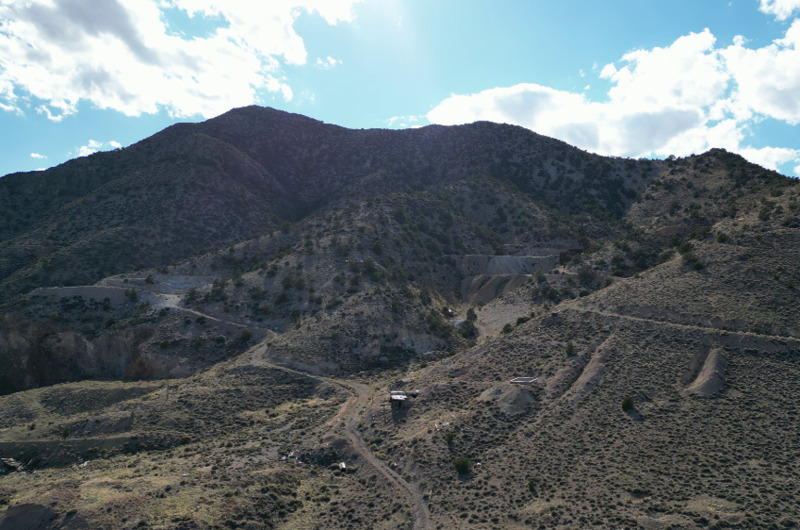
    <summary type="html"><![CDATA[<p><strong><em>The city of Frisco, Utah is just a ghost town now, with most of its remains carried away by scavengers and the leftover pieces strewn across the ground. But in 1885, it was the largest settlement in the southern Utah Territory. At the peak of the mining boom it had a population of around 4,000 people, at a time when less than 1,500 people lived in St. George. During the 1880s, prospectors extracted about 1.5 million troy ounces of silver from the Horn Silver Mine on a yearly basis. It also gained a reputation as one of the wildest towns of the West, populated by desperate and violent characters and scoundrels looking to make a quick buck.</em></strong></p><img src="https://www.intermountainhistories.org/files/fullsize/c36139e82fd53abfa94296f7cb67bdff.jpg" alt="Site of Horn Silver and King David Mines" /><br/><p><span style="font-weight:400;">Frisco, named for the San Francisco mountains which it borders, saw prospectors making claims in the area as early as 1871, but it was the discovery of the Horn Silver Mine in 1876 that sparked the biggest mining rush since the discovery of the Comstock Lode. According to legend, two prospectors stopped for lunch near a limestone outcropping of Grampian Hill, and one of the men tapped on a small boulder with his pick, accidentally breaking a large chunk of rock free. To his surprise, the rock was filled with silver so soft he could cut it with his knife.</span>
<span style="font-weight:400;"><span style="font-weight:400;">The Horn Silver bonanza created a powerful draw for men looking to find a claim of their own or those that sought employment within the huge mine and its related processing works. Even though the trans-continental railroad was completed in 1869, Frisco and the Horn Silver mine remained disconnected from the railroad for their first five years, and conditions in the region were largely inhospitable. The water from the San Francisco Mountains is muddy, and streams and springs flow only seasonally, so Frisco was forced to shipp its water supply from Milford, 15 miles to the southeast.</p></span>
<span style="font-weight:400;">With limited access to coal and charcoal, investors built great charcoal smelting plants to make fuel. In addition to the five great kilns still visible from the highway, an additional 24 kilns are in various clusters northeast of town. While the remains of these kilns look like primitive, oversized stone beehives, the kilns are the surviving parts of sophisticated plants once filled with cutting-edge 1880s equipment: blowers, boilers, steam engines, and a reverberatory flue-dust slagging furnace. When the mine closed down, the investors removed and recycled the steel and iron equipment, and left only the heavier stone kilns.</span>
<span style="font-weight:400;">The need for workers to operate the mines and their supporting operations brought all kinds of characters to town, and the streets filled with saloons and brothels. The local newspaper editor, Charles King, described the town as “Dodge city, Tombstone, Sodom and Gomorrah, all rolled into one.”</span>
<span style="font-weight:400;">The most repeated story of Frisco violence concerns Sheriff Pearson, who allegedly took the job to clean up the town’s wild ways. Instead of building a jail and setting up a traditional justice system, Pearson threatened the town’s miscreants with exile or a shootout. On his first night on the job, he allegedly shot six men, and would regularly dispatch a “meat wagon” to cart those who “died with their boots on” to their unmarked graves.</p><p>The Horn Silver mine collapsed on February 12, 1885, bringing an end to the silver rush, and the town soon numbered in the hundreds rather than the thousands. Even though a new shaft was built at Horn Silver and the mine soon became productive again, the boom and the era of finding a million ounces of silver a year were over. The mining works and the town slowly faded away, and in 1928, the last Friscoians left town. The mines, including the more recent King David shaft, continued work intermittently until 1952. The Horn Silver Mines company still “explores” the area for minerals, but the mines of Frisco have remained quiet for 80 years.</p></p><p><em><strong><a href="https://www.intermountainhistories.org/items/show/744">For more (including 5 images) view the original article</a></strong></em></p>]]></summary>
    <published>2023-04-11T15:57:52+00:00</published>
    <updated>2026-04-17T19:32:16+00:00</updated>
    <link rel="alternate" type="text/html" href="https://www.intermountainhistories.org/items/show/744"/>
    <id>https://www.intermountainhistories.org/items/show/744</id>
    <author>
      <name>Andrew Durbin, Brigham Young University </name>
    </author>
  </entry>
  <entry>
    <title type="html"><![CDATA[Emma Silver Mine at Alta <br />
]]></title>
    <summary type="html"><![CDATA[<p><strong><em>Every winter thousands of powder-seeking skiers make the trek up Little Cottonwood Canyon to ski at the acclaimed Alta Resort. Their journey mirrors a similar one taken one hundred years prior by miners who rushed up the canyon to mine  silver. During this bonanza, miners created the City of Alta while working at the Emma Silver Mine. </em></strong></p><img src="https://www.intermountainhistories.org/files/fullsize/722c2a6faebb6607e91c6bc7b4a584ed.jpg" alt="Emma Mine in 1873" /><br/><p><span style="font-weight:400;">Only a few miles southeast of Salt Lake City on the Wasatch Front stands Little Cottonwood Canyon, forged by a giant alpine glacier. Soon after arriving at the Salt Lake Valley, the pioneers quickly sought to explore their new home, including the canyon. Up until the 1860s, there had been very little mining done in the Salt Lake Valley apart from the quarrying near the mouth of Little Cottonwood Canyon. However, the 1863 discovery of ore in Bingham Canyon, directly west from Little Cottonwood Canyon, led to an increase in mining and prospecting throughout Utah. The discovery piqued interest in prospecting and led to the subsequent discovery of silver in 1864 in Little Cottonwood Canyon. The details surrounding the first silver strike are vague, but the stunning reaction to the ore is not. </span>
<span style="font-weight:400;">After the discovery, miners quickly petitioned for a new mining district, which eventually led to the creation of the Little Cottonwood Mining District. With a proper mining district in place, the miners of Salt Lake City began frantically searching for deposits all along the Wasatch Range. Eventually, the miners struck a lode brimming with silver about nine miles up the canyon. The continual influx of miners led to the creation of a small mining city in 1865 that they named Alta, due to the high elevation of the city. The miners also named the mine itself the Emma Mine. </span>
<span style="font-weight:400;">Miners continued to profit from the Emma Silver Mine during the end of the 1860s but still required financing from investors to support the operation. Owners of the Emma Mine looked to sell ownership to British investors in accordance with common practice of the time. In 1871, Senator William M. Stewart and James E. Lyon attempted to sell the mine for an estimated $1.5 million. To portray the mine as profitable, Stewart and Lyon sent falsified estimates and production numbers that hid the reality of the declining profitability of the mine. They even went as far as to have Robert C. Schenck, a U.S. ambassador, promote the quality and profitability of the Emma Mine to English investors. Eventually the mine sold for $5 million to English investors, and even after an investigation, Congress did not charge any individual with criminal offense. </span>
<span style="font-weight:400;">The obvious lack of ore within the region led to a decrease in production and relevance of the mine. Additionally, a massive fire destroyed the mine and most of the City of Alta in 1878. Then in 1885, an avalanche leveled the town once again during one of Utah’s intense winters. By the turn of the century, the already small mining town of Alta had greatly diminished and by the 1930s, only one resident remained, George Watson. Watson eventually sold his land in the canyon to the U.S. Forest Service who had plans to develop the area into a ski resort with the help of skiing legend Alf Engen. By 1938, they built the first ski lift, and the city began to grow once again, this time as a resort city instead of a mining town. </span></p><p><em><strong><a href="https://www.intermountainhistories.org/items/show/740">For more (including 3 images) view the original article</a></strong></em></p>]]></summary>
    <published>2023-04-07T19:03:31+00:00</published>
    <updated>2026-04-17T19:32:16+00:00</updated>
    <link rel="alternate" type="text/html" href="https://www.intermountainhistories.org/items/show/740"/>
    <id>https://www.intermountainhistories.org/items/show/740</id>
    <author>
      <name>William Howarth, Brigham Young University</name>
    </author>
  </entry>
</feed>
