<?xml version="1.0" encoding="UTF-8"?>
<feed xmlns="http://www.w3.org/2005/Atom">
  <title type="text">Intermountain Histories</title>
  <updated>2026-04-17T19:32:20+00:00</updated>
  <generator uri="http://framework.zend.com" version="1.12.20">Zend_Feed_Writer</generator>
  <link rel="alternate" type="text/html" href="https://www.intermountainhistories.org/"/>
  <link rel="self" type="application/atom+xml" href="https://www.intermountainhistories.org/items/browse?output=rss2"/>
  <id>https://www.intermountainhistories.org/</id>
  <author>
    <name>Intermountain Histories</name>
    <uri>https://www.intermountainhistories.org</uri>
  </author>
  <link rel="hub" href="https://pubsubhubbub.appspot.com/"/>
  <entry>
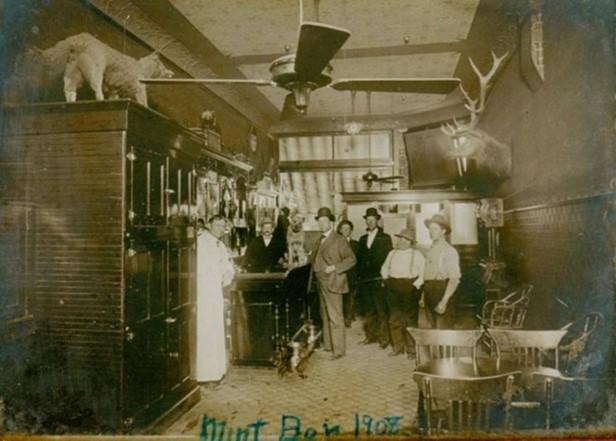
    <title type="html"><![CDATA[The Mint Bar – Sheridan, Wyoming]]></title>
    <summary type="html"><![CDATA[<p><strong><em>In 1907 Charles “Dick” Marlow founded the Mint Saloon in Sheridan, WY. When Wyoming Prohibition laws banned alcohol in 1919, Marlow rebranded “the Mint” as legal storefronts but continued illegal alcohol sales. In 1935, post-Prohibition, the Mint Bar reopened its storefront as a bar. Today, the Mint Bar is still a staple of entertainment in Sheridan, Wyoming.</em></strong></p><img src="https://www.intermountainhistories.org/files/fullsize/634d0740f89c76472de8ecde2b526e01.jpg" alt="The Mint Bar in 1907, shortly after opening. " /><br/><p>In 1907 Charles “Dick” Marlow bought the building that would later become the Mint Bar from a barber and transformed it into the “Mint Saloon,” which locals often referred to as “the Mint.” In 1919, Wyoming passed laws banning the sale and consumption of alcohol unless for prescribed medicinal purposes. At this time, Marlow changed the Mint’s front into a dress shop, then a real estate office, while continuing alcohol sales in the back. In 1923, Oran Moore purchased the Mint, turning it into the “Mint Cigar Company and Soda Shop.” Between 1923 and 1930, Moore operated the Mint’s legal front while maintaining one of Sheridan’s more notorious speakeasies and gambling halls in the back.
During this time, law enforcement suspected the Mint of alcohol sales and conducted multiple raids on the location. On 23 June 1925, the <em>Sheridan Post Enterprise</em> published an article describing a moonshine bust at the Mint. Sheridan town sheriffs and a Wyoming state officer raided the Mint at four o’clock in the afternoon. Police discovered one gallon of moonshine whiskey hidden in a coffee pot by employees. The officers arrested Moore and several other employees. The court fined Moore $500.
On Tuesday, 23 June 1925, an article appeared in the <em>Sheridan Post Enterprise</em> about the officer’s raid at the Mint. A month later, the paper published a follow-up article on Tuesday, 07 July 1925, which mentioned that the court judge postponed the Mint employees’ trial. Lax police and judicial enforcement meant that raids, arrests, and trials like this never prevented the Mint from selling illegal alcohol. The establishment continued its bootlegging and alcohol sales until the stock market crash of 1929 forced Moore to close its doors. In 1933, the United States’ Twenty-first Amendment ended Prohibition, and Wyoming dissolved its alcohol ban.
In 1934, Archie Milson and Robert Thirlwell purchased the establishment and reopened the space as “the Mint Bar.” In 1948, the owner at the time, Lauren L. McVean, renovated the Mint Bar, giving the location its warm rustic style and now iconic bucking horse and cowboy neon sign. Cowboys, locals, travelers, and even celebrities like Ernest Hemingway once again made the bar a popular stop because of its historic charm, great beer, and gambling.
The Mint Bar’s story shows how Prohibition reshaped Sheridan without breaking its spirit. The hidden bar was a gathering place for cowboys and townsfolk alike. Raids and fines were a constant threat, but the establishment’s patrons remained loyal. After Prohibition, the Mint Bar never lost its notoriety. Today, “Meet me at the Mint” is now a signature phrase shared between Sheridan locals. The Mint Bar’s history is a nod to Western independence and resilience.</p><p><em><strong><a href="https://www.intermountainhistories.org/items/show/894">For more (including 4 images) view the original article</a></strong></em></p>]]></summary>
    <published>2025-09-23T15:34:46+00:00</published>
    <updated>2026-04-17T19:32:20+00:00</updated>
    <link rel="alternate" type="text/html" href="https://www.intermountainhistories.org/items/show/894"/>
    <id>https://www.intermountainhistories.org/items/show/894</id>
    <author>
      <name>Scarlett Kluge, Northern Arizona University </name>
    </author>
  </entry>
  <entry>
    <title type="html"><![CDATA[Preserving the WY Medicine Wheel]]></title>
    <summary type="html"><![CDATA[<p><strong><em>For decades, American Indians have fought to preserve sacred sites across the United States.  One important site is the Wyoming Medicine Wheel, located in the Bighorn Mountains, 60 miles outside of Sheridan, Wyoming.</em></strong></p><img src="https://www.intermountainhistories.org/files/fullsize/f55d6614142cdabeb464d673bb1b482d.jpg" alt="Medicine Wheel" /><br/><p>It is not known what group of indigenous peoples built the Wyoming Medicine Wheel, located 60 miles outside of Sheridan, Wyoming in the Bighorn Mountains, or when they did so, but various Native American tribes have used the wheel as a sacred site for centuries. The Medicine Wheel is a circular pattern of stones surrounding a central stone cairn; twenty-eight stone pathways lead to smaller cairns as part of the wheel. Today, a six-foot-high barbed wire fence surrounds the wheel, placed by the Forest Service to protect the Medicine Wheel.
Those indigenous people who consider the wheel a sacred sight view the Medicine Wheel as a holistic model for life. The different teachings of the Medicine Wheel help individuals learn to live in balance with the Creator and all of creation. A 2007 article in the newspaper <em>Win Awenen Nisitotung</em> described how tribes use the Medicine Wheel: “The medicine wheel is like a mirror in which everything about human condition is reflected back.” The Medicine Wheel assists people along their path of life. This sacred site is important to Indigenous people to continue their ceremonies using the Medicine Wheel.
In 1970, the United States Forest Service designated the Medicine Wheel a National Historic Landmark. Tourists took to visiting the wheel, but the National Forest Service did not adequately provide protection for the site. Over the decades, some visitors removed rocks from the Wheel and vandalized the site with graffiti. In the early 1990s, tribes and coalitions fought to protect this land such damages and thefts.
On June 9, 1993, tribes—including the Arapaho, Blackfeet, Cheyenne, Crow, Navajo, Shoshone, Sioux, and Southern Ute—political coalitions, and the Forest Services reached an agreement on managing the site. The Memorandum of Agreement (National Historic Preservation Act) contained several steps to curtail damage caused by tourists. The agreement reads, “The programmatic agreement will require the Forest Service in consultation with the parties to the MOA, to develop and implement a long term management plan which specifies the preservation and continued use of the Medicine Wheel and vicinity as its management priority.” Under the terms of the memorandum, the Forest Service agreed to only open Medicine Wheel to tourists between July 1 and November 1. Visitors would have to park away from the wheel itself and walk one-and-a-half a miles to the site. The government agreed to involve tribal members in discussions about managing the sacred site. The Forest Service would also close the site to visitors for three days around each equinox and solstice to “allow native practitioners undisturbed use for traditional rites and ceremonies.” This agreement set an important precedent. The government acknowledges sacred sites and protects them for American Indians.
Tribes have faced difficulties persuading the Forest Service to follow through with the National Historic Preservation Act. In May 1996, Diana Tillman Mitchell, a report for <em>On Indian Land</em>, revealed how the Forest Service failed to comply with the agreement. They were not including the elders from tribes in their consultations or management requirements. Mitchell wrote, “The guidance and policies should have active participation and notification to all Indian people involved! This is not happening.” The negotiations between Forest Service and the coalitions and tribes continued for a little over twenty years before reaching a final agreement. The updated agreement was implemented in September 1996 which issued the protocols the Forest Service must still follow followed today. The protocols designate 23,000 acres as sacred space to Native American and have provisions allowing Native American practitioners to use the site for ceremonies. In 2011, ethnographic discoveries about indigenous people’s cultural use of the surrounding landscape prompted the Forest Service to extend the boundaries of the Medicine Wheel National Historic Landmark to include an additional 4,080 acres. With this expansion, the Service also changed the name of the landmark to Medicine Mountain.
The steps taken in the 1990s to preserve the Medicine Wheel promoted a working relationship between Indigenous people and the United States government. Tribes and the federal government took steps to protect this special and sacred place. Still, the negotiated nature of this collaboration leaves some, including journalist Diana Tillman Mitchell, concerned that “the economics of a location may always outweigh Indigenous religious freedom.” Advocates like Chris Peters (Pohlik-lah/Karuk), an officer in Seventh Generation Fund, have insisted on their right to preserve sacred lands—“What’s more American: the right to drill for oil or the right to pray?—but when reviewing how the government has interacted with indigenous peoples in the past, it seems that if there is value to the land, the state will take it.</p><p><em><strong><a href="https://www.intermountainhistories.org/items/show/621">For more (including 3 images) view the original article</a></strong></em></p>]]></summary>
    <published>2022-06-25T01:36:18+00:00</published>
    <updated>2026-04-17T19:32:13+00:00</updated>
    <link rel="alternate" type="text/html" href="https://www.intermountainhistories.org/items/show/621"/>
    <id>https://www.intermountainhistories.org/items/show/621</id>
    <author>
      <name>Jessica Donaho, University of Wyoming</name>
    </author>
  </entry>
  <entry>
    <title type="html"><![CDATA[The Kendrick Mansion and Trail End]]></title>
    <summary type="html"><![CDATA[<p><strong><em>When John B. Kendrick drove Texas cattle westward, his “trail” ended in Sheridan, Wyoming. Trail End, also called the Kendrick Mansion by locals, was the summer home of Kendrick and his family in the 1900s. </em></strong></p><img src="https://www.intermountainhistories.org/files/fullsize/3bbbd0b25e27abe359b5507f64ca0278.jpg" alt="Manor House of a Grand Estate that is now the Trail End State HIstoric Site in Sheridan, Wyoming
" /><br/><p>Trail End, also called the Kendrick Mansion, served as home to John Benjamin Kendrick and his family. A self-educated man from Texas, Kendrick had a successful career as a rancher, banker, and politician. He married Eula Wulfjen in 1891, and together they had two children—Rosa-Maye and Manville. Kendrick came to Wyoming in 1879 driving a herd of Texas cattle. His journey ended in Sheridan, Wyoming, when he and his family decided to settle. Construction for the Trail End Mansion began in 1908. Although the house was completed in 1913, Kendrick had little time to spend there, as his constituents elected him Governor of Wyoming in 1914 and then US Senator two years later. The family largely used the Trail End Mansion as a summer home. When Kendrick passed away in 1933, Eula moved back to Trail End with Manville and his family.</p><p>A local contractor oversaw the workforce at Trail End, but the Kendrick family served as their own general contractors. Of the many consultants the family hired, Glenn Charles McAlister and Daniel Everett Waid proved to be the most influential. Due to their many design differences, the Kendricks assigned McAlister to the exterior and Waid to the interior to prevent disagreements in style. The 13,748-square-foot mansion has thirty rooms, including a ballroom on the third floor. The mansion has characteristics of the Flemish Revival architectural style with rubbed brickwork and curvilinear gables where the roof and walls meet. Trail End also has Neoclassical elements mixed in with columns, pediments, and balustrades. Built with electric lights, indoor plumbing, and a coal-furnace, the mansion cost about $160,000 to build. Much of the original furniture was custom made by the Berkey & Gay Company based in Grand Rapids, Michigan.</p><p>After Eula’s death in 1961, Manville and his family moved out. Seven years later, the Sheridan County Historical Society (SCHS) purchased Trail End and turned it into a community museum. In 1982, SCHS transferred ownership to the state of Wyoming due to the expense of opening and caring for the mansion. State operations oversaw the removal of museum-style exhibits and restored the historical appearance of the mansion—including much of its original furniture. Visitors can arrange a guided tour ahead of time or follow a self-guided tour of the mansion, including equipment for audio tours. The grounds are open to the public for no charge. With 3.8 acres of land, Trail End is home to a variety of birds, butterflies, trees, and shrubs. Guests can reserve the grounds for weddings or other events. </p><p><em><strong><a href="https://www.intermountainhistories.org/items/show/235">For more (including 3 images) view the original article</a></strong></em></p>]]></summary>
    <published>2018-06-19T21:37:16+00:00</published>
    <updated>2026-04-17T19:32:03+00:00</updated>
    <link rel="alternate" type="text/html" href="https://www.intermountainhistories.org/items/show/235"/>
    <id>https://www.intermountainhistories.org/items/show/235</id>
    <author>
      <name>Megan Nolan, Northern Arizona University</name>
    </author>
  </entry>
</feed>
