<?xml version="1.0" encoding="UTF-8"?>
<feed xmlns="http://www.w3.org/2005/Atom">
  <title type="text">Intermountain Histories</title>
  <updated>2026-04-17T19:32:09+00:00</updated>
  <generator uri="http://framework.zend.com" version="1.12.20">Zend_Feed_Writer</generator>
  <link rel="alternate" type="text/html" href="https://www.intermountainhistories.org/"/>
  <link rel="self" type="application/atom+xml" href="https://www.intermountainhistories.org/items/browse?output=rss2"/>
  <id>https://www.intermountainhistories.org/</id>
  <author>
    <name>Intermountain Histories</name>
    <uri>https://www.intermountainhistories.org</uri>
  </author>
  <link rel="hub" href="https://pubsubhubbub.appspot.com/"/>
  <entry>
    <title type="html"><![CDATA[Finnish Headstones and Saunas in Scofield<br />
]]></title>
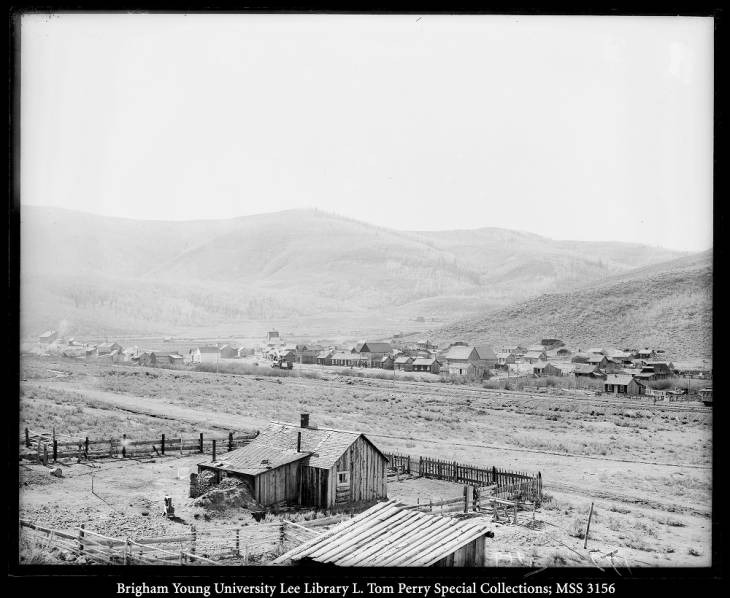
    <summary type="html"><![CDATA[<p><strong><em>Like many other mining districts, the town of Scofield went through a boom and bust cycle that effectively created a living ghost town. Despite the town’s current state, the Finnish immigrant community in Scofield left a lasting impact. Headstones and saunas are Scofield’s two most prominent visual features that tell the story of Utah’s immigrants from Finland. </p></strong></p><img src="https://www.intermountainhistories.org/files/fullsize/db01e37dc27f40411c5412b29a62a9f4.jpg" alt="The Town of Scofield, Utah at a South West Angle." /><br/><p>Although Scofield, Utah is not a booming community anymore, the town still retains remnants of immigrant life. According to the 2010 US Census, Scofield housed only 24 people. However, 120 years ago, Carbon County boasted a booming mining community. 	While most of Utah’s Scandinavian population came in the late nineteenth and early twentieth century as Mormon converts, Finland contributed only 14 people to those early groups of Mormon migrants. Instead, the year 1890 brought most of Utah’s Finnish immigrants to Utah as miners and railway workers. By the year 1900, there were over 200 Finns in Carbon County with most of them living in a small community in Winter Quarters, a suburb just outside Scofield.    </p><p>The Finns brought with them to America a desire to preserve their Finnish culture. This resulted in the building of many public and private saunas throughout Scofield. Saunas work by running water over hot stones to create steam. The saunas helped the Finns to teach their culture to the young in their company. The principle of “sisu” or internal fortitude was taught through the sauna as the Finns used the steam baths to provide both physical and spiritual cleansing. </p><p>Disaster struck Scofield’s Finnish community on May 1, 1900. An explosion in the WInter Quarters Number Four mine marked the largest mine explosion in the United States up to that point. Over 200 were numbered among the dead and many others lost that remained unaccounted for. The Finnish lost 62 of their fathers, sons, and brothers. Hit specifically hard was the Luoma family. Abe Luoma lost six sons and three grandsons in the destruction of the mine. Most of the Finns who died in the explosion were buried in the Scofield cemetery and Reverend A. Granholm, a Finnish Lutheran minister from Wyoming, came down to Scofield to dedicate the graves of the fallen Finns. </p><p>After the explosion, a majority of the Finns stayed in Scofield until the area’s mines began to cease operation in the 1920s. Even after the decline of the Scofield Finnish community, the Finns in Utah were some of the frontline advocates for greater safety for mine workers. The strikes of 1903, 1922, and 1933 featured Finns who desired to keep the period of unions alive. Despite the hardship that Finnish immigrants faced, their hearty spirit left a legacy of preserved culture and a new culture of defending and protecting their families and other immigrant workers. </p><p><em><strong><a href="https://www.intermountainhistories.org/items/show/448">For more (including 3 images) view the original article</a></strong></em></p>]]></summary>
    <published>2020-10-31T08:56:17+00:00</published>
    <updated>2026-04-17T19:32:09+00:00</updated>
    <link rel="alternate" type="text/html" href="https://www.intermountainhistories.org/items/show/448"/>
    <id>https://www.intermountainhistories.org/items/show/448</id>
    <author>
      <name>Josie Manwill, Brigham Young University </name>
    </author>
  </entry>
  <entry>
    <title type="html"><![CDATA[The Scofield Mine Disaster]]></title>
    <summary type="html"><![CDATA[<p><strong><em>On May 1, 1900, an explosion at the Winter Quarters mine killed at least 200 men. At the time, it was the worst mining accident to occur in the United States, and it devastated the families left behind in the mining town of Scofield.</em></strong></p><img src="https://www.intermountainhistories.org/files/fullsize/e97bda205bd88ea68ad598ea6aa80eb4.jpg" alt="Caskets at Wasatch Store, Winter Quarters, Utah" /><br/><p>Scofield is a small mining town located in Carbon County, located next to the Winter Quarters mine. On May 1, 1900, there was an accidental explosion in the Winter Quarters mine. While many men rushed to rescue miners caught in the blast, many were killed in the initial explosion, struck by falling debris, or killed by afterdamp, a toxic gas. Miners from other mines in the area, such as Castle Gate, Clear Creek, and Sunnyside, helped retrieve bodies the next day. A total of 200 - 246 men were killed in the accident. There were not enough coffins to bury all of the miners, so some coffins had to be ordered from Denver, Colorado and taken to Scofield on a train.</p><p>The Winter Quarters mine explosion had devastating effects on the town of Scofield. Nearly every family lost someone in the accident, with some families losing several family members. In a tragic example, the Louma family lost six sons and three grandsons, all in the same day. However, some incredible stories came from the disaster as well. One such story is that of John Wilson, who was blown 820 feet from the entrance of the mine into the surrounding canyon and miraculously survived. Another well-known story is that of Thomas Pugh, a 15-year-old boy who put his cap in his teeth, used it to plug his nose, and ran a mile and a half through toxic gas back to the mine entrance in the dark.</p><p>Although the exact cause of the explosion was never discovered, many believe that the accident could have been prevented if the Pleasant Valley Coal Company had implemented safety procedures and taken better precautions. Unsurprisingly, many families blamed the company for the accident. Labor unrest from this event no doubt contributed to later strikes in the region, such as the 1901 Pleasant Valley strike. The Winter Quarters mine puts into perspective how dangerous an occupation mining was, and how much miners were asked to sacrifice for their livelihood. Today, many remember the Scofield mining disaster as a horrible event that showcases the brutal treatment of working-class individuals in the 20th century.</p><p><em><strong><a href="https://www.intermountainhistories.org/items/show/389">For more (including 3 images) view the original article</a></strong></em></p>]]></summary>
    <published>2020-02-16T07:01:51+00:00</published>
    <updated>2026-04-17T19:32:07+00:00</updated>
    <link rel="alternate" type="text/html" href="https://www.intermountainhistories.org/items/show/389"/>
    <id>https://www.intermountainhistories.org/items/show/389</id>
    <author>
      <name>Abby Donaldson, Brigham Young University</name>
    </author>
  </entry>
</feed>
