<?xml version="1.0" encoding="UTF-8"?>
<feed xmlns="http://www.w3.org/2005/Atom">
  <title type="text">Intermountain Histories</title>
  <updated>2026-04-17T19:32:17+00:00</updated>
  <generator uri="http://framework.zend.com" version="1.12.20">Zend_Feed_Writer</generator>
  <link rel="alternate" type="text/html" href="https://www.intermountainhistories.org/"/>
  <link rel="self" type="application/atom+xml" href="https://www.intermountainhistories.org/items/browse?output=rss2"/>
  <id>https://www.intermountainhistories.org/</id>
  <author>
    <name>Intermountain Histories</name>
    <uri>https://www.intermountainhistories.org</uri>
  </author>
  <link rel="hub" href="https://pubsubhubbub.appspot.com/"/>
  <entry>
    <title type="html"><![CDATA[First National Bank of Rock Springs]]></title>
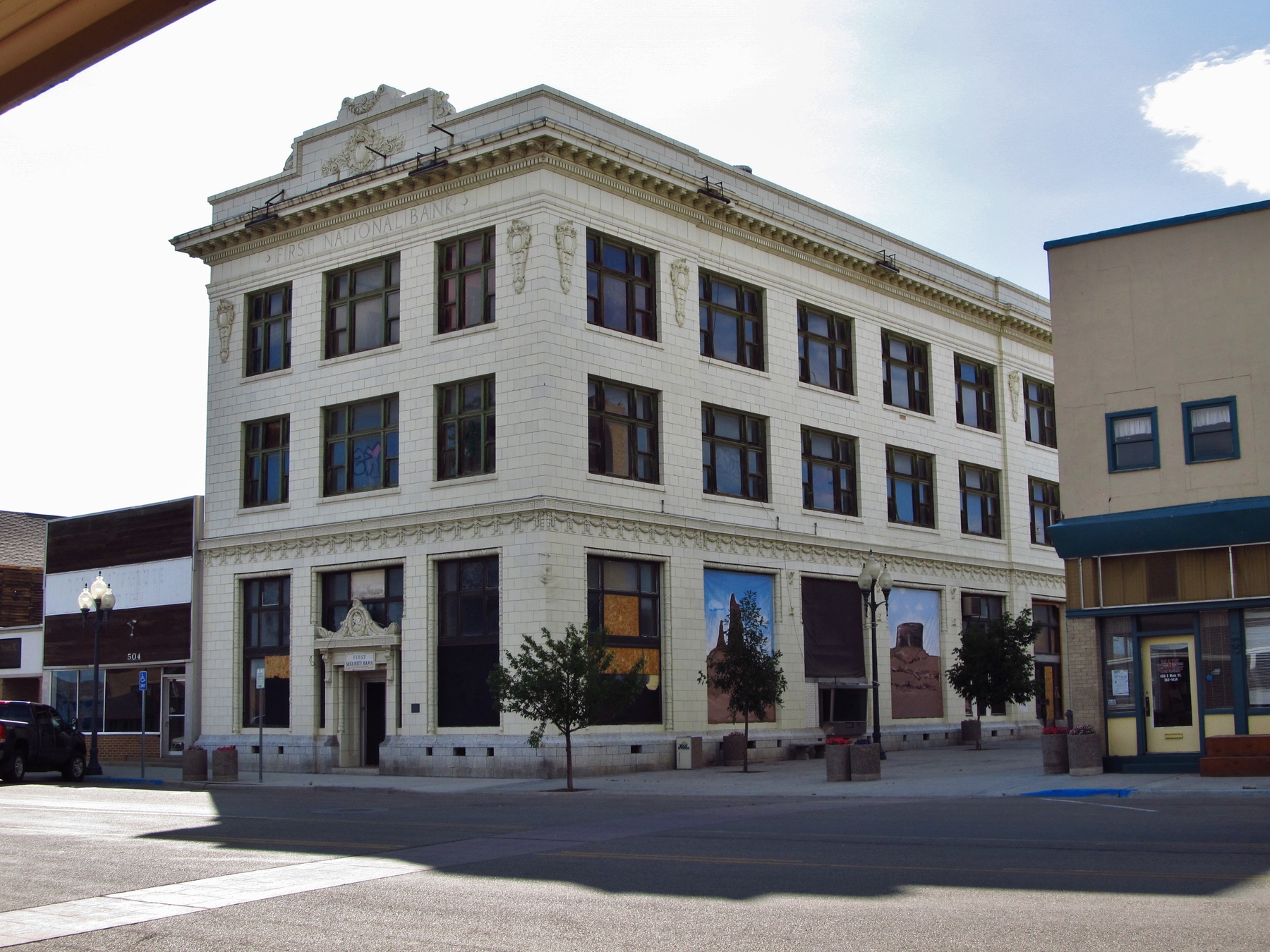
    <summary type="html"><![CDATA[<p><strong><em>Founded in 1887 as a local institution, the First National Bank of Rock Springs became one of Wyoming’s most stable financial houses, operating for 110 years.</em></strong></p><img src="https://www.intermountainhistories.org/files/fullsize/d43c0253826109ad76e45834b493d866.jpg" alt="The First National Bank" /><br/><p><span style="font-weight:400;">In the late 1880s, Rock Springs began transitioning from a modest mining town into western Wyoming’s economic center, and the state’s financial interests took notice. First among them was Henry Gordon Balch, a stockman and state politician who established the Laramie National Bank in 1881. In response to Rock Springs’s mounting population, growing by 346% from 1880-90, Balch expanded his reach, opening the First National Bank of Rock Springs in 1887.</span>
<span style="font-weight:400;">By 1890, Balch’s speculation paid off, as First National’s assets reached $270,000, with almost $20,000 in gold and silver on hand. This success allowed Balch to expand further by founding the Rock Springs Coal Company and the Commercial National Bank in Salt Lake City, bolstering First National’s profile. As ranching and mining operations developed, the bank’s wealth jumped to $389,000 by 1900, only for Balch to pass away from pneumonia in 1901, aged forty-nine. </span>
<span style="font-weight:400;">In Balch’s wake, Augustine Kendall, a long-term financial partner who co-established First National as its cashier, became president. Kendall, who held interests in lumber, cattle, and sheep, also served as Rock Spring’s Mayor from 1904-07. He also increased First National’s standing through his personal reputation and supplementary holdings. By 1909, assets reached $750,000, becoming Wyoming’s third-largest financial house. Kendall also served as Wyoming’s Federal Fuel Administrator from 1917-20, a department encouraging energy conservation by supporting American entry into the Great War.</span>
<span style="font-weight:400;">By 1917, First National’s directors hired Walter J. Cooper, a Salt Lake City-based architect, to construct a more secure building for their financial operations. Compared to the older structure, built from stone and prone to collapse after a fire, the new bank consisted of fire-resistant materials like brick and cement. The bank, now three stories high, became Rock Springs’s tallest structure, centrally located across from the local railroad situation. By 1922, First National's assets rested at $1.2 million. Kendall served as bank president until 1927, eventually retiring in California and dying in 1944, aged 81.</span>
<span style="font-weight:400;">By 1928, First National, acquired by Eccles-Browning Affiliated Banks, an Intermountain financial conglomerate including sixteen other operations, became the First Security Bank of Rock Springs. Marriner Eccles, becoming a millionaire at age twenty-one, served as the corporation’s leading figure, and later became a member of the Federal Reserve Board from 1934-51, acting as its chairman until 1948. Eccles further consolidated Intermountain finance in 1929 by establishing the First Security Cooperation of Ogden after purchasing another eight banks, making twenty-five total. Altogether, these financial houses encompassed $46 million in assets, with First Security representing $2 million, or 4.3%, of the conglomerate’s value.</span>
<span style="font-weight:400;">Corporate ownership of First Security continued, and its profitability grew. By 1975, $19.7 million existed in client accounts, increasing to $40.7 million in 1982 and $71.3 million in 1993. However, by 1997, First Security Corporation merged its Rock Springs branch, previously semi-independent, into its corporate structure. In 2000, First Security Corporation, bought out by Wells Fargo & Company, shuttered operations completely. The bank building, empty and in disrepair for many years, is currently under renovation.</span></p><p><em><strong><a href="https://www.intermountainhistories.org/items/show/797">For more (including 6 images) view the original article</a></strong></em></p>]]></summary>
    <published>2024-03-20T23:36:48+00:00</published>
    <updated>2026-04-17T19:32:17+00:00</updated>
    <link rel="alternate" type="text/html" href="https://www.intermountainhistories.org/items/show/797"/>
    <id>https://www.intermountainhistories.org/items/show/797</id>
    <author>
      <name>William R. Batson, Northern Arizona University</name>
    </author>
  </entry>
  <entry>
    <title type="html"><![CDATA[John Jarvie’s Historic Ranch]]></title>
    <summary type="html"><![CDATA[<p><strong><em>Not all hospitality is returned in kind. In the case of John Jarvie, the outlaws to whom he was so obliging went on to rob and murder both him and his son. </p></strong></p><img src="https://www.intermountainhistories.org/files/fullsize/fa571c3f7ee8336879f9a9d505c7f737.jpg" alt="John Jarvie" /><br/><p><span style="font-weight:400;">In 1880 John Jarvie and his wife Nellie Barr moved from Rock Springs, Wyoming to the burgeoning settlement of Brown’s Park. Jarvie set up a general store, post office, and ran a river ferry that crossed the nearby Green River. Jarvie became well known for his sagacity and kindness to all those who lived in the region, even the Wild Bunch outlaws. Such associations did not serve him well in the long run, but his kindness did, and his legacy has continued to today in Uintah and Daggett County.</span>
<span style="font-weight:400;">John Jarvie was born in Scotland in 1844. As a young man after being beaten soundly by a mine supervisor, Jarvie elected to immigrate to the United States as a stowaway. He arrived in America in 1870 and settled in Rock Springs, Wyoming.  After several years as a businessman in Rock Springs, working as a Saloon Owner, Jarvie met residency requirements and became a citizen on October 8</span><span style="font-weight:400;">th</span><span style="font-weight:400;">, 1875. In 1880 at the age of 36, Jarvie married Nellie Barr, 22, and the couple moved to Brown’s Park, the present location of John Jarvie’s Historic Ranch.  Jarvie opened a general store, moved the local post office to his property, and ran a ferry that crossed the Green River.</span>
<span style="font-weight:400;">Jarvie sold to everyone in the region, even notorious outlaws. One location on the historic ranch in particular, a storage cellar, was thought to have housed criminals like Butch Cassidy when they were on the run from the law. One notable event on the Ranch in 1895 termed the “Outlaws’ Thanksgiving Dinner” saw a dinner of gratitude  between several notorious outlaws including Billie Bender, Les Megs, Butch Cassidy, Elza Lay, Isom Dart, and the Sundance Kid. The meeting was jovial and in celebration of Jarvie and other residents in Brown’s Park tolerance of the outlaw’s activities. In light of their warm relationship, it is tragic that Jarvie and one of his sons eventually lost their lives to outlaws.</span>
<span style="font-weight:400;">William King and George Hood, hearing false rumors about Jarvie’s great wealth, came to the ranch on July 6</span><span style="font-weight:400;">th</span><span style="font-weight:400;">, 1909. Jarvie was alone, his sons having taken jobs on other farms, and his wife having died of Tuberculosis in 1895. Jarvie was known for his generosity and tendency to feed visitors so he set the table for three. The outlaws did not return his kindness. They forced Jarvie to open his store safe and took the contents, a $100 bill and a pearl handled revolver. Jarvie fled the store and was shot in the back and head. The outlaws placed his body on a boat and sent it down the river. Details of the murder slowly tricked out. When reports circulated of two men trying to change a $100 bill in Rock Springs, Jarvie’s son Jimmy pursued the outlaws voraciously. Jimmy was on their trail at an Inn in Idaho when he was pushed from a second-floor balcony and fell to his death. The criminals were never apprehended.</span>
<span style="font-weight:400;">Jarvie left a powerful legacy which was seen in the obituary written for him in the Vernal Express. There he was praised as a “the sage of the Uintahs, the Genius of Brown’s Park, and the Wizzard [sic] of the hills and rivers. He was not only a man among men but he was a friend among men… He was as broad and generous and far reaching in his good deeds as the stream which he knew and loved[.]”</span></p><p><em><strong><a href="https://www.intermountainhistories.org/items/show/770">For more (including 3 images) view the original article</a></strong></em></p>]]></summary>
    <published>2024-01-20T08:08:00+00:00</published>
    <updated>2026-04-17T19:32:17+00:00</updated>
    <link rel="alternate" type="text/html" href="https://www.intermountainhistories.org/items/show/770"/>
    <id>https://www.intermountainhistories.org/items/show/770</id>
    <author>
      <name>Samuel Pulsipher, Brigham Young University</name>
    </author>
  </entry>
  <entry>
    <title type="html"><![CDATA[The Rock Springs Massacre of 1885 <br />
]]></title>
    <summary type="html"><![CDATA[<p><strong><em>In Rock Springs, Wyoming a fatal display of jealously and racism took place against Chinese immigrants on September 2, 1885. </p></strong></p><img src="https://www.intermountainhistories.org/files/fullsize/4813f8fd04b20abf1d38258622e59ced.jpg" alt="Rock Springs Massacre" /><br/><p>The first large wave of Chinese immigrated to California in 1848 in search of gold. The Chinese labored in mines and railroads. Companies loved Chinese laborers because they worked longer hours than their white counterparts and for less pay. Many white laborers in the West felt threatened by the Chinese laborers because of the lower wages and poorer conditions they worked for. The Chinese laborers experienced discriminated in political, social, and economic life. Some examples of this discrimination include denied citizenship, negative social stereotypes, and lower wages.  </p><p>In 1882 the United States Congress passed the Chinese Exclusion Act, which prohibited Chinese from entering the United States. It did not directly impact those immigrants already in America although violence and discrimination towards Chinese increased. </p><p>One of the notorious atrocities occurred in Rock Springs, Wyoming in 1885. Over 600 Chinese lived there with 250 white workers at the mine run by the Union Pacific Railroad. White laborers had tried to unionize to protect wages but the Chinese laborers did not unionize with them. On the morning of September 2, 1885, a fight broke out between Chinese and Caucasian miners. The white workers went to town and rallied people together to go and attack the China town portion of Rock Springs across Bitter Creek. The mob gave the Chinese an hour to leave but the mob attacked a half hour after the warning. They burned all the homes in Chinatown, killed twenty-eight Chinese laborers and injured fourteen more as a direct result of the massacre. </p><p>In Wyoming Territory, Governor Francis F. Warren telegraphed President Grover Cleveland on September 7, 1885, asking for federal troops to come to the aid of Wyoming to help control the mob telling him that the mob would not allow the Chinese to return to the city. The president commanded the army to protect the Chinese laborers and they went back to the mines with the guaranteed protection of the army. None of the murderers were prosecuted. The white laborers felt as though the federal government, in protecting the Chinese, enabled and upheld a type of slavery that negatively impacted their ability to compete. This incident served as catalyst for other anti-Chinese race riots that occurred throughout the United States. </p><p><em><strong><a href="https://www.intermountainhistories.org/items/show/276">For more (including 4 images) view the original article</a></strong></em></p>]]></summary>
    <published>2019-02-09T04:16:46+00:00</published>
    <updated>2026-04-17T19:32:04+00:00</updated>
    <link rel="alternate" type="text/html" href="https://www.intermountainhistories.org/items/show/276"/>
    <id>https://www.intermountainhistories.org/items/show/276</id>
    <author>
      <name>Sarah Adams, Brigham Young University</name>
    </author>
  </entry>
</feed>
