<?xml version="1.0" encoding="UTF-8"?>
<feed xmlns="http://www.w3.org/2005/Atom">
  <title type="text">Intermountain Histories</title>
  <updated>2026-04-17T19:32:19+00:00</updated>
  <generator uri="http://framework.zend.com" version="1.12.20">Zend_Feed_Writer</generator>
  <link rel="alternate" type="text/html" href="https://www.intermountainhistories.org/"/>
  <link rel="self" type="application/atom+xml" href="https://www.intermountainhistories.org/items/browse?output=rss2"/>
  <id>https://www.intermountainhistories.org/</id>
  <author>
    <name>Intermountain Histories</name>
    <uri>https://www.intermountainhistories.org</uri>
  </author>
  <link rel="hub" href="https://pubsubhubbub.appspot.com/"/>
  <entry>
    <title type="html"><![CDATA[Bryce Canyon Lodge and Deluxe Cabins - Bryce Canyon National Park]]></title>
    <summary type="html"><![CDATA[<p><strong><em><span style="font-weight:400;">In 1923, the Union Pacific Railroad created the Utah Parks Company, which connected its rail line to attractions such as Zion National Park and the North Rim of Grand Canyon National Park. The Bryce Canyon Lodge and Deluxe Cabins linked Bryce Canyon State Park to this system of resorts in 1925. </span></em></strong></p><img src="https://www.intermountainhistories.org/files/fullsize/2d65ab73bf5bf337b81a40dba1d6d45e.jpg" alt="Bryce Canyon Lodge, c. 1929" /><br/><p><span style="font-weight:400;">In 1874, Bryce Canyon became part of a cattle ranch owned by Ebenezer Bryce. His ranch was unsuccessful, but automobile tourism revitalized the area when passable roads reached what is now Zion National Park in 1917. In 1921, Utah’s state legislature accepted a proposition from Park Service director Stephen Mather that protected Bryce Canyon as a state park. Utah made no attempt to develop the area for public use, but the Union Pacific Railroad spurred development in Bryce Canyon by creating the Utah Parks Company in 1923. This connected the Union Pacific’s Cedar City spur line to Bryce Canyon, the North Rim of Grand Canyon National Park, and Zion via bus lines. By establishing a network of parks and resorts, the Union Pacific aimed to compete with other successful railroad companies such as the Northern Pacific, Atchison-Topeka Santa Fe, and Great Northern. These companies had established successful tourist attractions at the South Rim of Grand Canyon, Yellowstone National Park, and Glacier National Park. As tourism brought in profit, road construction improved access to rural points of interest like Bryce Canyon. In 1924, Congress established Utah National Park, and the Utah Parks Company constructed Bryce Canyon Lodge and Deluxe Cabins in the same year to provide visitors with accommodations. Congress enlarged Utah National Park and renamed it Bryce Canyon in 1928. </span>
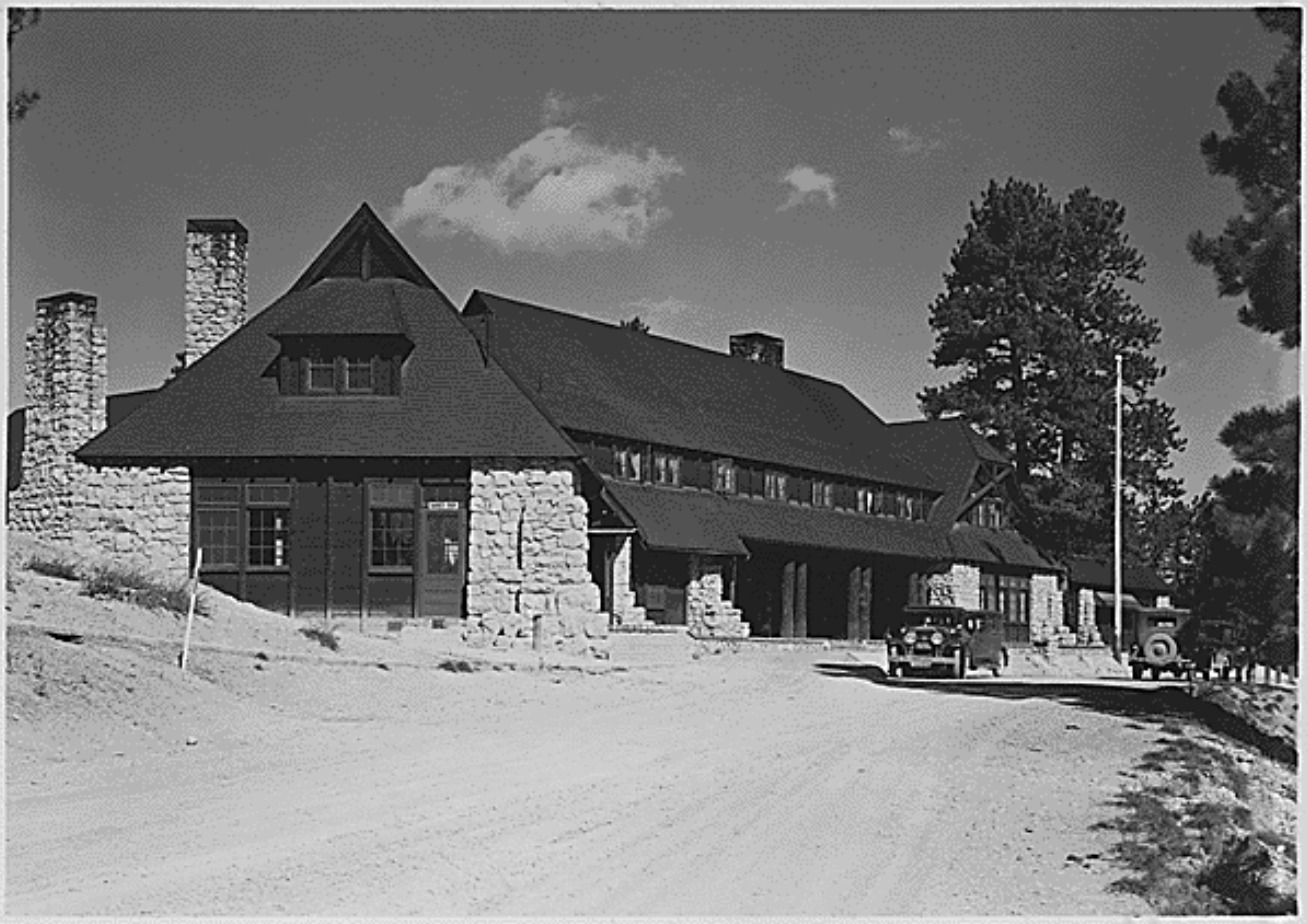
<span style="font-weight:400;">The Utah Parks Company enlisted Gilbert Stanley Underwood, one of the Union Pacific’s consulting architects, to design Bryce Canyon Lodge. Underwood’s designs are notable for their commitment to rustic architecture, which used natural materials and textures to blend a building with its natural surroundings. He utilized locally quarried stone and large, exposed wooden details throughout the structure, figuratively connecting the building to its location. After the company completed the original building in 1925, it added two new wings in 1926 to make room for an increasing number of visitors. The Utah Parks Company constructed fifteen deluxe guest cabins the following year in a pine grove near the main structure. Their design used rough stone and natural wood to imitate the design of Bryce Canyon Lodge. </span>
<span style="font-weight:400;">During the 1950s, the National Park Service renovated Bryce Canyon Lodge to make room for updated amenities. The hotel originally housed a barber shop, but the Park Service replaced it with a soda fountain. The Park Service also enlarged a road at the hotel’s front entrance to make room for larger vehicles, but the Park service expanded a plaza outside Bryce Canyon Lodge’s front entrance by removing the original bus lane in 1989. In 1985, the Park Service removed sixty-one of the lodge’s original sixty-seven standard cabins. The Sunrise Motel and Sunset Motel replaced them. In 1995, the National Register of Historic Places officially listed forty-two buildings in Bryce Canyon, including Bryce Canyon Lodge. This restricted future renovations, allowing the complex to retain most of its architectural significance. Today, Bryce Canyon Lodge operates as a historic hotel alongside five standard cabins and fifteen deluxe cabins. </span></p><p><em><strong><a href="https://www.intermountainhistories.org/items/show/843">For more (including 5 images) view the original article</a></strong></em></p>]]></summary>
    <published>2024-05-29T21:42:39+00:00</published>
    <updated>2026-04-17T19:32:19+00:00</updated>
    <link rel="alternate" type="text/html" href="https://www.intermountainhistories.org/items/show/843"/>
    <id>https://www.intermountainhistories.org/items/show/843</id>
    <author>
      <name>Kaylen Wilson, Northern Arizona University </name>
    </author>
  </entry>
  <entry>
    <title type="html"><![CDATA[Many Glacier Hotel: Glacier National Park ]]></title>
    <summary type="html"><![CDATA[<p><strong><em>After Congress created Glacier National Park in 1910, the Great Northern Railway constructed a complex network of hotels, chalets, roads, trails, and tent camps in the region. The railroad modeled this system after luxury resorts in Europe, and Many Glacier Hotel served as one of its crown jewels.</em></strong></p><img src="https://www.intermountainhistories.org/files/fullsize/2eecb9d891c46a783d81ec6dcc049230.jpg" alt="Many Glacier Hotel, c. 1921" /><br/><p><span style="font-weight:400;">Constructed at the edge of what is now Swiftcurrent Lake, Many Glacier Hotel provided the Great Northern Railway’s second grand hotel at Glacier National Park. It served as the center of the Great Northern’s network of chalets and tent camps alongside the 1910 Glacier Park Hotel. From the grand hotels, tourists could access chalets and tent camps in Glacier’s backcountry. Visitors accessed these locations on horseback, but automobiles later drew tourists away from them. The Great Northern brought an unprecedented level of development into Glacier, and it spent approximately $1.5 million on hotels, chalets, campsites, trails, and roads by 1917. Many Glacier Hotel cost $400,000. </span>
<span style="font-weight:400;">Designed by Great Northern architect Thomas D. McMahon, the hotel comprises three separate buildings connected by covered walkways. The central portion opened in 1915, but the railroad did not complete the hotels’ north and south ends until 1917. Its rough stone siding and foundations resemble the rustic architecture that was becoming increasingly common in national parks. The architect further emphasized this feature in the lobby, which included a grand fireplace and tall wooden support pillars. This imitated the “forest” lobby at Glacier Park Hotel, which uses massive Douglas fir trees as pillars and includes an open fire pit. Many Glacier briefly featured an indoor pool, but the Great Northern removed it due to sanitary issues. </span>
<span style="font-weight:400;">The railroad also intended Many Glacier to match the Great Northern’s other buildings in the park, which imitate Swiss chalets. The hotel’s three sections look like individual Swiss chalets from a distance. Wooden pieces called moldings adorn their windows and balconies, and these pieces feature cutout patterns inspired by the Swiss chalet style. This created a unified sense of place in the region and emulated Glacier’s status as the “Switzerland of North America.” Early advertisements capitalized on this idea during World War I, encouraging guests to “see America first” instead of spending their vacation money to visit foreign locales. The Great Northern hired numerous artists to paint Glacier National Park, and their work hung in train depots and ticket offices. The railroad displayed a variety of paintings from the See America First in Many Glacier Hotel, but only a few remain today. </span>
<span style="font-weight:400;">While Glacier National Park quickly became a popular tourist attraction, the Great Northern’s vast building network became increasingly expensive to maintain. Initially, the railroad kept its resort system to draw train passengers into the park, but it made numerous attempts to sell the hotels as more visitors began to arrive by car. In 1957, the Great Northern hired the Knutson Hotel Company to prepare Glacier’s hotels for sale, and Glacier Park Inc. purchased them in 1960. In 2001, the National Park Service funded a $42 million restoration project that replaced the lodge’s roof and siding, restored original architectural features like balconies, and reinstalled an original circular staircase that the Knutson Hotel Company removed from the hotel lobby in 1957. Xanterra Parks and Resorts currently manages Many Glacier Hotel.</span></p><p><em><strong><a href="https://www.intermountainhistories.org/items/show/842">For more (including 5 images) view the original article</a></strong></em></p>]]></summary>
    <published>2024-05-29T21:10:56+00:00</published>
    <updated>2026-04-17T19:32:19+00:00</updated>
    <link rel="alternate" type="text/html" href="https://www.intermountainhistories.org/items/show/842"/>
    <id>https://www.intermountainhistories.org/items/show/842</id>
    <author>
      <name>Kaylen Wilson, Northern Arizona University</name>
    </author>
  </entry>
  <entry>
    <title type="html"><![CDATA[Glacier Park Hotel - Glacier National Park]]></title>
    <summary type="html"><![CDATA[<p><strong><em>In 1911, the Great Northern Railway began constructing a complex network of hotels and chalets in the fledgling Glacier National Park. Originally nicknamed the “Entrance hotel,” Glacier Park Hotel provided a gateway to this unique resort system.</em></strong></p><img src="https://www.intermountainhistories.org/files/fullsize/06a86c061b2ec07ad3f9f6d5b187daae.jpg" alt="Glacier Park Hotel lobby, c. 1910-20" /><br/><p><span style="font-weight:400;">The Great Northern Railway constructed Glacier Park Hotel in 1913 to provide visitors touring Glacier National Park with a starting point along the railroad. From Glacier Park Hotel, these tourists entered a complex system of smaller chalets and tent camps. Each hotel and chalet included a guide operation that provided saddle horses to visitors, who entered the area from a train depot connected to the Glacier Park complex. Resorts in Europe inspired this system, and an American national park had never utilized it. The resort brought an unprecedented level of development into Glacier, and the Great Northern spent about $1.5 million dollars (about $36 million today) on hotels, chalets, campsites, trails, and roads by 1917. </span>
<span style="font-weight:400;">The Great Northern Railroad executive F.I. Whitney encouraged the railroad to seek out tourist attractions in the Glacier region as soon as it reached the park’s southern end. Famous conservationists like George Bird Grinnell and John Muir, who brought Glacier to the attention of railroad founder James J. Hill and his son Louis, reinvigorated Whitney’s efforts. The failure of local oil and copper and oil industries provided a political opening for conservationists, and James J. Hill soon began to advocate for the area’s protection. However, Hill opposed the conservationists’ idea of a vast forest reserve at Glacier, and this ultimately shaped the park’s development. President William Howard Taft signed the bill that protected Glacier National Park in 1910. </span>
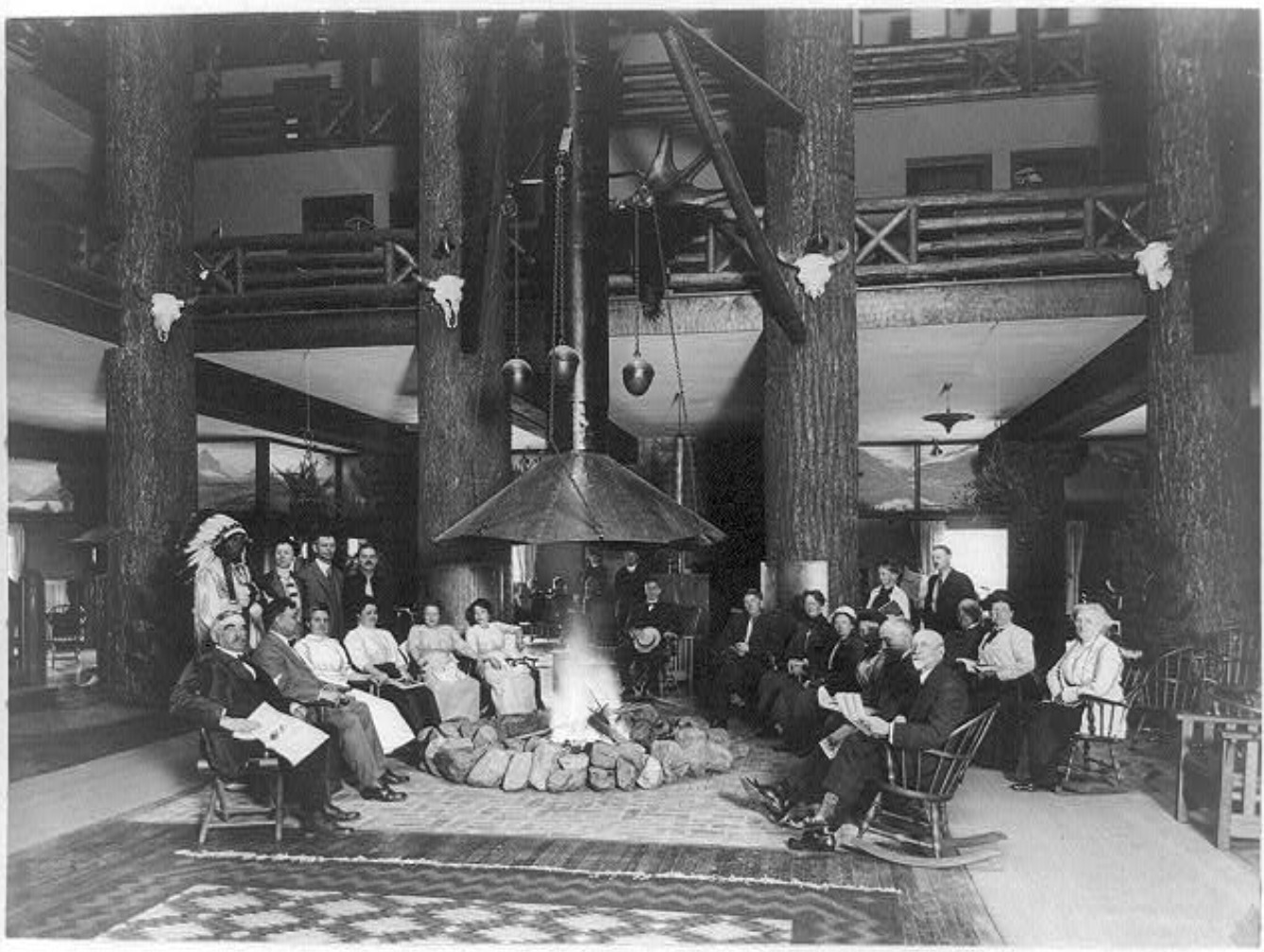
<span style="font-weight:400;">Luxurious chalets in Switzerland inspired the architecture of Glacier Park Hotel and the Great Northern’s other buildings, which catered to the tastes of wealthy travelers. Louis Hill, who served as president of the Great Northern during construction, chose this style. It connected the system visually and advertised Glacier’s reputation as the “Switzerland of North America.” Glacier Park Hotel, designed by Samuel Bartlett, is particularly famous for its massive log pillars, which support the hotel’s vast roof. These logs vary in size, with the largest being over forty feet tall and three to four feet wide, and they are most prevalent in the hotel’s lobby. Advertised as a “forest,” these log posts retain their bark, emphasizing their organic nature and contributing to the idea of an indoor forest. The lobby even includes a fire pit in its center. These features emphasized the hotel’s environment and emulated the rough, handcrafted style popularly defined as rustic architecture. The luxurious complex included a</span> <span style="font-weight:400;">music room, writing room, a sun parlor, and a hospital in case of emergencies. </span>
<span style="font-weight:400;">In 1957, the Great Northern hired Knutson Hotel Company to renovate its hotels for sale. The $3 million project expanded the hotel gift shop, installed bathrooms in all the guest rooms, added a swimming pool to the hotel complex, and renamed the hotel Glacier Park Lodge. In 1960, Glacier Park Inc. purchased the Glacier resort system from the Great Northern. The National Park Service granted Xanterra Parks and Resorts concession rights in Glacier in 2013, but Glacier Park Inc. retained Glacier Park Lodge and several other properties.</span></p><p><em><strong><a href="https://www.intermountainhistories.org/items/show/841">For more (including 4 images) view the original article</a></strong></em></p>]]></summary>
    <published>2024-05-29T20:53:22+00:00</published>
    <updated>2026-04-17T19:32:19+00:00</updated>
    <link rel="alternate" type="text/html" href="https://www.intermountainhistories.org/items/show/841"/>
    <id>https://www.intermountainhistories.org/items/show/841</id>
    <author>
      <name>Kaylen Wilson, Northern Arizona University</name>
    </author>
  </entry>
  <entry>
    <title type="html"><![CDATA[El Tovar Hotel - Grand Canyon National Park ]]></title>
    <summary type="html"><![CDATA[<p><strong><em>In 1901, the Atchison-Topeka Santa Fe Railway constructed a spur line from Williams, Arizona, that provided access to the Grand Canyon’s South Rim. El Tovar soon followed, providing its guests with the region’s first luxury accommodations.</em></strong></p><img src="https://www.intermountainhistories.org/files/fullsize/4856f91fdf081f933e9854aa688f9055.jpg" alt="El Tovar’s east side, circa 1905" /><br/><p><span style="font-weight:400;">Before the Atchison-Topeka Santa Fe Railway reached Grand Canyon Village in 1901, only a few rudimentary hotels served the Grand Canyon’s South Rim. These establishments relied on a local stagecoach line, which operated between Flagstaff, Arizona and a ranch near the rim. Because the twenty-dollar journey took three days to complete, the railroad provided a more efficient way to reach the canyon, and its arrival shifted the center of activity at Grand Canyon Village away from Thurston’s stagecoach line. Fred Harvey, a hospitality company whose Harvey houses provided quality food and lodging to passengers on the Santa Fe Railway, constructed El Tovar near the railroad tracks to draw in train passengers. The hotel cost $250,000 to construct, providing the Grand Canyon’s first luxury lodgings. </span>
<span style="font-weight:400;">Opened in 1905, El Tovar hotel predated the Grand Canyon’s designation as a national monument in 1908 and a national park in 1919. As a national monument, the Grand Canyon received less funding and attention than established national parks like Yellowstone. However, as tourism increased, calls for the area to receive further protections intensified. Ford Harvey, who served as president of the Harvey company until 1928, routinely advocated for Grand Canyon’s national park status at conferences. Conservation efforts gained strength when Arizona became a state in 1912, but many Grand Canyon residents opposed the national park proposal due to concerns about land and mineral rights. Regardless, President Woodrow Wilson officially signed the bill that established Grand Canyon National Park on February 26, 1919, and the Harvey company secured a hospitality contract from the new National Park Service (created in 1916) in 1920.</span>
<span style="font-weight:400;">Architect Charles Whittlesey’s design for El Tovar used the rustic architectural style, which aimed to establish a connection between buildings and their environment. Whittlesey designed the log siding on the first floor to resemble the wall of a log cabin. Natural building materials like rough stone and logs appear throughout the building, reinforcing this style. Whittlesey combined these rustic features with the architecture of traditional luxury resorts, which catered to Victorian tastes and a desire for exotic destinations. Decorative wooden poles known as balusters, which mimic Swiss chalet architecture, enclose El Tovar’s porches and balconies. The design also includes a small round tower known as a turret, which echoes resort architecture. </span>
<span style="font-weight:400;">El Tovar originally featured luxurious amenities, including hot running water and electric lighting. In the 1950s, the Harvey company added a new cocktail lounge to the hotel’s dining area. A 1983 renovation exchanged the hotel’s sparse public restrooms with private facilities, added carpeting, replaced windows, and included a new heating system. For this reason, El Tovar currently houses seventy-nine rooms instead of the original ninety-five. In 1968, Hawaii-based hospitality company Amfac purchased the Harvey company and gained control of El Tovar. In the 1990s, Amfac created Xanterra Parks and Resorts to control its concessions at the Grand Canyon, and Xanterra still manages El Tovar today. </span></p><p><em><strong><a href="https://www.intermountainhistories.org/items/show/840">For more (including 6 images) view the original article</a></strong></em></p>]]></summary>
    <published>2024-05-29T20:25:01+00:00</published>
    <updated>2026-04-17T19:32:19+00:00</updated>
    <link rel="alternate" type="text/html" href="https://www.intermountainhistories.org/items/show/840"/>
    <id>https://www.intermountainhistories.org/items/show/840</id>
    <author>
      <name>Kaylen Wilson, Northern Arizona University </name>
    </author>
  </entry>
  <entry>
    <title type="html"><![CDATA[Old Faithful Inn - Yellowstone National Park]]></title>
    <summary type="html"><![CDATA[<p><strong><em><span style="font-weight:400;">When the Northern Pacific Railroad’s Upper Geyser Basin Hotel burned to the ground on November 17, 1894, the U.S government pressured the railroad to replace it with new tourist accommodations. The result was Old Faithful Inn, which utilized a new style of architecture to highlight Yellowstone’s iconic landscape. </span></em></strong></p><img src="https://www.intermountainhistories.org/files/fullsize/eddddd6f4d185123b8615299ae39a69b.jpg" alt="Old Faithful Inn, Entrance Drive" /><br/><p><span style="font-weight:400;">On March 1, 1872, President Ulysses S. Grant officially signed Yellowstone into law as America’s first national park. The Yosemite Act of 1864 had restricted settlement in the Yosemite Valley and placed it under the jurisdiction of California’s state government, but the Yellowstone Park Act expanded upon this legislation by designating all of Yellowstone a public park. As a result, the Yellowstone Park Act contained many restrictions on private development and very few administrative procedures to enforce regulations or oversee public use. Poorly supervised independent companies called concessionaires, who paid park administrators a fee to use the land, ran Yellowstone’s public facilities. Only a few concessionaires ferried guests into the park, but the Northern Pacific Railroad quickly expressed interest in Yellowstone’s small tourism industry.</span>
<span style="font-weight:400;">When the Northern Pacific reached Gardiner, Montana, in the early 1880s, its presence provoked interest in Yellowstone’s tourism industry. At this time, only a few concessionaires opened small hotels and tent camps. One such concessionaire, the Yellowstone Park Improvement Company, constructed the Upper Geyser Basin Hotel in 1885 to preserve its failing business. The Northern Pacific purchased its properties in 1885, gaining control of the Upper Geyser Basin Hotel. When fire destroyed it</span><span style="font-weight:400;"> in 1894,</span><span style="font-weight:400;"> the importance of a new hotel in Yellowstone became clear</span><span style="font-weight:400;">. At the time</span><span style="font-weight:400;">, many railroad hotels utilized conventional architectural styles that provided a sense of familiarity for their upper-class audience. The Northern Pacific’s Lake Hotel, constructed in 1890, followed this example. However, </span><span style="font-weight:400;">rustic architecture, which emphasized harmony with the natural environment surrounding a structure, gained popularity in the 1890s. Because distinctive architecture drew more attention from visitors, the Northern Pacific experimented with a rustic style for its new hotel. </span>
<span style="font-weight:400;">The Yellowstone Park Association, a subsidiary of the Northern Pacific, selected Robert Reamer to design its new rustic hotel. The railroad constructed the log building near Yellowstone’s most famous geyser, from which the Old Faithful Inn derived its name. </span><span style="font-weight:400;">The Union Pacific completed the central core of the hotel, known as the “Old House,” in 1903.</span><span style="font-weight:400;"> The finished building was seven stories tall at its highest point, and it cost a total of $140,000 (about $4.9 million today) to construct. The Northern Pacific set aside a further $25,000 (approximately $875,000 today) to furnish the new hotel. Reamer designed his massive log structure to emulate Swiss chalets and Norwegian villas, and he utilized rough, unfinished wood logs obtained in the Park on both the inside and outside of the building to connect it to Yellowstone’s forested landscape. The hotel’s most prominent feature is its seven-story lobby, which features a vast fireplace made of native stone. A complex log frame that supports the hotel’s roof surrounds this room. The structure’s use of exposed wooden supports emphasizes the rustic nature of the lobby, and a series of wooden balconies overlook the main floor of the hotel. </span></p><p><em><strong><a href="https://www.intermountainhistories.org/items/show/839">For more (including 5 images) view the original article</a></strong></em></p>]]></summary>
    <published>2024-05-29T19:43:03+00:00</published>
    <updated>2026-04-17T19:32:19+00:00</updated>
    <link rel="alternate" type="text/html" href="https://www.intermountainhistories.org/items/show/839"/>
    <id>https://www.intermountainhistories.org/items/show/839</id>
    <author>
      <name>Kaylen Wilson, Northern Arizona University</name>
    </author>
  </entry>
  <entry>
    <title type="html"><![CDATA[Echo Railroad Depot]]></title>
    <summary type="html"><![CDATA[<p><strong><em>The Echo Railroad Depot was moved to its present site in Coalville in 1975.</p></strong></p><img src="https://www.intermountainhistories.org/files/fullsize/d1e07ea7df89d14108a032b609935e98.jpg" alt="The Echo Railroad Depot " /><br/><p><span style="font-weight:400;">In 1861, the town of Echo, Utah was founded. When tracks were laid down in Echo, the town shifted from an agricultural community to a railway hub. By 1869, the first of many trains passed through the area and its first railway station. As was common, young men flocked to Echo for work on the railway. Once this initial depot was completed, only a small number of these men remained in the town to settle down and continue work in the area. </span>
<span style="font-weight:400;">By 1880, a second depot was completed and was used until 1913, when a third and final depot was erected. It was a popular and important place for much of northern Summit County. People came from miles around to receive the latest news, telegrams, and the results of sports games. The building also had living quarters for the acting agent and his family. A kitchen, pantry, living room and 2 bedrooms. Occasionally, extra space was used for newcomers until they found homes nearby.  </span>
<span style="font-weight:400;">The town continued to grow and thrive thanks to these depots, drawing people and resources into the town. One of the depot's employees, Mike Tsoukatos, a native of Greece, designed an elaborate garden outside the depot and named it the Park. Tsoukatos used his own money to bring in beautiful plants and flowers that were the envy of all gardeners in the area. Sadly, when Tsoukatos retired, the garden was left neglected and was eventually laid over with gravel to make a parking lot.</span>
<span style="font-weight:400;">As time passed and railways gave way to other modes of transportation, the town morphed from vital to unneccessary and unknown. In 1960, the final steam engine made its way through the Echo Railroad Depot. However, thanks to the efforts of Henry Pennybaker, Pennybaker and other volunteers moved the building to its present location just west of the Summit County Fairgrounds in Coalville. It serves as the North Summit County Senior Citizen Center.</span></p><p><em><strong><a href="https://www.intermountainhistories.org/items/show/697">For more (including 4 images) view the original article</a></strong></em></p>]]></summary>
    <published>2022-11-04T17:36:15+00:00</published>
    <updated>2026-04-17T19:32:15+00:00</updated>
    <link rel="alternate" type="text/html" href="https://www.intermountainhistories.org/items/show/697"/>
    <id>https://www.intermountainhistories.org/items/show/697</id>
    <author>
      <name>Scarlett Alexis Wilson, Weber State University</name>
    </author>
  </entry>
  <entry>
    <title type="html"><![CDATA[Terrace and Kelton, Central Pacific Railroad Section Stations <br />
]]></title>
    <summary type="html"><![CDATA[<p><strong><em><span style="font-weight:400;">This original route by the Central Pacific Railroad (1869) became known as the Promontory Branch and received only sporadic use after 1904. Soon the railroad facilities were removed and the dependent towns abandoned. The rails of the Promontory Branch were finally taken down in 1942.</span></em></strong></p><img src="https://www.intermountainhistories.org/files/fullsize/b9a00f018bca845d7e9c45d7a09be3c4.jpg" alt="Terrace in 1967" /><br/><p><span style="font-weight:400;">Known as the Promontory Branch Stations, the Central Pacific Railroad maintained nearly 30 section stations along the tracks in Utah. These stations were each located roughly 10-12 miles apart and provided needed maintenance and upgrades to the rail lines. Some of the stations had permanent buildings, while others were not much more than tent cities. Typically, each was overseen by two white foremen, and housed anywhere from eleven to thirty Chinese workers. A few stops became actual towns, booming and bustling with the railroad traffic along the stretch.  </span>
<span style="font-weight:400;">Two of the major section stations along the Promontory route included Terrace and Kelton. </span><span style="font-weight:400;">Terrace was inhabited from 1869 to 1910. It was the largest station of the Promontory Branch, and provided the main source of maintenance and repair resources for the Salt Lake Division, which stretched from Wells, NV to Ogden, UT. The population estimates vary widely, but could have reached up to 1,000 residents at its peak. Nearly half of those were</span><span style="font-weight:400;"> projected to be Chinese workers for the railroad. Although, according to the 1880 census, the actual Chines population was under 100. </span>
<span style="font-weight:400;">The town, which boasted a number of establishments including a saloon, barber, general store, grocer and two hotels, also had a communal structure called the Athenaeum. The Athenaeum was funded by a small local tax and provided bath houses and a library. The Chinese settled on the east side of town, and maintained a laundry, cook house, and Joss sanctuary. Water was supplied to the town via a 12-mile aqueduct from Rosebud Creek. The aqueduct was traded out for a pipe in 1887. They later tried drilling a well in 1892, but were unsuccessful. The town was heavily affected by the completion of the Lucin cutoff in 1904 and a fire that decimated town buildings around that same time. By 1910, there was nothing but scraps of metal and building remnants left of Terrace. </span>
<span style="font-weight:400;">The section station of Kelton, also known as Indian Creek, lasted much longer, spanning from 1869 to about 1942. The town served as a major shipping and travel connection. It was the  southern terminus of the Utah, Idaho, and Oregon Stage Company and also an Overland Mail Route station. During the 1870s alone, six million pounds of goods and supplies were transferred from train to wagon from Kelton. The railroad had a depot, turntable, engine house, water tank, pump house, section house, rail spurs, and sidings. Businesses in town included a two-story hotel, saloons, general stores, a post office, and a blacksmith. The town water was piped in from the Raft River Mountains just seven miles north. The population peaked at about 150 people in the late 1800s. </span>
<span style="font-weight:400;">The town's decline happened over a period of years with one event  after another. The stage route was no longer in use by the 1880s, the Lucin Cutoff project significantly slowed train traffic down to just a few trains per week, an earthquake rocked the city in 1934, and the railroad removed the rails to donate to the war effort in 1942. The few structures that are left in the ghost town are visited only by railroad enthusiasts, local historians, and tourists.</span></p><p><em><strong><a href="https://www.intermountainhistories.org/items/show/681">For more (including 5 images) view the original article</a></strong></em></p>]]></summary>
    <published>2022-10-26T16:10:03+00:00</published>
    <updated>2026-04-17T19:32:15+00:00</updated>
    <link rel="alternate" type="text/html" href="https://www.intermountainhistories.org/items/show/681"/>
    <id>https://www.intermountainhistories.org/items/show/681</id>
    <author>
      <name>Cami R. Isle, Weber State University</name>
    </author>
  </entry>
  <entry>
    <title type="html"><![CDATA[Ogden-Lucin Cutoff ]]></title>
    <summary type="html"><![CDATA[<p><strong><em>The Lucin Cutoff was built to provide a better route for recent railroad developments that made the route through the Sierra Nevada Mountains too steep and long at the turn of the century.</em></strong></p><img src="https://www.intermountainhistories.org/files/fullsize/36f5304b9af8ff5d6d5ff15f6e1aab76.jpg" alt="Another look at the Lucin Cutoff in 1920" /><br/><p><span style="font-weight:400;">Though the joining of the rails at Promontory, Utah was an iconic moment, the resulting route from the Sierra Nevada Mountains through Promontory was too steep and long for trains that were longer, faster, and carrying increasing numbers of passengers and freight. Both the Union Pacific and Southern Pacific companies wanted a better route. Collis Potter Huntington, the president of Southern Pacific, ordered William Hood, his chief engineer, to plan alternate routes. These plans were put on hold due a financial crash and Huntington’s own death in 1900. However, when, after his death, his shares were sold to Edward Harriman, an official of the Union Pacific, plans were made for a new route that would save over forty miles off the Promontory route and be far more level. The route would lead from the small town of Lucin on the Nevada border, through a trestle on the Great Salt Lake, and ultimately to the town of Ogden, Utah.</span>
<span style="font-weight:400;">Though most of the Ogden-Lucin Cutoff was built quickly, construction of the trestle itself took over a year. Large loads of gravel and fill were poured into the lake for months, and many places in the lake were virtual sinkholes. Piles were driven into this fill to support the trestle, but many simply sank into the lake or had to be driven on top of each other. Massive amounts of piles, wood, rails, and supplies for the workers had to be shipped in. During the building of the Lucin Cutoff, forty-four workers were killed in train crashes, explosions, and drownings, including many Greek and Austrian immigrants. When construction was complete, the cutoff totaled over eight million dollars, over double its original estimate. </span>
<span style="font-weight:400;">After over fifty years of service, rising levels in the Great Salt Lake threatened the trestle and a parallel track supported by a causeway was built in 1959. The trestle was still occasionally used until the 1970s. In 1986-1987, the cutoff was severely damaged by lake waters. Despite the trestle’s importance in railroad history and its documentation on the National Register of Historic Places, it was sold for a dollar and the wood was hauled off for salvage. Many local homes and businesses took wood from the trestle, which was described as “pickled” and very strong due to its long existence in saltwater. Thus marked the end of the Lucin Cutoff. </span></p><p><em><strong><a href="https://www.intermountainhistories.org/items/show/680">For more (including 4 images) view the original article</a></strong></em></p>]]></summary>
    <published>2022-10-26T13:45:34+00:00</published>
    <updated>2026-04-17T19:32:14+00:00</updated>
    <link rel="alternate" type="text/html" href="https://www.intermountainhistories.org/items/show/680"/>
    <id>https://www.intermountainhistories.org/items/show/680</id>
    <author>
      <name>Amber Howard, Weber State University</name>
    </author>
  </entry>
  <entry>
    <title type="html"><![CDATA[Grand Canyon Depot]]></title>
    <summary type="html"><![CDATA[<p><strong><em>Take the Grand Canyon Railway to the historic train depot in Grand Canyon National Park and experience the unique architectural design of the only operating log depot in the United States.</em></strong></p><img src="https://www.intermountainhistories.org/files/fullsize/f9bfc58de0278251fc6045574c950f38.jpg" alt="The depot in 1975" /><br/><p>Designed by architect and Santa Barbara, California native Francis W. Wilson, the Grand Canyon Train Depot is one of fourteen log depots ever constructed in the United States and is now one of only three remaining. Out of these, the Grand Canyon Depot is the only one built mainly from logs and the only one still operating today. The building features a central two-story section and a wing on each side one-story in height. The unique design of the wood—three flat sides and one rounded—allowed the building to give off a frontier appearance while keeping out moisture and maintaining structural integrity. The original copper lettering on the front spelled out “Grand Canon,” but workers replaced it in 1911 to spell “Grand Canyon.” Between the late-1920s and mid-1950s the depot underwent structural and functional renovations which added office space and upgraded lighting.
Before 1901, a trip to the Grand Canyon required a bumpy, sixty-five-mile stagecoach ride on dirt roads to reach the South Rim. To rectify this—and simultaneously capitalize on interest to the park—in 1901, the Santa Fe Railway built a line of tracks connecting their depot in Williams, Arizona to what would become Grand Canyon Village. Instead of going by stagecoach, visitors to the Grand Canyon could ride the train and relax while enjoying the view on the way to one of the greatest natural wonders in the world.
The arrival of the railroad in 1901 shifted the tourist experience to what became the Grand Canyon Village. In 1905, the Santa Fe Railroad completed the El Tovar Hotel between the track and the canyon. Santa Fe then partnered with the Fred Harvey Company and the National Park Service to add more buildings to accommodate the growing number of tourists, including Hopi House, Bright Angel Lodge, and the Red Horse Cabin. Architect Mary Jane Colter designed many of these structures.
Popularity for the railroad dwindled as the automobile industry grew, however; in 1968, the Grand Canyon Railway made its final passenger run, and the Santa Fe Railway left the buildings it owned to the National Park Service. Freight transportation continued on the line, but soon after, in 1972, the railway discontinued passenger services to the Grand Canyon. In 1989 the formation of the Grand Canyon Railway revived the route when entrepreneurs Max and Thelma Biegert funded the restoration of the Grand Canyon Line: tourists once again could travel to the park by train. For visitors today, the station represents the idea of western national parks as rustic and scenic. Often the first experience guests have when they step off the train, the depot remains one of the best structures from the National Park’s rustic period.</p><p><em><strong><a href="https://www.intermountainhistories.org/items/show/603">For more (including 4 images) view the original article</a></strong></em></p>]]></summary>
    <published>2022-06-09T22:59:59+00:00</published>
    <updated>2026-04-17T19:32:13+00:00</updated>
    <link rel="alternate" type="text/html" href="https://www.intermountainhistories.org/items/show/603"/>
    <id>https://www.intermountainhistories.org/items/show/603</id>
    <author>
      <name>Jennifer John, Northern Arizona University</name>
    </author>
  </entry>
  <entry>
    <title type="html"><![CDATA[The Bigelow Hotel and Historic 25th Street<br />
]]></title>
    <summary type="html"><![CDATA[<p><strong><em>The Bigelow Hotel has graced Ogden's historic 25th Street since 1891. It is one of old three "grand" hotels in Utah </em></strong></p><img src="https://www.intermountainhistories.org/files/fullsize/2e59ff9e864ab71274edda7cac593bb8.jpg" alt="Union Station in Ogden, Utah " /><br/><p>In 1889, Ogden history changed forever with the opening of the Union Station. The arrival of the railroad brought new life to the town of Ogden as people from all over the nation now stopped in and became acquainted with the previously little-known town. With the increase of visitors, Ogden quickly needed to provide better accommodations for incoming guests. The answer came in the summer of 1889 with the approval of a new 5-story hotel to be built on the corner of Washington and 25th street. The hotel was to be built by E.A. Reed Esquire at the cost of $75,000. Initially the hotel had several struggles and delays in development but it finally opened its doors for business on July 4th 1891. The hotel opened with 130 rooms and had elegant interior furnishings including velvet carpet. The hotel struggled financially early on, even closing briefly in 1893, but it quickly reopened and continued to serve guests to the city.</p><p>With the boom in the economy at the heels of World War I, the hotel was completely remodeled in the 1920’s to become a more modern facility. M.S. Eccles and A.P. Bigelow took on the reconstruction project, adding eleven stories to the hotel. With much anticipation, the hotel officially reopened under the new name of The Bigelow Hotel, on March 3rd, 1927. The remodeling was praised for its elegance and quickly became known as a first class hostelry as it was considered one of only 3 grand hotels in Utah. In 1933, the hotel was again renamed as it took on the new title of the Ben Lomond Hotel, named after the local mountain in Weber County.</p><p>The hotel is part of the intriguing history of 25th street in Ogden. With the arrival of the railroad on the west end of 25th, many new and interesting personalities descended on Ogden and more specifically on this famous street. Soon after the railroad arrived, brothels infiltrated many of the establishments on this road. With these came much gambling and crime, including many murders. In the 1920’s, the street became known for its many moonshiners selling alcohol illegally during the prohibition. Many of these establishments would hide the alcohol under floorboards, or would have someone posing as a guest to conceal the alcohol under a coat. When a guest came asking for a drink, the bartender would give a signal to the individual who would then secretly come forward with the illegal drink. These are just a few examples of the crime and corruption that permeated this street.</p><p>Today, the Bigelow Hotel and 25th street have held onto their compelling history and is true to their historic roots. As one explores the hotel and wanders down 25th they truly feel that they have stepped back almost 100 years into 1920’s Ogden.</p><p><em><strong><a href="https://www.intermountainhistories.org/items/show/435">For more (including 6 images) view the original article</a></strong></em></p>]]></summary>
    <published>2020-10-24T03:49:51+00:00</published>
    <updated>2026-04-17T19:32:08+00:00</updated>
    <link rel="alternate" type="text/html" href="https://www.intermountainhistories.org/items/show/435"/>
    <id>https://www.intermountainhistories.org/items/show/435</id>
    <author>
      <name>Josh Camp, Brigham Young University </name>
    </author>
  </entry>
  <entry>
    <title type="html"><![CDATA[Forest City]]></title>
    <summary type="html"><![CDATA[<p><strong><em>Several miles up a dirt road in American Fork Canyon you can find a former mining town with an interesting history.</em></strong></p><img src="https://www.intermountainhistories.org/files/fullsize/2b1227d5e01bad43bc52072888543763.jpg" alt="Sultana Smelter" /><br/><p>Soon after silver was found in Little Cottonwood Canyon, east of Salt Lake City, Utah, in the 1860s, prospectors looked to American Fork Canyon, the neighboring canyon south, for valuable ores. The American Fork Mining district was quickly formed in 1870 and the Pittsburg Mine just south of Alta and over the ridge into the American Fork Canyon drainage was the first of the many mines to come.  Among prospectors of the new American Fork mining district were Jacob and William Millar who discovered lead carbonate ore bearing some gold. They started a mining camp and later sold what would become known as the Miller Hill Mine to the Aspinwall Steamship company based in New York.  </p><p>To boost production, the Aspinwall Steamship Company built the Sultana Smelter close to the Miller mine. A mining town known as Forest City grew up around the smelter. Estimates of the population are hard to pin down. The highest estimates say that the peak population was around 2000-3000 people, but other sources limit the population to about 500 or less. Even though the exact numbers of the population are unclear, Forest City was much more than a large mining camp. There were enough children that the school district built a schoolhouse and brought in a teacher from Salt Lake. There was a sawmill that was used to produce lumber for building and an industrious farmer started a up a dairy farm to provide goods for the miners. </p><p>When the Sultana Smelter began producing more than could be transported down the mountain, the Aspinwall Steamship Company started building the American Fork Railroad to transport the ore that was produced in Forest City. The road was graded all the way up to Forest city, but due to excessively steep grades, the railroad shopped short at Deer Creek. The ore was brought by wagon from Forest City to Deer Creek and the train was able to coast down the mountain until the mouth of the Canyon.  An resulting town that grew at the Deer Creek rail terminus is now submerged under the Tibble Fork Reservoir. </p><p>A bad winter in 1872 stopped production in the mine and a diphtheria outbreak killed several Forest City residents, including children. The Miller Hill Mine slowed after that. While there were other good veins found, the rugged terrain made accessing them difficult. Decreased mining led to profit loss for the railway, so the company began offering rail services to day trip tourists in 1878. Eventually the American Fork Railroad closed, making it the first railroad in in Utah to go out of business.</p><p>Without the railway operating, Forest City collapsed and most residents left by the early-1880s. Small mining excavations occurred in American Fork canyon up until the 1950s, including Tyng’s camp and others, but none of those competed with the peak production years of 1870-1876.</p><p>The graveyard where those that died of diphtheria were buried was preserved for a long time under the new name “Graveyard Flats” but with heavy winters up American Fork Canyon with snowpack easily reaching 6 feet or more, the site has been lost. What was left of Forest City was destroyed with the actions of snowmobilers who didn’t know they were driving over a snow covered ghost town. Today all that stands of the old town are the remains of the old Sultana Smelter. </p><p><em><strong><a href="https://www.intermountainhistories.org/items/show/428">For more (including 4 images) view the original article</a></strong></em></p>]]></summary>
    <published>2020-10-09T02:45:27+00:00</published>
    <updated>2026-04-17T19:32:08+00:00</updated>
    <link rel="alternate" type="text/html" href="https://www.intermountainhistories.org/items/show/428"/>
    <id>https://www.intermountainhistories.org/items/show/428</id>
    <author>
      <name>Kristyanne Woodland, Brigham Young University</name>
    </author>
  </entry>
  <entry>
    <title type="html"><![CDATA[Helper, Utah]]></title>
    <summary type="html"><![CDATA[<p><strong><em>This Carbon County hub was one of Utah’s most ethnically diverse towns in the early twentieth century.</em></strong></p><img src="https://www.intermountainhistories.org/files/fullsize/3c8dd110b632fb394c09a83e1b1db99a.jpg" alt="Helper Station" /><br/><p>Helper—situated between Castle Gate and Price in Castle Valley—is the product of the Denver & Rio Grande Western Railroad’s search for coal in the late nineteenth century. Low-grade coal fueled the railroads, but until the 1880s no one had discovered a coal seam of sufficient quality in Utah to produce good “coke” for industrial smelting. This meant that metal mines in other parts of the state could not process low-grade copper and silver at a profitable rate. The D&RGW extended through Castle Valley in the early 1880s in its search for coal, and an engineer for the railroad discovered high quality coal in Castle Gate. The town’s name comes from the railroads; “helper” locomotives waited along that stretch of railway to tow trains up the steep grade.</p><p>The demand for Castle Valley’s coal meant that there was an increased demand for workers. Italians, Slovenians, Croatians, and Serbians immigrated to the area to work in the mines, adding to the mix of cultures where Chinese people had previously worked on the railroad. In 1894, Carbon County split from Emery County. By then, it had an industry and ethnic mix distinct from the Mormon homesteaders to the south. By 1900 there were sixteen different nationalities represented in Helper in a population of only 385 people. This would increase in 1903 and 1904, as a strike at Castle Gate prompted the mine’s owners to bring in Greek and Japanese workers as strikebreakers. </p><p>With its location at the center of several nearby coal mining camps and farms, Helper became a hub for commerce for the many different ethnic groups in the county. Immigrants in Helper worked as merchants and business owners. European and Asian immigrants operated saloons and coffee houses and otherwise provided services for nearby workers. As a steadily growing town—in contrast to the boom towns usually associated with mining in the West—community life for its diverse enclaves became a part of Helper’s story. By the 1910s, there was a Catholic church in Helper and a Greek Orthodox church in nearby Price. There were Italian, Croatian, and Slovenian lodges in the county, and a YMCA in Helper served as a general public meeting place. The influx of immigrants during this pivotal time in Utah’s history has left a lasting imprint on the culture of Helper as well as the state overall. </p><p><em><strong><a href="https://www.intermountainhistories.org/items/show/373">For more (including 3 images) view the original article</a></strong></em></p>]]></summary>
    <published>2019-11-22T03:58:41+00:00</published>
    <updated>2026-04-17T19:32:07+00:00</updated>
    <link rel="alternate" type="text/html" href="https://www.intermountainhistories.org/items/show/373"/>
    <id>https://www.intermountainhistories.org/items/show/373</id>
    <author>
      <name>Nate Housley, University of Utah</name>
    </author>
  </entry>
</feed>