<?xml version="1.0" encoding="UTF-8"?>
<feed xmlns="http://www.w3.org/2005/Atom">
  <title type="text">Intermountain Histories</title>
  <updated>2026-04-17T19:32:17+00:00</updated>
  <generator uri="http://framework.zend.com" version="1.12.20">Zend_Feed_Writer</generator>
  <link rel="alternate" type="text/html" href="https://www.intermountainhistories.org/"/>
  <link rel="self" type="application/atom+xml" href="https://www.intermountainhistories.org/items/browse?output=rss2"/>
  <id>https://www.intermountainhistories.org/</id>
  <author>
    <name>Intermountain Histories</name>
    <uri>https://www.intermountainhistories.org</uri>
  </author>
  <link rel="hub" href="https://pubsubhubbub.appspot.com/"/>
  <entry>
    <title type="html"><![CDATA[The American Fork Presbyterian Church]]></title>
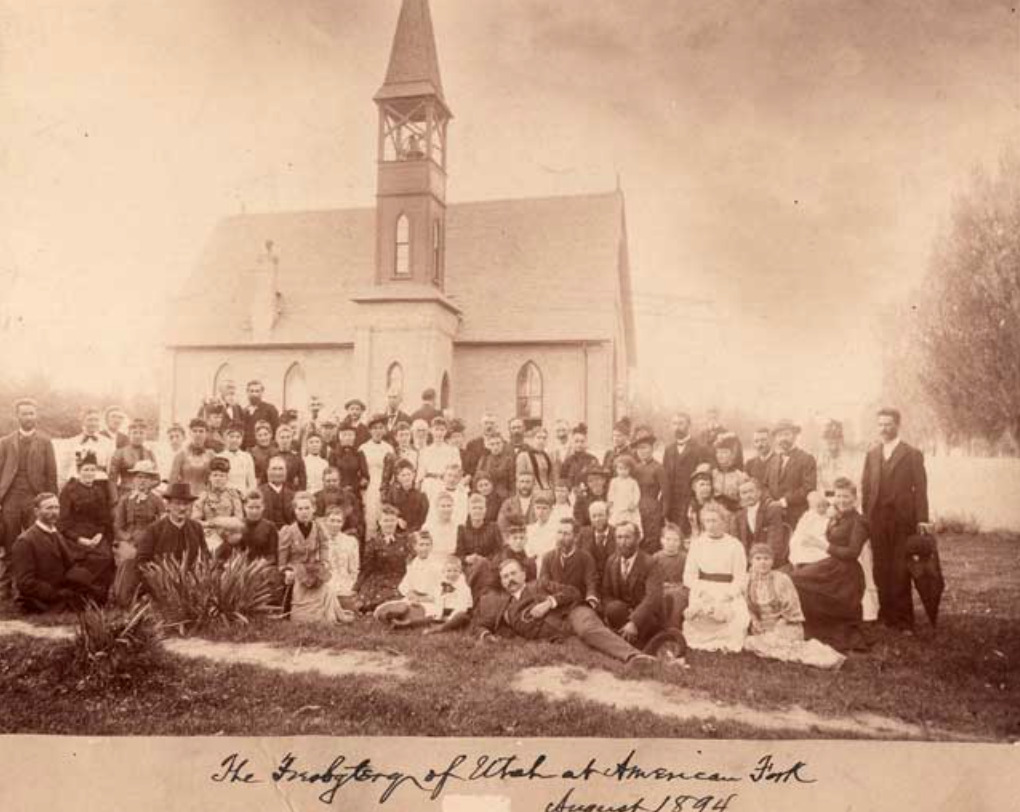
    <summary type="html"><![CDATA[<p><strong><em>The Community Presbyterian Church in American Fork, Utah is a historic building that has been standing since the late 1800s. It has represented the prosperity of Presbyterianism within the majority-LDS state, while also being an institution of education and charity within the community of American Fork.</p></strong></p><img src="https://www.intermountainhistories.org/files/fullsize/b6c5b16467e99ac505960b7c545231bf.jpg" alt="American Fork Presbyterian Church with congregation, 1894" /><br/><p><span style="font-weight:400;">In 1877 Reverend George R. Bird arrived in American Fork to begin a religious ministry among the small Presbyterian community there. For the first year of his work, congregants met in the upstairs social hall of Chipman’s Store. They later assembled in a log cabin that Bird purchased with the help of the Board of National Missions of the Presbyterian Church. Work began on a dedicated Presbyterian Church in 1878, with architect Peter Van Houghton designing the sanctuary in a “modified Gothic revival style,” made especially evident in stained-glass windows, which are one of the church’s prominent features. Reverend Bird was replaced in 1880 by Reverend Thomas F. Day, who laid the cornerstone when the church was finished in 1881. </span>
<span style="font-weight:400;">The Community Presbyterian Church has functioned continuously as a place of worship ever since its completion in 1881 and served as a school until 1909. Despite on-and-off contention between Presbyterians and members of the Church of Jesus Christ of Latter-day Saints during the 19th century, the First Presbyterian Church became a central part of the Christian community in American Fork. Relations between the two faiths improved as they found ways to serve the community of American Fork together. In 1940 the church was renamed the “Community Presbyterian Church” by Reverend Elias Jones to reflect the different religious backgrounds of those who made up the congregation. In 1984 the church building gained national notoriety with its appearance in the hit movie, </span><i><span style="font-weight:400;">Footloose</span></i><span style="font-weight:400;">, for which members of the congregation played extras and even had some speaking roles. The Community Presbyterian Church was listed on the National Historic Register on May 23, 1980.</span>
<span style="font-weight:400;">Over the decades of its presence, the Community Presbyterian Church has continued to serve community members through a variety of  projects. In 1961, the congregation built the Kershaw Christian Education Building adjacent to the church. The building is used today for some Sunday meetings but is mainly leased by the church to the Belmont Classical Academy, a non-denominational, independent Christian church that offers K-12 education. Today the church hosts a community vegetable garden, a 9/11 memorial garden, and a playground dedicated to children with autism, all open to the public.</span>
<span style="font-weight:400;">Over the years, many renovations have been needed to maintain the building. A kitchen was built onto the back of the church in the 1940s and has now been renovated as a narthex, or a traditional entrance on the western side of a church. The bell tower was struck by lightning and badly damaged on July 12, 1952, and members replaced the weathervane with a stainless-steel cross. Funds were donated to repair the tower in 1997, with the cross remaining in place. Between 1975 and 1977 many renovations to the inside of the church were made to prepare for the church’s 100</span><span style="font-weight:400;">th</span><span style="font-weight:400;"> anniversary. Workers repaired the roofing, removed wallpaper, and rewired the building. Pews were purchased from the Salt Lake City Kol Ami Synagogue, and they remain in the church today. The church also had stained-glass windows designed by a Salt Lake City local, J. Fred Brown, installed. These stained-glass windows were replaced in 2013 with new windows creatde by Tom Holdman, which depict many scenes and symbols from the life of Jesus Christ. </span>
<span style="font-weight:400;">Today the Community Presbyterian Church of American Fork continues to serve the community. Weekly Sunday worship meetings are open to members of the congregation and visitors alike. The church also offers twelve-step and community groups and works alongside local organizations and charities to help people in the area.</span></p><p><em><strong><a href="https://www.intermountainhistories.org/items/show/767">For more (including 6 images) view the original article</a></strong></em></p>]]></summary>
    <published>2024-01-18T03:50:02+00:00</published>
    <updated>2026-04-17T19:32:17+00:00</updated>
    <link rel="alternate" type="text/html" href="https://www.intermountainhistories.org/items/show/767"/>
    <id>https://www.intermountainhistories.org/items/show/767</id>
    <author>
      <name>McKay Kimball, Brigham Young University</name>
    </author>
  </entry>
  <entry>
    <title type="html"><![CDATA[Wasatch Academy]]></title>
    <summary type="html"><![CDATA[<p><strong><em>In 1875 Presbyterian Reverend, Duncan McMillan arrived in the heart of Mormon country on a mission to make inroads with the predominantly LDS population. The best way to reach the people of Utah during the late nineteenth century was to build a school, an institution which most communities found to be lacking. While the school set off religious tensions between the with the Church of Jesus Christ of Latter-day Saints, the school was able to provide an education to the students of Utah communities during a time when they needed it most. Today, Wasatch Academy still stands as a functioning boarding school for students in Utah, the greater United States, and the world. </em></strong></p><img src="https://www.intermountainhistories.org/files/fullsize/083e2db3227ff947e2dc10ae4385053f.jpg" alt="Wasatch Academy Dormitories" /><br/><p>Located in Utah’s Sanpete County, in the town of Mount Pleasant, Wasatch Academy has stood for over a hundred years. The history of the site can be traced back to the arrival of the Reverend Duncan James McMillan in Mount Pleasant on March 2, 1875. His arrival to some marked the beginning of the Presbyterian Church, of which he was affiliated, in Mount Pleasant the next day, yet his memorable impact for the church came with the establishment of a school. The beginnings of the Wasatch Academy for him were difficult, yet he was determined to do all that he could in the Mormon country of Utah. Upon his arrival, he befriended the local, non-Mormon postmaster and “learned that there was a real opportunity for service among the Mormons.” The service of which he referred was the need for schools in the area. Though Reverend McMillan did not have the funds to start a school himself, he was able to receive the funds to pay for the old Liberal Hall to be used as the school building from the Women’s Missionary Society in Cedar Rapids, Iowa. </p><p>The school helped to bring education to students of the area. Wasatch Academy, then referred to as the Liberal Hall, first opened to students on April 19, 1875 with a student enrollment of only forty-four. The number rose to one hundred and nine students by the end of the first term. The school, as with many other Presbyterian schools under the Home Missions established in the United States, provided women an opportunity to serve as teachers. Delia R. Snow was one such teacher from 1875 to 1878, after having been the first convert in the area to the Presbyterian faith. Her experience underlines the religious, as well as educational, mission of Reverend McMillan and the Presbyterians in Mount Pleasant. The main focus for the Wasatch Academy was to establish a school because Reverend McMillan noted that “[the Mormons] had no school system… and as he looked out upon that pioneer territory he seemed to hear the command of the Master, ‘Feed my lambs.’” Indeed the school was able to provide education in various subjects and across all levels by 1887. </p><p>Wasatch Academy eventually saw need to expand out of its original home in order to progress. Work began on the new building in 1888, but it would eventually give way to changes again in 1910 as the structure of the school systems and demand shifted in Utah. Wasatch Academy would continue to undergo changes in curriculum and physical structure throughout the decades. Currently, Wasatch Academy is a private boarding high school that focused on preparing its students for higher education.  The current Wasatch Academy does not have religious affiliations, despite its early history, and serves a wide, global student body.  It’s original home of Liberal Hall has since been purchased and renovated by Wasatch Academy to function as a museum to tell the history of the school in the region and where it all began.</p><p><em><strong><a href="https://www.intermountainhistories.org/items/show/98">For more (including 3 images) view the original article</a></strong></em></p>]]></summary>
    <published>2018-01-17T19:23:14+00:00</published>
    <updated>2026-04-17T19:31:59+00:00</updated>
    <link rel="alternate" type="text/html" href="https://www.intermountainhistories.org/items/show/98"/>
    <id>https://www.intermountainhistories.org/items/show/98</id>
    <author>
      <name>Samantha R. Beck, Brigham Young University</name>
    </author>
  </entry>
</feed>
