<?xml version="1.0" encoding="UTF-8"?>
<feed xmlns="http://www.w3.org/2005/Atom">
  <title type="text">Intermountain Histories</title>
  <updated>2026-04-17T19:32:17+00:00</updated>
  <generator uri="http://framework.zend.com" version="1.12.20">Zend_Feed_Writer</generator>
  <link rel="alternate" type="text/html" href="https://www.intermountainhistories.org/"/>
  <link rel="self" type="application/atom+xml" href="https://www.intermountainhistories.org/items/browse?output=rss2"/>
  <id>https://www.intermountainhistories.org/</id>
  <author>
    <name>Intermountain Histories</name>
    <uri>https://www.intermountainhistories.org</uri>
  </author>
  <link rel="hub" href="https://pubsubhubbub.appspot.com/"/>
  <entry>
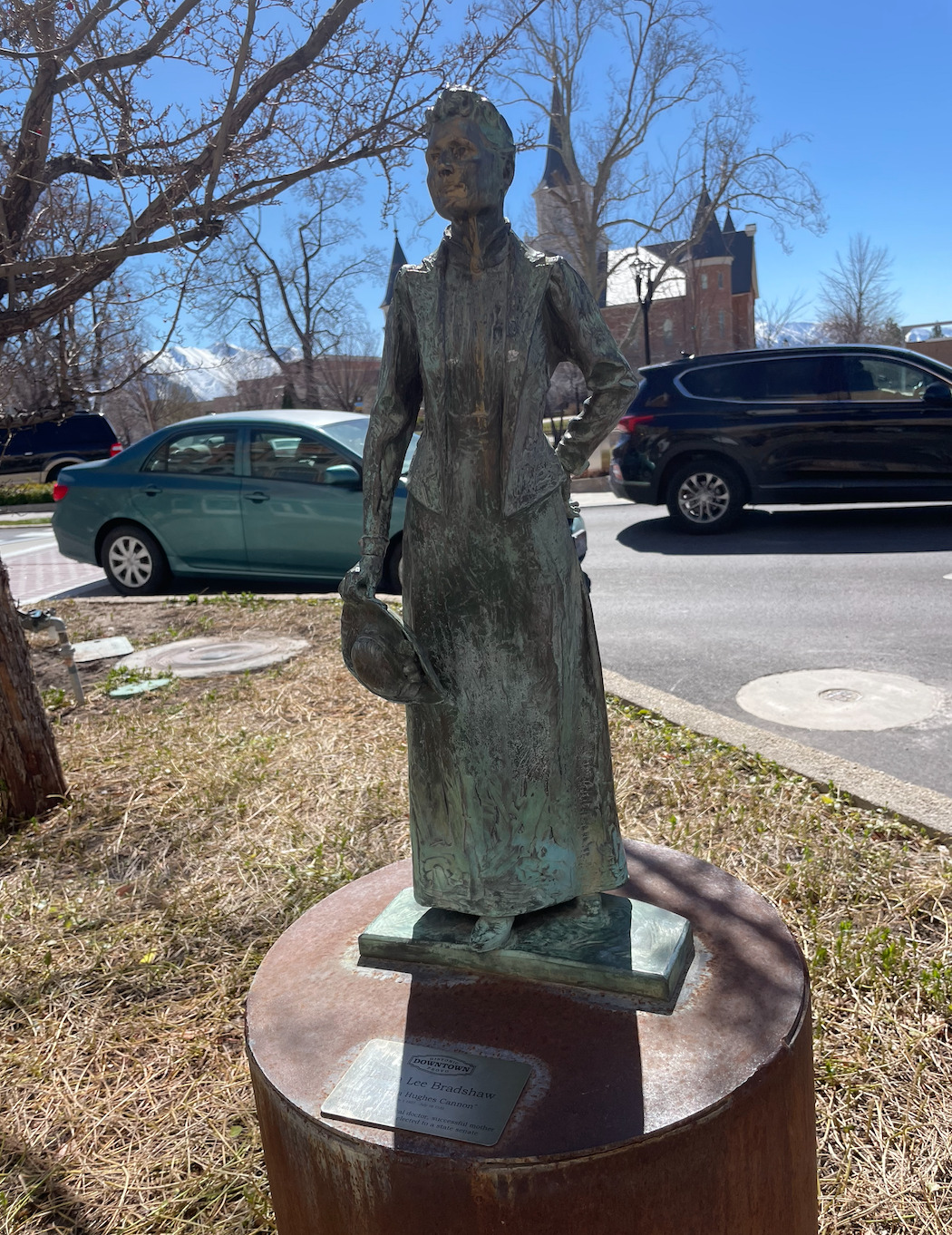
    <title type="html"><![CDATA[Martha Hughes Cannon Memorial Statue]]></title>
    <summary type="html"><![CDATA[<p><strong><em>Martha Hughes Cannon was an outstanding woman with great ambition and intelligence. As she gained an education and grew in the LDS religion, she capitalized on her position as an educated woman of faith to represent Utah women as they battled anti-polygamy legislation and public health issues.</em></strong></p><img src="https://www.intermountainhistories.org/files/fullsize/48b93f901ad49440cfe49a8350fd6fe1.jpg" alt="Martha Hughes Cannon Statue, Provo" /><br/><p>Martha Hughes Cannon was born in Wales on July 1st, 1857. During her infant years, Martha’s parents joined other new converts to the LDS faith on a long journey to Utah. Tragically, her father passed away only three days after arriving in Utah and surviving the arduous westward trek. By her teenage years, Martha had faced considerable hardship and poverty, but showed resilience and hope for the future. Martha’s young adult years were full of education. After graduating college with a degree in chemistry, Martha was accepted into the University of Michigan, one of few medical schools that admitted men and women. She also studied at the National School of Oratory, becoming a skilled public speaker. Her medical skills and oratorical skills would be great assets during her involvement in Utah politics. </p><p>Martha’s personal and professional life gave her a unique position in the eyes of the United States government. As the fourth wife to Angus M. Cannon, Martha faced considerable scrutiny from territorial officials. As a doctor, she delivered many children born to polygamist mothers and was seen as an important witness to prosecute polygamy. She lived out of state for many years to avoid testifying against and incriminating her husband, along with other polygamist families. The official outlawing of polygamy in 1890 allowed Martha to return to Utah and begin her career in politics.</p><p>A request from the Democratic party prompted Martha to run in the state senate election. Although her husband was running for the Republican party, this did not stop Martha from fulfilling what she viewed as an incredible civic opportunity. After winning the Democratic seat, Martha spent four years effectively advocating for public health and education causes in Utah. She authored bills to start the Utah Health Department, and schools for children with disabilities. Unfortunately, Martha’s political career came to an end with her third pregnancy. The nation viewed this as proof that Mormons were still practicing polygamy, and she was now an unacceptable representative. Although her time was cut short, Martha provided many valuable insights to Utah’s state legislature and was a voice for women across the state of Utah.</p><p><em><strong><a href="https://www.intermountainhistories.org/items/show/783">For more (including 3 images) view the original article</a></strong></em></p>]]></summary>
    <published>2024-02-26T19:39:54+00:00</published>
    <updated>2026-04-17T19:32:17+00:00</updated>
    <link rel="alternate" type="text/html" href="https://www.intermountainhistories.org/items/show/783"/>
    <id>https://www.intermountainhistories.org/items/show/783</id>
    <author>
      <name>Olivia Stockman, Brigham Young University</name>
    </author>
  </entry>
  <entry>
    <title type="html"><![CDATA[Polygamy on the State Line: Short Creek Settlement]]></title>
    <summary type="html"><![CDATA[<p><strong><em>Short Creek was an isolated fundamentalist Mormon intentional community where locals practiced polygamy and communalism. It drew public attention due to a government raid in the 1950s and the imprisonment of its leader in the 2000s.</em></strong></p><img src="https://www.intermountainhistories.org/files/fullsize/1b0bce102b2c4e32a46d16d967d6663f.jpg" alt="Lorin C. Wooley (1856-1934)" /><br/><p><span style="font-weight:400;">Mainstream members of the Church of Jesus Christ of Latter-day Saints (LDS, or Mormons) practiced and accepted polygamy from its introduction to Church practice in the 1840s until the Church prohibited it in 1890 and 1904. This came after years strong anti-polygamy sentiments in the United States and legal persecution of its practitioners. Though facing excommunication after this, some continued the practice and began to coalesce in isolated rural sites, producing their own leaders such as Lorin C. Wooley (1856-1934). He wanted to revive another nineteenth-century practice, the United Order program, intended to emulate the collectivism of the early Christian community by establishing communities based on income equality, group self-sufficiency, and the elimination of poverty. Generally, members contributed their economic property to the community and received a share of the proceeds as income or as housing and food. </span>
<span style="font-weight:400;">Aiming to continue these two traditions, Woolley’s followers established settlements such as Short Creek. Located on the Arizona side of the border with Utah, Short Creek was difficult to reach from Arizona due to the Grand Canyon, an ideal location for remaining out of public scrutiny and for escaping to Utah in case of trouble. Polygamists settled in Short Creek in the 1920s and 1930s, eventually reaching forty families as the Church continued to excommunicate practicing polygamists. Cooperative living was a goal of the inhabitants from the beginning, and in 1936, the community created a trust holding title to land and farm equipment; it also collected clothing and fuel and redistributed these items among the members, who worked the community’s lands.</span>
<span style="font-weight:400;">The community entered public awareness in the early 1950s. Following a complaint from a judge in Kingman, the county seat, the Arizona attorney general planned a raid. He commissioned a detective agency to explore the settlement under the guise of Hollywood agents scouting movie locations. For the operation, the attorney general received $50,000 from the Arizona legislature, though they were not alerted to the purpose of the funds. On July 26, 1953, state police entered the community. Residents had been tipped off in advance by sympathetic law enforcement and some managed to escape into Utah; however, most of the community assembled in the small schoolhouse where Arizona national guardsmen took them into custody. Arizona Governor Howard Pyle announced the raid by radio the following day. Public reaction was mixed, with one editorial worrying about the effect on the women and children. Twenty-six men received one-year suspended sentences and were ordered not to further practice polygamy. The state attempted to retain the children, but the Arizona Supreme Court ordered that they be released.</span>
<span style="font-weight:400;">The raid remained significant in local memory for decades. Ironically, press coverage of the incident raised awareness of the fundamentalist movement, drawing new members to the community. In the 1960s, a new road improved accessibility from the outside. Locals later incorporated the community as Colorado City, Arizona, and Hildale, Utah. The community opened up more to the outside world, establishing hotels and restaurants catering to travelers. However, Short Creek faced new challenges in the early twenty-first century. Its leader, Warren Jeffs (1955- ), was imprisoned for sexual assault against two female minors whom he had married, and the community experienced an epidemic of fumarase deficiency, a debilitating congenital disorder. The community has recently seen several changes, including a new resort, a female mayor, and a public school. </span></p><p><em><strong><a href="https://www.intermountainhistories.org/items/show/704">For more (including 7 images) view the original article</a></strong></em></p>]]></summary>
    <published>2023-02-21T18:20:20+00:00</published>
    <updated>2026-04-17T19:32:15+00:00</updated>
    <link rel="alternate" type="text/html" href="https://www.intermountainhistories.org/items/show/704"/>
    <id>https://www.intermountainhistories.org/items/show/704</id>
    <author>
      <name>Evan Železny-Green, Northern Arizona University</name>
    </author>
  </entry>
  <entry>
    <title type="html"><![CDATA[Daniel Heiner House]]></title>
    <summary type="html"><![CDATA[<p><strong><em>The Daniel Heiner home in Morgan is a distinguished pioneer residence that marks the importance of a local man who combined a life of religious leadership with active entrepreneurial activity in ranching, mining, banking, and politics.</em></strong></p><img src="https://www.intermountainhistories.org/files/fullsize/9381682d589f70a69f10fe50163bd149.jpg" alt="Daniel Heiner and his wives, Martha Stephens and Sarah Coulam" /><br/><p><span style="font-weight:400;">Daniel Heiner was one of 11 children born to German immigrant parents, Martin Heiner and Adelgunda Dietzel Heiner.  Martin and Adelgunda were the first people from the town of Wasungen, Germany, to apply for emigration to the United States in 1845 following the repeal of anti-emigration laws. They moved to Thomastown, Pennsylvania, where they met LDS missionaries and joined The Church of Jesus Christ of Latter-day Saints.</span>
<span style="font-weight:400;">In 1859, Daniel, along with his parents and nine of his siblings, migrated from Pennsylvania to Utah in 1859. Heiner was eight years old at the time of the journey and walked most of the thousand miles to Salt Lake City, Utah. In Utah they faced financial hardship and all held various jobs around Salt Lake City to provide for the family.</span>
<span style="font-weight:400;">The family then moved from Salt Lake City to Morgan County, Utah  in  December 1863. Here, the family took care of a small lot of sheep. Daniel Heiner helped tend to the family’s sheep crop and wheat and potato fields which had been cleared in the summer of 1864. Later, he got a job working on the Union Pacific Railroad. In 1872, he became the school master for Morgan County, despite having little education. He gained a reputation during this time for becoming an expert deer hunter and marksman, leading several successful hunting parties throughout the county to provide for his family. </span>
<span style="font-weight:400;">He and his two wives, Martha Stephens and Sarach Coulam, farmed and hunted to provide a meager living. In the 1880s, he was arrested for polygamy and faced trial at the Weber County Courthouse in Ogden. He was not convicted due to the 1890 Manifesto from the Church of Jesus Christ of Latter-day Saints. This manifesto ended the practice of polygamy and halted active prosecutions of polygamists under the Edmunds-Tucker Act.</span>
<span style="font-weight:400;">After this, Heiner created a family ranching business, the Echo Land and Livestock Company, which he maintained throughout his life. In addition, he bought and sold cattle on behalf of the Whitney & Chambers Company of Evanston, Wyoming. He also invested in the Black Hawk coal mine in Emery County. Growing out of his mining and ranching activity was Heiner's interest in banking. This led to the creation of the First National Bank of Morgan of which he was President for 16 years. </span>
<span style="font-weight:400;">Twice, Heiner was elected to be Mayor of Morgan. Heiner was also elected to be Morgan County’s Representative in Utah’s first State Legislature in 1896. In 1898, Governor Heber Manning Wells appointed Heiner as the Road Commissioner for Morgan County, where he built a new road between Mountain Green, Utah, and Devils Canyon, Utah. He was also active in church service locally and served as Stake President for his church from 1900-1924. Heiner died August 8, 1931 in Morgan, Utah, where his historic home still stands. </span></p><p><em><strong><a href="https://www.intermountainhistories.org/items/show/667">For more (including 3 images) view the original article</a></strong></em></p>]]></summary>
    <published>2022-10-14T15:44:47+00:00</published>
    <updated>2026-04-17T19:32:14+00:00</updated>
    <link rel="alternate" type="text/html" href="https://www.intermountainhistories.org/items/show/667"/>
    <id>https://www.intermountainhistories.org/items/show/667</id>
    <author>
      <name>Joseph Brownlow, Weber State University </name>
    </author>
  </entry>
  <entry>
    <title type="html"><![CDATA[Tarlton Lewis, “Grand Old Man”]]></title>
    <summary type="html"><![CDATA[<p><strong><em>Tarlton Lewis, a survivor of the Hawn’s Mills Massacre in Missouri, went on to live an energetic life as he explored the West and settled new towns such as Parowan and Minersville in Iron and Beaver Counties in Utah. He lived his life helping other Latter-day Saints, farming and building on the land, and raising a family in the desert.</em></strong></p><img src="https://www.intermountainhistories.org/files/fullsize/04d4a6e7d1c614593ab9129186616d5d.jpg" alt="Tarlton Lewis" /><br/><p>Tarlton Lewis was the fourth of twelve children born to Neriah Lewis and Mary Moss on May 18, 1805 in South Carolina. Tarlton married Malinda Gimlin on March 27, 1828; over the course of their marriage, they had eight children together. While living in Illinois, Tarlton and Malinda joined The Church of Jesus Christ of Latter-day Saints (sometimes nicknamed “Mormons”) and were baptized July 25, 1836 by Tarlton’s older brother Benjamin Lewis. The brothers joined moved to Missouri to live among other Latter-day Saints, and on October 30, 1838, while living near Hawn's Mill, they were attacked by a violent mob agitating for the expulsion of all Mormons from Missouri. The mob murdered Tarlton’s older brother Benjamin, and Tarlton suffered an injury to his shoulder; their younger brother David, however, was uninjured.
After surviving this tragedy, the brothers moved with other Latter-day Saints to Nauvoo, Illinois. There, Joseph Smith, president of the Church, and his brother Hyrum set apart Tarlton as bishop of the Nauvoo Fourth Ward. Also in Tarlton and Malinda received the endowment and sealing ordinances—the Church’s highest sacraments—before joining the mass exodus of Latter-day Saints from Nauvoo, leaving behind the temple they had spent years helping build.
The Lewis family left as part of the second wave of Saints, fleeing westward across the Mississippi Rive, but Tarlton himself stayed behind to continue his service as a bishop and help the Church members under his care prepare to go West. After many weeks crossing Iowa, they settled temporarily at Council Bluffs in Pottawattamie, Iowa, 1846.
After the Latter-day Saints regrouped in Iowa, Tarlton joined the first company of pioneers departing in 1847. As part of the Vanguard Company led by Brigham Young—Smith’s successor to the Church presidency—Tarlton was captain of 50 wagons and entered the Salt Lake Valley on July 21, 1847. There, Young called Tarlton as the first bishop in Salt Lake Valley, and Tarlton remained in the valley to build cabins and plant crops for the Saints who would arrive next. After an almost two-year separation, Tarlton reunited with his family when they arrived at the Salt Lake Valley on September 21, 1848.
Two years later, in December 1850, the Church called Tarlton to travel with apostle George A. Smith and one hundred others to explore southern Utah. Tarlton again captained 50 wagons, and on January 17, 1851, the explorers officially organized Iron County. In their first election, the young county elected Tarlton Lewis as a magistrate. George Smith organized the settlement into four wards, and Tarlton became bishop of the Second Ward in Parowan. The Lewis family helped build roads, log cabins, and furniture.
After Tarlton’s brother David died in September 1855, Tarlton married two of his brother’s widows as polygamous wives. Tarlton explored the mountains of Beaver Valley for lead ore, finding a mine and becoming a director of it. They also helped found Minersville, and Tarlton was active in the community and donated a portion of his lot to finance a Relief Society building. Life in Minersville was a struggle as farming was difficult with little water from Beaver Creek.
The family managed a humble living for fourteen years until the Church assigned Tarlton to establish a United Order in Joseph, Sevier County. The most pressing issue that settlers faced was the difficulty of irrigating water for farmlands; their hard work was paid off with “diverse crops as apples, apricots, peaches, pears, grapes, and black walnuts,” but there was not enough to make Joseph prosper. The Lewises lived there a few years before moving northeast to the larger town of Richfield, and the United Order in Sevier County dissolved in November 1877. Apostle Erastus Snow then set Tarlton apart as bishop of the Richfield Second Ward on July 16, 1877. As an active citizen of Richfield, Tarlton and a hundred other citizens petitioned the Utah Territorial House to incorporate the town, and the provision passed.
Tarlton’s time as a bishop in Richfield was brief, as health complications warranted his resignation a year later, but he recovered his strength enough to serve as a stake patriarch, as listed in the Sevier Stake Conference for August 27, 1887.
Tarlton Lewis died on November 22, 1890 at Teasdale, Utah Territory, at the home of his son, Beason Lewis. He was buried in the Teasdale Cemetery. In 1987, Mount View Camp, the Daughters of Utah Pioneers, and the Lewis Family sponsored and built a marker and plaque at his burial site in 1987.</p><p><em><strong><a href="https://www.intermountainhistories.org/items/show/633">For more (including 3 images) view the original article</a></strong></em></p>]]></summary>
    <published>2022-07-01T03:06:04+00:00</published>
    <updated>2026-04-17T19:32:13+00:00</updated>
    <link rel="alternate" type="text/html" href="https://www.intermountainhistories.org/items/show/633"/>
    <id>https://www.intermountainhistories.org/items/show/633</id>
    <author>
      <name>Debra Tangren, Brigham Young University</name>
    </author>
  </entry>
  <entry>
    <title type="html"><![CDATA[Suffrage at the City and Council Building in Salt Lake City]]></title>
    <summary type="html"><![CDATA[<p><strong><em>Utah’s Constitutional Convention and the Rocky Mountain Suffrage Convention, both major events in the story of women’s suffrage in Utah, were held here in 1895. Dr. Martha Hughes Cannon also served in office here after she became the country’s first female U. S. state senator.</em></strong></p><img src="https://www.intermountainhistories.org/files/fullsize/521903b93ed013636ed82163ece66a80.jpg" alt="Sisters in suffrage" /><br/><p>Although Utah was one of the earliest territories to codify women’s right to vote, it was not always easy for women to maintain this right. In 1887, the United States Congress passed the Edmunds–Tucker Anti-Polygamy Act; in addition to enhancing criminal penalties for polygamy and “unlawful cohabitation,” Edmunds–Tucker also revoked the voting rights of women in Utah Territory, a right which women had been exercising since 1870. This unequal state of affairs persisted until Utah’s Constitutional Convention met at the then-Capitol Building, today’s City and County Building, in 1895.
That March, delegates came together in Salt Lake City to pursue statehood and write a constitution. For Utah’s women, this was an opportunity to restore suffrage, and they campaigned to include gender equal suffrage as a clause in the constitution so that when Utah received statehood, they would also reobtain the right to vote and hold political office. Although the convention did not allow women to vote for delegates, Utah’s women—led by state suffrage leaders such as Sarah M. Kimball, Emmeline B. Wells, and Dr. Martha Hughes Cannon—still advocated for themselves. An assembled group of women marched into the building to hear their petition read, and Utah women also testified in a committee hearing about the benefits of allowing women to vote.
In this same year, Utah women also hosted the Rocky Mountain Suffrage Convention in the same building; prominent suffragist women like Susan B. Anthony and Anna Howard Shaw, among others, attended and gave speeches. In November 1895, the constitutional convention voted to approve the new state constitution, including an equal suffrage provision. When Utah officially achieved statehood in January 1896, women also reobtained the right to vote and hold public office.
Dr. Martha Hughes Cannon soon exercised that right when she ran for public office. Originally from the United Kingdom, Cannon immigrated to Utah to join the Latter-day Saints with her family in 1861. She later graduated with a medical degree in pharmaceuticals from the University of Pennsylvania; she was the only woman in her graduating class. In addition to running a private practice while also working as the resident physician at Deseret Hospital in Salt Lake City, in 1896 Cannon ran against her own husband for a state senate seat and won, making her the United States’ first female state senator.
Because the City and County Building also served as the first state capitol, Cannon took office and served there until 1900. In 1916, Utah completed a new state Capitol Building on a hill to the north. Today, the City and County Building is still in use for public purposes, and it also serves as a monument for women’s suffrage in the United States.</p><p><em><strong><a href="https://www.intermountainhistories.org/items/show/617">For more (including 4 images) view the original article</a></strong></em></p>]]></summary>
    <published>2022-06-23T08:02:09+00:00</published>
    <updated>2026-04-17T19:32:13+00:00</updated>
    <link rel="alternate" type="text/html" href="https://www.intermountainhistories.org/items/show/617"/>
    <id>https://www.intermountainhistories.org/items/show/617</id>
    <author>
      <name>Megan Salinas, Northern Arizona University</name>
    </author>
  </entry>
  <entry>
    <title type="html"><![CDATA[Suffrage at Council Hall in Salt Lake City]]></title>
    <summary type="html"><![CDATA[<p><strong><em>In 1869, Utah became the second territory to codify women’s right to vote, and in 1870 a young woman named Seraph Young became the first woman in the United States to cast a vote under an equal suffrage law.</em></strong></p><img src="https://www.intermountainhistories.org/files/fullsize/ec17009c35844913ef31aefc7de55ea3.jpg" alt="The first vote under equal suffrage" /><br/><p>Wyoming became the first United States territory to extend women the right to vote with the passage of an equality act in 1869. A few months later, Utah Territorial Secretary S. A. Mann signed a similar act, extending voting rights to women who were at least twenty-one-years old and were U. S. citizens or the wife, daughter, or widow of a U. S. citizen. Utah then beat Wyoming to the punch when a woman named Seraph Young—a young schoolteacher and grandniece of Brigham Young, former territorial governor and then-president of The Church of Jesus Christ of Latter-day Saints (nicknamed “Mormons”), the majority faith in Utah—made history on February 14, 1870, when she walked up the steps to Utah’s Council Hall in Salt Lake City and became the first woman to legally cast a vote, only a few days after Utah passed the equal suffrage act.
The seeming irony of women first voting in Utah was not lost to history. In the nineteenth century, Utah was nationally famous—or infamous—for the Latter-day Saints’ practice of religious polygamy, something many Americans at the time and later on as well considered irreconcilable with women suffragists’ vision of political rights and social equality. Latter-day Saints plural marriage primarily took the form of polygyny, meaning one man could have multiple wives, and many people believed this practice could only be oppressive to women. However, polygamy was not a hindrance to making Utah one of the earliest sites of women's suffrage. To anti-polygamists, Utah was the perfect place to experiment with women’s voting rights, as they hoped enfranchised women would rise up and end the practice through their votes. Inside Utah, however, it was this exact attitude that drove Utahns to adopt women’s suffrage, hoping that endorsing women’s voting rights would dispel the idea that their society oppressed women.
Although only a few women voted in this first special election in 1870, thousands more joined in by voting in Utah’s general election a few months later. A few years after her momentous vote, Seraph Young married veteran Seth L. Ford, and they later moved to New York City in the late 1870s to be close to his family. Even though Young was a part of such a momentous occasion, she was all but forgotten in popular memory until Utah women and Young’s descendants resurrected her story in the twenty-first century. In February 2020, Utah women gathered to march from City Creek Park to Council Hall, honoring Young and the other women who were so important to Utah’s history. A mural displayed at Council Hall also commemorates Young’s historic vote.</p><p><em><strong><a href="https://www.intermountainhistories.org/items/show/615">For more (including 4 images) view the original article</a></strong></em></p>]]></summary>
    <published>2022-06-23T06:04:16+00:00</published>
    <updated>2026-04-17T19:32:13+00:00</updated>
    <link rel="alternate" type="text/html" href="https://www.intermountainhistories.org/items/show/615"/>
    <id>https://www.intermountainhistories.org/items/show/615</id>
    <author>
      <name>Megan Salinas, Northern Arizona University</name>
    </author>
  </entry>
  <entry>
    <title type="html"><![CDATA[Ladies Literary Clubhouse]]></title>
    <summary type="html"><![CDATA[<p><strong><em>The Ladies Literary Club was a vanguard of women’s organizations in Utah. This clubhouse, nicknamed the Grand Dame of South Temple [Street], provided a space where the club could realize its mission: “education for the many.”</em></strong></p><img src="https://www.intermountainhistories.org/files/fullsize/f6c71d22049015e253559aba82d8bc25.jpg" alt="The Clubhouse" /><br/><p>Jennie Froiseth, a staunch anti-polygamist living in Salt Lake City, formed an exclusively non-Mormon women’s group called Blue Tea in 1875. Two years later, Eliza K. Royle resigned from Froiseth’s club to pursue a more democratic organization with a constitution that excluded no one. She and a few other former Blue Tea members started the Ladies Literary Club (LLC) with Royle as their first president. After Blue Tea had its last recorded meeting in 1883, LLC absorbed about 20% of Blue Tea’s former members. LLC’s more open membership helped foster tolerance and civic unity, bringing together women of different religious backgrounds, even including members of The Church of Jesus Christ of Latter-day Saints (sometimes nicknamed “Mormons”). When the club incorporated in 1882, its membership numbered twenty-eight. By 1897, LLC boasted 110 members.
The Ware and Treganza architectural firm, a leading business in the Intermountain West during the nineteenth and twentieth centuries, built the Ladies Literary clubhouse in 1912. Its design resembles the Prairie School style, marked by overhanging eaves, horizontal bands of windows, and ornament craftsmanship. Club members met in this building every Friday morning for two hours to discuss art and history, current events, literature and Shakespeare, music, and entertainment.
Over the years, the local community has utilized this space for various other purposes. During World War II, LLC members set up sewing machines in the auditorium and spent their Wednesdays helping the Red Cross sew hospital clothes for soldiers. During the 1950s and 1960s, the Utah Symphony used the space to rehearse while LLC members sat in on some practices to listen to the music.
The Ladies Literary Club is one of Utah’s most successful and long-lasting culture clubs for women. For over 100 years, the clubhouse provided a place for women with common interests to gather and develop skills for mental self-improvement and community culture. Lois Harris, a member of the Utah Heritage Foundation successfully procured the building a spot on the National Register of Historic Places in 1978, and in 2013, LLC gifted the clubhouse to the Utah Heritage Foundation (UHF).
In 2016, UHF sold the Clubhouse to Photo Collective Studios (PCS) and secured a preservation easement as part of the deal, ensuring the continuation of the building’s historic character. As of 2017, the Ladies Literary Club continued to meet, albeit with fewer numbers and less frequent meetings. Under PCS’ management, the building has continued to host community events, including musical performances, dance recitals, film screenings, and more.</p><p><em><strong><a href="https://www.intermountainhistories.org/items/show/605">For more (including 4 images) view the original article</a></strong></em></p>]]></summary>
    <published>2022-06-10T06:01:49+00:00</published>
    <updated>2026-04-17T19:32:13+00:00</updated>
    <link rel="alternate" type="text/html" href="https://www.intermountainhistories.org/items/show/605"/>
    <id>https://www.intermountainhistories.org/items/show/605</id>
    <author>
      <name>Amy Megowan, Northern Arizona University</name>
    </author>
  </entry>
  <entry>
    <title type="html"><![CDATA[Rose Cottage and the Blue Tea]]></title>
    <summary type="html"><![CDATA[<p><strong><em>Clubs provided women a means to promote sisterhood, education, and empowerment. The Blue Tea club, which met at Rose Cottage in Salt Lake City, embodied these ideals.</em></strong></p><img src="https://www.intermountainhistories.org/files/fullsize/ceda601cbf3aba27f4eb042ff150dbd0.jpg" alt="Froiseth family and Rose Cottage" /><br/><p>In the nineteenth century, Utah territory was principally populated by members of The Church of Jesus Christ of Latter-day Saints (often nicknamed “Mormons”), and the Church maintained considerable influence over social and political affairs. Consequently, the small population of non-Mormons struggled with limited opportunities for political representation and social engagement; there were few easy ways to meet non-Mormon women when so much of Utah society fell within Latter-day Saint community life. Controversy over the practice of religious polygamy, then endorsed by the Church (though now prohibited by the Church) further contributed to the barrier between practicing Mormons and objecting non-Mormons. Irish immigrant Jennie Froiseth was among this group of anti-polygamists, and she struggled with isolation and loneliness after following her husband, an army surveyor assigned to Utah territory, to Salt Lake City in 1871.
Craving socialization and a sense of culture outside the Church most of her neighbors attended, Jennie established an exclusively non-Mormon organization in 1875. Her home, Rose Cottage, became the site of Utah’s first women’s literary club. Jennie named it Blue Tea in honor of a long social and cultural tradition of tea drinking as well as in commemoration of the Blue Stocking Society, an educational movement for women in mid-eighteenth-century England. On September 21 of the same year, members formalized the club with the purpose to “organize exclusively for women… to promote mental culture.” Like Jennie, members were also looking for a social outlet and an opportunity for self-education, as few had direct access to formal education.
Members met every Thursday afternoon in Rose Cottage to share and discuss research ideas. The first topics focused on London and its history, including the English Parliament, British banking, the architecture of London Tower and Westminster Abbey, the royal family, and London museums, churches, and royal gardens. Through their time together, members of Blue Tea formed bonds of sisterhood, and they celebrated birthdays, anniversaries, and holidays together each year. Sorority, greater confidence, and stronger literary and writing skills led to more participation in political activity.
Blue Tea also provided what historian Lola van Wagenen called an “organizational basis for the anti-polygamy movement” in Utah. By November 12, 1878, several Blue Tea members, including Jennie Froiseth, helped found the Anti-Polygamy Society, an association of Utah residents that petitioned for “special legislation from… Congress to compel a cessation of plural marriages” in the territory. The women of the Anti-Polygamy Society, led by Blue Tea members including Jennie, helped produce <i>The</i> <i>Anti-Polygamy Standard</i> newspaper and a book reprinting some of the <i>Standard</i>’s articles entitled <i>The Women of Mormonism, Or the Stories of Polygamy</i>.
Nevertheless, Blue Tea was primarily a cultural and social club. They focused on the pursuit of mental culture outlined in their mission. Rose Cottage provided a space for non-Mormon women in Salt Lake City to join in self-improvement. Members taught each other about American history, politics, government, and economics as well as European culture, art, literature, and music. They gained self-confidence, created networks, empowered each other, and formed lasting friendships.
Blue Tea functioned for eight years, from 1875 to 1883. The last recorded meeting in the Blue Tea minute book was held on May 2, 1883, and the club disbanded sometime thereafter. Several years later, in 1915, Jennie reflected that on recognizing “the larger scope of the [Ladies] Literary Club, [Blue Tea] discontinued [its] organization.” About twenty percent of former Blue Tea members joined the new Ladies Literary Club, although Jennie did not.</p><p><em><strong><a href="https://www.intermountainhistories.org/items/show/604">For more (including 3 images) view the original article</a></strong></em></p>]]></summary>
    <published>2022-06-10T04:54:37+00:00</published>
    <updated>2026-04-17T19:32:13+00:00</updated>
    <link rel="alternate" type="text/html" href="https://www.intermountainhistories.org/items/show/604"/>
    <id>https://www.intermountainhistories.org/items/show/604</id>
    <author>
      <name>Amy Megowan, Northern Arizona University</name>
    </author>
  </entry>
  <entry>
    <title type="html"><![CDATA[The Elm Hotel and the Udall Family]]></title>
    <summary type="html"><![CDATA[<p><strong><em>In St. Johns, Arizona, a two-story house called the Elm Hotel stands on the corner of First Street and Cleveland. Built in 1911 by a family of Mormon polygamists that had once fled the city, the Elm Hotel in its century-long life has been a home, hotel, and restaurant.</em></strong></p><img src="https://www.intermountainhistories.org/files/fullsize/4c7934b3fe3a9dfc89f7788ccfd68610.jpg" alt="Elm Hotel" /><br/><p><span style="font-weight:400;">In 1911, David Udall returned with his family to St. Johns, Arizona with the intent to stay. They had first lived in St. Johns in 1880, but <a href="https://www.intermountainhistories.org/items/show/497?tour=39&index=0">David’s plural marriages to both Ella Stewart and Ida Hunt</a> led to <a href="https://www.intermountainhistories.org/items/show/500?tour=39&index=3">his prosecution and imprisonment</a>. His second wife, Ida, spent two years in hiding with her in-laws, and even when David was released from prison, the family lived in impoverished conditions on the frontier’s margins, outcasts for practicing plural marriage. By the turn of the twentieth century, though, two separate Latter-day Saint prophet-presidents had publicly renounced plural marriage, and while members and leaders applied the first renouncement inconsistently, the second was firm. While the Udalls remained married and continued variously living together, with the Church no longer solemnizing new marriages, the most overt persecution finally waned.</span>
<span style="font-weight:400;">From the 1880s onward, the Udalls had, whether together or separately, lived throughout northeastern Arizona, in St. Johns, Snowflake, Round Valley, Eagar, and Hunt. In 1911, however, with many of the children now adults and David committed to living in the area as president of the Church’s St. Johns Stake, the family worked together to build a “dream home” in the city. They hired contractors from Thatcher, Arizona, and the Udall sons—both Ella’s and Ida’s—labored with them, helping to haul material, craft cement bricks, and do carpentry work. Ella’s daughter Pearl also participated, cooking meals for the builders. During this time, most of the family lived in a house that Ida owned in St. Johns, a three-story edifice so drafty they nicknamed it the “Air Castle.”</span>
<span style="font-weight:400;">In the spring of 1912, the Udalls finished building their new home and moved in. David estimated it had cost $8,000, including both building materials and furnishings, and he called it a “monument” to “years of effort in building up St. Johns, and what I deem more important… the solidarity of our family circle.” The family nicknamed their dream home the Elm Hotel, naming it for an elm tree that David had previously planted on the lot years before, in 1887.</span>
<span style="font-weight:400;">The family’s unmarried sons lived in the Udall home until they married and went on to establish their own homes in St. Johns. Ida had a first-floor room and spent most of the next three years there—the last of her life. Later, when the Church called David to serve as a temple president in Mesa, he rented out rooms in the Elm Hotel while he was gone, finally fulfilling the nickname’s second half.</span>
<span style="font-weight:400;">The building stayed in the family for generations. After David passed, his and Ida’s son Grover and his wife Dora bought the Elm Hotel. Dora’s niece Elma recalled that “</span><span style="font-weight:400;">she</span><span style="font-weight:400;"> turned it into a hotel. She even got AAA approval,” added bathrooms, and started a restaurant. The hotel-motel operation outlasted the restaurant, serving customers as late as the 1980s.</span>
<span style="font-weight:400;">When Grover and Dora passed away, the Elm Hotel passed into the possession of David’s grandson Keith and his wife Gwen, among whose family is the author Brady Udall, their grandson.</span>
<span style="font-weight:400;">David’s elm tree on the lot grew to a tremendous size, and locals dubbed it the “centennial tree” for its old age. Elma Udall recalled that “it [took] five of us like this,” with arms outstretched, “to go around the trunk.” Unfortunately, after so long, the tree grew too big for the property. When it was more than a hundred years old, it began rotting, and out of concern it might fall on the house, the tree was cut down.</span>
<span style="font-weight:400;">Eventually, another St. Johns local bought the house from the Udall family and lived there for a time, but they moved out after the attic caught fire. Today, one block to the east of the Elm stands a chapel of The Church of Jesus Christ of Latter-day Saints, and two blocks to the west is the Apache County Historical Society Museum. Though the house is in some disrepair, the Elm Hotel still stands.</span></p><p><em><strong><a href="https://www.intermountainhistories.org/items/show/504">For more (including 10 images) view the original article</a></strong></em></p>]]></summary>
    <published>2021-09-24T07:46:52+00:00</published>
    <updated>2026-04-17T19:32:10+00:00</updated>
    <link rel="alternate" type="text/html" href="https://www.intermountainhistories.org/items/show/504"/>
    <id>https://www.intermountainhistories.org/items/show/504</id>
    <author>
      <name>Makoto Hunter, Brigham Young University</name>
    </author>
  </entry>
  <entry>
    <title type="html"><![CDATA[Polygamists in the Sugar House Pen]]></title>
    <summary type="html"><![CDATA[<p><strong><em>In the 1880s, Latter-day Saints convicted for polygamy filled Western prisons. One of these was “the Pen,” or Utah Territorial Penitentiary.</em></strong></p><img src="https://www.intermountainhistories.org/files/fullsize/98499b6cc99aca4386a3f83d7a5c4484.jpg" alt="Cannon and the Brethren" /><br/><p><span style="font-weight:400;">In 1857, Latter-day Saints in Britain could buy the fourth volume of the </span><i><span style="font-weight:400;">Journal of Discourses</span></i><span style="font-weight:400;"> and find a stirring declaration attributed to Brigham Young. The prophet-president of The Church of Jesus Christ of Latter-day Saints (sometimes nicknamed “Mormons” at the time) decried the United States Congress’ agitations against polygamy, saying, “True we have more wives than one, and what of that?” Young questioned if Congress could even enforce the law. He hyperbolically supposed a prison large enough to contain every polygamist lawbreaker in Utah would eventually have to encompass the entire Great Basin, “roofed… over from the summit of the Rocky Mountains to the summit of the Sierra Nevada.” When federal prosecution of polygamy cases escalated in the 1870s and 1880s, officials instead relied on western prisons like the Utah Territorial Penitentiary—sometimes nicknamed “the Pen.”</span>
<span style="font-weight:400;">Completed in 1854, the Territorial Penitentiary was southeast of Salt Lake City in Sugar House, Utah. Just two years previous, the territorial Legislative Assembly had requested federal money for building a prison in order “to prevent crime, but also to reform the offenders.” Decades later, federal officials were now trying to use the penitentiary to prevent polygamy and reform the Mormons.</span>
<span style="font-weight:400;">This included Mormons such as George Q. Cannon, who lived in hiding “underground” from 1885 to 1888. Cannon was the First Counselor in the First Presidency of the Church—a high office held only by apostles—and with five wives and thirty-two children, he was an easy target for federal marshals. Despite the dangers, though, hiding grated on Cannon. In his journal, he wrote he was “not anxious to become a martyr,” yet also “always felt to urge our people to stand up courageously to their principles” and wanted to live up to the same standard. When a prosecutor and marshal tried to extort the Church—money in exchange for not prosecuting Cannon—Cannon resolved to turn himself in, deciding, “I had much rather go to the penitentiary and serve the full term” than have the Church pay blackmail money to do him a special favor other Latter-day Saint polygamists could not afford.</span>
<span style="font-weight:400;">Cannon entered the Territorial Penitentiary in Sugar House in September 1888, and he found himself in good company. Fifty other Mormon polygamists were also in the Pen “for living with their wives,” as Cannon wrote, and they even took a few photographs together when they had visitors. Perhaps with some irony, Cannon observed in his journal that he and “the brethren”—as he liked to call his fellow Latter-day Saint incarcerees—resided in the same prison as twenty-two men either accused or convicted of murder. </span>
<span style="font-weight:400;">Conditions in the Pen were scant. Winters were cold, but fires were prohibited for fear of arson. One inmate remembered waking up on winter mornings with his beard frozen solid. The prison provided spoons but no other utensils, so “the brethren have improvised knives out of spoon handles and other scraps of metal they have got hold of and made wooden forks,” Cannon wrote. Meals themselves were mostly coffee, bread, meat, gravy, and “mush.” Cannon did not drink coffee, and he often forewent meat. He substituted milk and butter when he could.</span>
<span style="font-weight:400;">Unlike some other prisons in the Western territories, the Pen did not make labor part of the sentence, leaving inmates with copious free time. Cannon filled the extra time by researching and writing a history he called </span><i><span style="font-weight:400;">The Life of Joseph Smith the Prophet</span></i><span style="font-weight:400;">, a project he and his sons had been writing for the last six years.</span>
<span style="font-weight:400;">On Sundays, Cannon and the other imprisoned Latter-day Saints held Sunday School together, reading the Bible and singing hymns. In October 1888, they even procured an organ from the Church’s Sunday School Union for musical accompaniment. Other ministers came to the Pen to give sermons in the afternoon, and Cannon sometimes assessed them. One Episcopal preacher’s “discourse was a very weak effort,” Cannon thought, but a few months later a Methodist “preached the best Methodist sermon” Cannon had ever heard.</span>
<span style="font-weight:400;">Cannon’s prison sentence was short—only five months—and he left the Pen in February, 1889. In his journal, he was optimistic. He wrote, “The Lord manifested to me in a very plain manner, before I came in, that I ought to go, and that if I did, it would be easier for the brethren who should follow.” Now, five months later, Cannon noticed polygamists receiving shorter sentences, prison officials granting more privileges to inmates, and even the quality of the food improving. “Our lot was far from being a hard one,” Cannon thought. The Latter-day Saints would continue to endure, he was certain.</span></p><p><em><strong><a href="https://www.intermountainhistories.org/items/show/503">For more (including 5 images) view the original article</a></strong></em></p>]]></summary>
    <published>2021-09-24T04:58:21+00:00</published>
    <updated>2026-04-17T19:32:10+00:00</updated>
    <link rel="alternate" type="text/html" href="https://www.intermountainhistories.org/items/show/503"/>
    <id>https://www.intermountainhistories.org/items/show/503</id>
    <author>
      <name>Makoto Hunter, Brigham Young University</name>
    </author>
  </entry>
  <entry>
    <title type="html"><![CDATA[Annie Clark Tanner’s Underground Journey: “Years I Had Wandered”]]></title>
    <summary type="html"><![CDATA[<p><strong><em>When Annie became pregnant, masquerading as an unmarried woman became impossible. She put her teaching career on hold and went underground, moving more than twenty times in the span of two years.</em></strong></p><img src="https://www.intermountainhistories.org/files/fullsize/26719c90dcb49901dda01e5abfac6678.jpg" alt="Annie and Marion" /><br/><p><span style="font-weight:400;">In early 1888, Annie Clark Tanner was expecting her first child with Joseph Marion Tanner (see “Annie Clark Tanner’s ‘Wedding Supper’ and Early Marriage” for background). Motherhood made her feel “secure,” “thankful,” and “happy,” but contemporary circumstances cast a shadow over the pregnancy. Annie was Marion’s second wife, and for the last four years she had been masquerading as a single woman. Now pregnant, Annie could no longer pass as unmarried, and as a pregnant woman without an obvious husband, federal marshals would suspect she was a plural wife and might target her as a potential witness against her husband. To avoid subpoenas, Annie had to go underground.</span>
<span style="font-weight:400;">Annie was familiar with plural wives going underground, as her father sometimes provided a safehouse to underground women. She remembered, “When a young woman with a little baby came to my father’s, the only question asked by any of the family was, ‘Is she on the “underground railway”?’ No one wanted to know more for fear of being questioned by some Deputy Marshal who may be looking for her.”</span>
<span style="font-weight:400;">Latter-day Saints employed various underground strategies, including living far away or hiding on the outskirts of town. Annie’s strategy was to assume a false name—Mrs. Wilson—and live on the move, staying with family, friends, or willing strangers in any given town for as long as two months or as short as a day.</span>
<span style="font-weight:400;">Annie began her underground journey on April 11, 1888. Three-months pregnant, Annie felt “happy at the prospect of being a mother,” but “sad to have to leave” Farmington.</span>
<span style="font-weight:400;">Within five months, Annie moved seven times, moving back and forth to Logan, then Ogden, then Farmington with her family, then to Salt Lake City, then back to Farmington, then to Bountiful, and then finally to Centerville.</span>
<span style="font-weight:400;">Although living with her family was risky, Annie found her stays in Farmington welcome respites. Her hosts and neighbors in other towns were friendly, but she felt lonely because she could not meaningfully converse without risking revealing her true identity. “I could not say, ‘I am Ezra Clark’s daughter,’ and I hated the name of Wilson,” she recalled. Living in Farmington was precarious, though. During one stay, a neighbor saw Annie in the backyard, and “she did not conceal her surprise at seeing me big in the family way.”</span>
<span style="font-weight:400;">In Centerville, Annie stayed in the home of John Woolley and his wife. There on September 30, 1888, at around 2:00 AM, she gave birth to her daughter Jennie. Five days later, Marion made it to Centerville to visit.</span>
<span style="font-weight:400;">When Jennie was three weeks old, Annie returned again to Farmington for a few weeks, but this time her stay was “somewhat unpleasant.” Keeping baby Jennie a secret was stressful, and Annie constantly worried someone might discover them. Like her pregnancy, Annie’s daughter made her a target for federal marshals.</span>
<span style="font-weight:400;">In November, Annie moved to Ogden for a few days and then to Mendon. While she was in Mendon, both Marion and his first wife Jane “Jennie” Tanner visited. It was the first time Jennie saw Annie’s daughter, and Annie noticed Jennie start to cry, perhaps because she had no children of her own. Even so, Annie thought Jennie “loved the baby and manifested respect for me.”</span>
<span style="font-weight:400;">Even with her baby, Annie stayed itinerant. Over the next year, she lived in Logan and Richmond, Utah and then in Franklin, Georgetown, Montpelier, Paris, and Thomas’ Fork, Idaho.</span>
<span style="font-weight:400;">Marion visited Idaho in August, and on August 11 he and Annie joined a dinner in Paris, Idaho with Church apostles George Q. Cannon and Francis Lyman and Church president Wilford Woodruff also attended. While Annie “enjoyed the meetings splendidly,” one interaction became awkward. After dinner, they moved to the front room, where Jennie played on the floor while the adults talked. During the conversation, Woodruff asked Annie if she was the child’s mother. Annie said yes. Woodruff then inquired, with Marion still in the room, “And who is the happy father?”</span>
<span style="font-weight:400;">Annie wrote in her diary,</span>
<p style="margin-left:40px;"><span style="font-weight:400;">I hesitated a little and Brother Cannon, who had married us, came to my rescue by saying, “That is hardly a fair question, is it, Brother Woodruff?”</span>
<p style="margin-left:40px;"><span style="font-weight:400;">Later, one of my brothers who was there said, “You wouldn’t even tell the President of the Church who your husband was, would you?” Those of us who knew who the father was, could see how proud Brother Tanner would be to acknowledge claim on that lovely little girl. But nothing further was said.</span>
<span style="font-weight:400;">Annie’s whirlwind life continued. She left Paris the next day, and by August 16 she lived with her brother in Auburn, Wyoming. In December, she and Marion spent Christmas together in Auburn before moving to Liberty, Idaho for a week. By January 1890, Annie moved again to Montpelier for a night, then to Georgetown for a few days, and then to Franklin, arriving by January 20.</span>
<span style="font-weight:400;">For her February 8, 1890 diary entry, Annie wrote, “Mr. Tanner came to see us. We talked that evening of a home for me and baby which made our visit very memorable to me.”</span>
<span style="font-weight:400;">“Six years I had wandered,” Annie reminisced, including two years on the underground in which she moved more than twenty times and raised their daughter Jennie. Now, when she was a month pregnant with a second child, Marion finally provided Annie with a long-term home of her own in Franklin, Idaho.</span>
<span style="font-weight:400;">Franklin was comfortable, and Annie was in good company as a plural wife. She noticed “dozens of polygamist women, under assumed names, had temporary homes there while their husbands had employment elsewhere. No one asked questions.”</span>
<span style="font-weight:400;">Annie only lived in Franklin for a year before moving again, but she treasured her home while she had it. Decades later, after her relationship with Marion all but dissolved, Annie went on to build another home for herself in Farmington, Utah. The house was her “pride and security,” and she never sold it, living in Farmington for the rest of her life.</span></p><p><em><strong><a href="https://www.intermountainhistories.org/items/show/502">For more (including 4 images) view the original article</a></strong></em></p>]]></summary>
    <published>2021-09-23T11:54:46+00:00</published>
    <updated>2026-04-17T19:32:10+00:00</updated>
    <link rel="alternate" type="text/html" href="https://www.intermountainhistories.org/items/show/502"/>
    <id>https://www.intermountainhistories.org/items/show/502</id>
    <author>
      <name>Makoto Hunter, Brigham Young University</name>
    </author>
  </entry>
  <entry>
    <title type="html"><![CDATA[Annie Clark Tanner’s “Wedding Supper” and Early Marriage]]></title>
    <summary type="html"><![CDATA[<p><strong><em>After marrying Joseph Marion Tanner, Annie Clark spent the next four years masquerading as a single woman to evade anti-polygamy laws. She lived with her family, boarded with landladies, and pursued a teaching career in schools throughout northern Utah and southern Idaho, pretending she was unmarried all the while.</em></strong></p><img src="https://www.intermountainhistories.org/files/fullsize/0b954188f883617d837cdcb97ec279c9.jpg" alt="Annie and Marion" /><br/><p><span style="font-weight:400;">After Annie Clark Tanner married Joseph Marion Tanner in the Endowment House in Salt Lake City, they rode the northbound train home in silence. Annie suspected they refrained from conversation on account of the feelings of Jane “Jennie” Tanner, who also sat in the same train car. Jennie was Marion’s first wife, and by marrying Annie he had violated the Edmunds Anti-polygamy Act of 1882.</span>
<span style="font-weight:400;">Like many other members of The Church of Jesus Christ of Latter-day Saints at the time (nicknamed Mormons), the Tanners considered plural marriage a significant, even spiritually saving religious practice, and they chose to participate in spite of increasing pressure from federal marshals with arrest warrants and territorial judges with federal appointments. Even living in the heart of Latter-day Saint territory in Utah did not shield the Tanners from the judicial reach of the American government. To avoid arrest, the family resolved to engage in one of a few strategies used by the newly plurally wed of the time: acting as if the marriage had not happened. To the world, Marion would still be married only to Jennie, and Annie would still be single. Only they and their direct families knew the truth.</span>
<span style="font-weight:400;">Marion and Jennie dropped Annie off in Farmington, Utah, and they continued on the train to Ogden while Annie returned to her family’s home by herself. Arriving after they finished dinner, Annie just had a “glass of bread and milk” for her evening meal and thought to herself, “Well, this is my wedding supper.” Years later, Annie recalled feeling “conscious of the obscurity of my own first evening after marriage. ‘What a contrast,’ I said to myself. ‘No one will ever congratulate </span><i><span style="font-weight:400;">me</span></i><span style="font-weight:400;">.”</span>
<span style="font-weight:400;">Annie continued living with her family after marrying, and although Marion visited her, he did so sporadically. They scheduled their first date as husband and wife for two weeks after the wedding, but Marion missed the date and instructed Annie by mail to wait for him for another week. While Marion did make the new date, his visits thereafter remained infrequent, and Annie never felt sure of his promised dates after that.</span>
<span style="font-weight:400;">Even with Marion’s occasional calls, no one in Farmington outside of Annie’s family, even her closest friends, knew she was married. But while Annie kept her secrets, so did Marion. Within the first six months of their marriage, he married a third wife, Josephine Snow, without telling Annie. With no opportunity for recourse, Annie recalled she simply “hoped and prayed I would love her.” Shortly afterward, Marion left the country entirely, heading to Europe to serve a religious teaching mission at the call of the Church.</span>
<span style="font-weight:400;">In her husband’s absence, Annie lived actively. She volunteered in the Church, attended an 1886 women’s protest in Salt Lake City against anti-polygamy laws, and began a career as a schoolteacher, instructing at Centerville, Utah and at Bear Lake, Georgetown, and Woodruff, Idaho. In each city, Annie lived as a boarder and continued to be “known as Miss Clark,” and secrecy sometimes collided awkwardly with marital propriety:</span>
<p style="margin-left:50px;"><span style="font-weight:400;">I was true to my position as a married woman. If invited by some young man to go to a dance, I would answer, “I’ll be there; I’m coming with the Calls, with whom I board.” I recall one fine persistent young man who seemed puzzled to the point of vexation at my repeated declaration to accompany the Calls.</span>
<span style="font-weight:400;">Near the end of 1887, Annie finished teaching another school term in Georgetown, and she returned to live with her family in Farmington. Around the same time, Marion finished his three-and-a-half-year mission. He finally came home to Utah, and he visited Annie more frequently. They read American novels together, both discussing and laughing about them, and Annie recollected, “it was the happiest time of my life.”</span>
<span style="font-weight:400;">At the same time, though, she noted, “I was still Miss Clark and could go and come among my friends, but never with my husband.” After four years of marriage, Annie had interacted with her husband only sporadically, only her family knew she was married to Marion, and she had never had a home of her own—nor would she for the next two years. During this time with Marion, Annie became pregnant, and while this excited her, Annie realized she would soon be unable to masquerade as an unmarried woman. To keep her plural marriage to Marion a secret, Annie would have to take measures more drastic than living with her mother and going by Miss Clark. (For more, see the next story, <a href="https://www.intermountainhistories.org/items/show/502?tour=39&index=5">“Annie Clark Tanner’s Underground Journey.”</a>)</span></p><p><em><strong><a href="https://www.intermountainhistories.org/items/show/501">For more (including 3 images) view the original article</a></strong></em></p>]]></summary>
    <published>2021-09-23T11:20:21+00:00</published>
    <updated>2026-04-17T19:32:10+00:00</updated>
    <link rel="alternate" type="text/html" href="https://www.intermountainhistories.org/items/show/501"/>
    <id>https://www.intermountainhistories.org/items/show/501</id>
    <author>
      <name>Makoto Hunter, Brigham Young University</name>
    </author>
  </entry>
  <entry>
    <title type="html"><![CDATA[The United States v. Udall Cases and the St. Johns Ring]]></title>
    <summary type="html"><![CDATA[<p><strong><em>In the 1880s, David Udall—bishop of the St. Johns Ward of The Church of Jesus Christ of Latter-day Saints—found himself and his community increasingly at odds with the St. Johns Ring, a group of sheriffs, court officers, and town leaders who brought the power of public opinion and the authority of the courts to bear in their crusade against Mormon polygamy.</em></strong></p><img src="https://www.intermountainhistories.org/files/fullsize/6957fe46c0ddc29d6012b614f16e12bc.jpg" alt="Courthouse in Prescott" /><br/><p><span style="font-weight:400;">When authorities arrested Latter-day Saint bishop David King Udall on perjury charge in May 1884, his second wife Ida Hunt Udall called it a “trumped-up charge, simply got through malice on the part of the ‘ring.’” Though Ida dismissed the case as spiteful and unfounded, within the year David was in court both this perjury charge and two more trials, including a polygamy charge and second perjury case. Ida saw the “St. Johns Ring” operating behind each charge—an anti-polygamy group in St. Johns, Arizona who thoroughly controlled the town.</span>
<span style="font-weight:400;">Solomon Barth, a German Jew who founded St. Johns with Mexican farmers, led the Ring. As the town’s founder, Barth became its de facto leader, and his marriage to Refugio Landavazo y Sanchez, a prominent Spanish-American, extended his influence to the local Hispanic community. Barth regularly served as a grand jury foreman, and his employees often filled grand jury seats. With his intersecting business and political influence, Barth could influence his employees’ votes as grand jurors.</span>
<span style="font-weight:400;">Others in positions of civic authority joined Barth in the St. Johns Ring. Ebenezer S. Stover, Tomas Perez, and John Lorenzo Hubbell all served as sheriff; Charles L. Gutterson was the local United States District Attorney, Alfred Ruiz was district clerk, and George A. McCarter was the local United States Court Commissioner. McCarter’s position was particularly powerful. He determined the priority for pressing charges and often chose cases prosecuting Latter-day Saints.McCarter was also editor of the </span><i><span style="font-weight:400;">Apache Chief</span></i><span style="font-weight:400;"> (renamed </span><i><span style="font-weight:400;">St. Johns Herald</span></i><span style="font-weight:400;"> in 1884), a newspaper regarded as heavily anti-polygamy and anti-Mormon. In an 1884 journal entry, Ida reported the newspaper wrote about her “frequently,” describing her in “glowing colors” as a “prostitute, mistress, etc.” Even after McCarter sold the paper in 1885, it still declared itself “the only exclusively anti-Mormon paper in Arizona.”</span>
<span style="font-weight:400;">Although the St. Johns Ring justified their actions as the duties of elected public office, St. Johns’ Mormons accused Ring members of holding their offices through voter fraud. For example, David reported being barred from voting in November 1882. The election official simply told him, “We have decided that no polygamist should vote today.” David recalled, “There was no redress; I turned and walked away.” With the sheriffs in the Ring, investigations into the voter suppression did not materialize.</span>
<span style="font-weight:400;">By 1882, Mormons faced frequent “nuisance suits,” including larceny, unlawful assembly, and perjury. With Barth serving as grand jury foreman, indictments were frequent.</span>
<span style="font-weight:400;">Under these difficult circumstances, David testified before a grand jury for the perjury complaint filed against him. In David’s June 1884 grand jury, however, an independent St. Johns local named David Campbell served as jury foreman, not Barth. After hearing David’s testimony about the supposed perjury—an error caused by a misunderstanding on district clerk Ruiz’s part—Campbell convinced the grand jury to dismiss the case.</span>
<span style="font-weight:400;">The dismissal was only a temporary respite. By August, David was charged and arrested for unlawful cohabitation, despite his second wife Ida going into hiding two months earlier. All but one of the witnesses signing the indictment were members of the St. Johns Ring, whom Ida in her journal insisted, “knew nothing whatever of our family affairs, except from hearsay.”</span>
<span style="font-weight:400;">In November, David stood trial in Prescott, Arizona. However, the prosecution failed to subpoena Ida and compel her testimony, and without further evidence the court found David not guilty. David was fortunate; three Latter-day Saint neighbors were convicted in the same timespan. By January 1885, Church prophet-president John Taylor was advising members to flee Arizona and migrate to Mexico, beyond the reach of the U.S. government. David stayed in St. Johns, but some forty other families packed up and left town.</span>
<span style="font-weight:400;">David, perhaps, should have also left. In the summer of 1885, a grand jury convened to attempt a second indictment for the previously dismissed perjury charge, and this time the court did not inform David. Without his testimony, the grand jury indicted David for perjury.</span>
<span style="font-weight:400;">At the trial itself, Judge Howard Sumner presided. Sumner was a respected jurist and frequent speaker on the evils of polygamy. In David’s trial, Sumner sustained the prosecution’s objections to defense testimony and evidence, effectively excluding all possible proof that might have exonerated David. The jury returned a guilty verdict after 30 minutes. In response, David wrote this prayer: “Oh God, please deliver me… If I am to suffer imprisonment, let it be for my religion and not for the heinous crime that will be a disgrace to me and my family throughout life.” By September 1885, David was serving his prison sentence in Detroit, Michigan.</span>
<span style="font-weight:400;">This was the St. Johns Ring’s last anti-Mormon victory. Some unknown disagreement between Barth and the others caused him to split from the Ring. Meanwhile, former sheriff Hubbell had begun forming business relationships with Mormons, and district clerk Ruiz had actually tried to testify on David’s behalf before Sumner ruled against the defense. The two of them left the Ring, and they even signed on to a letter to President Grover Cleveland asking him to pardon David. Cleveland did, freeing David in December 1885.</span>
<span style="font-weight:400;">By 1887, the Ring fell apart. McCarter was dismissed as court commissioner due to alcoholism, and Barth went to prison for two years as the territorial court turned against him and found him guilty of destroying county records. Meanwhile, by 1888 David moved to Round Valley, Arizona, where he lived for several years before eventually moving back to St. Johns with his family and going on to <a href="https://www.intermountainhistories.org/items/show/504?tour=39&index=7">build a home there</a> and become a stake president for the Church. After his prison sentence, Barth also returned to St. Johns. Having apparently mellowed out toward Mormons by the time he died in 1928, Barth requested his funeral be held in a Latter-day Saint chapel. Levi Udall, David’s son, conducted the service.</span></p><p><em><strong><a href="https://www.intermountainhistories.org/items/show/500">For more (including 8 images) view the original article</a></strong></em></p>]]></summary>
    <published>2021-09-23T10:37:53+00:00</published>
    <updated>2026-04-17T19:32:10+00:00</updated>
    <link rel="alternate" type="text/html" href="https://www.intermountainhistories.org/items/show/500"/>
    <id>https://www.intermountainhistories.org/items/show/500</id>
    <author>
      <name>Makoto Hunter, Brigham Young University</name>
    </author>
  </entry>
  <entry>
    <title type="html"><![CDATA[Polygamist Flight from St. Johns]]></title>
    <summary type="html"><![CDATA[<p><strong><em>Though federal anti-polygamy laws had been on the books for years, the Latter-day Saints of St. Johns, Arizona hoped the remote frontier town would be a refuge for them. An arrest on the evening of July 10, 1884 dashed this hope, and four plural wives fled the city that very night.</em></strong></p><img src="https://www.intermountainhistories.org/files/fullsize/26339c61ea7e17df5da2d02549fe31a0.jpg" alt="St. Johns, Arizona" /><br/><p><span style="font-weight:400;">In July 1884, the David, Ella, and Ida Udall family of St. Johns, Arizona was optimistic about the future. The Udalls were members of The Church of Jesus Christ of Latter-day Saints (then often nicknamed Mormons), and they were also polygamists, plural marriage being a central religious practice of the Church at the time. David’s marriage to both Ella and Ida violated the Edmunds Anti-Polygamy Act of 1882, but like most other Mormon polygamists, the Udalls followed the counsel of their prophet-president John Taylor to engage in civil disobedience. When faced with the choice to “obey God or Congress,” the Udalls chose God.</span>
<span style="font-weight:400;">Despite the 1882 Edmunds Anti-polygamy Act, David had thus far avoided being arrested for polygamy, and their nontraditional family was growing. On July 5, David’s first wife Ella gave birth to their second daughter, to be named Erma. Meanwhile, their first daughter Pearl was four-years old. Despite anti-polygamy sentiments in St. Johns, the Church hoped eastern Arizona could be a haven for polygamist members. A neighbor, Catharine Cottam Romney, second wife to Miles Romney, had even returned to St. Johns after hiding in New Mexico. Ida thought her family might soon be “able to go out and do something as other people did.”</span>
<span style="font-weight:400;">However, July 10 dashed that hope. Just as the Udalls finished dinner, Mormon neighbors Ammon Tenney and Joe Crosby arrived with urgent news. Federal marshals had arrested Tenney for violating the Edmunds Act (though they had not yet taken him into custody) and issued a subpoena to his second wife Eliza Udall Tenney, Ida’s sister, who promptly fled. Tenney and Crosby warned the marshals might next arrest David and subpoena Ida to testify against him.</span>
<span style="font-weight:400;">Ida was hesitant to leave Ella, still recovering from the birth, and Pearl and Erma, who Ida regarded as if her own daughters. Still, she soon agreed to go “underground,” a term Latter-day Saints in the late-nineteenth century used to describelong-term hiding to evade arrests or subpoenas related to polygamy.</span>
<span style="font-weight:400;">Ida stayed the rest of the evening at a neighbors’ home, but before she could sleep David arrived and took Ida along with Eliza, Catharine, and Annie (Miles Romney’s third wife) three miles out of town, arriving at the home of Joel White around 2:00 AM. The house did not have room for all four women, so the group arranged beds for them outside. In her journal, Ida described sleeping “on the shady side of the house, under the blue canopy of heaven… Thus passed our first night as exiles from home.”</span>
<span style="font-weight:400;">All day July 11, Eliza kept watch with binoculars. Whenever she saw someone draw near the homestead, the four women hid behind curtains or underneath the beds. The four remained in hiding at the White home until July 16, when “it was decided,” as Ida wrote, that they would “be shipped” to Snowflake, Arizona. Unlike St. Johns, where the Mormons were newcomers, Latter-day Saints had founded Snowflake, and Ida and Eliza had family there. The women would still need to hide, but everyone hoped they would be safer in Snowflake than in St. Johns.</span>
<span style="font-weight:400;">After sunset that day and before leaving St. Johns, Ida visited Ella, Pearl, and Erma one last time, and she kissed each of them.</span>
<span style="font-weight:400;">The women departed for Snowflake thereafter and traveled through the night. Ida rode with Catharine and Annie in a wagon driven by their husband Miles Romney, but as an extra precaution Eliza (“the only criminal of the lot,” Ida wrote) took a different route. Accompanied by her husband Ammon Tenney and a neighbor, Eliza rode to Snowflake on horseback, disguised in men's clothes. </span>
<span style="font-weight:400;">Catharine gave birth in Snowflake two weeks later, having gone into, out of, and back into the underground in the span of two months, all during her final trimester. </span>
<span style="font-weight:400;">Over time, as federal marshals continued combing northeastern Arizona with subpoenas, the families decided even Snowflake wasn’t far enough. In September, David and Ida agreed to have her travel to Nephi, Utah, where she could live with David’s parents. There in Nephi, in March 1885, Ida, like Catharine, gave birth on the underground to her daughter Pauline. Ida did not reunite with the rest of the family again until the late 1880s, in Round Valley, Arizona.</span>
<span style="font-weight:400;">Catharine moved from Snowflake to St. George, Utah, where she lived with her family for a few years. After Miles resolved to flee prosecution by moving to Mexico, he, Catharine, Hannah, Anna, and their children reunited in Juarez by 1886, continuing their underground exile beyond the reach of the United States.</span>
<span style="font-weight:400;">By 1885, mounting persecution prompted President Taylor to advise the Latter-day Saints of eastern Arizona to flee the country and go to Mexico as the Romneys would in 1886. Around fifty families left St. Johns and the surrounding region, and while David did not leave initially, he eventually quit St. Johns and moved to Round Valley, Arizona in 1888, where the whole family lived together by 1892.  Some families eventually returned to St. Johns, like the Udalls who went on to build a home there (see <a href="https://www.intermountainhistories.org/items/show/504?tour=39&index=7">“The Elm Hotel and the Udall Family”</a>). Other families, like the Romneys who eventually repatriated, never lived in St. Johns again.</span></p><p><em><strong><a href="https://www.intermountainhistories.org/items/show/499">For more (including 3 images) view the original article</a></strong></em></p>]]></summary>
    <published>2021-09-23T09:57:09+00:00</published>
    <updated>2026-04-17T19:32:10+00:00</updated>
    <link rel="alternate" type="text/html" href="https://www.intermountainhistories.org/items/show/499"/>
    <id>https://www.intermountainhistories.org/items/show/499</id>
    <author>
      <name>Makoto Hunter, Brigham Young University</name>
    </author>
  </entry>
  <entry>
    <title type="html"><![CDATA[George Reynolds’s Polygamy Convictions]]></title>
    <summary type="html"><![CDATA[<p><strong><em><i><span style="font-weight:400;">Reynolds v. United States</span></i><span style="font-weight:400;"> would eventually resolve the dispute over polygamy and religious freedom in favor of the United States government. But before the case could get to the Supreme Court, George Reynolds needed to be convicted—and he wanted to fight the charge. </span></em></strong></p><img src="https://www.intermountainhistories.org/files/fullsize/227143f7e6fb8fc3a97c8b41e9bab676.jpg" alt="George Reynolds and sons" /><br/><p><span style="font-weight:400;">Although Congress passed the Morrill Anti-bigamy Act in 1862, twelve years later in 1874 no court had yet found a single member of The Church of Jesus Christ of Latter-day Saints (sometimes nicknamed “Mormons” in that time) guilty of having multiple wives. While the rest of America condemned Mormon polygamy as a barbaric heresy and theocratic threat to democracy, Church leaders insisted the First Amendment to the Constitution protected their plural marriages under the free exercise of religion. Meanwhile, most Latter-day Saint polygamists lived in remote western U.S. territories. Latter-day Saints held electoral majorities for years, effectively guaranteeing territorial law enforcement, judges, and juries were friendly to Latter-day Saints.</span>
<span style="font-weight:400;">However, in June 1874 Congress passed the Poland Act, granting United States district courts exclusive criminal jurisdiction in the territories, thereby putting judges, juries, and polygamy cases in the hands of the federal government instead of territorial voters. Within a year, federal prosecutors finally had a trial for an anti-polygamy case against George Reynolds, a clerk in the office of the Church’s First Presidency who had married a second wife earlier that year. Reynolds originally agreed to be indicted as a “test case” negotiated between the Church and federal prosecutors to settle the Church’s First Amendment claims, but the agreement fell apart after his October 1874 indictment. By the time of Reynolds’s trial in March 1875, Reynolds was fighting for a not guilty verdict.</span>
<span style="font-weight:400;">Court convened on March 31, 1875 for </span><i><span style="font-weight:400;">United States v. Reynolds</span></i><span style="font-weight:400;">. Although Latter-day Saints were among the jury, they agreed to respect the trial court’s ruling on the Morrill Act’s constitutionality for the sake of deciding the verdict. But Carey, the prosecutor, soon found himself at an impasse anyway. He declared his intent to prove Reynolds lawfully married Mary Ann Tuddenham in 1865 and unlawfully married Amelia Jane Schofield in 1874, but the fourteen witnesses he subpoenaed—including friends and family of Reynolds—had planned ahead of time to give testimonies that would obscure as much as possible Reynolds’s relationship to Schofield. Historian Bruce van Orden observed, “their testimonies bordered not merely on evasion but on lying.” Daniel H. Wells, who had officiated the marriage, testified he could not clearly remember the ceremony. Reynolds’s sister Julia, who shared his home, admitted that a woman besides Reynolds’s first wife did live in the house but insisted she did not know if the second woman and Reynolds were married. In later polygamy cases, other families made similar efforts to dance on the edge of “truth” to avoid implicating husbands and wives.</span>
<span style="font-weight:400;">Before the end of the trial’s first day, the prosecution team privately agreed they were failing to prove the case—but they were not ready to give up. There was one potential witness they had not subpoenaed already: Amelia Jane Schofield, Reynolds’s second wife. Since the government did not recognize their marriage as lawful, they could justify subpoenaing Amelia to testify against her husband. The prosecution quietly obtained a subpoena, and while they waited for a deputy marshal to escort Amelia to the courthouse, Carey asked for and received a brief recess.</span>
<span style="font-weight:400;">Not long after, Amelia arrived. Benjamin R. Cowen (sometimes spelled Cowan), Assistant Secretary of the Interior, was in the courtroom audience and believed “the ghost of Joe Smith would scarcely have produced a more profound sensation.” Now several months into her pregnancy, Amelia was obviously carrying someone’s child, and “she must either have sworn herself the lawful wife of George Reynolds or tacitly confessed to being his concubine,” Cowan thought.</span>
<span style="font-weight:400;">In the end, her cross-examination was even simpler. Because the prosecution had not previously subpoenaed Amelia, she had not been part of the other witnesses’ preparation. Carey asked Amelia who she was married to, and she calmly testified that Reynolds was her husband.</span>
<span style="font-weight:400;">Court reconvened on April 1, 1875, and Carey rested his case. J.G. Sutherland, Reynolds’s defense attorney, pivoted his strategy and admitted Reynolds and Amelia indeed were married, but he asserted the First Amendment protected their marriage as a religious practice. The prosecution objected to the statement as irrelevant, and the judge upheld the objection—establishing grounds for Reynolds to eventually bring his case to the Supreme Court. The jury—Mormons and all—returned a guilty verdict after deliberating for thirty minutes.</span>
<span style="font-weight:400;">Several legal snafus followed the trial, including an appellate court decision to overturn the trial’s verdict for irregularities in the original indictment. But after a second trial in which Reynolds’s defense again insisted the First Amendment protected his practice and a second judge again declared this defense invalid, a second jury again declared Reynolds guilty. On December 21, 1875, Judge Alexander White sentenced Reynolds to serve two years in prison.</span>
<span style="font-weight:400;">Reynolds and the Church immediately appealed the decision, and the government postponed his sentence in the meantime. But when the Supreme Court upheld the Morrill Act as constitutional in 1879, Reynolds’s two-year prison sentence caught up to him. On June 16, 1879, Reynolds handed himself over to federal marshals. Latter-day Saints called him a “living martyr,” “imprisoned for conscience’ sake.”</span></p><p><em><strong><a href="https://www.intermountainhistories.org/items/show/498">For more (including 6 images) view the original article</a></strong></em></p>]]></summary>
    <published>2021-09-23T08:48:23+00:00</published>
    <updated>2026-04-17T19:32:10+00:00</updated>
    <link rel="alternate" type="text/html" href="https://www.intermountainhistories.org/items/show/498"/>
    <id>https://www.intermountainhistories.org/items/show/498</id>
    <author>
      <name>Makoto Hunter, Brigham Young University</name>
    </author>
  </entry>
  <entry>
    <title type="html"><![CDATA[Three Conversions to Mormon Polygamy: David, Ella, &amp; Ida Udall]]></title>
    <summary type="html"><![CDATA[<p><strong><em>What persuaded nineteenth-century Latter-day Saints to depart from monogamous norms? Three different Latter-day Saints—Ella Stewart, Ida Hunt, and their husband David Udall—provide three different answers.</em></strong></p><img src="https://www.intermountainhistories.org/files/fullsize/90c5216d6194a73ae17489d82e5a8aec.jpg" alt="David and Ella Udall family" /><br/><p><span style="font-weight:400;">In 1882, Ella Stewart Udall and her husband David King Udall had a happy life as a frontier couple. David ran a store in St. Johns, Arizona and led their local congregation, and they had a two-year-old daughter, Pearl. But on May 25, the family participated in a ceremony deemed illegal by the Edmunds Act of 1882: David married a second wife, Ida Hunt Udall. They were all members of The Church of Jesus Christ of Latter-day Saints (in that time often nicknamed Mormons), which taught plural marriage to its members as a central religious practice. Yet Church membership alone did not persuade Euro-Americans with Protestant roots to accept polygamy, a practice the broader United States abhorred. All three came to accept plural marriage in different ways, often based on lifetime pondering and experiences.</span>
<span style="font-weight:400;">David Udall began considering polygamy while serving as bishop of the St. Johns ward. During that time, Church prophet-president John Taylor encouraged all Church leaders to practice polygamy. For David, this was difficult. His father’s plural marriage was unhappy, so David grew up skeptical of polygamy. In his memoir, David reported he assented to polygamy because of “only the deepest religious conviction,” and many Latter-day Saints of the era couched their acceptance of polygamy in similarly spiritual terms. Some family histories even describe “conversions” to polygamy, much as one might describe conversion to a faith.</span>
<span style="font-weight:400;">David’s attitude softened after he married Ella Stewart. Ella also grew up in a plural family, but both wives, Margery and Macy Wilkerson, were sisters and got along well. Ella’s mother Margery died when Ella was only fifteen, and Macy raised her thereafter, leading Ella to develop a positive attitude toward polygamy But while Ella was open-minded in the abstract, she may have been hesitant about participating in polygamy herself. David occasionally broached the subject of marrying a second wife, but in every case before Ida, Ella disapproved of his suggested spouse, and David dropped the matter each time.</span>
<span style="font-weight:400;">Ida entered the Udalls’ lives in 1881, when David hired her as a clerk for his Co-op store in St. Johns. At the time, she had a boyfriend named Johnny Murdock in Beaver, Utah. Unlike Ella, Ida’s parents were not polygamists during her childhood, so she had not grown up with plural marriage in her immediate family. Instead, Ida converted to polygamy in 1880 when she met Jesse N. Smith, president of the Eastern Arizona Stake, and his wives Emma Seraphine West and Mary Aikens. Ida saw a “distinct spiritual quality” in the family and an “unselfish devotion between” Emma and Mary. Ida was so impressed that she resolved to also have a plural marriage. When Johnny Murdock, her boyfriend from Beaver, wrote to her with a marriage proposal, Ida promptly broke off the relationship because Murdock did not want to practice polygamy, and Ida did.</span>
<span style="font-weight:400;">By 1881, when Ida moved to St. Johns and began working at David’s Co-op, she, Ella, and David each accepted plural marriage, though each for different reasons and to different extents. After Ida broke up with Murdock, David courted her, and he proposed in January 1882. Before accepting, Ida left St. Johns for Snowflake, and she asked Ella by letter for her consent to the proposal: </span>
<p style="margin-left:50px;"><span style="font-weight:400;">I cannot allow another day to pass by without writing you to ascertain if possible your true feelings upon… the possibility or probability of my becoming at some future day a member of your family… I cannot allow the matter to go farther, without first having received some assurance of your willingness to such a step being taken, at least that you have no more serious objections to me than you would to any other under like circumstances.</span>
<span style="font-weight:400;">Two months later, Ella wrote back:</span>
<p style="margin-left:50px;"><span style="font-weight:400;">The subject in question has caused me a great amount of pain and sorrow, more perhaps than you could imagine, yet I feel as I have from the beginning, that if it is the Lord’s will I am perfectly willing to try to endure it and trust it will be overruled for the best good of all. My feelings are such that I can write but briefly on this subject.</span>
<p style="margin-left:50px;"><span style="font-weight:400;">With kind regards to all, I remain your friend.</span>
<span style="font-weight:400;">Ella's blessing on the union was unenthusiastic, but she, Ida, and David reached an agreement. In May, David and Ida married in the St. George, Utah Temple, and in her journal entry for that day, Ida observed she had </span><i><span style="font-weight:400;">two</span></i><span style="font-weight:400;"> new relationships:</span>
<p style="margin-left:50px;"><span style="font-weight:400;">When he [David] bade me goodnight, the sacred name of </span><i><span style="font-weight:400;">wife</span></i><span style="font-weight:400;"> was whispered for the first time in my ear, causing my heart to flutter with a strange new happiness. During the night, Ella, being unable to sleep, came into my room, and mentioned for the first time our relationship to each other, and we talked long and earnestly of our hopes and desires for the future, both feeling much happier for the same.</span>
<span style="font-weight:400;">In the coming years, anti-polygamy laws, Ida going into hiding for two years, David’s arrest and imprisonment, tensions over how to balance the marriage, and financial hardship would all combine to complicate these “hopes and desires.” But at least for that May night in St. George, they were a happy family.</span></p><p><em><strong><a href="https://www.intermountainhistories.org/items/show/497">For more (including 3 images) view the original article</a></strong></em></p>]]></summary>
    <published>2021-09-23T07:25:20+00:00</published>
    <updated>2026-04-17T19:32:10+00:00</updated>
    <link rel="alternate" type="text/html" href="https://www.intermountainhistories.org/items/show/497"/>
    <id>https://www.intermountainhistories.org/items/show/497</id>
    <author>
      <name>Makoto Hunter, Brigham Young University</name>
    </author>
  </entry>
</feed>