<?xml version="1.0" encoding="UTF-8"?>
<feed xmlns="http://www.w3.org/2005/Atom">
  <title type="text">Intermountain Histories</title>
  <updated>2026-04-17T19:32:17+00:00</updated>
  <generator uri="http://framework.zend.com" version="1.12.20">Zend_Feed_Writer</generator>
  <link rel="alternate" type="text/html" href="https://www.intermountainhistories.org/"/>
  <link rel="self" type="application/atom+xml" href="https://www.intermountainhistories.org/items/browse?output=rss2"/>
  <id>https://www.intermountainhistories.org/</id>
  <author>
    <name>Intermountain Histories</name>
    <uri>https://www.intermountainhistories.org</uri>
  </author>
  <link rel="hub" href="https://pubsubhubbub.appspot.com/"/>
  <entry>
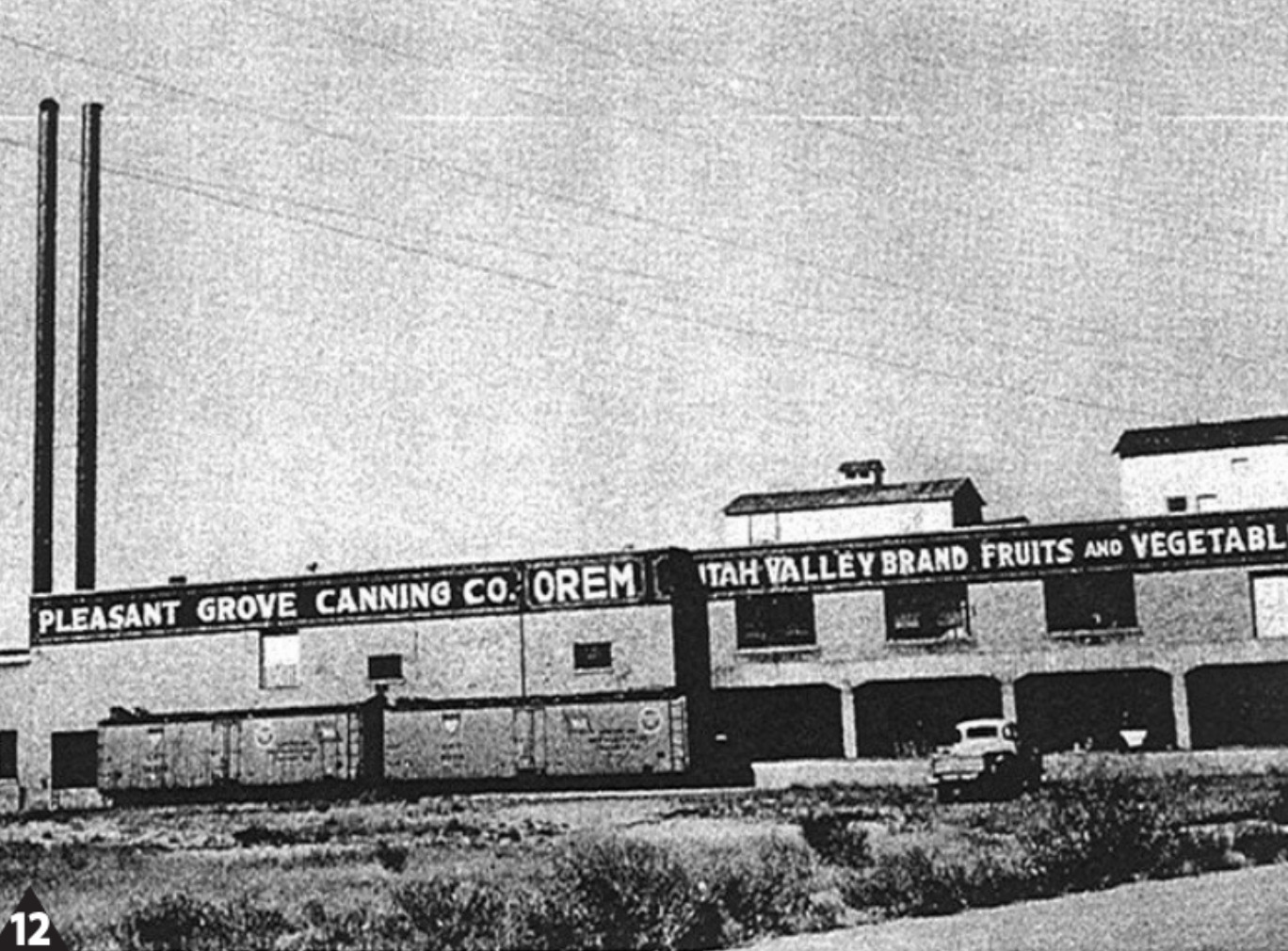
    <title type="html"><![CDATA[Pleasant Grove Canning Company]]></title>
    <summary type="html"><![CDATA[<p><strong><em>Although no longer standing, the Pleasant Grove Canning Company was once a thriving business, canning large quantities of locally-grown produce and distributing it to many places around the country.</em></strong></p><img src="https://www.intermountainhistories.org/files/fullsize/00b1f46b83a87cfaed7060d882876abc.jpg" alt="Pleasant Grove Canning Company" /><br/><p><span style="font-weight:400;">The Pleasant Grove Canning Company, established in 1919 in Orem, Utah, marked a significant milestone as the town’s inaugural major industry. The canning industry had been growing in the United States for about 50 years before the Pleasant Grove Canning Company was created. By the time it opened, the preservation of produce through canning had been perfected. In the 1930s, during the Great Depression, there was little industry in Utah County, but the canning company took in produce from local farmers and farmers of the Provo Bench, canning, among other things, 75,000 cases of tomato paste. The company sold the tomato paste to the Campbell Soup Company.  </span>
<span style="font-weight:400;">The canning company underwent substantial changes in subsequent years as the industry in the state evolved.  In 1960, the Pleasant Grove Canning Company merged with Ogden’s Utah Canning Company and it became known as the Orem Plant of Utah Packers. Eventually, the decision was made to sell the company. In 1972, the company was sold to Booth Distributing Inc. and they used the building as a warehouse. </span>
<span style="font-weight:400;">Over the ensuing decades, the building was sold multiple times to different owners. In 1992, the once-thriving structure had fallen into disrepair and deemed a hazard by the city of Orem. Consequently, in 1993, the building was demolished, leaving behind only memories and a historic marker commemorating the site of the former Orem landmark. </span></p><p><em><strong><a href="https://www.intermountainhistories.org/items/show/785">For more (including 3 images) view the original article</a></strong></em></p>]]></summary>
    <published>2024-02-26T20:24:10+00:00</published>
    <updated>2026-04-17T19:32:17+00:00</updated>
    <link rel="alternate" type="text/html" href="https://www.intermountainhistories.org/items/show/785"/>
    <id>https://www.intermountainhistories.org/items/show/785</id>
    <author>
      <name>Trevor Sites, Brigham Young University</name>
    </author>
  </entry>
  <entry>
    <title type="html"><![CDATA[Daniel Thomas and Orem&#039;s Mammoth]]></title>
    <summary type="html"><![CDATA[<p><strong><em>While digging to connect his home to city water, Orem resident Daniel Thomas made a fascinating discovery. First finding a “large ancient tooth” himself, Thomas later invited excavators from the University of Utah to his property. They unearthed a complete Columbian mammoth skull and skeleton. Today, this mammoth discovery continues to shape Orem city’s identity.</p></strong></p><img src="https://www.intermountainhistories.org/files/fullsize/46e5de08e7ca215c800c29b66ca73be6.jpg" alt="Cast of the Huntington Mammoth" /><br/><p><span style="font-weight:400;">Utah is home to rich fossil deposits that describe the greater natural history of the region. Lake Bonneville and its shoreline were home to a wide variety of plant and animal species, many now extinct. Columbian mammoths were a large species of mammoth and are cousins with the modern-day African elephant. These beasts roamed throughout Utah along the ever-changing Bonneville shoreline until their extinction thousands of years ago.</span>
<span style="font-weight:400;">Daniel Thomas, an Orem resident who lived in what is now known as the Cherry Hill neighborhood, began digging an irrigation trench in his yard in 1937. Thomas’s goal was to connect his home to the city’s new municipal water supply system. What he was not expecting to find, however, was a remnant of a Columbian mammoth. Thomas himself found “a large ancient tooth,” and soon after invited excavators from the University of Utah. They recovered a full skull and skeleton, and the remains are currently owned by the University of Utah and housed in the Utah Museum of Natural History collection. A city marker is displayed at the original excavation site, in front of The Paper Store and More, where the Thomas home used to be.</span>
<span style="font-weight:400;">Today, mammoths and this particular mammoth find are still celebrated in Orem city. The Orem City “All Together Playground,” which opened in 2016, features a mammoth skeleton painted onto one of its prominent play structures. More recently, in the fall of 2021, Orem city unveiled their mascot, Mero the Mammoth. Mero, whose name is Orem spelled backwards, is described as “Orem’s first resident,” hallmarking the unique natural history of the area. Mero makes appearances at city and community events. He also appears on a variety of city marketing, signage, and web pages. The use of a mammoth as Orem’s mascot today (named Mero) shows the city’s desire to remember their home’s natural history.</span></p><p><em><strong><a href="https://www.intermountainhistories.org/items/show/774">For more (including 4 images) view the original article</a></strong></em></p>]]></summary>
    <published>2024-01-22T03:14:13+00:00</published>
    <updated>2026-04-17T19:32:17+00:00</updated>
    <link rel="alternate" type="text/html" href="https://www.intermountainhistories.org/items/show/774"/>
    <id>https://www.intermountainhistories.org/items/show/774</id>
    <author>
      <name>Edward Patterson, Brigham Young University</name>
    </author>
  </entry>
  <entry>
    <title type="html"><![CDATA[Provo and Orem WWII Labor Camps: Japanese-American Internees<br />
]]></title>
    <summary type="html"><![CDATA[<p><strong><em>Due to war-time labor shortages, prisoners from the Topaz Internment Camp helped Orem and Provo farmers harvest fruit, amid discrimination. </p></strong></p><img src="https://www.intermountainhistories.org/files/fullsize/2cf7dddc066089ac665145de8968404b.jpg" alt="Plaque located at 950 North and 800 East Orem, Utah" /><br/><p>After the Japanese military bombed Pearl Harbor in 1941, some Americans feared that US citizens of Japanese descent might engage in espionage for Japan. This racially charged wartime hysteria led President Roosevelt to sign Executive Order 9066, which forced those of Japanese descent into prison camps across the country. One such camp was in Delta, Utah. It was known as the Topaz Relocation Center.  </p><p>World War II labor shortages increased as more Utah men joined military efforts, and state officials and Utah farmers sought workers to fill their places in designated labor camps to harvest various crops. Seeking work opportunities outside of the prison camp, many of Topaz’s  internees volunteered to work at these labor camps in the surrounding town of Delta and in the northern Utah towns of Provo and Orem. The Provo camp, located at Ninth South and Fourth East, housed 400 persons and consisted of a temporary tent city where local farmers hired Japanese workers to work on beet farms. The Orem labor camp, located at 950 North and 800 East, was a more permanent site with large barracks and cabins, administrative offices, a kitchen and mess hall, and outhouses. The internees worked in orchards of various kinds. In May of 1943, the first seventeen young men arrived in Utah County to work as farmhands. The Utah Farm Association eventually relocated these hired Japanese American workers to the permanent Orem site shortly after.  </p><p>Though farmers hired Japanese workers willingly, anti-Japanese sentiments continued among many Utah residents. In 1943, these sentiments culminated in a violent incident involving Japanese-American workers and some white Provo residents. On October 3rd, five white youth, with shotguns and .30 caliber rifles, gathered and opened fire on the Provo labor camp and on local Japanese homes. Three people were struck by pellets, but no one was seriously injured. The attack had been the third of the week, with two previous reports of white youth throwing stones at Japanese workers and quickly escaping in cars. The War Relocation board threatened to remove the workers, and thereby their desperately needed labor, if Provo residents could not tolerate and protect Japanese workers. The residents chose to protect the workers and keep their labor. The five youth were later arrested for their attack.</p><p>In the fall of 1944, German and Italian prisoners of war replaced Japanese American and immigrant workers at the Orem labor camp, ending the Topaz prisoners’ connections at the Orem labor camp. But today the Topaz prisoners’ important role in Utah farm labor is memorialized at the Orem Heritage Museum. Though a school now stands on the actual Orem camp site, a sign commemorates Japanese workers and the labor contributions they made to WWII-era agricultural efforts. Residents can visit these sites and see Topaz’s influence far beyond the internment camp in central Utah.</p><p><em><strong><a href="https://www.intermountainhistories.org/items/show/300">For more (including 3 images) view the original article</a></strong></em></p>]]></summary>
    <published>2019-02-13T10:52:38+00:00</published>
    <updated>2026-04-17T19:32:05+00:00</updated>
    <link rel="alternate" type="text/html" href="https://www.intermountainhistories.org/items/show/300"/>
    <id>https://www.intermountainhistories.org/items/show/300</id>
    <author>
      <name>Hannah Lee, Melodie Jackson, and Sarah AdamsBrigham Young University</name>
    </author>
  </entry>
  <entry>
    <title type="html"><![CDATA[United States Geneva Works<br />
]]></title>
    <summary type="html"><![CDATA[<p><strong><em> “In that maelstrom of dust, noise and menacing machinery it was like standing at the gates of hell.” -Mark Johnson</em></strong></p><img src="https://www.intermountainhistories.org/files/fullsize/ac548ab4e5ef31f5610bba09bd1afadb.jpg" alt="Provo/Orem Aerial view, ca. 1950" /><br/><p>Heading South on Interstate 15 towards Orem, UT, it’s hard to miss the massive, industrial-themed Harley-Davidson dealership, situated just across the street from where the colossal Geneva Steel Plant once stood. Much of the exterior material used to build the dealership was salvaged from the rubble of Geneva—one of Utah’s largest employers for decades—in an effort to preserve its memory. Since demolition in 2002, Geneva’s smokestacks no longer dominate the horizon, but its impact on Utah Valley’s fate remains profound. </p><p>In 1940, Orem had 2,914 inhabitants, most of whom lived on farms. Geneva Steel would drastically change Orem’s demographics within only a few years. As the United States’ involvement in World War II escalated, the US Federal government began sponsoring new steel mills to accelerate production. Orem was considered the perfect location, because not only was it far enough inland to be safe from foreign invasion, but it was also situated near deposits of coal and other natural resources essential for steel-making. </p><p>Columbia Steel constructed the plant and began operation in 1944, bringing thousands to the valley. By the end of the war, Orem’s population had more than doubled; the 1945 US Census reported a population of 8,351. The Great Depression had hit hard in Utah, and the prospect of over 4,000 new jobs at Geneva was a powerful beckoning call. One former Geneva worker, Ken Jolley, who was a young man at the time, recalls expanding his paper route to hundreds of people camped out in trailer homes, as there wasn’t enough permanent housing available to accommodate the dramatic influx of families to the valley. </p><p>Geneva’s operation continued long after the war, though it wouldn’t last forever. In 1946, U.S. Steel bought Geneva, and after 40 years, sold it to Utah investors. Many factors worked against Geneva—newer and more cost-effective technology was being used elsewhere, foreign competition was replacing American-made steel consumption, and heightened environmental awareness was lowering public approval of the plant. Eventually, Geneva was sold for the last time. Between 2002-2004, some of the equipment was shipped overseas to other steel mills, and the rest of the factory was demolished. </p><p>Today, all that physically remains of what was once an operation stretching over 1,750 acres is a motorcycle dealership using Geneva’s remains as its exterior. However, the impacts of Geneva’s steel production, both negative and positive, are still visible. Decades of air pollution and discharge of heavy metals into Utah Lake have been cause for scrutiny, and whether Geneva was detrimental to Utahns’ health has been a pivotal public debate.  However, the thousands of people who migrated to Utah Valley and stayed there have made it what it is today. Orem’s rapid shift from agricultural to residential, as well as much of its economic success, is attributable to the plant—born out of wartime necessity and years of labor by thousands of hard-working individuals. </p><p><em><strong><a href="https://www.intermountainhistories.org/items/show/82">For more (including 9 images) view the original article</a></strong></em></p>]]></summary>
    <published>2017-08-15T00:27:15+00:00</published>
    <updated>2026-04-17T19:31:59+00:00</updated>
    <link rel="alternate" type="text/html" href="https://www.intermountainhistories.org/items/show/82"/>
    <id>https://www.intermountainhistories.org/items/show/82</id>
    <author>
      <name>Aubrey Glazier, Brigham Young University</name>
    </author>
  </entry>
</feed>