<?xml version="1.0" encoding="UTF-8"?>
<feed xmlns="http://www.w3.org/2005/Atom">
  <title type="text">Intermountain Histories</title>
  <updated>2026-04-17T19:32:03+00:00</updated>
  <generator uri="http://framework.zend.com" version="1.12.20">Zend_Feed_Writer</generator>
  <link rel="alternate" type="text/html" href="https://www.intermountainhistories.org/"/>
  <link rel="self" type="application/atom+xml" href="https://www.intermountainhistories.org/items/browse?output=rss2"/>
  <id>https://www.intermountainhistories.org/</id>
  <author>
    <name>Intermountain Histories</name>
    <uri>https://www.intermountainhistories.org</uri>
  </author>
  <link rel="hub" href="https://pubsubhubbub.appspot.com/"/>
  <entry>
    <title type="html"><![CDATA[Eugene “Timp” Roberts’ Annual Timpanogos Hike<br />
]]></title>
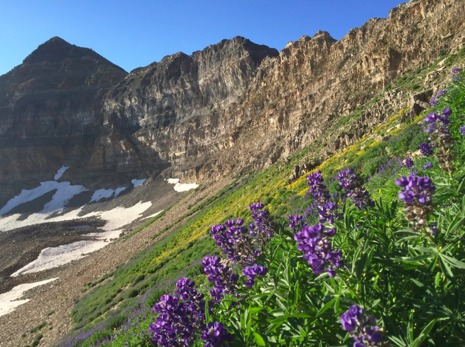
    <summary type="html"><![CDATA[<p><strong><em>Inspired by a vigil in the Alps, Brigham Young University’s annual Timpanogos hike, which began in 1912 and lasted for more than sixty years. Its organizer, Eugene “Timp” Roberts was BYU’s first director of physical education. The earliest hikes brought men and women together in an era when women were expected to remain indoors and allowed participants to feel equal on the face and summit of the mountain.</em></strong></p><img src="https://www.intermountainhistories.org/files/fullsize/0df951123b8ebf3e59b222f524b5434d.jpg" alt="Looking Towards the Summit of Mount Timpanogos" /><br/><p>Shortly after marrying Sytha Brown in 1906, Eugene L. Roberts and his newlywed bride decided to serve a mission for The Church of Jesus Christ of Latter-day Saints in the Swiss Alps. One evening, near Einsiedeln, Switzerland, Roberts watched as 5,000 worshipers, reverently holding candles in the darkness, made their way to a mountainside shrine. Roberts, who had been born in Provo in the shadow of Mount Timpanogos, observed the procession and envisioned a similar event for his hometown. After returning from Europe, Roberts organized the Timpanogos Hike in the summer of 1912.</p><p>In the hike’s first year, 19 students and faculty reached the 11,750-foot summit. In July 1918, the Department of Physical Education initiated an annual moonlight hike, and as the event grew, other institutions became involved, including the University of Utah, the Utah Agricultural College (known today as Utah State University), and the Wasatch Mountain Club. One historian noted that the “Timp hike was a ritual event, Provo’s town festival.” Roberts would have agreed. He wrote that the outing’s purpose was to climb the “Wasatch Giant under wholesome conditions, both physical and social.” He wanted the hike to be synonymous with a spiritual experience and hoped that it would elevate climbers’ spirits as they yielded themselves to mighty Mount Timpanogos. In 1957, four years after Roberts’s death, 1,297 hikers summited the mountain, a feat that attracted the attention of Sports Illustrated, which hailed Roberts’s pioneering vision. The writer stated Roberts “felt the Lord reveals himself to man powerfully in nature and that a stern climb in utter beauty would be spiritually good for anyone.” </p><p>Over time, the annual Timpanogos hike—as a result of its popularity among locals and out-of-towners—became harder to organize and was more taxing on the environment. In 1970, the Forest Service asked the university to discontinue the annual hike, but in 1984, Congress designated Mount Timpanogos as a wilderness area - a designation which limits hiking groups to a maximum of 15 individuals. Unfortunately, many groups violate this rule each hiking season. Known by many as “the best hike in Utah,” the mountain is still summited by many hikers, both young and old alike—albeit in smaller groups. They are captivated by its beauty, as was George H. Brimhall, the president of BYU who offered Roberts a job, and wrote in a poem:</p><p>Child of the earthquake featured by time</p><p>King of the Wasatch, majestic sublime;</p><p>Chieftain of Nature calling to art,</p><p>Boundless the raptures thy glories impart.</p><p>Emblem of progress, symbol of thrift,</p><p>Reaching for sunbeams and holding the drift;</p><p>A joy to behold thee, Mount of the West—</p><p>But, O, to ascend thee! to stand on thy crest! </p><p><em><strong><a href="https://www.intermountainhistories.org/items/show/215">For more (including 7 images) view the original article</a></strong></em></p>]]></summary>
    <published>2018-06-11T23:12:32+00:00</published>
    <updated>2026-04-17T19:32:03+00:00</updated>
    <link rel="alternate" type="text/html" href="https://www.intermountainhistories.org/items/show/215"/>
    <id>https://www.intermountainhistories.org/items/show/215</id>
    <author>
      <name>Marc Jonathan Wein, Brigham Young University</name>
    </author>
  </entry>
  <entry>
    <title type="html"><![CDATA[The Bomber Peak Crash Site]]></title>
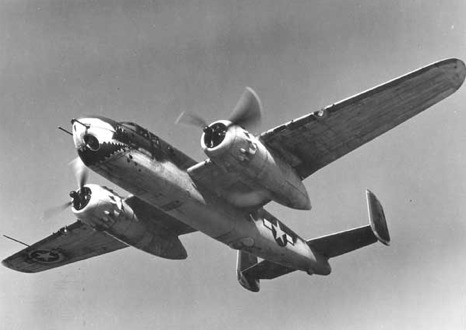
    <summary type="html"><![CDATA[<p><strong><em>When a 1955 storm blanketed the Wasatch Mountains in eighteen fresh inches of snow, a U.S. Air Force pilot lost control of his B-25 and crashed into eastern flank of Mount Timpanogos. Although search parties were sent, no survivors were found. Decades later, remnants of the aircraft can still be seen by hikers.</em></strong></p><img src="https://www.intermountainhistories.org/files/fullsize/93bc4a8d2af66f16d61117bfdde2ee4a.jpg" alt="World War II era bomber, similar in design to the one that crashed on Timpanogos.

" /><br/><p>On March 9, 1955, a World War II-era B-25 bomber took off in Great Falls, Montana, refueled at Hill Air Force Base in Ogden, and attempted to cross the Wasatch Mountains as it made its way towards a base in Riverside, California. In snowy conditions blanketing the area, an unknown series of events led to the plane crashing around 7:30 p.m. Although the wreckage was found the following day, avalanche threats prevented an immediate rescue. Local hikers were the first to reach the crash site, where they discovered scattered body parts and the bomber’s deceased pilot, who was “fastened into his seat . . . apparently in an upright position, but was decapitated.”  </p><p>The next day, volunteers searched through the wreckage and snow until they found four of the bodies on March 15. The fifth and last body was not recovered until May 30, more than two and a half months after the crash. Sometime in June, two residents from Alpine rode horses up the canyon and found tattered pajamas, smaller fragments from the wreckage, and several body parts, “including one whole leg with red hair.” Later in the summer, the Air Force contracted a man from Lindon to recover anything from the crash that was small enough to carry. After scavenging through the wreckage, the man burned larger pieces of the aircraft with gasoline. A few weeks later, green paint was covered on the wreckage “so other search planes wouldn’t confuse it for other downed crafts.”</p><p>The five men killed were Major Daniel C. Holley (pilot, 33-years-old, Springfield, MA), 2nd Lieutenant Howard E. St. John, Jr. (co-pilot, 25-years-old, Mendham, NJ), Airman 2nd Class Doyle H. Dempsey (engineer, 22-years old, Hawkins, TX), Donald R. Cubbage (civilian engineer, 45-years-old, Great Falls, MT), and Maurice J. McNalty (civilian engineer, 30-years-old, Wyoming). Those who summit Mount Timpanogos hike past the peak where those men died, and in the summers hikers can see large radial motors situated among the wildflowers. The wilderness scenery is beautiful, but what remains of the wreckage reminds passerby of the deadly power of winter in Utah’s Wasatch Mountains. </p><p><em><strong><a href="https://www.intermountainhistories.org/items/show/211">For more (including 3 images) view the original article</a></strong></em></p>]]></summary>
    <published>2018-06-08T17:50:51+00:00</published>
    <updated>2026-04-17T19:32:03+00:00</updated>
    <link rel="alternate" type="text/html" href="https://www.intermountainhistories.org/items/show/211"/>
    <id>https://www.intermountainhistories.org/items/show/211</id>
    <author>
      <name>Marc Jonathan Wein, Brigham Young University</name>
    </author>
  </entry>
</feed>