<?xml version="1.0" encoding="UTF-8"?>
<feed xmlns="http://www.w3.org/2005/Atom">
  <title type="text">Intermountain Histories</title>
  <updated>2026-04-17T19:32:19+00:00</updated>
  <generator uri="http://framework.zend.com" version="1.12.20">Zend_Feed_Writer</generator>
  <link rel="alternate" type="text/html" href="https://www.intermountainhistories.org/"/>
  <link rel="self" type="application/atom+xml" href="https://www.intermountainhistories.org/items/browse?output=rss2"/>
  <id>https://www.intermountainhistories.org/</id>
  <author>
    <name>Intermountain Histories</name>
    <uri>https://www.intermountainhistories.org</uri>
  </author>
  <link rel="hub" href="https://pubsubhubbub.appspot.com/"/>
  <entry>
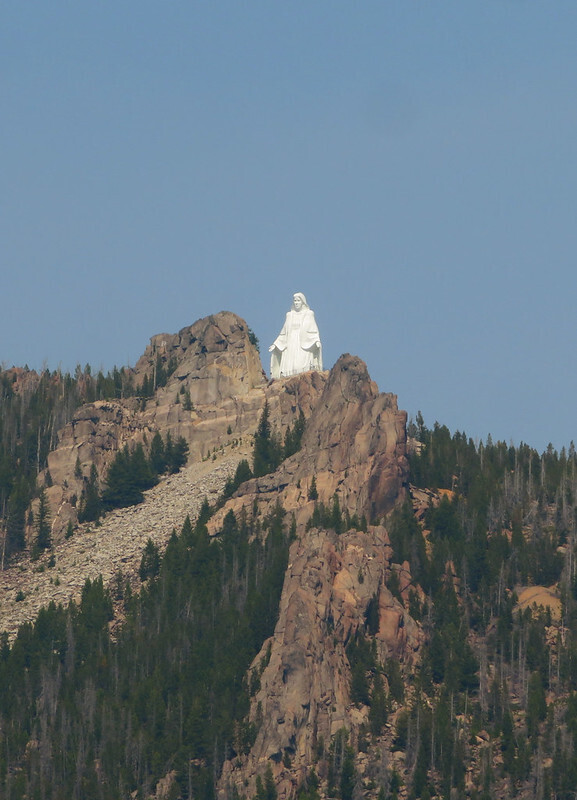
    <title type="html"><![CDATA[Our Lady of the Rockies]]></title>
    <summary type="html"><![CDATA[<p><strong><em><em>Our Lady of the Rockies </em>looks out across the city of Butte, Montana with arms stretched wide from a vantage of some 3,500 feet above the city, and weighing over 50 tons.</em></strong></p><img src="https://www.intermountainhistories.org/files/fullsize/c4ae7467ddb2ea3d296e2b06e342e9ae.jpg" alt="Our Lady of the Rockies. " /><br/><p>The statue project began with Bob O’Bill, who, in 1979 made a plea with God in hopes that his bed-ridden wife Joyce would make a full recovery. When she did, O’Bill began to discuss with his peers the logistics of building the statue. As word spread about the building project, an overwhelming amount of support arose, making the statue a community project. The initial plan for the six-foot statue with community support soon grew to a project that would be over 90 feet tall. Though some thought that the project was strictly Catholic, project sponsors took care to present it as a community effort which symbolized “the dignity of motherhood and the sacrificial love a mother has for her child.” Community pride has always been strong in Butte, extending back in Butte's mining history in the 19th century. Whenever the future was uncertain, the community of Butte banded together and cared for each other. This bond and the meaning behind the statue are both driving factors in what makes Butte’s community so special. </p><p>Supplies including paint, food for workers, and enough iron and steel to build the statue, were all gifted to the project by donors. A major contributor to the project, Joe Roberts, was connected to O’Bill through Ann Nettles, who knew Joe to be a guy whot took up outlandish projects. Once he familiarized himself with the project and got over how crazy he thought it to be, Robert’s Rocky Mountain Equipment Co. discussed a plan to put up the statue, ensuring that it was done safely with high stability. Roberts grew to have a major role in the project, raising funds, donating the use of his equipment, and even providing one thousand dollars to start off the construction fund. From there the community took care of the rest. </p><p>After six years of trouble-shooting technical difficulties, the statue was finally ready to assemble on the mountain top. On December 17, 1985, the statue was lifted in four sections by the Nevada Air National Guard Team and assisted by the Army Reserve stationed in Butte, as well as the Montana National Guard. Today Our Lady of the Rockies continues to show civic generosity through the volunteers that keep the statue up and running so that it may be able to show hope and optimism to inspire generations to come.</p><p><em><strong><a href="https://www.intermountainhistories.org/items/show/862">For more (including 4 images) view the original article</a></strong></em></p>]]></summary>
    <published>2024-10-18T13:00:52+00:00</published>
    <updated>2026-04-17T19:32:19+00:00</updated>
    <link rel="alternate" type="text/html" href="https://www.intermountainhistories.org/items/show/862"/>
    <id>https://www.intermountainhistories.org/items/show/862</id>
    <author>
      <name>Logyn J. Klebe, Rocky Mountain College</name>
    </author>
  </entry>
  <entry>
    <title type="html"><![CDATA[“A Path Forward”: Celebrating Women&#039;s Suffrage in Utah]]></title>
    <summary type="html"><![CDATA[<p><strong><em>“A Path Forward” was built in 2020 in Salt Lake City, Utah, to celebrate 150 years since women first voted in Utah, and 100 years since the 19th Amendment gave women throughout the United States the right to vote. The memorial, located near the Utah State Capitol, highlights women’s suffrage leaders and movements for women’s rights in Utah, in the United States, and for women of color. </em></strong></p><img src="https://www.intermountainhistories.org/files/fullsize/1854c046bfba836fd7f45e298b4376f2.jpg" alt="Archways" /><br/><p>On February 14, 1870, Seraph Young voted in Utah two days after Utah’s territorial legislature granted women the right to vote. She was, in the words of <i>Better Days 2020</i>, the "first woman to vote under a women’s equal suffrage law" in the United States. Six months later, women in Utah had the opportunity to vote in the general election that took place. The hope for equality for women in Utah and the United States was on the horizon.
However, seventeen years later, the United States federal government revoked the voting rights of Utah women as part of the anti-polygamy Edmunds–Tucker Act of 1878, which disfranchised all women in Utah, including whether or not they Latter-day Saints. However, Utah’s women continued to campaign for their voting rights. In 1894, just four years after the practice of polygamy officially ended in the Church of Jesus Christ of Latter-Day Saints, the United States passed the Enabling Act, which invited Utah to apply for statehood. Utah became a state in 1896, and the constitutional convention included Article Four in the state constitution, which granted women the right to vote and hold office. Twenty-four years later, in 1920, Congress finally granted women across the United States the right to vote with the ratification of the 19th Amendment.
The fight for women’s rights in America did not end here. Other acts were passed through the years that protected and enforced voting rights for women of color. For example, the Voting Rights Act of 1965 secured African Americans’ right to.
The memorial “A Path Forward” takes visitors through a timeline of these milestones of women’s suffrage in Utah and the United States. Tourists first follow footsteps engraved on the ground of the monument honoring Seraph Young as the first woman to vote in a United States election. Next to the footsteps is a sculpted table displaying the Enabling Act. Article 4 of the Utah Constitution is etched on the ground next to the table. A series of arches, each one progressively wider than the previous, represents the expansion of women’s suffrage rights. The first arch includes quotes from suffragists who played a significant role in the women’s suffrage movement including Sojourner Truth, Emmeline B. Wells, Martha Hughes Cannon, Susan B. Anthony, and many more. Emmeline B. Wells wrote in her journal, “I desire to do all in my power to help elevate the condition of my own people, especially women.” The “A Path Forward” monument honors courageous suffragists who, like Wells, fought for women’s right to vote. Today, we have the opportunity to honor them and their valiant efforts.</p><p><em><strong><a href="https://www.intermountainhistories.org/items/show/561">For more (including 3 images) view the original article</a></strong></em></p>]]></summary>
    <published>2021-12-18T06:45:38+00:00</published>
    <updated>2026-04-17T19:32:12+00:00</updated>
    <link rel="alternate" type="text/html" href="https://www.intermountainhistories.org/items/show/561"/>
    <id>https://www.intermountainhistories.org/items/show/561</id>
    <author>
      <name>Kate Hill, Brigham Young University</name>
    </author>
  </entry>
  <entry>
    <title type="html"><![CDATA[Galena–Soo’nkahni Preserve &amp; Sundial ]]></title>
    <summary type="html"><![CDATA[<p><strong><em>Along the banks of the Jordan River there is a 252-acre preserve that protects ancient artifacts and lands of tribes that once inhabited the area. Within the preserve is a monument, designed as a natural sundial, that honors all of Utah’s Native American tribes. </em></strong></p><img src="https://www.intermountainhistories.org/files/fullsize/8be27fa24032daf27fa7e33649d058c4.jpg" alt="Galena Soo’nkahni Preserve" /><br/><p>During a land survey conducted in 1991, remnants of an ancient Native American village were found in the Draper, Utah area along the Jordan River.  Stone tools, weapons, corn, animal bones, and the remains of two ancient dwellings were discovered in the area, some of which dated back to Archaic Period between 800 and 480 BC. The artifacts suggest those living in the 3,000-year-old village were corn farmers. Archeologists believe this is one of the earliest known locations of corn farming in the Great Basin.
In 2009, 252 acres were set aside to preserve and protect the wetland and wildlife in the area as well as conserve its cultural heritage. Jason Walker, chairman of the Northwestern Band of Shoshone, described said his ancestors roamed the area and described the land as sacred. The preserve was named Galena Soo’nkahni, which is Shoshone for “many dwellings.” It is protected by Utah Open Lands and managed by the Utah Department of Forestry, Fire and State Lands.
To pay homage to the former inhabitants of the area, as well as all Native American tribes in Utah, the the state’s eight indigenous tribes and the Utah Division of Indian Affairs partnered to create a memorial was constructed in the preserve, which they dedicated in March 2015. Utah Transit Authority, who had planned to build a FrontRunner station on the preserve before it was protected in 2009, donated money for the monument to demonstrate their commitment to recognizing cultural landmarks. The memorial is a natural sundial, with 8 posts for each of the Utah tribes: Skull Valley Band of Goshute, Northwestern Band of the Shoshone Nation, Ute Indian Tribe, Navajo Nation, Ute Mountain Ute Tribe, San Juan Southern Paiute Tribe, Paiute Indian Tribe, and Confederated Tribes of the Goshute Reservation. Each post has information on a tribe and sits in the direction that best matches the tribe’s location in Utah.
The monument and preserve hold deep significance for many Native Americans today as it honors their ancestors and provides an opportunity for others to learn about Utah’s tribes. At the monument’s dedication, Shirley Silversmith, director of the Utah Division of Indian Affairs, said, “We don’t want them to be forgotten,” she said. “We have to have a way to remember that our ancestors lived here.”</p><p><em><strong><a href="https://www.intermountainhistories.org/items/show/557">For more (including 3 images) view the original article</a></strong></em></p>]]></summary>
    <published>2021-12-18T02:57:25+00:00</published>
    <updated>2026-04-17T19:32:12+00:00</updated>
    <link rel="alternate" type="text/html" href="https://www.intermountainhistories.org/items/show/557"/>
    <id>https://www.intermountainhistories.org/items/show/557</id>
    <author>
      <name>Bethany Erickson, Brigham Young University</name>
    </author>
  </entry>
  <entry>
    <title type="html"><![CDATA[Fossil Butte]]></title>
    <summary type="html"><![CDATA[<p><strong><em>Congress created Fossil Butte National Monument on October 23, 1972 to protect exceptionally rare paleontological sites and other geographical phenomena in southwestern Wyoming near Kemmerer. Fossil Butte is the site of a 50-million-year-old lakebed from the Eocene Epoch within the Green River Formation.</em></strong></p><img src="https://www.intermountainhistories.org/files/fullsize/7280e502631197b6e088eb0694915fa6.jpg" alt="Fossil Butte National Monument" /><br/><p>Dubbed “America’s Aquarium in Stone” by the National Park Service, Fossil Butte is exceptional because it has many well-preserved fossils, especially those of aquatic animals. It is considered by researchers to be one of the richest paleontology sites on earth. Paleontologists have recovered fossils of crustaceans, gars, stingrays, plankton, crocodiles, turtles, bivalves, and birds, among many others, preserved for 56 to 34 million years. Fossil Butte used to be the smallest of three prehistoric lakes from the Eocene Epoch in what is now southwest Wyoming, northeast Utah, and northwest Colorado, collectively known as the Green River Lake System. The bottom of the lake is thought to have contained hydrogen sulfide, which is poisonous, which prevented fish from scavenging off of the lake bottom. When an animal in the lake died, it sank to the bottom of the lakebed and remained undisturbed, eventually to be covered and preserved beneath the mud. Fossil Butte is also famous for fossils of mass mortalities, where many fish all died at the same time and became fossilized next to each other. This could be caused by a variety of factors like seasonal changes in water salinity or PH. It is likely as well that the hydrogen sulfide became disturbed from time to time and caused poisonings.
Though some explorers like Ferdinand V. Hayden and John C Frémont already knew about the fossil beds in this area, the full extent of Fossil Butte’s paleontological significance wasn’t understood until the late 1860s. The Union Pacific Railroad’s construction passed through the formation, and railroad workers showed fossils to paleontologists. One collector, Robert Craig, began quarrying fossils there in 1897. The site gained interest from museums around the world for its richness in high-quality fossils. As a result of this fame, Congress created the Fossil Butte National Monument in 1972 to preserve some of it for public viewing.
The visitor center of the Fossil Butte National Monument Visitor Center has over eighty fossils on display of various types of prehistoric aquatic creatures, as well as a variety of prehistoric bats, birds, plants, and insects. The center shows a thirteen-minute video to inform visitors about the discoveries paleontologists have made within the site. Visitors are allowed to make their own “fossil imprints” as souvenirs and access an educational computer program about fossils and the natural history of the monument.</p><p><em><strong><a href="https://www.intermountainhistories.org/items/show/514">For more (including 6 images) view the original article</a></strong></em></p>]]></summary>
    <published>2021-10-15T07:17:23+00:00</published>
    <updated>2026-04-17T19:32:11+00:00</updated>
    <link rel="alternate" type="text/html" href="https://www.intermountainhistories.org/items/show/514"/>
    <id>https://www.intermountainhistories.org/items/show/514</id>
    <author>
      <name>Jacob French, Northern Arizona University</name>
    </author>
  </entry>
  <entry>
    <title type="html"><![CDATA[Dinosaur National Monument]]></title>
    <summary type="html"><![CDATA[<p><strong><em>Dinosaur National Monument is a fossil bone quarry where visitors can see fossilized remains still fixed in the rocks. Petroglyphs show earlier human culture, and scenic views and river canyons provide opportunity for sightseeing and recreation.</em></strong></p><img src="https://www.intermountainhistories.org/files/fullsize/cd482b8e85c65dadfd0f3837400f9d44.jpg" alt="The wall of bones" /><br/><p>Earl Douglass was a paleontologist working at Carnegie Museum in Pittsburgh, Pennsylvania. In 1909, Douglass traveled to Utah to look for dinosaur fossils. Years before, he had nearly completed an entire Diplodocus skeleton from Wyoming. The Pennsylvania public loved it, so he was eager to find more fossils for Carnegie Museum. He and his workers excavated thousands of dinosaur fossils at Dinosaur National Monument beginning in 1909 while doing work for the museum. The site near Vernal, Utah, quickly gained worldwide renown for its paleontological research potential. President Woodrow Wilson established the fossil beds as a national monument in 1915. Besides dinosaurs, the site shows culture from past civilizations. Prior to the fourteenth-century, the Fremont people inhabited the region. They left ceramic artifacts, petroglyphs, and pictographs which visitors today can still see.
The Wall of Bones is perhaps the most interesting feature of Dinosaur National Monument. It is a cliff wall with more than 1,500 dinosaur fossils from the late Jurassic period still embedded in the rock. Guests are even permitted to touch the fossils themselves. Another feature is the Quarry Exhibit Hall, the location where Douglass first discovered multiple fossils in 1909. It has fossils, footprints, and exceptionally rare specimens like a fossilized juvenile Stegosaurus.
Dinosaur National Monument provides ample opportunity for sightseeing and recreation. Adventure-seekers can whitewater raft down the Green River and see the towering landmark Steamboat Rock while they appreciate the scenery of the canyons and valleys. They can choose private or commercial rafting trips, which can be as short as a day or as long as a week. Dinosaur National Monument was also made into an International Dark Sky Park by the International Dark-Sky Association. This limits light pollution to allow for better star-gazing. Visitors can camp at one of six different campgrounds, or choose to explore the wilderness to find their own camp site. Dinosaur National Monument contains many miles of hiking trails along rivers, through canyons, and across vast expanses. Picnic areas are available throughout the monument, as well as at the Quarry Visitor Center, Canyon Visitor Center, and the Josie Morris Ranch.</p><p><em><strong><a href="https://www.intermountainhistories.org/items/show/512">For more (including 4 images) view the original article</a></strong></em></p>]]></summary>
    <published>2021-10-15T06:22:17+00:00</published>
    <updated>2026-04-17T19:32:10+00:00</updated>
    <link rel="alternate" type="text/html" href="https://www.intermountainhistories.org/items/show/512"/>
    <id>https://www.intermountainhistories.org/items/show/512</id>
    <author>
      <name>Jacob French, Northern Arizona University</name>
    </author>
  </entry>
  <entry>
    <title type="html"><![CDATA[Helena, Montana’s Confederate Memorial Fountain]]></title>
    <summary type="html"><![CDATA[<p><strong><em>For more than a century, the Confederate Memorial Fountain in Helena, Montana was one of the country’s northernmost Confederate monuments. But when racial violence in the former Confederacy rippled across the nation, the effects reached Helana’s distant fountain as well.</em></strong></p><img src="https://www.intermountainhistories.org/files/fullsize/faadbd52b5715f201d8facc259ac4c22.jpg" alt="Confederate Memorial Fountain" /><br/><p><span style="font-weight:400;">On the late summer evening of September 6, 1916, Montana’s capital city of Helena formally unveiled and dedicated its newest landmark: a $2,000 fountain gracing the highest hill of a city park. George H. Carsley, known as “the architect of Helena,” designed the fountain and made it from native Montana granite.</span>
<span style="font-weight:400;">Even though it was a monument in Montana, it did not memorialize anyone from the Big Sky State. Instead, carved into the side were the words, “A Loving Tribute to Our Confederate Soldiers.” Helena’s local chapter of the United Daughters of the Confederacy—three members strong with Mrs. Aiken, Mrs. Read, and Gertrude “Georgia” C. Young—had fundraised for the fountain since 1903 and donated it to the city. In a dedicatory speech, Young said the fountain was the Daughters’ gift to their new home, and she praised the city’s American spirit of unity in which there were no bad feelings between the American North and South. “On behalf of the Daughters of the Confederacy,” she concluded, “I present this fountain to the city of Helena as a token of our esteem toward our new home.”</span>
<span style="font-weight:400;">City attorney Edward Horsky declared, “Helena is pleased and honored to accept this substantial and beautiful donation.” Horsky added that the fountain would “long keep bright the memory” of its donor, the United Daughters of the Confederacy.</span>
<span style="font-weight:400;">Although fifty years removed from the Civil War, the nation was in the middle of a decades-long movement to memorialize the Confederacy. Helena’s fountain was one of hundreds of memorials built and dedicated in the first half of the twentieth century (see tour introduction for “Confederate Imagery in the Intermountain West”). At the same time that more and more Confederate monuments dotted the nation, the Ku Klux Klan also resurged in activity and membership nationwide, including in Helena, terrorizing Black Americans.</span>
<span style="font-weight:400;">Aiken, Read, and Young fundraised for and built the Confederate Memorial Fountain against this backdrop, reifying White reconciliation and undermining Black experiences under the chattel slavery the Confederacy promoted. And though they gave Helena a memorial for Confederate soldiers, the city built no Civil War monument for Union soldiers thereafter, whether Black or White, even though there were Union veterans who lived in Helena, including the architect Carlsey himself.</span>
<span style="font-weight:400;">Nearly one hundred years later, on June 17, 2015, a white supremacist gunman murdered nine Black Americans at Emanuel African Methodist Episcopal Church in Charleston, South Carolina. The shock rippled across the United States, reaching Helena and prompting residents to scrutinize their fountain more critically. The Helena City Commission asked the county Heritage Tourism Council to design a sign with contextualizing history to place near the fountain.</span>
<span style="font-weight:400;">By August, heritage preservation officer Pam Attardo proposed a text which explained how Confederate memorials were tools in “the South’s quest for vindication after the Civil War.” The proposed sign even mentioned the United Daughters’ influence on school textbooks and curriculum.</span>
<span style="font-weight:400;">However, the city discovered that a sign large enough to accommodate Attardo’s text legibly would have to be massive, and the project stalled. For two years, Attardo checked in with city officials every few months to no avail while the Heritage Tourism Council waited for the city to approve the sign.</span>
<span style="font-weight:400;">In the wake of violence and death at the August 12, 2017 Unite the Right Rally in Charlottesville, Virginia, Confederate markers returned to the national conversation and to Helena. On August 15, the American Indian Caucus of Montana’s state legislature issued a call to remove the fountain entirely, and other advocates joined the call.</span>
<span style="font-weight:400;">On August 16, the City Commission held a hearing to decide the fountain’s fate. About forty Helena residents spoke, both for and against removal. Some Helenites claimed removing the fountain would disgrace history, though Montana blogger Don Pogreba wryly observed that such “passionate regard for history… seemed to be lacking when… the Montana Historical Society’s funding was under debate” several months earlier. In the end, the Commission directed city workers to remove the fountain on August 18. For lack of better storage, the city moved it to an undisclosed field where it remains.</span>
<span style="font-weight:400;">In February 2018, local civil rights advocate Ron Waterman began raising money to replace the now-gone fountain with a new monument: an Equity Fountain dedicated to equality and compassion. The grassroots campaign fundraised, called for designs, and met with the Public Arts Committee. In January 2019, the City Commission voted unanimously to accept the Equity Fountain as a donation, and in April 2020 the city installed it. Once again, Helena was “pleased and honored to accept” a “substantial and beautiful donation.”</span></p><p><em><strong><a href="https://www.intermountainhistories.org/items/show/493">For more (including 4 images) view the original article</a></strong></em></p>]]></summary>
    <published>2021-09-18T05:48:51+00:00</published>
    <updated>2026-04-17T19:32:10+00:00</updated>
    <link rel="alternate" type="text/html" href="https://www.intermountainhistories.org/items/show/493"/>
    <id>https://www.intermountainhistories.org/items/show/493</id>
    <author>
      <name>Makoto Hunter, Brigham Young University</name>
    </author>
  </entry>
  <entry>
    <title type="html"><![CDATA[The Icelander Lighthouse Monument of Spanish Fork: A Tribute to Icelandic Settlers]]></title>
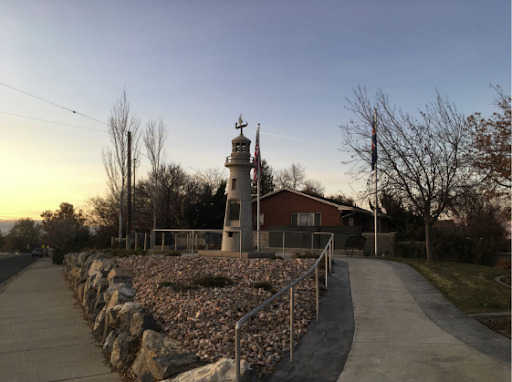
    <summary type="html"><![CDATA[<p><strong><em>A lighthouse monument was erected in Spanish Fork in 1938 to honor the first sixteen permanent Icelandic settlers in the United States. These immigrants came to Utah in 1855 after converting to the Church of Jesus Christ of Latter-day Saints.  </em></strong></p><img src="https://www.intermountainhistories.org/files/fullsize/20df20e0ba5f6d47d3afd8ebd282bad9.jpg" alt="Lighthouse Broad Perspective" /><br/><p>The lighthouse monument in Spanish Fork, Utah, was erected in 1938 to honor the original Icelandic pioneers, the first permanent settlers from that country, who immigrated into the United States in 1855. The monument is a celebration of Icelandic culture and customs. It also celebrates the bravery of those first Icelandic pioneers who crossed the Atlantic in 1854 after their conversion to the Church of Jesus Christ of Latter-day Saints. The structure was unveiled as part of the “Iceland Day” celebrations in 1938. The monument is a miniature lighthouse replica with a Viking ship on the top that references the seafaring for which the Vikings, the Icelanders’ ancestors, were best known. A plaque, which carries the names of the first sixteen Icelandic settlers, accompanies the monument. The first Iceland Day took place in Utah in 1897 to commemorate the settlement of Iceland in 870 CE. Every year from this point on, Iceland Day has been celebrated on the same day as the annual holiday in the Westmann Islands (Vestmannaeyjar), Iceland, from which the first Icelandic pioneers came. </p><p>This monument is a hallmark that has helped foster ever-improving relationships between the Church of Jesus Christ and the Icelandic government. The improving relations made it possible for the Church to renew their missionary efforts in Iceland after not having a permanent presence in the country for over 50 years. In 1975, Bryon T. Geslison and his family would be the first missionaries since 1914 called to serve in Iceland. Because of the missionary efforts initiated by Geslison and his family, the Icelandic government officially recognized the missionary work of the Church in 1983. Ever since then, the relations between the Icelandic government and the Church of Jesus Christ have been very positive and friendly. The importance of the monument has been recognized by local representatives of Utah who, in 2005, started a makeover project to make this monument more similar to one that was erected in the Westmann Islands, Iceland in 2000. The monument in Iceland was erected by the local government to honor the brave men who faced the harsh weather, sea, and other difficulties and emigrated to Utah after “hearing the call to build Zion.” </p><p>Some of the new features of the lighthouse monument in Spanish Fork include a rock brought from the shores of Vestmannaeyjar, where the first pioneers were baptized; bronze plaques that retell the history of Icelanders in Utah; and, a granite monument that lists the names of over 400 Icelanders who settled in Utah between 1855 and World War I. The renewed project was dedicated by President Gordon B. Hinckley, then the president of the Church of Jesus Christ, who commemorated the culture and faith of the Icelandic settlers in his speech</p><p><em><strong><a href="https://www.intermountainhistories.org/items/show/427">For more (including 3 images) view the original article</a></strong></em></p>]]></summary>
    <published>2020-10-07T03:59:58+00:00</published>
    <updated>2026-04-17T19:32:08+00:00</updated>
    <link rel="alternate" type="text/html" href="https://www.intermountainhistories.org/items/show/427"/>
    <id>https://www.intermountainhistories.org/items/show/427</id>
    <author>
      <name>Jessyca K. O. Zanetti, Brigham Young University</name>
    </author>
  </entry>
  <entry>
    <title type="html"><![CDATA[Navajo Code Talker Monument]]></title>
    <summary type="html"><![CDATA[<p><strong><em>This monument honors the Navajo young men who used their Native language on behalf of the United States of America to transmit coded messages during World War II. Their contributions proved to many the importance and value of preserving native culture.</em></strong></p><img src="https://www.intermountainhistories.org/files/fullsize/c32297ab11f821ec3c0e513dc1a57bfe.jpg" alt="Navajo Code Talker Memorial" /><br/><p>Early in World War II, the Japanese managed to break every military code transmitted throughout the Pacific Ocean. As a result, U.S. military officials wrestled with the problem of creating an unbreakable code. After the failure of many pilot programs featuring various native tongues, Philip Johnston suggested the Navajo language. Johnston grew up on the Navajo reservation with his missionary family and was one of the few non-Navajos to fluently speak the language. Johnston encouraged the United States Marine Corps to involve the Navajos and supported the development of the Navajo Code Talker program.</p><p>The pronunciation and specific use of words in the Navajo language is fundamentally impossible to master as an adult. Many descriptive words sound the same and are only differentiated by an exchange of tone; this aspect of the Navajo language ensured a protected transference and translation of a message to its target. In 1940, fewer than thirty people outside the Navajo tribe knew the language, and the isolation of the Navajo reservation helped preserve its exclusivity. </p><p>Prior to World War II and directed by government treaties, many Navajo children attended boarding schools near the reservation, learned English, and were forbidden to use the Navajo language. Although an unplanned benefit, minimizing the use of this native language meant that very few people knew or spoke it, an effect that persuaded the Marine Corps to recruit young Navajos to serve in areas throughout the Pacific Ocean during the war. These young men learned how to use their language as a code for use in combat procedures. As the first 29 Navajo recruits completed bootcamp, they began developing the combat code at Camp Elliot. The unique nature of this descriptive yet ambiguous language made it unbreakable. The Navajo Code Talkers succeeded so well at transmitting and interpreting messages that even U.S. cryptographers could not understand the code, successfully frustrating Japanese translation efforts. The United States accomplished a favorable victory during World War II with the help of the Navajo Code Talkers.   </p><p>The young men who participated as Navajo Code Talkers honored the Navajo Nation by responding to the need of the United States and completing the required responsibility. The account of their achievements remained secret for decades after World War II due to the government’s confidential policies. In the late 1960s, the United States declassified the topic of the Navajo Code, which allowed Navajo Code Talkers to share their experiences with their families and the nation. In 2010, famous Navajo Ute sculptor Oreland Joe designed and erected the Navajo Code Talker Monument near Window Rock, Arizona. It serves as a tribute to the Navajo Code Talkers who sacrificed and secured victory for the United States. </p><p><em><strong><a href="https://www.intermountainhistories.org/items/show/405">For more (including 3 images) view the original article</a></strong></em></p>]]></summary>
    <published>2020-03-11T23:49:29+00:00</published>
    <updated>2026-04-17T19:32:08+00:00</updated>
    <link rel="alternate" type="text/html" href="https://www.intermountainhistories.org/items/show/405"/>
    <id>https://www.intermountainhistories.org/items/show/405</id>
    <author>
      <name>Crystal Stewart, Brigham Young University</name>
    </author>
  </entry>
  <entry>
    <title type="html"><![CDATA[Veterans of Indian Wars Memorial: While the statue atop the Veterans of Indian Wars Memorial in Provo is rumored to be a mass-produced Union soldier, it was actually carved by a local artist. ]]></title>
    <summary type="html"><![CDATA[<img src="https://www.intermountainhistories.org/files/fullsize/098bc07643f98611856fd3731515ad04.jpg" alt="The Veterans of Indian Wars Memorial" /><br/><p>The Veterans of Indian Wars Memorial, located on the southwest corner of the intersection of 500 West and Center Street in Provo, UT, was constructed by the Sons of the Utah Pioneers and unveiled July 24, 1909.  The memorial is dedicated to the original settlers of Provo and residents who fought in Utah's Indian Wars from 1850 to 1868. These wars included the Walker War, the Battle of Provo River, and other conflicts. The northeast plaque lists twenty-eight individuals and thirteen families as original settlers of Provo in 1849. The southeast, southwest, and northwest plaques list 121 veterans of the Indian Wars. </p><p>There is a story in circulation that a New England company mass produced stock Civil War memorial statues in 1908 in preparation for the fiftieth anniversary of the war in 1911 and that the statue on top of the Provo Indian Wars Memorial is one of these (a statue of a Union soldier).  However, this rumor is untrue. "Victory," the statue that rests atop the memorial, was sculpted by Cyrus Edwin Dallin, renowned sculptor, native of Springville, and creator of The Angel Moroni statue that was placed on the LDS Salt Lake Temple spire.</p><p><em><strong><a href="https://www.intermountainhistories.org/items/show/193">For more (including 7 images) view the original article</a></strong></em></p>]]></summary>
    <published>2018-05-31T18:15:07+00:00</published>
    <updated>2026-04-17T19:32:02+00:00</updated>
    <link rel="alternate" type="text/html" href="https://www.intermountainhistories.org/items/show/193"/>
    <id>https://www.intermountainhistories.org/items/show/193</id>
    <author>
      <name>Jerron Orton, Brigham Young University</name>
    </author>
  </entry>
  <entry>
    <title type="html"><![CDATA[The Hellenic Historic Monument]]></title>
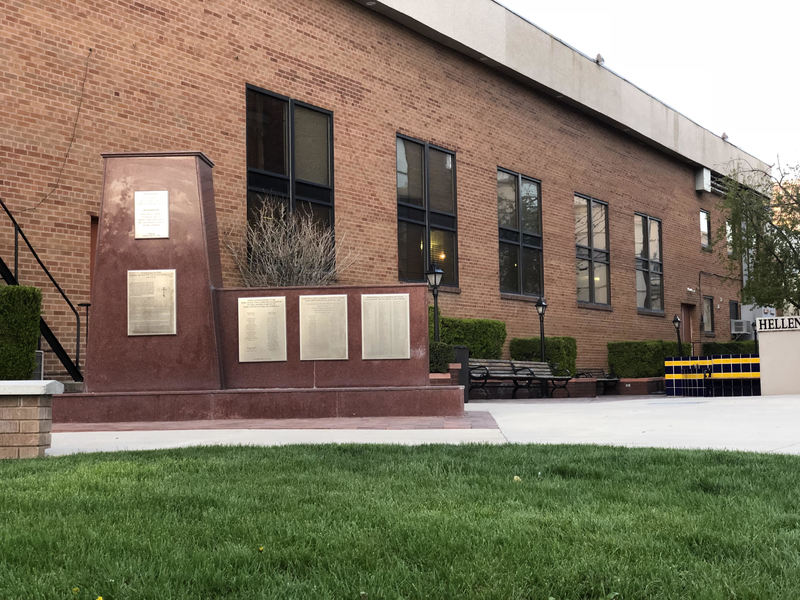
    <summary type="html"><![CDATA[<p><strong><em>A significant number of Greek Utahns served in the United States military. Their sacrifice to protect the nation is honored at the Hellenic Historic Monument in Salt Lake City. How can this monument impact our appreciation for United States service men and women?</em></strong></p><img src="https://www.intermountainhistories.org/files/fullsize/5b2ad5dcbfae1cdfc8fca342a54518b0.jpg" alt="Hellenic Historic Monument" /><br/><p>America experienced heightened nationalist ideology during World Wars I and II. As hysteria over the broader conflicts in Europe increased, xenophobia in the United States created strong inter-ethnic stress. In Utah, tension already existed in the industrial labor forces between Greeks, Americans, and other Eastern European immigrants at the start of the century. Lynchings were not widely publicized but nevertheless occurred in response to immigrant culture in the Salt Lake Valley. Greek immigrants were particularly targeted as un-American because they did not immediately desert their language and customs (often due to foundational religious beliefs), were involved in domestic labor strikes, and sent large amounts of money home. However, many Greeks were at the forefront of purchasing Liberty Bonds. Though criticized for not knowing English, Greek Newspapers (like O Ergatis) provided a resource to Greek-speaking immigrants to stay updated on war efforts in the United States.</p><p>Greek-Americans held an invested interest in World War I and II, regardless of their position on the conflict. Not only was America involved in the war, but so was their expatriate country – Greece. While many Greek Utahns joined the military by choice, others were drafted. The fairness of the draft was called into question when 221 of the 801 people in the Carbon County draft were Greek. Other members of the Greek community wanted to enlist, but were unable because they did not speak English. While many enlisted in the military to show their support for the war, others supported it through the Greek Orthodox Church. A parade was held from Price to the Holy Trinity Greek Orthodox church where speeches of patriotism were given and loyalty was pledged to the United States. </p><p>The wars significantly impacted Greek communities in Salt Lake City. Economically, the wars pushed copper miners and other industrial workers toward the city and into the middle class. This was partially due to the smaller number of more highly educated immigrants that came to Utah to be with family or friends who had already immigrated. Marriages decreased during the war (though they increased once the war had ended), and the Greek school located in the basement of the Holy Trinity Orthodox Church became less important than Orthodoxy itself. </p><p>To honor the history of Greek Utahns that fought in World Wars I, II, and the Korean Conflict, as well as the resulting effects of the war, the Hellenic Cultural Association (HCA) erected the Hellenic Historic Monument. The monument names the thirty-eight Greek Utahns that lost their lives in World Wars I, II, and the Korean Conflict, including Private First Class Theodore C. Dimas. Dimas was honored both in the community and by the Holy Trinity Orthodox church after his death. The HCA continues to hold Memorial Services for Greek servicemen and women at the monument each year.</p><p><em><strong><a href="https://www.intermountainhistories.org/items/show/157">For more (including 3 images) view the original article</a></strong></em></p>]]></summary>
    <published>2018-05-06T01:22:42+00:00</published>
    <updated>2026-04-17T19:32:01+00:00</updated>
    <link rel="alternate" type="text/html" href="https://www.intermountainhistories.org/items/show/157"/>
    <id>https://www.intermountainhistories.org/items/show/157</id>
    <author>
      <name>Katie Calton, Brigham Young University</name>
    </author>
  </entry>
</feed>