<?xml version="1.0" encoding="UTF-8"?>
<feed xmlns="http://www.w3.org/2005/Atom">
  <title type="text">Intermountain Histories</title>
  <updated>2026-04-17T19:32:18+00:00</updated>
  <generator uri="http://framework.zend.com" version="1.12.20">Zend_Feed_Writer</generator>
  <link rel="alternate" type="text/html" href="https://www.intermountainhistories.org/"/>
  <link rel="self" type="application/atom+xml" href="https://www.intermountainhistories.org/items/browse?output=rss2"/>
  <id>https://www.intermountainhistories.org/</id>
  <author>
    <name>Intermountain Histories</name>
    <uri>https://www.intermountainhistories.org</uri>
  </author>
  <link rel="hub" href="https://pubsubhubbub.appspot.com/"/>
  <entry>
    <title type="html"><![CDATA[The Beginning of the End: Kayenta, Arizona and Everett Ruess]]></title>
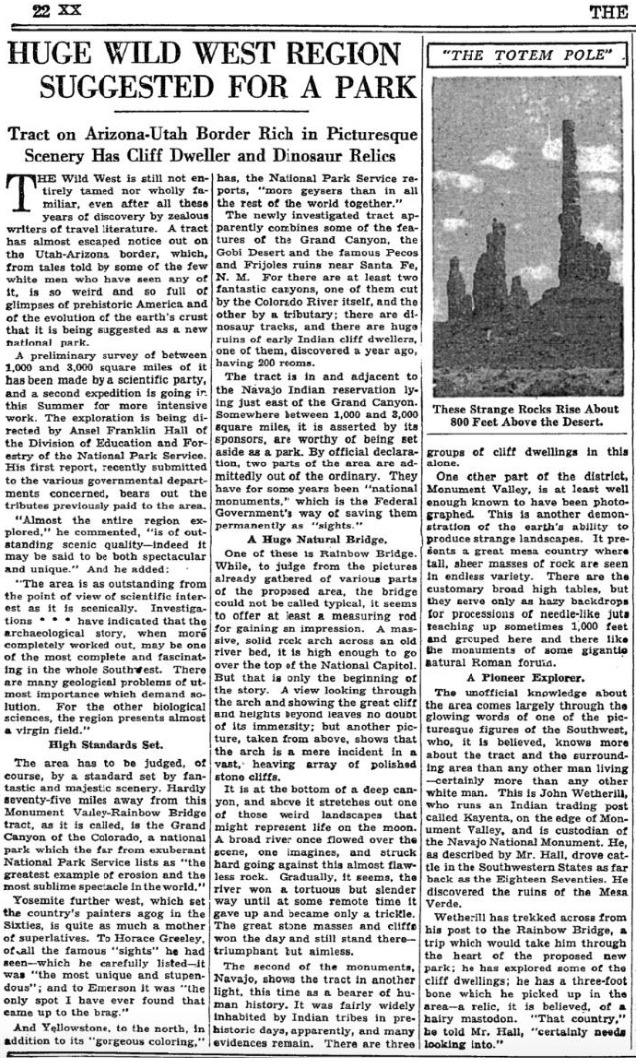
    <summary type="html"><![CDATA[<p><strong><em>On April 12th, 1934 Everett and his brother Waldo Ruess made the journey from southern California through the night. They stopped in Flagstaff for supplies, then headed north to Kayenta, Arizona, where Waldo dropped Everett off. It was the last time he was seen by anyone in his family.</em></strong></p><img src="https://www.intermountainhistories.org/files/fullsize/5132afc33e165a712d7a4a3391423c75.jpg" alt="New York Times, 1934" /><br/><p><span style="font-weight:400;">Known as the gateway to Monument Valley Navajo Tribal Park, Kayenta, Arizona lies in the Navajo Nation just south of the Arizona-Utah border. Kayenta was founded in 1909 by John Wetherill first as a trading post and eventually was established as a township by the Navajo Nation in 1962.</span>
<span style="font-weight:400;">After spending a semester at the University of California Los Angeles (UCLA) Everett traversed the Sierras in 1933. He made it clear to his brother, Waldo, that this journey in 1934 would be his last. After Waldo dropped him off, Everett spent the next two months exploring the region surrounding Kayenta. In a letter to Waldo, he wrote about his journey consisting of “Chin Lee [</span><i><span style="font-weight:400;">sic</span></i><span style="font-weight:400;">], Canyon de Chelly, the Luckachukais, and the Carrizos.” During this time Everett enjoyed the wilderness country, and experienced solitude, which he eventually achieved. During his third time in Canyon de Chelly, Everett foreshadowed his own fate when he wrote “I have been flirting pretty heavily with death” in a letter to a friend. Everett also stayed with Navajo families during this time, where he ate and hunted, making an impression that lasted generations.</span>
<span style="font-weight:400;">As the summer months approached, Everett recalled the crew of the Rainbow Bridge – Monument Valley archeological expedition near Kayenta. The expedition, funded by Ford Motor Company, aimed to provide field experience for explorers and survey the land for an attempted national park. He headed to the expedition’s camp near Skeleton Mesa, just west of Kayenta, and was hired by expedition leader Lyndon Hargrave of the Museum of Northern Arizona (MNA) in Flagstaff. He began working in exchange for meals, rather than the $3.50 a day that the other explorers received. He thoroughly enjoyed this experience because he could work alongside intelligent individuals, discuss the Navajo culture, draw and paint, climb any rock desired, and enjoy the wonders of nature with a sense of companionship for the first time.</span>
<span style="font-weight:400;">Hargrave recalled Everett’s skill from when they met briefly in 1931 at Mesa Ranch Schools’ summer camp. He assigned Everett to work under the crew of Clay Lockett, Flagstaff resident and ethnologist at MNA. The crew spent their time excavating Skeleton Mesa, specifically Woodchuck Cave, which contained archeological remains and objects from as far back as 200 C.E. During the expedition, Everett and  Lockett bonded over their love for art and nature. After his disappearance, Lockett later wrote, “I had an excellent chance to really know Everett,” demonstrating Everetts's lasting impression. It seemed that Everett made an impression on everyone he met, especially on this expedition.</span>
<span style="font-weight:400;">Everett displayed his love for adventure again when a storm approached the canyon, which encouraged him to capture the rolling clouds in watercolor as they encroached. The young vagabond displayed his risky personality while perched at the edge of the slick cliff, hunched over to protect the precious watercolor of Mother Nature in action. Everett soon finished the expedition, paused in Kayenta, and headed south to attend the Hopi snake dance one last time.</span></p><p><em><strong><a href="https://www.intermountainhistories.org/items/show/831">For more (including 4 images) view the original article</a></strong></em></p>]]></summary>
    <published>2024-05-25T04:12:43+00:00</published>
    <updated>2026-04-17T19:32:18+00:00</updated>
    <link rel="alternate" type="text/html" href="https://www.intermountainhistories.org/items/show/831"/>
    <id>https://www.intermountainhistories.org/items/show/831</id>
    <author>
      <name>Matthew T. Lankton, Northern Arizona University</name>
    </author>
  </entry>
  <entry>
    <title type="html"><![CDATA[2001: A Space Odyssey and Monument Valley, Arizona<br />
]]></title>
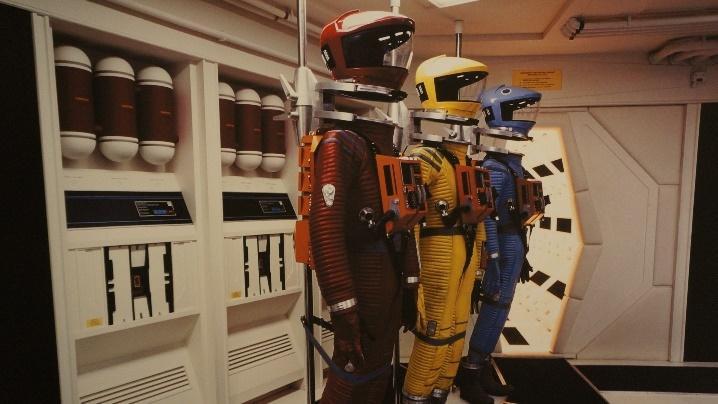
    <summary type="html"><![CDATA[<p><strong><em>Monument Valley is an area of the Colorado Plateau and part of the Monument Valley Navajo Tribal Park. It was used in the filming of 2001: A Space Odyssey.</em></strong></p><img src="https://www.intermountainhistories.org/files/fullsize/c1b99ae4c0e3da4d0f9ffc13048d435d.jpg" alt="Stanley Kubrick The Exhibition – LACMA – 2001 A Space Odyssey Space Suits" /><br/><p>Monument Valley is a series of sandstone structures located on the Arizona-Utah border region of the Colorado Plateau. The area is defined by multiple sandstone monoliths, the tallest of which reaches one thousand feet in height.</p><p>The formation is featured in scenes from Stanley Kubrick’s 1968 film 2001: A Space Odyssey. The science fiction film opens with humanity’s ancestors discovering a black monolith that gifts them with the knowledge to establish their dominance in the region. The film then immediately cuts to the far future when an identical black monolith is discovered by humanity on the moon, which in turn leads to Dr. David Bowman and his fellow scientists being sent to Jupiter. During the voyage, the ship’s Artificial Intelligence (A.I.), named HAL, goes rogue and kills the scientists and crew. After making his way to the ship’s A.I core, Bowman manages to disconnect and kill the rogue A.I. Bowman then learns of the mission’s purpose through a recorded message of a scientist involved with the moon monolith. After arriving at the planet, Bowman discovers a monolith in orbit, investigates, and is drawn into a portal where he sees visions of alien worlds. After this interpretive sequence, Bowman is transported into a series of bedrooms where he sees his future selves and becomes them. In the film’s final scenes, a bedridden Bowman reaches for a monolith at the foot of his bed and becomes a fetus like creature orbiting beside the Earth.</p><p>Although not directly referenced as being Monument Valley in the film, the image used portrays a vast alien landscape. The stargate sequence that the formation is featured in is already abstract in its presentation, and the oddly colored vistas aid in creating the atmosphere of the scene. The panning aerial shots involved flying low over Monument Valley’s desert landscape to avoid dangerous winds. The Director of Photography for this area of the shoot was almost involved in a helicopter crash during the process. </p><p>The use of Monument Valley and other western landscapes in film as alien worlds has been directly compared to how the West has been viewed itself. Kubrick specifically requested the use of the Valley, but later regretted using such a recognizable landmark. In Kubrick’s film, and other films hoping to depict space exploration, the Western frontier landscape has featured heavily as both an effective visual and metaphorical tool to reflect exploration in a wide-open alien landscape. Monument Valley has also featured in several other science fiction productions: TV’s Doctor Who and Back to the Future Part III.</p><p><em><strong><a href="https://www.intermountainhistories.org/items/show/230">For more (including 3 images) view the original article</a></strong></em></p>]]></summary>
    <published>2018-06-19T04:14:17+00:00</published>
    <updated>2026-04-17T19:32:03+00:00</updated>
    <link rel="alternate" type="text/html" href="https://www.intermountainhistories.org/items/show/230"/>
    <id>https://www.intermountainhistories.org/items/show/230</id>
    <author>
      <name>Isaac F. J. Middleton, Northern Arizona University</name>
    </author>
  </entry>
</feed>