<?xml version="1.0" encoding="UTF-8"?>
<feed xmlns="http://www.w3.org/2005/Atom">
  <title type="text">Intermountain Histories</title>
  <updated>2026-04-17T19:32:14+00:00</updated>
  <generator uri="http://framework.zend.com" version="1.12.20">Zend_Feed_Writer</generator>
  <link rel="alternate" type="text/html" href="https://www.intermountainhistories.org/"/>
  <link rel="self" type="application/atom+xml" href="https://www.intermountainhistories.org/items/browse?output=rss2"/>
  <id>https://www.intermountainhistories.org/</id>
  <author>
    <name>Intermountain Histories</name>
    <uri>https://www.intermountainhistories.org</uri>
  </author>
  <link rel="hub" href="https://pubsubhubbub.appspot.com/"/>
  <entry>
    <title type="html"><![CDATA[Pine Valley: A Mountain Home and Child&#039;s Paradise]]></title>
    <summary type="html"><![CDATA[<p><strong><em>Pine Valley, Utah is an idyllic pioneer lumber settlement in Southern</p><p>Utah. Its mild climate and lush meadows drew settlers from the surrounding desert and created a prosperous, yet close-knit community. </em></strong></p><img src="https://www.intermountainhistories.org/files/fullsize/e00755ebcf86d12072de2204d7cea38f.jpg" alt="Map of Pine Valley" /><br/><p>In the summer of 1855, Gunlock Bill Hamblin and Isaac Riddle were herding cattle in the mountains of Southern Utah. One day, as Riddle followed a stray cow, he stumbled upon a beautiful valley seemingly untouched by man. The valley</p><p>was filled with lush green meadows, pine trees and fauna. It was named Pine Valley. </p><p> </p><p>Not long after the discovery of Pine Valley, Jehu Blackborn and Company built a sawmill and set to work. In 1860, Brigham Young called 300 members of the church to move to St. George and grow cotton as part of the Dixie Mission. Many of those who migrated grew tired of the heat and other challenging living conditions in the area and moved to Pine Valley. Pine Valley, 35 miles north of St. George, had a higher elevation and a milder summer which attracted many St. George families to seek refuge there. As a result, Pine Valley grew in size and popularity.</p><p>Robert Gardner Jr. and Erastus Snow were two of the settlers sent to the Dixie Mission. In 1862, on a trip from Cedar City to Saint George, they took a path through Pine Valley. They saw the operating sawmill and recognized room for growth. After telling Brigham Young of the potential for the area,  Young assigned them to build an additional sawmill in the valley. This project, known as the Pine Valley Mission, produced lumber for the Dixie Mission settlements and beyond. In Salt Lake, the timber was used to fashion the organ pipes for the Salt Lake Tabernacle. </p><p>The secluded nature of Pine Valley fostered a tight-knit community. At the center of town stands the Pine Valley chapel, built in 1867. The chapel housed religious services, school, dances, and other events. Laura Gardner Snow said of her childhood in the valley, “Pine Valley was a child’s paradise. Summers were the most delightful.” Winters were full of sledding, sleigh rides and a magical Christmas Eve party in the chapel. </p><p>After the sawmills shut down in the 1920s, many families remained to farm the valley and raise cattle. Although Pine Valley has remained a small town, it continues to be a favorite summer destination for descendants of Pine Valley pioneers, as well as other residents from nearby communities.</p><p><em><strong><a href="https://www.intermountainhistories.org/items/show/644">For more (including 3 images) view the original article</a></strong></em></p>]]></summary>
    <published>2022-09-09T19:57:21+00:00</published>
    <updated>2026-04-17T19:32:14+00:00</updated>
    <link rel="alternate" type="text/html" href="https://www.intermountainhistories.org/items/show/644"/>
    <id>https://www.intermountainhistories.org/items/show/644</id>
    <author>
      <name>Olivia Bagley, Brigham Young University</name>
    </author>
  </entry>
  <entry>
    <title type="html"><![CDATA[The Riordan Mansion State Historic Park]]></title>
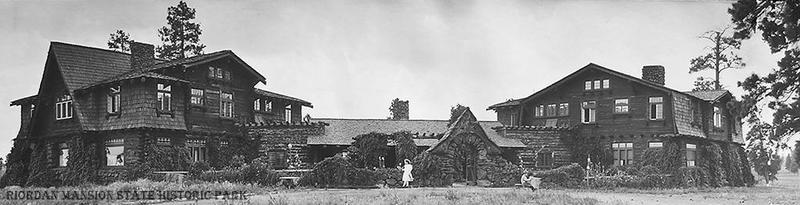
    <summary type="html"><![CDATA[<p><strong><em>Located just minutes away from Northern Arizona University, Riordan Mansion State Historic Park is tucked away behind towering Ponderosa Pine trees. As the home of two lumber barons, the mansion provides insight into the history of Flagstaff and the people who built the town.</em></strong></p><img src="https://www.intermountainhistories.org/files/fullsize/db10a9b07601bba1ccde5e5fce5f7961.jpg" alt="The Front of Riordan Mansion circa 1911
" /><br/><p>Starting off as middle-class, second-generation Irish immigrants, the Riordans amassed a fortune in the lumber industry in Flagstaff, Arizona. The eldest brother, Denis “Matthew” Riordan, became the foreman of the Ayer Lumber Mill in 1884. In 1887, Matthew bought the mill, then invited his brothers Timothy and Michael to work alongside him. Matthew sold the renamed Arizona Lumber and Timber Company to his brothers in 1897. By 1903, Timothy and Michael earned enough money to build the Riordan Mansion. Tim married Caroline Metz in 1889, and Michael married her sister Elizabeth in 1892. Timothy and Michael moved into the mansion with their wives and kids in 1904, but descendants of the family lived in the home until the 1980s. The Riordan family contributed to the Flagstaff community in education, banking, business, water development, and conservation. </p><p>Riordan Mansion is a 13,000-square-foot duplex-style mansion. Construction only took nine months. Timothy and his family lived in the east side, and Michael and his family lived in the west. The floor plans of both sides are near perfect mirror images of each other, though there are a few stylistic differences. The center room is shared by both sides of the family. Charles Whittlesey designed the mansion in the Arts & Crafts architectural style – promoting local materials, built-in furniture, and the celebration of nature. The walls are lathe and plaster with slab siding to give the appearance of a log cabin. The wood is local Ponderosa Pine, while volcanic rock makes up the base. Whittlesey designed built-in ice boxes, closets, window seating, countertops, and other surfaces throughout the house. The duplex contains one of the largest public collections of Stickley furniture, including some from Harvey Ellis.</p><p>Arizona State Parks and Trails (ASPT) owns Riordan Mansion. Bob Chambers, the son-in-law of Timothy, donated the east half of the home in 1981. Blanche, the oldest daughter of Michael, donated the west half of the home in 1985. After the 2008 recession, ASPT nearly closed the mansion. Due to the efforts of volunteers and a partnership with the Arizona Historical Society, Riordan Mansion remained open. </p><p>Staff and volunteers offer hour-long tours throughout the day year-round, though they are closed Tuesdays and Wednesdays during the winter. Guided tours take visitors room by room through Tim’s side of the home, giving the history of the family and of Flagstaff and showing much of the original furniture. Michael’s side is open as a museum with interpretive displays for guests to explore at their leisure. Tours cost $10 per person, though visitors can take complimentary walks around the grounds and look at exhibits in the Visitor Center. With five acres of land, Riordan Mansion can provide the perfect spot for a wedding or a picnic. </p><p><em><strong><a href="https://www.intermountainhistories.org/items/show/234">For more (including 6 images) view the original article</a></strong></em></p>]]></summary>
    <published>2018-06-19T21:05:23+00:00</published>
    <updated>2026-04-17T19:32:03+00:00</updated>
    <link rel="alternate" type="text/html" href="https://www.intermountainhistories.org/items/show/234"/>
    <id>https://www.intermountainhistories.org/items/show/234</id>
    <author>
      <name>Megan Nolan, Northern Arizona University</name>
    </author>
  </entry>
  <entry>
    <title type="html"><![CDATA[Clearwater Paper: Lewiston’s Defining Feature]]></title>
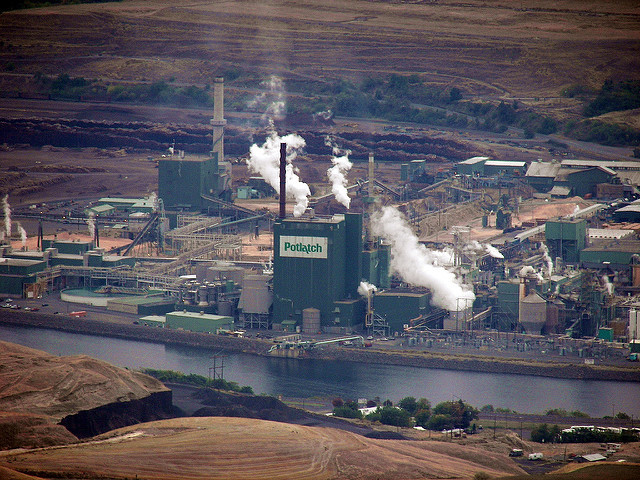
    <summary type="html"><![CDATA[<p><strong><em>The Clearwater Paper mill is one of the first things you notice in Lewiston, Idaho. Known for providing the town with a pungent odor, it has provided thousands of jobs to the people of the Lewis Clark Valley and has a long history in the area. </em></strong></p><img src="https://www.intermountainhistories.org/files/fullsize/76d988c5d48f0d3e760aeca5d51f605f.jpg" alt="Potlatch Paper MIll" /><br/><p>The Clearwater Paper Mill in Lewiston, Idaho (formerly known as the Potlach Paper Mill) is well known to locals for emitting billowing clouds of steam from its smoke stacks. It can be seen and smelled from miles away. People visiting the town notice the stench almost instantly, while the residents hardly notice it because it just becomes natural to them. The mill has been a major provider of jobs in the Lewis and Clark Valley and helped with population growth in the surrounding area. </p><p>The Lewiston Mill was created in 1950 while still under the Potlach Lumber Company name. During World War II, there was a high demand for wood and other timber products. Potlach took advantage of this and became one of the biggest timber companies in the United States and expanded to Lewiston. The Lewiston Mill was unique. It was the first factory to produce bleached poster board from wood waste. Not only was this efficient for the company, but it was also a move that was environmentally conscious as it put wood waste to use. The Lewiston Mill became one of the company’s most successful factories, which resulted in the headquarters moving from San Francisco to Spokane due to Spokane being much closer to Lewiston. Lewiston was also subject to constant new installations and upgrades which, by the 1990s, included a $40 million upgrade to the sawmill and log processor, a $400 million modernization to the pulp and paper mill, and a $107 million upgrade for a twin wire tissue machine. In 1997, Potlach was awarded $95 million from Beloit Corporation due to a defective pulp washer system. </p><p>Due to falling revenue, Clearwater Paper Corporation was created via spin-off in 2008. This was very controversial to the LC valley, as Potlach was a large provider of jobs. Hundreds of lay-offs results from this, but the mill still stayed as a major source of jobs, as well as continued to be a defining feature for the town of Lewiston, Idaho. </p><p><em><strong><a href="https://www.intermountainhistories.org/items/show/178">For more (including 3 images) view the original article</a></strong></em></p>]]></summary>
    <published>2018-05-24T01:22:26+00:00</published>
    <updated>2026-04-17T19:32:02+00:00</updated>
    <link rel="alternate" type="text/html" href="https://www.intermountainhistories.org/items/show/178"/>
    <id>https://www.intermountainhistories.org/items/show/178</id>
    <author>
      <name>Nate Quarry, University of Idaho</name>
    </author>
  </entry>
  <entry>
    <title type="html"><![CDATA[Lake Pend Oreille: Booming Industries and Depleting Resources]]></title>
    <summary type="html"><![CDATA[<p><strong><em>The last domesticated region in Idaho, known as Lake Pend Oreille, contains a long history of human activity. Pend Oreille’s first inhabitants include indigenous peoples followed by fur traders, explorers, miners, and loggers. The lake received its name from Canadian fur trapper and mapmaker David Thompson. The words “Pend Oreille” are French for “an ear pendant” or “hangs from ears”, possibly referring to the lakes shape or the jewelry worn by the Kalispel Indians who resided there. </em></strong></p><img src="https://www.intermountainhistories.org/files/fullsize/14e0b562f8c4bad39231ac3a23bec93f.jpg" alt="Pend d&#039;Oreille Lake" /><br/><p>In the fall of 1809, a fur agent with the North-West Company named David Thompson found Lake Pend Oreille. Thompson recognized the environmental value the area held.  Years after making the discovery, he wrote in his memoir, “The impression of my mind is, from the formation of the country and its climate, its extensive Meadows and fine forests, watered by countless brooks and Rills of pure water, that it will become the abode of civilized Man, whether Natives or other people.” Soon after his arrival, Thompson established a fur-trading outpost called the Kullyspell House. It was the first permanent wooden structure in Idaho next to Lake Pend Oreille and was named after the Kalispel Indians who guided Thompson around the Columbia River Basin. Once Thompson succeeded with his trading house, he moved on to other adventures, leaving Finan McDonald in charge. The location was forgotten until 1928 when a group of Idaho historians were guided by a blind Kalispel man to the remains of the trading outpost on the lake. </p><p>Lake Pend Oreille’s history did not end with Thompson and the Kullyspell House; the area grew over the next two hundred years. With the beginning of the gold rush era in 1866, the lake served as a passage for miners traveling from the Columbia River to Helena, Montana. With the ending of one boom comes the beginning of another. The demand for timber reached North Idaho, one of the largest areas of timber in the United States. The industry began in 1880 when Robert Weeks opened a general store dealing furs in the lake’s largest community, Sandpoint, in the panhandle of Idaho. As the town expanded so did the timber industry, along with the establishment of several sawmills, including the world-class Humbird Mill. The mill sparked modernization in the little lake town. By 1920, Sandpoint became the largest shipper of cedar poles and pilings in the Northwest. </p><p>The towns’ populations grew as the industries surrounding the lake attracted people from all over the country. Today, the location is featured in the media as one of the last, best places to live, but with its discovery came the chopping of its meadows and forests. This was followed cultivation and logging, which caused pesticides and other chemicals to drain into the lake. Just as David Thompson stated in his memoir, Lake Pend Oreille did become an abode for man and suffered from the exploitation of its abundant resources along with pollution from its inhabitants.</p><p><em><strong><a href="https://www.intermountainhistories.org/items/show/171">For more (including 3 images) view the original article</a></strong></em></p>]]></summary>
    <published>2018-05-16T01:42:20+00:00</published>
    <updated>2026-04-17T19:32:02+00:00</updated>
    <link rel="alternate" type="text/html" href="https://www.intermountainhistories.org/items/show/171"/>
    <id>https://www.intermountainhistories.org/items/show/171</id>
    <author>
      <name>Madison Huck, University of Idaho</name>
    </author>
  </entry>
  <entry>
    <title type="html"><![CDATA[Riverside Dance Hall]]></title>
    <summary type="html"><![CDATA[<p><strong><em>The Riverside complex was a popular community venue and social hotspot for the residents of Potlatch, Idaho, and the surrounding Palouse from its construction in the 1930s to its closing in the 1960s. Riverside provided a social gathering place outside of town where citizens and employees of Potlatch connected with others from the surrounding area.</em></strong></p><img src="https://www.intermountainhistories.org/files/fullsize/73cae1c5f424d4837c4fef0cb8ab1b6c.jpg" alt="William Deary Memorial" /><br/><p>Potlatch, Idaho, a small North Idaho town, was the location of the world’s largest lumber mill from its construction in 1906 to its closure in 1981. Potlatch Lumber Company employed hundreds of people in the mill as well as in the various company-owned businesses. The town was built by the company to provide housing for its employees. The company provided several options for recreation, often in the now historic gymnasium. Despite the dominant presence of the company, there were other places for entertainment within a short drive. One of the most fondly remembered and universally enjoyed was Riverside, the octagonal building off what is now Highway 95 at the base of Riverside Hill. The building served as a dance hall, concert venue, and later a roller skating rink. The grounds included the building, as well as a racetrack and rodeo grounds. </p><p>The first iteration of the iconic Riverside building was constructed in the 1920s. Ray Hanson constructed the building most people associate with Riverside in the 1930s after a fire destroyed the first. Much of the lore surrounding the popular gathering place comes from the oral histories and stories from the older generations that are shared both in private and at the many community events.</p><p>Many people look back fondly on the iconic race track and dance hall located at Riverside. The venue hosted some of the most famous country and western singers The Grand Ole Opry had to offer. Those big names include but are not limited to Hank Thompson, Johnny Cash, Tex Ritter, George Jones, and Dolly Parton. Even former University of Idaho Professor and proud Potlatch resident Malcolm Renfrew played his trombone at Riverside. It was thanks to the efforts of owners Leonard and Marlene Zahnow that Riverside drew the star power and surrounding communities to the dance hall. The couple, along with Leonard’s father Wesley, owned the venue from 1957 to 1962. The couple dedicated their time to caring for the grounds and maintaining the building to ensure both locals and performers would come back for another good time at Riverside. Due to yearly floodwaters from the Palouse River and the high maintenance costs attributed to the flooding, the Zahnows sold the dance hall in 1962. Soon after the sale the building succumbed to the years of flood damage and fell into disrepair. </p><p>Ask residents of the town who were around in the 1950s and 60s and they will be able to tell you a story about their experiences at Riverside. The joy of a place like Potlatch and its population are the stories the younger generations get to hear at celebrations like Potlatch Days and the new Return to Riverside music festival. The Riverside dance hall will forever be in the memory of Potlatch and the surrounding Palouse. </p><p><em><strong><a href="https://www.intermountainhistories.org/items/show/120">For more (including 5 images) view the original article</a></strong></em></p>]]></summary>
    <published>2018-02-01T03:42:31+00:00</published>
    <updated>2026-04-17T19:32:00+00:00</updated>
    <link rel="alternate" type="text/html" href="https://www.intermountainhistories.org/items/show/120"/>
    <id>https://www.intermountainhistories.org/items/show/120</id>
    <author>
      <name>Charlie Taylor, University of Idaho</name>
    </author>
  </entry>
  <entry>
    <title type="html"><![CDATA[Potlatch Lumber Mill and the Company Town]]></title>
    <summary type="html"><![CDATA[<p><strong><em>Potlatch, Idaho, is a small town on the edge of the Palouse region of Idaho, originally built to house the employees of the world’s largest white pine sawmill.  The Potlatch Lumber Company’s mill in Potlatch employed hundreds in its almost eighty-year lifespan and produced millions upon millions of board feet of lumber. </em></strong></p><img src="https://www.intermountainhistories.org/files/fullsize/d30a6c53feae4f8e778093fbea5eba7a.jpg" alt="Potlach Mill Workers" /><br/><p>In 1903, the Potlatch Lumber Company was incorporated by William Deary of the Northland Pine Company (a company established by the Weyerhaeuser Syndicate) and Henry Turrish of Wisconsin Log and Lumber.  These men who were originally competitors chose to collaborate in pursuit of keeping land prices down by merging their companies to form the Potlatch Lumber Company.  The mill opened in 1906 and processed the company’s holdings of over 100,000 acres of western white pine and other timber holdings around the region.  The mill was one of the largest sawmills in the United States at the time and was the largest white pine sawmill in the world.   </p><p>The company soon decided to build a town on the hills near the mill to house their employees.  Established with 128 homes and soon after a hotel, churches, a general store, and schools, the town continued to grow.  The town, aptly named Potlatch, symbolized pride for the company.  By 1907 over two hundred houses had been built.  Much of the workers housing had been constructed in haste, often with green lumber, resulting in constant remodeling of windows, doors, and flooring.  Company Towns were not uncommon in the Pacific Northwest, dozens of them dotted across the landscapes of Idaho, Washington and Oregon.  These towns would see a great “boom” but most met the same fate when a “bust” occurred and the communities shrunk into shells of their former selves.</p><p>When the mill first opened it could cut 350,000 feet of lumber in a single ten-hour shift.  An eighteen-hundred horsepower steam engine powered the mill and drove a series of belts that worked the various machines and implements.  The power plant produced enough excess steam to heat many of the houses in town.  In its early days the mill employed five hundred workers and thirty horses to operate.   In the 1950s, the mill transitioned from its steam engine and series of belts and pullies, to individual electric motors on machines, modernizing the facility. </p><p>Although there had been a lot of product moving through the mill in the past several decades, the mill had begun to downsize and in August 1981 the sawmill closed due to dropping lumber prices in a depressed market, forcing two hundred people out of work.  Workers and residents hoped, like several closures before, that it would only be a temporary shut-down until the market recovered.  In March 1983, however, Potlatch Corporation announced that the closure would be permanent, and the mill was quickly torn down and the materials salvaged.  During its heyday Potlatch had over fifteen-hundred residents, today the population has idled around eight hundred.  </p><p><em><strong><a href="https://www.intermountainhistories.org/items/show/112">For more (including 8 images) view the original article</a></strong></em></p>]]></summary>
    <published>2018-01-31T19:21:49+00:00</published>
    <updated>2026-04-17T19:32:00+00:00</updated>
    <link rel="alternate" type="text/html" href="https://www.intermountainhistories.org/items/show/112"/>
    <id>https://www.intermountainhistories.org/items/show/112</id>
    <author>
      <name>Zac Carscallen, University of Idaho</name>
    </author>
  </entry>
  <entry>
    <title type="html"><![CDATA[Soaked Timber in Idaho&#039;s Clearwater River]]></title>
    <summary type="html"><![CDATA[<p><strong><em>Between 1900 and 1930, half of all men in northern Idaho and eastern Washington were employed in the lumber industry,  outranking all other product manufacturing during that time. Without safer, modernized technology such as log-loaders, eastern businessmen and timberland owners, including the famous Frederick Weyerhaeuser, were forced to rely on waterways to transport lumber. The process of transporting logs downriver, known as river log-driving, was prevalent on the Clearwater River in north central Idaho before becoming obsolete in 1971.</em></strong></p><img src="https://www.intermountainhistories.org/files/fullsize/efba046a663ae077f06dcd296e4b1b87.jpg" alt="Breaking a Log Jam" /><br/><p>Lumber companies in the Inland Empire (interior Pacific Northwest) competed for ownership of waterways. One such company, the Clearwater Timber Company (merged with the Pine Tree Lumber Company in 1903 to become the Potlatch Timber Company), gained possession of lands around the Clearwater River, and proceeded to dot the river with small lumber camps at the turn of the century. Composed of about twenty to forty men each, these camps oversaw the cutting and transporting lumber downriver toward mills in towns such as Lewiston and Ahsahka, Idaho. Prior to the drives, loggers built guiding channels (flumes) to conduct logs to the river, and constructed barriers (booms) to act as makeshift dams for log collection.</p><p>William Dyche, a Clearwater logger, recounted an experience with a 1913-1914 log drive in which he was appointed as camp superintendent. Dyche’s camp was placed in the middle of the northern Idaho wilderness, and appointed by a businessman from Minnesota to create a path and guide logs through the water. Given about a week to start the drive, groups of men were appointed tasks such as flume and boom creation or to act as “river-hogs”; guides who literally rode floating lumber. Loggers constructed about a quarter mile of flume daily while others fell timber in preparation for the drive. While many workers were inexperienced and paid inadequately, only two lumbermen left, one because of injury. Logs were rolled down flumes and guided in the river by “hogs,” who donned spiked boots for traction and carried poles called peavies designed to direct lumber in the water. Periodically, lumber camps located along the same stretch of river would make the mistake of sending logs downriver simultaneously, resulting in severe jams. The Forest Service was heavily involved in the industry, and because of this, tons of dynamite delivered by the USFS were used to clear log-jams.</p><p>As logging technology developed, practices became relatively safer. The famed Idaho logger, Charles “Red” McCollister, worked on the Clearwater from 1950 to 1971 and later compiled a photo-essay of the last major whitewater log-drive in the United States on the river in 1971. Evident in the photographs are floating camps, called “wanigans.” Instead of making camp on the riverside in regularly freezing temperatures, men shared buoyant rooms, usually heated with a stove. A kitchen drifted alongside the bunkhouses as well, providing three meals a day for loggers. In some situations, though, loggers were forced to resort to past practice, dangerously climbing out of motorboats onto logs in attempts to restore flow or free a jam.</p><p>Although the tradition of log-driving is now gone, replaced by practice freer from danger, using the river as a lumber guide was common in a region known for its lumber industry. Without the dangerous occupation, north central Idaho would be without communities like Potlatch. Early in the 20th century, the lumber industry reigned supreme in Idaho. Without it, Idaho’s communities and economy would have suffered a major loss, as logging attracted needy workers and helped to literally build small towns which still exist today.</p><p><em><strong><a href="https://www.intermountainhistories.org/items/show/104">For more (including 5 images) view the original article</a></strong></em></p>]]></summary>
    <published>2018-01-18T20:42:33+00:00</published>
    <updated>2026-04-17T19:31:59+00:00</updated>
    <link rel="alternate" type="text/html" href="https://www.intermountainhistories.org/items/show/104"/>
    <id>https://www.intermountainhistories.org/items/show/104</id>
    <author>
      <name>Colton Clark, University of Idaho</name>
    </author>
  </entry>
</feed>