<?xml version="1.0" encoding="UTF-8"?>
<feed xmlns="http://www.w3.org/2005/Atom">
  <title type="text">Intermountain Histories</title>
  <updated>2026-04-17T19:32:13+00:00</updated>
  <generator uri="http://framework.zend.com" version="1.12.20">Zend_Feed_Writer</generator>
  <link rel="alternate" type="text/html" href="https://www.intermountainhistories.org/"/>
  <link rel="self" type="application/atom+xml" href="https://www.intermountainhistories.org/items/browse?output=rss2"/>
  <id>https://www.intermountainhistories.org/</id>
  <author>
    <name>Intermountain Histories</name>
    <uri>https://www.intermountainhistories.org</uri>
  </author>
  <link rel="hub" href="https://pubsubhubbub.appspot.com/"/>
  <entry>
    <title type="html"><![CDATA[Idaho’s Territorial Capital Dispute]]></title>
    <summary type="html"><![CDATA[<p><strong><em>Lewiston was Idaho's first territorial capital, but the title was short-lived. Many disputes over moving the capital down to Boise ensued between the people of Lewiston and the people of Boise, contributing to a longstanding divide between northern and southern Idaho.</em></strong></p><img src="https://www.intermountainhistories.org/files/fullsize/acc53b1a3c757d53c6ac8a90857a5ee8.jpg" alt="First" /><br/><p>A nineteenth-century dispute over where to place the state capital dispute helped create a regional divide that persists in Idaho to this day. It all started when westward settlers found gold in 1860, leading many to migrate to the Rocky Mountains in hopes of striking it rich. Settlers found gold in the Clearwater River, in northern Idaho, and some formed mining camps, one of which was Lewiston. As the settler population grew, many in the area called for establishing a seat of United States government closer than Olympia, Washington. In response, in March 1863, territorial governor William H. Wallace pronounced Lewiston the capital of Idaho. Wallace chose this location because in addition to the gold, there was already an established transportation and communication system that linked northern Idaho to other U.S. states and territories.
After the discovery of gold in 1862 in the Boise Basin, however, eager settlers rushed to the southern part of the territory. At the same time, gold had depleted up north in Lewiston, even further accelerating the southward migration. With most of the settler population now residing in the south, moving the capital seemed logical, especially since mountainous terrain made traveling between Boise and Lewiston difficult.
This turned out to be easier said than done, however. The territorial legislature, primarily made up of representatives from northern Idaho, failed the first initiative to change Idaho’s capital. However, in 1864 Idaho’s number of legislative representatives changed to accommodate the difference in population, leaving three representatives for the north and four for the south. This change in political power—plus pressure from H. C. Riggs, one of Bosise’s founders—convinced acting governor Caleb Lyon to move the capital to Boise. On November 23, 1864, Riggs introduced a bill to make Boise the capital. It passed six days later, and Lyon signed it into law.
Rather than fix the problem, this may have only made it worse. Governor Lyon fled to nearby Walla Walla, Washington, and sent a trusted official to retrieve the official documents from the acting secretary of Lewiston. After a stalemate over who had rights to the papers, and where the capital would officially reside, President Lincoln’s territorial secretary C. DeWitt Smith went to serve as acting governor of Idaho. With help from Fort Lapwai soldiers, Smith obtained the documents and traveled to Boise, where he put the new law into effect.
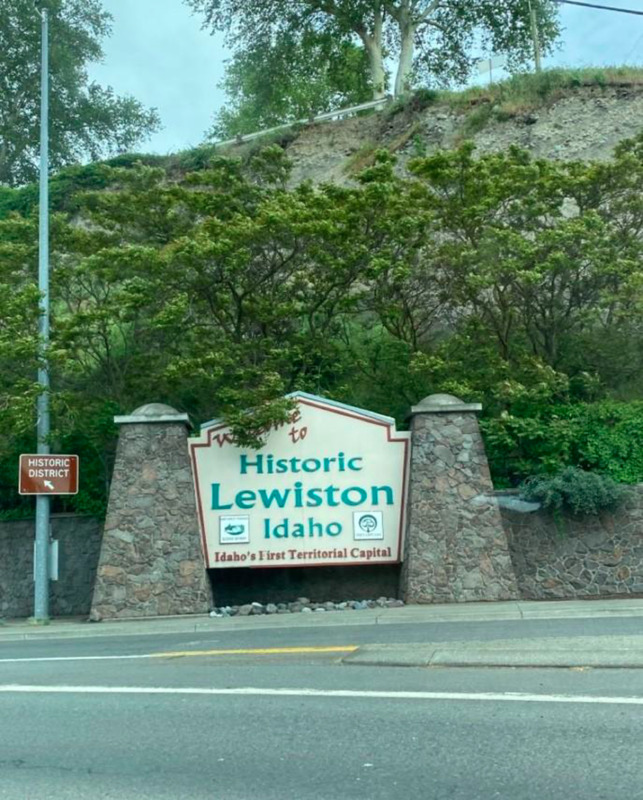
In the end, moving the capitol from Lewiston to southern Idaho left its residents with a sense of lost pride. This sparked a cultural divide between northern and southern Idaho that continues to this day. To this day, downtown Lewiston hosts a sign proclaiming the city “Idaho's First Territorial Capital,” demonstrating that the residents remember their city’s history and will not let people forget Idaho’s original territorial capital.</p><p><em><strong><a href="https://www.intermountainhistories.org/items/show/628">For more (including 3 images) view the original article</a></strong></em></p>]]></summary>
    <published>2022-06-30T20:51:21+00:00</published>
    <updated>2026-04-17T19:32:13+00:00</updated>
    <link rel="alternate" type="text/html" href="https://www.intermountainhistories.org/items/show/628"/>
    <id>https://www.intermountainhistories.org/items/show/628</id>
    <author>
      <name>Dawson Packwood, College of Idaho</name>
    </author>
  </entry>
  <entry>
    <title type="html"><![CDATA[Clearwater Paper: Lewiston’s Defining Feature]]></title>
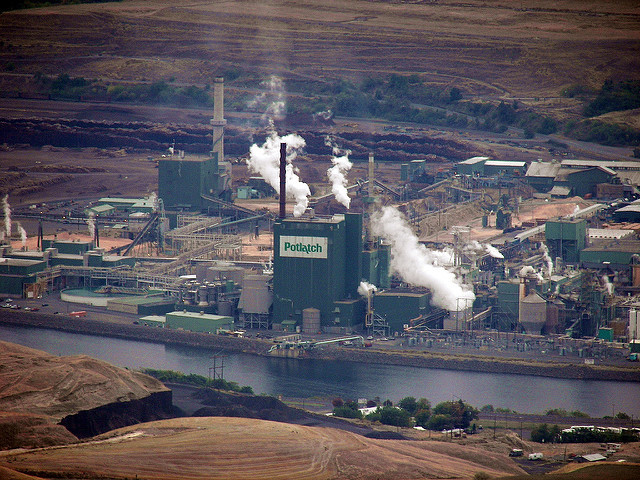
    <summary type="html"><![CDATA[<p><strong><em>The Clearwater Paper mill is one of the first things you notice in Lewiston, Idaho. Known for providing the town with a pungent odor, it has provided thousands of jobs to the people of the Lewis Clark Valley and has a long history in the area. </em></strong></p><img src="https://www.intermountainhistories.org/files/fullsize/76d988c5d48f0d3e760aeca5d51f605f.jpg" alt="Potlatch Paper MIll" /><br/><p>The Clearwater Paper Mill in Lewiston, Idaho (formerly known as the Potlach Paper Mill) is well known to locals for emitting billowing clouds of steam from its smoke stacks. It can be seen and smelled from miles away. People visiting the town notice the stench almost instantly, while the residents hardly notice it because it just becomes natural to them. The mill has been a major provider of jobs in the Lewis and Clark Valley and helped with population growth in the surrounding area. </p><p>The Lewiston Mill was created in 1950 while still under the Potlach Lumber Company name. During World War II, there was a high demand for wood and other timber products. Potlach took advantage of this and became one of the biggest timber companies in the United States and expanded to Lewiston. The Lewiston Mill was unique. It was the first factory to produce bleached poster board from wood waste. Not only was this efficient for the company, but it was also a move that was environmentally conscious as it put wood waste to use. The Lewiston Mill became one of the company’s most successful factories, which resulted in the headquarters moving from San Francisco to Spokane due to Spokane being much closer to Lewiston. Lewiston was also subject to constant new installations and upgrades which, by the 1990s, included a $40 million upgrade to the sawmill and log processor, a $400 million modernization to the pulp and paper mill, and a $107 million upgrade for a twin wire tissue machine. In 1997, Potlach was awarded $95 million from Beloit Corporation due to a defective pulp washer system. </p><p>Due to falling revenue, Clearwater Paper Corporation was created via spin-off in 2008. This was very controversial to the LC valley, as Potlach was a large provider of jobs. Hundreds of lay-offs results from this, but the mill still stayed as a major source of jobs, as well as continued to be a defining feature for the town of Lewiston, Idaho. </p><p><em><strong><a href="https://www.intermountainhistories.org/items/show/178">For more (including 3 images) view the original article</a></strong></em></p>]]></summary>
    <published>2018-05-24T01:22:26+00:00</published>
    <updated>2026-04-17T19:32:02+00:00</updated>
    <link rel="alternate" type="text/html" href="https://www.intermountainhistories.org/items/show/178"/>
    <id>https://www.intermountainhistories.org/items/show/178</id>
    <author>
      <name>Nate Quarry, University of Idaho</name>
    </author>
  </entry>
</feed>