<?xml version="1.0" encoding="UTF-8"?>
<feed xmlns="http://www.w3.org/2005/Atom">
  <title type="text">Intermountain Histories</title>
  <updated>2026-04-17T19:32:07+00:00</updated>
  <generator uri="http://framework.zend.com" version="1.12.20">Zend_Feed_Writer</generator>
  <link rel="alternate" type="text/html" href="https://www.intermountainhistories.org/"/>
  <link rel="self" type="application/atom+xml" href="https://www.intermountainhistories.org/items/browse?output=rss2"/>
  <id>https://www.intermountainhistories.org/</id>
  <author>
    <name>Intermountain Histories</name>
    <uri>https://www.intermountainhistories.org</uri>
  </author>
  <link rel="hub" href="https://pubsubhubbub.appspot.com/"/>
  <entry>
    <title type="html"><![CDATA[Kay&#039;s Cross]]></title>
    <summary type="html"><![CDATA[<p><strong><em>Built in the 1940s and blown up in the 1990s, Kay’s Cross is cherished by the people of Kaysville, Utah. Legends surround the site, which is known to be haunted.</em></strong></p><img src="https://www.intermountainhistories.org/files/fullsize/f6c0c1be04d431c3ab862e7e0c5613c5.jpg" alt="Remains of Kay&#039;s Cross" /><br/><p><span style="font-weight:400;">Kay’s Cross is a 20ft by 13ft cross and an important symbol for the people of Kaysville, Utah. However, no one knows where the cross came from or who created it. Myths prevail regarding its source including one of a murderous polygamist. According to lore, the story says that a husband murdered six of his seven wives and either buried the seventh beneath the cross or put her heart in the cross. Mysticality seems to surround the symbol. Some people have claimed to see werewolves in the area during the full moon. Others have claimed to see the ghost of the seventh wife whose body was laid to rest in the hallowed cross. Some locals say that during a full moon, the cross will glow. </p>
<span style="font-weight:400;">According to one local whose family previously owned the land which included Kay's Cross, the real story is less horrific than a murederous polygamist. Elden Kingston and his two wives lived on the land in the early twentieth century. Elden Kingston (1909-1948) left the Church of Jesus Christ of Latter-Day Saints in the 1920s to found a group of polygamous families. He established the Davis County Co-op of Bountiful, Utah. Eventually, the Kingston family met a man named Krishna Venta (Francis Pancovic, 1911-1958) who had founded a cult: the Wisdom, Knowledge, Faith and Love Fountain of the World. Venta preached that he was Jesus Christ and the Second Coming was near at hand. According to Jack, Venta convinced the family to build a cross in his honor. Later, Venta fled to California where he continued to gain followers. </span>
<span style="font-weight:400;">During the 1980s, devil worship was soon introduced to the site. Locals claim that devil worshipers would steal local chickens to sacrifice. Other animals, such as dogs and raccoons, have been found dead on the site. In 1992, the cross was bombed. There have been claims that the bomb was so loud, it echoed through the city. Some believe the Kaysville police bombed it hoping to reduce the number of trespassers on private property, but the police department denies any involvement in the bombing. The demolition did not stop trespassers, and the site soon became a place of mischief. </span><span style="font-weight:400;">Directly across the site of Kay's Cross, a man hanged himself in 2005, further adding to the despair surrounding the cross. Nevertheless, some are still anxious to see the site of Kay's Cross and, d</span><span style="font-weight:400;">uring October, the owners of the land open the site for visitors.  </span></p><p><em><strong><a href="https://www.intermountainhistories.org/items/show/366">For more (including 4 images) view the original article</a></strong></em></p>]]></summary>
    <published>2019-10-19T00:55:23+00:00</published>
    <updated>2026-04-17T19:32:07+00:00</updated>
    <link rel="alternate" type="text/html" href="https://www.intermountainhistories.org/items/show/366"/>
    <id>https://www.intermountainhistories.org/items/show/366</id>
    <author>
      <name>Claire Larson, Weber State University</name>
    </author>
  </entry>
  <entry>
    <title type="html"><![CDATA[The Kaysville Tabernacle]]></title>
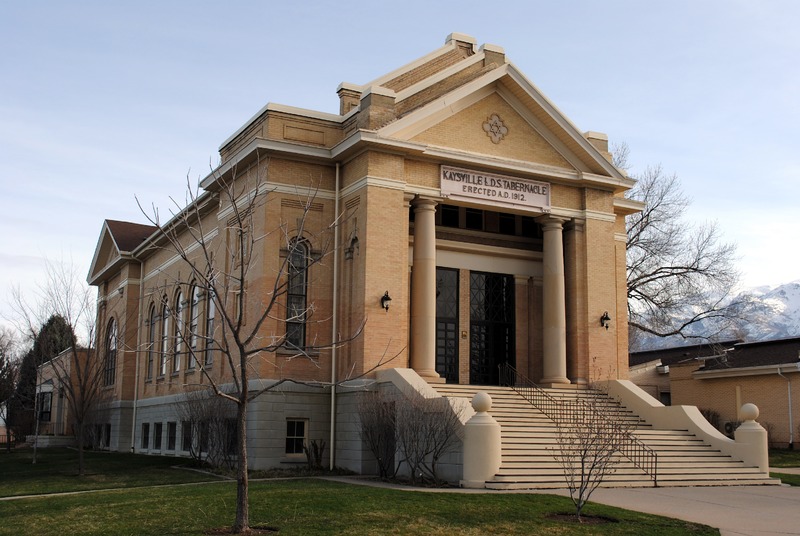
    <summary type="html"><![CDATA[<p><strong><em>The Kaysville Tabernacle was built in 1912 after members of the Church of Jesus Christ of Latter-day Saints outgrew their meetinghouse. It was renovated in the 1970s and still functions as a meetinghouse today. </em></strong></p><img src="https://www.intermountainhistories.org/files/fullsize/4f85405ce8057ce0b9f08a555088a3c1.jpg" alt="Kaysville Tabernacle" /><br/><p>By the beginning of the twentieth century, members of The Church of Jesus Christ of Latter-Day Saints in Kaysville, Utah had outgrown their adobe meetinghouse. Church leaders commissioned William Allen (1849-1928), a local architect, to build a new meetinghouse that would accommodate local members. Construction began in 1910 and was completed on May 24, 1912. The members were excited to use the new building, as it was unique to the area. While unlike other tabernacles built at the time, the tabernacle lacked a tower, or spire at the top, it sported beautiful, large, stained glass windows and Greek-revival influences. Another key feature of the construction of the building was the local woodwork, which included custom stairway carpentry, moldings, and the pulpit of the central meeting hall. </p><p>During the construction of the meetinghouse, tragedy struck when Alex Barnes, a citizen of Kaysville commissioned to help with the construction, was killed. Barnes was pushing a wheelbarrow up a wooden ramp to the top of the building when he lost balance and fell off the top of the Tabernacle followed by the wheelbarrow, which crushed him. His loss was commemorated by Henry Blood’s speech during the dedication. </p><p>The cornerstone of the Tabernacle was laid on July 24, 1912, just two months after finishing construction. The ceremony dedicating the building was attended by many residents of the Davis County area, including the keynote speaker, Henry Blood (1872 - 1942), who would go on to become Utah’s Governor from 1933 to 1941. </p><p>Funds were raised starting in 1943 to expand the building. Construction began in 1949 and  included a cultural hall, Relief Society room, and kitchen. A new wing was added in 1973 that featured additional classrooms, office space, and a library. The building was also remodeled in the late 1970s. This work restored and protected the stained-glass windows, upgraded the chapel, and improved the sound and cooling systems. Space for offices was added later.</p><p>The Tabernacle is listed on the Utah State Register of Historic Places and continues to be used as a meetinghouse by local congregations of the Church of Jesus Christ of Latter-day Saints.</p><p><em><strong><a href="https://www.intermountainhistories.org/items/show/358">For more (including 3 images) view the original article</a></strong></em></p>]]></summary>
    <published>2019-10-04T02:34:23+00:00</published>
    <updated>2026-04-17T19:32:07+00:00</updated>
    <link rel="alternate" type="text/html" href="https://www.intermountainhistories.org/items/show/358"/>
    <id>https://www.intermountainhistories.org/items/show/358</id>
    <author>
      <name>Cayden Hurst, Weber State University</name>
    </author>
  </entry>
</feed>