<?xml version="1.0" encoding="UTF-8"?>
<feed xmlns="http://www.w3.org/2005/Atom">
  <title type="text">Intermountain Histories</title>
  <updated>2026-04-17T19:32:13+00:00</updated>
  <generator uri="http://framework.zend.com" version="1.12.20">Zend_Feed_Writer</generator>
  <link rel="alternate" type="text/html" href="https://www.intermountainhistories.org/"/>
  <link rel="self" type="application/atom+xml" href="https://www.intermountainhistories.org/items/browse?output=rss2"/>
  <id>https://www.intermountainhistories.org/</id>
  <author>
    <name>Intermountain Histories</name>
    <uri>https://www.intermountainhistories.org</uri>
  </author>
  <link rel="hub" href="https://pubsubhubbub.appspot.com/"/>
  <entry>
    <title type="html"><![CDATA[Burr Studio and the Denver Women’s Press Club]]></title>
    <summary type="html"><![CDATA[<p><strong><em>The Denver Women’s Press Club met in Burr Studio beginning in 1924 to organize, socialize, and develop their professional interests. Members discussed writing topics, offered feedback, and provided support and friendship.</em></strong></p><img src="https://www.intermountainhistories.org/files/fullsize/1775257afe5059fb2574db204b9f7d2c.jpg" alt="Studio and Press Club" /><br/><p>In 1906, George Burr, an American artist of natural scenes, decided to settle in Denver, Colorado, and he built Burr Studio as his home. This red brick building’s style resembles that of an English cottage. It has restricted decorative elements and horizontal windows. Inside the entrance hall is a small staircase that leads to a loft overlooking the skylighted studio.
After Burr moved to Phoenix, Arizona, in 1924, the Denver Women’s Press Club (DWPC) purchased the studio. Founded in 1898, DWPC is one of the oldest women’s press clubs in the nation. Members include professional women from various writing occupations such as journalists, editors, essayists, novelists, poets, and historians. Burr Studio was a place where members developed writing and communications skills for publications.
In addition to being a meeting ground for women to organize and socialize, the studio was also a business, and authors could earn a living by working at Burr Studio. President Minnie J. Reynolds was an influential leader for the suffrage movement and one of the first woman political writers for a local newspaper, the <i>Rocky Mountain News</i>. Club members inspired much of Reynolds’s political writings for that paper.
The Denver Women’s Press Club celebrated its 200th anniversary in 1998, and its membership has continued to grow since. In 1980, DWPC expanded its occupational fields to include a wider variety of communication professions, including marketing, electronics, and advertising. Members of DWPC secured Burr Studio a spot on the National Register of Historic Places in 1995. The studio continues to act as a community center and has also grown in functionality to host receptions and other events. Burr Studio has long honored DWPC’s mission by functioning as a gathering place for women pursuing literary endeavors. Above all, it was and remains a haven where members could cultivate friendship, encouragement, and moral support.</p><p><em><strong><a href="https://www.intermountainhistories.org/items/show/608">For more (including 5 images) view the original article</a></strong></em></p>]]></summary>
    <published>2022-06-10T20:57:01+00:00</published>
    <updated>2026-04-17T19:32:13+00:00</updated>
    <link rel="alternate" type="text/html" href="https://www.intermountainhistories.org/items/show/608"/>
    <id>https://www.intermountainhistories.org/items/show/608</id>
    <author>
      <name>Amy Megowan, Northern Arizona University</name>
    </author>
  </entry>
  <entry>
    <title type="html"><![CDATA[Camels at Kingman]]></title>
    <summary type="html"><![CDATA[<p><strong><em>In 1893, The <em>Mohave County Miner </em>reported on what is now an Arizona legend: the Red Ghost, a rampant camel with a dead man strapped to its back. The story may have been fictional, but it was not as unlikely as one might expect.</em></strong></p><img src="https://www.intermountainhistories.org/files/fullsize/574fe4e6432ea0f69ebc55832dbf65df.jpg" alt="Camel Express" /><br/><p>Kingman’s newspaper, The<em> Mohave County Miner</em>, reported on February 25, 1893 that the “Red Ghost” had finally been laid to rest. The Red Ghost, the story explained, was a camel reported to have trampled a woman near Eagle Creek. On later sightings, viewers noticed there seemed to be something stuck to its back—and it was not a hump. A hunter named Si Hamlin caught sight of the Red Ghost from a distance and reported he thought that something was the body of a dead man. Some weeks later, some cowboys fired at it but missed. As it fled, they found it had left behind a human head. When a priest named Mizoo Hastings finally shot it, he found the camel’s back had been knotted with rawhide straps, presumably once holding on a corpse that had by now disintegrated.
So <em>The Mohave County Miner</em> reported. Detailing events for the most part located in eastern Arizona, this article may have taken liberties with the truth using the benefit of distance and how remote the area was. Though the newspaper claimed sightings had been reported for ten years before the camel’s death at Mr. Hastings’s hands, there is no trace of earlier reports. Even Gilded Age newspapers had “fake news.” For example, Mark Twain spun hoaxes while writing for Virginia City’s <em>Territorial Enterprise</em>, and according to local tradition, in 1959, editor Bob Richards wrote the city’s annual camel races into existence with a spoof story taken too seriously.
The Red Ghost article, however, takes on the role of relaying a legend. Perhaps it truly was derivative and is simply the only extant written record of an oral tradition that may have spanned Arizona. Indeed, that oral tradition may not have been as outrageous as might seem. Camels did briefly roam the deserts of Arizona, having been set loose in the aftermath of the 1863 dissolution of the US Camel Corps, an army experiment in using camels to carry explorers and supplies through southwestern deserts. Kingman was especially cognizant of this camel history, as Lieutenant Edward Fitzgerald Beale had camped nearby on his 1857–1858 camel expedition from Fort Defiance to the Colorado River. The town of Kingman named a street after him and in 1901 erected the Hotel Beale.
Amid Kingman’s heightened camel-consciousness due to Beale’s local fame, the story indeed could have had a grain of truth. As camels at forts from Texas to California idled during the Civil War, some either escaped or were helped to escape by minders with no fondness for them. When those remaining were finally auctioned off in 1864, they ended up in the hands of Hadji Ali, well known as Hi Jolly, one of the original Camel Corps handlers. He used them for two years in southern Arizona carrying water to sell to travelers, but eventually he also set the camels loose. <span>Our Red Ghost may well have been a remnant of either of these dissolved government plans or business enterprise hopes.</span></p><p><em><strong><a href="https://www.intermountainhistories.org/items/show/527">For more (including 5 images) view the original article</a></strong></em></p>]]></summary>
    <published>2021-10-22T21:22:40+00:00</published>
    <updated>2026-04-17T19:32:11+00:00</updated>
    <link rel="alternate" type="text/html" href="https://www.intermountainhistories.org/items/show/527"/>
    <id>https://www.intermountainhistories.org/items/show/527</id>
    <author>
      <name>Emily Moore, Northern Arizona University</name>
    </author>
  </entry>
  <entry>
    <title type="html"><![CDATA[Camels at Virginia City]]></title>
    <summary type="html"><![CDATA[<p><strong><em>Camels traversed to and from Virginia City carrying salt to the mines to process gold and silver ore. They have lingered in contemporary Virginia City life in the form of the International Camel Races thanks to journalistic playfulness in the tradition of Mark Twain.</em></strong></p><img src="https://www.intermountainhistories.org/files/fullsize/6dca0be67a8f123c338a726b9ad7af27.jpg" alt="Camel train" /><br/><p>In Virginia City, camels arrived in 1865 to convey salt. Nevada, famed for its Comstock lode and peppered with mining towns such as Virginia City, derived much of its wealth and population from ore deposits. However, translating these deposits into a livelihood required processing the raw ore. The Washoe process, developed in the 1860s by Comstock millmen, involved heating and grinding ore in an iron vessel along with mercury and a solution of salt. Thus, the silver rush required a salt rush as well.
Camels helped supply the need, bringing salt across the desert lands from the Walker River salt marsh district all the way to Virginia City. Otto Esche, a commission merchant who imported hemp as well as humped beasts from Central Asia, supplied some of these camels, hoping to install them as useful contributions to the American West. The auction intended to raffle these camels off, however, flopped, and Julius Bandmann, the agent for Esche’s commission, bought all thirteen Bactrians. He then sold them to Nevadan mining companies in need of salt transporters. Another entrepreneur, Samuel McLeneghan, purchased camels from the government when they auctioned the remains of their defunct US Camel Corps, an experiment in using dromedaries as military pack animals, in 1864. Marius Chevalier, a Frenchman, also supplied salt-packing Nevada camels.
By the end of the century, the cyanide reduction process replaced salt amalgamation for ore processing. The use of camels in Nevada, though, had already declined. Camels frightened horses and mules, much more ubiquitous than they and much more familiar to the settlers and miners. Camels caused such a nuisance with their disturbance of other, more common steeds that the Nevada state government passed a law prohibiting camels from public highways in 1875. This law remains on the books today.
Despite this ban, Virginia City engages in an annual sanctioned public appearance of camels in the form of their International Camel Races. According to popular legend, a spoof article written in 1959 by Robert Richards, the editor of the local paper <em>The Territorial Enterprise,</em> claiming that his city held camel races, fooled the editor of <em>The San Francisco Chronicle</em>, who reprinted it. Realizing he’d been hoodwinked, he challenged Virginia City to actually hold a camel race and offered to send a team to compete. The Hollywood director John Huston, who was filming <em>The Misfits</em> in northern Nevada at the time, came down to win this first race.
The journalistic jocularity of this saga holds well with <em>The Territorial Enterprise</em>’s fame as the proving ground for the young Samuel Clemens, who first wrote under the name of Mark Twain at this newspaper. Twain similarly fabricated stories and appreciated tall tales such as the ones surrounding the origin of Virginia City’s annual Labor Day camel racing tradition.</p><p><em><strong><a href="https://www.intermountainhistories.org/items/show/526">For more (including 5 images) view the original article</a></strong></em></p>]]></summary>
    <published>2021-10-20T09:42:41+00:00</published>
    <updated>2026-04-17T19:32:11+00:00</updated>
    <link rel="alternate" type="text/html" href="https://www.intermountainhistories.org/items/show/526"/>
    <id>https://www.intermountainhistories.org/items/show/526</id>
    <author>
      <name>Emily Moore, Northern Arizona University</name>
    </author>
  </entry>
  <entry>
    <title type="html"><![CDATA[The Woman’s Exponent<br />
]]></title>
    <summary type="html"><![CDATA[<p><strong><em>Published in Salt Lake City from 1872 to 1914, the Woman’s Exponent, which acted as the unofficial newspaper of the Relief Society of the Church of Jesus Christ of Latter Day Saints, was an important advocate for women’s suffrage in Utah and one of the longest-running suffrage publications in the country.</p></strong></p><img src="https://www.intermountainhistories.org/files/fullsize/46e58cd8e9c52abdd7db00f69e643de3.jpg" alt="Front page of the December 1, 1893 issue of the Woman’s Exponent
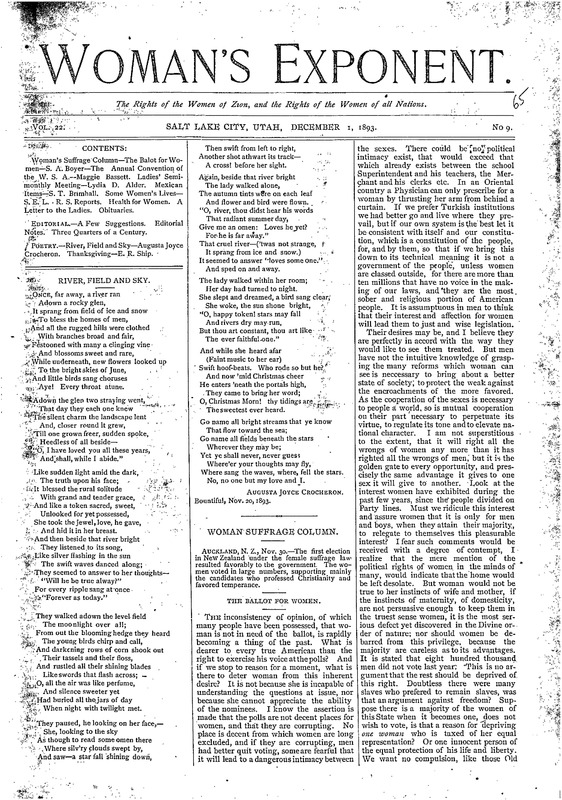
" /><br/><p>Women’s suffrage has an interesting history in Utah. Women in Utah gained the right to vote, had it taken away, and regained it again years before the passage of the Nineteenth Amendment. The question of female enfranchisement was closely tied to the issue of polygamy. Before Utah became a state, the territorial legislature granted women the right to vote in 1870. However, in 1887, the federal government revoked this right in the Edmunds-Tucker Act because of the dispute with the LDS church over polygamy. Utah women organized on the local and territorial level to protest for the reinstatement of their right to vote. When the LDS church issued the 1890 Manifesto ending the practice of polygamy, the path both to statehood and women’s suffrage opened once again. The women of Utah mobilized in great numbers and successfully fought to have female enfranchisement written into the new constitution when Utah became a state in 1896.</p><p>The Woman’s Exponent was founded in 1872 and published bimonthly in Salt Lake City, Utah until 1914. Fully managed, written, and edited by women, the newspaper amplified women’s voices in Utah and helped communicate information between the women scattered in settlements across the territory. The newspaper printed news from across Utah and the United States, articles on topics ranging from domestic life to theology, stories and poetry, reports from LDS women’s organizations like the Relief Society, and information about women’s suffrage. Published in Salt Lake City, the Exponent occupied a number of different offices over the course of its forty-two years of existence. In the early years of its publication, the headquarters of the Exponent were located in the Council House until its destruction by a fire in 1883. Later, the Exponent had offices in the Constitution building on East Temple Street. Eventually, the offices of the Woman’s Exponent moved to the Bishop’s Building on 40 North Main Street. Unfortunately, all of these building were either destroyed in accidents or demolished to make room for new buildings and the expansion of Temple Square. The old location of the Bishop’s Building is closest to the current Relief Society Building on Temple Square.</p><p>The Woman’s Exponent was a major proponent of women's right to vote. Emmeline B. Wells, the main editor of the paper from 1877 until it ceased publication in 1914, was an active suffragette. She often acted as a liaison between Utah suffragettes and national suffrage leaders like Susan B. Anthony and Elizabeth Cady Stanton. Wells attended national suffrage conventions, met with Congressional committees and the President of the United States, served as the president of Utah’s suffrage association, and helped lobby Utah congressmen to support women’s suffrage. Her activism carried over to the Exponent, where, as editor, she helped publish articles, write editorials, and include news about women’s suffrage. </p><p>During the back-and-forth over women’s suffrage in Utah, the Woman’s Exponent played an important role in covering the issue and mobilizing the women of Utah to fight for their right to vote, especially after the Edmund-Tuckers Act of 1887. The Exponent often contained a Woman Suffrage column, which published news about women’s suffrage in Utah, the United States, and the world. An issue published on December 1, 1893, for example, contained news about women in New Zealand voting in their first election under new suffrage laws. The column included articles about the importance of winning the vote for women and also published information about local and state suffrage association meetings, rallies, speeches, and other events tied to the campaign for women’s suffrage. In 1889, the Exponent included a call for the women of Salt Lake City to meet and organize a Territorial Suffrage Association. Throughout 1895, the paper detailed the efforts of Utah suffragettes to lobby the territorial congress for the inclusion of women’s suffrage in the new state constitution. After the women of Utah regained the right to vote in 1896, the Woman’s Exponent continued as an important advocate for women’s rights and suffrage across the United States.</p><p><em><strong><a href="https://www.intermountainhistories.org/items/show/252">For more (including 3 images) view the original article</a></strong></em></p>]]></summary>
    <published>2019-01-18T06:49:08+00:00</published>
    <updated>2026-04-17T19:32:04+00:00</updated>
    <link rel="alternate" type="text/html" href="https://www.intermountainhistories.org/items/show/252"/>
    <id>https://www.intermountainhistories.org/items/show/252</id>
    <author>
      <name>Sarah Rounsville, Brigham Young University</name>
    </author>
  </entry>
  <entry>
    <title type="html"><![CDATA[The Territorial Enterprise and &quot;Birth&quot; of Mark Twain and Western Journalism]]></title>
    <summary type="html"><![CDATA[<p><strong><em>Sweeping the west like wildfire, The Territorial Enterprise became the mainstream venue for sensational stories of the American frontier. Founded in 1858, The Enterprise provided a foundation for western American journalism for more than three decades, operating out of Nevada’s famous boom town, Virginia City. </p></strong></p><img src="https://www.intermountainhistories.org/files/fullsize/c9c073bda2cd7047763a9a5395b40c4d.jpg" alt="Mark Twain" /><br/><p>In 1858, W.L. Jernegan and Alfred James published a local newspaper in a former Mormon colony, Mormon Station (later renamed Genoa) in the then Utah Territory. This paper, The Territorial Enterprise, later became the first newspaper in Nevada Territory. Printed as a weekly column, The Enterprise did not gain much traction until its move in 1860 to the quickly booming town of Virginia City.   </p><p>The Comstock Lode, one of the largest silver discoveries in the United States, brought thousands of hopeful miners to Virginia City. Capitalizing on the rising mining population, Jernegan and James decided to uproot their small-town newspaper, and moved it to Virginia City in September of 1860. The move to Virginia City brought the paper under new ownership. Throughout its time of operation in Virginia City, The Enterprise resided in three locations, its last and present location on C street. </p><p>The 1860’s was a prosperous decade for the growing newspaper. In 1861 Joseph T. Goodman and Dennis E. McCarthy became the new proprietors of the newspaper. With their business sense combined with the hiring of shrewd, witty writers, Goodman and McCarthy made The Territorial Enterprise the territory’s most popular paper. William Wright (under the pen name ‘Dan de Quille’) Rollin M. Daggett, Sam Davis, and Judge C.C. Godwin were among the few who created The Territorial Enterprise’s lasting legacy. However, the most famous of the small crew was a man who would later become one of America’s most beloved authors, Mark Twain. Before the birth of ‘Twain,’ he was simply known as Samuel Clemens. Clemens, a former riverboat pilot, migrated west hoping to strike-it-rich in mining. However, due to bad luck and laziness, Clemens found that mining was not his calling. Turning to journalism, Clemens was hired as an editor, and joined The Enterprise staff in 1862. </p><p>Between 1862-1864, Clemens created a new name for himself. Adopting the pen name ‘Mark Twain,’ Clemens wrote the most sensational articles for The Enterprise. Entertaining, but not necessary accurate, Twain’s stories quickly became a favorite. Writing for a community where libel was rarely monitored, Twain creatively reported mining incidents, Indian encounters, local leaders and gossip, as blown-up, over-the-top dramas. He humored readers of The Enterprise with his sharp criticisms and hilarious commentaries. Twain left The Territorial Enterprise after two years, but the newspaper did not fall apart after his departure. Continuing to print daily after Twain’s departure, the bohemian-style stories of local and national news entertained and informed the citizens throughout the territory and later, the state of Nevada for nearly two decades. However, as the silver boom died, so did the town and the newspaper. Its last issue came off the press on January 15, 1893, The Territorial Enterprise closed its doors after three decades, but left a legacy as the foundation of Western American journalism and produced some of America’s wittiest writers.  </p><p><em><strong><a href="https://www.intermountainhistories.org/items/show/247">For more (including 4 images) view the original article</a></strong></em></p>]]></summary>
    <published>2019-01-17T23:27:36+00:00</published>
    <updated>2026-04-17T19:32:03+00:00</updated>
    <link rel="alternate" type="text/html" href="https://www.intermountainhistories.org/items/show/247"/>
    <id>https://www.intermountainhistories.org/items/show/247</id>
    <author>
      <name>Rachel Hendrickson, Brigham Young University</name>
    </author>
  </entry>
</feed>
