<?xml version="1.0" encoding="UTF-8"?>
<feed xmlns="http://www.w3.org/2005/Atom">
  <title type="text">Intermountain Histories</title>
  <updated>2026-04-17T19:32:17+00:00</updated>
  <generator uri="http://framework.zend.com" version="1.12.20">Zend_Feed_Writer</generator>
  <link rel="alternate" type="text/html" href="https://www.intermountainhistories.org/"/>
  <link rel="self" type="application/atom+xml" href="https://www.intermountainhistories.org/items/browse?output=rss2"/>
  <id>https://www.intermountainhistories.org/</id>
  <author>
    <name>Intermountain Histories</name>
    <uri>https://www.intermountainhistories.org</uri>
  </author>
  <link rel="hub" href="https://pubsubhubbub.appspot.com/"/>
  <entry>
    <title type="html"><![CDATA[Joseph F. Smith and the Islanders of Iosepa]]></title>
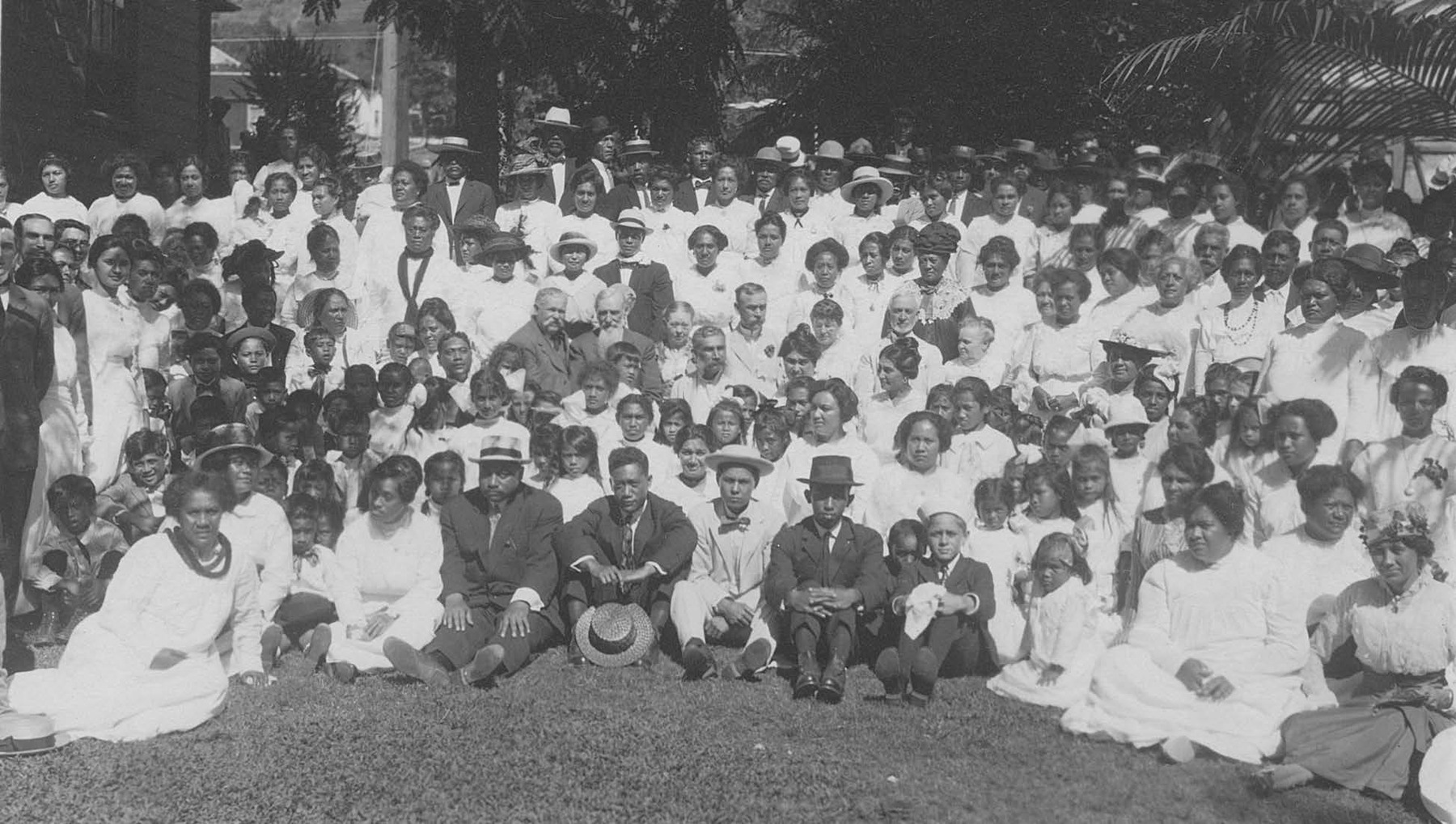
    <summary type="html"><![CDATA[<p><strong><em>The Hawaiian members of the Church of Jesus Christ of Latter-day Saints had a very special relationship with the Church’s sixth president, Joseph F. Smith. He was influential in Hawaiian migrations both to and from Utah, including during the time that many of them resided in Iosepa, a Hawaiian colony.</p></strong></p><img src="https://www.intermountainhistories.org/files/fullsize/c4441ee0af02c1fa09ac1230935470cc.jpg" alt="Joseph F. Smith and Hawaiian Saints" /><br/><p><span style="font-weight:400;">At the age of fifteen, Joseph F. Smith served as a missionary for the Church of Jesus Christ of Latter-day Saints in the Hawaiian Islands in the early 1850s. During his several missions, Smith learned the Hawaiian language and developed a loving relationship with the Native Hawaiians. Throughout his life, Smith traveled to Hawaii more often than any other place outside of the western United States. Smith was successful in converting many Hawaiians to the LDS Church. The doctrine of gathering to “Zion” was a central teaching preached by Joseph F. Smith and other missionaries at that time. When immigration laws allowed it, a few hundred Hawaiian Latter-day Saints migrated to Utah to gather with their fellow Saints and to follow the teachings they had received. The Islanders experienced racism, discrimination, job-turnover, and prejudice that led the LDS Church to seek solutions. In 1889, a settlement was established in Tooele County for the Pacific Islanders settling in Utah. It was to be named after Joseph F. Smith, which in the Hawaiian Language is “Iosepa.” At that time, Smith was a member of the Church’s First Presidency and would later become the President of the Church.</span>
<span style="font-weight:400;">In both public and private correspondence, Joseph F. Smith was explicit in expressing his love for the Iosepan Saints. With a letter to S. M. Kinimakalehua of Iosepa, Smith sent “some cloth pants for the cold time that is coming… This is only rags, but take it with my love.” He reported that “Canon [George Q. Cannon] is joining with my family and I in sending a lot of our love to you and Makaweli and all of the Saints in Iosepa.” During a visit to Hawaii in 1915, Smith became convinced of the need for a temple in Hawaii. Upon returning to Utah, he encouraged the Hawaiian Saints to move back to Hawaii and help build a temple in La’ie. Smith also thought that the future Church Presidents would not have the same love for the Hawaiians that he did, which influenced his encouragement of the Islanders to return to their homeland. The Saints trusted in the council of Joseph F. Smith, and most resettled near the temple site in Hawaii. The settlement of Iosepa was fully abandoned by 1917. In November of 1918, Joseph F. Smith passed away and one year later the La’ie Temple was completed. </span></p><p><em><strong><a href="https://www.intermountainhistories.org/items/show/780">For more (including 4 images) view the original article</a></strong></em></p>]]></summary>
    <published>2024-02-24T03:37:50+00:00</published>
    <updated>2026-04-17T19:32:17+00:00</updated>
    <link rel="alternate" type="text/html" href="https://www.intermountainhistories.org/items/show/780"/>
    <id>https://www.intermountainhistories.org/items/show/780</id>
    <author>
      <name>Jordan Castillo, Brigham Young University</name>
    </author>
  </entry>
  <entry>
    <title type="html"><![CDATA[Joseph F. Smith Building (JFSB)]]></title>
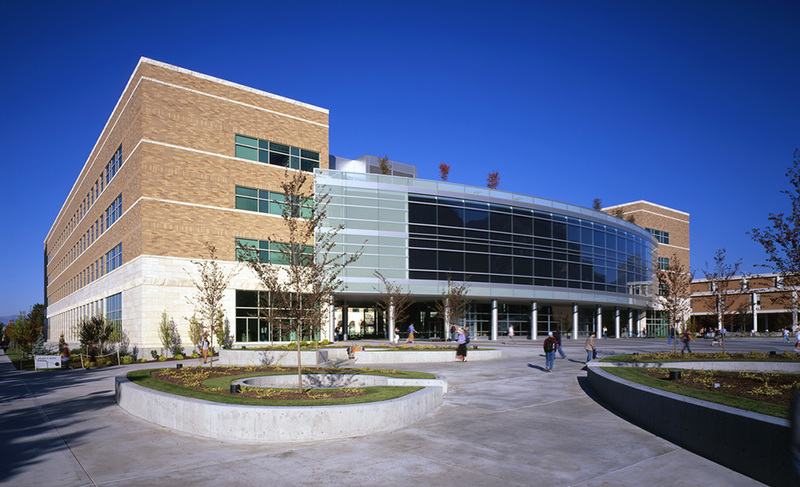
    <summary type="html"><![CDATA[<p><strong><em>The Joseph F. Smith Building, completed in 2005, replaced the Joseph F. Smith Family Living Center. It is home to the College of Humanities and the College of Family, Home, and Social Sciences.</em></strong></p><img src="https://www.intermountainhistories.org/files/fullsize/0e0cd3fc4772add36a468011f0149bd2.jpg" alt="Eastern Face of the Joseph F. Smith Building" /><br/><p>The Joseph F. Smith Building was completed in 2005. It replaced the Joseph F. Smith Family Living Center which had housed the College of Family, Home, and Social Sciences, a School of Nursing, and the Departments of Sociology and Psychology. The new building includes 27 classrooms, 401 faculty and administrative offices, a large auditorium, a theater, and a three-level underground parking lot. It is more than double the square footage of the Family Living Center and takes up less space on BYU’s campus. The College of Humanities and the College of Family, Home, and Social Sciences now share the building. </p><p>Architects were asked to focus on natural light as they designed the building. Van C. Gessel, Dean of the College of Humanities when the building was completed, said “The architectural concept emphasizes light as the source of any kind of knowledge and learning. Education at BYU is very much about the light that comes from the Spirit.” In order to allow as much light as possible to enter the building, it features a large courtyard with windows into faculty offices and hallways. The east side of the building features a large glass façade that reflects the image of the mountains while providing natural light for the building’s Education in Zion exhibit. </p><p>The Education in Zion exhibit was opened as a permanent exhibition in 2008. Original curator Dr. C. Terry Warner, professor emeritus of Philosophy, featured the stories of BYU’s educational pioneers. The exhibit was refreshed in 2018 by curator Heather Seferovich, who changed the focus of the exhibit and renamed it Education for Eternity. The exhibit now elaborates on BYU’s aims for education and the cycle of study, experience, and spiritual revelation.</p><p>Like its predecessor, the building was named for Joseph F. Smith, former President of the Church of Jesus Christ of Latter-day Saints from 1901-1918. President Smith had established the seminary program and standardized courses for Church auxiliaries. He encouraged Church members to become educated “not only for time but also for eternity.” At the dedication of the building, Church President Gordon B. Hinckley said, “To provide this kind of education the Church maintains this university with a great infusion of its resources. It demonstrates to all the world that the acquisition of secular knowledge is important, but just as important is the acquisition of spiritual truth.”</p><p><em><strong><a href="https://www.intermountainhistories.org/items/show/375">For more (including 5 images) view the original article</a></strong></em></p>]]></summary>
    <published>2019-12-05T23:23:55+00:00</published>
    <updated>2026-04-17T19:32:07+00:00</updated>
    <link rel="alternate" type="text/html" href="https://www.intermountainhistories.org/items/show/375"/>
    <id>https://www.intermountainhistories.org/items/show/375</id>
    <author>
      <name>Allie Patterson, Brigham Young University</name>
    </author>
  </entry>
  <entry>
    <title type="html"><![CDATA[Joseph F. Smith Family Living Center (SFLC)]]></title>
    <summary type="html"><![CDATA[<p><strong><em>The Joseph F. Smith Family Living Center was completed in 1957 as part of BYU’s effort to become a “leader in the field of family relations.” It housed the College of Family Home and Social Sciences until it was demolished in 2002.</em></strong></p><img src="https://www.intermountainhistories.org/files/fullsize/a69bc627e21db4135077b907adf5fe61.jpg" alt="The Family Living Center facing East." /><br/><p>The Joseph F. Smith Family Living Center was completed in 1957, the largest building on BYU’s campus at the time at 94,000 square feet and with 244 rooms. The Living Center was built to help BYU become a “leader in the field of family relations.” In the groundbreaking ceremony, architect Fred Markham said, “No other college or structure of this kind is known in a university today. Its concept lies in the LDS philosophy which recognizes the home and family as the heart of our earth life experience.” </p><p>In designing the building, architects hoped to provide space for both men and women, “based upon the fact that a man has an equal responsibility in the home with his wife.” It included an indoor-outdoor nursery, kitchens, sewing rooms, child observation facilities, telephone switchboards, and nursing facilities. It housed the College of Family Living, the School of Nursing, and the Departments of Sociology and Psychology. </p><p>The College of Family Living had been created in 1954 out of the College of Applied Science. It was organized to prepare students for “homemaking, professions related to homemaking, and to strengthen and enrich family life within their communities.” It included departments for Home Economics, Food and Nutrition, Human Development, Interior Design, Family Life Education, and other related subjects. The college was reestablished in 1981 as the College of Family, Home, and Social Sciences. </p><p>The building was named for Joseph F. Smith, former President of the Church of Jesus Christ of Latter-day Saints from 1901-1918. President Smith laid the foundations for the Church Education System by establishing the seminary program in 1912. During his time as President, the Church standardized courses of study in Church auxiliaries and added weekly lesson plans to Church magazines. President Smith had encouraged church members to focus on learning truths and said, “If you will learn the truth and walk in the light of truth you shall be made free from the errors of men.” He advised students to “search all things” but to “hold on only to that which is true.”</p><p>The building was eventually replaced by the Joseph F. Smith Building, which was completed in 2005. The new building is almost double the square footage of the old building and includes 27 classrooms and 401 faculty and administrative offices. </p><p><em><strong><a href="https://www.intermountainhistories.org/items/show/374">For more (including 7 images) view the original article</a></strong></em></p>]]></summary>
    <published>2019-12-05T22:58:52+00:00</published>
    <updated>2026-04-17T19:32:07+00:00</updated>
    <link rel="alternate" type="text/html" href="https://www.intermountainhistories.org/items/show/374"/>
    <id>https://www.intermountainhistories.org/items/show/374</id>
    <author>
      <name>Allie Patterson, Brigham Young University</name>
    </author>
  </entry>
</feed>