<?xml version="1.0" encoding="UTF-8"?>
<feed xmlns="http://www.w3.org/2005/Atom">
  <title type="text">Intermountain Histories</title>
  <updated>2026-04-17T19:32:21+00:00</updated>
  <generator uri="http://framework.zend.com" version="1.12.20">Zend_Feed_Writer</generator>
  <link rel="alternate" type="text/html" href="https://www.intermountainhistories.org/"/>
  <link rel="self" type="application/atom+xml" href="https://www.intermountainhistories.org/items/browse?output=rss2"/>
  <id>https://www.intermountainhistories.org/</id>
  <author>
    <name>Intermountain Histories</name>
    <uri>https://www.intermountainhistories.org</uri>
  </author>
  <link rel="hub" href="https://pubsubhubbub.appspot.com/"/>
  <entry>
    <title type="html"><![CDATA[Antler Arch — Wyoming]]></title>
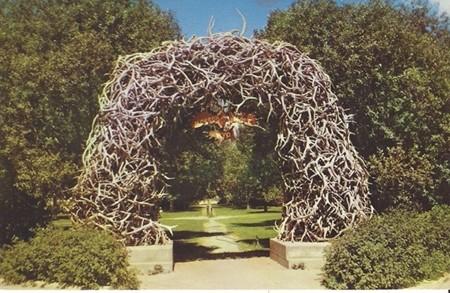
    <summary type="html"><![CDATA[<p><strong><em>Members of the Jackson Hole Rotary Club constructed the antler arch in 1953 as an installation that would capture the essence of the American West. Community members built the arch in the Jackson Hole Town Square, which is adjacent to Highway 89. </em></strong></p><img src="https://www.intermountainhistories.org/files/fullsize/012bb102c748391c0dd61daa10d08cf0.jpg" alt="Jackson WY-Wyoming, Elk Horn Arch, Scenic View" /><br/><p><span>Since its creation in 1953, the antler arch in Jackson Hole, Wyoming, has attracted countless Highway 89 travelers. Regardless of whether the destination is Jackson Hole itself or Grand Teton National Park further north, tourists often include a visit to the antler arch on their trip itinerary. The Jackson Hole Rotary Club developed an idea for a beautifying sculpture project in the Town Square in 1953. They agreed that the concept should capture the most iconic qualities of Jackson Hole, and that the sculpture itself may become a town icon. The same year, members of the Rotary Club asked locals to donate antlers for the construction of an arch made entirely of antlers. The Rotary Club initially planned to build one arch in Town Square, until the finished structure proved to be immensely popular, attracting large crowds of admiring people and individuals wanting to take photos beneath the arch. With such positive reception, the Jackson Hole Rotary Club began raising funds to build four more arches in the Town Square.</span>
<span> Due to the limited lifespan of natural elk antlers, the Jackson Hole community adopted the tradition of reconstructing the arch every 40-50 years. The Rotary Club developed this tradition to collaborate more with the community by partnering with local organizations. With the support of the U.S. Fish & Wildlife Service, local Boy Scouts began hiking into the National Elk Refuge annually in late April to acquire fresh antlers. The Rocky Mountain Elk Foundation then auctioned these antlers off at the Jackson Elkfest each year to raise funds for wildlife conservation. Individuals who purchased antlers at this auction typically donated them to the Rotary Club to help construct new arches or repair damaged ones in Town Square.</span>
<span>Both admiring and maintaining the Jackson antler arches are ongoing traditions in this town. With the National Elk Refuge, a home to one of the world’s largest elk herds, located just north of the town of Jackson, elk antlers are a fitting medium for an installation that aims to illustrate the town’s identity. Since their creation, the arches have been the site of various community events, including auctions, Christmas decorating, competitive winter sports registrations, Easter egg hunts, staged cowboy shoot-outs, and Wyoming Statehood Day celebrations. For tourists visiting Jackson or passing through on their way to a National Park, they are sure to catch a glimpse of the arches as they pass by the Town Square off of Highway 89. Automobile tourists often make a stop to take photos beneath the arches, capturing a symbol of the American West and Wyoming’s natural landscape.</span></p><p><em><strong><a href="https://www.intermountainhistories.org/items/show/911">For more (including 3 images) view the original article</a></strong></em></p>]]></summary>
    <published>2025-09-23T15:38:25+00:00</published>
    <updated>2026-04-17T19:32:21+00:00</updated>
    <link rel="alternate" type="text/html" href="https://www.intermountainhistories.org/items/show/911"/>
    <id>https://www.intermountainhistories.org/items/show/911</id>
    <author>
      <name>Alexandra Williams, Northern Arizona University</name>
    </author>
  </entry>
  <entry>
    <title type="html"><![CDATA[Sheep Eaters (Mountain Shoshones) in the Greater Yellowstone Ecosystem]]></title>
    <summary type="html"><![CDATA[<p><strong><em>The Sheep Eaters (also known as Mountain Shoshones, Tukudika, or Snake Indians), resided in Yellowstone National Park, the Wind River Mountains in Wyoming, and parts of central Idaho, until the reservation era.</p></strong></p><img src="https://www.intermountainhistories.org/files/fullsize/5a9a77ddc55c952bffe2d127a3c16817.jpg" alt="Tukudika (Sheepeater) men, women, and children at Medicine Lodge Creek, Idaho, in 1871." /><br/><p><span style="font-weight:400;">Much of the history of the Sheep Eaters emanates from archeological and ethnographic research. Many scholars believe their origins are in the Great Basin, though that continues to be debated. Trappers like Osborne Russell were among the first Euro-Americans to leave written accounts about the Sheep Eaters. Russell noted that a group of about 22 Sheep Eaters he met were “neatly clothed in dressed deer and Sheep skins of the best quality and seemed to be perfectly contented and happy … [They had] about 30 dogs on which they carried their skins, clothing, provisions etc on their hunting excursions. They were well armed with bows and arrows pointed with obsidian…” Early descriptions provide useful information, but they also often encouraged stereotypes. For example, Philetus Norris, Superintendent of Yellowstone National Park in 1877, described the Sheep Eaters as “vanished” and “hermits."</span>
<span style="font-weight:400;">The Sheep Eaters domesticated dogs they used to carry packs and pull travois. Their name came from their main source of food, Rocky Mountain Bighorn Sheep, which the dogs may have assisted in hunting. Pots and pipes carved from steatite represent another distinguishing characteristic of Sheep Eater culture.</span>
<span style="font-weight:400;">The Sheep Eaters participated in the Rocky Mountain fur trade from the 1820s through the 1850s. During the 1870s, the Lemhi Valley Agency was created to oversee the removal of the Sheep Eaters, Bannocks, and Shoshones to Lemhi Valley in central Idaho. In 1880, they began to be relocated to Fort Hall, but some Sheep Eaters remained in Yellowstone, eventually joining the Eastern Shoshones on the Wind River Reservation. Idaho censuses continued to list Sheep Eaters as a distinct group through the early part of the twentieth century.</span>
<span style="font-weight:400;">It is important to note that the Sheep Eaters did not “vanish” or go extinct as Norris and others described. </span><span style="font-weight:400;">Today, some of the Sheep Eater descendants live on the Wind River Reservation in Wyoming and the Fort Hall Reservation in Idaho. </span>
<span style="font-weight:400;">In 2023, the town of Jackson, Wyoming issued a land acknowledgement concerning the Sheep Eaters:</span>
<ul>
<li><em><span style="font-weight:400;">We recognize that the land we are gathering on is the ancestral homeland of the Mountain Shoshone People who stewarded it for thousands of years and that many other tribes also lived upon and cared for this area … With gratitude, we honor Indigenous peoples, past and present. We also acknowledge the sovereignty of the Native nations closest to Jackson whose land was taken through broken treaties that resulted in the creation of the Wind River and Fort Hall Indian Reservations. We recognize this acknowledgement is simply a first step. The Town of Jackson is committed to continued and informed action to connect with Indigenous people.</span></em></li>
</ul></p><p><em><strong><a href="https://www.intermountainhistories.org/items/show/887">For more (including 3 images) view the original article</a></strong></em></p>]]></summary>
    <published>2025-04-19T02:12:32+00:00</published>
    <updated>2026-04-17T19:32:20+00:00</updated>
    <link rel="alternate" type="text/html" href="https://www.intermountainhistories.org/items/show/887"/>
    <id>https://www.intermountainhistories.org/items/show/887</id>
    <author>
      <name>Emmaretta Barnett, Brigham Young University</name>
    </author>
  </entry>
  <entry>
    <title type="html"><![CDATA[Geraldine Lucas, Female Homesteader<br />
]]></title>
    <summary type="html"><![CDATA[<p><strong><em>“They’ll never get me off my land,” vowed Geraldine Lucas. Drawn to Jackson Hole as a beautiful location to retire and by the presence of several siblings, Geraldine became a legendary character of the locale both for her eccentricity and her refusal to sell her land to the National Parks Association. </p></strong></p><img src="https://www.intermountainhistories.org/files/fullsize/59bed290014649aa28d35288cc8edfc5.jpg" alt="Geraldine with other locals during winter
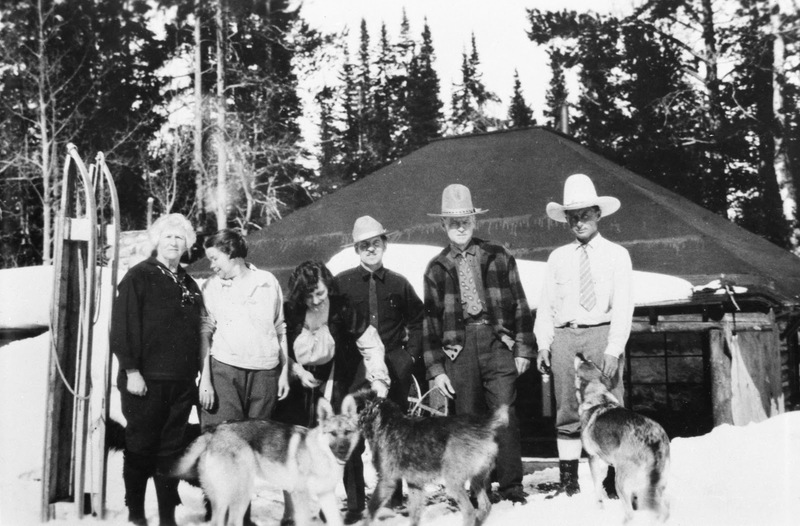
" /><br/><p>Geraldine Lucas was not one to simply comply with traditional norms. At 21, she left a brief but rocky marriage, bringing her son, Russell with her. She then chose to attend school at Oberlin College, becoming both a “returning student” and “single parent” before either term was common. Both Geraldine and Russell had strong personalities, and they clashed over Russell’s educational future spurring him to run away to the Navy. When he returned, they made up, and Geraldine successfully convinced him to join the Coast Guard.</p><p>After she retired in 1913 from teaching public school in New York, Geraldine joined several of her siblings in Jackson Hole, Wyoming where she filed for a 160-acre homestead. Geraldine chose her property as much for the grandeur of the Tetons as for its agricultural potential. She cultivated what was required by law to obtain the property, but then abandoned those efforts and grew only what she needed.</p><p>Geraldine built a cabin and made other improvements, including a second cabin, log storeroom, granary, rabbit hatch, fencing, and over two miles of ditches, all valued at over $7,000. In 1914, she also applied for a timber and stone claim along Phelps Lake, intending to enlarge her landholdings. Geraldine was at odds early on with the federal government due to various errors and complexities associated with her claim. In 1918, when she planned to prove up (colloquial phrase for the legal process of securing title to homestead lands after meeting certain government requirements) on the land, there were complications with the new land office survey and records of intention to file. Geraldine was finally issued her certificate nine years after initiating the process. Then in 1922, Geraldine filed for a desert land entry, but encountered more difficulties with the land office and, ultimately, had to revise the claim from 100 to 70 acres. These frustrations and delays antagonized her against government interference and regulation. Like many Westerners, Geraldine “believed the agency loved technicalities that bordered on harassment.”</p><p>Around 1918, Geraldine persuaded Naomi Colwell to take up an adjacent homestead. At the final proof, Geraldine witnessed that Naomi had no intention to sell her land, a legal requirement, but a short two months later bought 80 acres from her for $500. There were few qualms on the frontier about evading laws or restrictions in the pursuit of additional property. </p><p>In many ways “a loner, ”Geraldine garnered a reputation in Jackson Hole as a man hater. This was reinforced by her efforts to undermine an emerging relationship between Naomi and Russell, as well as run off other potential suitors of the young woman. </p><p>Geraldine spent her summers visiting various family members for weeks at a time, but, come fall and winter, she returned alone to her homestead until spring. She would gather the necessary groceries and wood supply then settle into her books and sewing. A talented seamstress, according to her nephew, she “would sew until hell wouldn’t have it.” Geraldine only ever wore knickers, so it is a mystery what or whom she sewed for. Her personal library consisted of over 1,350 carefully cataloged and numbered books. She also owned a piano, and her home was decorated with gifts from Russell's travels, including a walrus skull and tusks, Kodiak bear head, Eskimo pipe, and reindeer antlers. He also sent a sled and dog team to serve as transport during winter months.</p><p>A mountain climbing craze hit in the 1920s, and Geraldine suddenly had more on her mind than land. In August 1924, age 58, she joined Paul Petzoldt on his climb and became the second woman to summit the crest of the Grand. Instead of warrant accolades, her actions only tended to convince family and neighbors of her eccentricity. As they reached the summit, Petzoldt pushed Geraldine ahead of him so she would be the first on top. He said of her, “I don’t think she often broke through her protected personality, but in that moment when she threw her arms around me with a soft sob, I sensed the real Geraldine Lucas, an intelligent, loving woman who had elected for some reason to leave most of society behind.” Blunt, opinionated, and perhaps unconventional, Geraldine was certainly a character of Jackson Hole. She “simply lived life on her own terms... Yet, much of what set her apart as ‘eccentric’ in her own day, has become commonplace for today’s western women.”</p><p>In the late 1920s, John D. Rockefeller and allies formed a front organization, the Snake River Land Company, to buy property that could be added to the Grand Teton National Park. Many affected by the Great Depression were ready and willing to sell for the fair market prices being offered, but Geraldine was not one of these. Harold Fabian, tasked with buying parcels of land, said of her, “She came out from the east and homesteaded under the Tetons because she wanted to spend the rest of her life within sight of these mountains. She is a lover of beauty and nature.” When offered $50,000 for her homestead, Geraldine responded, “You stack up those silver dollars as high as the Grand Teton and I might talk to you!” She did not share the vision for a national park and had “no use for those who wanted to transform her private playground into a public one.”</p><p>Even amidst the tension of the park property disputes, Geraldine had very pleasant final years on her beloved homestead. She considered making a gift of her land to Oberlin College, but died of heart failure without a will and before any plans were official, so the homestead and property went to Russell. He sold it to a neighbor who sold to Rockefeller who in turn gave it to Jackson Hole Preserve. While Russell never shared his mother’s love for her homestead, he did appreciate it. He placed her cremated remains under a large boulder on her property with a plaque bearing her name and commemorating her memory.</p><p><em><strong><a href="https://www.intermountainhistories.org/items/show/456">For more (including 11 images) view the original article</a></strong></em></p>]]></summary>
    <published>2021-02-06T09:19:15+00:00</published>
    <updated>2026-04-17T19:32:09+00:00</updated>
    <link rel="alternate" type="text/html" href="https://www.intermountainhistories.org/items/show/456"/>
    <id>https://www.intermountainhistories.org/items/show/456</id>
    <author>
      <name>Anna Bailey, Brigham Young University</name>
    </author>
  </entry>
  <entry>
    <title type="html"><![CDATA[American Settlement of Jackson Hole, Wyoming<br />
]]></title>
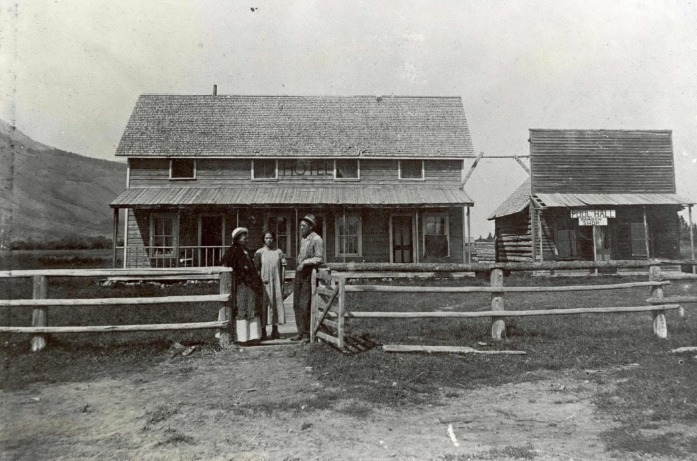
    <summary type="html"><![CDATA[<p><strong><em>In the late 19th century, Jackson Hole, Wyoming was home to seasonal hunters and fur trappers. When the Wilson-Cheney settling company crossed Teton Pass in 1889, they brought with them women, children, and the trappings of civilization to the valley.</p></strong></p><img src="https://www.intermountainhistories.org/files/fullsize/04ae0cedc5be58f1bf0b9a20cf1389af.jpg" alt="First Post Office" /><br/><p>In 1878, Sylvester Wilson and his family, members of The Church of Jesus Christ of Latter-day Saints (LDS), settled what became Wilsonville, UT. A decade later, in the face of a prolonged drought, Sylvester and his son-in-law, Selar Cheney, moved their families north seeking better conditions. Initially intending on settling in St. Anthony, ID, the group chanced upon Sylvester’s brother, Nick Wilson, who convinced them to settle instead in Jackson Hole, a fertile and relatively untouched valley in Wyoming.</p><p>Leaving most of their possessions in Idaho, the company crossed Teton Pass in 1889. As the first company to bring women, children, and wagons into the valley, the group enlarged an indigenous trail through the pass, cutting aside trees and other growth. After two weeks and 88 miles of rough terrain, the company reached Jackson Hole on November 11, 1889.</p><p>When the Wilson-Cheney company arrived, the valley was home to only 28 individuals. The large company more than doubled the valley’s population, and quickly began constructing various elements of American civilization. In 1891, following the deaths of Sarah and Joseph Wilson, they established the valley’s first cemetery. In 1892, they opened the first school in Sylvester Wilson’s home. In 1893, Nick Wilson opened a hotel and post office at the base of Teton Pass.</p><p>The company’s greatest impact on the valley, however, was the clearing of Teton Pass for wagon travel. The trail the Wilson-Cheney company expanded allowed more homesteaders and merchants to access the valley. From its initial population of roughly 28 in 1889, the valley grew to 638 men, women, and children by 1900. The short-lived town of Cheney, one of the company’s settlements, consisted itself of almost 150 people by 1910, and included a blacksmith, carpenter, postmaster, doctor, and taxidermist. Although the LDS settlers mostly left the valley during economic struggles in the 1920s and 1930s, their initial settlements in Jackson Hole brought civilization to the otherwise rugged, mountainous backcountry, and opened the door for countless more settlers.</p><p><em><strong><a href="https://www.intermountainhistories.org/items/show/283">For more (including 3 images) view the original article</a></strong></em></p>]]></summary>
    <published>2019-02-09T07:15:45+00:00</published>
    <updated>2026-04-17T19:32:04+00:00</updated>
    <link rel="alternate" type="text/html" href="https://www.intermountainhistories.org/items/show/283"/>
    <id>https://www.intermountainhistories.org/items/show/283</id>
    <author>
      <name>Matthew Cheney, Brigham Young University</name>
    </author>
  </entry>
</feed>