<?xml version="1.0" encoding="UTF-8"?>
<feed xmlns="http://www.w3.org/2005/Atom">
  <title type="text">Intermountain Histories</title>
  <updated>2026-04-17T19:32:17+00:00</updated>
  <generator uri="http://framework.zend.com" version="1.12.20">Zend_Feed_Writer</generator>
  <link rel="alternate" type="text/html" href="https://www.intermountainhistories.org/"/>
  <link rel="self" type="application/atom+xml" href="https://www.intermountainhistories.org/items/browse?output=rss2"/>
  <id>https://www.intermountainhistories.org/</id>
  <author>
    <name>Intermountain Histories</name>
    <uri>https://www.intermountainhistories.org</uri>
  </author>
  <link rel="hub" href="https://pubsubhubbub.appspot.com/"/>
  <entry>
    <title type="html"><![CDATA[The 509th Composite Group at Wendover Air Force Base<br />
]]></title>
    <summary type="html"><![CDATA[<p><strong><em>In the words of historian Roger D. Launius, “America in the early 1940s was a nation on the move as never before. The exigencies of war reoriented virtually every aspect of the culture, economy, demographics, and politics of aviation in the United States.” The 509th Composite Group at Wendover Air Force Base played an integral role in this transformation by training new pilots, testing new aviation technologies, and successfully executing the Manhattan Project, bringing an end to the bloodiest war the world has ever seen.</em></strong></p><img src="https://www.intermountainhistories.org/files/fullsize/670f71176dece6eb09d290a00396650a.jpg" alt="[Untitled]" /><br/><p><span style="font-weight:400;">One of Utah’s most significant contributions to the American effort during WWII was the creation and training of the 509th Composite Group, “the only unit ever to drop an atomic bomb in combat.” Originally the 393rd Bombardment Squadron, the 509th was created by General Henry “Hap” Arnold, who selected Lt. Colonel Paul W. Tibbets to head the group. Lt. Col Tibbets was given the options of Mountain Home, ID; Fairmont, NE; and Wendover, UT to host his group, as “all three had acceptable facilities and runways for B-29 operations.” Lt. Col Tibbets ultimately chose the site in Utah based on its extensive bombing and gunnery range facilities, as well as the history of heavy bomber training in Utah. The required facilities were already in place in Wendover. The Utah site was also desirable because of its relative proximity to Los Alamos, NM; the site responsible for developing the nuclear payload Tibbets’ team would be delivering. Additionally, since Wendover was so isolated, the project could be kept secret from prying eyes, both foreign and domestic.  </span>
<span style="font-weight:400;">The 509th Composite Group trained from 1944-1945, dropping 5,000 to 10,000 pound dummy bombs, conducting rapid turns to avoid the nuclear blowback (though the crews weren’t told the reason for these maneuvers), and increasing accuracy to within 200 meters of their targets. On May 29, 1945 the group was relocated to Tinian in the Mariana Island chain. Afew months later they dropped two atomic bombs on Japan, effectively ending the world’s largest and bloodiest conflict. From the “History of the 509th Composite Group” written in 1945, there was an interview with Lt. Colonel Tibbets where he was asked about the success and contributions of the 509th Composite Group. When asked whether the group “measured up to expectations” regarding its contributions and fulfillment of the Manhattan Project, Lt. Colonel Tibbets replied:  </span>
<span style="font-weight:400;">The mission of the 509th was accomplished. Its success is now a matter of world history. In all probability this success surpasses the expectations of those intimately connected with the early phases of the project. It is safe to say that the 509th never held up the work of the project. Many times the 509th caused the project to speed up their efforts because the unit shaped up faster than expected and was committed to the theater ahead of schedule. The success of this organization is due to teamwork by all people in the outfit and the willingness with which they cooperated with the project people to accomplish our assigned mission.</span>
<span style="font-weight:400;">Following the successful conclusion of World War II, thanks in large part to the efforts of the 509th Composite Group, Wendover Air Force Base continued to train new generations of pilots, develop new technologies, and build the fledgling Army Air Corps into the most dominant Air Force the world has ever seen.  </span></p><p><em><strong><a href="https://www.intermountainhistories.org/items/show/794">For more (including 4 images) view the original article</a></strong></em></p>]]></summary>
    <published>2024-03-19T01:53:40+00:00</published>
    <updated>2026-04-17T19:32:17+00:00</updated>
    <link rel="alternate" type="text/html" href="https://www.intermountainhistories.org/items/show/794"/>
    <id>https://www.intermountainhistories.org/items/show/794</id>
    <author>
      <name>Joshua W. Sturgill, Brigham Young University</name>
    </author>
  </entry>
  <entry>
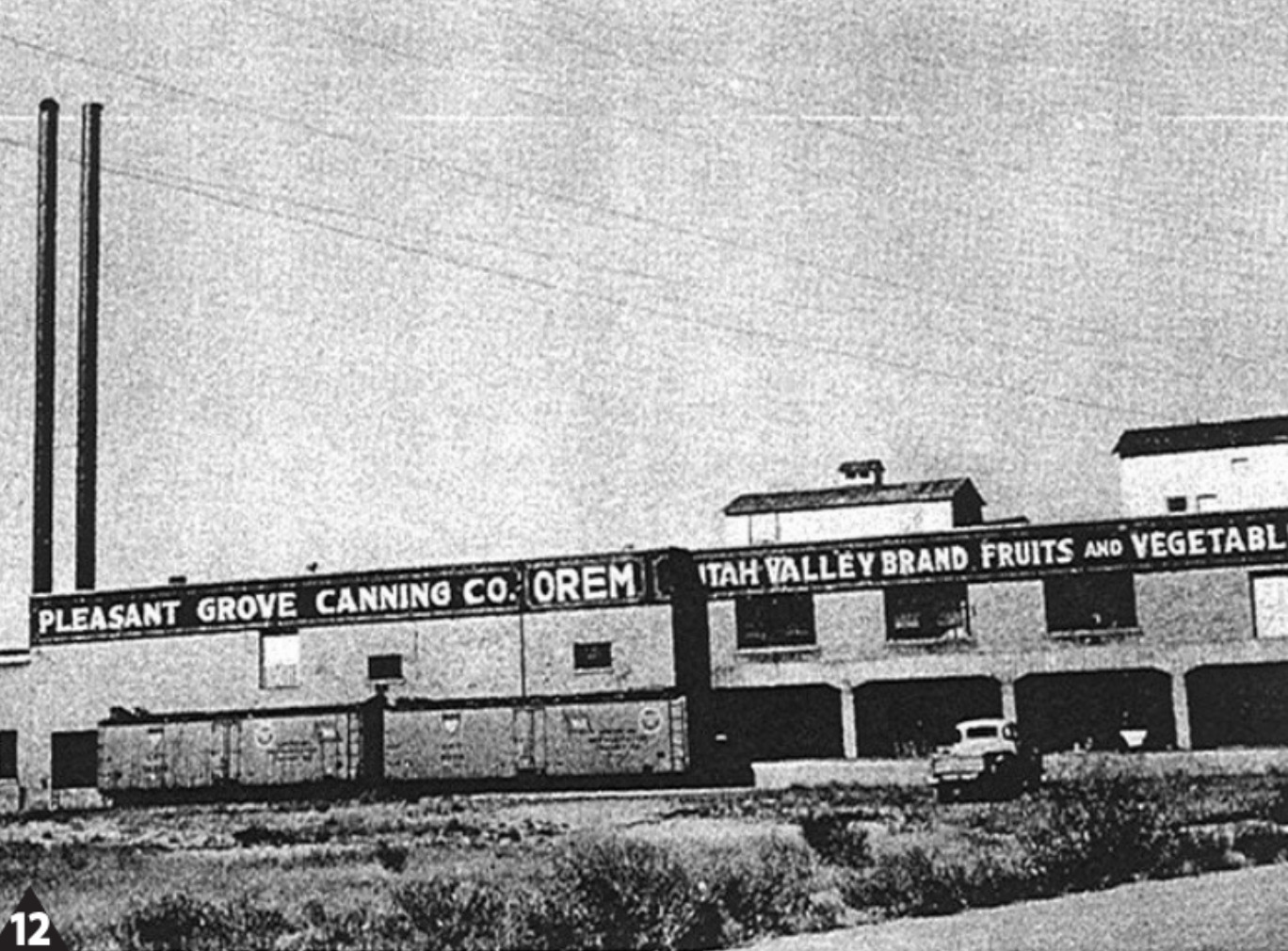
    <title type="html"><![CDATA[Pleasant Grove Canning Company]]></title>
    <summary type="html"><![CDATA[<p><strong><em>Although no longer standing, the Pleasant Grove Canning Company was once a thriving business, canning large quantities of locally-grown produce and distributing it to many places around the country.</em></strong></p><img src="https://www.intermountainhistories.org/files/fullsize/00b1f46b83a87cfaed7060d882876abc.jpg" alt="Pleasant Grove Canning Company" /><br/><p><span style="font-weight:400;">The Pleasant Grove Canning Company, established in 1919 in Orem, Utah, marked a significant milestone as the town’s inaugural major industry. The canning industry had been growing in the United States for about 50 years before the Pleasant Grove Canning Company was created. By the time it opened, the preservation of produce through canning had been perfected. In the 1930s, during the Great Depression, there was little industry in Utah County, but the canning company took in produce from local farmers and farmers of the Provo Bench, canning, among other things, 75,000 cases of tomato paste. The company sold the tomato paste to the Campbell Soup Company.  </span>
<span style="font-weight:400;">The canning company underwent substantial changes in subsequent years as the industry in the state evolved.  In 1960, the Pleasant Grove Canning Company merged with Ogden’s Utah Canning Company and it became known as the Orem Plant of Utah Packers. Eventually, the decision was made to sell the company. In 1972, the company was sold to Booth Distributing Inc. and they used the building as a warehouse. </span>
<span style="font-weight:400;">Over the ensuing decades, the building was sold multiple times to different owners. In 1992, the once-thriving structure had fallen into disrepair and deemed a hazard by the city of Orem. Consequently, in 1993, the building was demolished, leaving behind only memories and a historic marker commemorating the site of the former Orem landmark. </span></p><p><em><strong><a href="https://www.intermountainhistories.org/items/show/785">For more (including 3 images) view the original article</a></strong></em></p>]]></summary>
    <published>2024-02-26T20:24:10+00:00</published>
    <updated>2026-04-17T19:32:17+00:00</updated>
    <link rel="alternate" type="text/html" href="https://www.intermountainhistories.org/items/show/785"/>
    <id>https://www.intermountainhistories.org/items/show/785</id>
    <author>
      <name>Trevor Sites, Brigham Young University</name>
    </author>
  </entry>
  <entry>
    <title type="html"><![CDATA[The Benson Gristmill of Tooele]]></title>
    <summary type="html"><![CDATA[<p><strong><em>The popular image of early pioneer Utah is often one of rural and agricultural communities, with little technology beyond the cow and plow. However, industrial mills like the Benson Gristmill in Tooele were integral to utilizing Utah’s resources and encouraging the economy. </em></strong></p><img src="https://www.intermountainhistories.org/files/fullsize/89c222b5d013dedec2fccdeb4f69666a.jpg" alt="Gristmill 1" /><br/><p><span style="font-weight:400;">In the early days of Utah’s settlement, the Church of Jesus Christ of Latter-day Saints encouraged Utahns to develop their land and build industrial infrastructure. One fitting example of this occurred in 1854, when Ezra T. Benson (the great-great grandfather of the later prophet, Ezra Taft Benson) moved to Tooele Valley with orders from Brigham Young to build a gristmill, which would grind raw cereal grains into flour. Such a mill would provide a vital service for the surrounding settlements. Soon, Benson and a few other men gained the rights to the land, water, and timber from Brigham Young and started building the mill by a pond in northern Tooele. </span>
<span style="font-weight:400;">The mill itself was a remarkable piece of resourceful architecture. For example, wooden pegs were used in stabilizing the beams of the building. This allowed the pegs to expand and contract along with the beams as the weather changed, leading to greater stability. </span>
<span style="font-weight:400;">For almost one hundred years, from 1854 until the 1940s, the mill processed many tons of corn and wheat for the communities of Tooele Valley. For instance, in 1860 alone, the mill processed about $17,000 worth of grains. That same year, the mill’s rights were transferred to Brigham Young, after Benson moved to Cache Valley. This transfer of ownership was likely to prevent the mill from being seized by the federal government during the conflict over polygamy. </span>
<span style="font-weight:400;">  In 1922, the mill was bought by the future LDS apostle J. Reuben Clark. Under his ownership, the mill was upgraded and the older wooden waterwheel and millstones were replaced by a metal turbine and free standing “grain breakers,” which were more durable and could grind the grain with greater efficiency. In 1938 the mill switched from milling flour to making animal feed. A few years later the mill stopped being used and fell into disrepair. </span>
<span style="font-weight:400;">The building stood abandoned until 1983, when a committee of volunteers recognized the Benson Gristmill as an important historical site to the community of Tooele. In the next few years, the small group got Terracor Corp, a land development firm that then owned the property, to donate the site to Tooele County as a historical monument, allowing them to restore and preserve the mill. The Benson Gristmill is now one of the most intact pioneer-era sites in the state, standing as a reminder of the humble yet powerful origins of Utah’s communities. </span></p><p><em><strong><a href="https://www.intermountainhistories.org/items/show/773">For more (including 3 images) view the original article</a></strong></em></p>]]></summary>
    <published>2024-01-22T02:54:31+00:00</published>
    <updated>2026-04-17T19:32:17+00:00</updated>
    <link rel="alternate" type="text/html" href="https://www.intermountainhistories.org/items/show/773"/>
    <id>https://www.intermountainhistories.org/items/show/773</id>
    <author>
      <name>Grace Bodily, Brigham Young University</name>
    </author>
  </entry>
  <entry>
    <title type="html"><![CDATA[ Women in Los Alamos during the Manhattan Project <br />
]]></title>
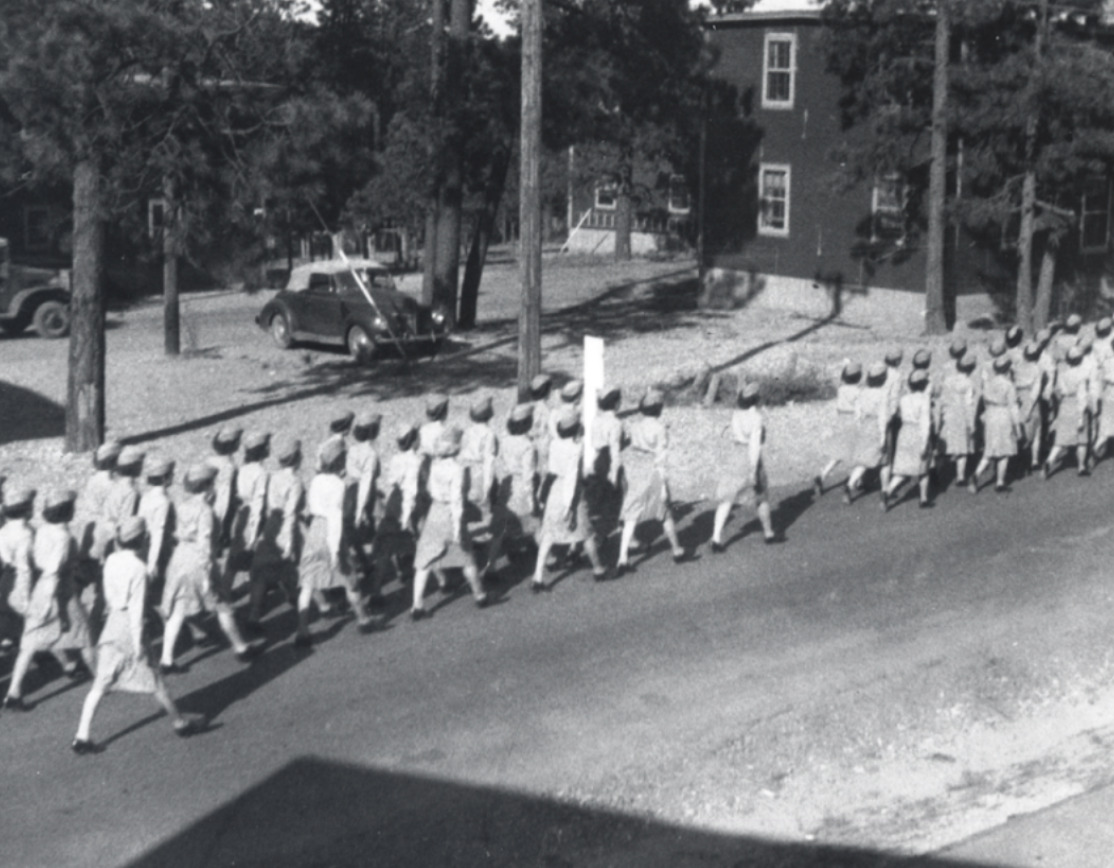
    <summary type="html"><![CDATA[<p><strong><em>With the war effort withdrawing men from the domestic labor force, women became an increasingly important part of the Manhattan Project in Los Alamos. </p></strong></p><img src="https://www.intermountainhistories.org/files/fullsize/c8f195c81db8f6804378056bc75c3f0b.jpg" alt="WAC March in Los Alamos" /><br/><p><span style="font-weight:400;">Wartime labor shortages were a constant struggle for the United States during World War II. They needed to send troops overseas, develop weaponry, spy on their enemies, strategically plan, and mobilize the entire nation as quickly as possible. By 1943, the United States Army was 200,000 men short for their invasion on D-Day, they were in need of 315 more physicists for their defense projects, and the Manhattan Project was desperately in search of all kinds of labor from scientists and engineers to machinists and pipefitters. In response, President Franklin D. Roosevelt signed into existence the Women’s Army Auxiliary Corps established “for the purpose of making available to the national defense the knowledge, skill, and special training of women of the nation” on May 15, 1942. Still facing discrimination, unequal pay, and fewer opportunities than their male counterparts, women played an essential role in World War II, especially in Los Alamos. </p>
<span style="font-weight:400;">Because Los Alamos was such a restricted town and the directors wanted to limit the number of outsiders, General Leslie Groves encouraged wives of scientists to work on the project in whatever capacity they could. As an incentive, they provided nursery schools for their young children to aid with childcare. Despite the government’s encouragement, some women were still hesitant to work on the project over concerns for their family’s well-being. Many had not expected to work at all, and quite a few were dissatisfied with the living conditions in which they now were expected to raise their children. Charlotte Serber, the only female group leader at the laboratory, wrote, “For the potential working wife, there was one chief worry. Could she manage her home here on the mesa and work too?” These were fair concerns. The conditions under which they were expected to work were difficult. They were isolated from extended family, were allowed only one day off of work per month for shopping in Santa Fe, were expected to work forty-eight hours in a week, and had almost no bargaining power to shift their rules or salary. They were also far less likely to gain security clearance than their male counterparts, so it was unlikely that they knew what they were helping create. </p>
<span style="font-weight:400;">Despite these stringent circumstances, many women in Los Alamos did work on the secretive atomic gadget. By October 1944, women constituted about 30% of the labor force in the Tech Area, hospital, and schools. It is also notable that although they did employ some women in clerical positions, the vast majority were scientists or technicians. They were metallurgists, engineers, physicists, chemists, and teachers, involved in every aspect of the atomic effort until the very end. The exception for this participation was in Project Alberta. This was the very last phase of the project; the physical delivery of the bomb to the Pacific island Tinian where the nuclear components were assembled before being dropped on Japan. Women who had spent years contributing to this moment were left behind in the United States to learn about the bombingsfrom the same newspapers as everyone else. However, the atomic bomb could not have been built as quickly or efficiently as it was without the contribution of women. They faced gender discrimination, suboptimal conditions, and unfair pay to contribute to the atomic effort in Los Alamos. </span>

</p><p><em><strong><a href="https://www.intermountainhistories.org/items/show/756">For more (including 3 images) view the original article</a></strong></em></p>]]></summary>
    <published>2023-09-24T18:36:48+00:00</published>
    <updated>2026-04-17T19:32:16+00:00</updated>
    <link rel="alternate" type="text/html" href="https://www.intermountainhistories.org/items/show/756"/>
    <id>https://www.intermountainhistories.org/items/show/756</id>
    <author>
      <name>Abigail Beus, Brigham Young University</name>
    </author>
  </entry>
  <entry>
    <title type="html"><![CDATA[Frontier No. 1 Mine and the Explosion that Rocked Kemmerer, Wyoming]]></title>
    <summary type="html"><![CDATA[<p><strong><em>Kemmerer, Wyoming has been a mining town for over a century. In 1923, an explosion from the Frontier No.1 mine rocked the town and killed 99 men. Not only did this event leave many fatherless and widowed, but it also represented the dangers of industrialism in the early 20th century. </em></strong></p><img src="https://www.intermountainhistories.org/files/fullsize/d5a639434211920e5755e69130230de8.jpg" alt="A Brick of the Mine" /><br/><p><span style="font-weight:400;">The Kemmerer mine explosion is memorialized in a mural in the neighboring community of Diamondville. The mural is separated into several different sections and tells the history of mining in Lincoln County, Wyoming, ending with the tragic explosion in 1923. The city of Kemmerer decorates the miners’ graves every Memorial Day with  commemorative flowers. At the local museum, exhibits tell the stories of the many mines in the area, including Frontier No. 1.  </span>
<span style="font-weight:400;">John Kemmerer and Patrick J. Quealy formed a partnership that grew into four companies, including the mine. The mine opened in 1887, a mile outside of Kemmerer. For nearly a decade, the mine had no name until 1897, when Kemmerer dubbed the mine Frontier,  the same name as their supply company. At the time of the explosion, the mine produced up to 700 tons of coal a day. It also contained 30 workable areas. </span>
<span style="font-weight:400;">On August 14, 1923, Frontier No. 1 exploded and killed 99 men, the second-worst mining disaster in Wyoming history. A fire boss had tried to relight the flame of a safety lamp and accidentally ignited some nearby gas. It exploded and trapped the workers as the exits filled with rock and other debris. If the miners didn’t die from the initial explosion, then smoke or suffocating gasses, known as black damp, soon overtook them. It took 48 hours for rescuers to find the first survivors. The explosion made newspapers all over the state and became a symbol of the dangers of industrialism. Most of the men that died in the accident were immigrants from places such as South America, Italy, Japan, Australia, and Mexico. The </span><i><span style="font-weight:400;">Rock Springs Rocket</span></i><span style="font-weight:400;"> newspaper called the miners, "Martyrs to Industrialism."  The mine started back up after six months only to be shut down three or four years later. Today, the mine is buried to keep the public safe, but evidence of the explosion and the existence of the mine remains.</span></p><p><em><strong><a href="https://www.intermountainhistories.org/items/show/738">For more (including 4 images) view the original article</a></strong></em></p>]]></summary>
    <published>2023-04-07T17:30:44+00:00</published>
    <updated>2026-04-17T19:32:16+00:00</updated>
    <link rel="alternate" type="text/html" href="https://www.intermountainhistories.org/items/show/738"/>
    <id>https://www.intermountainhistories.org/items/show/738</id>
    <author>
      <name>Madison D. King, Brigham Young University</name>
    </author>
  </entry>
  <entry>
    <title type="html"><![CDATA[North Ogden Cannery Building]]></title>
    <summary type="html"><![CDATA[<p><strong><em>Beginning in 1900, the North Ogden Canning Company opened in Weber County. As one of several canneries, the North Ogden Canning Company wished to take advantage of new traffic provided by the railroad. Today, the building houses several businesses.</em></strong></p><img src="https://www.intermountainhistories.org/files/fullsize/19c833e23d289e288ff3f885b0754112.jpg" alt="Women working with tomatoes" /><br/><p><span style="font-weight:400;">In 1869, Union Pacific laid tracks stopping through Ogden, Utah to Promontory. The resulting traffic led citizens of Ogden to construct a cannery to sell excess crop production throughout the nation. In 1886, the Ogden Canning Company opened. Three years later, the Utah Canning Company was organized. Canning success motivated the start of other canneries throughout Utah. </span>
<span style="font-weight:400;">In 1900, the North Ogden Canning Company was created by James Enoch Randall, Alexander Leslie Brewer, and nearby neighbors. They built a factory in 1901, one mile from the Randall home. Since the factory opened, numerous products have been added to the company's manufacturing. Any products grown by local farmers were eligible to be canned and transported: sugar peas, green beans, pie cherries, tomatoes, peaches, apricots, and more. </span>
<span style="font-weight:400;">When the factory first began operating, methods of canning were slow and mostly by hand. Beans were snipped, tomatoes peeled, and labels pasted and attached all by hand. In later years, newer methods of canning were installed; mechanical devices and machines were purchased to improve the handling of the produce. Produce included sugar peas, green beans, apricots, peaches, pie cherries, fancy-pack cherries, whole tomatoes, tomato catsup, tomato juice, and red beets. </span>
<span style="font-weight:400;">Early in July 1925, a fire destroyed part of the warehouse of the factory. When damage by fire had been repaired, members of the community gathered to spend an evening of dancing on the new floor upstairs to celebrate the restoration of the building. </span>
<span style="font-weight:400;">In the early 1920s, Weber County was one of the most agriculturally productive counties in the state; however, over time the county became more urbanized and overall production declined. By 1930, there were thirteen canning factories in Weber County that employed 2,350 workers during the packing season, with a pay-roll of $266,000. In that year the total value of production was $3,225,000. In the entire district, the normal pack was 3,500,000 cases, valued at $9,000,000, making Ogden one of the least profitable. </span>
<span style="font-weight:400;">One of the major interruptions of service for the North Ogden Cannery came during World War II when canning and distribution was halted for several crops including sweet cherries and sour cherries. Wartime rationing hurt the canning business as Americans were encouraged to can their own food in order to promote self-sustainability. After the war, the North Ogden Canning Company stayed afloat until it closed its doors a few decades later. </span>
<span style="font-weight:400;">In 1970, the North Ogden Cannery building was purchased by Lloyd Searle for his business, Lloyd’s Heating and Air. Throughout the coming and going of many businesses through the next few decades, the inside of the building was changed dramatically. Nine years after the hiring of Shawn Maynard as a manager of the location in 1994, he bought the building from Lloyd Searle and, with his wife Sharlene, began remodeling. In Sharlene’s words, “knowing that the building was in desperate need of repairs, and could possibly fall victim to eminent domain and demolition, we made an offer to Lloyd to purchase the building.” </span><span>In their remodel, the Maynards hoped to restore some original designs present when the building was a cannery. </span><p>Several other businesses have taken up residence in the</span> <span>newly remodeled building including: the Pet Chalet Boarding and Grooming, Great Harvest</span> <span>Bread, Rejuvenation Massage and Yoga, and Shine Beauty and Nails. This wave of entepreneurship and renovation has kept the factory in good company. </span></p><p><em><strong><a href="https://www.intermountainhistories.org/items/show/688">For more (including 3 images) view the original article</a></strong></em></p>]]></summary>
    <published>2022-10-31T20:55:16+00:00</published>
    <updated>2026-04-17T19:32:15+00:00</updated>
    <link rel="alternate" type="text/html" href="https://www.intermountainhistories.org/items/show/688"/>
    <id>https://www.intermountainhistories.org/items/show/688</id>
    <author>
      <name>Harley Pence, Weber State University</name>
    </author>
  </entry>
  <entry>
    <title type="html"><![CDATA[Abel E. Eaton House]]></title>
    <summary type="html"><![CDATA[<p><strong><em>Owned by a schoolteacher turned industrialist, the Abel E. Eaton House remains an unusual but attractive example of Second Empire architecture in Oregon.</em></strong></p><img src="https://www.intermountainhistories.org/files/fullsize/781b69d9143d6aecf6a39c04d172878f.jpg" alt="Enclosed porch" /><br/><p>Union, Oregon began as an industrial town in 1862, serving as one of the state’s primary economic centers through the end of the nineteenth century. Abel Elsworth Eaton, a former schoolteacher in the Midwest, moved to Oregon seeking financial gain, and he opened a successful freighting business in Baker City in 1867. He eventually purchased a woolen mill in neighboring Union in 1871. When the mill became his primary business, he moved to the town permanently and started a ranch in the area. Because of these and other financial interests, Eaton developed a considerable fortune and decided to build a home equivalent to his status in 1908, culminating in the Abel E. Eaton House. He combined two ornamental architectural styles, the waning Second Empire style with the more popular Queen Anne style, to create an unusual but appealing structure.
Queen Anne style bears similarities to Second Empire as it often contains high amounts of interior and exterior decoration, though it follows eighteenth-century <em>British</em> design cues instead of French ones. Instead of Second Empire mansard roofs, which distinctly curve downward from a square or rectangular top, Queen Anne roofs are gabled, sloping downward on the front and back, leaving a gable (the wall) in between the roof’s sides. Steeply pitched roofs are common on Queen Anne structures, creating the perception of a larger home, while Second Empire ones are symmetrical, curving down from the flat top on four sides, providing more space in the second story. The Eaton House combines these two designs, as its roof is mansard, but steeply pitched, including several smaller roofs in front of the second-story balconies and windows, expanding with the exterior walls.
Unlike many Second Empire and Queen Anne houses, the Eaton House does not embrace ornamentation, remaining plain, but tasteful. While elegant in appearance, it is not large and is slightly under 1,500 square feet, though it contains five bedrooms and two-and-a-half bathrooms. Its simple brick siding, however, is broken by the classically-inspired wraparound porch. This feature, often found in Queen Anne style, makes homes seem larger in scale and provides greater exterior variety. In another contradiction, ornamental cast-iron fencing, typical in Second Empire homes, tops the section of the roof curved in the shape of a bell, known as a bellcast tower, above the balconies.
The Eaton House remains well-preserved, with the floor plan unchanged, staying close to the condition Eaton left it when he died in 1917. Before his passing, Eaton served as Mayor of Union for one term and unsuccessfully ran for governor under the Prohibition ticket in 1910, winning 5.1% of the vote. The only major adjustment to this house after his death is the alternation of the wraparound porch. Previously enclosed by large windows in-between classical pillars, the entrance has since been exposed, showing the front door and exterior brickwork. Without older photographs of the Eaton House, this change would be almost unnoticeable, as the open-air entrance appears natural. Listed on the National Register of Historic Places in 1977, the Eaton House remains private property at the time of writing and is not open to the public.</p><p><em><strong><a href="https://www.intermountainhistories.org/items/show/595">For more (including 5 images) view the original article</a></strong></em></p>]]></summary>
    <published>2022-04-16T04:41:33+00:00</published>
    <updated>2026-04-17T19:32:13+00:00</updated>
    <link rel="alternate" type="text/html" href="https://www.intermountainhistories.org/items/show/595"/>
    <id>https://www.intermountainhistories.org/items/show/595</id>
    <author>
      <name>William R. Batson, Northern Arizona University</name>
    </author>
  </entry>
  <entry>
    <title type="html"><![CDATA[Browning Firearms Museum: The Legacy of John M. Browning]]></title>
    <summary type="html"><![CDATA[<p><strong><em>The Browning Collection at The Ogden Union Station commemorates and celebrates the genius of the man who revolutionized the firearm industry.</em></strong></p><img src="https://www.intermountainhistories.org/files/fullsize/355594e8162bff8d4970bb6c897e96e9.jpg" alt="Browning shop replica" /><br/><p>On January 23, 1855 in Ogden Utah, John Moses Browning was born to Jonathan Browning and Elizabeth Clarke. From his earliest years, John spent his days in the Browning shop, experimenting with tools and firearm components while the hammer rang out at his father’s workbench. John had little formal schooling but received an education as his father’s protégé. Later accounts called the Browning shop the inventor’s school, for it was where the Browning firearms legacy emerged. Throughout his boyhood, John M. Browning committed to memory every gun part that came through the shop, gaining first-hand experience with everything related to gunsmithing. He eventually learned the fundamentals well enough to assess and tag a customer’s gun for repairs while his father was out of the shop.
Around age 10, the inventive John Moses recruited his younger brother Matt to try his hand at gunsmithing. Taking the sawn-off end of a damaged barrel they found in their father’s scrap pile, John attached the barrel to a stock he had hacked from a board of wood with his hatchet. The gun was crudely fashioned, having no hammer or trigger mechanisms, and the only way to load the gun was to insert a bullet and pour gunpowder through a small vent behind where the ammunition sat. With the newly assembled firearm and some pillaged gunpowder, John and Matt ran to the edge of the Browning property that extended beyond the Ogden City limits. Aiming at a couple of prairie hens sighted down the barrel of his gun, John told Matt to light the end of a stick with the coals in order to ignite the powder in the funnel. As John recalled, that handmade gun knocked him to the ground, but it did its job. The two boys managed to bring home three birds for supper using that single-shot makeshift weapon. When the two told their father about their success, Jonathan only remarked, “John Moses, you’re going on eleven; can’t you make a better gun than that?” Flustered at his father’s remarks, John determined to do exactly that.
It was this upbringing that laid the foundation for the firearm dynasty John Moses Browning established throughout his 71 years of life. At age 23 he designed his first gun: the John M. Browning’s Single Shot Rifle. With the help of his brothers, John manufactured this model in their own little factory in Ogden until selling the patent to Winchester in 1883. From that point on, John designed every gun that can come to mind: machine guns, shotguns, pistols, and rifles. He created designs of exceptional quality, and many of his inventions were referenced and copied throughout the world. These designs are displayed in museums worldwide, but no museum houses a more complete tribute to his legacy than the Browning Firearms Museum. The museum is an important monument to his life and represents the culmination of his life’s inventions that helped shape the United States and the world.</p><p><em><strong><a href="https://www.intermountainhistories.org/items/show/482">For more (including 4 images) view the original article</a></strong></em></p>]]></summary>
    <published>2021-09-15T06:13:52+00:00</published>
    <updated>2026-04-17T19:32:10+00:00</updated>
    <link rel="alternate" type="text/html" href="https://www.intermountainhistories.org/items/show/482"/>
    <id>https://www.intermountainhistories.org/items/show/482</id>
    <author>
      <name>Brandon E. Jeppson, Brigham Young University</name>
    </author>
  </entry>
  <entry>
    <title type="html"><![CDATA[Sage Treharne Jones, Female Homesteader]]></title>
    <summary type="html"><![CDATA[<p><strong><em>Sage Treharne Jones was many things before she turned to homesteading— immigrant, teacher, wife, mother, widow, and postmistress. Efficient and industrious, Sage embodied characteristics necessary to thrive on Utah frontiers in the 19th century.</p></strong></p><img src="https://www.intermountainhistories.org/files/fullsize/8eec0e69d3629d4e63f439c06eb1a19b.jpg" alt="Image of Sage Treharne Jones
" /><br/><p>In 1849, Sage Treharne migrated from Wales to the United States after being taught by Mormon missionaries. She faced cholera and smallpox along the way and watched both her parents die. She continued west, travelling with a Greene family. On her way, Sage met Thomas Jones and, upon arriving in Utah in October 1852, the two were married. Following demand for iron workers, or possibly answering a call from church leaders, Sage and Thomas moved to Southern Utah. When the iron works were discontinued in 1858, the family turned completely to farming and livestock. In 1860, they built a small adobe house in Cedar City. Thomas developed rheumatism which grew increasingly worse, disabling him until his death in September 1862. </p><p>Sage was left a widow with six living children under the age of eight. She turned to sewing to make a livelihood and depended on her farm to raise the necessary crops and livestock. She is described as an independent woman and “determined to give her children all the advantages that could be had.” “Never ashamed of how little they had,” Sage raised her family to be hardworking and proud of their heritage. Life was difficult, but growing children stepped up, taking over the farm work, and the Jones received support from their neighbors when needed. When harvests failed, the community came together, sharing what little they had and “in their kindness to one another, they found their greatest joy.”</p><p>Her oldest sons, Lehi and Kumen, acquired a contract delivering mail and freight along Pony Express routes and Sage assumed the role of postmistress. “Without ever a word of complaint,” she was a firm supporter of the boys in their position. The mail contract continued with younger sons and nephews continuing to deliver until 1876. In 1885, Sage was appointed as the postmistress of Cedar City. In this new role and with the help of her children, Sage learned to write English. She kept the post office for thirteen years. </p><p>In 1895, at age 62, Sage filed for a homestead on two land sections in Cedar Canyon, near the intersection of Moots Hollow. With her children largely established and self-reliant, it seems she filed hoping to acquire more land for her family. Soon after, she received her US citizenship. One year after becoming a citizen and before she could legally acquire the deed to her claim, Sage died. The property defaulted to her heirs several years after her death. Sage was an active member of her community and Relief Society. A dignified woman, she “was respected and loved wherever she went.” Sage was not a homesteader, at least initially, in the traditional sense of filing on a claim, but she certainly worked hard, sought independence, and “learned to love the wild country of the West.”</p><p><em><strong><a href="https://www.intermountainhistories.org/items/show/451">For more (including 4 images) view the original article</a></strong></em></p>]]></summary>
    <published>2021-02-03T05:34:32+00:00</published>
    <updated>2026-04-17T19:32:09+00:00</updated>
    <link rel="alternate" type="text/html" href="https://www.intermountainhistories.org/items/show/451"/>
    <id>https://www.intermountainhistories.org/items/show/451</id>
    <author>
      <name>Anna Bailey, Brigham Young University</name>
    </author>
  </entry>
  <entry>
    <title type="html"><![CDATA[AIM Occupation of Fairchild Plant on Navajo Reservation]]></title>
    <summary type="html"><![CDATA[<p><strong><em>Activism plays a significant role in improving employment quality and longevity, but situations like the occupation of the Fairchild Plant on the Navajo Reservation causes people to question whether or not activism is the best method to achieve such goals.</em></strong></p><img src="https://www.intermountainhistories.org/files/fullsize/f881a04cf0a41c0bb4ee8d31723f525d.jpg" alt="Ribbon cutting at Fairchild Building Dedication, 1969" /><br/><p>In the early 1960s, unemployment on the Navajo Reservation hovered around 40% and Tribal leadership desperately tried to create jobs for Diné peoples. In 1964, Tribal chairman Raymond Nakai advocated for better economic development on the reservation and – hoping to attract outside investment – opened up the Navajo Nation to outside businesses. To further entice companies, the tribe offered $1 million toward development to any company willing to relocate. Fairchild Camera and Instrument Corporation responded to the offer and decided to build a plant in Shiprock, New Mexico and provide housing for tribal members who helped with construction. After its completion, Fairchild employed more than a thousand workers (the majority being female) and provided consistent jobs for ten years. </p><p>In the early 1970s, however, the country’s economy lagged, affecting companies like Fairchild. Many of the workers in Shiprock faced reduced paychecks or even termination. According to one Navajo account, the plant manager said, “This is a business venture, not a charitable activity.” The weakened economy combined with news of the plant’s financial solution wounded the community’s morale. The American Indian Movement (AIM) – an organization founded during the Civil Rights Era that fought for indigenous communities’ rights – heard about the situation and decided to intervene. Protestors including activist Russell Means came to Shiprock and laid siege to the plant on behalf of the underpaid and dismissed workers. The protestors demanded that Fairchild rehire the workers and restore their paychecks to pre-reduction rates. However, some local Natives considered this protest against the company dangerous and unnecessary. </p><p>Fairchild refused AIM’s conditions and let the tribal government handle the matter. However, the tribal government did not help overcome the impasse and the siege ultimately shut down the plant. Fairchild executives expressed frustration over how the tribe handled the situation and withdrew from the reservation altogether, relocating their operations to Korea. Some AIM supporters perceived this result as a victory, but locals recognized the great loss of employment opportunity alongside a damaged reputation for future incoming businesses on the Navajo Reservation. Even today, these consequential outcomes continue to have a harmful effect on Navajo employment.</p><p><em><strong><a href="https://www.intermountainhistories.org/items/show/398">For more (including 3 images) view the original article</a></strong></em></p>]]></summary>
    <published>2020-03-06T23:38:51+00:00</published>
    <updated>2026-04-17T19:32:08+00:00</updated>
    <link rel="alternate" type="text/html" href="https://www.intermountainhistories.org/items/show/398"/>
    <id>https://www.intermountainhistories.org/items/show/398</id>
    <author>
      <name>Elias Gold, Brigham Young University</name>
    </author>
  </entry>
  <entry>
    <title type="html"><![CDATA[The Scofield Mine Disaster]]></title>
    <summary type="html"><![CDATA[<p><strong><em>On May 1, 1900, an explosion at the Winter Quarters mine killed at least 200 men. At the time, it was the worst mining accident to occur in the United States, and it devastated the families left behind in the mining town of Scofield.</em></strong></p><img src="https://www.intermountainhistories.org/files/fullsize/e97bda205bd88ea68ad598ea6aa80eb4.jpg" alt="Caskets at Wasatch Store, Winter Quarters, Utah" /><br/><p>Scofield is a small mining town located in Carbon County, located next to the Winter Quarters mine. On May 1, 1900, there was an accidental explosion in the Winter Quarters mine. While many men rushed to rescue miners caught in the blast, many were killed in the initial explosion, struck by falling debris, or killed by afterdamp, a toxic gas. Miners from other mines in the area, such as Castle Gate, Clear Creek, and Sunnyside, helped retrieve bodies the next day. A total of 200 - 246 men were killed in the accident. There were not enough coffins to bury all of the miners, so some coffins had to be ordered from Denver, Colorado and taken to Scofield on a train.</p><p>The Winter Quarters mine explosion had devastating effects on the town of Scofield. Nearly every family lost someone in the accident, with some families losing several family members. In a tragic example, the Louma family lost six sons and three grandsons, all in the same day. However, some incredible stories came from the disaster as well. One such story is that of John Wilson, who was blown 820 feet from the entrance of the mine into the surrounding canyon and miraculously survived. Another well-known story is that of Thomas Pugh, a 15-year-old boy who put his cap in his teeth, used it to plug his nose, and ran a mile and a half through toxic gas back to the mine entrance in the dark.</p><p>Although the exact cause of the explosion was never discovered, many believe that the accident could have been prevented if the Pleasant Valley Coal Company had implemented safety procedures and taken better precautions. Unsurprisingly, many families blamed the company for the accident. Labor unrest from this event no doubt contributed to later strikes in the region, such as the 1901 Pleasant Valley strike. The Winter Quarters mine puts into perspective how dangerous an occupation mining was, and how much miners were asked to sacrifice for their livelihood. Today, many remember the Scofield mining disaster as a horrible event that showcases the brutal treatment of working-class individuals in the 20th century.</p><p><em><strong><a href="https://www.intermountainhistories.org/items/show/389">For more (including 3 images) view the original article</a></strong></em></p>]]></summary>
    <published>2020-02-16T07:01:51+00:00</published>
    <updated>2026-04-17T19:32:07+00:00</updated>
    <link rel="alternate" type="text/html" href="https://www.intermountainhistories.org/items/show/389"/>
    <id>https://www.intermountainhistories.org/items/show/389</id>
    <author>
      <name>Abby Donaldson, Brigham Young University</name>
    </author>
  </entry>
  <entry>
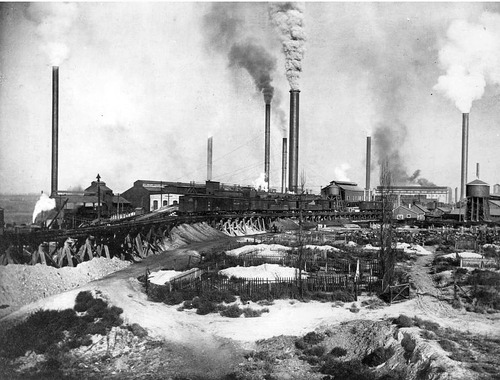
    <title type="html"><![CDATA[Murray Smelter: The Purpose of the Superfund Program]]></title>
    <summary type="html"><![CDATA[<p><strong><em>State, local, and EPA officials worked together in Murray, Utah - a suburb of Salt Lake City - to clean up a lead smelter that had received the highest ever hazard rating from the EPA. </em></strong></p><img src="https://www.intermountainhistories.org/files/fullsize/f5dd95bbbf8d8a7695a767a59e41168b.jpg" alt="Murray Smelter" /><br/><p>The Murray Smelter Superfund demonstrates the potential of the ambitious Superfund program and stands as a testament to its limitations. Modern industry has had staggering destructive impacts across the West. Clean-up processes have been complicated and often delayed. There are flaws in the Superfund program, but ultimately it was created for a good purpose. It marked an era when Americans started to be conscious of the impacts that they were having on the environment and strove to remediate the damage they had done. </p><p>Opened in 1902 and operated by the American Smelting and Refining Company (ASARCO), the Murray Smelter grew to become the nation’s largest supplier of lead. As early as 1907, nearby farmers began to complain of the effect that lead and arsenic released into the air were having on livestock and crops. A national court case forced ASARCO to invest in new towering smokestacks that would reduce the effects of the pollution. The smelter operated 24 hours a day, seven days a week, superheating lead ore and separating it from other material while also releasing copious amounts of toxic material into the air and water. Following the end of WWII, the demand for lead declined and the Murray Smelter closed in 1949, leaving behind the iconic smokestacks and 142 deserted acres of polluted property. In 1994 when the EPA evaluated the site for consideration on the Superfund list, it received the highest ever hazard rating ever given in agency’s history, at 86.6. By comparison, the average hazard rating for the other Superfund sites in this tour is only 45.3. The hazard rating is used “to assess the relative potential of sites to pose a threat to human health or the environment.” The rating that the Murray Smelter received was alarming, especially when considering the town’s high school was just across the street.</p><p>And yet, the city of Murray refused to be defined by its environmental problem. City, state, and EPA officials immediately began work together on cleanup operations. The smokestacks that were caked in toxic lead and asbestos were demolished in 2000, and thousands of tons of contaminated soil have since been removed. ASARCO has contributed to the cleanup as well, providing funding and installing groundwater monitoring stations. By 2002, the site was deemed clean enough for commercial development, and now is home to a massive Intermountain Healthcare Medical Center, Costco, and the local public transportation Frontrunner station. The EPA’s site manager commented, “The ability to work and problem solve with so many different groups made the cleanup process exciting.” The successful collaboration turned one of the most potentially dangerous toxic sites in America into a thriving commercial area. </p><p>The Murray Smelter site shows the potential that the Superfund program has; however, it also shows that the clean-up process can be highly selective. In the other locations featured in Superfund Me: Stories of Environmental Tragedies in the West, as well as many others across the nation, groups of people are neglected because of the lack of economic opportunities in their cities. The Navajo and the Coeur d’Alene tribes are ignored as the land and water they have relied on for generations is poisoned. The cries for help from the people of Monticello, Silverton, and Libby are discarded because their communities are so small. The immigrant miners of Butte were forced to move as their homes were consumed by a giant pit, and just as the people of Hayden today face economic and environmental pressures that threaten to create a new ghost town. The attention and effort that we give to clean the massive messes we have made should not be based on the economic potential of that area. We should learn from those past mistakes to ensure a healthy relationship between man and the environment in the future. We owe it to everyone and everything that considers the West its home.  </p><p><em><strong><a href="https://www.intermountainhistories.org/items/show/383">For more (including 4 images) view the original article</a></strong></em></p>]]></summary>
    <published>2020-01-08T23:38:49+00:00</published>
    <updated>2026-04-17T19:32:07+00:00</updated>
    <link rel="alternate" type="text/html" href="https://www.intermountainhistories.org/items/show/383"/>
    <id>https://www.intermountainhistories.org/items/show/383</id>
    <author>
      <name>Sam Heywood, Brigham Young University</name>
    </author>
  </entry>
  <entry>
    <title type="html"><![CDATA[Run Like Hell: The Libby Asbestos Story	]]></title>
    <summary type="html"><![CDATA[<p><strong><em>In 2009, the EPA declared the situation in Libby, Montana a public health emergency due to residents' levels of exposure to asbestos from nearby mines.  </em></strong></p><img src="https://www.intermountainhistories.org/files/fullsize/bb2ee5fd316ff1cffbb7fa0dbb243e89.jpg" alt="Zonolite Insulation Advertisement" /><br/><p>In 1999 the EPA began to investigate claims that an alarming number of residents of Libby, Montana were experiencing health problems from exposure to asbestos. This was linked to nearby mines and Libby was placed on the superfund list in 2002. In 2009 the EPA declared the situation in Libby a “Public Health Emergency” - a first in the agency’s history - citing the immediate need for additional funding from the national government. Over 400 people have died in this small mountain town due to an asbestos contamination, and an estimated 3,000 additional people have been diagnosed with diseases such as mesothelioma. </p><p>The Zonolite company first started mining operations in Libby in the 1920s, extracting the mineral vermiculite from the surrounding mountains. Vermiculite is a unique mineral that expands when exposed to heat and is used for a variety of purposes. Zonolite marketed vermiculite as the cheapest, most efficient way to insulate homes and experienced great success initially. During its operation, the mine in Libby was responsible for providing 80% of the country’s vermiculite supply and was successfully marketed to homeowners across America.  Pure vermiculite is not dangerous, but unfortunately for the townspeople of Libby, the nearby deposit was contaminated by a naturally occurring form of asbestos called tremolite-actinolite.</p><p>By 1956 it was clear that Zonolite knew about the asbestos risk, but they did not disclose it to their employees. In 1963 when W. R. Grace and Company bought the mine in Libby, the effects of the asbestos were readily apparent in miners. A company report from 1965 contained a long list of employees that are listed as having “abnormal chests,” many of whom had already died from lung disease. People in the town were certainly aware that the large quantity of dust was linked to rising number of health problems, but when they asked about the mysterious “dust disease,” company officials always responded that the mine only contained tremolite. One miner remembered confronting a mining operator upon learning that tremolite is one of the most dangerous forms of asbestos. “That really upset me because we’re not geologists. There’s not a person up on that hill that new the definition for tremolite.”</p><p>The dust affected the entire community, not just the employees. When miners returned home from work, they were covered in toxic dust. Embraces with loved ones were unknowingly dangerous for their families. Waste and dust from the mines contaminated over one million cubic yards of soil, land on which schools and playgrounds were built. Surrounding groundwater was contaminated as well, carrying deadly fibers of asbestos into the intestines of the people of Libby. By the time the mine closed in 1990, it was too little too late for many of the town’s residents. Asbestos from the mine devastated Libby, killing up to 10% of the population, and afflicting many more. </p><p>W. R. Grace executives were acquitted in a trail brought against them by the federal government for knowingly causing harm to the people of Libby, in which the CEO stated "the company worked hard to keep the operations in compliance with the laws and standards of the day." The judge who presided in the case took issue with the prosecution’s “inexcusable dereliction of duty” in the handling of some evidence, and ultimately could not convict a company responsible for violating a law (the Clean Air Act) that was not in effect during the mine’s operation. Locals of Libby were disappointed in the verdict, but many admit that the company was not entirely to blame for the mine staying open for so long. Zonolite and Grace provided jobs for these people and are responsible in large part for the existence and identity of the town. One miner summed up the precarious situation like this, “I loved my job at Zonolite. I loved it so much that even if they had told me that I was endangering my life, I would probably have stayed. But if they’d told me it was killing my wife and my family too, I would have run like hell.” </p><p>The EPA initially divided Libby into zones for the cleanup operation. Today, certain zones have been deemed “clean,” while other, more isolated areas still report contamination. People in Libby still gather every year to remember the loved ones they have lost to disease. Some still demand compensation from the government, but the Superfund program is unable to offer any financial assistance to affected residents. By law, the EPA can only divert funds to cleanup operations. Others want to move on from the disaster, and look forward to a future where their small town is not defined by the asbestos tragedy.  </p><p><em><strong><a href="https://www.intermountainhistories.org/items/show/382">For more (including 7 images) view the original article</a></strong></em></p>]]></summary>
    <published>2020-01-08T23:23:55+00:00</published>
    <updated>2026-04-17T19:32:07+00:00</updated>
    <link rel="alternate" type="text/html" href="https://www.intermountainhistories.org/items/show/382"/>
    <id>https://www.intermountainhistories.org/items/show/382</id>
    <author>
      <name>Sam Heywood, Brigham Young University</name>
    </author>
  </entry>
  <entry>
    <title type="html"><![CDATA[Becoming a Ghost Town: The Superfund of Hayden, Arizona]]></title>
    <summary type="html"><![CDATA[<p><strong><em>Hayden, Arizona faces depopulation and pollution due to the nearby copper smelter that provided most of the town's jobs over the last century. </em></strong></p><img src="https://www.intermountainhistories.org/files/fullsize/3e32f171ae34e5252cf0c9c3ca0fcd9c.jpg" alt="Hayden Smelter" /><br/><p>Unlike scenic towns in Colorado and Idaho, Hayden, Arizona has been unable to shift its economic focus to tourism. According to one article, it lacks “charm” and is too polluted to attract visitors. Today Hayden’s very existence is threatened by depopulation: it has lost 75% of its people since 1920. Residents worry that if things don’t change soon, Hayden could be abandoned entirely. Like other cities in this tour, Hayden was built as a company town in the early 20th century close to the nearby source of jobs: a copper smelter. Kennecott built the smelter and operated the nearby mine that supplied the ore, but eventually both were bought by the Arizona-based mining company ASARCO in 1986. The smelter in Hayden has released a staggering amount of toxic metals into the air throughout the years and is responsible for adverse health effects on the townspeople.</p><p>Pollution and the health problems that come from it have divided the town. Some demand justice for ASARCO’s disregard for health and the environment, while others defend the company’s economic value in Hayden. There are key differences in Hayden though. For one, the smelter is still in operation today, and the threat of air pollution is still relevant. Another important distinction in Hayden is that the town isn’t technically on the National Priority List for Superfund sites. Instead, it has been classified as a Superfund alternative approach, which according to the EPA, “uses the same investigation and cleanup process and standards that are used for all Superfund sites.” Basically, when a potentially responsible party, in this case ASARCO, presents a plan for cleanup that the EPA deems acceptable, they allow the private company to handle operations with state and national oversight. Due to copper’s importance to the state’s economy, the state of Arizona worked hard to ensure Hayden avoided the stigma of being officially listed as a Superfund. However, no one worked harder than ASARCO to avoid the designation.</p><p>Over the years they have maintained that pollution is well under dangerous levels, even in the face of serious litigation brought on by fed-up Hayden residents in 2008. Reforms include installing new equipment with emission-reducing technology and covering contaminated soil. However, residents complained that the thin layer of gravel laid down by ASARCO isn’t enough to mitigate the danger, especially when it rains, and the contaminated soil escapes from underneath. </p><p>In 2011 the EPA officially sanctioned ASARCO for violating the Clean Air Act by having as much as two to three times the federal limit of lead emissions on some days, but cleanup was still left to the company. With budget cuts to the EPA and the current administration’s general views towards the environment, it is uncertain if federal aid for the cleanup will ever arrive in Hayden. Many have left as evidenced by the boarded-up buildings that line Main Street, but some claim to be too poor to relocate. Even the 10,000 dollars that residents won in the lawsuit against ASARCO is not enough to help people escape. For some, it feels as if they are trapped watching Hayden become a ghost town. </p><p><em><strong><a href="https://www.intermountainhistories.org/items/show/381">For more (including 3 images) view the original article</a></strong></em></p>]]></summary>
    <published>2020-01-08T23:11:54+00:00</published>
    <updated>2026-04-17T19:32:07+00:00</updated>
    <link rel="alternate" type="text/html" href="https://www.intermountainhistories.org/items/show/381"/>
    <id>https://www.intermountainhistories.org/items/show/381</id>
    <author>
      <name>Sam Heywood, Brigham Young University</name>
    </author>
  </entry>
  <entry>
    <title type="html"><![CDATA[The Gold King Mine Disaster: EPA’s “Help” Not Wanted ]]></title>
    <summary type="html"><![CDATA[<p><strong><em>After an accidental spill at Gold King Mine in 2015, Silverton residents resisted Superfund designation fearing it would negatively impact tourism in the area. </em></strong></p><img src="https://www.intermountainhistories.org/files/fullsize/a7c08f5be62c192ef0eaf31a5c578cb2.jpg" alt="Gold King Mine" /><br/><p>In 2015, the EPA hired private contractors to clear the entrance to the abandoned Gold King Mine outside of Silverton, Colorado. They sought to determine the mine’s impact on contamination of the nearby Animas River. There had been a steady trickle of highly acidic waste coming from the mine since its closure in 1991, but the workers were not expecting to find 3 million gallons of highly pressurized orange sludge waiting on the other side of a massive plug in the mine. Those present were fortunate to escape with their lives as the poisonous mixture flowed down the mountain, eventually draining into the Animas River. The river turned a murky orange and immediately a ban was placed on drinking or swimming in the water due to the high amounts of toxic lead and arsenic. Exactly one year after the disaster, the EPA placed the region surrounding Silverton on the superfund list, qualifying it for federal funding for clean-up efforts. Silverton had actually been fighting Superfund designation for over 20 years. Residents feared it would impact the region’s primary economic market - tourism.</p><p>Silverton has a history of defending itself. Concern over pollution was a century-old affair, but the people of Silverton vehemently defended their principal sources of income: mining and processing raw ore. In the early 20th century, residents of the downstream town of Durango were fed up with Silverton’s pollution. In 1902, the Durango Democrat complained, “There never was a word or sentence uttered against the purity and excellence of the Animas river water until Silverton, in open violation of the law, began using the stream for a dumping ground for garbage and mill tailings.” The Silverton Standard shot back, “The thing for Durango to do is employ its energy in providing a water supply from some of the many pure mountain streams[…] It certainly cannot afford to take any action that will annoy or embarrass the mining and milling of Silverton.” However, Silverton was also well accustomed to the economic booms and busts associated with mining. In response, the city had turned to tourism as early as the 1930s. The Animas River provided adventurous river rafting experiences, and the surrounding San Juan Mountains left visitors awestruck. When the last mines closed in the 1990s, tourism was the largest industry left in Silverton. </p><p>With the same passion that residents once defended their mines, they defended their reputation as a scenic mountain paradise. One lifelong Silverton resident remarked, “We’re a tourist area. You hear the word ‘Superfund’ site and 99 percent think ‘danger.’ So why would you want to go to a Superfund site?” It is not as though the people of Silverton are pro-pollution, for there is an organized community effort to clean up the Animas, but rather they are understandably committed to protecting what brings business into their town. Some residents blame the EPA for the leak, while others fault the Gold King Mine Company for the pollution in the first place; however, everyone in Silverton can agree that the EPA’s Superfund program is not welcome relief from environmental tragedy, but a death sentence on the town’s marketability as a popular destination. </p><p>The Animas River was deemed safe for drinking and recreational use weeks after the spill, though there are still consequences from the disaster. Today the EPA continues clean-up operations near Silverton and the site has grown to include 48 mines that risk contaminating groundwater. A water treatment plant was constructed in 2015, though according to the EPA, “migration of contaminated groundwater is not stabilized.” The impact of human exposure to the toxic waste is uncertain, but contaminated waste reached as far as New Mexico, Utah and the Navajo Nation, harming crops and livestock near the Animas and San Juan Rivers. Despite their initial misgivings towards the EPA and the Superfund program, the people of Silverton now work together with the federal government to clean-up the last mess and assure this never happens again. </p><p><em><strong><a href="https://www.intermountainhistories.org/items/show/380">For more (including 5 images) view the original article</a></strong></em></p>]]></summary>
    <published>2020-01-08T22:28:45+00:00</published>
    <updated>2026-04-17T19:32:07+00:00</updated>
    <link rel="alternate" type="text/html" href="https://www.intermountainhistories.org/items/show/380"/>
    <id>https://www.intermountainhistories.org/items/show/380</id>
    <author>
      <name>Sam Heywood, Brigham Young University</name>
    </author>
  </entry>
  <entry>
    <title type="html"><![CDATA[Tragedy at Church Rock: Superfunds and the Marginalization of Navajos]]></title>
    <summary type="html"><![CDATA[<p><strong><em>In 1979 the United Nuclear dam in New Mexico failed and released over 1,000 tons of radioactive waste, greatly harming the Navajo community at nearby Church Rock. </em></strong></p><img src="https://www.intermountainhistories.org/files/fullsize/24fb43a1f523a53719f4159e884c1d1d.jpg" alt="Church Rock Dam Breach" /><br/><p>Before sunrise on July 16, 1979, Navajos who resided in Church Rock, New Mexico, awoke to the sound of rushing water. They were confused, for there had been no rain to cause flooding of the nearby Puerco River. Unbeknownst to them, a nearby dam owned by United Nuclear had failed, releasing 95 million gallons of mine waste into the local water systems. This waste contained 1,100 tons of radioactive waste from a mill that processed uranium, killing sheep that drank it and burning the feet of children who waded in it. United Nuclear temporarily closed the mill and immediately the Indian Health Services urged people not to drink the water, but without assistance many poor families had no other options. Shortly after, the CDC tested the radiation levels of just six people, and when their results weren’t alarming, declared that no major threat to public health existed due to the spill. In spite of this, the Navajo Nation appealed to the state’s governor to declare a state of emergency in the Church Rock area, a request that was denied. However, when United Nuclear threatened to start laying people off if the mill remained closed, the state and federal government quickly complied to let mill operations resume just five months after the massive spill. The spill, and effects from the mill’s continued operation after, landed the Church Rock on the National Priority List for Superfund sites in 1983.</p><p>The neglect of Navajo lands is evident when one compares the response to another nuclear accident that happened just four months prior at Three Mile Island in Pennsylvania. A partial nuclear meltdown led to the evacuation of 140,000 people and to the state declaring a state of emergency, even though the release of nuclear radiation was significantly less than at Church Rock. Many government funded investigations were commissioned to understand the causes and the long-lasting effects of the accident in Pennsylvania, but such studies do not exist for the Navajo at Church Rock. The failure of United Nuclear’s dam was no mystery; cracks were reported in the 75-foot earthen structure nearly two years prior to the spill, but no action was taken. United Nuclear efforts to clean amounted to the removal of 3,500 tons of contaminated soil downstream, estimated to be just 1% of the total affected soil.</p><p>The site’s designation as a Superfund has hardly been effective at providing meaningful assistance. After 36 years as a Superfund, the EPA’s website still reports today that “groundwater contamination, and the migration of contaminated groundwater is not stabilized.” Many Navajos have long given up hope of government assistance. They have formed grassroots organizations like Eastern Navajo Diné Against Uranium Mining to prevent future mining operations and aid contaminated areas. In 2017, the ENDAUM discovered a small Navajo community was still using contaminated water to hydrate and bathe their livestock. They found hairless sheep and insides of cows that had turned yellow. The Navajo had to burn the sick animals to avoid further contamination. Even though there is a lack of scholarly investigation on the effects of the spill, the experiences of Navajo show the terrible consequences on local health. One Navajo remarked on the high cancer rates in the reservation: “That’s why we drink. We think we won’t live long.” This has negative implications for the future Navajo, as one resident of Church Rock commented, “Our generation is afraid of having children. Cancer runs in our family, but it shouldn't.” </p><p>Americans generally don’t view pollution positively, but the time of putting production and profits over human lives must end. The current presidential administration values economic potential over the environment and public health, a trend that does not bode well for the neglected Navajo. The Navajo Nation deserves the reparation that disasters like the Church Rock spill demand as well as protection from future exploitation. </p><p><em><strong><a href="https://www.intermountainhistories.org/items/show/379">For more (including 3 images) view the original article</a></strong></em></p>]]></summary>
    <published>2020-01-08T22:11:58+00:00</published>
    <updated>2026-04-17T19:32:07+00:00</updated>
    <link rel="alternate" type="text/html" href="https://www.intermountainhistories.org/items/show/379"/>
    <id>https://www.intermountainhistories.org/items/show/379</id>
    <author>
      <name>Sam Heywood, Brigham Young University</name>
    </author>
  </entry>
  <entry>
    <title type="html"><![CDATA[Lead Heads and a Toxic Timebomb: The Bunker Hill Superfund Site]]></title>
    <summary type="html"><![CDATA[<p><strong><em>Silver mining in the Coeur d'Alene River Basin contaminated the area, which now constitutes the second largest EPA superfund site in the US.</em></strong></p><img src="https://www.intermountainhistories.org/files/fullsize/6b86473fee6667b3c27c80bccfde820d.jpg" alt="Bunker Hill Miner" /><br/><p>The Coeur d’Alene River Basin in Idaho has earned its nickname as “The Silver Valley.” Since the late 19th century over 140 million tons of ore have been mined and processed from the surrounding mountains, including silver, zinc, and lead. Mine waste was often dumped directly into the Coeur d’Alene River, which in turn flows into the scenic Coeur d’Alene Lake and eventually into the Spokane River in Washington. The effects of contamination stretch about 166 miles, creating the nation’s second largest superfund site in 1983, and introducing complex problems to diverse groups of people in the basin.</p><p>Though many companies have mined in the valley, the biggest contributor to the pollution was the Bunker Hill Company. Though attitudes toward pollution differed greatly in the 1930s from views today, the terrible effects of waste disposal from the Bunker Hill mine were already indisputable. One local paper reported in 1934 that just 20 years prior to the Coeur d’Alene River measured 60 feet deep in one section, but now was reduced to a depth of just two feet because “it has been filled up with mine slimes” and has led to a “concerning number of dead fish and lead” in the river. Some measures were taken to curb pollution then, but it wasn’t until the nationwide environmental movement began in the 1960s and 1970s that regulations were enacted. Towns where much of the ore was processed, namely Kellogg and Smelterville, are the easiest to identify the negative effects of the dumping.</p><p>“You had the taste of metal in your teeth,” one resident remembers from growing up in Kellogg. An initial study conducted by the Idaho state government found that 99% of children living in Smelterville had over 40 micrograms of lead in their blood per deciliter, when just 5 micrograms is already a serious cause for concern. Such high levels of lead are responsible for the increase in health problems among residents, mental illnesses like schizophrenia and attention deficit hyperactivity disorder. Some residents claim that the lead poisoning has created a stigma in the surrounding towns that the townspeople of Kellogg are crazy. “They call us ‘lead heads,’” remarked one former miner. Though the more prosperous people of nearby cities like Coeur d’Alene may look down on Kellogg and Smelterville, they must deal with their own effects of this environmental tragedy. </p><p>Lake Coeur d’Alene has long drawn visitors with its beautiful mountain vistas and scenic forests, but few tourists know that the lake is a repository for 75 million tons of sediment contaminated by lead, zinc, and arsenic. For now, the dangerous metals are trapped at the bottom of the lake and can’t harm those who enjoy it’s waters, though this is subject to change. Both modern forms of pollution and suggested treatment options can decrease the amount of oxygen in the lake, which would allow the metals to rise and create a toxic mess that “in other places, has shut down water supplies and caused fish die-offs.” Because of the scale of the problem, a proper clean-up is projected to take many years, however; the process has already been delayed and muddled many times because of the number of parties involved. The EPA is often at odds with the state government, which itself must deal with the conflicting opinions of local activist groups. On top of that the local Native American tribe, the Coeur d’Alene, have continuously fought to earn decision making power when it comes to protecting and cleaning the lake they have relied on for centuries. The lake was incorporated into the Bunker Hill superfund site in 2002, but the complexity of issues in the entire basin make it clear that the EPA is unequipped to effectively deal with the damage done to this beautiful area.</p><p>Despite all the unresolved problems, the Trump administration has repeatedly expressed interest in reopening mining operations at Bunker Hill, even giving one company a permit in 2018. The possibility of the Bunker Hill mine operating again creates even more divides in the surrounding communities, and could only worsen the already precarious environmental situation in the Coeur d’Alene River Basin. </p><p><em><strong><a href="https://www.intermountainhistories.org/items/show/378">For more (including 4 images) view the original article</a></strong></em></p>]]></summary>
    <published>2020-01-08T06:13:51+00:00</published>
    <updated>2026-04-17T19:32:07+00:00</updated>
    <link rel="alternate" type="text/html" href="https://www.intermountainhistories.org/items/show/378"/>
    <id>https://www.intermountainhistories.org/items/show/378</id>
    <author>
      <name>Sam Heywood, Brigham Young University</name>
    </author>
  </entry>
  <entry>
    <title type="html"><![CDATA[Monticello Mill: Federal Government Forces Locals to Unite]]></title>
    <summary type="html"><![CDATA[<p><strong><em>Residents of Monticello -  a small town in southeast Utah - are still weighing the economic benefits of the Monticello Mill against the environmental and health problems it caused in their community. </em></strong></p><img src="https://www.intermountainhistories.org/files/fullsize/4267f041bea81fd7d2246268ad36780e.jpg" alt="Monticello Mill" /><br/><p>When a new government-owned mill opened in 1942 in the small town of Monticello, Utah, the local response was overwhelmingly positive. The local paper rejoiced, “Monticello is feeling the influx of much more money… Owners of restaurants, markets, garages, the motion picture house, and other businesses have learned that the coming of a new industry means a new source of income for all.” The new industry that caused the boom in Monticello was the mining and processing of vanadium, and later uranium. Both were essential elements in the production of America’s growing stockpile of nuclear weapons, and both are radioactive. The initial enthusiasm built from promised economic development soured due to pollution and health crises. Even though the EPA has designated two Superfund sites, many locals remain unsatisfied with government efforts to remediate the damage done to their community. </p><p>Economic growth was not the only factor influencing the initial positive reception of the mill. Patriotism also fueled the resident’s support of the mill’s operation. People felt that they were meaningfully contributing to the efforts of the Cold War. San Juan County was touted as “the new muscle behind the American effort in waging total war” and was deemed the “area that has made a greater contribution to the scientific world than any other spot in the universe.” The Department of Energy ran the Monticello Mill, so people employed there were working for the federal government, not a greedy private company. By the 1960s, however, the bottom had fallen out in the uranium industry and after the mill’s closure, people were left in an economic depression and with a lot of unanswered questions. </p><p>For about 40 years after the mill’s closing, over 2 million tons of tailings waste and other contaminated materials sat exposed at the mill site. Wind blew dust from the radioactive waste into the town and contaminated materials used in construction throughout Monticello. In 1993, locals officially formed the committee Victims of Mill Tailings Exposure (VMTE). The VMTE is especially unique because of the lack of organizations like it in the state of Utah. Even though there have been as many as 25 super fund sites in the Beehive State, the VMTE is the only organization that has formed in response to environmental damage done to the community. A memorial funded by the VMTE reads “During the Cold War, we fought against communist ideology, but it was ourselves we were killing.” The tribute continues describing the effects of contamination, “Chrome came off car bumpers. Screen doors changed color. White sheets hung on the line turned yellow, and fumes from the plant were inhaled in the lungs of young and old alike; mill workers, miners, ore haulers, city residents, families and children.” </p><p>Despite the mounting evidence that contaminants have led to an increase in cancer and other disease rates in Monticello, the VMTE continues to fight for at least two things they feel they deserve: access to and payment for adequate treatment. The nearest cancer center over 100 miles away in Durango, Colorado. Some residents travel up to 300 miles for treatment in St. George, Utah. Monticello was once notable as a town whose residents enthusiastically supported of the national government. Today, many demand that the United States take responsibility for its mistakes and provide compensation. One VMTE member explained how fellow townspeople motivate him to keep fighting, “They say ‘Don't stop. We know that mill caused our cancer.’”</p><p><em><strong><a href="https://www.intermountainhistories.org/items/show/377">For more (including 4 images) view the original article</a></strong></em></p>]]></summary>
    <published>2020-01-08T05:53:41+00:00</published>
    <updated>2026-04-17T19:32:07+00:00</updated>
    <link rel="alternate" type="text/html" href="https://www.intermountainhistories.org/items/show/377"/>
    <id>https://www.intermountainhistories.org/items/show/377</id>
    <author>
      <name>Sam Heywood, Brigham Young University</name>
    </author>
  </entry>
  <entry>
    <title type="html"><![CDATA[The Berkeley Mine Pit: Butte’s Scenic Toxic Lake]]></title>
    <summary type="html"><![CDATA[<p><strong><em>The Berkeley Mine Pit is the most expensive site on the EPA’s superfund list, filled with water so acidic it can dissolve the propeller of a boat.</em></strong></p><img src="https://www.intermountainhistories.org/files/fullsize/b0280a5e449e8efb8945c58f3821f84f.jpg" alt="Berkeley Pit" /><br/><p>Butte, Montana’s history is inseparably tied to mining. A gift shop on the outskirts of town sits next to a massive man-made pit filled with 40 billion gallons of water. Some visitors comment on the beauty of the contrast between the “blue sky and emerald green waters” and enjoy signs that give brief snippets about the history of the Anaconda Copper Mining Company and the pit. Others who visit know that that the pit is filled with water so acidic that it can dissolve the propeller of a boat. In 2016 the poisonous water was responsible for the death of an estimated 4,000 geese who stopped for a drink. The Berkeley Mine Pit is now the most expensive site on the EPA’s superfund list.</p><p>Underground mining operations date back to the 1870s in Butte. By 1955, however, Anaconda decided that it would be more profitable and safer for miners to dig straight down to copper veins instead of tunneling to them. This method resulted in a growing pit. The people of Butte proudly identified as miners, but the pit exposed the community to a type of mining never before experienced and they began complaining to company officials about the noise and dust from nearby explosions. As the pit grew deeper and wider and more waste was produced, Anaconda saw only one way to stop complaints and keep their operation going: obtain more land.</p><p>Anaconda faced the task of dismantling communities that they helped create. East Butte, Meaderville, McQueen, Dublin Gulch, and Finn Town were towns of immigrant miners close enough to the Berkeley Pit that the company deemed their destruction necessary to continue mining operations. Fortunately for Anaconda, they already owned most of the land in these towns, they needed only to buy or trade the houses on top of it. A sign by the pit today reads, “many of the relocated residents didn’t mind because it meant that good paying jobs would stay in the community.” While it is true that these communities were eventually abandoned and engulfed by waste or the pit itself, the reality of people leaving their homes, churches, and baseball fields to be destroyed was more complicated. One resident remarked, “People said they’d fight, but then they jumped.”</p><p>Anaconda was no longer the typical pre-WWII mining company that hired detectives to intimidate or beat workers into submission. They used legal means to move workers and their families to different parts of town. They offered fair sums of money for houses or offered a trade so people could immediately move into a house in a different town also owned by Anaconda. Though many took the deals offered by the company, there were always holdouts. In 1961 however, a bill passed in the state legislature that gave private companies like Anaconda the right to exercise eminent domain to expand pit operations. Though the process was used sparingly, Anaconda could take property if they wanted to, making resistance to pit expansion futile. Still, one man in charge of covering the old school in Meaderville with mine waste said, “I felt like a murderer. Progress does have its price.”</p><p>By the 1980s, pressures from environmentalists and the financial state of Anaconda Copper led to the closure of the Berkeley Pit. Pumps that kept surrounding groundwater from the pit were turned off, and the pit has been filling with toxic water ever since. In 1983 the pit was placed on the EPA’s superfund list. Last year, ground was broken on a facility that will stop water in the pit from raising to levels that would poison surrounding water supplies in Butte. The pit stands today as a poignant reminder of the large-scale destructive effects of capitalism in the West and represents the complex relationship between people and the resources on which they depend for jobs, and ultimately, life. The Berkeley Pit cannot be discussed in Butte without a reverence for the thousands of miners that sacrificed limbs, time, and sometimes their lives all to earn a decent wage. As we look forward to solutions for Berkeley, we must not forget to remember how and why it was created.</p><p><em><strong><a href="https://www.intermountainhistories.org/items/show/376">For more (including 4 images) view the original article</a></strong></em></p>]]></summary>
    <published>2020-01-07T03:35:54+00:00</published>
    <updated>2026-04-17T19:32:07+00:00</updated>
    <link rel="alternate" type="text/html" href="https://www.intermountainhistories.org/items/show/376"/>
    <id>https://www.intermountainhistories.org/items/show/376</id>
    <author>
      <name>Sam Heywood, Brigham Young University</name>
    </author>
  </entry>
  <entry>
    <title type="html"><![CDATA[The Rich History of the Anaconda Copper Mine]]></title>
    <summary type="html"><![CDATA[<p><strong><em>The Anaconda Copper Mine was the true epitome of an Irish immigrant’s American dream coming to life. Its creator, Marcus Daly, not only built a copper industry that was incomparable to others at the time, but he also provided the opportunity for thousands of Irish immigrants to come to the West with the promise of a stable job and a strong community. His success created the potential for many American dreams to follow. </p></strong></p><img src="https://www.intermountainhistories.org/files/fullsize/64942ddddffb68a48e273acd7fe99a46.jpg" alt="Anaconda Copper Mining Company in the 1920s" /><br/><p>Within months of its creation, the Anaconda Copper Mine, located near Butte, Montana, was a leading producer of copper across the entire North American continent. And it all began with one Irishman, Marcus Daly. Having advanced in the mining business for over two decades, Daly bought the Anaconda Silver Mine in 1881, with the help of the Haggin-Hearst-Tevin organization. When his workers discovered a rich vein of copper several months later, the other owners weren’t thrilled—there weren’t the resources to easily treat the copper, and no one knew if this discovery could grow to compete with the copper plants in the Midwest. Even so, Daly kept hope. He bought the properties from his partners and switched the mine to focus only on copper; the company quickly became very prosperous. Daly continued to buy mines in the surrounding area of Butte and to incorporate them into the Anaconda Copper Mining Company throughout the 1890s. By 1895, the prosperity had spread; in a report to British investors, mining expert Hamilton Smith stated that the mine could produce more copper than any other company, at a fraction of the cost. </p><p>Much of the surrounding landscape and population of Butte, Montana was shaped by the incredible success of the Anaconda Copper Mining Company in the late 1800s and into the early 1900s. Timber proved critical to the success of the mining business, and Daly bought and utilized the Montana forests in order to run his mine. Furthermore, Daly’s Irish heritage and promise of a stable mining company drew thousands of Irishmen to Butte to work in his mines. Historian David M. Emmons has said, “By 1900, there were approximately 12,000 immigrant and second-generation Irish in a total Silver Bow County (Butte) population of 47,365. Thus, 25 percent of the residents . . . were either Irish-born or the children of Irish-born.” Irishmen came to the Anaconda Copper Mining Company because of the relationships Daly built with his workers there. These relationships started the moment applicants applied directly to him, and they continued as he met workers’ families and would even personally train young men in the work. The mines were incredibly prosperous for both owner and workers, and with the promise of employers who respected their people, the Irish had clear incentives to flood to Butte. </p><p>Although not much remains of the Anaconda Copper Mine beyond abandoned mine shafts and railroad tracks, it is worth the trip through Butte to see the residue of a true American dream that played such a heavy role in shaping Montana economy, environment, and population in the late 1800s. </p><p><em><strong><a href="https://www.intermountainhistories.org/items/show/278">For more (including 3 images) view the original article</a></strong></em></p>]]></summary>
    <published>2019-02-09T05:30:47+00:00</published>
    <updated>2026-04-17T19:32:04+00:00</updated>
    <link rel="alternate" type="text/html" href="https://www.intermountainhistories.org/items/show/278"/>
    <id>https://www.intermountainhistories.org/items/show/278</id>
    <author>
      <name>Makayla Beitler, Brigham Young University</name>
    </author>
  </entry>
  <entry>
    <title type="html"><![CDATA[Scowcroft Warehouse<br />
]]></title>
    <summary type="html"><![CDATA[<p><strong><em>Scowcroft & Sons was an important business in Ogden, Utah, and family members made significant contributions to the social and cultural life of the area.</p></strong></p><img src="https://www.intermountainhistories.org/files/fullsize/2089a0cdfe604cd0580232d1c7ffef28.jpg" alt="Front of restored Scowcroft &amp; Sons Office Building" /><br/><p>John Scowcroft (1844 -1902) emigrated to Utah from Tottington, Manchester, England, in 1880 with his wife, Mary Fletcher, and children as part of the “Gathering” of converts of The Church of Jesus Christ of Latter-Day Saints.  Although he had worked as a weaver under the tutelage of his parents James and Hannah Scowcroft, it was a confectionery and bakery business which he established in Ogden, eventually expanding it into the general merchandise and wholesale trade. From one small store, the company of Scowcroft & Sons grew into a regional produce and dry goods institution, bringing considerable wealth to the family. After John’s death, the sons (Joseph, Willard, Heber and Albert) continued the company until they dissolved it in 1958.</p><p>As noted in his obituary: “John Scowcroft was one of the most highly respected citizens of his city and state. Coming here almost penniless he built up a business that had made his name a power in the commercial world. He was broad minded and public spirited, and served as a member of the board of education for many years. His name is associated with many public charities and educational institutions.” He also played a prominent role in the organization and development of the Ogden Sugar Company, later the Amalgamated Sugar Co., one of the largest sugar beet companies in the United States.</p><p>The stock of Scowcroft & Sons included: “the celebrated Fuji tea, imported by the firm direct from Japan, [as] their exclusive brand. They also entered an agreement with Ogden Woolen mills by which they were to purchase the mills entire output of blankets, woolens and flannels.” They had spices with their label as well as all other kinds of food products such as peanut butter.  However, the firm was probably best known for their “never rip overall and pants, Western made by 200 western Maids.” By 1919 the firm employed close to 300 people and was among the largest commercial interests in the Intermountain West.</p><p>The four-story company warehouse designed by prominent Ogden architect Leslie S. Hodgson was built in 1906. It is considered one of the most architecturally significant buildings in Ogden’s old industrial district and in 1978 was placed on the National Register of Historic Places. In 2003, the building was renovated at $8 million to house the offices of the Internal Revenue Service. The design-develop-build team of CRS Architects, Cottonwood Realty, and Jacobsen Construction tackled this complicated rehab project. The project included “enhancing the indoor environment by carving out two new full-height atria to bring daylight into the building.”</p><p>In addition to meeting historic preservation standards, the Scowcroft project utilized “green” building techniques. In fact, Scowcroft was the first building in the United States to qualify for both federal historic rehab tax credits and Leadership in Energy and Environmental Design certification. Once a “white elephant,” Scowcroft Warehouse building now serves 1,100 employees in downtown Ogden each day.</p><p><em><strong><a href="https://www.intermountainhistories.org/items/show/269">For more (including 6 images) view the original article</a></strong></em></p>]]></summary>
    <published>2019-02-02T06:42:28+00:00</published>
    <updated>2026-04-17T19:32:04+00:00</updated>
    <link rel="alternate" type="text/html" href="https://www.intermountainhistories.org/items/show/269"/>
    <id>https://www.intermountainhistories.org/items/show/269</id>
    <author>
      <name>Ron J. Atencio, Weber State University</name>
    </author>
  </entry>
  <entry>
    <title type="html"><![CDATA[Clearwater Paper: Lewiston’s Defining Feature]]></title>
    <summary type="html"><![CDATA[<p><strong><em>The Clearwater Paper mill is one of the first things you notice in Lewiston, Idaho. Known for providing the town with a pungent odor, it has provided thousands of jobs to the people of the Lewis Clark Valley and has a long history in the area. </em></strong></p><img src="https://www.intermountainhistories.org/files/fullsize/76d988c5d48f0d3e760aeca5d51f605f.jpg" alt="Potlatch Paper MIll" /><br/><p>The Clearwater Paper Mill in Lewiston, Idaho (formerly known as the Potlach Paper Mill) is well known to locals for emitting billowing clouds of steam from its smoke stacks. It can be seen and smelled from miles away. People visiting the town notice the stench almost instantly, while the residents hardly notice it because it just becomes natural to them. The mill has been a major provider of jobs in the Lewis and Clark Valley and helped with population growth in the surrounding area. </p><p>The Lewiston Mill was created in 1950 while still under the Potlach Lumber Company name. During World War II, there was a high demand for wood and other timber products. Potlach took advantage of this and became one of the biggest timber companies in the United States and expanded to Lewiston. The Lewiston Mill was unique. It was the first factory to produce bleached poster board from wood waste. Not only was this efficient for the company, but it was also a move that was environmentally conscious as it put wood waste to use. The Lewiston Mill became one of the company’s most successful factories, which resulted in the headquarters moving from San Francisco to Spokane due to Spokane being much closer to Lewiston. Lewiston was also subject to constant new installations and upgrades which, by the 1990s, included a $40 million upgrade to the sawmill and log processor, a $400 million modernization to the pulp and paper mill, and a $107 million upgrade for a twin wire tissue machine. In 1997, Potlach was awarded $95 million from Beloit Corporation due to a defective pulp washer system. </p><p>Due to falling revenue, Clearwater Paper Corporation was created via spin-off in 2008. This was very controversial to the LC valley, as Potlach was a large provider of jobs. Hundreds of lay-offs results from this, but the mill still stayed as a major source of jobs, as well as continued to be a defining feature for the town of Lewiston, Idaho. </p><p><em><strong><a href="https://www.intermountainhistories.org/items/show/178">For more (including 3 images) view the original article</a></strong></em></p>]]></summary>
    <published>2018-05-24T01:22:26+00:00</published>
    <updated>2026-04-17T19:32:02+00:00</updated>
    <link rel="alternate" type="text/html" href="https://www.intermountainhistories.org/items/show/178"/>
    <id>https://www.intermountainhistories.org/items/show/178</id>
    <author>
      <name>Nate Quarry, University of Idaho</name>
    </author>
  </entry>
  <entry>
    <title type="html"><![CDATA[Lake Pend Oreille: Booming Industries and Depleting Resources]]></title>
    <summary type="html"><![CDATA[<p><strong><em>The last domesticated region in Idaho, known as Lake Pend Oreille, contains a long history of human activity. Pend Oreille’s first inhabitants include indigenous peoples followed by fur traders, explorers, miners, and loggers. The lake received its name from Canadian fur trapper and mapmaker David Thompson. The words “Pend Oreille” are French for “an ear pendant” or “hangs from ears”, possibly referring to the lakes shape or the jewelry worn by the Kalispel Indians who resided there. </em></strong></p><img src="https://www.intermountainhistories.org/files/fullsize/14e0b562f8c4bad39231ac3a23bec93f.jpg" alt="Pend d&#039;Oreille Lake" /><br/><p>In the fall of 1809, a fur agent with the North-West Company named David Thompson found Lake Pend Oreille. Thompson recognized the environmental value the area held.  Years after making the discovery, he wrote in his memoir, “The impression of my mind is, from the formation of the country and its climate, its extensive Meadows and fine forests, watered by countless brooks and Rills of pure water, that it will become the abode of civilized Man, whether Natives or other people.” Soon after his arrival, Thompson established a fur-trading outpost called the Kullyspell House. It was the first permanent wooden structure in Idaho next to Lake Pend Oreille and was named after the Kalispel Indians who guided Thompson around the Columbia River Basin. Once Thompson succeeded with his trading house, he moved on to other adventures, leaving Finan McDonald in charge. The location was forgotten until 1928 when a group of Idaho historians were guided by a blind Kalispel man to the remains of the trading outpost on the lake. </p><p>Lake Pend Oreille’s history did not end with Thompson and the Kullyspell House; the area grew over the next two hundred years. With the beginning of the gold rush era in 1866, the lake served as a passage for miners traveling from the Columbia River to Helena, Montana. With the ending of one boom comes the beginning of another. The demand for timber reached North Idaho, one of the largest areas of timber in the United States. The industry began in 1880 when Robert Weeks opened a general store dealing furs in the lake’s largest community, Sandpoint, in the panhandle of Idaho. As the town expanded so did the timber industry, along with the establishment of several sawmills, including the world-class Humbird Mill. The mill sparked modernization in the little lake town. By 1920, Sandpoint became the largest shipper of cedar poles and pilings in the Northwest. </p><p>The towns’ populations grew as the industries surrounding the lake attracted people from all over the country. Today, the location is featured in the media as one of the last, best places to live, but with its discovery came the chopping of its meadows and forests. This was followed cultivation and logging, which caused pesticides and other chemicals to drain into the lake. Just as David Thompson stated in his memoir, Lake Pend Oreille did become an abode for man and suffered from the exploitation of its abundant resources along with pollution from its inhabitants.</p><p><em><strong><a href="https://www.intermountainhistories.org/items/show/171">For more (including 3 images) view the original article</a></strong></em></p>]]></summary>
    <published>2018-05-16T01:42:20+00:00</published>
    <updated>2026-04-17T19:32:02+00:00</updated>
    <link rel="alternate" type="text/html" href="https://www.intermountainhistories.org/items/show/171"/>
    <id>https://www.intermountainhistories.org/items/show/171</id>
    <author>
      <name>Madison Huck, University of Idaho</name>
    </author>
  </entry>
  <entry>
    <title type="html"><![CDATA[The Provo Woolen Mills]]></title>
    <summary type="html"><![CDATA[<p><strong><em>Today there is nothing left of the Provo Woolen Mills, but for a third of Provo’s history they were one of the most prominent landmarks in the city. The complex of buildings that made up the Mills covered a whole city block, and the biggest building was four stories tall. Between 1873 and 1932, they employed hundreds of workers, many of whom were immigrants from Europe who had grown up working in woolen mills in their home countries.</em></strong></p><img src="https://www.intermountainhistories.org/files/fullsize/254916fe4bb6f068e841407ee651b5b5.jpg" alt="The Mills around 1890" /><br/><p>The Mills were built in the 1870s at a time in Utah’s history when the leaders of the Church were trying hard to keep Utah’s economy closed. Between 1847 and 1869, Utah had been a tightly-knit Mormon community where almost everything that was grown or made by Mormons -- fruit, wool, furniture -- was sold to other Mormons. Church members believed that this economic restriction would help keep them spiritually strong and safe from the dangers of wild capitalism. However, in 1869 the transcontinental railroad was built through Utah, upsetting the balance by making cheap worldly merchandise easy for the Saints to buy. In response, Brigham Young decided to build his own wool factory in Provo.</p><p>The Mills opened for business in 1873, and for their first thirty years they were a success. Between 1880 and 1900 sheep herding became very popular in Utah, and shepherds from Utah Valley and beyond made lots of money selling their wool to the Mills, where it was turned into coats and blankets and sold to other Utahans. However, the depression of the 1890s slowed down business, and the Mills closed in 1904. In a risky business decision, Jesse Knight, Provo’s famous philanthropist, bought the factory in 1910 and renamed it the Knight Woolen Mills, but it continued to suffer financial trouble, perhaps because the Church by now had reversed its economic policies and members were buying cheaper clothes from bigger companies, perhaps because of a fire in 1918 that destroyed a lot of wool and machinery. The Great Depression was too much for it, and it closed for good in 1932. Its sixty years of existence across a period of great change in Utah history tell a complicated story of faith, money, and wool.</p><p><em><strong><a href="https://www.intermountainhistories.org/items/show/100">For more (including 4 images) view the original article</a></strong></em></p>]]></summary>
    <published>2018-01-17T19:58:32+00:00</published>
    <updated>2026-04-17T19:31:59+00:00</updated>
    <link rel="alternate" type="text/html" href="https://www.intermountainhistories.org/items/show/100"/>
    <id>https://www.intermountainhistories.org/items/show/100</id>
    <author>
      <name>Jonathan Reil, Brigham Young University</name>
    </author>
  </entry>
</feed>